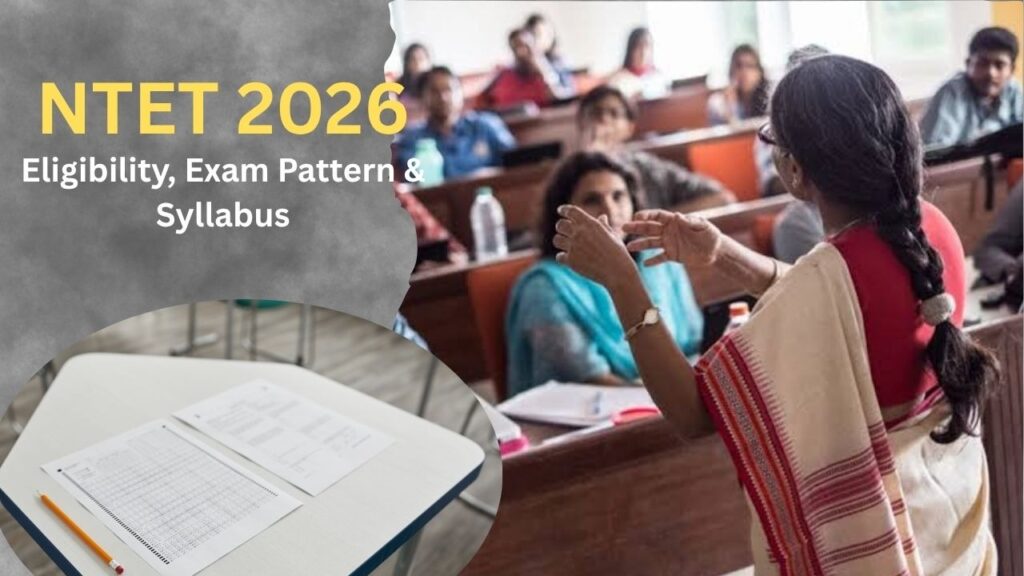
Do you want to develop the future of healthcare education in India? If you intend to apply for the post of Assistant Professor, Associate Professor or Professor in ISM or Homoeopathy, then the first step is to qualify the NTET 2026.
National Teachers Eligibility Test (NTET) for teaching in AYUSH Institutions (PCM/PCB) NCISM NCH has notified the conduct of National Teachers Eligibility Test (NTET) for educators in AYUSH colleges. From Minimum Eligibility Criteria, Exam Pattern, Syllabus, to preparation tips, this complete, evergreen guide dresses up all the essential aspects for NTET.
Let us check out the details to start your academic career.
What is the NTET 2026 Exam?
The National Teachers Eligibility Test (NTET) is a country level AYUSH teachers suitability test that aims at testing potential teaching capabilities, communication skills and knowledge of educational psychology of prospective AYUSH teachers. Be it Ayurveda, Unani, Siddha or Homoeopathy, the NTET 2026 is a mandatory requirement for teachers to keep abreast with contemporary teaching methods to train future doctors. It tests your teaching potential, not your medical know-how, which you have already been through a sufficient number of times in your postgraduate medical degree.
NTET 2026 Eligibility Criteria
Cooperating with the rules of UPSC before applying to NTET is the right choice because you can waste your time if you’re not eligible for the examination. Whether it’s a document or age criteria, make sure you lie on the guidelines. NTET is solely for post graduates and final year students of certain medical and para-medical disciplines.
Here is the list for the minimum eligibility criteria:
Basic educational qualification: Must complete your masters in whatever field you have chosen. Graduated students can pursue any of these postgraduate degrees in Ayurveda, Unani, Siddha, Homoeopathy or allied areas to be eligible.
Related fields: The candidates should have valid bachelor’s degree in AYUSH (BAMS, BUMS, BSMS, BHMS) withMaster of Public Health (MPH) or M.Sc in Anatomy, Physiology, Biochemistry orMicrobiology.
Students in their final year of education can take the exam if you are progressing and have completed at least 30 months of your masters program.
Career Stage: Only first time aspirants to the teaching profession (Assistant Professor) at the entry level are required to qualify in this exam. It is also necessary for higher teaching positions if the candidate is coming to teaching from clinical practice or research for a number of years and not for the first time.
NTET Exam Pattern
| Feature | Details |
| Mode of Examination | Computer-Based Test (CBT) |
| Total Duration | 120 Minutes (2 Hours) |
| Total Questions | 100 |
| Question Type | Multiple Choice Questions (MCQs) with 4 options |
| Maximum Marks | 100 Marks |
| Marking Scheme | +1 mark for every correct answer |
| Negative Marking | No Negative Marking |
| Medium of Paper | English and Hindi |
| Difficulty Distribution | 40 Easy, 40 Medium, 20 Difficult questions |
Detailed NTET 2026 Syllabus
The NTET 2026 syllabus is concerned only with teaching techniques, management of the class and human mind. It has been segmented into 8 modules. Here you go, this is What to Study:
Teaching & Training
- Definition, aims, and levels of teaching (to teach at Memory Level, to teach at Understanding Level, to teach at Reflective Level).
- Features of adult and youth learners (Educational, Social, Emotional, and Intellectual).
- Contemporary methods of teaching, clinical teaching and teaching at the bedside.
- VARK learning style (Visual, Aural, Reading/Writing in Learning, Kinesthetic).
Communication
- Definition, nature, types and barriers of communication.
- Verbal vs non-verbal and intercultural communication.
- Teacher-Learner and Doctor-Patient communication models.
- Place of mass media in society and contemporary education.
Classroom Management
- Maintaining studious engagement, and motivated learning in heterogeneous classrooms.
- disciplinary management and discipline and positive, inclusive learning environments.
- Work with real teaching environments such as OPDs, clinical labs, skill labs, and community outreach programs.
Methods of Evaluation
- The formative and summative assessment processes in learning.
- Evaluation mechanisms under the CEC procedures.
- Evaluation of clinical competence by OSCE (Objective Structured Clinical Exam), long case and short case.
- Importance of organised feedback in learning.
Educational Technologies
- The emergent and shifting terrain In medical education: ICT and its management.
- The utilization of the Internet, e-mail and video conferencing in the contemporary teaching environment.
- Knowledge of online teaching environments and MOOCs (e.g. SWAYAM and SWAYAMPRABHA).
Educational Psychology
- The cognitive development from childhood to adult with storing knowledge and learning through life experience by the human mind.
- Psychological theories of relevance to teaching: Piaget’s cognitive development, Vygotsky’s sociocultural perspective, Bronfenbrenner’s social context.
Educational Andragogy
- Get to know Andragogy (the designated way and technique of teaching adult learners).
- The principles, needs and characteristics of adult learning.
- Building Skills for Self-Directed and Lifelong Learning.
Learning and Pedagogy
- Fundamental notions and sequential procedures of pedagogical analysis.
- Critical pedagogy and the development of particular learning outcomes.
- A few guidelines to facilitate doing student-centred teaching-learning workflow effectively.
- Eligibility Conditions and Validity of the Certificate
Examination Result:
The candidates are required to obtain the minimum of 50% marks (without any rounding off) in the examination to be considered as “NTET Qualified”.
Certificate Validity:
On clearing the NCTET, your NTET Eligibility certificate is valid for 10 years from the date of passing. If they fail to join teaching within the 10 years or take a career break of above 10 years, they would need to take up and clear the test once again to continue in teaching.
Read More:- DECE-LE Admission Form 2026: Apply Online, Eligibility, Exam Date & Full Details
Tips to Crack the NTET 2026
Since teaching is what the NTET 2026 tests and not medical science, your prep plan needs to adjust slightly.
- Learn the Pedagogy Fundamentals: To learn some of the main educational psychology concepts, read some of the key texts by Piaget, Vygotsky and from contemporary educational models.
- Concentrate on Clinical Teaching: The usual pedagogy holds only tenuously when considering the OPD and in AYUSH teaching. Attending clinical, bed side and OPD teaching methods, they are very practical.
- Manage Your Time: There are 100 questions in 120 minutes. Time is more than sufficient, but reading the lengthy scenario-based teaching method questions can be consuming. You will be building your reading speed with regular mock tests.
- Take Advantage of the ‘No Negative Marking’ Rule: Have a guessing game plan for hard questions. Do not leave a question unanswered on your CBT screen.
- Keep Abreast with Ed-Tech: Keep track of the latest digital education tools and steps taken by the Indian government in the education sector.
Conclusion
The NRIMT or NTET 2026 is one of the excellent, forward-looking measures by NCISM & NCH to bring about a unified quality in the AYUSH education throughout the country. This idea of focusing on “how to teach” rather than “what to teach” makes future doctors be taught by qualified, caring and extremely capable teachers.
So with this article, get yourself prepared to land on the hot seat of the National Teachers Eligibility Test. Go in depth with your syllabus and learn to think like the psychology of adult learners and you are on your way to a very successful and satisfying career as a medical teacher.