Junior Hindi Translator Recruitment: Exam Pattern, Eligibility, And Salary Details

Junior Hindi Translator Recruitment

If you are someone who always ends up correcting the English grammar of the English movies or newspapers’ headlines/trailers in Hindi and English languages be it at office or traveling or on vacation then this time your hobby can help you earn some good bucks. Enter the Junior Hindi Translator Recruitment.

It’s one of those “hidden gem” professions. It doesn’t always get the loud buzz of the administrative services, but for language lovers, it’s a wonderful route to stability, respect, and an actually compelling day-to-day work life. So, let’s decode all you need to know about Junior Hindi Translator Recruitment without the wordy, government jargon. 

What Does a Junior Hindi Translator Recruitment Do?

As a Junior Hindi Translator, you are not just sitting in a room with a dictionary collecting dust. Are you the linguistic bridge for the Government of India.

The Government of India functions in Two-Languages Hindi and English. Each and every official document, press release, circular and policy has to be impeccably worded in both. As a JHT you will be primarily responsible for translating these official documents into Hindi and English. 

But this is more than the translation of words. You have to be sure the Rajbhasha(official language) policies are properly executed in all the central government departments, ministries and offices under them. You’re basically the gatekeeper of official communication. It’s a desk job, yes, but it’s one that calls for a quick brain, cultural awareness and a flawless vocabulary. 

SSC Junior Hindi Translator Recruitment Exam

Although different agencies also have their own jobs listings, the undisputed king of Junior Hindi Translator Recruitment is the Staff Selection Commission (SSC).

The SSC conducts the Combined Open Competitive Examination for the post of Junior Hindi Translators, Junior Translators and Senior Hindi Translators for the recruitment of Ministry offices, Departments and Organizations of the Government of India on yearly basis. If this career path is something you very seriously want to pursue, then the SSC JHT notification is the one to watch out for. 

Dates to Remember

EventDate
Notification Release23/April/2026
Application Start Date23/April/2026
Last Date to Apply14/May/2026 
Last Date for Fee Payment15/May/2026 
Correction Window19–20/May/2026

Are You Eligible? 

This is the point at which crowds start to thin out, which is actually great for you. Not like general exams that are open to all the bachelor degree holders, the Junior Hindi Translator Recruitment has minimum educational qualifications.The criteria for eligibility are usually as follows: 

You are required to have a Master’s degree from a recognized university in Hindi with English as a compulsory/optional subject (or as the medium of examination in the degree course).

OR

A Master’s degree in English with Hindi a compulsory/elective subject. 

If you are without a Master’s in either of the two mentioned, it is still possible to get in with a Master’s in any subject, given that you took Hindi and English as either your core or elective subjects at the undergraduate level. 

Apart from the degrees, the SSC in general also asks for a Recognised Diploma/Certificate course in translation from Hindi to English and vice versa. If you do not have the diploma, you can also qualify with two to three years experience working as a translator from Hindi to English (and vice versa) in a Central or State Government Office. 

Exam Pattern SSC JHT exam

The Junior Hindi Translator Recruitment exam is conducted in 2 stages: Paper 1 and Paper 2. Let’s check what really is in store for you. 

Paper 1: The Computer-Based Test (Objective)

General Hindi (100 Marks)

General English (100 Marks)

You usually get two hours for this. The syllabus includes everything from grammar, vocabulary, synonyms and antonyms to sentence formation, idioms and phrases. It’s meant to measure your fundamental knowledge of each language. 

Paper 2: The Descriptive Test

If you qualify for the cutoff in Paper 1, welcome to the big league. Paper-2 is offline descriptive with a pen and in-answer sheet containing 200 marks in 2 hours.

This paper assesses your real translation skills and writing. You will typically be asked to:

  • Translate a passage from Hindi into English.
  • From English to Hindi.
  • Write an essay in Hindi.
  • Write an essay in English.

This is the part when genuine language buffs glow. Rote memorization will not help you here – you need natural flow, good handwriting and the ability to express complex thoughts clearly. 

Salary and Lifestyle

The post of Junior Hindi Translator is generally in pay level-6 of 7th CPC. It means your basic pay begins at ₹35,400. But that’s just the base. With the addition of Dearness Allowance(DA), House Rent Allowance (HRA) and Transport Allowance(TA), the gross in hand salary you get is around ₹50,000 to ₹70,000 per month which varies depending on the city of your posting (X, Y, or Z category cities). 

Apart from the finances, the way of life is very attractive. It’s a white-collar respected desk job with fixed hours dictated by the government. You get all the perks of central government: medical facilities, pension schemes (NPS), job security, and a predictable promotion ladder moving up to Senior Translator, Assistant Director, and beyond. 

Read More:- Junior Assistant vs Clerk: Complete Guide of Job Profiles, Responsibilities And Career Growth 

Conclusion

Junior Hindi Translator recruitment is a testament to the fact that you don’t need to be a maths wizard or a coding genius to land a great job with a stable career. If you have an affinity for words, sentence structures and the lovely nuances of Hindi and English, then this one is right for you.

It’s commitment and constant practice and a real respect for language. Watch the SSC schedule, start translating your favorite articles now, and get ready to transform your love of language into a career for life. 

GovUpdatewala is your trusted source for real-time updates on government exams and jobs in India. We provide verified info on SSC, UPSC, Banking, Railways, Defense, and Teaching exams. From syllabus and patterns to important dates and career tips — we support aspirants at every step.


Leave a Comment

Your email address will not be published. Required fields are marked *

Best Government Jobs in Uttar Pradesh in 2025

Getting a government job in Uttar Pradesh is every youth’s dream. In 2025, the UP government has brought many amazing job opportunities – in many fields like police, teacher, engineer, clerk, and health department. In this blog you will find the best government jobs for which you can apply according to your qualification!

S.NoJob TitleConducting BodyQualificationHighlightsOfficial Website
1UPPCS Officer (SDM, DSP, etc.)UPPSCGraduationHigh authority, residence, securityuppsc.up.nic.in
2UP Sub-Inspector (SI)UP Police Recruitment BoardGraduationUniform job, field dutiesuppbpb.gov.in
3UP LekhpalUPSSSC12th PassRevenue department jobupsssc.gov.in
4Assistant Teacher (Shikshak Bharti)UP Basic Education BoardD.El.Ed/B.Ed + TETSocial respect, stable careerupbasiceduboard.gov.in
5Junior AssistantUPSSSC12th + TypingClerical job, regular promotionsupsssc.gov.in
6UPPSC Staff NurseUPPSCGNM/B.Sc NursingHealthcare sector, job securityuppsc.up.nic.in
7UPPSC AE (Assistant Engineer)UPPSCB.Tech/B.E.Engineering post in public worksuppsc.up.nic.in
8UPPCL JE/AEUPPCLDiploma/Degree in EngineeringTechnical job, good salaryuppcl.org
9UPPCL Office Assistant/AccountantUPPCLGraduation (Any/Commerce)Clerical job, government benefitsuppcl.org
10UP Police ConstableUP Police Board12th PassEntry-level job in police forceuppbpb.gov.in
11UPPCL Technician (Electrical)UPPCLITITechnical job, field workuppcl.org
12UPSSSC PET-Based Group C JobsUPSSSC10th/12th + PETMultiple posts via PET examupsssc.gov.in
13UPPCL StenographerUPPCLGraduation + Steno SkillsTyping/Steno-based jobuppcl.org
14Block Development Officer (BDO)UPPSCGraduationBlock-level planning officeruppsc.up.nic.in
15UPPSC RO/AROUPPSCGraduationDesk job in UP Secretariatuppsc.up.nic.in

Aerospace Engineering Courses: Complete Guide to Soar into the Sky with the Right Education

Aerospace Engineering Courses

If you have ever been curious as to how the planes you ride on stay in the air or how a rocket can travel all the way to space, then you think like an aerospace engineer. From Aerospace Engineering Courses, eligibility criteria to future scope and interesting specializations available, this all you need to know guide will help you make an informed decision which you take for pursuing aerospace engineering course in India.

The Indian aerospace industry is booming. ISRO, DRDO, HAL, and a host of private companies are actively hunting for talented engineers to design, build and fly planes and spacecraft. With increasing demand and attractive salary packages, this is the way to your dream career. 

What Exactly is Aerospace Engineering?

Aerospace engineering is the primary engineering discipline concerned with the design, construction, science and technology of aircraft and spacecraft. It is a combination of physics, mathematics, materials science, and advanced tech that address real life problems in the fields of aviation and space travel. 

The range of activities in this field is so broad that it divides into four key specializations:

Aeronautics — This pertains to air within the atmosphere and includes such things as commercial jets, military planes, helicopters, drones (UAVs), and blimps. Aeronautical engineers study flow-air, aircraft design, motion, and propulsion.

Astronautics — A subject of business such as astronauts, rockets, satellites and all the stuff that goes beyond the atmosphere. Astronautical engineers specialize in orbital mechanics, satellite communications, rocket propulsion, and space exploration missions.

Avionics — These are the electronics and computers used in an aircraft and spacecraft. Avionics engineers create the system software of navigation, communication and autopilot systems, etc., in raw air borne machines.

Defense Technologies — This area concentrates on military, and its ability to develop and deploy new systems involving missiles, defense technologies, military drones and weaponized technology. This is important part of national security and defense system. 

Aerospace Engineering Courses

Now let’s move on to the various types of courses under aero space engineering. Whether you are a high school beginner or already have a bachelor’s degree, there is a path for you.

1.Diploma in Aerospace Engineering (3 Years) 

If you are looking forward to pursue a career in aerospace engineering, you can opt for the Diploma in Aerospace Engineering from a reputable board after 10th class.

This is good to start if you have done your 10th grade. It is not really theoretical but ‘practical’ which provides aerospace technologies experience. 

AspectDetails
Duration3 years
Eligibility10th pass with Mathematics and Science (minimum 50% marks)
FocusPractical skills and industry-ready training
Career PathCan pursue B.Tech (lateral entry) or start working
Average Fees₹2-4 Lakh for the entire program

2. Bachelors in Aerospace Engineering — B.Tech (4 Years)

It serves the largest client base and is considered the gateway course for professional aerospace. It is a bachelor’s degree course and the eligibility is 10+2 with Physics, Chemistry and Mathematics (PCM). 

AspectDetails
Duration4 years (8 semesters)
Eligibility12th pass with PCM (minimum 50-60% depending on college)
AdmissionBased on JEE Main Score, state-level exams, or direct merit
Average Fees₹ 2-2.5 Lakh/year in government; ₹5-10 Lakh/year in Private colleges
Total Program Cost₹4-40 Lakh depending on college type

The B.Tech is an all-inclusive course which includes theory and practical based knowledge. Subjects like mathematics, physics, and general engineering will be included in your first two years for foundation then you can choose specializing in aerospace-related subjects in your third year.

3. M.Tech in Aerospace Engineering (2 Years)

M.Tech in Aerospace suits better for those who want a higher level of education in aerospace engineering. Building a professional level career internationally, you must need this degree.

AspectDetails
Duration2 years (4 semesters)
EligibilityB.Tech/BE in Aerospace or related field with 55% minimum marks
AdmissionThrough GATE exam (for government colleges) or merit-based (private)
Average Fees₹40,000-1 Lakh/year in Government; ₹2-4 Lakh/year in Private colleges
Career AdvantageHigher salaries, research opportunities, senior positions

Job opportunities for M.Tech graduates are applicable in research, designing and higher level management. Top companies and research centres look for M.Tech holders for their specialised projects. 

4. Ph.D. in Aerospace Engineering (3-5 Years)

“This Is for the Research and Innovative Curious”. It’s the top aerospace engineer qualification for those who want to know how to research and innovate. 

AspectDetails
Duration3-5 years
EligibilityM.Tech or equivalent with GATE qualification
FocusOriginal research and innovation
OpportunityTeaching, research at ISRO, universities, private labs

5. Aerospace Engineering Few Months Certification Courses 

In just 6 months to 1 year duration, you can enhance knowledge or skills in certain areas. It is best for hands-on experience in a specific field.

Course TypeDurationCostSuitable For
CAD and Aircraft Design6 months₹20,000-50,000Working professionals, students
Avionics Systems6-8 months₹30,000-60,000Interested in Electronics
Propulsion Systems3-6 months₹15,000-40,000Engineers wanting specialization
Aerospace Materials4-6 months₹25,000-50,000Manufacturing professionals

B.Tech Aerospace Engineering Core Subjects

YearSemestersEssential Subjects
1st YearSem 1-2Mathematics/Physics/Chemistry help develop problem-solving skillsEngineering Mechanics/Thermodynamics/Fluid Mechanics/ and Basic Electronics introduce how physical laws apply to real engineering systems.
2nd YearSem 3-4Gas Dynamics and Aerodynamics, which explain how air behaves around aircraftPropulsion and Aircraft Structures teach how engines work and how aircraft are builtStrength of Materials and Computer Programming strengthen technical and analytical skills.
3rd YearSem 5-6You study higher-level aerodynamics, flight dynamics, and structural analysis Heat Transfer and Avionics.
4th YearSem 7-8You learn advanced tools like Computational Fluid Dynamics (CFD)Aircraft Design and Systems

Aerodynamics describes how air moves around air and is an important factor in the level of efficiency of airflow around the wings.

  • Propulsion: Discussion of jet engines, rockets, turboprops
  • Structures deals with building an aircraft to be as strong as possible but still as light as possible.
  • Stability and control the motion of an aircraft.
  • CFD Computational Fluid Dynamics: Uses computers to emulate airflow — a modern necessity
  • Aircraft Design: All of the above are brought to bear on realistic, total aircraft design projects.
  • Most B.Tech courses will involve a lot of lab work, wind tunnel testing, simulators and a capstone design project where you actually design an aircraft or spacecraft. 

Who Are Eligible For Aerospace Engineering

B.Tech (Undergraduate)Need to pass 12th class with PCMB or PCB and should have obtained 50 to 60% marks Meet the age criteria of 17 to 28 yearsEntrance exams such as JEE Main, State Level Exam etc
M.Tech (Postgraduate)Hold a valid B.Tech/BE degree in Aerospace or equivalent with 55% marks Valid GATE score (for government colleges)
DiplomaAfter 10th with Mathematics and Science having 50% marks as a minimum15 years as a minimum age
Lateral Entry to B.Tech 3-year engineering diplomaBSc in Physics, Chemistry, Mathematics

Where Will Aerospace Engineers Work?

OrganizationTypeSpecializationSalary Range (Fresh)
ISROGovernmentSatellites, space missions, rocket development₹8-10 LPA
DRDOGovernmentDefense systems, missile technology₹7-10.5 LPA
HAL (Hindustan Aeronautics)GovernmentAircraft manufacturing, defense₹7-9.5 LPA
Boeing IndiaInternationalAircraft systems, defense solutions₹8-12 LPA
Airbus IndiaInternationalAircraft manufacturing, maintenance₹7-10 LPA
GE AviationInternationalAerospace engine design₹7-9 LPA
Rolls-Royce IndiaInternationalPropulsion systems₹8-11 LPA
Tata Advanced SystemsPrivateAircraft components, defense₹7-11 LPA
Godrej AerospacePrivateSpace and defense hardware₹5.5-7.5 LPA

Salary & Career Growth 

India's aerospace engineering salary

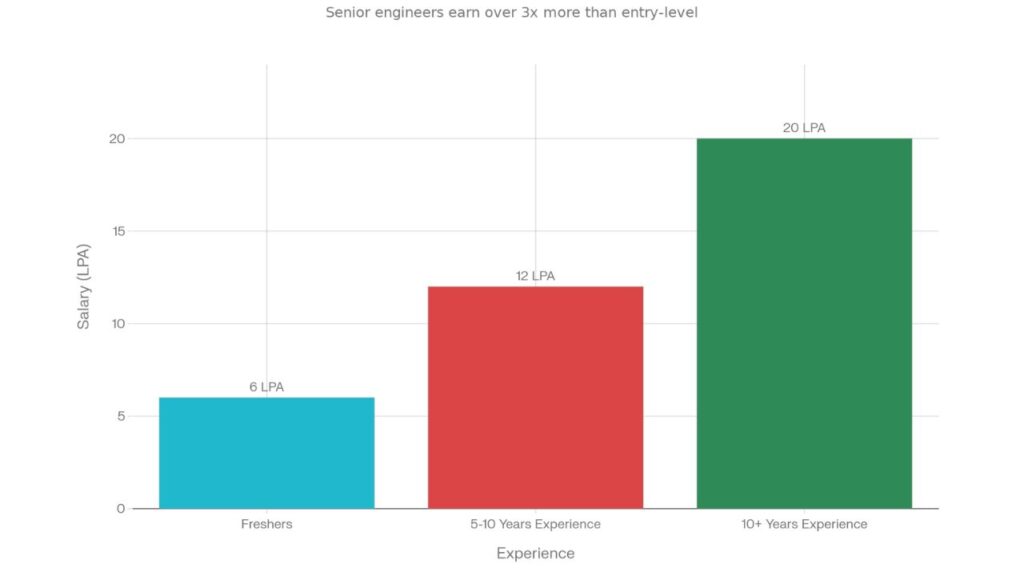
Aerospace Engineering Salary Progression in India

LevelsSalary — LPAMonthly IncomeStages
Fresher (0-1 year)₹4.5-7₹37,500-58,333Graduate joining first job
2-5 years₹8-12₹66,667-1,00,000Intermediate engineer
5-10 years₹8-15₹66,667-1,25,000Senior engineer or team lead
10+ years₹15-25+₹1,25,000-2,08,000+Manager, specialist, researcher

Salary by Sector:

SectorFresher PackageExperienced Package
Government (ISRO, DRDO, HAL)₹7-10 LPA₹20+ LPA
Private Indian Companies₹5-9 LPA₹12-18 LPA
International Companies (Boeing, Airbus)₹8-12 LPA₹20-28+ LPA
Startups & Newer Companies₹4.5-6.5 LPA₹10-14 LPA

The Future Looks Bright

India’s aerospace engineering salary will increase by 20-25% by 2030 and is highly influenced by demand in electric aircraft, AI integration, space exploration, and green aviation related technologies, suggest the industry projections. .

Read More 👉 HR Professional Courses: Get Complete Guide on Career Path, Salary & Growth

The Roadmap To Become Aerospace Engineer

Year 1 & 2: Begin From Basics

The initial two years are dedicated to core subjects such as mathematics, physics and general engineering. These years are tough, but necessary. If you have a strong base in these stuff, then you can understand high level stuff in aero easily later on. 

Year 3: Where Aerospace Engineering Gets Exciting

In year 3, the real aerospace journey begins. You then go on to such specialised areas as aerodynamics, propulsion and aircraft structures.  

Year 4: Major Project and Real-World Problem Solving

Senior year is spent mostly on a senior project. You could design an airplane, build spacecraft systems, or even study a real problem in aerospace engineering. Many of these projects are sponsored by industry, giving students real-world experience and making them more employable. 

Internships: The Key to Career Growth

The majority of aerospace engineering programs require 2 to 3 internships, such as summer and at times semester-long training. Top organizations including ISRO, HAL and Boeing hire interns on a regular basis. This hands on experience is invaluable and it contributes a lot in building a strong resume and career in future. 

Choose Your Specializations

SpecializationFocusScopePreferred Companies
AerodynamicsAirflow, drag reduction, aircraft efficiencyAircraft design, researchISRO, Airbus, NASA etc
PropulsionEngines in Jet engines, space rocketsEngine design, space missionsGE Aviation, Rolls-Royce, ISRO
Flight Dynamics & ControlAircraft stability, autopilots, guidance systemsControl systems, UAVsBoeing, HAL, Airbus
Aircraft StructuresMaterials, stress analysis, lightweight designDesign Structure, & aerospace manufacturingAirbus, HAL
AvionicsRadio System, navigation, ElectronicsUAVs & Avionics Boeing, DRDO

Best Aerospace Engineering Colleges in India

CollegeTypeLocationSpecialization
IIT BombayGovernmentMumbaiAll specializations
IIT MadrasGovernmentChennaiAircraft & Space
IIT KharagpurGovernmentWest BengalAll specializations
IIT KanpurGovernmentUttar PradeshAll specializations
Mahindra UniversityPrivateHyderabadComprehensive curriculum
SRM ISTPrivateChennaiModern labs & industry focus
Chandigarh UniversityPrivatePunjabIndustry-driven curriculum
Ramaiah InstitutePrivateBangaloreWell-equipped facilities
Manipal AcademyPrivateBangaloreResearch-oriented

Conclusion

Aerospace Engineering Courses aren’t simple, it’s a journey through innovation, precision and human ability. Whether you want to design the next generation of commercial planes, put satellites into space, or work on autonomous drones, this is a field with limitless options.

The Indian aerospace industry is poised for growth. With ISRO’s ambitious space programs, HAL’s indigenous aircraft development and international partnerships with Boeing and Airbus, there is no dearth of opportunities. And if you are in the top performers, the world is your sky. 

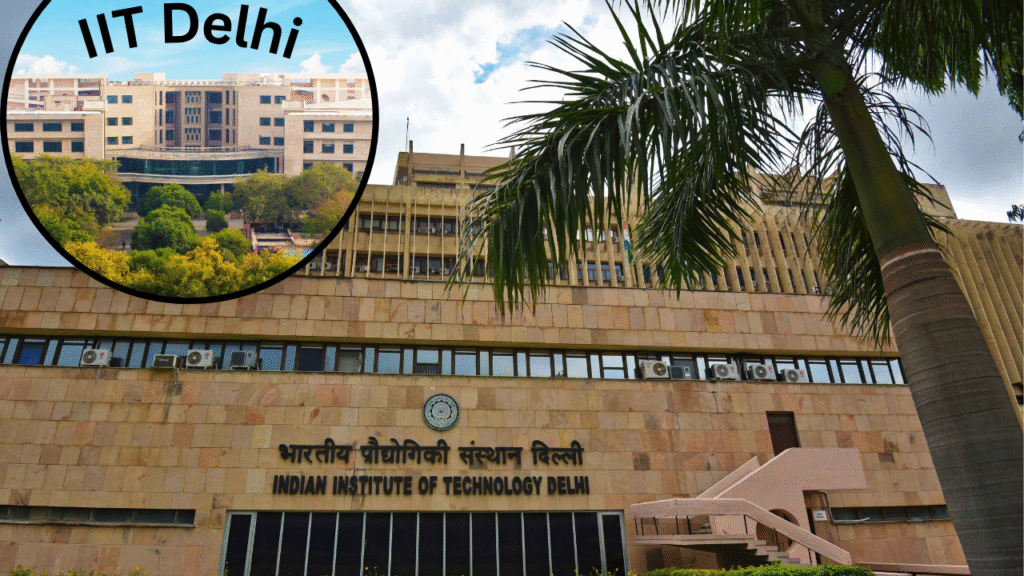
IIT Delhi MBA Fees – Complete Details on Tuition, Hostel And Other Charges

IIT Delhi

The IIT Delhi MBA is considered one among the best return on investment management course in India. Offering a perfect blend of quality education, good industry connect at a manageable fee, it enables students to dream big without the fear of being burdened with debts in private b-school cost. For 2025-27 batch, the total IIT Delhi MBA Fees 2025 is 12.17 lakhs which makes it one of the cost effective option in top management institutes of India. 

IIT Delhi makes quality affordable with a transparent detailed batch-wise payment plan, clearly defined hostel and academic fees, and several options for financial assistance. In addition, the program provides a good return on investment (ROI) as the average placement package is ₹25.82 LPA, which further adds to the enunciation as a top choice for prospective business leaders. 

IIT Delhi MBA Fee Structure 

IIT Delhi MBA fee is ₹ 12.17 lakhs for 2025-27 batch and this makes it one of the least expensive top Indian b-schools. The fee is designed so that the students can derive maximum benefit from it, but still, it should be within the reach of students coming from varied financial backgrounds.  

Complete Breakdown of Detailed Fee Components

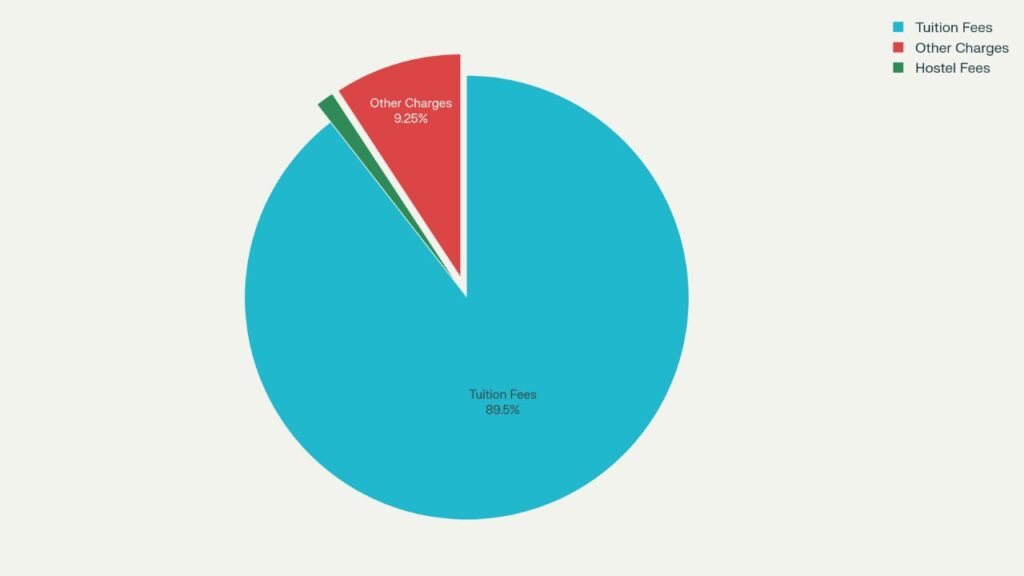
The tuition fee for the two-year course is ₹12,00,000, which is payable in four equal installments of ₹3,00,000 per semester. All the education fees, materials for courses and learning resources and even the use of campus facilities are covered by these fees. The total cost of accommodation in the dormitory for two years is Rs. 17,200 or 8,600 per semester.

Complete Breakdown of Detailed Fee Components

Mess fees are to be paid extra and they vary according to consumption, hostel fees are Rs 8,600 per semester. Semester fees are 22,400 for academic and administrative purposes which include the use of internet, sports equipment, library and student-welfare programs. 

Total tuition fees₹12,00,000
Per semester₹3,00,000
Total hostel₹17,200
Per semester hostel₹8,600
Academic charges₹22,400

First Semester Payment Structure

The admission fee structure is categorized based on the candidate’s classification. The fee for the first term for candidates in the General, OBC, and EWS categories is ₹3,31, 000, inclusive of hostel fees and other relevant expenditure like tuition. Those who belong to the SC, ST or PwD categories, however, get a Tuition Fee Waiver. First term fees are drastically reduced for these categories to Rs 31, 000, which is only for the hostel and other miscellaneous expenses. This tiered fee system also reflects a commitment to ensuring equitable access to education, as well as to financial viability for marginalized populations. 

How IIT Delhi MBA Fees Compare with Other Top Colleges

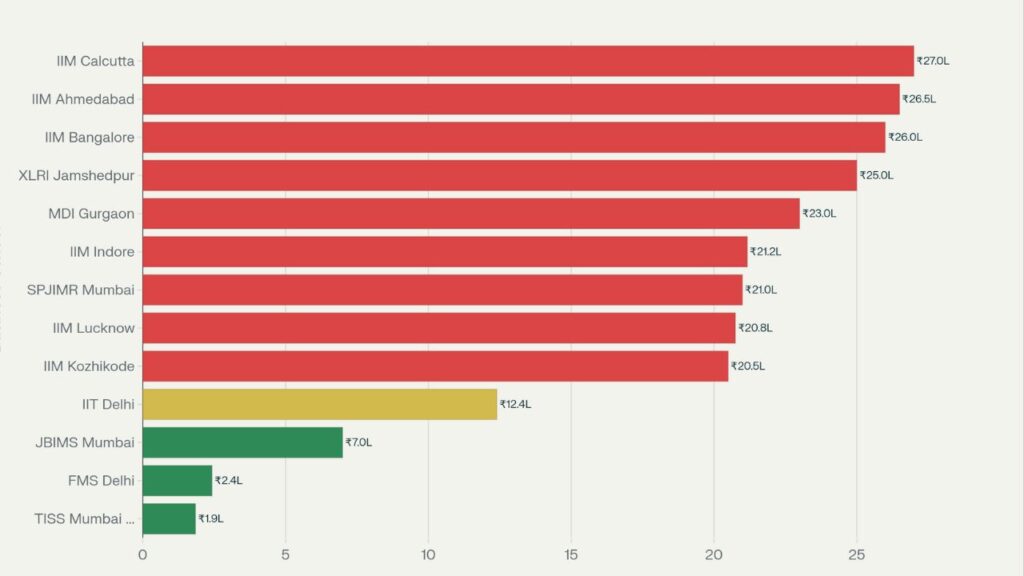
Comparison of MBA Fees Across Top Indian Colleges

How IIT Delhi MBA Fees Compare with Other Top Colleges

IIT Delhi offers great value for money as compared to other top b-schools in India. The fee structure makes it a kind of cross between the premium IIMs and the dirt cheap government ones. 

Old IIMs (Higher Fee Range)
IIM Calcutta₹27.00 lakhs
IIM Bangalore₹26.00 lakhs
IIM Ahmedabad₹26.50 lakhs
Newer IIMs (Moderate Fee Range)
IIM Lucknow₹20.75 lakhs
IIM Kozhikode₹20.50 lakhs
IIM Indore₹21.17 lakhs
Private B-Schools
XLRI (Xavier School of Management) Jamshedpur₹25.00 lakhs
ISB (Indian School of Business) Hyderabad₹40.50 lakhs
MDI (Management Development Institute) Gurgaon₹23.00 lakhs
SPJIMR (Shreyans Prasad Jain Institute of Management & Research ) Mumbai₹21.00 lakhs
Budget-Friendly Government Colleges
FMS (Faculty of Management Studies) Delhi₹2.43 lakhs
JBIMS (Jamnalal Bajaj Institute of Management Studies) Mumbai₹7.00 lakhs
TISS (Tata Institute of Social Sciences) Mumbai₹1.85 lakhs

Although these institutes charge very minimal fees, IIT Delhi gives a middle path with a reasonable fee structure and excellent results. 

IIT Delhi MBA Program Cost Breakdown (Total ₹12.17 Lakhs)

Return on Investment Analysis

The exceptional 2024 Placement Performance demonstrates that IIT Delhi’s MBA Program offers a tremendous return on investment (ROI). Graduates are offered an average salary package of ₹25.82 LPA, the highest package is an impressive ₹41.13 LPA while the median package is ₹24.45 LPA. The program’s remarkable 100 percent placement record is a testament to its strong industry relations and career support. It is the most lucrative choice for an aspiring management professional for a total programme fee of ₹ 12.17 Lakhs. Students have managed their expenses for a few months after they start working. 

Financial Support and Scholarship Options

IIT Delhi provides several support to the students who want to pursue MBA to ensure that everyone gets a chance of education. SC/ST/PwD students are entitled for 100% tuition fee waiver under category based benefits except for hostel and other fees. Furthermore, meritorious students are also eligible for merit scholarships, which are awarded on the basis of their programme-wide academic performance. Also, due to prestige of the institute, education loan for MBA course can be availed from all major banks. And given the school’s elite status, those loans typically carry competitive interest rates. 

Payment Schedule and Methods

In order to ensure transparency and ease of understanding for all students, the fee payment follows a semester-wise structured format. As per the schedule of payment, the fee for the 1st semester is to be paid at the time of admission. Fees are payable at the beginning of each subsequent semester. For your convenience, the fee can also be paid in two installments over two years, making finances a little easier to manage. 

Multiple modes of payments are available for easy transactions. Students can pay online from the time of official portals which ensures the safe and efficient process. Bank loans are disbursed by demand drafts. To suit different taste, there is also bank transfer payment option. This systematic procedure keeps the payment process formal and transparent, at the same time ensuring flexibility and accessibility to the students. 

Why Choose IIT Delhi MBA

Why Choose IIT Delhi MBA

Academic Excellence

The institute, which was ranked 4th in Management by NIRF 2024, is renowned for its outstanding academics and is supported by a strong faculty having rich research and industry experience. The curriculum is broad-based and focuses on experiential learning to ensure that the students are well-prepared to face real-world challenges. 

Industry Connections

It has great industry connections, and excellent placement support with top recruiters due to its vast alumni network in prestige companies, recurring industry interactions and guest lectures. 

Facilities & Location Advantage

The modern facilities on the state of the art campus include a well-equipped library, state of the art computer laboratories, sports and leisure facilities. Opportunity to work in corporate offices and the institution is located strategically in Delhi NCR, the emerging business hub of India making it the best for commerce studies.

Read More:- DSSSB Recruitment 2025 – Latest Vacancy, Eligibility & Application Details

Conclusion

For Indian business schools, the IIT Delhi MBA delivers the best price, quality and outcomes combination you can get. With a total fee of Rs 12.17 lakhs, it holds itself at a higher standard than many of the private IIMs while giving exceptional value for money when compared with the ones that are more prestigious. Given the reputed brand, good placements and affordable fees, it is an excellent value for money for MBA aspirants. 

Transparent breakdowns of fees and category-wise concessions ensure accessibility to students from diverse backgrounds. When viewed from the perspective of ROI, career opportunities and ranking experience, IIT Delhi MBArr its place among the topmost feasible options in India in business school arena. 

Top 10 Government Jobs for 12th Pass Candidates in 2025

12th Pass Government Jobs 2025

There are numerous 12th Pass Government Jobs 2025 in India where students can secure their stable career in the specific sector including defense, banking, admin, and public sector undertakings (PSUs). Read the full article to know about job roles, salary, eligibility, and future scope for 12th-pass candidates.

The government is spreading job vacancies for 12th-pass candidates in 2025. You can also secure your career in a specific sector.

Police and Defense

The defense sector has many job roles after 12th pass candidates

  • Police Constable
  • Police Sub-Inspector (some states may require graduation for this job role but some recruit after 12th)
  • National Defence Academy (NDA)
  • Technical Entry Scheme (TES) – Indian Army
  • Agniveer Scheme
  • Military Nursing Service (MNS)

Railway Jobs after 12th pass

Railway job offers a good salary to the candidates, you can apply after 12

  • Junior Clerk Cum Typist
  • Commercial Cum Ticket Clerk
  • Trains Clerk
  • Railway Group D Posts
  • Ticket Collector
  • Ticket Examiner

Banking Jobs after 12th pass

There are Government banks where candidates can apply after 12 but they must pass the exam with a good score. This sector provides long-term career stability.

  • Clerk
  • Data Entry Operator
  • Sales Executive
  • Banking Assistant
  • Cashier
  • Peon

Public Sector Undertakings (PSUs)

  • Junior Assistant/Apprentice
  • Technician
  • Fieldworker
  • Helper

SSC Jobs (Staff Selection Commission)

  • Data entry jobs
  • Lower Clerk
  • Postal
  • Assistant

Similar Eligibility Criteria across these Sectors

There is some eligibility for these roles in Railway, defense, SSC, PSU, and banking are same. Let’s talk about the common criteria for the job roles.

Nationality: Candidates must be the Indian Citizen
Age Limit: The minimum age must be 18 years or older, and the maximum age should be exceeded by the sector and category of the person. You can check these exact eligibility requirements while applying for the specific role.
Educational Qualification: Candidates should pass 10+12 with a 50% score in any stream.

  • Railway:
    For a Technical post in the Railway, the candidate must have an ITI/Diploma.
    Physical Tests are necessary for Group D positions.
  • Defense:
    Only Unmarried candidate apply for NDA post
    Candidate must have good health and pass the medical tests
  • SSC:
    Age Limit vary for some posts
    For Clerical post typing test will be included
  • Banking:
    The Bank Officer post requires graduation, candidates must have a degree in a similar field for this job role
    Computer skills are required in bank jobs
  • PSU:
    GATE score required for the technical posts
    The minimum age required in the range (21-27) may vary according to the various categories.

There are some competitive exams which are conducted by the government for the various job roles in each sector. If you want a government job, you must pass the exam (every job role has different exams)

  • If you want a Job in the Indian Army, navy, or Air Force, You have to attempt the National Defense Academy (NDA) exam and score well to secure a job role.
  • For entry-level jobs in banking, you need to take the IBPS clerk exam.
  • If you want to go in Police jobs you must attempt State Police Constable Exams that are conducted by the state government.
  • For clerks, assistants, and data entry operator job roles candidates must pass the SSC CHSL.
  • Indian Railway offers jobs for the candidates who passed RRB NTPC.

You can apply for 12th Pass Government Jobs 2025 and secure the rewarding career for a lifetime. Every sector has different job roles, just stay focused and clear out the competitive exams. Stay updated with the official notification for latest vacancies in defense, railway, SSC, and PCU to apply early.

Which Entrance Exam Is Best for MBA Abroad in 2025? 

Best for MBA Abroad

For too many future leaders, a foreign MBA is not just an academic ambition—it is the gateway to a global career, prestige, and personal growth. If an international MBA is at the top of your 2025 goals, you must have asked yourself “Which entrance exam do Is Best for MBA Abroad in 2025? 

The major MBA Entrance Exams for Studying Abroad in 2025 include GMAT, GRE, IELTS, TOEFL and each vary on the basis of the eligibility, scope and impact on career. Prestigious universities overseas need you to have good percentile score in GMAT or GRE for taking MBA admissions and also IELTS or TOEFL as a proof of your English language proficiency. The decision on which exam to take depends on your educational background, the universities you want to apply to, and your career aspirations. 

Let’s travel to a geographical imagination in this important choice to keep it straight forward and practical in a way that fits today’s environment. 

Why Entrance Exams Matter for MBA Abroad

Why do these tests matter so much? Top schools abroad like Harvard and Wharton, London Business School and INSEAD, use standardized test scores as a way to compare applicants from every country, profession and educational background. And they have to make sure that a student can handle a tough workload, add to the class and succeed in a cutthroat atmosphere.

So, selecting your entrance test is one of the major early decisions you’ll have to make in your MBA journey. 

GMAT: The Classic Choice, Still Reigning in 2025

The Graduate Management Admission Test (GMAT) has been the MBA admissions boss for decades—and it remains the best option this year. GMAT scores are accepted by more than 2,400 business schools worldwide. The test’s emphasis on critical thinking, quantitative ability and analytical writing is tailored to the needs of typical business classes. 

Who should choose GMAT?

  • Applicants with the clear intent to attend a full time MBA program, particularly in the USA, UK, Canada, Europe, and Asia Pacific.
  • Those ready to put some effort into business logic, data sufficiency, and analytical writing—the very same writing and logical thinking skills that B-school professors rave about.
  • Students who want their competitive nature captured in a single score. Top schools tend to like GMAT scores ranging from 700 to 740.

The GMAT is tough, but it’s a fair test. It consists of Quantitative Reasoning, Verbal Reasoning, Integrated Reasoning and Analytical Writing. A number of dedicated test-takers have reported that their GMAT studying not only helped with admissions, but with classwork as well. 

GRE: The Flexible, Multi-Path Option

The Graduate Record Examination (GRE) used to be the obscure relative in business school admissions. Now it’s a key competitor — particularly at top schools. Why? Universities seek more diverse cohorts and numerous candidates are considering multiple programs — from MBA to MS, PhD, or even public policy or engineering degrees. 

Why pick GRE?

  • You’re also applying to other graduate programs (not the MBA) that require GRE scores.
  • You have strong verbal and analytical skills – the verbal section of the GRE is more vocabulary intensive than the GMAT.
  • You like math a little more straight forward as you don’t get the infamously tricky data sufficiency section in GRE quant questions.

The tide of data is turning: 41% of Harvard Business Schools have recently begun to admit a larger proportion of students with GRE scores, an increase from 12% just seven years ago. Almost all top MBA schools in the world accept both exams now. That being said, look up the individual trends at each school before you apply to see if they are more GMAT or GRE score friendly. 

Executive Assessment for Experienced Professionals

If you are a busy professional seeking an Executive MBA (EMBA) program, here is a new and growing alternative—the Executive Assessment (EA). The EA is more than 100 top business schools, is much shorter (90 minutes), and is designed for people with advanced professional expertise as opposed to those who have recently been involved in academic study. 

Should you choose EA?

  • You are applying for an EMBA, not the regular full-time MBA.
  • You have been working for at least 8 to 10 years, maybe even more, a few might already have some leadership roles.
  • Select your target schools list that includes EA among accepted exams and don’t rely on it as a backup option.

The best EA scores are around 155-160 for the top programs of the world, but always check the averages for each school as you would for GMAT or GRE. 

A New Trend: Test Waivers for Qualified Candidates

Here’s good news for many candidates — The number of MBA colleges offering waivers for GMAT, GRE, or EA in 2025 is expected to increase even further in 2025 after the pandemic and with the overwhelming number of mature professionals desirous of getting seats for the next batch. Well-ranked schools, including MIT Sloan, NYU Stern, Michigan Ross and others, now waive requirements for applicants with strong academic backgrounds, advanced degrees, major professional certifications (such as CFA or CPA), or significant work experience.

A waiver isn’t a sure admission. but it can help you save some precious time, take some pressure off and get your focus on other parts of what you need to apply—like essays and interviews. 

No Test Is Complete Without Language Proficiency

In addition to GMAT, GRE or EA, nearly all foreign MBA programs will require evidence of your English language ability. This is in the form of TOEFL, IELTS, or PTE results. Minimum requirements vary, but top schools generally want 100-110 in TOEFL and 7.0-7.5 in IELTS.

A few MBA colleges are now also offering waivers for the language test if you have studied predominantly in English in your undergraduate program or have got high verbal scores in GMAT / GRE. 

Read More 👉 PhD Entrance Exam Eligibility 2025: Everything You Must Know About Qualifications, Age Limit & Admission Rules

How Should You Decide? 

With all these options, how do you decide what’s right for you for your future?

Step 1: Narrow down your list to a few target schools. See which tests they need, like, and the average grades they posted last year.

Step 2: Take practice GMAT and GRE exams on the Internet. Find out which one plays to your strengths.

Step 3: Determine you may be eligible for test waivers based on your transcripts, degrees, certifications, and professional experience.

Step 4: Set your timeline Schedule for the size Up Keep in mind that the GMAT / GRE can be taken more than once (after a waiting period of 16 days, and 21 days for the GRE), so start your preparation early for maximum results. 

Step 5: Don’t forget about English proficiency and TOEFL/IELTS waiver possibilities. 

Personalizing Your Strategy: GMAT vs GRE vs IELTS vs TOEFL

  • GMAT is the most sought after exam for global MBA programs, more so for full-time MBA at the top universities. It tests the fundamental quantitative, reasoning, and analytical writing abilities necessary to study management of business. Most top schools such as Stanford, Harvard, London having Business School and INSEAD, expect scores in excess of 720.
  • GRE is now accepted at all top MBA programs, as well as thousands of other graduate programs (MS, PhD). That said, it’s not just business schools that it caters to: It’s a good choice for those who want more options. GRE’s verbal section tests your vocabulary, while its quantitative section is simpler than GMAT for many test takers.
  • The exams are necessary for non-native English speakers. IELTS is more popular in the UK, Europe, Canada and Australia due to the fact that it has a face-to-face speaking part and is more flexible in its format. It’s the standard for US and Canadian institutions, and now it’s fully computer-based.
  • Executive Assessment (EA) — The Executive Assessment is tailored for busy professionals who are considering EMBA or mid-career MBA programs, recognized by over 100 leading schools around the globe. Test Waivers- Several business schools these days also waive the GMAT/GRE/EA and English language proficiency examinations for candidates with outstanding academic qualifications or work experience. Always verify with each school, since policies change regularly. 

MBA Abroad Entrance Exams: Comparison Table

ExamEligibilityScope/UseStructure/ScoreCareer Tips/Impact
GMATGraduates; 2+ yrs work often preferredGlobal MBA and business schoolsQuant, Verbal, IR, AWA; 200-800, valid 5 yrsWidely accepted at top B-schools, strong quantitative and reasoning skills valued
GREGraduates; flexible for dual-applicantsMBA, MS, PhD, other grad coursesVerbal, Quant, Writing; 260-340, valid 5 yrsUseful for multi-program applicants; check school preference for MBA
IELTSFor non-native English speakersAll study levels, visa, jobsReading, Writing, Listening, Speaking; bands 1–9, valid 2 yrsUK, Canada, Australia, Europe prefer IELTS. Face-to-face speaking section
TOEFLFor non-native English speakersUS/Canada, global schoolsReading, Listening, Speaking, Writing; 0–120, valid 2 yrsUS, Canada schools favor TOEFL; computer-based format
EAExperienced professionals Executive MBA Condensed GMAT-style testAccepted at EMBA programs; short exam

Which Entrance Exam Is Best for MBA Abroad in 2025?

  • The GMAT remains the gold standard for the traditional MBA aspirant, especially for those targeting the best programs globally. 
  • GRE is more suitable for candidates with wider graduate options, or who have strength in vocabulary/verbal reasoning.
  • IELTS is suitable for applying to the UK, Australia, Canada and Europe; TOEFL is good for the US/Canada and other regions that have a preference for digital format.
  • Executive Assessment (EA) is a specialised exam for seasoned professionals applying for an EMBA.
  • For those with outstanding credentials, test waivers may be granted – always check the latest rules of each university. 

Conclusion

Select the exams based on your MBA target location, school requirements, personal strengths, and the Zukunftscope of your career. Develop your application as a whole, starting with strong test scores, and then building compelling essays and a vibrant profile to maximize your chances for admission and career success. 

Scroll to Top