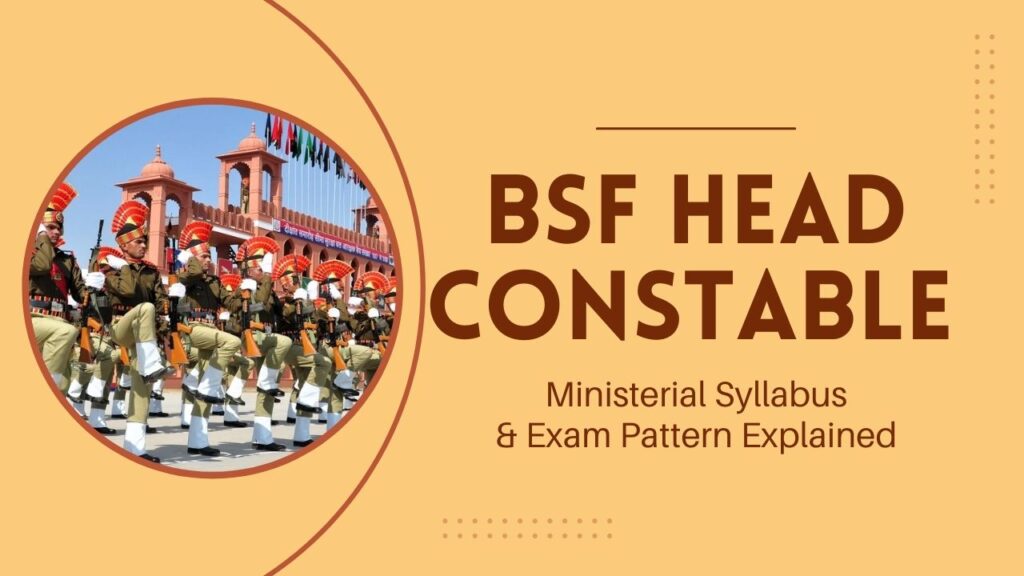
So, you are eyeing the BSF HCM Syllabus. Specifically, you wanted the Head Constable (Ministerial) vacancy for the year 2026. That’s a spectacular aim. It’s a position that brings stability, a little dignity and an opportunity to serve your country from inside the institution that actually defends its borders.
But let’s be honest for a second — Taking this exam cold is like patrolling the desert in flip-flops. You’ll make some headway but it’s gonna be painful and probably futile. The syllabus is broad and the competitive is cut-throat. You have to begin early if you want to keep ahead of things, and you are going to need to know just what you are getting into.
Your one stop destination to know what Expected BSF Head Constable Ministerial Syllabus Exam Pattern. Let’s look into this guide to be aware of what’s coming next.
Understanding The Selection Process
Before we discuss the books and formulas, we need to see the framework. While the official notification for 2026 is yet to become available (at present), the BSF maintains a relatively stable pattern. Knowing “Stages” is important because this isn’t just a pen-and-paper exam; it’s an assessment of your entire being.
For the 2026 cycle, the selection procedure is anticipated to broadly comprise five phases:
- The Written Exam (The Big Filter): It’s the gatekeeper. Score well here, and you move forward.
- Physical Standard Test (PST) & Physical Efficiency Test (PET): You are enlisting a uniformed service so there is no doubt about importance of fitness.
- Typing Speed Test: As this is a “Ministerial” position, clerical skills are important.
- Verification of Documents : To verify whether your certificates are as per with your claims.
- Medical Examination: To make sure you are physically capable of serving.
We’re going to be heavily focusing on that first phase—the Written Exam because that’s where 80% of the battle is won or lost.
Phase 1: The Written Exam Pattern
| Parameter | Details |
| Exam Format | Objective Multiple Choice (OMR-based) |
| Total Questions | 100 |
| Total Marks | 100 |
| Duration | 2 Hours (120 Minutes) |
| Question Type | Objective Type (MCQs) |
| Negative Marking | Yes, 0.25 marks per wrong answer |
Subject-wise Distribution:
| Subject | Marks Allocated |
| General Intelligence & Reasoning | 25 |
| General Awareness & GK | 25 |
| Numeric | 25 |
| English/Language Comprehension | 25 |
What You Actually Need to Study
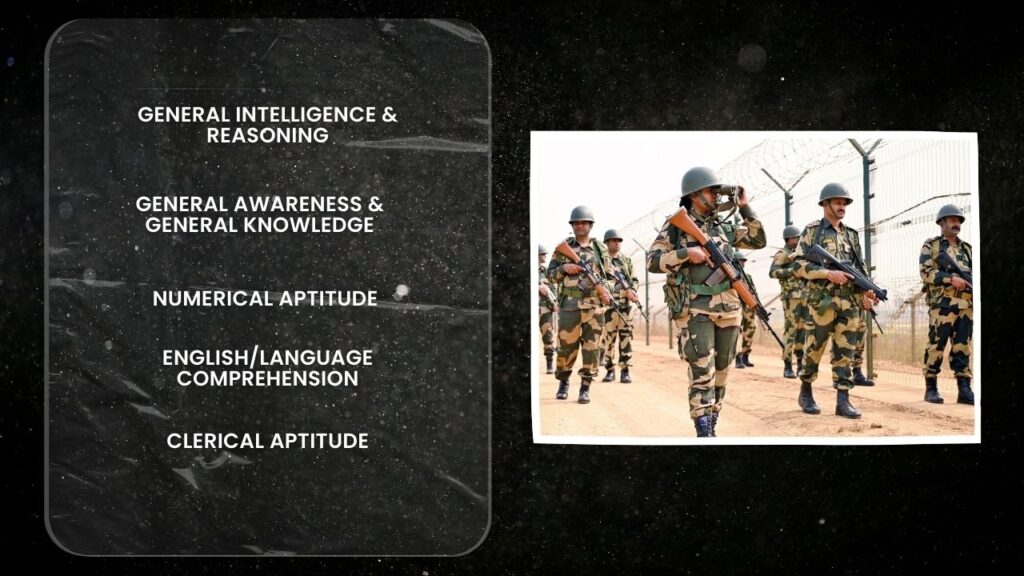
1. General Intelligence & Reasoning (25 Marks)
- Analogy : To recognize relationships among words (e.g. Doctor, Hospital, Teacher).
- Decoding Coding: The traditional sleuthing.
- Series Completion: In this, a certain pattern of numbers and alphabets is given. Find the missing link.
- Blood Relations: These are tangled family trees. If A is B’s brother’s mother’s sister…
- Direction Sense: If you make a left turn, walk five kilometres, then take a right.
- Venn Diagrams: representing Group Intersections.
2. General Awareness & GK (25 Marks)
This part divides the normal aspirants and the obsessed aspirants.
- Current Affairs : Open the newspaper every day (without fail). Concentrate on national news, sports, awards, and books.
- Indian History: Freedom movement is a favourite topic. Be familiar with the Gandhian era, the 1857 Revolt, and significant milestones.
- Geography: Emphasize on Indian geography like rivers, mountains, states and their capitals. The geography of the world is often restricted to a few key aspects.
- Indian Polity: The Constitution. Rights, Duties and Parliamentary Procedure.
- General Science. Normal Physics + Chemistry + Biology ( till 10 grade). Do not skip this portion; high yield and simpler than engineering science.
3. Numerical Aptitude (25 Marks)
You don’t have to be a mathematician but you do have to be quick with numbers.
- Number Systems: LCM, HCF, Whole Numbers.
- Simplification: BODMAS rule.
- Percentages & Profit/Loss
- Ratio & Proportion: Add things in the right amount.
- Time and Work : If A can paint a house in 5 days and B can paint it in 10… then what is the combined time?
- Time, Speed, and Distance: Trains and Platforms.
4. English/Language Comprehension (25 Marks)
As the role is ‘Ministerial’, your proficiency in using official language is assessed.
- Grammar: Spot the errors in a sentence, find tenses of the to complete the sentences.
- Vocabulary: Find every given word synonyms, antonyms and idioms.
- Comprehension: You are provided a passage to which you would have to pose questions.
- One Word Substitution: One word is said for something complicated.
5. Clerical Aptitude
This is specific to this job. It determines if you have the personality for working in an office.
- Detail Orientation: Identifies mistakes in addresses, numbers.
- Routines in a Basic Office: Knowledge of filing, indexing, and verifying data consistency.
Read More 👉 IAS Preparation Roadmap: Step-by-Step UPSC Strategy That Actually Works
Phase 2: The Skill Test (Typing)
After you clear the written test, you have to appear for the Typing Test. It has stood the best practical test for 2026 cycle.
- English Typing: 35 words per minute (wpm) is usual.
- Hindi Typing: 30 words per minute is usual.
Please Don’t Ignore This: So many brilliant students do not make it here because they only concentrated on the written exam. If you can’t type, you can’t do the job. Get started with your practice on Typing Master or any other typing software. Build muscle memory. Speed comes with accuracy, so concentrate first on hitting the right keys and later on going fast.
Phase 3: Physical Standards (PST/PET)
They have to meet the various physical criteria, such as for males and females a minimum height of approximately 167.5 cm and 157 cm respectively, subject to relaxations for certain categories.
Male applicants are subject to chest measurements of 78 cm unexpanded and 83 cm expanded. There is also a physical efficiency test, generally a 1.6 km run which must be completed within a stipulated time (e.g.6.5 minutes for males).
Strategy for the 2026 Cycle
Since this is the 2026 paper, you have time after all. Most candidates are underprepared, starting too late, just 3 or 4 months prior to the exam.
1.The Foundation Period (Months 1-3):
Not so fast in the mock tests. NCERTs (read class 6 to 10) for Science and History. Solidify your grammar base. Clear your concepts of reasoning.
2.The Practice Phase (Months 4-6):
Start solving previous year papers. Not for the score, but to see what the BSF questions look like “trending” Are they give me more on current affairs? Is the math getting harder? Adapt accordingly.
3.The Mock Test Phase (Last 3 months):
Simulate the exam environment. Sit at a table, put your phone away and finish a 100-question test in 2 hours. Analyze each mistake and prepare for the last one.
Conclusion
Becoming a BSF HCM Syllabus 2026 is a long journey. There will be days when you get the feeling that you are not holding on to anything but don’t lose hope.
Keep Consistent to fulfil your dream. Even studying a bare minimum of 4 hours a day but doing so everyday without fail would be enough to beat 90% of the competition who study sporadically.
Keep the syllabus handy, follow the pattern and have the eyes on the prize. That uniform isn’t just fabric, it’s a responsibility. And it’s waiting for you.