UP students who are waiting to apply for the scholarship to continue their education can fill out the application now. Registration for the scholarship starts for all the students of class 10th, 12th, graduation, and post-graduation. Interested candidates from Uttar Pradesh can apply.
When to Apply?
You can apply for the UP Scholarship form from 10 July to 20 December 2025.
Where to Apply?
Apply through the official website of Uttar Pradesh.
UP Scholarship Important Dates to Follow
Program/Activity
Start Date
Last Date
Student Registration/Online Application
10 July 2025
20 December 2025
Students to Take Final Print
12 July 2025
23 December 2025
Submission of Hard Copy with Required Attachments by Students at School
12 July 2025
24 December 2025
Online Verification and Forwarding of Application by School
11 July 2025
10 December 2025
Verification of Actual Students by District School Inspector
07 November 2025
15 November 2025
Scrutiny by NIC
11 December 2025
22 December 2025
Correction of Defective Applications by Students/Institutions
18 November 2025
21 November 2025
Submission of Corrected Applications by Students at School
23 December 2025
10 January 2026
Documents required for the Scholarship
Aadhaar Card
Income Certificate
Birth Certificate
Domicile Certificate
Marksheet of Last Year
Fee Receipt from the School/College
Photocopy of Bank Passbook
Caste Certificate
Passport-size Photograph
How to Apply for the UP Scholarship
Apply through the Official website of UP Scholarship, link is mentioned in the article.
Click on Pre-Matric or Post-Matric Registration.
Enter your details carefully to complete the registration.
Once the registration is complete, log in again and fill out the entire application form.
Once you fill in the details correctly, take a printout.
Upload the required documents and take a hard copy to your college and submit it there with all the documents.
Finding a stable, respected, and rewarding job in Bihar is not hard because government jobs can provide you with all of these features. I have maintained a list of the Best Government Jobs in Bihar along with their details. Whether you are a 10th, 12th pass, graduate, or even a postgraduate, there are roles in various government ministries and departments for different-level jobs.
Government jobs are still the first choice for many because of job security, high salary, reputation, and long-term benefits like a pension. Whether you’re from a rural or urban background, Bihar has options for all.
Each job has different eligibility, salary, and exams for selection. Worth applying for any government job because it will also provide you with career growth.
Top 10 Best Government Jobs in Bihar
1. BPSC – Administrative Services
This exam is designed to recruit high-level administrative roles. One of the best and hardest exams in Bihar. Popular posts include:
Deputy Collector
Block Development Officer (BDO)
Revenue Officer
DSP (Police Officer)
Supply Inspector
Eligibility
Age Limit
Selection
Salary
Graduate in any stream
21–37 years
Prelims → Mains → Interview
₹50,000 – ₹70,000/month
2. Bihar Police Jobs
If you are interested in the defense sector then you can apply for this job. There are different roles in the Bihar Police Service:
Sub-Inspector
Constable
Assistant Sub-Inspector
Inspector
Eligibility
Age Limit
Selection Process
Salary
12th pass to Graduation (depending on post)
18–37 years
Written Test + Physical Efficiency Test + Medical Exam
₹25,000 – ₹45,000/month
3. Bihar Teacher Recruitment Exam by BPSC
If you want to work in a Peaceful job, with long holidays, ideal for women and parents, teaching jobs have gained a lot of attention in Bihar, especially among women with thousands of vacancies in recent years. Popular posts include:
Primary Teacher (Class 1–5)
Upper Primary (Class 6–8)
PGT (Higher Secondary)
TGT (Secondary School)
Eligibility
Selection Process
Salary
D.El.Ed/B.Ed + CTET/Bihar TET
Written Test conducted by BPSC
₹30,000 – ₹50,000/month (based on class level)
4. Bihar Staff Selection Commission (BSSC) Jobs
BSSC is another body that recruits thousands of candidates for various roles which offers plenty of vacancies and it’s easy to prepare. Popular posts include
Clerk
LDC (Lower Division Clerk)
Assistant
Data Entry Operator
Stenographer
Eligibility
Age Limit
Selection Process
Salary
12th pass or Graduation
18–37 years
Written Test + Skill Test (for some posts)
₹20,000 – ₹40,000/month
5. Bihar Court Jobs (High Court & District Court)
These are all office-based jobs which offer fixed working hours. Judiciary departments in Bihar offer non-legal posts like:
Various roles for local development recruited under schemes like MGNREGA and PMAY, Bihar Government hires for local development roles like:
Panchayat Secretary
Block Program Officer
Technical Assistant
Computer Operator
Rozgar Sevak
Eligibility
Selection Process
Salary
Why Apply
Graduate or Diploma in a related field
Written Test + Document Verification/Interview
₹20,000 – ₹35,000/month
Local postings, social impact, and less stressful work
7. Health Department Jobs (NHM Bihar)
If you are interested in working for the health department then Bihar health sector jobs are in demand after COVID, especially under the National Health Mission (NHM). Popular posts include:
Community Health Officer (CHO)
Staff Nurse
Pharmacist
ANM / GNM
Lab Technician
Eligibility
Selection Process
Salary
Diploma/Degree in Nursing OR Pharmacy
Written Test + Document Verification
₹25,000 – ₹40,000/month
8. Bihar Rural Development Department
Government-funds schemes are implemented under this department. These schemes are initiated for the Bihar Development projects. You can apply for these roles if you are interested in office-based and project-related work. Some common posts are:
Gramin Awas Sahayak
Account Assistant
MIS Executive
Junior Civil Engineer
Eligibility
Selection Process
Salary
ITI/Diploma/Graduate
Written Test + Skill/Trade Test
₹18,000 – ₹35,000/month
9. Banking Jobs in Bihar
If you want financial security and fast promotions then banking jobs can offer you that. The Bihar government recruits candidates for public banks each year. You can apply for the following common posts:
Clerk (Office Assistant)
Probationary Officer (PO)
Officer Scale I, II, III
Eligibility
Selection Process
Salary
Graduation in any discipline
IBPS Prelims → Mains → Interview
₹30,000 – ₹60,000/month
10. Group D & 10th Pass Jobs
Those with basic education can apply for Group D posts in the railways or post offices. There are several jobs that are common:
Railway Group D (Helper, Track Maintainer)
Postman/Gramin Dak Sevak
Peon, Watchman, Office Assistant in various departments
Eligibility
Selection Process
Salary
10th pass
Merit-based or a simple written test
₹18,000 to ₹30,000 per month
Tips to Get a Government Job in Bihar
Start early Preparation: For common posts, Group D has easy exams that can be prepared within 4-6 months but some exams like BPSC or BSSC take 6–12 months of preparation.
Know the syllabus and exam pattern: Focus on Bihar GK, Current Affairs, Math, and Reasoning more.
Practice daily: To finish the exam in a given time you need to be prepared with practice like Mock tests.
Stay updated: Check on recruitment announcement on the official Bihar Government website. Here are the websites for Bihar government job updates:
Keep multiple options open: Know your interest in the field and then apply for the role but apply for at least 2-3 roles to increase chances.
Conclusion
There is no shortage of good government jobs in Bihar if you are ready to prepare and stay consistent. Don’t waste your time thinking that you can’t beat the competition, the core syllabus and the right strategy for exams can help you get high level jobs.
Whether you’re aiming for a high-ranking BPSC officer post or want a peaceful teacher’s life, the Bihar government also gives a chance to 10th pass students who want to start earning early and become a government employee. Choose any of the Top 7 Best Government Jobs in Bihar that ensure respect, stability, and financial peace for the long term.
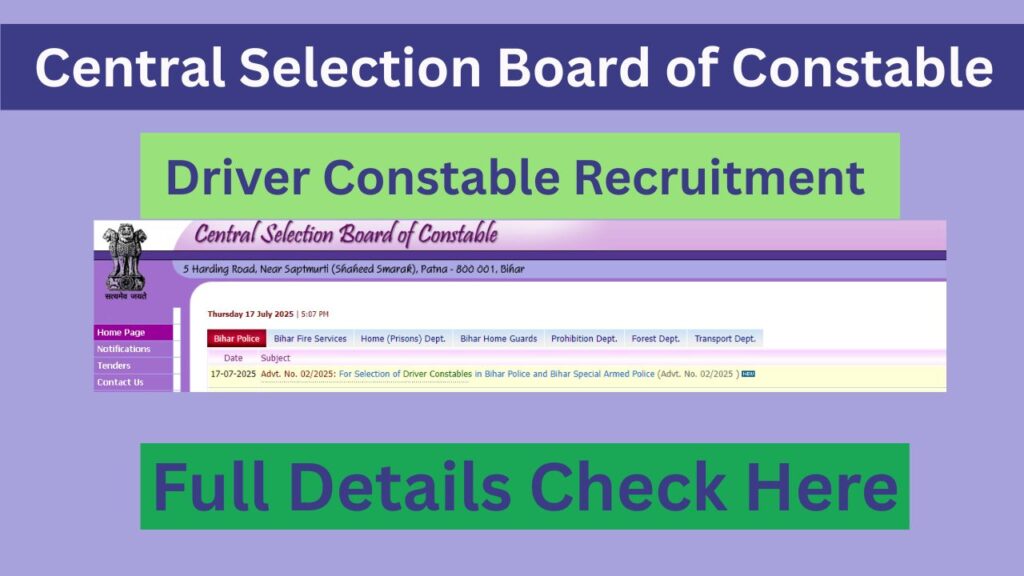
CSBC has officially announced the Driver Constable Recruitment 2025. Candidates who are waiting for this position can download the notification to check the full details of the recruitment. Always check updates on the official website to fill out the application.
Check the eligibility criteria before applying for this post. The initial pay of Driver Constable is around Rs. 30,000 to Rs. 40,100 per month including allowances as per Pay Level 3.
CSBC Driver Constable Recruitment 2025 – Short Details
Eligibility For CSBC Driver Constable Recruitment 2025
Qualification
Candidates have to pass 12th in any stream to be eligible for this position. If they have an equivalent education, they can also apply. Candidates must vary the educational qualification and age limit to meet the standard for eligibility criteria.
Age Limit
Minimum Age
20 years for all categories
Maximum Age
General–Male: 25 years OBC/EBC–Male: 27 years General/OBC/EBC–Female: 28 years SC/ST–both: 30 years
Necessary Documents for CSBC Driver Constable Recruitment 2025
Passport Size Photo
Signature
Educational certificate (marksheet)
Adhaar or PAN card
Income Certificate
Caste Certificate
Other certifications if you belong to special categories
NTA UGC NET JRF online form is open for candidates who have Master’s degree or equivalent through the official NTA website. The form will not be accepted after 28 October 2026 so fill the form quickly if you also want to sit in the exam. The exam will be held after two months when the application gets closed.
The National Testing Agency released the notification and opened the application on 8 October 2026. Anyone who misses it can still apply between 29 and 31 October by paying a late fee of ₹500, with the last successful transaction on 31 October. After that, there is no form to fill at all.
NTA opens a correction window after all the applications are submitted so any mistakes in the application form can be fixed between 2 and 4 November. But try to fill in the correct information at once because some fields are usually locked during correction.
The computer-based test runs from 14 to 19 December 2026. NTA has not yet announced exam city intimation, admit card release, answer key or result dates. Those will appear on the official site. The dates are also described as tentative in the notification, so keep checking the NTA site.
Event
Date
Online applications open
October 8, 2026
Regular application and fee deadline
October 28, 2026
Late application window (₹500 late fee)
October 29–31, 2026
Form correction window
November 2–4, 2026
UGC NET December 2026 exam
December 14–19, 2026
Exam city and admit card dates
To be announced
Who Can Fill the NTA UGC NET JRF Online Form
The basic requirement is a Master’s degree or equivalent. General, General-EWS and unreserved candidates need at least 55% marks, without rounding off. OBC-NCL, SC, ST, PwD/PwBD and third-gender candidates need 50%.
Final-year Master’s students and those awaiting results can apply too. They are admitted provisionally and get JRF or Assistant Professor eligibility only after passing with the required percentage.
Age matters only for the fellowship. Upper limit for JRF — 30 years
Age relaxation of OBC-NCL, SC, ST, PwD/PwBD and third-gender, women, and experienced get 5 years. An LL.M. degree earns 3 years. Assistant Professor eligibility and Ph.D. admission have no upper age limit.
NET is not a recruitment drive, and there is no fixed vacancy count. NTA qualifies roughly 6% of the candidates who appear for Assistant Professor eligibility. Within that group, the JRF cutoff is higher, so a “pass” can still leave you without the fellowship.
JRF Online Form Fees
General/unreserved
₹1,150
General-EWS and OBC-NCL
₹600
SC, ST, third-gender and PwD/PwBD
₹325
The fees will not be refunded by NTA once the form is filled and submitted successfully. So fill carefully and don’t try to fill at the last minute.
How to Fill the NET JRF Online Form
Start on ugcnet.nta.nic.in and open the December 2026 application link.
You need a mobile number and email that belong to you, since NTA sends all communication there, along with your Master’s marksheet.
Registration now runs through the Meri Pehchaan (National Single Sign-On) platform, so create or log in to that account first.
Enter your personal and educational details, upload a live photograph and signature, review everything, pay the fee, and submit.
Download the confirmation page and keep it. You’ll need it later.
Keep your documents ready before you begin:
A photograph of 10-200 KB showing about 80% of your face, ears included, on a white background is required. The signature file must be 10-50 KB. Category or disability certificates go in as PDFs, and the disability certificate must be 50-300 KB. Rejected uploads are the commonest reason for a stalled form, so resize files before you start.
Documents and payment must be submitted carefully without any error. Only completing Step 1 and 2 leave your application ignored.
Exam Pattern and Preparation
The question paper has two parts. One part is covered with common questions to access the knowledge and research of teachers. There are a total of 50 questions that come from aptitude, reasoning, reading comprehension, and general knowledge. The second part is covered with 100 questions from the subject you select. There is no negative marking so don’t leave the question and the test is worth 200 marks altogether.
If you wanna finish in time then try to solve each question in 72 seconds. Check previous year papers and practice mock tests because it will increase your time to solve one question. You will get only 180 minutes for this paper.
Complete the application form by October 28. Upload the documents first and your information on the desk. Complete the application form by submitting the fee and prepare for the exam. The examination city will be announced soon on the official website.
Check out their time-to-time for latest updates and admit cards because it is the entry card for your entrance in the examination hall. Give the exam carefully and wait for the result.
Nainital Bank Recruitment 2025: Nainital Bank invites applications from eligible candidates for the posts of Clerk CSA, PO and SO. The application process started on 12 December 2025 and the last deadline for applying is 01/January/2026. The candidates need to be 21 years old at least and the maximum age limit is 40 years. For more information visit the official website to see the notification.
Event
Date
Online Apply Start Date
12/December/2025
Online Apply Last Date
01/January/2026
Last Date for Fee Payment
02/January/2026
Exam Date
18/January/2026
Admit Card Release
Before Exam
CSA CLERK Form Fees
Rs. 1000
PO/SO Form Fees
Rs. 1500
The Eligibility For the Clerk CSA, PO and SO Recruitment
The age limit for different posts in Nainital Bank are: While the candidates for the posts of CSA, PO and IT officer must be aged between 21 to 32 years. The age limit for the posts of Manager IT and Manager Risk (Grade-II) is from 25 years to 35 years. Likewise, applicants for the posts of CA or Manager-Law (Grade-II) must be 25 to 40 years of age. Nainital Bank also grant the relaxation of age as per policy.
The agency has declared 175 jobs in different posts. These are 71 vacancies for the post of Customer Service Associate (CSA) / Clerk, 64 vacancies for Specialist Officers (SO) and 40 vacancies for Probationary Officers (PO). Eligible aspirants may apply for the posts applicable to them after reading the instructions.
Follow These Steps To Apply Online
Browse the official website of Nainital Bank and go to the Recruitment tab. Click on the link for Nainital bank Recruitment.
Log in with your username and password and fill out the multi-page form one relevant step at a time with your personal information, education, employment, and post preferences.
Kindly upload your latest passport size photograph and signature in the given format.
Attach you valid documents which support your claim of education qualifications and ID proof.
Pay the application fee online through various payment methods, and finalize the application by click on submit.
RRB Section Controller is the one who monitors every train to keep them on track without turning it into a chaos. The responsibility is hard but the salary is very good which comes with additional benefits. To hold the position, you must meet the eligibility criteria and understand everything about the job before applying for its application.
The good thing is this is the right time to know about this role and selection process because the Railway Recruitment Board is opening a fresh cycle for 2026.
Who Is an RRB Section Controller?
A Section Controller job is to handle the schedule of running trains. They are the ones who decide which train gets priority at a junction and which one has to wait on a line. The train moves on a signal, that signal is given by the section controller. Indian Railways trust only section controllers to move and stop the train.
It is a desk job with a practical responsibility, it comes with high punctuality and safety of the passengers. So sitting in a control room and making decisions in real time needs the full attention and focus of the person.
Indian Railways put this role under the Operating department and considered as mistakes are non-negotiable terms in this.
RRB Section Controller Eligibility 2026
This post has higher eligibility criteria compared to other RRB non technical posts as this post demands good judgement and coordination which is a higher requirement.
Educational qualification: You need a graduate degree from a recognised university, and the discipline does not matter. No matter if you are from commerce, arts, science, or engineering, you are eligible as long as the degree is completed. Aspirants awaiting their final year results cannot apply this cycle, so if your degree is ongoing, this will not be your chance now.
Age limit: The age of the candidates should be between 20 and 33 years (as on 1st January, 2026), standard age relaxation shall be applicable for reserved categories as per government rules. If you are near either limit, it is worth verifying the exact cutoff date once the detailed notification is out, since a few weeks can make/break eligibility.
Medical standard: candidates must meet the A2 medical standard to hold this position as it requires sustained attention and quick decision-making which includes specific vision and hearing benchmarks. This is more strict than a lot of other railway positions so it is worth getting a basic medical check up early on rather than be surprised later on in the process.
Nationality: Applicants should be Indian nationals or subjects of Nepal or Bhutan, Tibetan refugees who came to India before 1962.
Selection Process for RRB Section Controller
To become an RRB Section Controller, involves clearing four distinct stages. Each stage evaluates different skills and reduces the number of applicants.
It begins with a Computer-Based Test (CBT) that tests candidates on general awareness, reasoning, mathematics and general science and also the subject knowledge related to railway operations.
The aspirants who qualify the CBT are eligible to appear for Computer Based Aptitude Test (CBAT), a stage exclusive for posts of safety and control. This is not a test of theoretical knowledge, rather an examination of your ability to make decisions, maintain situational awareness and stay calm under pressure – all important attributes for a Section Controller.
Candidates who clear both rounds are called for Document Verification in which original certificates, proofs of category, and date of birth are verified with respect to the application.
The last step is a Medical Examination to ascertain the level of A2 fitness. Only those candidates who successfully clear all the stages are considered for the final merit list and merit is decided based on the aggregate performance in the CBT and fulfilling all the eligibility criteria at each stage.
On a daily basis, a Section Controller keeps track of trains running in their section with control charts and communication devices and remains in continuous communication with station masters, loco pilots, and other controllers on the route.
In case of a delay, a breakdown, or an unusual event such as a signal failure, it is the controller who makes the decisions in terms of rerouting or reprioritising trains to reduce the impact of disturbances not on the immediate line but on the total traffic.
It’s also a job with real accountability. The decisions a controller makes influence on-time performance statistics, freight movement goals, and, in certain cases, passenger safety itself.
It is a position that rewards those who can think multiple moves ahead and keep their composure when multiple things are going wrong at once, and that’s precisely why the CBAT phase is part of the selection process.
RRB Section Controller Salary and Benefits
The selected individuals are appointed on Pay Level 6 of 7th CPC having the starting basic pay of Rs. 35,400/month. In addition to the basic salary, employees are eligible for Dearness Allowance, House Rent Allowance, Travel Allowance, and other railway-related benefits such as free or concessional journey passes for the staff and their dependents.
Component
Details
Pay Level
Level 6, 7th CPC
Basic Pay
Rs. 35,400 per month
Job Type
Permanent, Central Government
Perks
DA, HRA, TA, railway travel passes, pension benefits
Advantages of Becoming a Section Controller
Apart from the pay, this is a Central Government job which brings the usual job stability, pension benefits and future security, which is what makes the railway recruitment a preferred choice for most of the graduates to begin with.
Section controllers can be promoted to senior controller and divisional posts in due course and the operational experience obtained at this level is highly regarded throughout the Traffic branch. For those who are looking for a government job that involves intellectually engaging, this post is like the best option through RRB.
Latest RRB Section Controller Recruitment 2026
The Railway Recruitment Board has confirmed 119 approved vacancies for this cycle under CEN 03/2026, spread across railway zones such as East Central Railway, which currently holds the highest zone-wise allocation.
Events
Details
Recruitment cycle
Railway Recruitment Board CEN 03/2026
Post
Section Controller
Approved vacancies
119
Highest zone-wise allocation
East Central Railway
Short notice released
23 June 2026
Detailed notification released
14 July 2026
Online application start date
15 July 2026
Online application last date
14 August 2026
This year vacancies are lesser than previous year for Section Controller so candidates should treat this as a genuinely competitive recruitment and prepare with the right strategy to beat the exam.
You need to apply entirely online through the website of the Railway Recruitment Board of your region. When you visit the official website, you can find this notification on the homepage or in the recruitment section.
Open Section Controller notification link and read all the necessary points before clicking on the apply now button.
Login with registration number and DOB, if you are new then register yourself with a valid phone number or email ID.
Don’t forget your password, write it somewhere to login again and fill the entire application with correct information for yourself.
Upload the required photograph and signature, pay the applicable examination fee around INR 250–500, and submit the form before the deadline.
It is worth downloading and saving a copy of the final submitted application and payment receipt for your own records.
Conclusion
The RRB Section Controller job is among those railway jobs which never get discussed as much as RRB NTPC or Group D, but it really should as it has more workload, salary, and long term job stability.
With 119 vacancies open under CEN 03/2026 and applications starting 15th July 2026, graduates who meet the eligibility criteria have a real window to build a serious career inside Indian Railways. The preparation period is brief, so if this position aligns with your interests, the best place to start is now for the CBT rather than later when the notification fully sinks in.