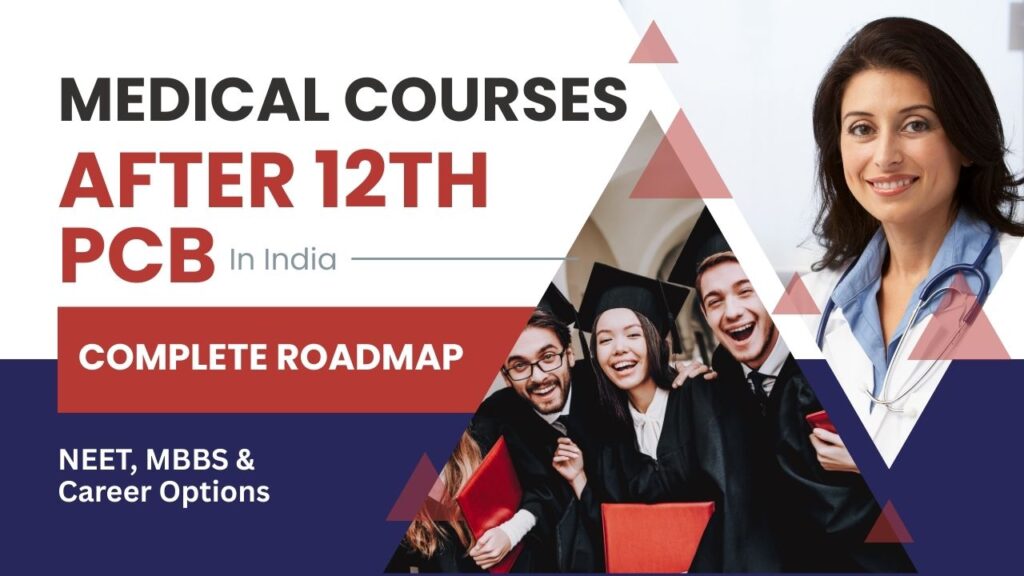
Medical Courses After 12th PCB in India: Complete Roadmap, NEET, MBBS & Career Options

Medical Courses After 12th PCB in India

To become a medical sciences professional in India, students have to opt for the Bachelor of Medicine, Bachelor of Surgery (MBBS) degree, which is an arduous and comprehensive five-year program that aims to develop the students into healthcare professionals. But the path to Medical Courses After 12th PCB in India is a confusing maze of courses and entrance exams (the most important is National Eligibility-cum-Entrance Test (NEET).

NEET entrance exam has played a pivotal role in making the process of admission of MBBS more transparent and ensuring the method of admission on merit basis and curbing malpractices in India. 

The usual path through medical training is to go straight from medical school into a foundation program, then core training, higher specialty training and then either general practice or hospital specialist/consultant. This lengthy, complex training process exists to make certain that doctors have the critical foundational knowledge, the practical skills unique to their specialty, and the clinical understanding needed to safely contribute to patient care. 

Other than MBBS, there are plenty of other medical and paramedical courses out for students PCB which are Bachelor of Dental Surgery (BDS), Bachelor of Ayurvedic Medicine and Surgery (BAMS) and Bachelor of Homeopathic Medicine and Surgery (BHMS)

Medical Courses After 12th PCB in India

Most Popular and Hard-Level Courses

These courses offer a variety of specializations in the healthcare domain for the interested and the ambitious. For example, MBBS is a course on allopathic medicine while BAMS and BHMS are courses on Indian and homeopathy systems of medicines respectively which have profound history in India. Such classic systems, such as Ayurveda, are conceptually coherent and dynamically insightful intellectual traditions with unique theories of physiology.  

The content in medical education is constantly being updated to reflect advances in science and to prepare students adequately for clinical practice. For instance, personalized medicine is more and more being implemented in undergraduate medical education by using spiraled learning approaches. This design exposes undergraduates to evidence-based and clinically pertinent personalized medicine principles during all four years in medical school. 

Easy Courses in Biomedical Science

In the same vein, growing awareness of the need to incorporate artificial intelligence (AI) – a tool that enhances patient management and care in specialties like radiology and pathology in biomedical science education to foster healthcare education advancement is emerging. 

EBM Courses in Medical Courses After 12th PCB

Today’s medical education demands that students gain scientific foundational knowledge and not only practical exposure and clinical reasoning skills. Pragmatic EBM courses, such as the one at our institution, are intended to prepare students to sift through large bodies of evidence to answer clinical questions preparing them for the transition from undergraduate to graduate medical education. 

Cultivating systems thinking in medical education may contribute to educating scientists and clinicians of the future by counteracting dwindling interests in science through early involvement, hands-on experience, and improved coordination between educational phases. 

Professional Exams — Membership of the Royal Colleges of Surgeons

Medical education is organized into levels that sequentially increase in complexity. Following primary medical education, a phase of practical training under supervision, e.g. postgraduate residency training, is essential in order to convert theoretical knowledge into applied skills in the delivery of care to patients. 

This stage is said to be a formalised apprenticeship, to guarantee that practitioners are ready to work on their own. Passing professional exams, such as the Intercollegiate Membership of the Royal Colleges of Surgeons (MRCS) exam, is required for candidates to begin advanced specialty training in a number of specialties. 

Practical Specialization in Medical Science

Practical Specialization in Medical Science

The number of specialties open to students is huge and they can focus on general practice or pursue a highly specialised field. For instance, these are pediatric rehabilitation medicine physicians who are subspecialists working to optimize the health and function of children with disabilities across the lifespan. 

Specialties can also provide their own focus training on particular aspects, such as behavioral health, as behavior disorders are frequently seen in children and pediatric residency training in India is now having integrated behavioral health modules. Consideration is also being given to global health challenges of the future, for example increasing paediatric surgery provision in low and middle-income countries. 

Other Specializations Paths

There are also other specialist routes besides the core medical degrees. The radiation biology, dosimetry, and imaging aspects of medical physics intertwine with biology, anatomy, and physiology, and are subject to the rigorous education and training that is needed for safe and quality patient care. 

Medical physics educational programs range from undergraduate to doctoral level to facilitate the collaborative practice of physicists and physicians in a clinical environment. Likewise, clinical chemistry and biochemistry are recognized specialties requiring dedicated postgraduate training.

Choosing The Right Path in Medical is Important

Becoming a health care provider is challenging, and continuous learning and adaptation are necessary. Medical education curricula are regularly revised to be more integrated and competency based with an emphasis on the application of knowledge and on the development of problem-solving skills. This prepares future clinicians to manage complex medical knowledge and varied patient demands. 

Students need to be provided with necessary information to help them make right decisions regarding their career option after 12th class as choosing the right course is a crucial decision which will determine their future. 

In addition to MBBS being a popular-choice, it is also important to know different career options in healthcare and non-healthcare fields. Different admissions routes are being introduced into Medical Courses After 12th PCB, which enable students from under-represented groups to access medicine and aim to widen participation in the selection process are being developed. 

Conclusion

The path of Medical Courses After 12th PCB in India is the jack of all trades’ requiring preparation for entrance exams like NEET and dedication towards lifelong specialized training. The curriculum is changing as constantly evolving science, including personalized medicine and AI, is being introduced and the next generation of healthcare professionals will take on the challenges of the modern medical field. 

The option isn’t only MBBS, now there are other streams like dentistry, Ayurveda, Homeopathy and scientific specializations under Medical Courses After 12th PCB which can be integrated into healthcare. 
Leave a Comment

Your email address will not be published. Required fields are marked *

India Post GDS 2026 Recruitment Notification & Apply Guide

India Post GDS Recruitment

India Post GDS 2026 Recruitment will start soon and you can apply directly from the official website once the link will be activated. Until then prepare your documents and read the notification to apply as soon as possible for various posts including Gramin Dak Sevak (GDS), Branch Postmaster (BPM), Assistant Branch Postmaster (ABPM) and Dak Sevak. A large number (28,890) of vacancies is posted by the India Post.

This is an opportunity for 10th pass jobseekers of strong mettle and the beginning of the online applications process for the 1230 India Post jobs is expected shortly on the official website of India Post. 

Follow These Dates to Apply for India Post GDS

EventDate
Official Notification Released28/January/2026
One-Time Registration Starts31/January/2026
Application Submission Starts02/February/2026
Last Date to Apply (Till 5 PM)16/February/2026
Correction Window18 — 19/February/2026
First Merit List Release28/February/2026
Process Completion Date30/June/2026

Qualification Needed For These Posts

If you also have completed your 10th with Maths and English then you are eligible to apply for GDS. 

Candidate’s age should lie between 18 to 40 years as of 16 February 2026.

Age relaxation is admissible as per government rules: 5 years for SC/ST, 3 years for OBC and 15 years for PwBD candidates of the SC/ST category.

The selection procedure is merit-based, on the basis of Class 10 marks, with grades being converted into marks on the basis of a multiplication factor of 9.5. 

Education10th standard marksheet
Age Limit18-40 years

Application Fee 

Only General/OBC/EWS candidates must pay Rs. 100 while submitting the online form for this post. Other caste candidates do not have to pay any amount.

Read More 👉 Paramedical Courses Career Roadmap After 12th: Jobs, Salary & Scope

Circle-Wise Vacancies For India Post GDS

CircleVacancies
Uttar–Pradesh3,169
West–Bengal2,982
Maharashtra3,553
Madhya–Pradesh2,120
Telangana609
Tamil–Nadu2,009
Bihar1,347
Andhra–Pradesh1,060
Assam639
Chhattisgarh1,155
Delhi42
Gujarat1,830
Haryana270
Himachal–Pradesh520
Jammu/Kashmir 267
Jharkhand908
Karnataka1023
Kerala1,691
North Eastern1,041
Odisha1,191
Punjab262
Rajasthan634
Uttarakhand445
Total28,740

Pay-Scale 

India Post GDS 2026 Recruitment: The TRCA amount varies between ABPM/Dak Sevak and BPM, with ABPM/Dak Sevak receiving a sum ranging from ₹10,000-₹24,470 to BPM ranging from ₹12,000-₹29,380, along with 3% annual increase, DA, gratuity and pension like schemes. 

Work: 4 to 5 hours daily in villages. 

Application Form 

  1. Click on the Official Website link in the below link section
  2. If you are new then register yourself with email & number
  3. Login to fill the entire application form with correct details, attach photo and signature.
  4. You must prepare your all the documents to attach it with your application and submit with application fee
  5. Print it out for offline proof
Useful Links
NotificationClick Here
InstructionsClick Here
Official WebsiteClick Here

Leave a Comment

Your email address will not be published. Required fields are marked *

NTA CSIR UGC NET Admit Card 2025 Released – Check Exam City & Download Now on Gov Update Wala!

NTA CSIR UGC NET Admit Card

Candidates who have applied for the UGC NET exam can check their NTA CSIR NET Admit Card 2025 on the official website. Candidates must download their admit card to know the exact location of the exam centre. The admit card consists of Name, Exam centre, Exam Name, Shift Timing, Roll Number, etc. 

There are a total of three parts – A, B, and C where part A contains objective-questions from general aptitude, the rest of the two parts are based on the subjects. Negative marking is applicable, so candidates must prepare well for this exam.

Qualifying candidates will be eligible for different opportunities such as Junior Research Fellowship, Assistant Professor, and PhD admission. 

Short Details for the NTA CSIR UGC NET Admit Card

Exam NameUGC NET
Exam Conducting BodyNational Testing Agency
StatusAdmit Card Released
PurposeUGC NET is a national-level exam to open the path for programs in research and scientific fields.
Exam Date28/July/2025
Exam ModeOnline
Duration of Exam180 minutes
Official WebsiteClick Here

NTA CSIR UGC NET Admit Card 2025 Dates

Application Date03–23 June, 2025
Last Date for Fee Payment24/June/2025
Exam Date26, 27, & 28/July/2025
Admit Card DateJuly/2025 (before exam)
Exam City Intimation19/July/2025

For the latest update on the admit card, candidates should check the official website. The admit card will be released soon (before the exam date).

Guide to NTA CSIR UGC NET Admit Card Download 

  1. You need to click on the link to the Official NTA Website.
  2. Then navigate the login section or click on the direct link to log in from this article.
  3. Candidates must enter an application number and password to log in.
  4. After logging in, you can download your admit card or exam city slip to your system.
  5. Save it for future reference.
Important Links
Log inClick Here
NotificationClick Here
Short NoticeClick Here
Official WebsiteClick Here

Leave a Comment

Your email address will not be published. Required fields are marked *

DSSSB MTS Recruitment 2026: Apply Online for Multi-Tasking Staff Posts

DSSSB MTS Recruitment 2026

DSSSB MTS Recruitment 2026: The Delhi Subordinate Services Selection Board (DSSSB) has released the Notification for the Recruitment of Multi Tasking Staff (MTS) vacancies for the Year 2026. There are 714 posts in all. The application form submission will start from 17th December, 2025 and will end on 15th January, 2026. Eligible and interested candidates may apply online from the official DSSSB website. Candidates can check the detailed notification for eligibility criteria, application fee, age limit, salary, selection procedure, etc. 

Follow the link to download the detailed notification and to apply. Hope you apply if you qualify. Information regarding eligibility criteria, application fee, age limit, salary and selection process is provided in the notification. Make sure you have gone through the official notification before you apply. 

Details of DSSSB MTS Recruitment at a Glance

OrganizationDelhi Subordinate Services Selection Board
PostMulti Tasking Staff
Vacancy 714 
Min Age to apply18 years
Max Age to apply27 years
Salary Lie Between ₹18,000 to ₹56,900/- Per Month
Official WebsiteClick Here

Dates To Remember For Application Process

EventDate
Notification Date11/December/2025
Application Start17/December/2025 
Last Date Apply Online15/January/2026 
Last Date Fee Payment15/January/2026 
Correction DateAs Per Schedule 
Admit CardUpdate Soon 
Exam DateUpdate Soon 

Read More:- SSC Exam Calendar 2026–27: Complete SSC Exam Schedule

Follow These Steps To Apply 

DSSSB MTS Notification 2026 has been published on 30 September 2025 for 5159 vacancies. of MTS has been released on 17/December/2025. 

To Apply Online for Multi Tasking Staff, Follow These Steps:

1. Observe the DSSSB MTS Notification 2026 PDF for complete details.

2. Go to the Official site at dsssb.delhi.gov.in or click below to Apply Online.

3. Fill in the DSSSB MTS Online Application Form 2026 with the necessary details.

4. Upload the required files to prove your claimed information.

5. Submit the requisite fee via the mode of payment mentioned.

6. Print a copy of your application form after you have submitted it.

If you’d like, you can also check out reasoning ability practice tests’, exam preparation courses’, and time management techniques’ for more help. 

Useful Links
Apply NowClick Here
Download NotificationClick Here
Official WebsiteClick Here

Leave a Comment

Your email address will not be published. Required fields are marked *

HR Professional Courses: Get Complete Guide on Career Path, Salary & Growth

HR Professional Courses

If you’re curious about what it takes to be a Human Resources (HR) professional, you’re in the right place. Over the past 10 years, the HR Professional Courses has undergone significant transformation, shifting away from an administrative role to gaining importance and recognition as a strategic business partner in organizational culture, employee satisfaction and business performance. This all-in-one resource will take you through the Need to Knows of building a fulfilling HR career in India, whether you are a fresher exploring career options or a career changer seeking a meaningful direction. 

What Does an HR Professional Actually Do?

Before we get into courses and salaries, let’s demystify the day-to-day life of a HR professional. Despite the stereotype that human resources is just paperwork and policies, HR employees today wear many hats. You will participate in strategic talent acquisition to seek and recruit candidates aligned with company values and who will drive growth. You’ll design and deliver programs to upskill the employees, mentor junior staff, and help them grow their career within the company. 

On the compliance and policy side, you will be monitoring the company’s compliance with labour laws, conducting employee relations with tact, mediating disputes equitably and managing the full spectrum of employee life from hiring to offboarding. Compensation and benefits policies are your domain too: You develop the strategies, coordinate the performance reviews, and you can even assist with organizational development by working with your leaders on future staffing and succession planning. In today’s world of data and analytics, many HR professionals are also utilizing analytics to monitor indicators such as employee engagement, retention rates and hiring effectiveness to drive additional business improvements. 

The joy of human resources is that each day is different, with issues ranging from handling a difficult employee complaint to developing a creative new-hire program or spearheading an organization-wide change effort. 

Educational Roadmap To Become HR Professional

HR career paths

The great thing about HR career paths is that there is no single “correct” path. To your education and current level of career aspirations, you can add several points of entry: 

After 12th Grade

If you have completed the high school you can go for the Diploma in Human Resource Management. These 1-3 year courses are available at a cost of Rs 50,000 to Rs 2,00,000 according to the classification of institution as a government or a private one. Alternatively, you can do 3 years of Bachelor’s degree (BBA, BA, BS) in HR or something related. Government College fee is goes from ₹1-8.5 lakhs and for private college fee is from ₹3-16.25 lakhs.The eligibility criterion is generally 50-60% in 12th class. 

For Graduates

If you already hold a bachelor’s degree (in any stream as per your undergraduate major), you can go forward for professional certificates or a post graduate diploma. A professional certificate of 6-12 months costs between ₹20,000 and ₹1,00,000, while a post graduate diploma for 1-2 years is valued at ₹50,000-₹1,20,000. These courses are great if you want to make a move into HR for then a full 2 year MBA. 

MBA / PGDM Route

If you are looking for an overall business education with focus on HR, a 2 year MBA or PGDM in Human Resources fees vary from ₹ 2-27 lakhs based on the tier of the college and the location. These programs on the repel need entrance exams as CAT, SNAP, MAT, or XAT. Top tier institutions such as IIM, XLRI have higher fee yet provide excellent placement package and networking. 

Professional Certifications

Professional certification is also valuable in addition to formal education. The popular certification include CHRG (Certified Human Resource Generalist) which has fees of ₹50,000-₹2, 00,000.

The CHRM (Certificate in Human Resource Management) is priced at ₹90,000-₹8,00,000 and the CHRP (Certified Human Resource Professional) costs ₹80,000-₹4, 00,000.Two globally-oriented credentials that also have value on an international basis are the SHRM-CP (Society for Human Resource Management Certified Professional) and the aPHR (Associate Professional in Human Resources) both of which are recognized by employers in many countries around the world.   

Eligibility Requirements You Need to Know

  • For Diploma Courses: You need to pass 12th grade exam with minimum 45% in aggregate.
  • ​For Bachelor’s Degrees: Obtain 50-60% in 12 grade; some colleges require entrance exams.
  • ​For M.B.A. Directly after 10+2: Achieved a minimum of 60% in your 12th grade exams; passed entrance exams such as CAT, MAT, SNAP, or XAT.
  • ​HR-Related Certifications: Many certifications such as SHRM-CP have prerequisites of at least 3 years of HR work experience in an HR function, whereas entry-level aPHR caters to HR novices or individuals beginning their journey in HR. 

Starting Salary For HR

Entry level HR professionals in India get a good pay as per market standard. An HR fresher gets a salary in the range of ₹15,000-₹30,000 per month, which comes around ₹3-5 LPA per annum. However, this might differ drastically depending on a few things such as: 

  • By Role: HR recruiters and coordinators normally begin with salaries of ₹18,000–₹26,000 per month and HR analysts with good technical skills can make ₹25,000–₹35,000 per month from the very start.
  • By Education: Tier-1 MBA (HR) pass-outs have high salary prospects of ₹30,000–₹40,000 per month and BBA or BA grad can make ₹18,000–₹25,000 per month.
  • By Industry: It is not always that an HR company gives you a chance but you can get IT, finance and e-commerce industries offer for an HR with starting pay of ₹28, 000 to ₹35, 000. 
  • By Location: Metrocities like Bengaluru and Delhi offer great pay to HR Professionals.  

Career Growth

Indian HR salaries have increased 24% from 2019, this is higher compared to IT sector’s 6.5% CAGR. This signals the rising level of strategic importance that HR has in organizations. 

Indian HR salaries

Career Progression Timeline

Start as an HR Assistant or Coordinator (0-2 years), then advance to HR Generalist or Specialist (2-10 years) in areas such as L&D Manager or Recruiter, then go to HR Manager or HR Business Partner (5-10 years) and subsequently to executive positions which include Director, Head of HR, or CHRO (10+ years).   

Salary Growth by Experience

A fresher can typically expect a starting salary of ₹3–5 LPA. As you gain more experience, this can be anywhere from ₹11-15 LPA at HR Manager level, ₹20-25 LPA in senior specialist roles and anywhere between ₹40-150+ LPA for CHRO of a large company. The steepest rise in salary is generally seen between 10 to 13 years of experience- whereby the median CTC varies around ₹38 LPA.   

Emerging High-Growth Specializations

For maximum growth, strategic HR roles are the way to go. HR Analytics Managers earn ₹40-60 LPA, Salary & Benefits Managers earn ₹28-42 LPA, and Diversity & Inclusion Managers earn close to ₹20 LPA. These positions are growing at 15-22% per year because they have a direct effect on business results. 

Conclusion

The Job growth of approximately 7% over the next ten years will add about 17,400 new jobs and is expected for the HR occupation. Instead of being automated out of existence like some admin jobs, strategic HR roles are increasingly precious. You get to work with people, solve truly complex organizational issues, shape company culture, and have a tangible impact on whether employees are happy at work.

​”The investment, be it ₹50,000 for a diploma or ₹20 lakhs for an MBA, gets returned fast in the form of a competitive pay package and strong career growth. More than who you’re working for, it is the work, financial and personal fulfilment you are creating.

First, decide on the HR professional Courses that best matches your current qualifications and your career timeline, learn core HR skills to get started, and don’t overlook the impact certifications can have in helping you stand out. 

Leave a Comment

Your email address will not be published. Required fields are marked *

Top B.Tech Colleges in India: Latest Ranking & Admission Guide

BTech Colleges in India

When thinking about starting a career in engineering then choosing among the top BTech Colleges in India is the priority for every student. The race for a Bachelor of Technology (BTech) course has gotten much tougher and thrilling as there are plethora of options for would-be engineers across the country. If you’re a Class 12 student planning to appear for entrance exams or a parent navigating the admissions maze, this one-stop guide will give you an overview of the current scenario of top BTech colleges in India, their rankings, placements and admission criteria. 

Understanding the Current Landscape: NIRF Rankings 2025

Indian BTech Colleges NIRF Ranking 2025 is considered as the standard for deciding the best BTech colleges in India. As per the updated list, IIT Madras ranked 1st once again for the ninth straight year, further consolidating its hold on engineering. The top five Engineering institutes in India according to NIRF 2025 are IIT Madras, IIT Delhi, IIT Bombay, IIT Kanpur, and IIT Kharagpur.​

 IIT Madras, IIT Delhi

But the story is not all IITs, the NIRF Rankings are not limited to the only IITs. As far as the National Institutes of Technology (NITs) are considered, only NIT Trichy emerges among the top 10 at rank 9 in the list, which speaks about the immense competition in rankings. Following NIT Trichy we have the older NITs like NIT Roorkela, NIT Suralgkal, we have NIT Calicut who all regularly get top 25! 

NIT Roorkela and NIT Suralgkal

Private institutes have also made a place for themselves, with BITS Pilani at Rank 11 and VIT Vellore at Rank 16 in NIRF 2025. These colleges are no joke, they do provide a world class education and you will have no problem finding employment. 

The Tier System

In addition to the usual rankings, a number of industry insiders grade schools according to tiers based on placement results, presence of recruiters, and number of competitive cutoffs. This gives a more refined sense of the college pecking-order. 

Tier 1 (Premier Institutes) consists of the legendary IITs such as IIT Bombay, IIT Delhi, IIT Madras, IIT Kanpur, IIT Kharagpur, IIT Roorkee, IIT Hyderabad, and IIT Guwahati. These are also engineering colleges which dream destinations for most engineering aspirants. Indian academics are tough and placement records are also excellent.​

IIT Kanpur and IIT Bombay

Tier 1.5 (Strong and Competitive) has institutes such as IIT BHU (Varanasi), IIT Indore, BITS Pilani, IIT Ropar, IIT Gandhinagar, NIT Trichy, NIT Surathkal, and NIT Warangal. These universities have good academics and employment potential and have gained significant traction in reputation. 

Tier 2 (Well established with Consistent Track Records) Institutes of the second tier like IIT Mandi, IIT Jodhpur, IIT Bhubaneswar, IIT ISM Dhanbad, NIT Rourkela, NIT Calicut, BITS Goa, BITS Hyderabad, and the likes, boast of consistent placement records coupled with strong alumni network. These are established institutes and provide assured opportunities for students for career growth and links with industry.  

Placement Statistics

While selecting a college, the chief concern is usually the placement. Let’s dig into the real figures. The average salary package at IIT Bombay soared to ₹23.5 LPA in the 2024 placement drive, showing a 7.7% rise from last year’s ₹21.8 LPA. The highest package at IIT Bombay soared to a staggering ₹3.67 crore, with 22 students bagging offers scaling the ₹1 crore per annum mark. 

The placement rate for IIT Bombay’s BTech programme is a healthy 74.53%, with 1,475 students placed out of 1,979 registered. Curiously, Computer Science Engineering is the most in demand branch with 230 offers, then closely matched by Electrical Engineering (232) and again by Mechanical Engineering (229).​

The average package at IIT Kanpur hiked up to ₹26.27 LPA, whereas IIT Delhi saw an average package of ₹17.60 LPA with a highest package of ₹2.05 crore. These statistics attest to the amazing value top engineering colleges provide their students. 

Admission Process For B.Tech

Anyone with ambitions to be a part of these institutions should know the process of meteoric rise, which is Understanding the process of admissions is essential for any aspirant who wants to get into these esteemed organizations. The route for BTech admission in India: Your Class 12 results and entrance exams largely decide your fate.​

NIT Trichy

An all India examination termed JEE Main is required to be passed by the candidates for admission to the institutes like IITs, NITs. Candidates are required to qualify in JEE Advanced, which is the next level after JEE Main, for seeking admission to IITs. JEE Advanced for admission to IITs can be attempted only by JEE Main rank holders (JEE Main is qualifying exam for JEE Advanced), and seat allotment in IITs is done on the basis of JEE Advanced ranks alone. 

The eligibility criteria is simple, but important: candidates should have completed class 12th (science stream with physics, chemistry, and mathematics) with minimum marks of 50% to 75% which varies as per the institute and category. For reserved category contenders the qualification is generally 65%.​

Admission Process For B.Tech

The BTech admission schedule is designed in a manner that helps you to plan well in advance. Application period: It may be from November to March of next year, subject to specific entrance examination. 

Entrance exams are generally held in April-June, followed by counselling and seat allotment after the exams then classes usually start around August or September. 

Cutoff Ranks Matters

In top colleges, an applicant with a JEE Main rank less than 5,000 can expect to get one of the top five NITs. For example, NIT Trichy’s Computer Science Engineering has an opening and closing rank of 1000-2000 in general category, NIT Surathkal’s CSE has ranks in the range of 1500-3500. 

General 91-95
EWS 79-83
OBC-NCL77-81
SC 58-62
ST 44-48

Under this category, the likely cutoff percentile for JEE Main 2025 is General (91-95), EWS (79-83), OBC-NCL (77-81), SC (58-62), ST (44-48). But, all these are predictions based on the past year’s trends of the exam, the actual figure of cutoff may be different. 

Popular BTech Specializations

The present day BTech courses are not only confined to traditional engineering branches. Computer Science Engineering (CSE) leads the list as the most preferred branch for a bright career in software development, data science and cybersecurity. 

Popular BTech Specializations

But today the BTech branches in the specializations are far more than the CSE. Mechanical Engineering, Civil Engineering, ECE (Electronics and Communication Engineering), and IT (Information Technology) are still the standard choice but some new fields are emerging that are taking over the engineering world. AI and Data Science, Cyber Security, Cloud Computing, Biomedical Engineering, and Robotics and Automation Engineering are the courses currently making waves owing to high demand in industry. ​

Emerging disciplines such as these are the future of engineering, and firms looking to attract the best graduates in those niche are already hard-pressed to come up with competitive salary packages. 

Understanding the Financial Reality

It is also necessary to consider the expenses related to BTech. The entire course fee amount for government colleges like NITs and IITs is generally between ₹8.35 lakhs and ₹9.17 lakhs which is really affordable considering the kind of opportunities these institutes offer.​

Private universities such as BITS Pilani have much higher fees at ₹23.9 lakh for the full course, although they do have a variety of advantages such as more flexible curricula and better placement results.​

With a low fee structure of ₹8.35 lakh, IIT BHU, Varanasi also has the highest ROI of 239.52%, due to a median package of ₹20 LPA. 

Conclusion

Selecting a BTech college is among the most crucial decisions in your academic life. Despite the importance of rankings and placement statistics, you must keep in mind your interests, what you want to do in your career and your personal circumstances. If you’re going for the elite IITs, the perpetually decently performing NITs, or the private ones like BITS Pilani, do remember that your success depends as much on how hard you work as how good your education institution is.

Start your JEE Main preparation today, aim for a good rank, and keep track of the dates of the admission process. After all the efforts and proper guidance, it’s not going to be long before you’re striding down the hallways of the top engineering colleges in India, ready to make a mark on the world. 

Leave a Comment

Your email address will not be published. Required fields are marked *

Scroll to Top