If you are waiting for a job in NICL Assistant Online Form 2026 then it is the right time to apply for the Assistant (Class III) position since there are a total 500 vacant seats, your chance of selection is high. National Insurance Company Limited opens the application portal until August 7, 2026, so apply early to secure a seat into a reputed government job in the insurance sector.
There is a lot of time for candidates to register and upload the documents. But before you start filling this online form, you must know a few important points to not get rejected.
Event
Date
Application Start Date
18 July 2026
Last Date to Apply Online
7 August 2026
Last Date for Fee Payment
7 August 2026
Phase I — Prelims Exam
27 August 2026
Phase II — Mains Exam
30 October 2026
Apply early, don’t wait until the final week. Government websites are known to slow down or crash when thousands of applicants access them on the final day, and a deadline missed here means waiting for the next cycle.
Vacancy Details
NICL will hire for 500 Assistant posts in the Class III cadre, with selected candidates getting posted to different states and union territories on regional lines. The job includes routine office and field work at the NICL Branch Point or the Branch Office.
Before you start filling the form, make sure you tick these boxes:
A graduation degree in any subject with a good score from any recognized university.
NICL Assistant 2026 age limit is 21 to 30 years. Reserved categories are given only reserved category candidates, you can check in the official notification.
It is important to know the regional language of the state you are applying for, as the Recruitment is held through a Regional Language Test.
Note: Choose the state where you are familiar with and know their native language to handle the job smoothly. If you select multiple locations, you application can get rejected so easily.
Application Fee
Category
Fee
UR, OBC, EWS
₹850
SC, ST, PwBD, Ex-Servicemen
No fee
Selection Process
NICL Assistant recruitment happens in three stages:
Preliminary Examination — objective-type, online
Main Examination
Regional Language Test
Only those candidates who qualify in the prelims can appear for the mains, and only those who qualify in mains can feature in the language test. Remember this tiered format when you are considering your preparation — there is about a two month gap between prelims and mains which is sufficient to address weak points if you start early.
Open NICL website and find the recruitment section or click on the link “Recruitment of 500 Assistant (Class III) 2026-27”.
If you are new then register yourself using a valid email ID or mobile number. Once you get the registration number, login again with that credentials.
Fill the entire application form for the NICL Assistant Online Form 2026 role and re-check every detail.
Select your preferred examination state and language.
Prepare your passport-size photograph, signature, left thumb impression, and certificates to upload it immediately.
Make a payment for the application by using a net banking or card (this step is skipped for those who are exempted).
Preview the form carefully before hitting final submit — once submitted, corrections aren’t usually allowed.
Download and save a copy of the final application form and payment receipt for your records.
A Few Things Worth Remembering
Offline applications aren’t accepted — this is an online-only process.
Remember to save your progress at each stage by clicking on “Validate Your Details” and “Save & Next” to avoid losing data halfway.
Have all your documents scanned and ready in the correct file size and format so you aren’t rushing to get everything together at the final step.
If you’re eligible and considering a stable, long-term career in the public-sector insurance space, this is a solid opportunity to apply for. Just don’t leave the form for the last two days.
Conclusion
Eligible candidates should fill the NICL Assistant Online Form 2026 right now and grab a chance to secure a seat in the Indian public-sector insurance company. NICL offers 500 vacant spaces which will be filled under a three-tier selection procedure.
Verify your eligibility, select the appropriate State and Regional language, and keep all requisite documents handy to avoid last-minute hassles before applying. And most importantly, submit your application in advance of the deadline on7 August 2026 to avoid any last minute technical problems and to allow yourself some time to start studying for the Preliminary Exam which is held on 27 August2026.
BSc physiotherapy is a 4-year undergraduate professional course, that can be opted by those students who wish to pursue a career in healthcare services or wish to provide care to patients through physical rehabilitation and therapeutic care. The course gives you a thorough knowledge of human body anatomy, movement science and modern physiotherapy techniques as medical science and clinical practice. Due to increasing emphasis on physical well-being, rehabilitation, and sports medicine, physiotherapy has become a well-established and sought after profession and BSc Physiotherapy is a particularly good academic option for students who take interest in patient care, science of recovery and holistic health.
Overview of BSc Physiotherapy
The bachelor’s degree in physiotherapy is an application of clinical and science based physiotherapy. This course is conducted for four years both for theoretical sessions and practical training where the course participants learn basics of anatomy and physiology as well as methodology of physical therapy.
Students also complete clinical placements or internships where they have the opportunity to work with patients who have a range of bodily ailments. This practical experience is key to acquiring the skills you need to become a physiotherapist.
Course Curriculum for BSc Physiotherapy
The BSc Physiotherapy course combines theory and practice in equal measure to develop sound clinical and professional competence. It begins with core modules in anatomy, physiology, biochemistry, pharmacology, assessment techniques, research methodologies, and communication skills in order to build a robust base.
Students also take higher-level courses in rehabilitation techniques, therapeutic interventions, sports physiotherapy, kinesiology, and biomechanics in the second year. It also involves clinical training with practical placements, enabling students to put their knowledge into practice in real-life healthcare environments. Assessment of learning in physiotherapy is by written papers and practical examinations and project work, all of which are designed to ensure students’ all-round competence in the practice of physiotherapy.
Eligibility for BSc Physiotherapy
The requirements for admission to a Bachelor of Science (BSc) in Physiotherapy would vary from one institute to another and is subject to the individual decisions of the institute.
Basic academic requirement: candidates generally should have completed their 12th-grade higher secondary education with not less than 50% aggregate in science stream.
Requirements for Subjects: Apart from the total percentage, he/she has to compulsorily pursue some core subjects in class 12. The essential subjects to be studied usually are:
Physics
Chemistry
Biology
These are important subjects because they help you learn basics which are required to know the human body, its functions and scientific rules which are applied in physiotherapy.
Further Information: Vocational qualifications such as BTECs may be accepted by some institutions in addition to or in place of equivalent qualifications, subject to their individual application requirements.
The best universities might also have additional requirements such as entrance examinations (NEET, CUET, or state-level exams) or interviews to assess candidates.
Admission Process in Best Universities of India
Admission for the BSc Physiotherapy course is based on entrance exam conducted either by individual colleges or through centralized examination system.
These are the most common entrance exams:
NEET
CUET
KCET
IPU CET
LPU NEST
Application Process
Get/Download the Application Form: Students can either download the application form for the respective college or university from the official website or they can get the application form from the college or university itself by visiting the institute.
Submission of Documents: Documents to be submitted are usually the Class 10 and Class 12 mark sheets, photographs, identity proof, etc. as per the norms of the institution.
Entrance Exam: Aspirants need to take the designated entrance test by the specified deadlines of the college/university.
Cut-off list/Interview: When the entrance examinations are over, the college may announce a cut-off list/interview for finalizing the admission on the basis subject and other criteria.
Confirm Admission: After this, the qualified candidates have to confirm their admission by submitting the requisite fee and the formalities for the same are provided by the concerned institution.
Fees Range in India’s Best Colleges
In India, the BSc Physiotherapy course fees in the top institutes are generally in a range of INR 50,000 – 3,00,000 per year depending on whether it is a government or private institution.
Some of the top ranks such as All India Institute of Medical Sciences (AIIMS) and Christian Medical College (CMC) can command fees on the higher end of this, while others have much lower overall costs of training due to government subsidies.
All in all, the expenditure of Bsc Physiotherapy Education varies in different countries and institutions and it is recommended to explore each college for further information about tuition fee and living expenditure.
Future Opportunities
Career Focus with BSc Physiotherapy in India
BSc Physiotherapy is a good career option and has a very bright future in India as the demand of qualified physiotherapists is increasing all over the world. Graduates have several options to choose from, including options that are designed to work with patients that have different needs and in different healthcare environments.
Clinical Physiotherapy
One of the primary career opportunities is that of a Clinical Physiotherapist, which allows the graduates to work in hospitals, clinics and rehabilitation centers. Physiotherapists assess and treat patients in institutions, but may also be employed as independent consultants. Students can assess as orthopedics, neurology, pediatrics, geriatrics, and cardiopulmonary physiotherapy.
Sports Physiotherapy
Another important area is Sports Physiotherapy which relates the treatment and prevention of sports injuries. Sports physiotherapists work with athletes to improve performance and prevent injuries and they may be found working with sports teams and gymnasiums.
Rehabilitation Therapy
Rehabilitative is a key discipline the physiotherapists are concerned with rehabilitation and restoration of motion and function to people. Physiotherapy is important for post operative rehabilitation after surgery. It helps to regain function, manage pain and discourage complications, which are essential elements in the promotion of the best recovery.
Academic and Research Opportunities
The graduates can also go for academics, and teach the candidates in Physiotherapy in colleges and universities. Opportunities for higher education like MPT (Master of Physiotherapy) or even PhD will also add on to career options.
Government and Private Sector
BSc Physiotherapy graduates can apply for jobs in both the government and private sector. Qualified physiotherapists are in demand in government hospitals, health campaigns, non-governmental organizations (NGO), but they also have important positions in private clinics, companies, health care programs and sports clubs.
Career Focus with BSc Physiotherapy Abroad
Working abroad can increase chances of finding a job for physiotherapy graduates. Countries like Australia, Canada, Germany and Switzerland are very friendly to international physiotherapists and in many cases allow for foreign trained professionals to obtain licensure.
Professional Growth
Professional development is necessary in the field of physiotherapy. Additional to the physiotherapy degree, many physiotherapists also get specialised qualification/education in the field of paediatric physiotherapy, geriatrics or rehabilitation to name a few.
Work within international physiotherapy organizations and/or attend workshops or conferences in a foreign country to further your career development and to acquire a competitive advantage make you more marketable as a graduate when you’re seeking employment.
Salary Expectations
In India, a physiotherapist’s average annual salary is INR 1,018,527 (USD 12,300). Fresher physiotherapists are paid around INR 15,000 to 25,000 per month (varies as per employer and city conditions) or can get a stipend from the higher education institute from where they had studied.
With more experience, salaries are estimated at INR 50,000 – 80,000 per month.
Canadian physiotherapists can count on earning from $70,000 to 85,000 USD, which is quite a high salary when compared to that of other countries. Newly graduated physiotherapists in Australia generally earn a salary of around AUD 65,000 which grows significantly for more finding its way to up to around AUD 140,000 in senior positions or clinical educators.
Physiotherapists in Gulf countries like Saudi Arabia, UAE, Qatar, also enjoy good pay scales. Staff physical therapists in these areas typically make between USD 3,500 and 5,000, while senior therapists could be paid up to 6,000 USD or more per month.
The salary forecasts for physiotherapists indicate a wide range depending on region of work, sector specialisation and level of experience.
BSc Physiotherapy Comparison with BPT
The BSc physiotherapy is more a scientifically based approach covering a wide range, but the Bachelor of Physiotherapy (BPT) is also mixed with a considerable amount of practical training, which focuses on the therapeutic procedures and assessment methods required in the industry. BPT courses may also focus on the use of physiotherapy in different clinical areas so graduates can find employment there too.
The BPT course is innovatively crafted which equips students not only with theoretical knowledge but also with practical expertise required to evaluate, diagnose and treat various physical disorders, thus it is a good option for students who want to pursue a career in which they help patients regain mobility and quality of life vision enabled by physical rehabilitation.
Overall, BSc and the BPT in physiotherapy provide different routes to a career in physiotherapy BSc offers a wider scientific base and BPT concentrates more on clinical aspects and therapeutic procedures. Both courses could lead to rewarding careers in the ever changing area of physiotherapy, specific to the interests and talents of the graduates.
Conclusion
BSc Physiotherapy is a great opportunity to explore what a rewarding healthcare career could be like, with well-rounded knowledge in sciences, clinical practice and career types. Physiotherapy today is a dynamic and expanding profession all over the world including our country with multifaceted activities starting from hospital, sports rehabilitation to research, academic and international exposure.
Whether students are going into clinical practice, further education, or opportunities abroad, they will graduate from this program with the knowledge, skills and confidence to guide their growth. In essence, BSc Physiotherapy it not just a degree—it is a journey to a rewarding career dedicated to improving mobility, health and quality of life.
There are a lot of students who filled the application form for teaching in Kerala and appeared in the exam. They can check their Kerala TET Result 2026 on the official website of Kerala Pareeksha Bhavan. Many candidates wonder about the salary and professional growth at this stage, so here is the full detailed guide to Kerala TET exam. From eligibility to selection process, everything is here.
Achieving a qualifying score on the Kerala Teacher Eligibility Test (KTET) will help to achieve a teaching career. If you missed the 2026 cycle, you can apply next year but knowing every detail lets you understand how to crack the exam.
Overview of Kerala TET Result 2026
The Kerala Teacher Eligibility Test was conducted smoothly over two days, morning and afternoon shifts due to a large number of applicants.
Exam Name
Kerala Teacher Eligibility Test (KTET)
Conducting Body
Kerala Pareeksha Bhavan (KPB)
Exam Cycle
December Session (Exams held Feb 21 & 23, 2026)
Result Declaration Date
May 26–27, 2026
Official Website
https://ktet.kerala.gov.in
Credential Required
Category, Registration Number, and Date of Birth
Certificate Validity
Lifetime Validity
What is the Kerala TET (KTET) Exam?
Students in Kerala who are dreaming about becoming an educator, The Kerala Teacher Eligibility Test (KTET) is specifically structured to prepare you for teaching and provide you with an official certificate to be able to teach in school. Kerala Pareeksha Bhavan conducts this exam to check whether a candidate has the right knowledge and teaching skills to handle students effectively.
KTET is designed to evaluate applicant’s psychological understanding of children, teaching methods and proficiency in subjects. There four separate categories for specific educational tier:
Category I (Lower Primary): Focus on Classes 1 to 5.
Category II (Upper Primary): For those who can teach Classes 6 to 8.
Category III (High School): Focuses on relevant subjects for Classes 9 to 12
Category IV: Special teachers (foreign language or Arts) and Physical Education instructors.
Why is The Kerala TET Exam Important?
If you want to become an Educator then you need to clear this exam and please remember that this exam will allow you to teach school across Kerala only, not any other state.
Mandatory Entry Requirement
The state government makes this test mandatory to clear for teaching. Without a valid KTET scorecard, you cannot legally apply for teaching vacancies advertised by the Kerala Public Service Commission (KPSC) or state-aided institutions.
Lifelong Validity Benefits
KTET certificates now come with lifetime validity, that’s a huge relief for the teaching professionals. You never have to go through the stress of retaking the test to renew your qualification status.
Professional Credibility and Up-skilling
Preparing for the KTET naturally moulds you into a well-rounded teacher. As it covers the curriculum which increases your understanding of educational psychology and child development.
Step-by-Step Procedure to Check Kerala TET Result 2026
Open your web browser and visit the official Kerala Teacher Eligibility Test website.
Find KTET Result 2026″ link in the notice or on the homepage.
Use the drop-down menu to select your specific exam category and type your Registration Number and DOB to login.
Check the result and verify your name and marks to make sure that it’s yours, then download the PDF.
Eligibility Criteria for Kerala TET
Category
Classes Covered
Minimum Educational Qualifications
Category I
Classes 1–5
Passed 12th with 45% marks, plus Trained Teachers’ Certificate OR Diploma in Elementary Education
Category II
Classes 6–8
BA/BSc/BCom with 45% marks + Bachelor of Education (BEd) OR Higher Secondary + 4-year Bachelor in Elementary Education (BElEd)
Category III
Classes 9–12
Master’s degree with 50% marks + BEd degree
Category IV (Specialist/Language)
Specialist / Language subjects
Certificate, Diploma, or degree in the specific language/subject plus Training Certificate
Minimum Qualifying Marks (Cut-Offs)
The 150 objective-type multiple-choice questions of the KTET exam carry one mark for right answers. There is no negative marking for incorrect selections. But candidates have to score above the cut offs and its varying by their category:
90 out of 150 marks — General/Unreserved Category
82 out of 150 marks — Reserved Categories (SC/ST/OBC/PH)
Selection Process for Kerala TET
Once you got Kerala TET Result 2026 scorecard, you must follow the further path to secure a job:
Document Verification: Immediately after qualifying, you must report to the designated District Educational Officer (DEO) for a thorough physical document verification. Authorities will check your certificates, ID, and educational certificates.
Eligibility Certificate: Once the DEO confirms your documents are original, you will get a formal, valid-for-life KTET Eligibility Certificate.
Applying via KPSC: You must monitor KPSC notification for teacher eligibility so that you can apply for government school.
Career Prospects and Salary Structure
The doors will be open for you for the lifetime of teaching. You can apply everywhere in Kerala for stability, high community respect, and a rewarding compensation package.
Diverse Career Pathways
Primary School Teacher (LPST): Guiding children through their formative learning years.
High School Assistant (HSA): Specializing in core thematic subjects like Physics, Mathematics, Social Science, or Literature for older students.
Specialist Educator: Instructing students on Arts and curriculum activities which grow their mind into creativity. Give training on the grounds and manage sports development as a Physical Education teacher.
Institutional Growth: Experience in teacher matters, you will be promoted to the seniority level like Headmaster/Headmistress in a same school without any exam or interview..
Expected Salary Scale
Candidates after clearing KTET examination can easily get the teaching job in Kerala schools. They receive income according to their level of teaching, higher classes require more attention and effort. Primary Teachers get between ₹35,600 to ₹75,400 per month. And High School Teachers earned ₹41,300 to ₹87,000 per month.
People also give private tuitions or join coaching centers to earn passive income. The exam increases the chance of getting more valuable offers in future.
Kerala TET Result 2026 is out now and candidates can check using their registration number and DOB. Once you get your scorecard, you have to check the teacher jobs notification in Kerala for securing a high paying teaching job.
If you haven’t applied this year, you can apply next time but knowing every detail regarding this examination will help you understand how to clear the examination and most importantly check whether you are eligible or not.
If you began your preparation for the IBPS PO with the mock tests of the last year, then your syllabus is already out of date with yesterday’s blueprint. The IBPS PO MT XVI cycle for 2026 has evolved quite a bit in terms of number of vacancies, in the Mains exam, and even in the rounds after the interview, so aspirants who do not revise their strategy might find themselves sitting in the exam hall solving a paper that is no more.
Here are the real differences this time around and what that means for how you prepare.
What Changed in IBPS PO MT XVI 2026
The IBPS PO MT XVI detailed notification was published on 30 June and 01 July 2026 on ibps.in, inviting applications for the posts of Probationary Officer and Management Trainee in 11 participating public sector banks for the recruitment year 2027–28.
The total number of vacancies mentioned in the first notification was 6,715. That figure has since shifted — as per the 20 July 2026 update from IBPS, the number stands at 7,365, which is approximately 29% more than last year’s intake.
Two banks, UCO Bank and Union Bank of India, had not yet submitted their vacancy numbers as of this update, so the final count may change once more before the end of the process. Bank of Baroda, Canara Bank, and Bank of Maharashtra currently have the largest number of vacancies.
The date for application also got extended. It was initially scheduled to end on 21 July 2026 but IBPS extended the last date to 26 July 2026. This year also brings something new with effect: a two-day correction window post registration closure, so candidates who find an error in their form after submission are not doomed by it.
Important Dates for IBPS PO MT XVI Recruitment 2026
Milestone
Date
Detailed notification released
30 June – 1 July 2026
Online application window
1 – 26 July 2026 (extended from 21 July)
Preliminary exam
22 & 23 August 2026
Main exam
4 October 2026
Personality Test / Interview
To be announced
Treat the interview and personality test dates as provisional until IBPS confirms them closer to the Mains result — that stage of IBPS PO MT XVI typically gets scheduled bank-wise, so your call letter will carry the exact date and centre.
Eligibility Criteria
To apply for IBPS PO MT XVI Recruitment, you need a graduation degree in any discipline from a recognised university, with your mark sheet or provisional degree certificate in hand at the time of registration — IBPS doesn’t accept “result awaited” candidates.
The age bracket is 20 to 30 years as on 1 July 2026; the usual government relaxations for reserved categories apply, but confirm the exact slab-wise relaxation against the official notification PDF rather than assuming it mirrors last year’s, since IBPS has been known to revise fine print between cycles.
The application fee is ₹175 for SC/ST/PwBD candidates and ₹850for everyone else, payable online through the IBPS portal.
Salary and Pay Scale
An IBPS PO MT XVI Recruitment selected candidate shall begin at the basic pay of ₹48,480. When DA, HRA and other allowances are included, the salary comes to around ₹74,000-76,000 per month in-hand, although it may vary based on place of posting and allowances structure of individual banks.
The Exam Pattern For IBPS PO MT XVI Really Diverges From Last Year
Prelims remains the same. It’s still 100 questions for 100 marks on English Language, Quantitative Aptitude and Reasoning Ability, with 60 minutes for the duration which is divided into three separate timers of 20 minutes each. A ¼ mark will be deducted for each wrong answer and your Prelims score is only a qualifying hurdle — it is not taken into account for the final merit list.
Mains is what makes IBPS PO MT XVI Recruitment seem an altogether different exam. The objective paper has increased from 145 questions to 170 questions, while the total marks remain 200 in a duration of 160 minutes. The English Language now asks more questions but awards fewer marks – 20, down from 40, so that each English question is worth less than it ever was.
General/Economy/Banking/Digital/Financial Awareness has been increased to around 50 questions for 60 marks and is one of the heaviest sections in the exam and also Data Analysis & Interpretation has been given more marks.
The subjective paper remains 25 marks for 30 minutes, although sources vary on whether it’s essay writing and comprehension or if it includes letter writing — do confirm this with your admit card and the official notice when released, don’t take either version for your final source of information.
Selection Process: Four Stages, Not Three
Where IBPS PO MT XVI Recruitment used to run Prelims, Mains, and Interview, this cycle adds a fourth step: a Personality Test, conducted after Mains and before the interview. It’s mandatory for anyone shortlisted, but non-qualifying — its purpose is to hand the interview panel a personality profile rather than to filter candidates out on its own.
The interview itself is still conducted by the individual participating banks, and you’ll need at least 40% to qualify (35% for SC/ST/OBC/PwD candidates).
Final merit combines Mains and Interview scores in an 80:20 ratio — Prelims marks play no role beyond getting you through the door.
One Preparation Tip You Shouldn’t Skip
Don’t wait until after Prelims to deal with the Mains shift. Because Banking Awareness and Data Analysis & Interpretation now carry noticeably more weight in IBPS PO MT XVI’s Mains paper, block out a fixed weekly slot — even 30 minutes, three times a week for RBI circulars, recent monetary policy changes, and current banking-sector news, starting today rather than after Prelims is done.
Candidates who leave Banking Awareness for a last-minute cram before Mains are the ones most exposed by this year’s restructured weightage.
The vacancy count for IBPS PO MT XVI Recruitment isn’t fully locked yet, with two banks’ numbers still pending, and the interview-stage calendar hasn’t been released. Keep checking ibps.in directly rather than relying on secondhand vacancy figures as you get closer to results — in a cycle with this many moving parts, the official notification is the only version worth trusting completely.
Conclusion
The IBPS PO MT XVI Recruitment 2026 notification came with more vacancies and a new selection process, so it is a good chance to grab for banking aspirants. Check your eligibility, apply online, and start preparing for Prelims and the revised Mains exam today.
There might be updates for vacancies and schedules from IBPS’s side, so keep visiting the official site for the latest notifications and do not trust other websites.
If you are reading this, you are probably a student who has passed out his schooling or a parent who wants to get some tips to take admission of his child in best ITI in Bihar. Its very normal to be stress about admission procedures, and you are not at all the only one having that feeling. This is the high time to apply for Bihar ITI CAT Admission Form 2026. Hundreds of students, every year, lost out on good opportunities due to getting confused with the process or missing on key deadlines.
This is the perfect guide for you to get answers to all your questions related to Bihar ITI CAT Admission Form 2026. So, after reading this information, you will be able to learn how to apply in an easy manner without any hurdles.
What is Bihar ITI CAT?
Before we get into the forms and deadlines, let’s clear up exactly what we’re talking about. ITI – Industrial Training Institute: ITI is a training center formed under industrial training act which is best option after 10th. These are not random classes; they are designed to get you a job as soon as you finish.
CAT here means Common Admission Test. Unlike in certain states, where the admissions are given on the marks of board exams, a proper entrance exam was conducted by Bihar to make the seats in the best colleges available to deserving candidates. Consider it a level playing field, where preparation counts more than who you know.
The whole process is being handled by Bihar Combined Entrance Competitive Examination Board (BCECEB). Yes, That is the same board which takes various other professional course admission in the state. They are the ones who will issue the form, take the exam, and then assign you to an ITI based on your rank and what you have indicated as your preferences.
When Should You Check the Notification?
Most people are wrong at this point because they have waited too long. Based on the trends of the past years, the Bihar ITI CAT 2026 notification is expected to be released in the month of February/ March of that year. Around three to four weeks will elapse during the registration process.
Get your paperwork in order, know the qualifications requirements, and maybe even brush up on your basic arithmetic and general info. The early bird gets a special ITI and a trade in the worm!
Who Can Actually Apply?
You must know the requirements for the admission before filling out the Bihar ITI CAT Admission Form 2026. Students who passed 10th with a good score from a recognized board can take the admission. Good trades and government ITI’s except for a 10th certificate, some trades may take in class 8th pass students.
As a general rule, you should be at least 14 years old in the year of admission. There is usually an upper age limit of approximately 40 years, which makes the courses relatively accessible for older students hoping to reskill themselves – a really thoughtful touch, if you ask me.
In the admission, domicile is important. Preference will be given to residents of the state in Bihar ITI admissions. If you are a resident of Bihar you have to show your domicile certifícate. If you are from outside, see if there are any all-India quota seats since, strictly speaking, your options may be limited by the Bihar natives.
The Actual Form-Filling Process: Step by Step
Step 1: Registration
BCECEB is an official website which will provide you with the application portal, so visit the site to register by clicking on the ITI CAT 2026 link.
Step 2: Fill in Your Details
Enter your personal, educational and contact details meticulously. A minor spelling error may lead to inconvenience at a later stage of verification of documents, so review well before you proceed.
Step 3: Upload Documents
After that, you need to upload the evidence of your application. Sign, Photo, Marksheet, and certificates (caste and domicile) are needed.
Step 4: Application Fee
Pay the requisite amount (₹500 or ₹1000) for this application through UPI, Credit Card, Debit Card or Net Banking.
Step 5: Final Submission and Print
Check everything for the last time. Apply. At least two copies of your confirmation page should be printed. One copy for your records, another for good luck (and a third because you’ll want it later).
After the Form: What Comes Next?
Filling the form is just the starting of the whole procedure. The admit card is issued a few weeks before the exam — download it immediately and verify all the details. The exam generally comprises objective questions from your general awareness, basic maths and possibly some aptitude relating to your trade.
Then the results come out and there’s a counseling process at which you choose your preferred ITIs and trades according to your rank. So this is very very important – check out the ITIs beforehand. Some have good infrastructure, some have good placement records, and in some trades more jobs are available than the others. Just don’t pick because you’re exhausted by the process.
Common Mistakes to Avoid
I’ve seen smart people make this mistake over really dumb things. So, stop waiting for the last minute and apply as soon as possible.
Don’t forge documents — Bihar’s verification process is strict and getting caught means you will be banned from writing any more exams. Don’t trust the random videos on Youtube or WhatsApp forwards —always verify the information.
Bihar ITI CAT Admission Form 2026 is a Golden Opportunity
ITI training can really transform where your life goes. In a state like Bihar where the government jobs are minimum and private sector companies demand relocation to metros, an ITI certificate gives you portable skills. There are jobs in Bihar and you can also move to other states or even to foreign lands, the demand for skilled tradesmen is universal.
The Bihar ITI CAT 2026 Application Form is not just another form that you have to fill out to get to your next step. It’s your portal to hands-on training for real jobs. Take it seriously, but don’t be afraid of the process.
Conclusion
If you’re thinking about whether to go to a college or an ITI, then both are good options. You don’t have to be a doctor or an engineer to make it. Apply early and carefully to take a chance for making a better life ahead of you. Everything is here that is needed to know but still all students must check the latest updates and notification of the procedure about the Bihar ITI CAT Admission Form 2026 for admission.
The domain of paramedical sciences is an exciting path for students who have completed high school to explore the diverse aspects of the healthcare sector. In line with increasing need for trained personnel, Paramedical Courses Career Roadmap consist of specific training on diagnostics, emergency care, treatment and rehabilitation.
These Paramedical Courses aim not only to provide technical knowledge but also to train students to overcome professional challenges in an ever-changing healthcare environment, which is the reason why this is such a popular career path for young aspirants.
Here, we provide a full-fledge career guide for all the high school graduates who aspire to establish a career in paramedical services in the near future. Here, we will discuss your eligibility, the course, different specializations, the procedure to move into the sector and a variety of attractive career options after you complete it.
Why Choose a Paramedical Courses?
Types of paramedical jobs have also been included in the lists of healthcare occupations. What questions do you have about paramedics? They also play a vital role in critical diagnosis, emergency and outpatient treatment as well as in patient rehabilitation.Reasons to choose a job in paramedical science include:
In high demand: Health care is growing. The reports state that the need for paramedical technicians will increase by 20-25% over the next few years, especially in the developing countries.
Endless Career Paths: There are endless career paths in paramedic including Emergency Medical Technician (EMT), Medical Laboratory Technologist, or taking a leap into new-age disciplines like telemedicine and health informatics.
Personal and Social Satisfaction: In direct patient care and its positive impact on society, the paramedical professionals have the greatest chance for both professional fulfillment and job security permanently.
This has opened up a window of opportunity for high school graduates to make a career in the healthcare sector through paramedical courses.
Eligibility and Requirements for High School Graduates
The path to a good paramedical career begins with the right academic background. For class 12 board takers, the online eligibility criteria for admission are as follows:
Educational qualifications: A high school diploma with science subjects like biology, chemistry and physics is mandatory. Many paramedical centers have the expectation that students will excel in those subjects because they are the basis of the more difficult material taught in further courses.
Basic Certifications:You can get some extra certifications like basic life support (BLS) or CPR Training which can help you stand out. These credentials not only prepare candidates for the hands-on practical aspects of healthcare, but also attest to their dedication to the field.
Entry Exams and Selection Process: A few courses may have an entrance exam or an aptitude test, and have an admission process that involves showing your enthusiasm for the science and health care.
These essential qualifications allow high school graduates to pursue a variety of Paramedical Courses, and so the door is opened to a multifaceted education.
Courses and Specializations in the Paramedical Field
There are various types of Paramedical Courses that you can opt for—certificate and diploma courses to full degree courses. Theoretical as well as practical knowledge is imparted, so students gain a good understanding of what is required at workplaces in hospitals and other healthcare facilities.
Below is a table with a brief summary of some of the specializations with the work they do and place of work:
Specialization
Role
Work Settings
Medical Laboratory Technologist
Blood, Blood Fluids, Tissues Testing
Diagnostic center, Hospitals, Research Facility
Radiology Technician
X-rays, MRIs, CT scans using machines
Radiology Center
Emergency Medical Technician (EMT)
Provide First-Aid in Emergency
ER, Ambulance
Physiotherapist
Engage with Patients for Rehab and guide them
Rehabilitation Clinics and Hospitals
Anesthesia Technologist
Assisting with Anesthesia
Operation room
Other Roles (Optometrist, Dental Hygienist, Speech Therapist, Occupational Therapist)
Patient Special Care
Mostly private clinics
This table is a sample of the multiple occupations which are available for the paramedical candidates but, all of them may vary in their complexity and challenges. The courses in these disciplines usually consist of lectures and laboratories and/or clinical rotations and or paid or unpaid work placements that provide students with hands-on experience required to work in their chosen field.
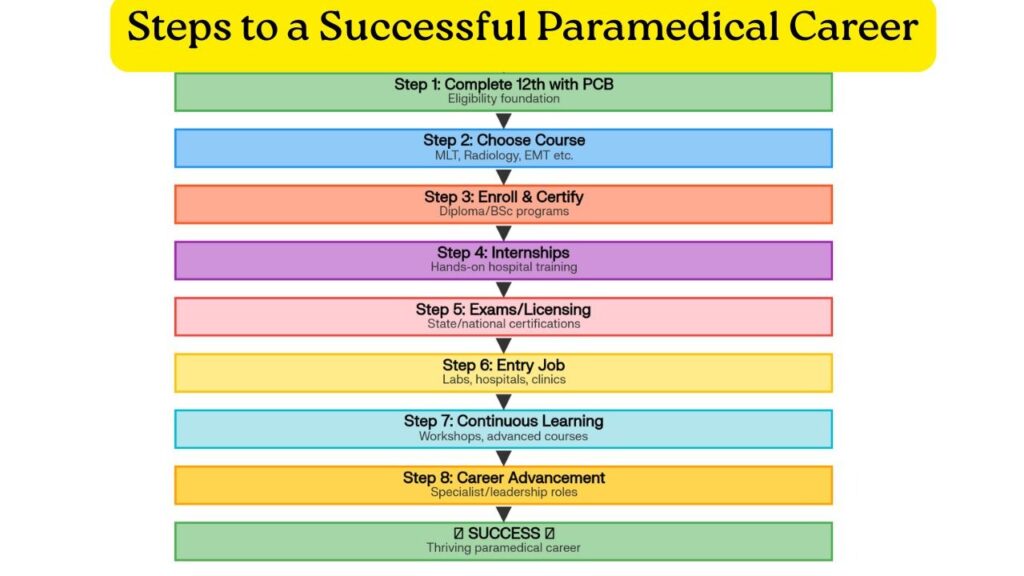
Steps to a Successful Paramedical Career
A step-by-step advance is necessary for a career in paramedical work. The given flowchart depicts the straightforward career opportunity for the regular high school pass outs:
The flowchart of Paramedical Courses shows the process step by step: Begin with a solid academic foundation, apply practical experience, get certified, and then specialize or move into management. Each phase relies on the previous one to build depth and breadth of skills in the professionals.
Career Opportunities in the Paramedical Courses
Paramedical professions have a wealth of options and opportunities that go well beyond the usual roles. After completing their education, students can work in multiple fields such as:
Hospital Environments: A large portion of paramedical professionals employed in hospitals include them in the diagnosis, patient care, and testing.
Diagnostic and Imaging Centers: Medical Laboratory Technologist, Radiology Technician and other allied health professionals play an essential role in identifying and diagnosing countless diseases.
EMS: EMTs and Paramedics are needed now as much as ever in ambulance services and emergency departments, where making split-second decisions in a pump-driven environment is part of the job.
Trend Trailers: As telemedicine and health informatics matures, more jobs are likely to emerge for people focused on the convergence of healthcare and technology.
Own Business: Many practitioners have transitioned from practicing to owning their own clinic, laboratory, or home healthcare service, and some contribute to the field by working in their own business while enjoying the personal freedom associated with being your own boss.
The positive growth in the healthcare industry along with technology enhancements is expected to create additional jobs, which makes it a promising field for people looking to build a career in this industry.
Benefits of a Paramedical Career
Benefits of a career in paramedics are numerous and high school graduates can look forward to a great future (Check out some of the pros and cons about joining this career below):
Employment Security: Increasing Paramedic jobs healthcare needs worldwide ensure a stable and promising future for paramedical practitioners.
High Salary: The salaries for a number of these positions are competitive, commensurate with their unique skill set and important responsibilities.
Variety of Opportunities: You can find job opportunities to suit your interest, whether that be hands-on with patient care, supporting diagnostics or working with new technology.
Personal Satisfaction: A career in paramedicine not only is financially rewarding, but it can positively affect the lives of thousands of patients and the community at large.
Career Advancement: Many health services have in place a career progression (e.g. the Paramedic Practice Advancement Ladder) to include rewarding experience and ongoing professional development.
Institutional Support for Aspiring Paramedical Professionals
There are many reputed colleges which offer good facilities and infrastructure for students who want to make a career in paramedical. For example:
Belarani Institute of Paramedical & Allied Sciences: The Training provided is more practical oriented by the experts with well experienced trainers and Placement Support to the students on completion of their Training.
LifeLine EMS: Nowhere is this more true than in Southern California where LifeLine EMS provides seamless EMT to Paramedic pathways, comprehensive training, mentorship programs and well-defined internal career promotion tracks.
Colleges like Foothill College and The George Washington University: The programs which run the gamut from short-term, intensive 11.5-month programs to long-term degree programs include classroom instruction, skills labs, clinical rotations and field internships designed to fully prepare students to meet the challenges of the profession.
These schools do more than train students in the latest tools and technology, they create cultures where a commitment to lifelong learning and professional success is ingrained.
Conclusion
Paramedical Courses Career Roadmap: High school graduates opting for a profession in paramedical sciences not only ensure a bright and stable career but also play an important role in the advancement of global healthcare. With the right skills and commitment, as the industry continues to grow, there will be countless opportunities for those dedicated to pursuing a career path with endless potential.
So whether you’re interested in the accuracy of laboratory diagnostics, the life-saving measures of emergency services, or the professional practice of physiotherapy and more, there’s no doubt that your career in the paramedical sector will be fulfilling and rich with opportunity. Begin your journey today and discover the opportunity to have a real impact on the lives of many.