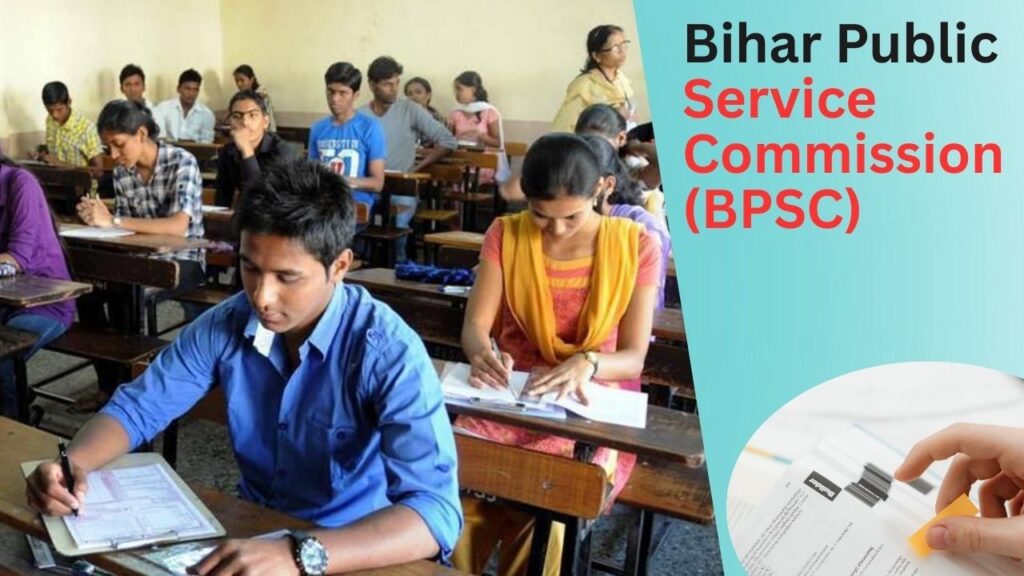
If you are among those dreaming for a Bihar government job then you must have heard about BPSC exams. Perhaps you observed some of your friends studying thick books or maybe you stumbled across those BPSC Toppers interviews that suddenly fill your YouTube recommendations list. You have to know that Bihar Public Service Commission will offer a great opportunity for various posts such as DSP, BDO, SDM and others.
So, let’s crack the details of Bihar Public Service Commission including Full Form, Exam, and Selection Process.
What is BPSC?
Bihar Public Service Commission is a government organization in short BPSC. It’s essentially the gatekeeper to some of the best government jobs in Bihar. It was established in 1956 and functions as a constitutional body to select the eligible and suitable candidates for multiple state civil services and administrative positions.
The BPSC mostly refers to the BPSC Combined Competitive Examination, popularly known as BPSC CCE. This is the top exam for jobs like Sub-Divisional Magistrate (SDM), Deputy Superintendent of Police (DSP), Block Development Officer (BDO), and other posts under Class I and II officers. If you want to be the guy who actually runs district administrations, implements policies on the ground, or maintains law and order, this is your path in.
The BPSC 2026 Exam
So, If you are going to participate in BPSC 2026 examination then this is for your information: Bihar Public Service Commission is a bit predictable when you compare it with some other state PSC. But “predictable” is not easy. It means you can plan better.
The BPSC CCE 2026 is expected to be conducted in a three-phase examination process established as the standard:
Stage One: The Preliminary Examination
This is your screening test. It’s a single paper objective type 150 marks. The syllabus includes General Studies (History with special emphasis on Bihar, Geography, Polity, Economy, Current Affairs and General Science).
Here’s the thing about BPSC Prelims: it’s qualifying in nature. Your marks here don’t count for the final merit list, but you have to clear this hurdle to move on. Bihar Public Service Commission cut-off changes every year according to number of vacancies and difficulty level but in general 105-115 out of 150 would keep you in safe zone.
Stage Two: The Main Examination
Here is where the real contest takes place. BPSC Mains is quite straightforward in comparison to UPSC Mains which has nine papers:
- General Hindi (Qualifying, 100 marks)
- General Studies Paper I (300 Marks)
- General Studies Paper II (300 Marks)
- Optional Subject Paper I (300 marks)
- Optional Subject Paper II (300 marks)
The General Studies is all pervasive: History, Geography, Indian Polity, Economy, Science & Technology and Current Events. But here’s a crucial tip: Bihar specific knowledge is given a lot of importance. The panel loves to quiz you on Bihar’s freedom struggle movements, its rivers and geography, state policies, and recent development schemes.
Fifth subject (Optional Subject) is the one You can capitalize in your favor. Options include History, Geography, Political Science and Economics as well as Agriculture, Botany and Mathematics. Choose carefully—this is a topic you really like, because you will be writing two detailed papers on it.
Stage Three: The Personality Test (Interview)
If you clear Mains, you will have to attend an interview for 120 marks. It’s not just a personality check; the panel also wants to gauge your administrative skills, knowledge of the socio-economic problems of Bihar and whether you’re capable of thinking on your feet.
They may question you on a particular law and order issue in a district, your opinion of the education system in Bihar, or even the reason why you want to enter the civil services to begin with.
Eligibility For the Bihar Public Service Commission
Age Limit
| Category | Minimum Age | Maximum Age |
| General | 20 years | 37 years |
| OBC | 20 years | 40 years |
| SC/ST | 20 years | 42 years |
Qualification for Bihar Public Service Commission
Any graduation degree will work including BA, BSc, BCom, B.Tech, MBBS, etc. The commission does not differentiate for your graduation stream. Anyone who has completed their graduation is eligible to apply a graduate in history has the same eligibility as an engineering graduate.
Physical Requirements
Posts such as DSP (Police) have physical requirements for height, chest measurements, as well as vision norms. These are not applicable for administrative posts like SDM, however.
Place of residence
Although the BPSC is a state commission, there is a catch. Some posts are filled on the basis of Indian domicile candidates while others are open for all Indian citizens. It will be mentioned in the notification very explicitly, so go through it carefully.
Selection Process
Here is a bit of information that most aspirants do not get to know instantly: Clearing each stage of the BPSC examination is not the purpose. It’s just a matter of how high you get your ranking to achieve your preferred post.
After the Interview, your final merit list is prepared in the BPSC on the basis of your Mains marks (out of 800) + Interview marks (out of 120) – altogether 920 marks. It is of no consideration here, the Prelims score. Based on this merit list, seats are allotted and candidates have to opt for their preferred cadre (SDM, DSP, BDO etc.) as per their ranking and category reservation.
Read More:- Sashastra Seema Bal (SSB): Full Form, Role, Recruitment 2026 & Complete Guide
Conclusion
Preparing for BPSC 2026 is not a piece of cake but with a smart approach and genuine zeal to join in Bihar administration, everything is achievable. Understand the syllabus completely, read Bihar paper religiously, practice answer writing from day one for Mains & Current Affairs.
Keep in mind that Bihar Public Service Commission exam is taken by thousands every year but only a few become. It’s not intelligence that differentiates most of us – it’s consistency, the right guidance, and not giving up when the syllabus seems unmanageable.
Your path to becoming a Bihar civil servant begins with a single step: knowing what you’re getting into. Now that you do, the real prep starts.