Candidates who applied for the assistant engineer post can now download their admit card through the link here. Candidates should check their exam dates to be well-prepared. BPSC AE Admit Card 2025 has elements such as Name, Father’s name, DOB, Examination Centre, Exam Date, Roll Number, etc. Candidates can download the notification for the examination.
Candidates should download their admit card for examination on 17, 18, & 19 July. They have to get a card to enter the examination hall. After the exam, candidates who pass the exam can be eligible for the interview round.
Short Detail For BPSC AE Admit Card 2025
Post Name
Assistant Engineer
Exam Conducting Body
Bihar Public Service Commission
Purpose
BPSC is selecting candidates through this exam for 1024 vacancies as Assistant Engineers for various departments.
MPPSC is selecting candidates for the FSO position, which offers a high salary. The organization released a notification for MPPSC Food Safety Officer Recruitment 2025 on its official website. The Application will start on 11th July 2025. The candidates should download the notification for the details about the job. If you are interested in inspecting food to ensure your health doesn’t get affected, this role is right for you.
The Food Safety Officer is responsible for ensuring that food products meet the standard range of quality so there can be no harm to the person who eats them. The Food Safety and Standards Authority of India inspects food manufacturing details like location, hygiene, and spoiled material to protect public health.
If you are interested in acquiring an FSO position then you must have a background in science. The undergraduate degree in Food Technology, Biotechnology, Dairy, Veterinary, Biochemistry, Microbiology, Agricultural, Pharmacy, and Chemistry are required for this job. To pursue any of these degrees you must pass 12th with PCM or PCB.
How to Fill Online Form For MPPSC FSO 2025
You have to wait till 11 July 2025 to fill out an application online through the official website.
Login with credentials to apply online.
Fill in all the details and attach the necessary documents.
Pay the fee amount to proceed with the application.
Important Links for MPPSC Food Safety Officer Recruitment 2025
The CUET UG Answer Key 2025 is officially released by NTA, it helps lakhs of aspirants to bring clarity and relief for the exam. Students must clear this exam to secure a seat in central universities across India. If you’ve prepared yourself then check the answer key to verify your answers. Check out the Answer Key 2025 directly from the link in this article. If you want to know more details about this exam, you visit the official website.
The answer key really matters to the aspirants because it provides self-evaluation to enhance the confidence and knowledge of aspirants. It builds trust in transparency for the evaluation system. If the students get confused after finding out the question then it is easy for them to understand quickly.
Exam Name
CUET UG
Eligibility
12th Passed Minimum Marks: 50% marks
CUET UG
It is an entrance exam for admission to UG courses in the central government universities across India.
Click on the login and enter your details such as your application number and password to view the question paper.
Challenge the question to view answers, then download the PDF.
The question ID is shown next to the correct option.
Application Fee
General
1000/-
EWS/OBC
900/-
SC/ST/PH
800/-
Additional subject charges
General
400 for each
EWS/OBC
375 for each
SC/ST/PH
350 for each
How to Challenge the CUET UG Answer Key
Log in with your CUET application number and password.
Navigate to the challenge answer key section and click on that to challenge that question.
To claim, Input your correct explanation with clear proof for the answer.
Pay the amount of fee for each objection.
Conclusion
The CUET UG Answer Key 2025 is a reliable source for the correct answer to your questions. Aspirants can claim the objection with proof along with the payment. It helps improve an aspirant’s confidence and clarity for the exams. By offering the direct link, ensuring the announcement will reach the aspirants. So, never miss an update from the website about CUET UG.
Preparing for an MBA program to establish your career in the management sector might be tough but possible with the right college. Top colleges can give you a lot of opportunities right after completing your MBA program. CAT vs CMAT is a common debate that generated from the confusion among students. CAT (Common Admission Test) and CMAT (Common Management Admission Test) are entry tickets for great business schools. There is a slight difference in both exams, IIMs accept only CAT highest scores. So, it might be difficult to achieve the highest scores among lakhs of students.
Other top business schools can accept both CAT and CMAT scores for admission. The best way to achieve the best scores in these exams is the right strategy for preparation.
Get deeper details of their exams to clear out and get into yourself in the top business schools of India.
The CAT: Gatekeeper to the Elite
CAT is one of the tough exams for students who have eyes on a top-tier management career can start preparing for this exam. Students who work hard and learn properly are able to beat the competition. This exam is designed in three sections — Verbal & Reading Comprehension, Data Interpretation & Logical Reasoning, and Quantitative Aptitude.
Prestige and Recognition: CAT is an entrance exam to most of the reputed colleges, especially IIMs. IIM colleges are given to those students who got the highest scores. Beyond IIMs, other colleges also take the CAT score as mandatory procedure for the admission in MBA programs.
Test your True Potential: This test is not just a normal test but it checks your ability to think under pressure. Questions are tough and based on the purpose of assessing a candidate’s analytical ability and problem solving skills. CAT is a well-known test of your management aptitude.
Gateway to Top Placements: Business schools provide opportunities to their students with higher offers from top companies. Business schools who accept CAT scores for admission have a highly valuable and strong alumni network that can be helpful to find good jobs.
The CMAT: Smart & Strategic Choice
CAT is a risky but high-rewarding exam, it will open the gates to bigger opportunities. But if you are unable to clear, CMAT is a smart and strategic choice for those students. It also opens a wider range of opportunities for your career. It is easier than CAT but comes with five sections including Quantitative & Data Interpretation, Logical Reasoning, Language Comprehension, General Knowledge, Innovation & Entrepreneurship.
Why CMAT Matters
Wider Acceptance: there are 1000+ colleges in India accepting CMAT scores for admission. AICTE-approved thousands of colleges offering various programs, especially management.
Less Intense Competition: students who take CAT exams but not get selected for the IIM college, this is the best option because the competition for top seats is less intense. CMAT is a huge advantage for good students who aim for broader opportunities.
Focus on All-Round Knowledge: General Awareness is included in the CMAT exam which tests your ability of current world knowledge. The Innovation & Entrepreneurship section tests students’ ability for forward thinking that will be helpful in the business world.
Feature
CAT (Common Admission Test)
CMAT (Common Management Admission Test)
Difficulty
Very High
Moderate
Acceptance
IIMs & other Top-Tier B-Schools (FMS, MDI)
1,000+ AICTE-approved colleges (JBIMS, GIM)
Exam Pattern
3 sections with strict sectional time limits
5 sections with no sectional time limits
Skills Tested
Deep analytical, logical, and verbal skills
Foundational aptitude plus general knowledge
Career Prospects
Higher average salary, top placements
Good placements, strong ROI, broader options
CAT or CMAT: Which Exam is For You?
The decision is yours in the end because it depends on your strength and aim to clear these exams.
CAT is the right option for those who want to get into IIM or most reputed top Indian business schools. Students having confidence in their analytical skills, able to give proper time to establish a command on analytical thinking. Sure to clear the CAT exam with your preparation journey, so it will maximize your chances of high-paying jobs.
CMAT is a great and smart option for students to get admission in top business schools across India. Students can easily crack the exam without the stress of high competition. A wider range of options is a great benefit for students. A strong general knowledge is countable in a great skill that will make a huge impact.
Conclusion
It’s not fixed that there is only one exam you can take, you can take both CAT vs CMAT exams. CMAT is a solid backup for the CAT exam, many students are unable to clear CAT, they have a second option to enter into the management. The common thing is preparation, the only way for admission in an MBA program. It’s a journey for self-improvement and achieving your success with the right strategy.
The HPSC Recruitment for 2026 Post Graduate teacher (PGT) Computer science Vacancy is out. There are a total of 1,672 posts and the process of application is going on. Those interested in this job can apply on-line from 16/February/2026 to 09/March/2026. Here is a golden opportunity for all the aspirants who want to become a teacher in Haryana.
Candidates should meet the eligibility criteria as per the HPSC to apply for the Teaching Posts. There is full information regarding eligibility, application fees, exam pattern and selection procedure in the notification. Applicants are advised to go through this notification carefully of HPSC Recruitment to ensure that they meet the eligibility criteria.
Application Fees of HPSC Recruitment
Category
Fee
General/EWS/OBC
₹1,000
SC/BC/PwD/Ex-Serviceman
₹250
Females
₹250
PH (Divyang)
No fee
Schedule For Haryana HPSC PGT Teacher
Event
Date
Notification Release
5/February/2026
Online Application Start
16/February/2026
Application Deadline
9/March/2026
Fee payment deadline
9/March/2026
Education Requirement
Qualification
Details
M.Sc. Computer Science
2-year regular course
MCA
3-year regular course
BE/B.Tech in Computer Science/IT
From recognized university, minimum 55% aggregate
Age Limit
Category
Age Range
Minimum
18 years
Maximum
42 years (relaxations apply)
Application Process
View the Official Notification Or Apply Online: Interested candidates can apply online through the HPSC website.
Now, go to the “Recruitment” section, check and click on the advertisement for PGT Computer Science.
Select the option for Online Registration. Make sure you provide the correct number and DOB for registration in this step.
Then, after registering for an account, you can complete your application form with the necessary details. It includes the details of educational qualification, ID, etc.
Now, make the payment of the application fee as specified in the notification. You need to ensure that you do this step otherwise your application will not proceed further.
After filling the form and making the payment of the fee, you may attach the required documents and submit the application.
NOTE: Do keep a printout of your application form and payment slip for your reference.
The PGT selection procedure of HPSC Recruitment is meant to be a just and fair assessment through a simple two-tier exam system where your basic knowledge as well as expertise in the subject is tested.
1. Screening Test:
This is the initial level of screening. It combines your general knowledge with rudimentary knowledge of your subject to get rid of the non-serious and non-able candidates.
2. Subject Knowledge Test:
This is the main exam phase. It examines more deeply into your subject and examines what extent your conceptual clarity, understanding and hold of the subject is.
The selected candidates may be called for interview which will be concentrated for personality, communication/interactive skill and teaching aptitude after these written tests.
Total Questions
100
Total Marks
100
Marking Scheme
+1 mark per correct answer (0.25 negative marking in screening test)
Syllabus for the HPSC PGT Exam
The HPSC PGT syllabus is very well crafted, as it is designed to impart teaching basics along with in-depth subject knowledge, guiding candidates to prepare in a comprehensive and methodical manner. It’s not just a test of what you know—it’s also a test of how well you know teaching.
General Topics (Applicable to all Subject)
These components are designed to focus on developing effective teaching practices:
Educational Psychology: Provides knowledge of how students learn, think, and grow, as well as some significant theories of learning and development.
Pedagogy: Practical teaching techniques, teaching in the classroom as well as learning to learn.
TLM (Teaching-Learning Materials): Related to production, use and management of TLM for efficient and effective classroom learning.
Subject Specific Knowledge
Each PGT subject has its own defined detailed syllabus by HPSC which is depth orientated and specialised.
For instance: For example, in Computer Science — Data structures, searching and sorting, algorithm analysis, graph theory getting solid computational and logical foundations.
English: A focus on reading comprehension, critical thinking and analysis of texts is effectively promoted by the syllabus.
Conclusion
The application for HPSC Recruitment for PGT Computer Science 2026 is expected to be filled with aspiring candidates who wish to establish their career in the teaching field through this Haryana Public Service Commission Teaching jobs. With 1,672 vacancies dealing with a transparent selection process & a well-structured exam pattern, this recruitment serves as the best platform to enter into Haryana education.
If you qualify for the eligibility and have the enthusiasm to teach, now is your time to take the plunge. Smart Preparation, Strategic Syllabus, brief Application Procedure & Get all Official Notifications. HPSC Recruitment 2026 can be the stepping stone for a bright and safe career in the Haryana’s Education System with hard work and integrity.
GovUpdatewala is your trusted source for real-time updates on government exams and jobs in India. We provide verified info on SSC, UPSC, Banking, Railways, Defense, and Teaching exams. From syllabus and patterns to important dates and career tips — we support aspirants at every step.
Selecting the Best IIT Colleges in Uttar Pradesh is the largest challenge to face any engineering aspirant. The state has only two IITs – IIT Kanpur and IIT (BHU) Varanasi – but its institutions have perennially churned out India’s top engineers, researchers, innovators and global leaders. The two colleges have excellent reputations on both national and international scales, world-class faculties, state-of-the-art labs, and one of the best placement records in the nation.
Whether you’re shooting for a top-300 JEE Advanced rank or making your way to a legacy-rich IIT with great future prospects, this guidance narrates rankings, fees, application process, placements and career outcomes, helping you make a smart and informed choice. So, let’s take a look at the top engineering colleges in Uttar Pradesh.
IIT Kanpur: The Engineering Powerhouse
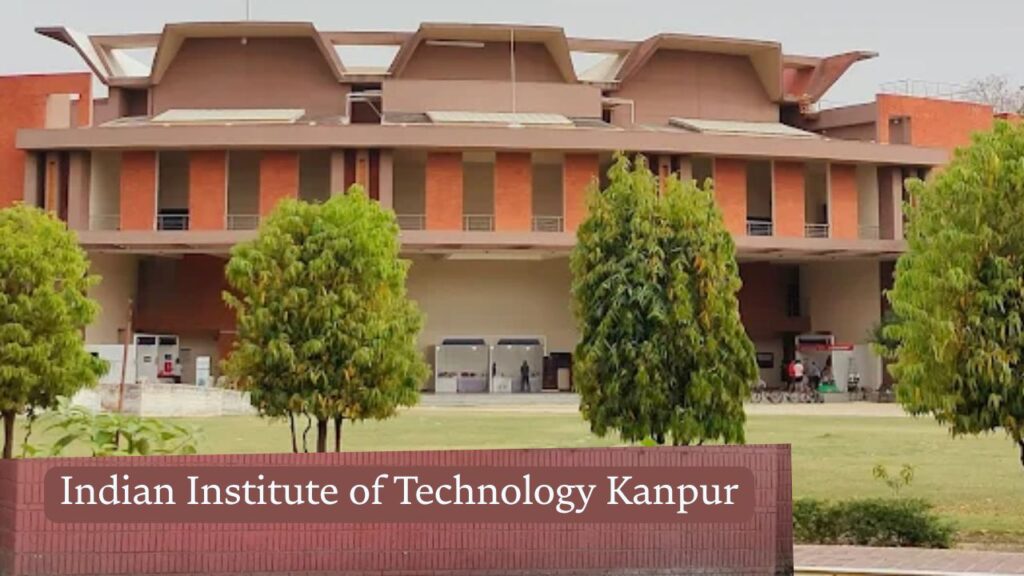
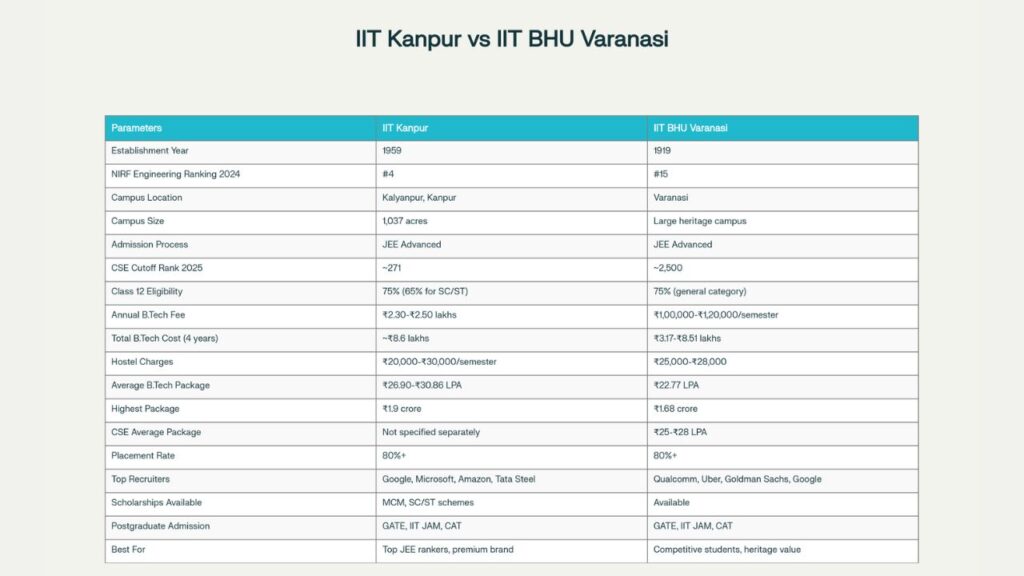
Founded in 1959, IIT Kanpur is now the best engineering school in UP. Ranked #4 in NIRF Engineering Rankings 2025, It always manages to be among the best universities making it as top engineering schools in India. The institute provides a high quality of education with its sprawling 1037-acre campus in Kalyanpur, Kanpur.
Image credit: IIT Kanpur
Admission and Eligibility
The admissions in the undergraduate B.Tech courses of IIT Kanpur are through JEE Advanced only. The cutoff for cse (computer science and engineering) for the year 2025 was 271 in very high competitions. Along with your JEE Advanced score you should have a minimum of 75% in Class 12 (65% for SC/ST categories). The institute accepts GATE scores for some of the postgraduate programmes (depending on the discipline), as well as IIT JAM and CAT scores.
Fee Structure
B.Tech fees is ₹ 2.30 – 2.50 lakhs per year, and ₹ 20,000 to ₹ 30,000 a semester for mess and hostel. So, a higher secondary B.Tech Degree will cost around Rs 8.6 lakhs, which is reasonable for quality education. Apart from these the institute has several other scholarships such as Merit-cum-Means (MCM) Scholarship, schemes for SC/ST students etc.
Career Prospects & Placements
Placement record of IIT Kanpur is known to be excellent. The average package for the B.Tech graduates is between ₹ 26.90 and ₹ 30.86 LPA while the highest package is ₹ 1.9 crore per annum. Top recruiters such as Google, Microsoft, Amazon, Tata Steel etc. ensure good options in core and tech industries.
IIT (BHU) Varanasi: The Heritage Institution
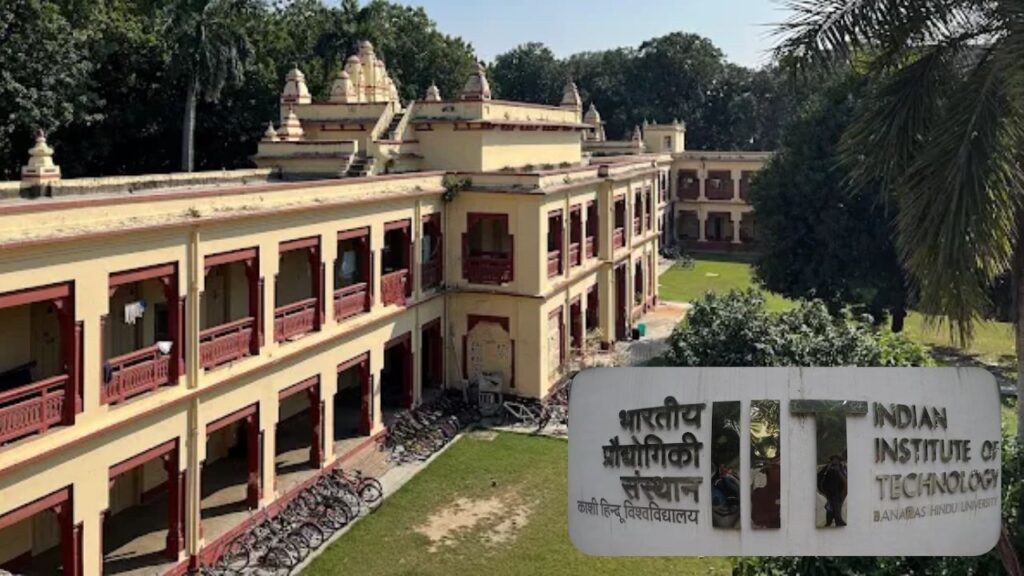
IIT (BHU) Varanasi was formed in 1919 to deliver vast education to new generations and is still doing it. Its one purpose is served well as everyone can see with their own eyes on the alumni network of IIT BHU. It is also grounded in a tradition of academic excellence spanning centuries, even now it actually tops on the edge and holds 10th position, according to NIRF Engineering Rankings 2025.
Image credit: BHU
Admissions Process & Eligibility Requirement
BHU conducts admissions through JEE Advanced as well, similar to IIT Kanpur. The closing rank for CSE in 2025 was around 2,500, however the cutoff is significantly lower. This means that if you take the JEE via BHU, you could get into a good IIT even if you don’t make a very high rank. For students of general category, minimum 75% is required in class 12 fulfilling the eligibility criteria.
BHU B.Tech Fees
Banaras Hindu University B.Tech program fees range from 3.17 L to 8.51 L for full course, whereas tuition fee is in the range of 1,00,000 to 1,20,000 per semester and hostel fee ranges between 25,000 to 28,000. With this, it rates somewhere around or even less expensive than IIT Kanpur, depending on the branch.
Career Prospects & Placements
BHU has no less amazing placement figures. The highest package is ₹1.68 crore per annum and the average package is ₹22.77 LPA. Over 80% of students were placed in 2024, and the CSE average lies within ₹25-₹28 LPA. Google, Qualcomm, Uber and Goldman Sachs are the top recruiters.
The selection is on the basis of your JEE Advanced score but both colleges are great for education. IIT Kanpur has a slightly better average package as well as branding if you fall under the top 300–400. Then, IIT (BHU) Varanasi is your best bet if your rank lies between 1,500 and 3,000. It combines legacy with excellent career outcomes. In both situations you are paying for the brightest engineering futures in India, twice.
Comparison Between IIT BHU & IIT Kanpur
The top JEE advanced students looking for a slightly better average package and brand name in a tier 2 engineering college should go with IIT Kanpur. It has a good number of students with a rank below 500, as the the #4 ranking for NIRF along with the world class facilities attracts students from all over the country.
IIT BHU Varanasi is equally competitive and is a great choice, though it does have a lower ranking (#15). Owing to a much lower cutoff rank (~2,500 as compared to ~271 for CSE), a lot more students qualify for it and yet it boasts great placement stats. The history of the institution is over 100 years and that provides some historical prestige but that many applicants doesn’t value.
Comprehensive Comparison of IIT Kanpur and IIT BHU Varanasi
Both universities provide good scholarship opportunities, have good placement and see participation from best global companies. Your decision should be based on your JEE Advanced rank, finances, and if you place more value in brand (Kanpur) or accessibility + heritage (BHU Varanasi).
Conclusion
These are the best IIT colleges in Uttar Pradesh which offer outstanding core academics, research, placements, and student life. If you are a high ranked aspirant and looking for an elite brand name with more research options and slightly higher average packages then IIT Kanpur is the clear winner.
But for hot IIT rank holders in the range of 1,500–3,000 and who want an IIT that combines tradition with bang for your bucks, a rock solid faculty and stellar placements year in and year out, IIT (BHU) Varanasi is the way to go.
Whichever institution you opt for, both pave the way to brilliant careers, worldwide prospects and a life-changing four-year experience of engineering.