Bihar BPSC APO Recruitment 2026: Eligibility, Vacancy & Apply Online

BPSC APO Recruitment 2026

If you have been eyeing a career for yourself in Bihar’s judiciary, then your wait is now over. Bihar BPSC APO Recruitment 2026 has already started Bihar Public Service Commission is inviting applications for 300 posts in the Prosecution Department. Apply Now for BPSC APO, if you are a fresh law graduate or an advocate in search for stability with government, then this may be the perfect job opportunity for you! 

Important Dates You Can’t Miss

Close Schedule for Bihar BPSC APO Recruitment 2026, So Please Mark Your Calendar Accordingly. The online submission of application was commenced on 27 February 2026 following the issuance of notification dated 25 February 2026. The essential thing was that until 20 March 2026 (date of closing of application) you can only make your application via the official site. 

Exam Schedule is important to remember by those who are applying for this application because preparation goes along the way accordingly. It’s a smart move if you consider dividing your syllabus to this timetable until 15 JULY 2026, the date of the preliminary exam. That means if you begin now, you have about four months to get ready for it. It is a tough competitive post for government exams, so every day is important, so don’t waste this head start. 

EventDate
Notification Release25/February/2026
Application Start27/February/2026
Application End20/March/2026
Prelims (Tentative)15/July/2026

Breaking Down the Bihar BPSC APO Recruitment 2026 300 Vacancies

Let’s get numerical since knowing the distribution of vacancies already gives you an idea of your competitors. The 300 posts of Bihar BPSC APO Recruitment 2026 are evenly distributed with a particular emphasis on gender representation across the categories. Here’s what the landscape looks like:

The Unreserved (UR) category is allotted the maximum number of 129 posts, out of which 41 are for women. Next is the category by EBC (Extremely Backward Class) which comes at 64 posts (22 for women), followed by the SC aspirants that can avail 42 posts (15 for women). EWS candidates can contest 29 posts (10 for women), BC candidates can challenge for 25 posts (9 for women), while ST candidates are left with 7 posts (2 for woman). There’s also a special BC Women category with 4 posts. 

CategoryPostsWomen Reserved
UR12941
EWS2910
SC4215
ST72
EBC6422
BC259
BC Women4
Total30099

What is more significant is the 35% horizontal reservation for women, which means 99 posts are specifically earmarked for women candidates. It is a big leap for equal representation of women in the prosecution services and also showcases Bihar’s stand for women empowerment in the legal profession. 

Who is Eligible For BPSC APO?

Before you get too excited about the numbers, let’s make sure you qualify. The eligibility criteria are simple – you need an LLB degree from a recognized university, and you have to be eligible to practice as an advocate. Qualified means recognized Your law degree should be recognized and valid as per the Bar Council.

Students who cross the age of 21 are eligible as of 1 August 2026. The maximum age limit varies from category to category. The relaxed age limits are indeed a boon for aspirants from reserved categories as it allows them a bit more time, a bit more space to prepare, a bit more time to mature and seamlessly enter their career.  

Read More:- BSc Emergency and Trauma Care: Get Trained to Serve in Emergencies

The Selection Marathon: Three Stages to Glory

Getting chosen as an APO is a marathon, not a sprint, with three separate phases. First is the Preliminary examination – an objective test which is qualifying in nature. Think of it as the gatekeeper, you have to pass it and go to the next step, it is not counted towards final credit.

Then begins the real fight: the Mains Examination. This essay type of test has 1000 marks and here the real merit list is prepared. Personal Interview is the last step for your personality which is for 100 marks and it’s important to have good performance in both Mains and Interview rounds to be a part of the final merit list.  

Exam Pattern for Bihar BPSC APO Recruitment 2026

The Prelims paper is a 4-hour marathon of 250 marks, split between General Studies (100 marks) and Law (150 marks). This 40:60 figure is a guide as to where to put your emphasis – although general knowledge is important, it’s your legal knowledge that will make you stand out.

The Mains exam is tougher, with 8 papers in General Studies, Hindi, English, Bharatiya Nyaya Sanhita 2023, Bharatiya Sakshya Adhiniyam 2023, Criminal and Civil Procedure, Constitutional Law and other applicable laws. Take note of the focus on recent legal changes such as the Bharatiya Nyaya Sanhita 2023 – this is not just about memorising old laws, but keeping abreast with India’s changing legal system. 

Attractive Paycheck

So, let’s get to the practicalities – the pay. The chosen applicants will be placed in Pay Level-9 with a salary of ₹53,100 to ₹1,67,800 plus allowances including Dearness Allowance (DA) and House Rent Allowance (HRA). This, in Bihar’s context, is a cushy government package that provides financial security along with professional prestige. 

How to Apply: The Digital Route

  1. The entire process of applying to Bihar BPSC APO Recruitment 2026 is online at bpsc.bihar.gov.in
  2. First of all you have to make the OTR (One Time Registration) then you can fill the main application form. 
  3. To ensure a smooth and paperless process, submit your documents via DigiLocker. 
  4. You will receive a confirmation after submitting your form and paying the application fee, save it for your reference. 

Pro tip: Don’t wait until the last week. Last-minute bugs and server crashes, are to be expected in the hot recruitments. Apply early, double check your details and keep a copy of the official notification pdf for your reference. 

Conclusion

The Bihar BPSC APO Recruitment 2026 is not just an opportunity for one to grab any of those 300 posts, but an avenue towards serving justice, making a good career, and assisting the legal system of Bihar. Last date to receive the applications is 20th March 2026, so hurry now.  Sharpen your legal acumen, brush up on current affairs and treat this examination with respect. Your path to becoming an Assistant Prosecution Officer begins with one step — a click on an official website link and Make it count! 

Leave a Comment

Your email address will not be published. Required fields are marked *

Essential Government Exams for 12th Pass Students in 2026: A Complete Guide

Essential Govt Exams for 12th Pass 2026 Guide

Post 12th Government exams are the best means to get a lucrative job in the government sector in India. Due to high salaries, job security, and lifetime benefits, these exams are dream of lakhs of students. In 2026, as we look to the future, several big recruitment cycles in Railways, SSC, Banking, Defence and Police departments are expected to be announced, which will once again pour in its biggest ever recruitment for 12th pass candidates.

Whether you are going to appear for RRB, SSC CHSL, MTS, Police or Defence services i.e. NDA or Navy, you can get complete information about Eligibility, Salary, Age Limit, Exam Pattern. If you have been looking for Govt exams for 12th pass 2026 then what you are reading is the most exhaustive 2026 roadmap for government jobs after 12th you will find online. 

Railway Exams (RRB)

RRB NTPC is one of the most popular railway recruitment to apply for jobs in Commercial Cum Ticket Clerk, Accounts Clerk Cum Typist, Junior Clerk Cum Typist etc. 

Railway Exams
Image Creadit : govupdatewala
  • 3,058 Posts are notified with the pay scale between ₹ 19,900 to ₹ 35,400. 
  • 12th pass or equivalent with 50% marks in aggregate is minimum eligibility. 
  • Selection Process: The selection will be two CBT (CBT 1 & CBT 2), typing skill test and document verification. 
  • Age Limit: 18-30 years. 

RRB Group D is one of the biggest recruitment by Indian Railways. Amidst the ongoing exams from November 2025 to January 2026, the recruitment process will extend to 2026. This exam can be appeared by both 10th and 12th pass candidates and it will be about 1 lakh of vacancy every year. Posts such as Track Maintainers, Helpers and more under Level 1 category. Salary ranges from ₹18,000 to ₹35,000, in most cases. The selection includes CBT, PET, Document Verification, Medical Examination. 

SSC (Staff Selection Commission) Exams

SSC CHSL (10+2) 2022 is conducted for the posts of LDC (lower division clerk), DEO (data entry operator). As per the 2025-26 calendar, this exam is generally held in September with the dates of the exam scheduled from 8-18 September 2025 and the following cycles continuing in 2026. The minimum qualification is 12th pass in from a recognized board. 

SSC MTS (Multi-Tasking Staff) is a non-technical post but the pay is lucrative. As per SSC schedule, notifications are usually issued in the month of June with exams in the month of September-October cycles. The pay scale is between ₹18,000 and ₹29,200 according to the post and experience. 

SSC (Staff Selection Commission) Exams
Image Creadit : govupdatewala

Recruitment for 2026 will be conducted in January-February 2026 with an expected 25,000-50,000 vacancies. The age limit is 18-23 years and the aspirants must be 12th pass. The selection procedure is Computer-Based Test (CBT), Physical Standard Test (PST), Physical Efficiency Test (PET) and Medical Test. 

SSC Stenographer (Grade C & D) is a 12th class level exam of SSC that requires good typing skills in English or Hindi. These are usually published around June-July and later in the year the exam is conducted. 

IBPS Banking Exams

IBPS RRB Clerk has Pre (Online) examinations on 06, 07, 13 & 14 December 2025 and IBPS RRB Clerk Mains 2025 on 01 February 2026. These roles generally offer pay per packages from ₹18,000 per month upwards. Age limits for the candidates is 18 to 28 years depending on the post. 

IBPS Banking Exams
Image Creadit : govupdatewala

The IBPS PO 2026 will probably follow the pattern of former cycles, the notifications to be released around August 2026, application process in August-September 2026, Preliminary Exam in October 2026, and Mains in November 2026. Applications are invited from eligible candidates to fill the posts of Electronic Engineer (EE) for this position PO requires generally a graduate degree; however, watch the notifications as for some posts the eligibility is 12th pass. 

Police & Armed Forces Recruitment

SSC Delhi Police Constable Recruitment 2020 is out @ssc.nic.in, Apply online for 7565 posts via 10+2 or equivalent. Age Limit 18-25 years. Selection Procedure is Computer Based Examination (CBE), Physical Endurance Test (PE&MT) and Document Verification. Candidates should possess a valid driving license (2-wheeler or 4-wheeler) for LMV (Motorcycle/Car). Salary Generally Salary ₹25,000-40,000 Per month. 

Recruitment for the police is state dependent The State Police in most states recruit for the position of Constable in the year 2026. The Age limit is generally between 18-25 years with relaxations for reserved categories. Education qualification is 10th/12th pass. Written Exam, Physical Efficiency Test (PET), Physical Standard Test (PST), Medical Test and Document Verification are the part of selection procedure. 

Police & Armed Forces Recruitment
Image Creadit : govupdatewala

12th Pass From a Recognized Board is Required for Indian Navy (Sailor SSR) Recruitment. Sailor jobs are the highest paying in this country to compete with salary packages. Age is usually 17.5 to 21 years. 

Indian Coast Guard Navik GD (General Duty) is for those candidates who have passed 12th with Physics and Mathematics. The age limit is 18-22 years for 260 vacancies declared for 01/2026 and 310 for 02/2026.The selection process consists of Written Exam(Stage I), Physical Fitness Test, Document Verification and Medical Examination. 

Indian Coast Guard Navik DB (Domestic Branch) is not only for the 10th pass candidates but 12th pass students can also apply. This is a little more within reach for the 12th pass candidates. 

NDA (National Defence Academy)

  • It happens two times a year, usually in April and September. 
  • The minimum age is 16.5, Candidates born between January 2, 2008, and January 1, 2011 are eligible to apply for 2026. 
  • For Air Force and Naval Wings you need to have passed 12th with Physics & Chemistry as compulsory subjects. 
  • There is no age relaxation in any category. 
  • The selection procedure consists of Written Exam( Mathematics and General Ability Test), SSB Interview and Medical Test. 

Read More 👉 SEBI Officer Grade A Recruitment 2025: Key Dates and Application Process 

2026 Government Exams Calendar

QuarterKey Exams Preparation Focus
Q4 2025 RRB Group D & Clerk Prelims/SSC GD/IBPS (on-going)Intensive prep is needed
Q1 2026 NDA/Police/NTPC/SSC GD Multiple exam focus
Q2 2026 NDA/SSC CHSL/Railway further processNDA, CHSL applications and initial preparation
Q3 2026 SSC CHSL exams/SSC MTS/Bank PO recruitmentInitial preparation
Q4 2026 Banking exams/ Stenographer exams/final recruitment cyclesFinal major exams

Strategic Preparation Tips

Choose the examinations according to your interests and strengths, do not attempt all at once. Stability and pension benefits are the other advantages of the railway jobs. It’s competitive to clear the Banking exams but the salary growth is amazing. 

  • A study planner will help you to schedule every topic for a limited time. You must focus on subjects including quantitative aptitude, reasoning, English, general awareness. 
  • Previous year question papers & Mock Test helps to understand the pattern and importance of the particular topic. 
  • Keep track of the notifications on the official website for the latest updates regarding exam date/pattern. 
Exam EligibilityAge LimitStarting SalaryHighest PaySelection Process
RRB NTPC12th Pass with 50%18–30 yrs₹19,900  ₹35,400CBT 1 & 2, Typing, DV
RRB Group D10th / 12th Pass18–33 yrs₹18,000  ₹35,000CBT, PET, DV, Medical
SSC CHSL12th Pass18–27 yrs₹25,500 ₹81,100CBT 1, CBT 2, Skill Test
SSC MTS10th / 12th Pass18–23 yrs₹18,000  ₹29,200CBT, PET, PST, Medical
SSC Stenographer C & D12th Pass + Typing18–30 yrs₹25,000  ₹81,100CBT + Skill Test
IBPS RRB Clerk12th / Graduation (varies)18–28 yrs₹18,000+Prelims + Mains
Delhi Police Constable12th Pass + Driving License18–25 yrs₹25,000 ₹40,000CBE, PET, PMT, DV
State Police Constable10th/12th Pass18–25 yrs₹20,000  ₹45,000Written + PET + Medical
Indian Navy SSR12th PCM17.5–21 yrs₹35,000₹45,000Written, PFT, Medical
Indian Coast Guard Navik GD12th with PCM18–22 yrs₹25,000₹35,000Written, PFT, DV, Medical
NDA 12th PCM 16.5–19.5 yrsStipend + Officer PayWritten + SSB + Medical

Conclusion

The preparation for government exams in the 12th standard itself is a smart move to secure a bright future. Well with thousands of job vacancies expected in 2026, Railways, SSC, Police, Defence, Banking you name it is raining vacancies, the wait is finally over and it is time for aspirants to start structured preparation. 

Pick your exam wisely based on interest and strength, uniformed services, clerical posts, railways, defence and stick with practice tests and mock exams. If you want a job that’s solid with long-term perks, this is the time to go. Begin at the right time, maintain your focus and the right opportunity will be yours. 

Leave a Comment

Your email address will not be published. Required fields are marked *

JEE Main Result 2026 – Eligibility, Syllabus, Dates, Pattern Explained

JEE Main Result

The JEE Main 2026 exam has been made the necessary academic test for Indian engineering aspirants since now for the engineering aspirants. On 16th February 2026, candidates who appeared for the exam will be able to check the JEE Main Result 2026 for January session. JEE Main is a system that requires one to be mentally strong, strategically enduring and regulation-tight  not only about ability. 

JEE Main Result the gateway exam for prestigious technical institutions in the country including the National Institutes of Technology (NITs), Indian Institutes of Information Technology (IIITs), and Centrally Funded Technical Institutes (CFTIs) the exam goes through a scale of participation that is unprecedented globally. Because it also serves as the single entrance path to the JEE Advanced, it represents a major turning point for the Indian education system. 

The information shows a strong increase in registrations with more than 1.35 million candidates for Session 1 alone. This demographic bulge requires a granular analysis of the test’s structural elements, including eligibility rules and the statistical normalization of scores. 

NTA Reforms & Administrative Changes in JEE Main 2026

In a bid to ensure the sanctity of the procedure, the NTA has brought in game changing measures:

  • Biometric Security : Now there is a “Live Photograph” taken during application that restricts impersonation.
  • Operative Changes: The test will be given on multiple dates and will require an advanced statistical “normalization” process to equate different levels of difficulty.
  • JEE Main Result Timeframes: Although administrative delays such as the Session 1 result postponement from February 12 to February 16, 2026 — do induce stress, they are vital for thorough validation of data. 

Examination Schedule and Timeline 

The NTA has adopted a two-tier system for the hour long sessions, offering candidates a tactical cushion. This enables students to view the January attempt as a baseline and the April attempt as a fine-tuning move.

The JEE Main Result 2026 Session 1 

Paper 1 (B.E. / B.Tech) was held on January 21, 22, 23, 24, and 28 over multiple days, while Paper 2 (B.Arch/Planning) was held on January 29.

The JEE Main Result delay is due to the complexity of the normalization process, it is now expected on February 16. For the NTA to be fair, it must normalize the scores within the millions of data points. 

Session 2 Dates 

EventSession 1 (January)Session 2 (April)
Application WindowConcluded1—25/Feb/ 2026
Exam Dates21–29/Jan/20262–9/Apr/2026
JEE Main Result Declaration16/Feb/202620/Apr/2026 (Expected)

Eligibility Architecture: The 75% Rule and Beyond

It is necessary to know the funnel of eligibility to avoid getting disqualified in the stage of admission process.

Age and Attempts Age: There is no upper age limit for JEE Main, however some institutions may have their own fixed limits.

The Three-Year Window: You should have passed Class 12 in 2024, 2025 or appearing in 2026.

Attempts: The exam can be attempted for three consecutive years by the candidates. 

The Performance Threshold

But the access to NITs, IIITs and CFTIs is limited by eligibility criteria that includes:

General/OBC-NCL/EWS: Minimum 75% in aggregate in class 12th.

SC/ST: 65% aggregate minimum.

Option 2: Be in the Top 20 percentile of your respective Board. 

State of Eligibility

Your ‘Home State Quota’ will be decided on the basis of the state of examination of your Class 12, not your residential status. For example, a student of Bihar coaching in Kota (Rajasthan) will come under Rajasthan Home State quota. 

Read More:- Railway RRB ALP Admit Card 2026: Download Now From Direct Link

Examination Pattern For JEE Main

AspectDetails
Exam ModeComputer-Based Test (CBT); focuses on application and speed.
Total Marks300
Duration3 Hours
SubjectsPhysics, Chemistry, Mathematics (each with two sections)
Section A20 Mandatory MCQs per subject
Section B10 Numerical Value Questions (NVQs) per subject; attempt any 5
Penalty Rule-1 negative marking for both MCQs and NVQs; precision required

Subject-Wise Syllabus Breakdown

Mathematics, Physics and Chemistry have strategic places where one must focus to improve performance:

Mathematics:  

Learn Calculus and Algebra well as they are the basics.Don’t ignore Vectors and 3D Geometry as these are very easy and carry good amount of marks in examinations.Also focus on Coordinate Geometry, Matrices and Statistics for high yield.

Physics:  

Concentrate on concepts and the use of the formulas. Modern Physics, Semiconductors = very good marks, not much calculation. Things are inevitably going to move around in your lab, so you need to be comfortable with experimental skills, especially Vernier Calipers and Error Analysis, handy points as well.

Chemistry:  

Chemistry is a very efficient subject for which you could save a lot of time and spend more time in Mathematics.  

Physical Chemistry: Be good at numericals to do well.  

Inorganic Chemistry: Be good in p-block trends;solidify your knowledge of Coordination Compounds.  

Organic Chemistry: Learn the reaction mechanisms and Biomolecules,bcoz they are very important.

Your study time can be better used and your score can be higher by focusing on these areas with the greatest yield. 

Post-Session 1 Roadmap to April

Reviewing how you did in January is the first step towards doing well in April.

  • Category A (98+ Percentile): Begin dedicating 70% of your time to JEE Advanced questions.
  • Category B (90-98 Percentile): Look for “low-hanging fruit.” Earn higher accuracy in Physics and Chemistry to enter the elite group.
  • Category C (<90 Precentile): Go back to basics. Concentrate your efforts on the most common chapters that ask questions instead of covering all the syllabus. 

The “Golden Window”

To Those Who Are Taking Boards In Feb-March The gap between the last Board exam and JEE on April 2 is crucial. Prepare Board to learn NCERT concepts which are directly used in the questions of Inorganic Chemistry and theoretical Physics. 

JoSAA & CSAB Counselling Process 2026

Admissions counselling for engineering in India is not limited to just ranking, as the Centralised Joint Seat Allocation (JoSAA) Authority in six rounds of seat allotment. Candidates may opt Freeze to accept and confirm their seat, Float to accept their seat and appear for seat updation in subsequent rounds, or Slide to retain the seat and try for an improved branch in the same institute. If there are still vacant seats after the JoSAA rounds, the procedure is continued by CSAB through special rounds which tend to be the last chance for many students with lower ranks to get an admission in a reputed NITs and other top institute. 

Conclusion

JEE Main 2026 is not just a good entrance exam—it is a good portal to sift through all the engineering institutes in the top Indian engineering colleges. Success is based on more than just knowledge: you also need to have a plan, be consistent, and make smart decisions. From understanding the exam pattern and eligibility criteria to utilising both attempts to the maximum and managing JoSAA–CSAB counselling effectively, every step will determine your outcome. Clarity, discipline, long term vision and direction in studying helped these students not only to qualify, but to open the right “doors” for their future. 

Leave a Comment

Your email address will not be published. Required fields are marked *

Bihar Vidhan Parishad PA, DEO, LDC & Steno Recruitment 2026

Bihar Vidhan Parishad

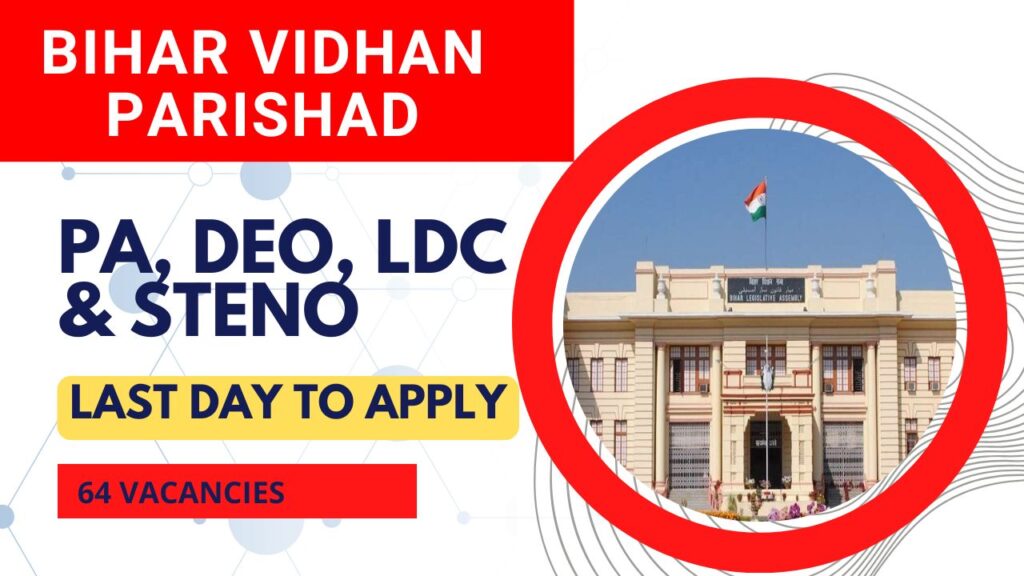
Bihar Vidhan Parishad BVP Recruitment 2025: Bihar Vidhan Parishad (BVP) under Government Of Bihar has invited BVP Recruitment application for 64 vacancies of Personal Assistant, Data Entry Operator (DEO), Lower Division Clerk (LDC), Stenographer posts. Eligible candidates can apply from 28 November 2025 to 05 January 2026. The applicant must be above 18 years of age and there is an age limit for maximum which is 42 years on 01 August 2025. For more information, candidates can visit the official website or read the notification. 

If you are an intermediate pass or graduate or a sure shot middle class, you are sure to get posts in Bihar Vidhan Parishad: the door is open for all. 

Dates, Application Fee & Short Details of Bihar Vidhan Parishad Recruitment

OrganizationBihar Vidhan Parishad
PostsPersonal Assistant, DEO, LDC & Stenographer Post
Vacancy 64
Application FeeRs. 100/
Last Date To Apply05/January/2026
Fee Payment Last Date07/January/2026
Exam DateUpdate Soon
Official WebsiteClick Here
PositionVacanciesMinimum QualificationStarting Salary of a Candidate
Personal Assistant—PA7UG Degree/Stenography 100 wpm & also Typing Speed 30 wpm₹44,900 accor. to 7th pay Level 7
Data Entry Operator—DEO35Intermediate Marksheet/133 keystrokes per minute₹25,500 accor. To the (Level 4)
Lower Division Clerk—LDC10Intermediate Marksheet/Speed should be 30 wpm₹19,900 – ₹63,200 (Level 2)
Stenographer12Graduation/Stenography 80 wpm/Typing 30 wpm₹25,500 – ₹81,100 (Level 4)

The position of DEO is undoubtedly the star of this recruitment with a staggering 35 vacancies – your chances of selection are truly bright! But don’t rule out the PA position if you have the stenographic skills, the pay is unbelievable at Level 7, it affords the best financial package of any job. 

Read More :- A Complete Guide to Cybersecurity Courses for Beginners and Career Switchers

Age Limit For Bihar Vidhan Parishad Recruitment

Minimum Age Limits

PostMinimum Age
DEO / LDC18 Years
Steno / PA21 Years

Maximum Age Limits

CategoryMaximum Age
General / EWS Male37 Years
General / EWS Female40 Years
BC / EBC (Male & Female)40 Years
SC / ST (Male & Female)42 Years

Follow These Instructions to Apply For These Posts

  1. Interested and eligible candidates may apply online for Bihar Vidhan Parishad posts on 05 January 2026.
  2. Click under the “Apply Online” tab in the Useful Links section below to redirect to the submission page.
  3. Or, Apply directly from the official website of Bihar Vidhan Parishad for the post. 
  4. Submit the application form after you finish carefully. 
Useful Links
Apply OnlineClick Here
Download NotificationClick Here
Official WebsiteClick Here

Leave a Comment

Your email address will not be published. Required fields are marked *

ITI Admission Fees in Government College: Complete Fee Structure Guide

ITI Admission Fees in Government College: Complete Fee Structure Guide Are you interested in Technical and Vocational Education Training (TVET) as a career option? A good Industrial Training Institutes(ITI) is a great way to learn a practical skill and get a job in a short span of time. How much does it really cost to join a government ITI? is probably among the most frequent questions that are buzzing in your mind if you have been looking for ITI courses. So let's get started with the full ITI Admission Fees in Government College details before jumping on the admission portal. Quick Overview of Fee Breakdown This is the fee structure in short for an Electrician course at a typical government ITI to make your career brighter. This will help you understand the budget of the two year course. Charge Amount Admission Fee –Given one time ₹100 Registration Fee –Given one time ₹50 Monthly Tuition ₹2,400 (₹100 × 24 months) Caution Money – given back later ₹250 Examination Fees ₹200 Student Welfare Funds ₹300 Total Approximate Cost ₹3,300 Note: The caution deposit is refundable on successful completion and your effective expenditure comes to approximately ₹3,050 for two years — Now that’s reasonably priced! Understanding the ITI Fee Structure The nice thing about government ITIs is that they are hilariously cheap when compared to private ones. With private ITI colleges charging fees ranging from ₹5,000 to more than ₹1,000,000 per year, fees of the government ITI colleges are affordable and it goes from ₹1,000 to ₹20,000 per year. So, students from all financial backgrounds can get quality technical education. But it's not just a single figure for the fee structure to pay and forget about it. The fees in government ITIs are divided into several heads, each of which is for a certain purpose. Knowing what all these entails will allow you to plan your finances so you don’t get a shock when it is time for admission. Tuition Fee: The Core Cost The tuition fee is the staple of your yearly outgoings. It is from ₹100 to ₹150 per month at most government ITIs in India which works out to be from ₹1,200 to ₹1,800 per year. For reference, the West Bengal government ITIs charge a total fee of ₹30 per month as a tuition fee, implying that you will be spending only ₹180 for the entire six-month course. These vary from state to state and institution to institution, so be mindful!​ The annual tuition fee for regular trainees, however, is Rs 1,800 (Rs 150 per month) at some government institutions such as the National Skill Training Institute (NSTI) in Patna. Yet if you are from SC/ST, you pay a lot less – just Rs 600 per year (Rs 50 per month). It is indicative of the government’s resolve to open the door of education to the underprivileged sections of the society. Admission Fee: One-Time Payment Consider the entry to the admission fees for the institution you are wants to apply. This is a one-time fee that you pay once you join and not every year. The admission fee is usually around ₹100 to ₹300 for most government ITIs. This is phenomenally low, and includes the cost of processing your application, verification of your documents, and the registration procedures.​ Interestingly, some institutes offer concessions to SC/ST students. For example, SC/ST students will have to pay Rs 25 instead of Rs 100 as admission fee. Registration Fee There is also a registration fee separate from the admission fee and the registration fee is usually between ₹30 to ₹200. This is for registering your enrolment with the records of the institute and getting you listed with the official registers. It’s a non-refundable fee which is paid generally at the time of verification of admission.​ Again, if you belong to SC/ST category you may get waived off from paying this fee in some institutes. Caution Money: A Security Deposit Important to understand: Caution money isn’t a fee that you are wasting. It’s a security deposit that is refunded. You pay it once (usually between ₹ 100 to ₹ 500) while admitting and you get it on successfully completing the course. This sum of money serves as a kind of insurance to keep students finishing their training and disciplined. Additional Funds and Charges In addition to the basic fees, the Govt ITI s also levies different student welfare and infrastructure enhancement funds which may be used for welfare activities of the students, for up-gradation or improvement in infrastructure. These might include: Gymkhana Fee Up to ₹100 To get along with sports and extracurricular activities Student Welfare Funds ₹50 to ₹375 Contributing to overall student development programs Placement Registration Fee Approximately ₹50 Helping the institute organize campus placements Smart Card Fund Around ₹200 For issuing digital identity cards Examination Fee At the time of examination, an institute usually levies a test fee of ₹25 to ₹100 per attempt. This includes the cost of holding exams, drafting question papers and conducting tests. Total Annual Cost For ITI Government Add all this up and see what the real number you’re looking at is. For a normal engineering trade class (say Electrician or Fitter) in a government ITI. First Year Fee is in range between ₹2,400 — ₹3,500 Subsequent Years As it vary on state, ₹1,500 to ₹2,000/year Delhi institute registration fee is Rs.200, so if you are applying there then this is the amount you have to pay at the time of verification along with the other applicable fees, which is quite nominal. Special Provisions and Exemptions For Girl Students A large number of Government ITIs provide relaxation to female trainees. Girl students are exempted from tuition fees as well as examination fees at institutes such as Patna's NSTI, rendering the course free for girls (the only exception being other compulsory deposits and fees). A few states have adopted similar policies to incentivize women to take up technical trades. For Reserved Categories There are hefty discounts for students who belong to the SC, ST, OBC or EWS category. Tuition is often waived or discounted to a token sum. In the ITIs of Odisha, the admission fees are waived for the trainees from SC, ST and women category whose family annual income is less than `2.5 lakhs, they have to pay only the caution money. For Persons with Disabilities (PwD) The government ITIs are said to extend exemptions and concessions to the special needs students, because 'they are handicapped and the financial burdens of study should be thrown off from their shoulders'. State-Wise Variations For the Fee of ITI One should note that the ITI fees vary according to states since education is a subject of state in Indian federalism. For instance, in Tamil Nadu, government ITIs charge anywhere between ₹5,000 and ₹7,000 per year, while in Himachal Pradesh, they charge between ₹6,000 and ₹8,000. With competition fees, states such as Bihar, Uttar Pradesh, and Rajasthan have the biggest network of government ITIs. Conclusion When you take into account that you are learning practical skills that are directly applicable to jobs in the public and private sectors, that is a huge amount of bang for your buck. Whether you are just finishing school and want to start your career or are planning a career change, government ITI courses provide a cost-effective, quality route to technical proficiency. The best way to get the most update on ITI Admission Fees in Government College is to go on your state’s ITI official website, check under what category you fit under for exemptions and email the best would be to the lucky one you want to attend for any questions. Your path to a rewarding career might be more affordable than you think! Meta title : ITI admission fee in government college. full fee guide 2025 Meta desc : Complete guide on ITI admission fees in government colleges: tuition, admission, exam fees, concessions for girls and reserved categories. Cost details for full 2 ​​years. Url : iti-admission-fees-in-government-college Focus Keyword : ITI Admission Fees in Government College Government ITI Fee Structure ITI Government College Fees 2025 ITI Course Fees in Government Institute ITI Fees for Girls & Reserved Category

Are you interested in Technical and Vocational Education Training (TVET) as a career option? A good Industrial Training Institutes(ITI) is a great way to learn a practical skill and get a job in a short span of time. How much does it really cost to join a government ITI? is probably among the most frequent questions that are buzzing in your mind if you have been looking for ITI courses. So let’s get started with the full ITI Admission Fees in Government College details before jumping on the admission portal.

Quick Overview of Fee Breakdown

This is the fee structure in short for an Electrician course at a typical government ITI to make your career brighter. This will help you understand the budget of the two year course.

ChargeAmount
Admission Fee –Given one time₹100
Registration Fee –Given one time₹50
Monthly Tuition ₹2,400 (₹100 × 24 months)
Caution Money – given back later₹250
Examination Fees₹200
Student Welfare Funds₹300
Total Approximate Cost₹3,300

Note: The caution deposit is refundable on successful completion and your effective expenditure comes to approximately ₹3,050 for two years — Now that’s reasonably priced! 

Understanding the ITI Fee Structure

The nice thing about government ITIs is that they are hilariously cheap when compared to private ones. With private ITI colleges charging fees ranging from ₹5,000 to more than ₹1,000,000 per year, fees of the government ITI colleges are affordable and it goes from ₹1,000 to ₹20,000 per year. So, students from all financial backgrounds can get quality technical education.

But it’s not just a single figure for the fee structure to pay and forget about it. The fees in government ITIs are divided into several heads, each of which is for a certain purpose. Knowing what all these entails will allow you to plan your finances so you don’t get a shock when it is time for admission. 

Tuition Fee: The Core Cost

The tuition fee is the staple of your yearly outgoings. It is from ₹100 to ₹150 per month at most government ITIs in India which works out to be from ₹1,200 to ₹1,800 per year. For reference, the West Bengal government ITIs charge a total fee of ₹30 per month as a tuition fee, implying that you will be spending only ₹180 for the entire six-month course. These vary from state to state and institution to institution, so be mindful!​

The annual tuition fee for regular trainees, however, is Rs 1,800 (Rs 150 per month) at some government institutions such as the National Skill Training Institute (NSTI) in Patna. Yet if you are from SC/ST, you pay a lot less – just Rs 600 per year (Rs 50 per month). It is indicative of the government’s resolve to open the door of education to the underprivileged sections of the society. 

Admission Fee: One-Time Payment

Consider the entry to the admission fees for the institution you are wants to apply. This is a one-time fee that you pay once you join and not every year. The admission fee is usually around ₹100 to ₹300 for most government ITIs. This is phenomenally low, and includes the cost of processing your application, verification of your documents, and the registration procedures.​

Interestingly, some institutes offer concessions to SC/ST students. For example, SC/ST students will have to pay Rs 25 instead of Rs 100 as admission fee. 

Read More 👉 CAT 2025 Exam Analysis: Difficulty Breakdown for VARC, DILR & QA

Registration Fee

There is also a registration fee separate from the admission fee and the registration fee is usually between ₹30 to ₹200. This is for registering your enrolment with the records of the institute and getting you listed with the official registers. It’s a non-refundable fee which is paid generally at the time of verification of admission.​

Again, if you belong to SC/ST category you may get waived off from paying this fee in some institutes.

Caution Money: A Security Deposit

Important to understand: Caution money isn’t a fee that you are wasting. It’s a security deposit that is refunded. You pay it once (usually between ₹ 100 to ₹ 500) while admitting and you get it on successfully completing the course. This sum of money serves as a kind of insurance to keep students finishing their training and disciplined.

Additional Funds and Charges

In addition to the basic fees, the Govt ITI s also levies different student welfare and infrastructure enhancement funds which may be used for welfare activities of the students, for up-gradation or improvement in infrastructure. These might include: 

Gymkhana FeeUp to ₹100To get along with sports and extracurricular activities
Student Welfare Funds₹50 to ₹375Contributing to overall student development programs
Placement Registration FeeApproximately ₹50Helping the institute organize campus placements
Smart Card FundAround ₹200For issuing digital identity cards

Examination Fee

At the time of examination, an institute usually levies a test fee of ₹25 to ₹100 per attempt. This includes the cost of holding exams, drafting question papers and conducting tests. 

Total Annual Cost For ITI Government

Add all this up and see what the real number you’re looking at is. For a normal engineering trade class (say Electrician or Fitter) in a government ITI. 

First YearFee is in range between ₹2,400 — ₹3,500
Subsequent YearsAs it vary on state, ₹1,500 to ₹2,000/year 

Delhi institute registration fee is Rs.200, so if you are applying there then this is the amount you have to pay at the time of verification along with the other applicable fees, which is quite nominal.  

Special Provisions and Exemptions

For Girl Students

A large number of Government ITIs provide relaxation to female trainees. Girl students are exempted from tuition fees as well as examination fees at institutes such as Patna’s NSTI, rendering the course free for girls (the only exception being other compulsory deposits and fees). A few states have adopted similar policies to incentivize women to take up technical trades. 

For Reserved Categories

There are hefty discounts for students who belong to the SC, ST, OBC or EWS category. Tuition is often waived or discounted to a token sum. In the ITIs of Odisha, the admission fees are waived for the trainees from SC, ST and women category whose family annual income is less than `2.5 lakhs, they have to pay only the caution money. 

For Persons with Disabilities (PwD)

The government ITIs are said to extend exemptions and concessions to the special needs students, because ‘they are handicapped and the financial burdens of study should be thrown off from their shoulders’. 

State-Wise Variations For the Fee of ITI

One should note that the ITI fees vary according to states since education is a subject of state in Indian federalism. For instance, in Tamil Nadu, government ITIs charge anywhere between ₹5,000 and ₹7,000 per year, while in Himachal Pradesh, they charge between ₹6,000 and ₹8,000. With competition fees, states such as Bihar, Uttar Pradesh, and Rajasthan have the biggest network of government ITIs. 

Conclusion

When you take into account that you are learning practical skills that are directly applicable to jobs in the public and private sectors, that is a huge amount of bang for your buck. Whether you are just finishing school and want to start your career or are planning a career change, government ITI courses provide a cost-effective, quality route to technical proficiency. 

The best way to get the most update on ITI Admission Fees in Government College is to go on your state’s ITI official website, check under what category you fit under for exemptions and email the best would be to the lucky one you want to attend for any questions. Your path to a rewarding career might be more affordable than you think! 

Leave a Comment

Your email address will not be published. Required fields are marked *

UPSSSC Lekhpal Online Form 2025: Apply Online for 7,994 Revenue Posts

UPSSSC Lekhpal Online

UPSSSC Lekhpal Online: If you are busy preparing for government exams in Uttar Pradesh, now is the time for good news. The wait for one of the most awaited recruitments is finally over! The Uttar Pradesh Subordinate Services Selection Commission (UPSSSC) has started the UPSSSC Lekhpal Online Recruitment 2025

With a whopping 7,994 vacancies, this is not just a job alert, it’s a golden chance for thousands of aspirants like you to get a high paying government job. The application link has been activated from yesterday i.e. December 29 2025, so let’s get straight to the point and have a look at what all you need to know to grab this opportunity. 

Key Dates & Details at a Glance

EventDate
Application Start Date29/December/2025
Last Date to Apply28/January/2026
Fee Payment Deadline28/January/2026
Correction Window Closes4/February/2026
Application Fee₹25 (For all categories)
Age Limit18–40 Years

Vacancy Breakdown For Lekhpal

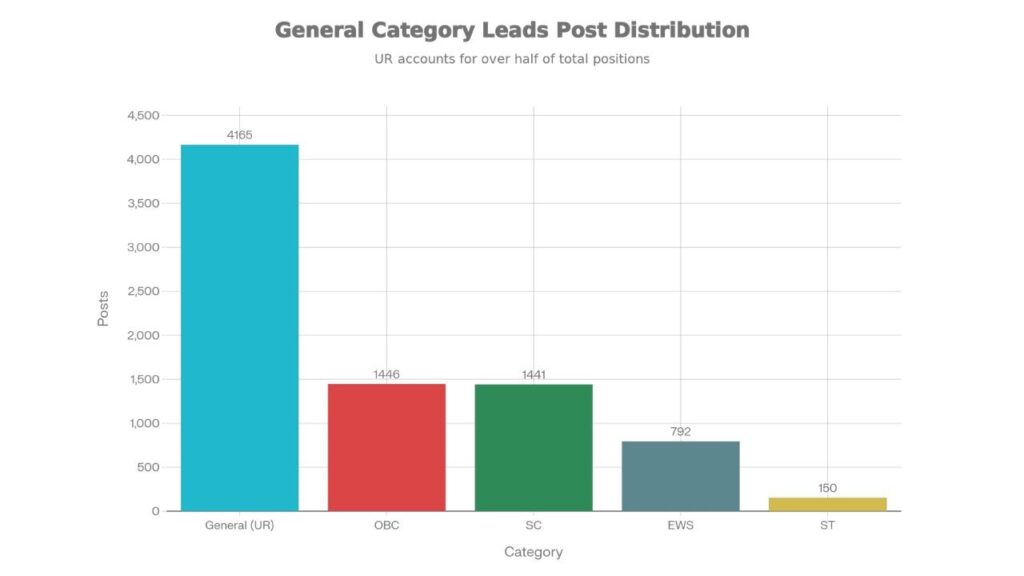
Knowing the rival is the first step. The commission has made available a clear breakdown of the 7,994 seats for various categories. Look out the chart whether you are from the General category or seeking a reservation? Here is the breakup of posts: 

Vacancy Breakdown For Lekhpal

Distribution for UPSSSC Lekhpal in a Category-wise

Firstly, the General (UR) Category is on the top with more than 4000 seats and then there is an almost equal split between OBC and SC candidates. This huge number of vacancies will make the cutoff competitive yet manageable with good preparation.  

Are You Eligible?

Before you hurry to the cyber cafe or switch on your laptop, let us confirm your eligibility. The rules are simple but hard:

Educational Qualification: The candidate should have completed 10+2 from any recognized board.

Top PET Requirement: And this is the most important part. You must hold a valid score card from UPSSSC PET 2025. The Mains exam will be short listed solely on your PET 2025 normalised score. 

Read More:- Best Courses for Business Analyst: Learn, Certify & Grow

How to Apply For UPSSSC Lekhpal Online

  1. Visit the official website of UPSSSC Lekhpal Online
  2. Click on the live notice link of Lekhpal recruitment.
  3. Sign in with your PET 2025 Registration Number. Most of your details will be auto-filled.
  4. Post your recent passport size D.O.B. & signature if not already posted.
  5. Make the application processing fee of ₹25.
  6. Apply and keep a print out of the form for future reference. 
Useful Links
Apply OnlineClick Here
Download NotificationClick Here
Official WebsiteClick Here

Leave a Comment

Your email address will not be published. Required fields are marked *

Scroll to Top