UP Special TET 2026 Admit Card Release Date & Exam Pattern

UP Special TET

UP Special TET 2026 admit card is not available yet on the online website of UPESSC. The exam city slip was released on 23 October 2026 so you can check which city your exam is going to hold but exam city slip is not the admit card. The admit card carries your name, timing, exam date, center name, personal info. 

UPESSC could probably release the UP Special TET 2026 admit card on 31 October 2026. The UP Special TET exam will be on 3 November 2026. So we can expect the admit card will be available 3 days before the exam.

UP Special TET 2026 Exam Dates

EventDate
Official notification / advertisement3 September 2026
Online application and OTR registration started5 September 2026
Last date for application, fee payment, and corrections8 October 2026
Exam city / district intimation slip24 October 2026 
Admit card download begins31 October 2026 
UP Special TET exam3 November 2026 
Result / answer keyNot announced yet

Exam-day Schedule

ShiftReporting / exam window
Shift 19:30 AM to 12:00 PM
Shift 22:30 PM to 5:00 PM

The exam shift will be available on your admit card so download your admit card from the official site when it’s available. Two shifts because the exam is divided into two papers.

Read More 👉 UP Homeguard Vacancy Notification 2026 Out: Apply Online, Vacancy Details

Exam Pattern for UP TET 2026

UP Special TET 2026 is conducted in two papers — Primary Level (Classes 1–5) and Upper Primary Level (Classes 6–8). Prepare to reach the exam center one hour before the exam timing on 3 November 2026. You are given 150 minutes to solve each paper.

Primary Level (Paper I)

SectionQuestionsMarks
Child Development and Teaching Method3030
Language I – Hindi3030
Language II – English / Urdu / Sanskrit3030
Mathematics3030
Environmental Studies3030
Total150150

Upper Primary Level (Paper II)

SectionQuestionsMarks
Child Development and Teaching Method3030
Language I – Hindi3030
Language II – English / Urdu / Sanskrit3030
Mathematics and Science or Social Studies / Social Science6060
Total150150

There is no negative marking so try to attempt every question if it’s correct you can get 1 mark. The qualifying marks are 60% (90 marks) for the general category and if you belong to reserved-category then you have to secure at least 82.5 marks (55%). So prepare well no matter which category you belong to because you still need to beat the competition. 

How to Download The UP Special TET 2026 Admit Card

  1. Visit upessc.up.gov.in.
  2. Open the UP Special TET 2026 Admit Card link.
  3. Log in using your registration/application number or mobile number and date of birth.
  4. Download and take a clear printout of the hall ticket.

Conclusion

The UP Special TET 2026 admit card is expected to be released on 31 October, just three days before the exam scheduled for 3 November. check the exam city slip to check your allotted city and try to be ready to reach there on time. check the official UPESSC website regularly because admit cards will soon be available on the website once you download it, take a clear printout, and carry it to the exam centre.

Leave a Comment

Your email address will not be published. Required fields are marked *

How to Make Money in the AI Era: Skills, Freelancing, and Career Opportunities

Make Money in the AI Era

People who are starting their career or doing a job, they want to make their own money. Wondering How to Make Money in the AI Era is harder when markets are changing rapidly and don’t know what clients would want. 

The right way to start is polishing your skills or opt for new skills, and make 2-3 sample work with proven results so you can freelance at online platforms.

Using AI for faster results isn’t the only thing you have to learn, but understand how you can use AI as a productivity tool. Clients, businesses or companies see the real outcome of your work, not just a sober portfolio. 

How to Make Money in the AI Era

Mid-sizing companies or small businesses need people who can use their mind for reliability and accountability with AI tools to get the job done faster and because owners don’t have the time or patience to learn. Clients pay for judgment, accuracy, reliability and someone who understands their business not for the AI tools.

  1. Pick one service, not ten ideas.
  2. Learn one AI workflow deeply.
  3. Make three portfolio samples before asking anyone to pay.
  4. Find 20 potential clients.
  5. Offer a small paid pilot.

For example: Instead of offering every type of editing service, position yourself to make AI generated videos of the story. Practice one AI workflow to create visuals and moments, no more pauses, captions, voiceovers, and speed up your editing. Create three portfolio samples before approaching clients which shows your ability to create short series that tell a story, without any errors.

Check your client’s videos and make two videos for free if they like your work then you could offer two edited episodes for $150-200. If they like the way you work, take a chance to discuss monthly packages and remember your goal to sell your editing skills, storytelling, smooth transitions, ability to deliver on time.

Read Also 👉   Microsoft Offers Buyouts to 60,000 Employees as AI Spending Surges

How Market Is Changing Career Opportunities

Path What you do Who it suits Income potential
AI-assisted freelancing Writing, editing, design, video editing, social media, research, resumes, translations Beginners with communication or creative skills Side income first; grows with clients 
Automation services Set up chatbots, lead follow-up, CRM updates, invoice/data workflows for local businesses Organized people; basic no-code tools help Higher-value service work 
Content and audience YouTube, courses, newsletters, niche websites, digital products People willing to publish consistently Slow start; can become scalable 
AI training/data work Label data, test AI answers, rate outputs, review quality Entry-level, non-coders Usually modest but accessible
Technical AI roles AI engineer, data scientist, ML engineer, AI product manager People who can learn coding/math or already have tech background Strong full-time salaries
Micro-SaaS / AI products Build a small tool solving one narrow problem Builders, developers, no-code creators High upside, high risk

There Are Two Broad Job Markets That Are Growing Rapidly in 2026

AI-Adjacent Jobs: Roles That Now Expect AI-Tool Fluency

People think learning AI means machine learning or Data science but now everything changes. Whether you are in marketing or sales or content creation, AI powered software makes things easier to work with. You can put your imagination into the words and it works as a collaborator to help you with that idea. How to Make Money in the AI Era across all these fields is knowing AI prompting, cross-check its data, and criticizing what you look inappropriate.

AI-Specialist Jobs: Technical Roles Behind the Tools

Data annotation, software automation, product management, data science are high technical positions that require AI-specialist roles that go far beyond using basic prompts. You must be able to actually build, test, and manage machine intelligence. If that’s what you do then you can figure out How to Make Money in the AI Era.

Most of the professionals say working with AI is as much about strategic problem-solving as it is about writing code. How to deploy and handle complex engineering comes under professionals who know programming and cloud infrastructure.

Read Also👉  How to Future Proof Your Career in the Age of Artificial Intelligence 

Conclusion

How to Make Money in the AI Era is a little confusing because work responsibilities are changing and you have to acquire new skills to work in the company or freelance. 

Clients don’t ask to make a video for their brand, they ask you to increase the potential of their business through video. If you know how to do that, you can sell your services by placing a strong portfolio, and start approaching potential clients.

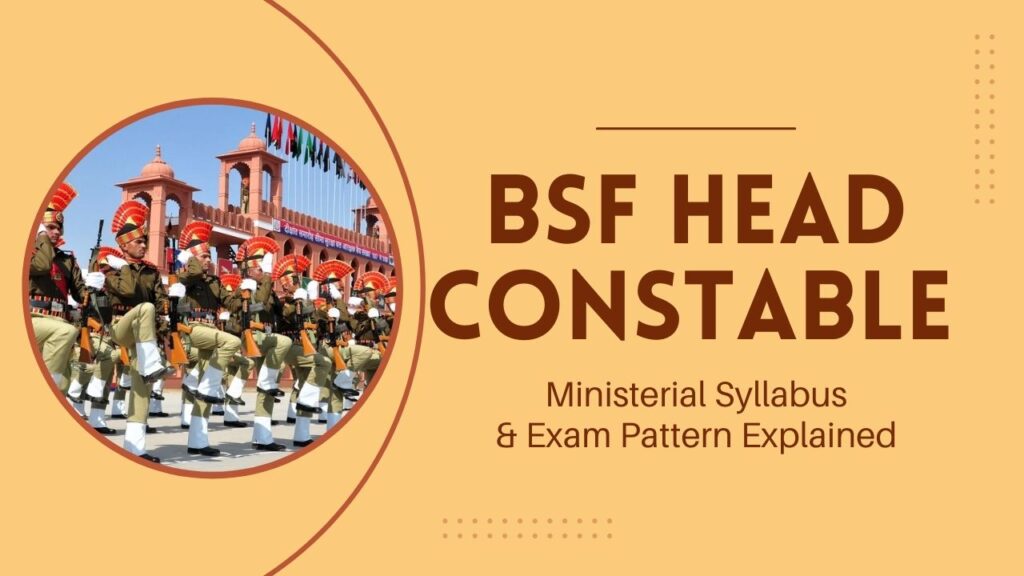
BSF HCM Syllabus 2026 & Exam Pattern Explained

BSF HCM Syllabus

So, you are eyeing the BSF HCM Syllabus. Specifically, you wanted the Head Constable (Ministerial) vacancy for the year 2026. That’s a spectacular aim. It’s a position that brings stability, a little dignity and an opportunity to serve your country from inside the institution that actually defends its borders.

But let’s be honest for a second — Taking this exam cold is like patrolling the desert in flip-flops. You’ll make some headway but it’s gonna be painful and probably futile. The syllabus is broad and the competitive is cut-throat. You have to begin early if you want to keep ahead of things, and you are going to need to know just what you are getting into. 

Your one stop destination to know what Expected BSF Head Constable Ministerial Syllabus Exam Pattern. Let’s look into this guide to be aware of what’s coming next.

Understanding The Selection Process

Before we discuss the books and formulas, we need to see the framework. While the official notification for 2026 is yet to become available (at present), the BSF maintains a relatively stable pattern. Knowing “Stages” is important because this isn’t just a pen-and-paper exam; it’s an assessment of your entire being.

For the 2026 cycle, the selection procedure is anticipated to broadly comprise five phases:

  1. The Written Exam (The Big Filter): It’s the gatekeeper. Score well here, and you move forward.
  2. Physical Standard Test (PST) & Physical Efficiency Test (PET): You are enlisting a uniformed service so there is no doubt about importance of fitness.
  3. Typing Speed Test: As this is a “Ministerial” position, clerical skills are important.
  4. Verification of Documents : To verify whether your certificates are as per with your claims.
  5. Medical Examination: To make sure you are physically capable of serving.

We’re going to be heavily focusing on that first phase—the Written Exam because that’s where 80% of the battle is won or lost. 

Phase 1: The Written Exam Pattern

ParameterDetails
Exam FormatObjective Multiple Choice (OMR-based)
Total Questions100
Total Marks100
Duration2 Hours (120 Minutes)
Question TypeObjective Type (MCQs)
Negative MarkingYes, 0.25 marks per wrong answer

Subject-wise Distribution:

SubjectMarks Allocated
General Intelligence & Reasoning25
General Awareness & GK25
Numeric 25
English/Language Comprehension25

What You Actually Need to Study

BSF HCM Syllabus

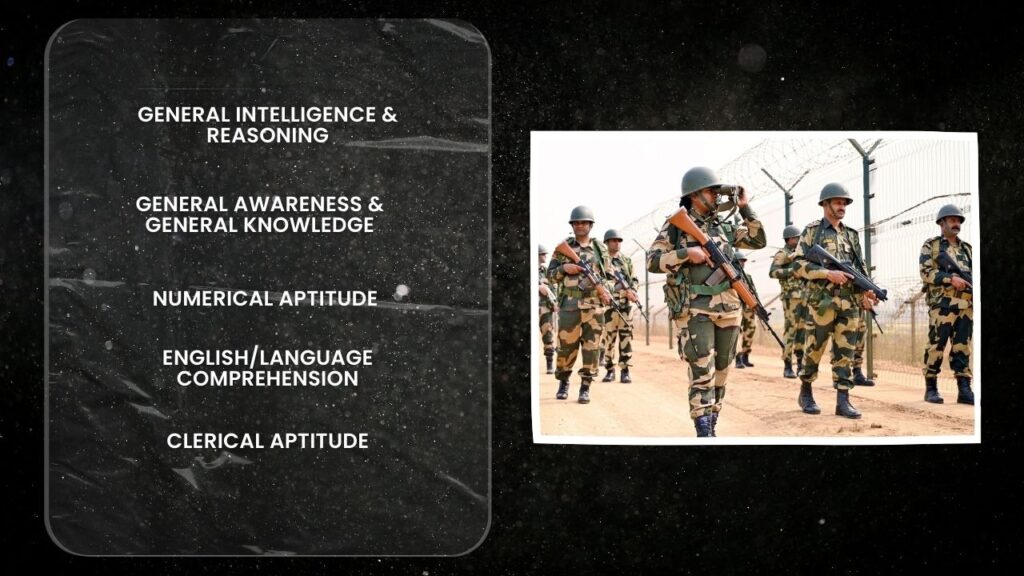
1. General Intelligence & Reasoning (25 Marks)

  • Analogy : To recognize relationships among words (e.g. Doctor, Hospital, Teacher).
  • Decoding Coding: The traditional sleuthing. 
  • Series Completion: In this, a certain pattern of numbers and alphabets is given. Find the missing link. 
  • Blood Relations: These are tangled family trees. If A is B’s brother’s mother’s sister…
  • Direction Sense: If you make a left turn, walk five kilometres, then take a right.
  • Venn Diagrams: representing Group Intersections. 

2. General Awareness & GK (25 Marks)

This part divides the normal aspirants and the obsessed aspirants.

  • Current Affairs : Open the newspaper every day (without fail). Concentrate on national news, sports, awards, and books.
  • Indian History: Freedom movement is a favourite topic. Be familiar with the Gandhian era, the 1857 Revolt, and significant milestones.
  • Geography: Emphasize on Indian geography like rivers, mountains, states and their capitals. The geography of the world is often restricted to a few key aspects.
  • Indian Polity: The Constitution. Rights, Duties and Parliamentary Procedure.
  • General Science. Normal Physics + Chemistry + Biology ( till 10 grade). Do not skip this portion; high yield and simpler than engineering science. 

3. Numerical Aptitude (25 Marks)

You don’t have to be a mathematician but you do have to be quick with numbers.

  • Number Systems: LCM, HCF, Whole Numbers.
  • Simplification: BODMAS rule.
  • Percentages & Profit/Loss 
  • Ratio & Proportion: Add things in the right amount.
  • Time and Work : If A can paint a house in 5 days and B can paint it in 10… then what is the combined time?
  • Time, Speed, and Distance: Trains and Platforms. 

4. English/Language Comprehension (25 Marks)

As the role is ‘Ministerial’, your proficiency in using official language is assessed.

  • Grammar: Spot the errors in a sentence, find tenses of the to complete the sentences. 
  • Vocabulary: Find every given word synonyms, antonyms and idioms.
  • Comprehension: You are provided a passage to which you would have to pose questions. 
  • One Word Substitution: One word is said for something complicated. 

5. Clerical Aptitude 

This is specific to this job. It determines if you have the personality for working in an office.

  • Detail Orientation: Identifies mistakes in addresses, numbers.
  • Routines in a Basic Office: Knowledge of filing, indexing, and verifying data consistency. 

Read More 👉 IAS Preparation Roadmap: Step-by-Step UPSC Strategy That Actually Works

Phase 2: The Skill Test (Typing)

After you clear the written test, you have to appear for the Typing Test. It has stood the best practical test for 2026 cycle.

  • English Typing: 35 words per minute (wpm) is usual.
  • Hindi Typing: 30 words per minute is usual.

Please Don’t Ignore This: So many brilliant students do not make it here because they only concentrated on the written exam. If you can’t type, you can’t do the job. Get started with your practice on Typing Master or any other typing software. Build muscle memory. Speed comes with accuracy, so concentrate first on hitting the right keys and later on going fast. 

Phase 3: Physical Standards (PST/PET)

They have to meet the various physical criteria, such as for males and females a minimum height of approximately 167.5 cm and 157 cm respectively, subject to relaxations for certain categories. 

Male applicants are subject to chest measurements of 78 cm unexpanded and 83 cm expanded. There is also a physical efficiency test, generally a 1.6 km run which must be completed within a stipulated time (e.g.6.5 minutes for males). 

Strategy for the 2026 Cycle

BSF Head Constable Ministerial Syllabus

Since this is the 2026 paper, you have time after all. Most candidates are underprepared, starting too late, just 3 or 4 months prior to the exam. 

1.The Foundation Period (Months 1-3):

Not so fast in the mock tests. NCERTs (read class 6 to 10) for Science and History. Solidify your grammar base. Clear your concepts of reasoning.

2.The Practice Phase (Months 4-6):

Start solving previous year papers. Not for the score, but to see what the BSF questions look like “trending” Are they give me more on current affairs? Is the math getting harder? Adapt accordingly.

3.The Mock Test Phase (Last 3 months):

Simulate the exam environment. Sit at a table, put your phone away and finish a 100-question test in 2 hours. Analyze each mistake and prepare for the last one. 

Conclusion

Becoming a BSF HCM Syllabus 2026 is a long journey. There will be days when you get the feeling that you are not holding on to anything but don’t lose hope.

Keep Consistent to fulfil your dream. Even studying a bare minimum of 4 hours a day but doing so everyday without fail would be enough to beat 90% of the competition who study sporadically.

Keep the syllabus handy, follow the pattern and have the eyes on the prize. That uniform isn’t just fabric, it’s a responsibility. And it’s waiting for you. 

BBA in Artificial Intelligence: Course Details, Admission, Fees and Career Scope

BBA in Artificial Intelligence

Changes in the world are happening so fast, and artificial intelligence is at the center of them all. If you are a Class 12 student considering your future course of study, the Bachelor of Business Administration in Artificial Intelligence (BBA in AI) is more than just a degree—it’s your chance to shape the future while earning a stable career in one of the most in-demand areas today. This programme stands for an exceptional blend of business management and state of the art AI technology that is transforming the business operations around the world.

Why BBA in AI Matters More Than Ever

You may have heard the term “artificial intelligence” (AI) thrown around a lot, but what does that actually mean for your job? AI isn’t some far-off science fiction concept anymore, it’s baked into the apps you use every day, from Netflix recommendations to banking fraud alerts. Businesses in every sector — healthcare, finance, manufacturing, e-commerce — are scrambling to adopt AI in their operations. That means there is a great opportunity for graduates with knowledge of business strategy and AI technologies. 

Instead of traditional BBA programs that just teach the basics of business or engineering degrees that focus only on technical skills, a BBA in AI is really both. You study business principles such as management, finance, and marketing as well as machine learning, data analytics, and applications of AI. With this cross-domain training, you have an extremely strong value proposition to potential employers as you can convert AI technicalities to business use cases and create meaningful innovation. 

Understanding the SET 2026 Pathway

If you want to pursue the BBA in AI through SET 2026, then here’s what you need to know. The Symbiosis Entrance Exam (SET) is your pathway to Symbiosis Artificial Intelligence Institute (SAII), IILM, IIMT, & many more. SET 2026 Exam will be held on 2nd May and 10th May 2026. There are approximately 760 seats in total through the SET at the Symbiosis institutes, which is a very competitive but rewarding process of selection. The application form from these universities is expected to be released From December 2025 to March 2026 for admission. ​

You should have passed Class 12 with at least 50% aggregate marks (45% for SC/ST students) to be eligible. The good news is that you can also apply if you have not got your Class 12 result, but will need to upload your certificate of passing later. The SET exam itself is simple – it’s a one-hour online test with multiple-choice questions (MCQs) in English and there’s no negative marking. 

The syllabus includes the following: General English, Logical Reasoning, Quantitative Skills, and General Awareness. The application fee is INR 2,250, and the test is held in over 80 cities across the country, so you have no excuse for not knowing where you can take it. 

Read More :- CTET Exam Date 2026: Notification, Exam Schedule, Application Dates and Complete Details

BBA in AI Curriculum

The SAII BBA in AI program curriculum is well planned as per the NEP 2020 directives and it provides an exit policy which is flexible. This means you can earn qualifications progressively — a Certificate after Year 1, a Diploma after Year 2, or proceed to complete your full Bachelor’s degree after Year 3, with an option for Honours or Honours with Research in Year 4.​

This isn’t just a matter of learning about theoretical concepts. Practicing real industry issues in project-based courses, obtaining hands-on experience in AI-specialized laboratories and studio spaces, receiving industry mentoring, and doing internships that connect the theory studied in classrooms and application in real industry.

Students can use the core curriculum to learn the basics of AI, machine learning, statistics and programming alongside more traditional business course topics. You will also study a number of specialist modules tailored to your individual interests, whether you want to work in healthcare technology, financial services, marketing analytics, or in the creative industries. 

Career Opportunities After BBA in AI

BBA in AI pass outs are earning good salaries and have excellent career options. New graduates usually receive packages ranging from 6 to 10 LPA followed by huge pay hikes as they gain experience and specialization. AI/ML Researchers or Data Scientists at mid-level earn ₹7-14 LPA, and a senior AI/ML Architect commands ₹10-20 LPA or more.​

The career options are extremely varied. I can imagine it as being either AI Business Analyst – making the data-driven business decisions for a company. You could be a Product Manager for AI platforms and guide the building of new solutions. 

Digital Strategy Consultants With AI Credentials Are Especially Needed as Organizations Seek to Transform Digitally. Data Science to Business Strategy Business Intelligence Experts While there are numerous talented experts in business intelligence, few possess a robust knowledge of both data science and business strategy, making their services highly sought after in today’s economy. 

More than 74% of Indian employers are expected to recruit freshers for AI jobs in 2025, witnessing a 22% year-on-year growth in fresher opportunities. Top companies including Amazon Web Services (AWS), Microsoft, Google Cloud, Meta, IBM, Infosys, TCS, HCLTech and Tech Mahindra are aggressively hiring freshers with skills in AI and business. Even startups and fintech firms are engaged in a bidding war for talent, paying lip smacking packages and offering work on bleeding edge projects. 

The Skills You’ll Need

For this profession you need communication and technical skills. Technical background is having knowledge in programming languages, mainly python, the standard of the industry for AI and ML. You also have to be well versed in math, statistics, and data science. As a part of your toolkit, you will have to understand machine learning algorithms, deep learning methodologies and frameworks such as TensorFlow and PyTorch.

But it’s not all code and algorithms. You’ll also need to be a critical thinker, a problem solver, and an effective communicator — because at the end of the day you’ll be explaining some pretty complex AI concepts to non-technical stakeholders in business environments. Creativity and an open mind are critical since you will have to solve new problems that may not have textbook answers. 

Fees and Financial Considerations

Cost transparency is important. BBA in AI from top Symbiosis institutes are between ₹1 lakh to 3 lakhs per annum but it depends on your chosen institute and mode of delivery. The range of total fees for 3 years for top institutions is around ₹ 3 lakhs and ₹ 9 lakhs but it varies from one institute to another. There are a few cheaper BBA programs through online or distance mode, where the entire program costs between ₹1.5 and ₹1.68 lakhs.​

So important to add that most schools do provide scholarships/financial aid in some way for need or merit – so don’t let fees be the only thing that stops you from applying if this is your passion. 

There are a number of colleges in India that provide BBA in Artificial Intelligence (AI)/ BBA in Data Analytics or BBA in Machine Learning, as per the demand in emerging field of business over the technology. Important information regarding fees, admission procedure, and recognitions including accreditations for particular colleges are mentioned in the following paragraphs, which are curated from authentic sources. 

CollegeProgram NameTotal Fees (INR)Admission ProcessRecognition
IIMT University, MeerutBBA in Data Analytics & AI (3 years)2.25 Lakh ​10+2 merit, assessment test, PI, CUET UG accepted, ₹2,000 application fee ​UGC approved, NAAC A Grade ​
IILM University— GurgaonBBA (Hons.) for 4 years with AI13.60 Lakh ​Eligibility-based (10+2), specific process via official site ​Private university (UGC implied) ​
Jagannath University—-NCRBBA in Artificial Intelligence in Business 1.50 Lakh (₹37,500/semester x 4) ​10+2 with 50%, merit/JUEE entrance + PI; ₹500 application fee ​Private university ​
LPU—- (Lovely Professional University)BBA in AI & ML3.00-7.20 Lakh (₹1-2.4 Lakh/year) ​10+2 with 45-60%; LPUNEST/CUET ​UGC recognized, high rankings ​
Graphic Era University— DehradunBBA in AI & Data Science (3 years)5.04-5.27 Lakh ​Online application (₹1,500 fee); 10+2 eligibility ​NAAC A+ Grade, UGC

Note that fees are the estimated total tuition fees (excluding one-time fees such as registration fee), and are subject to change, please check with the official website.

Conclusion

Selecting a BBA in AI with SET 2026 is opting for an opportunity laden future. The blend of business and technology results in graduates who are in high demand in today’s market place. You’re not just earning a degree — you’re staking your claim at the convergence of two powerful currents: strategic business thought and transformative technology.

Generic graduates are not what the world needs—it needs industry-ready professionals who can leverage AI to solve business problems, bring innovations, and deliver business value. If you’re inquisitive, analytical, enjoy problem solving, and want to make a difference with a rewarding career, BBA in AI through SET 2026 may just be what you are seeking. Begin to prepare for SET today, and the future of business and technology. 

Why ChatGPT Ads Deserve a Place In Your 2027 Media Plan 

ChatGPT Ads

ChatGPT is becoming another advertising platform for brands and businesses. In 2026, OpenAI opened self-serve access to its Ads Manager in India. But ChatGPT Ads doesn’t work like Google Search, PPC managers should understand before shifting a Google Ads/Paid Search budget to ChatGPT Ads. 

Before asking — why ChatGPT Ads deserve a place in your 2027 media plan? Decide whether you want visibility or conversion from the ads. The answer is not that simple because considering the fact that every business has different approaches and methods to connect with their customers.

But advertisers don’t receive a conversation history or chats, ChatGPT only discloses target, context hints, and intent. Context Hints also don’t work like traditional exact-match keywords. So let’s look into how it’s gonna work and why it’s better than Google search in most cases.

The Channel Is No Longer Experimental

OpenAI began testing ads for logged-in adult users on the Free and ChatGPT Go tiers in the US on February 9, 2026. Three months later, on May 5, it opened a self-serve Ads Manager to any US business, with no minimum spend requirement. By July, the platform had added a formal “Advertise in ChatGPT” hub with case studies from Best Buy, Lowe’s, and VistaPrint. 

By August, OpenAI said the ad business had crossed a $1 billion annualized revenue run rate in under 200 days, and international expansion was already underway — the UK, Mexico, Brazil, Japan, and South Korea by mid-August, with India, Europe, and parts of the Middle East and North Africa following in September.

ChatGPT is becoming a channel with a self-serve buying platform, agency integrations from Dentsu, Omnicom, Publicis, and WPP, and ad-tech partners like Adobe, Criteo, Kargo, and StackAdapt already plugged in. 

What ChatGPT Ads Look Like Inside a Conversation

When a user asks a question, and OpenAI’s system judges a sponsored result relevant, a small card appears below the AI’s answer — never inside it. The card carries a business name, a site icon, a headline, a short description, one square image, and a link out. It’s labelled “Sponsored” and visually separated from the response.

OpenAI has been consistent that the ad doesn’t touch what ChatGPT actually tells the user. Responses and ChatGPT ads from two separate systems.


Targeting doesn’t work the way Google Search advertisers are used to. There’s no exact-match keyword bidding. Instead, advertisers submit “context hints” — short descriptions of the topics, situations, or product categories where their ad might be relevant.

Then OpenAI matches those against the general subject of the conversation, not the user’s chat history or personal data. Advertisers never receive individual conversations, memories, or personally identifiable details. 

What they get back is aggregate performance data: impressions, clicks, spend, cost-per-click.

ChatGPT Ads Charges For a Campaign

ChatGPT ads launched in February at a fixed $60 CPM with a $200,000 minimum commitment — enterprise-only pricing designed to test with brands that could absorb the risk. By April, the minimum had dropped to $50,000 and a CPC pilot was alive. By May 5, both the minimum spend and the fixed pricing were gone entirely, replaced by a relevance-weighted, second-price auction with a $25 minimum daily budget.

As of mid-to-late 2026, CPM campaigns (bought under a Reach objective) run roughly $25 to $60, with real clearing prices often landing in the $25–$45 range as inventory has scaled. CPC campaigns (bought under a Clicks objective) start around $3 to $5 for most ecommerce and consumer categories, climbing to $8–$18 for competitive verticals like software and finance. 

For context, that CPC range sits close to Google Search’s reported Q1 2026 average of $2.96 across industries, but ChatGPT’s conversion rates have been reported in a wider and generally lower band — roughly 0.2% to 5.8%, compared to Google’s cross-industry figure near 8.18%. 

This is priced as premium, high-intent inventory, not as a cheap alternative to your existing channels. You’re not buying volume at a discount. You’re buying attention at a moment when someone is actively working through a decision.

Read More 👉 How AI Could Change India’s Digital Public Infrastructure

Why ChatGPT Ads Deserve a Place In Your 2027 Media Plan

Every performance channel has a window where being early is genuinely worth something, before the auction gets crowded and costs catch up to the value. Google Search had it in the early 2000s. Facebook had it around 2012. TikTok had it a few years ago. ChatGPT Ads is having that moment right now, and a handful of forces are converging to make 2027 the year it stops being optional for competitive categories.

First, the volume is already enormous. ChatGPT is processing billions of prompts a day, and a meaningful share of those are research and decision-making conversations — the exact moment advertisers spend fortunes trying to reach through search and comparison sites. Early advertisers are already seeing it translate into real traffic; Target, for instance, reported 40% month-over-month traffic growth from ChatGPT to its site during the early rollout.


Second, the competitive set is still thin. Ads are only reaching roughly half of eligible responses in the US as of mid-2026, and most advertisers in any given category simply haven’t shown up yet. That’s exactly the kind of gap that closes as more media buyers catch on — and once it closes, the “relevance discount” early movers are currently enjoying narrows. If you’re waiting for the safety of a crowded, well-benchmarked auction before you test, you’re also waiting until the cheap inventory is gone.

Third, the platform’s own roadmap points toward this becoming a full-fledged performance channel rather than a novelty placement. Conversion tracking (a Conversions API and pixel launched May 5), automated bidding, and conversion-based optimization have all landed within a matter of months. That’s the same maturity curve Google Ads and Meta Ads went through, just compressed into a fraction of the time.

Fourth, international expansion changes the calculus for any brand running global campaigns. What started as a US-only test in February had reached the UK, Mexico, Brazil, Japan, and South Korea by August, with India, parts of Europe, and the Middle East and North Africa opening up in September. A 2027 media plan built only around US inventory would already be behind where the platform is heading.

Do You Really Need to Run Campaign on OpenAI

None of this means ChatGPT Ads should replace anything in your current mix. It’s a complement, and a fairly specific one. 

ChatGPT ads strongest for categories where people genuinely research before buying — consumer electronics, home improvement, travel, financial products, higher education, software — because those are exactly the kinds of extended, multi-turn conversations the ad matching is built around. 

It’s a poor fit for anything in the excluded categories (health, politics, mental health), and it’s not yet the place to chase raw reach or awareness at the lowest possible cost, given the CPM sits above social platforms like Meta and closer to LinkedIn’s premium tier.

It’s also not a channel to fund with your test budget’s leftovers. Given the measurement is still aggregated rather than granular, and given automated bidding tools only perform well once there’s a real conversion history to learn from, this works best as a deliberate, funded pilot — enough spend to get past the “five conversions” threshold the platform’s own bidding tools need to function well, run for long enough to see a real trend rather than a single lucky week.

Question Worth Asking Before Shifting Your Marketing Budget

Before you set a number next to “ChatGPT Ads” in the 2027 budget, ask yourself – 

Does your brand already show up when someone asks ChatGPT an open-ended question in your category — with no ad involved? 

Because the sponsored card sits underneath the organic answer, and premium subscribers never see ads at all, meaning the only version of your brand a large and growing share of ChatGPT users will ever encounter is whatever the model says about you unprompted. 

If that organic answer already favors you, every paid dollar on top of it works harder. If it doesn’t, the ad budget is arguably the second problem to solve, not the first.


Your Business Needs a Brand Awareness Or Conversions? 

Brand awareness means getting in front of someone while they’re still researching, before they’ve decided what they want. 

Conversions means catching someone who already knows what they want and getting them to buy or fill out a form. 

Decide which one you’re paying for first, because the budget, the creative, and the way you judge success all flow from that one decision. 

How Ads Target a ChatGPT User?

When someone searches on Google “Best AI Agents for E-Commerce” will get the exact result. ChatGPT works in a different way. Due to the user’s chat privacy, Advertisers don’t get the exact keyword of the search, they are working on a context hint.

ChatGPT itself may understand what a user wants with far more nuance than a Google search does, but as the advertiser, you don’t get that same visibility. You’re targeting in the dark relative to what you’re used to on Search Engine. 

That gap should shape how much you’re willing to spend before you’ve proven the targeting actually reaches the right people.

Shifting From One Running Campaign Budget to Another Platform Is a Risk Marketer Shouldn’t Consider

Shifting a budget from a running campaign on Google Ads to ChapGPT is riskier if you get leads from the first platform already. So why consider ChatGPT ads? Platforms where you didn’t accomplish from the ads, replace that budget into ChatGPT ads. Pull smaller amounts from a few underperforming campaigns or channels instead, so a disappointing ChatGPT Ads result doesn’t cost you revenue you were already counting on.

Conclusion

ChatGPT Ads went from a $200,000-minimum enterprise pilot to an open, self-serve, globally expanding ad platform with automated bidding and conversion tracking in under seven months. That kind of speed doesn’t happen unless there’s real advertiser demand behind it, and real demand tends to mean real results. 

Google is often about: “I searched for something → show me relevant results/ads.”

ChatGPT can involve: “I’m researching something → I’m having a conversation → I’m comparing options → I’m trying to make a decision.”

Because ChatGPT Ads are still relatively new, marketers don’t have the same amount of historical data they have with Google Ads.

The auction is still relatively uncrowded, the CPCs are competitive with established search and social benchmarks, and the platform is adding exactly the tools — conversion optimization, expanded geography, agency integrations that turn a novelty placement into a durable channel.

Meet the Best Current Affairs Teacher for SSC CGL Who Can Boost Your Score

For the students preparing for the SSC CGL exam, the Current Affair section is important to cover up. Many students think that it is an easy section and it will get your score with a little preparation and strategy. These Best Current Affairs Teachers for SSC CGL will help you make every update remember their context. 

They’re not only helping you in keeping updated but they also gave you SSC CGL relevant current events which can come in the exam. Check news daily, read newspaper or e-news, follow social media news channels, read magazines and make revision for each topic.

Previous year papers might be not helpful so try mock quizzes and practice questions daily. These teachers have also shared a lot of MCQs, you can try and improve your speed and accuracy.

You better be consistent through your preparation, otherwise it won’t be helpful if you forgot everything you learn.

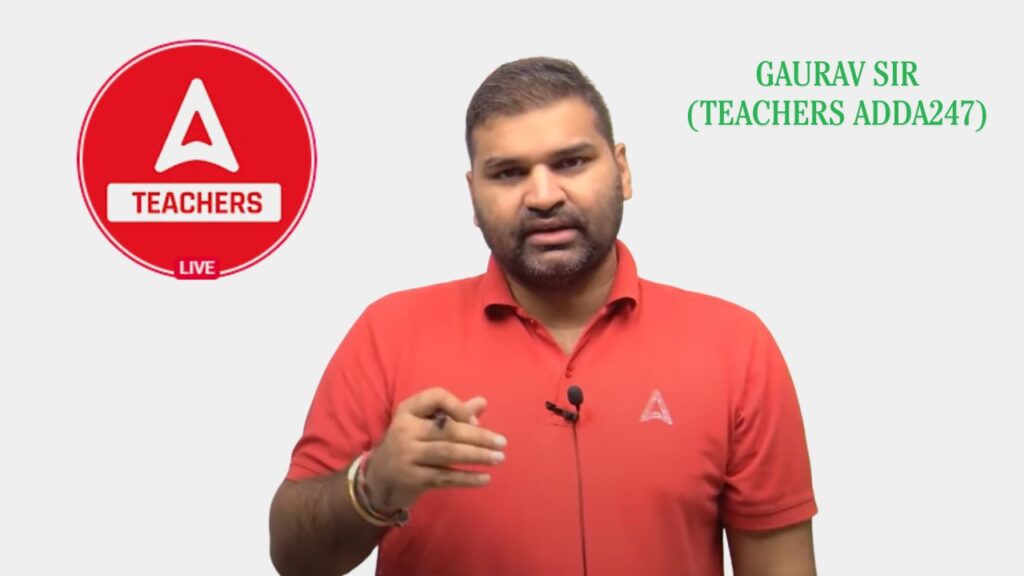
Gaurav Sir (Adda247)

Gaurav Sir (Adda247) best current affairs teacher for SSC CGL preparation

Gaurav Sir is known for his ability of connecting current events to static GK which help students to memorize everything. He encouraged a comprehensive understanding of current events rather than just rote memorization. His engaging and interactive teaching style involves deep explanations and real-life examples to elaborate concepts that help understanding complex topics easily.

Ideal for those students who want to understand the “why” behind the news. Gaurav Sir will help you to understand every topic beyond the headline. He is teaching serious topics in a friendly way that will be remembered by every student with a deep understanding of context. He also provides revision classes to keep tracking the previous sessions.

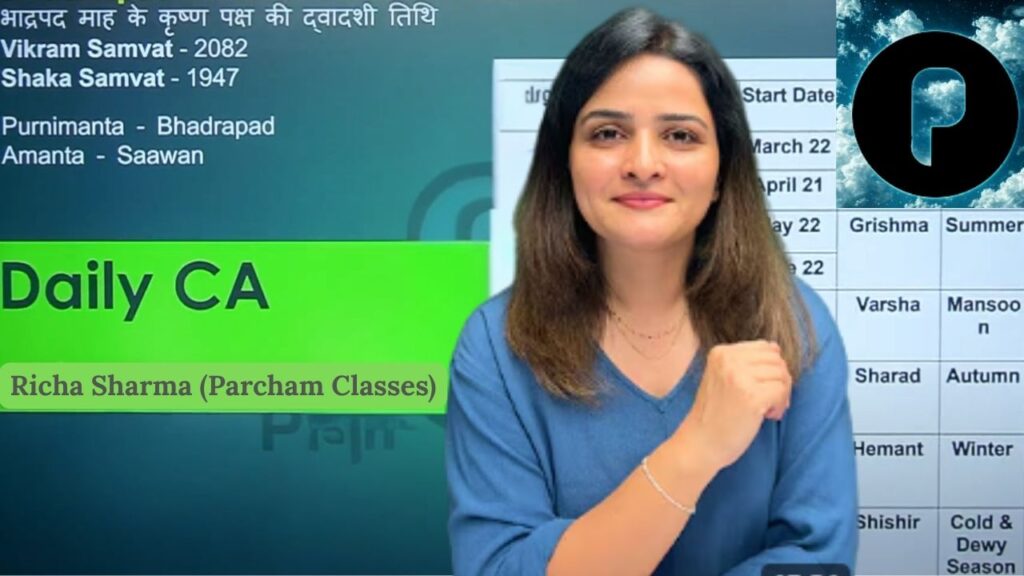
Richa Sharma (Parcham Classes)

Richa Sharma is best to help SSC aspirants for concise and exam-oriented preparation. Richa Ma’am’s teaching style is clear and structured which helps every student to understand current events that are relevant to SSC CGl. She specifically makes point-to-point notes for easy memorization and applies other techniques such as mnemonics to help in revision.

Richa Sharma (Parcham Classes) best current affairs teacher for SSC CGL

She is best for those students who prefer to prepare the current affair section with less time & efforts. It’s hard for many students to remember dates, names, and numbers. Richa Ma’am fits them because she uses simple flowcharts and bullet points to simplify the topic. You can easily remember them and cover all the topics within a short period of time.

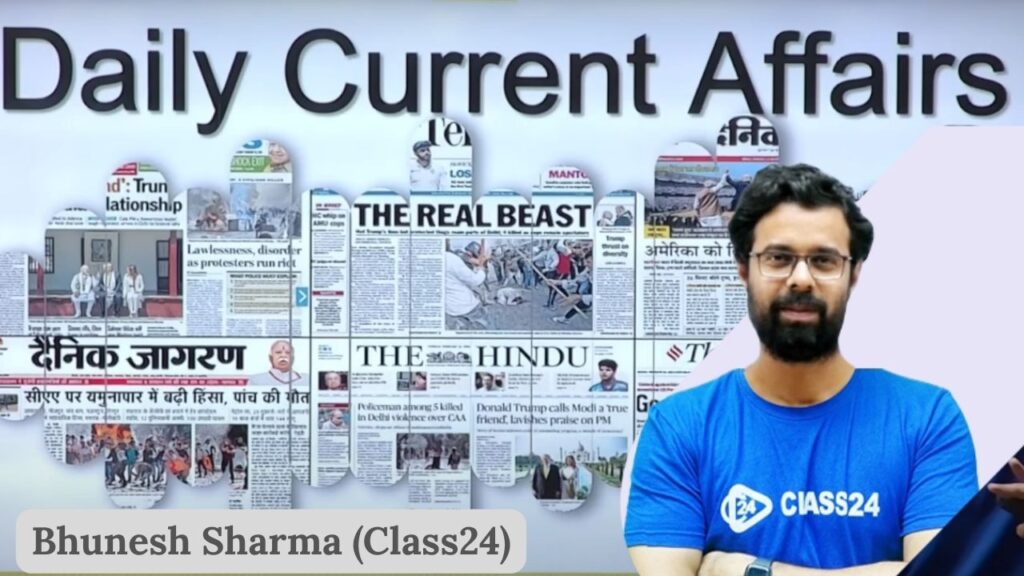
Bhunesh Sharma (Class24)

Bhunesh Sharma is experienced and popular for his lucid explanation which helps to understand complex topics of current affairs easily. He uses visuals and diagrams in its teaching to memorize every concept. Most importantly, it’s easily available for every student who is preparing for the SSC CGL Exam. 

Bhunesh Sharma (Class24) best current affairs teacher for SSC CGL

If you have a problem in understanding current affairs then Bhunesh Sir is best, he simplifies every topic with his friendly teaching style. Be ready for the In=depth analysis on a complex topic which can help you understand its core reasons, making you able to solve every question confidently.

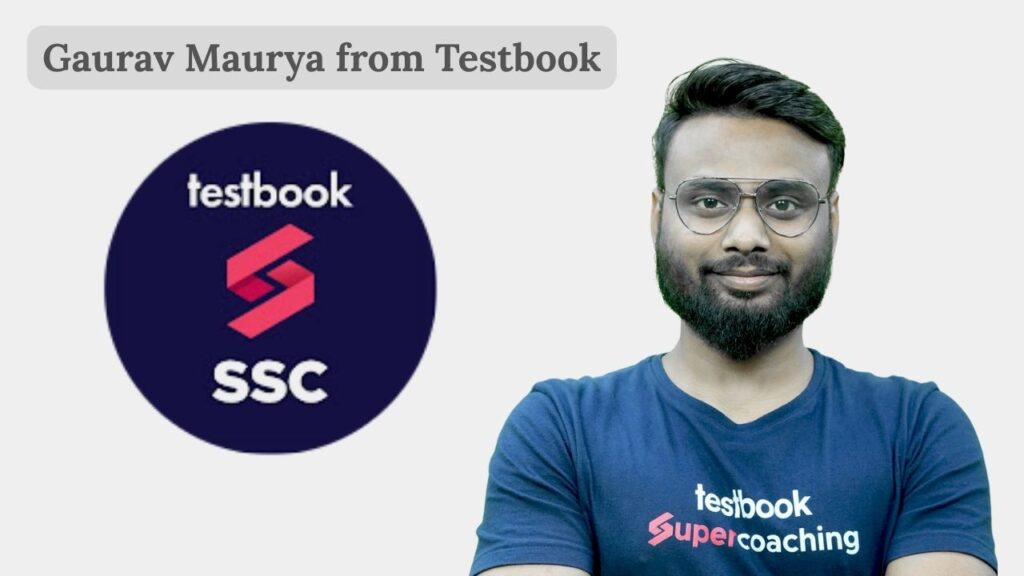
Gaurav Maurya from Testbook

For daily current affairs updates, watch Gaurav Maurya sir lectures because he gives updates in a very good explanation which helps many students to understand it. The factual accuracy and exam relevant topic in his sessions makes it a more precise choice for SSC CGL aspirants. He will prepare you for the exam in a short period of time.

Gaurav Maurya from Testbook best current affairs teacher for SSC CGL

He focuses on relevant information which can come in the SSC’s objective exam. Students can score well in current affairs sections if they cover all the Gaurav Maurya sessions. He prepares students for the competition with quizzes and practice questions in his classes. You can get all the daily information in one place. 

Krati Ma’am by SSC Wallah

Krati Ma’am by SSC Wallah best current affairs teacher for SSC CGL

Krati Ma’am is a perfect teacher for students who get bored easily. Her intrusive way of teaching can help SSC CGL aspirants to memorize each current affairs topic with interactive elements and discussion. She keeps you motivated for your preparation and guides you through the entire session. 

Her fun and energetic session is excellent for students who get distracted easily. Krati Ma’am focuses on motivating and encouraging students to follow their journey with focus and positivity. Her teacher methods including storytelling, playing quizzes, and interactions are excellent. 

Finding Your Ideal Current Affairs Guru: A Personalized Approach

It is hard to find the best teacher for current affairs. This section seems easy but it is not, many students try so hard to remember each event but can’t help themselves. A short guide to help you make a right choice:

Know Your Needs

Level of Understanding: Current affairs is your weakness or you are a  beginner then understanding each and every thing with deep-analysis is important.

Time Commitment: Each subject needs time but decide how much time you can give to the Current Affairs section to cover every topic.

Learning Style: Know which teaching style helps you understand complex topics easily — engaging, visualising, or quick facts.

Exam Focus: These SSC CGL focused teachers can help you prepare fast and easily, you just have to know which one can simplify fast for you. 

Explore and Experiment

Watch Demo Lectures: if you are still confused which one is right for you, watch demo sessions of a few teachers so you can see their teaching style.

Check Reviews and Testimonials: Many students who have already taken their lectures have shared their feedback on social media. You can have their opinion.

Consider Multiple Sources: once you select any teacher, it doesn’t mean you can’t access another teacher’s resources or study material. You can take one or two teachers’ lessons and notes to get well-rounded daily updates.

Evaluate Effectiveness

Assess Your Retention: practice questions and solve test series to know about your memorization. It helps to understand if you forgot the information taught by the teacher.

Track Your Progress: observing changes in your current event knowledge and performance in mock test

Stay Updated on Exam Trends: It’s important that your teacher prepares you for the SSC CGL new exam pattern. 

Conclusion

If you are thinking about clearing SSC CGL examination and score well, focus on every section including current affairs is important. Best Current Affairs Teacher for SSC CGL will help you get ahead on the preparation and enhance your chances of success in the examination. You must understand the fact that each teacher brings a unique strength to the table and the “best” one for you is the one that aligns with your preferences. 

Scroll to Top