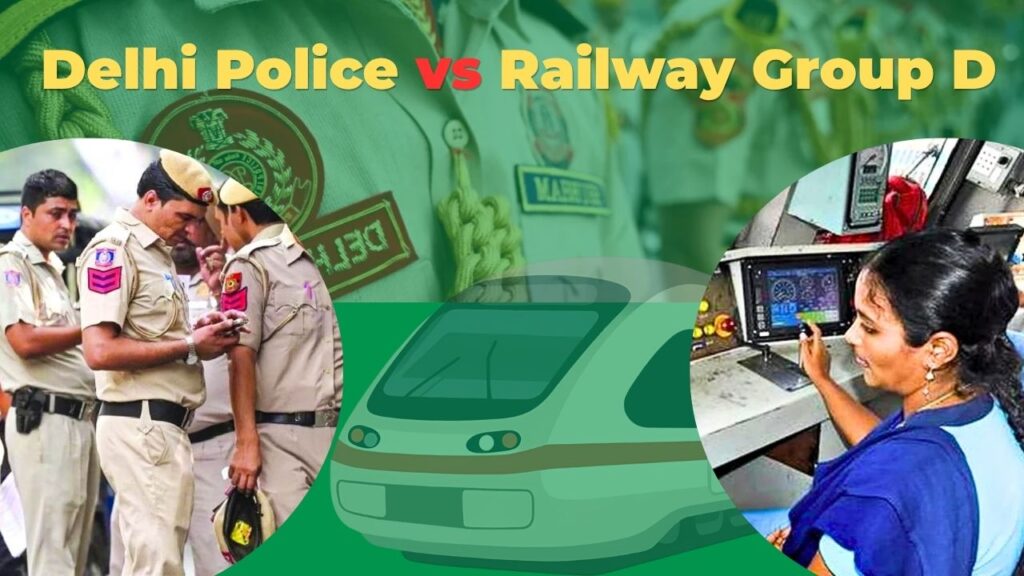
Finding a government job in India is just like a dream for many people as it offers financial security, job stability and respect in the society. There are large-scale recruitment every year which attracts recruiters from across the country but deciding between Delhi Police vs Railway Group D is hard because both offer great pay and career opportunities.
Both provide access to the elite government sector, but are tailored to vastly separate lifestyles, career paths, and abilities. One puts you in the national capital in a prized khaki uniform and the other has you running the Fourth Largest Rail Network in the world.
If you are confused between Delhi Police vs Railway Group D then must read this complete comparison on Work Profile, Eligibility, Salary, and Career Growth for a clear decision.
Delhi Police (Constable / Head Constable) Recruitment
Job Profile and Responsibilities
Becoming a member of the Delhi Police is to enter a world of dynamism, action and public interface As a cop in the national capital, where the pace of duty is naturally non-stop.
Your main duty is law enforcement. They patrol certain beats, work to deter crime, provide assistance with investigations and with traffic.
You would keep meeting the citizens, attend to panic callers, receive complaints (FIR), and your presence would be assuredness of keep to the public.
The Officers of Delhi police are to be seen in the front lines fighting and securing the capital at large and also protecting the top VIPs of the country and sometimes protecting foreign delegates. So, it is both challenging and high profile.
Delhi Police Eligibility
The candidates must hold a 10+2 marksheet from any recognized board. The ages considered are generally between 18 and up to 25 years of age. However, there is a relaxation in upper age limit for the SC/ST category (5 years), OBC (3 years), and other special categories
Male applicants must have a valid LMV Driving License (Motorcycle or Car) at the time of physical test. LCs are not accepted
Physical Standards and Selection Process
Delhi Police expects physical fitness of a high order since the duties of the post involve both muscular strength and bodily agility. The selection process comprises Computer Based Test(CBT) which tests the candidates General Knowledge, Reasoning, Numerical Ability and basic knowledge of Computer.
Candidates have to clear the written exam and then a tough Physical Endurance and Measurement Test. It also contains certain height requirements (male candidates approx 170 cm and female 157 cm large), chest measurement for men and physical activities such as 1600 meter race, long jump and high jump.
After that, the candidates are subject to a rigorous medical examination. This is to make sure that your vision is (minimum 6/12 in both eyes with or without glasses), you are not color blind and you are fit and healthy.
Salary Structure, Perks, and Allowances
Constables in Delhi Police are placed in Pay Level 3 with a basic pay of Rs 21,700 per month. The gross salary at the initial level after including the allowance is anything from Rs. 38000 to Rs. 40000 per month.
Receiving an HRA of 27% (Delhi is an ‘X’ city), as well as DA, TA, and Uniform allowance on an yearly basis. Other job benefits include use of specialised health care facilities and government quarters.
Career Growth and Promotions
The promotion prospects in Delhi Police are well-organized and with high prestige. Then, the junior police officer can be promoted through the ranks by seniority or by passing some departmental examinations. Promotion ladder goes like this:
Constable → Head Constable → Assistant Sub-Inspector (ASI) → Sub-Inspector (SI) → Inspector
SSC CPO exam is crucial and a life achieving door which can open directly at the Sub-Inspector level. Those who want to settle at a high-level fast, they can prepare themselves for this exam.
Work Environment and Lifestyle Factors of Delhi Police
You will be assigned to the National Capital Region (NCR) for life. You can be assigned for different tasks in the city or outside of the city. So, it’s a bit challenging for your family and kids to move but you get excellent city services, decent schools for your kids, and no-remote areas, unlike many other jobs in India.
It’s no secret that police work is tough. They work long hours that are unpredictable, as you are essentially on call all the time. Holidays and festivals usually involve long days working managing crowds and security.
Many young aspirants hesitate to choose this field because the uniform confers instant reverence and authority.
Railway Recruitment Board For Group D Jobs
Group D staff are a pillar of Indian Railways Functions as the role requires technical and manual work that keeps the train running on their tracks smoothly across the country. Jobs like Track Maintainer, Assistant Pointsman, Assistant Loco Shed, and multiple other maintenance roles.
Job Profile and Responsibilities
Based on the post, work is related to the railway tracks (Track Maintainer) and operation of railway switches (Pointsman) to work in signal telecom and electrical departments.
This job is different from being a police officer in that you do not really deal with the general public. As such, the primary focus is on infrastructure maintenance, technical support, and safe operations.
Most Group D jobs, in particular Track Maintainers, require you to do hard physical work and be out in the elements to ensure the tracks are secure.
Railway Group D Eligibility
The educational requirement is a 10th pass (matriculation) from a recognized board. But those having ITI (Industrial Training Institute) certificate or National Apprenticeship Certificate (NAC) are also eligible and that too for some technical posts they are preferred.
The age limit is also more lax here, from 18 to 33 years (or 36 years in recent revised notifications), this opens it up to older candidates. Age relaxation as per government norms for reserved categories.
Physical Standards and Selection Process
Railways is not choosing its candidates based on their height or combat-style fitness, they choose candidate’s ability to perform physical work consistently. A written examination on General Science, Mathematics, General Intelligence & Reasoning and General Awareness.
Candidates are now required to demonstrate their strength during the Physical Efficiency Test (PET) instead of height/chest measurement. For instance, a male aspirant is required to lift and carry 35 kg weight for 100 meter without putting it down in 2 minutes followed by 1000 meters run in 4 minutes and 15 seconds. Women candidates have reduced weight (20 kg) and time limits.
The standards for vision in railways are rigid, because color blind or poor sighted persons can commit havoc in track and signal.
Salary Structure, Perks, and Allowances
The Railway Group D employee will receive ₹18,000 per month as per Pay Level 1. Depending on place of posting, the salary in hand is approx. 22,000 to 25,000 Rs per month.
Although the salary is modest, Indian Railways provide many useful benefits. These are DA, HRA, TA, Night Duty Allowance and Risk or Hardship Allowance for jobs such as track maintainer.
One of the best perks of the job is the free or concessionary rail pass for staff and their families, enabling them to travel around the country for very little money. There are also well-equipped Railway hospitals, which the staff can avail.
Railway Group D Career Growth and Promotions
Indian railways is famous for its internal promotion opportunities for hardworking employees. A Group D employee can be promoted to Group C through competitions like LDCE (Limited Departmental Competitive Examination) and GDCE (General Departmental Competitive Examination).
For instance, A Track Maintainer or Pointsman have the chance to rise to posts like Assistant Station Master, Goods Guard, Ticket Clerk, and in some cases even to high technical posts subject to their educational qualifications and their performance in these examinations.
Life in Railway Group D
Indian Railways is zonal when Indian Railways Introduction is considered. Although you can select your zone during application, you will be posted to remote country stations, small towns, or busy city junctions. Movement within zone is allowed.
The hours are usually more stable and predictable (typically 8-hour shifts), with a more consistent daily work/life balance than the police force. But the labour of outdoor work – in the boiling summers or the monsoons – is punishing.
The work is largely behind the scenes and out of the public eye and political pressure. It is a quiet, steady life, with the reassurance of a huge, understanding railway community.
Read More:- DUVASU Mathura PVT Online Form And Full Details On Admissions, Eligibility, and Preparation
Conclusion (Delhi Police vs Railway Group D)
Choosing between Delhi Police vs Railway Group D depends on who you are, your educational qualifications and what you aim in life.
Opt for Delhi Police if:
If you are an active young person, love working under pressure and want your job to be authoritative and respectful in society. If you have 10+2 qualification, love to stay in a big metropolitan city forever, and can sacrifice on time for huge initial pay, the police force is your calling.
Opt for Railway Group D if:
You want to work in a non-public service, your job is technically focused or you have routine jobs. Railways is a good option if you have a 10th pass or ITI qualification, are physically fit, and want a predictable shift routine. Besides, the higher age limit provides an opportunity for aged candidates to get a stable central government job along with the best travel and medical benefits for their family.
Both have been very honourable ways of serving the nation. Consider your physical abilities, your preference for urban or pan-India lifestyle, and your long-term goals, and you’ll have an answer for what form to fill out next!