Punjab National Bank (PNB) has officially released the notification for the recruitment of Local Bank Officers (LBO) for 2025. Candidates who are waiting for this position can apply now through the official website of PNB. Application Schedule, What is the Application Schedule for BO 2025? This recruitment drive is 750 vacancies. For the eligibility criteria, age limit, education, job profile, syllabus, exam pattern and other important information, the candidates should go through the detailed notification.
A direct link for notification download and further updates on recruitment process will be provided on the official website. Applicants are advised to submit their applications at the earliest and ensure that they fulfill all the criteria as mentioned in the notification.
Candidates need to read the official notification and apply for PNB recruitment 2025. Candidates must have a graduation degree in any course and age criteria must meet the age limit (20–30 years) of this post.
You must read the notification before you start to apply.
To avoid errors, candidates are recommended to ensure that they fill in all required information including name, parents’ names, date of birth, address and educational qualifications properly in the application form.
Ensure you upload all the documents in the right size and format( pdf or jpeg) if required by the application form.
Before you submit the form, check that all the details you have entered and the documents you have uploaded are correct.
When you have submitted your application successfully, it is advised to take print out of application form or save in pdf format for future reference.
The following tips will make your Punjab National Bank Recruitment 2025 application easier.
Central Bank of India Recruitment happens every year for various posts. Candidates who are interested in working at the Bank Sector with good income and job stability can check the eligibility criteria, exam syllabus and exam pattern in this article. The idea of an exam structure can help candidates beat the competition for apprentice and credit officer posts. The main four sections are important to prepare first and other skill tests or sections are included according to the post.
The apprentice post is a one year training program for candidates who want to step into the world of banking in the government sector. It offers a monthly stipend but is valuable for the candidates to assess exposure to banking & finance.
The credit officer is a permanent post which offers high salary and allowance with increment for each year. So, this post has a lot of perks and responsibility which is attractive to the candidates.
Central Bank of India Recruitment 2025 Eligibility
Candidates can check eligibility before applying to the central bank of India recruitmentapplication. The online form 2025 will soon be released on the official website.
Educational Qualification: Candidates who have completed their graduation in specific disciplines for particular positions. The minimum score must be 50% but some positions may require additional skills and experience.
Computer Skills: Basic computer skills like fundamentals, MS Office, Powerpoint, Excel, and operating system.
Language Proficiency: Proficiency in local language is mandatory for the candidate to work in railways.
Age limit: Caste category also matters in the age limit – the age range is between 20 to 28 years. Age relaxation is provided to the reserved category.
Syllabus for Central Bank of India Recruitment 2025
There are four sections of the paper for Central Bank of India Recruitment. Each section carries out different types of topics such as Quantitative Aptitude, Logical Reasoning, English, and General Awareness. These four are core sections for the exam, some positions require a descriptive paper based on their skills.
The Central Bank Of India Apprentice post required computer knowledge with local language tests for candidates to prove their skills.
The Central Bank of India Credit officer post required writing skills for descriptive paper. So, both the posts require some basic knowledge on specific skills. You must understand the exam pattern and syllabus to clear this exam.
Quantitative Aptitude
Basic Mathematics – Number Series, LCM & HCF, Ratio & Proportion, SI & CI, Percentage, Data Interpretation, Geometry, and Algebra
Reasoning
Logic Building – Sequences, Coding-Decoding, Blood Relations, Verbal Reasoning, Odd one Out, Syllogism, Puzzle
English
Basic Grammar – Error Spotting, Indirect/Direct, Active/Passive, One Word, Synonyms/Antonyms, Sentences making
General Awareness
Banking Related Knowledge – RBI regulations, Current Affairs, Banking Knowledge, Static GK, Economic policies and Development
Computer Knowledge
Basic Fundamentals – Networking, MS office, Excel, Internet Knowledge, Devices and Tools knowledge
Descriptive
Letter & Essay Writing
Central Bank of India Exam Pattern for Apprentice Post
The total of 100 questions paper and each question carries one mark. It’s a good thing that there is no negative marking in this paper but the duration is only 60 minutes. The exam is conducted online and the question paper contains objective type questions.
Section
Questions
Marks
Quantitative Aptitude
15
15
Logical Reasoning
15
15
English Language
15
15
Computer Knowledge
15
15
Basic Insurance Products
10
10
Basic Investment Products
10
10
Basic Retail Asset Products
10
10
Basic Retail Products
10
10
Central Bank of India Exam Pattern for Credit Officer Post
There are a total of 120 questions and each carries one mark. The four main sections have 30 questions and 2 from descriptive – letter writing and essay. The duration is 120 minutes for this paper and there is no negative marking.
Section
Question
Marks
English
30
30
Quantitative Aptitude
30
30
Reasoning
30
30
General Awareness
30
30
Descriptive Test
2
30
Preparation Tips For Central Bank of India Recruitment
You can start preparing for these basics from any 10th class books or online resources. There are plenty of videos on youtube which can help you understand basic knowledge in each subject. Online tutorials are better than offline coachings as students can learn from anywhere and anytime without struggling to go to coaching centres regularly. Any professional can also start preparations today with the help of online material.
For Quantitative and Logical reasoning, you must regularly practice mock test series and previous years papers. Keep updates with current affairs and recent policies for General Awareness. Try out English Grammar test questions for practice.
Central Bank of India Apprentice Jobs Salary
This is apprenticeship so the stipend is fixed around Rs. 15000 per month with no other additional benefits. This will continue for one year and sometimes the bank may relocate you for this post.
This is best for students who want to start their career in Central Bank Jobs. This post focuses on training but there is no security like a permanent job.
The responsibilities included assisting in daily operations such as customer service, handling account and product queries, helping opening and closing accounts, making reports, documents and bank office operations.
Career Growth is depends on your performance because there is not direct
Starting salary for Credit Officer is around Rs. 48,480 and total In-hand approximately Rs. 50,000 to Rs. 90,000 including allowances. There is an increment in every year for credit officer salary.
This is a permanent job but candidates have to complete one year post graduate diploma in finance and banking. The credit officer is responsible for appraising loans, analyzing financial statements, monitoring people accounts, managing NPAs and developing strategies for maintaining operations.
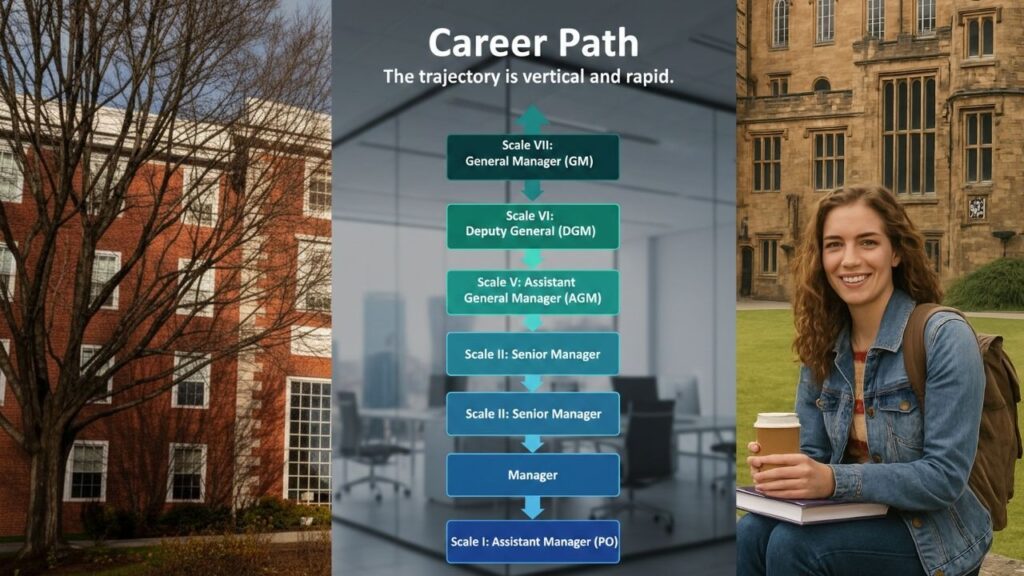
The career growth is good because after experience as a credit officer, candidates are eligible to apply for senior positions, chief manager, assistant general manager, and more. But the promotion depends on the candidate’s performance and qualifications.
Eligibility criteria for Central Bank of India Recruitment
Eligibility depends on the posts in CBI, some posts require specific certifications and experience but some posts can give you a chance to work at CBI. Let’s dive deeper into the eligibility for both apprentice and credit officer posts.
Central Bank of India Apprentice Educational Qualification
Graduation degree with minimum 50% score in any discipline. Candidates must have proof of the degree they claimed.
Age Limit
Minimum
20 years
Maximum
28 years
Age Relaxation
OBC (NCL)
3 years
SC/ST
5 years
PWD (Gen/EWS)
10 years
PwBD (OBC):
13 years
PwBD (SC/ST)
15 years
Central Bank of India Credit Officer Educational Qualification
Graduation with at least 60% score for general and 55% for reserved categories. Candidates must have a proof marksheet of the education from a recognized university in any discipline. Candidates have to pursue post graduate diploma after the selection in finance & banking.
Age Limit
Minimum
20 years
Maximum
30 years
Age Relaxation
SC/ST
5 years
OBC
3 years
PwBD
10 years
Conclusion
The Central Bank of India offers various posts through their recruitment process which happens each year. Interested candidates can start their preparation in core sections of the paper such as English, Mathematics, General Awareness, and Logical & Reasoning. These four sections are mandatory follows up with the descriptive test & computer knowledge. Candidates can check recruitment dates on the official website of the CBI. Practice everyday for each section to prepare yourself before the exam.
The basis of the present banking recruitment in India is the Institute of Banking Personnel Selection (IBPS). New mode of recruitment – Common Recruitment Process (CRP), is added transparency, uniformity and merit in recruitment in PSBs, RRBs and financial institutions. From probationary officers and clerks to technical officers at various levels of specialization, Institute of Banking Personnel Selection is the only gateway for obtaining safe, well-respected and rapidly growing jobs in the Indian banking sector.
To the hundreds of thousands of hopefuls they serve annually, Institute of Banking Personnel Selection is more than just an exam body — it’s a vehicle to financial stability, social standing, and long-term career growth in the country’s most trusted sector.
Public Sector Banks—PSBs
Regional Rural Banks—RRBs
Public Sector Banks—PSBs
Mentioned PSBs are the backbone of Indian banking with pan-India transferability and variety of career options. They offer PO, Clerk and Specialist Officers.
Participating Bank
Headquarters
Bank of Baroda
Vadodara
Bank of India–BOI
Mumbai
Bank of Maharashtra—BOM
Pune
Canara Bank
Bengaluru
Central Bank of India—-CBI
Mumbai
Indian Bank
Chennai
Indian Overseas Bank—IOB
Chennai
Punjab National Bank—PNB
New Delhi
UCO Bank
Kolkata
Union Bank of India—UBI
Mumbai
Those who desire to apply should note that the State Bank of India (SBI) holds its own recruitment, but the pattern is more or less similar to IBPS.
Regional Rural Banks (RRBs)
RRBs have a distinct type of recruitment as it gives the option to the candidate to attempt the language section in either Hindi or English, which is a crucial factor in terms of inclusivity.
Who are Eligible For Banking Jobs
Educational Qualifications
Eligibility for PO and Clerk – A Bachelor’s degree in any discipline from a recognized university.
Computer Literacy: Nowadays, operating knowledge of computer systems is a must for clerical posts. Candidates must possess a Certificate/Diploma/Degree in computer operation or must study Computer/IT as a subject in High School/College.
Percentage Calculation: IBPS is too accurate in terms of marks. The marks in percentage obtained in graduation shall be calculated by dividing the total marks obtained by the maximum marks of aggregate of all subjects/semesters. The fraction of percentage obtained will be ignored (e.g. 59.99% will be considered as less than 60%).
Age Limits and Relaxations
Post Category
Minimum Age
Maximum Age
Clerk (CSA)
20 Years
28 Years
Probationary Officer (PO)
20 Years
30 Years
Specialist Officer (SO)
20 Years
30 Years
RRB Office Assistant
18 Years
28 Years
RRB Officer Scale I
18 Years
30 Years
RRB Officer Scale II
21 Years
32 Years
RRB Officer Scale III
21 Years
40 Years
Relaxations for categories:
SC/ST: 5 years.
OBC: 3 years.
PwBD: 10 years.
Ex-Servicemen: + 3 years.
Examination Patterns For Institute of Banking Personnel Selection Exams
The selection stage is a multi round game that evaluates how fast you can work, how accurate you are, how deep your concepts go, and your personality.
1.The Preliminary Examination
Section
Questions
Marks
Duration
English Language
30
30
20 Minutes
Quantitative Aptitude
35
35
20 Minutes
Reasoning Ability
35
35
20 Minutes
Total
100
100
60 Minutes
Now candidates will have to concentrate on only Quantitative Aptitude & Reasoning to secure 40-40 marks for correct answers in the allotted time of 45 minutes.
The Main Examination
The Mains Exam is a battle of stamina and depth. The level of difficulty leaps up dramatically from Prelims.
IBPS PO Mains
Section
Questions
Marks
Duration
Reasoning & Computer Aptitude
45
60
60 Minutes
General/Economy/Banking Awareness
40
40
35 Minutes
English Language
35
40
40 Minutes
Data Analysis & Interpretation
35
60
45 Minutes
Objective Total
155
200
180 Minutes
Descriptive Test (Letter & Essay)
–
25
30 Minutes
Grand Total
–
225
210 Minutes
IBPS Clerk Mains
Related topics but none of those included the Descriptive Test and Interview.
Total: 200 Marks examination should be completed in just 160 Minutes.
Interview
After qualifying for the Mains exam, you need to clear the interview round for the final selection for the PO (Probationary Officer) post. 80% weightage is given to the score in Mains exam while 20% weightage is given to the interview score to prepare the overall merit list. The interview is for the purpose of evaluating SB candidates to see their suitability with the organisation in terms of their personality, communication skills and knowledge of banking.
To do well in the Data Interpretation (DI) in Mains, percentages, ratios and averages should be given the utmost importance as they are the base to solve the tricky and complex problems. Implicit Caselets, Radar Graphs and Missing DI Tables also find place in this section but rather drag simple calculation and hence analytical prowess is a necessity. Also mental calculation is necessary to increase calculation speed.
The newer pattern seems to favour “Quantity Comparison” (two given quantities to be compared) and “Data Sufficiency” items, which test conceptual clarity rather than just speed. With regular practice and tactics in place for these sections, one can surely boost performance.
Reasoning Ability
Puzzles and Seating Arrangement: These constitute an essential 50-60% of the section. Types include Circular, Linear (North-South facing), Box, Floor, and the terrifying “Uncertain number of persons” arrangement.
Strategy: Play four to five puzzles each day, every day. The trick is to know how to write down ”conditions” efficiently before making the arrangement.
Logical Reasoning: Syllogisms (now with “Only a few” cases), Inequalities, and Coding-Decoding inject a speed-boost.
English Language
For Institute of Banking Personnel Selection Mains, for Reading Comprehension preparation concentrate on practising long passages from reliable sources like the Economist, or financial dailies as they are frequently centred around similar topics like inflation, cryptocurrency, and geopolitics. Improve your grammar especially in Error Spotting & Phrase Replacement by learning Parts of Speech and Subject-Verb Agreement.
The reader’s “Editorial Routine” is well worth doing. Reserve a portion of your day to reading the editorial pages of leading newspapers like The Hindu. This is good for not only increasing the reading speed and building vocabulary but also of getting new ideas and useful material for Descriptive Essay as well as Interview.
General & Banking Awareness
To prepare well, concentrate on the following:
Current Affairs: Go through the previous 4-6 months of affairs, This includes biggest appointments, awards, summits, government schemes, sports etc.
Banking Awareness: Be aware of important terms like Repo Rate, Statutory Liquidity Ratio (SLR), Cash Reserve Ratio (CRR), Basel Norms, NPA (Non-Performing Assets), Priority Sector Lending.
Static GK: Learn about currencies, capitals, national parks and the headquarter of international bodies.
Probationary Officer (PO) / Management Trainee
The Probationary Officer is the first rung on the ladder of bank officers which is also the most sought after post in banking.
Role Description
A Institute of Banking Personnel Selection PO is then the all-purpose manager. In a two year working trial (probation) the officer is sent to all the areas of the branch-loans, forex, clearing, pensions and general banking. They receive training to monitor clerical employees, approve transactions, and oversee client relations. It is a highly responsible and decisive post.
Salary (2026 Estimates)
After the 12th Bipartite Settlement, the financial attractiveness for the post of PO has gone up further.
Basic pay: ₹48,480 – 85,920 varies according
The monthly pay is between Rs. 85000 and Rs. 90000 gross, with dearness allowance (DA), house rent allowance (HRA), and city compensatory allowance (CCA) and other small things.
Perks: Leased housing (rent is often reimbursed upwards of ₹20,000-₹30,000 depending on city), medical assistance, newspaper allowance, and leave fare concession.
Future Growth
Customer Service Associate (Clerk)
Once just titled Institute of Banking Personnel Selection “Clerk” this position has had a name change in a lot of banks to be more reflective of the work since this is a customer facing role as Customer Service Associate (CSA).
Role Description
The Institute of Banking Personnel Selection Clerk is the initial contact for any branch visit from a customer. Responsibilities are handling cash (depositor/teller), updating passbooks, validating KYC documents and running the single-window counter. Clerks are subject to fixed working hours (usually 10 AM to 5 PM) and they don’t have to worry so much about targets or administrative decisions as opposed to POs.
Salary
Component
Amount (₹)
Basic Pay
24,050
Gross Monthly Salary
37,000 – 41,000
In-Hand Salary
34,000 – 35,000
Future Opportunities
Although the entry level is low, internal promotion exams enable Clerks to rise to the Officer ranks in around 3-4 years. Several of the top PSB executives began their careers as clerks.
Specialist Officer (SO)
The Institute of Banking Personnel Selection SO position is designed for professionals with domain specific technical expertise.
IT Officer: Responsible for the bank’s Core Banking Solution (CBS), cybersecurity, and digital channels.
Agricultural Field Officer (AFO): The AFO is vital in India and the priority sector lending is entrusted with it. They visit villages, they visit crop patterns, they sanction agricultural loans, and then they ensure recovery. This position is the bank’s link with the rural economy.
Rajbhasha Adhikari: For activity under the Official Languages Act and for getting circulars and other documents translated in Hindi.
Officers in charge of Law, HR and Marketing: They manage the day to day running of their respective functions on litigation, manpower administration and product publicity respectively.
Specialist Officer (SO) Streams
Agricultural Field Officer (AFO)
As the Indian economy is agriculture based, banks are required to provide 18 per cent of their Adjusted Net Bank Credit to agriculture.
Syllabus: Soil Science, Agronomy, Horticulture, Animal husbandry, Agricultural Economics and recent Government Schemes (like PM-KISAN).
Preparation: Aspirants will need to concentrate on both the rabi and kharif crop seasons, diseases, and breeds of cattle /poultry, as the queries are very technical.
IT Officer
As banks go digital the IT Officer protects the infrastructure.
Course Outline: Installing and managing Database Management Systems (DBMS), Networking (OSI Model, TCP/IP), Network Security, Operating Systems and emerging new technologies such as Cloud Computing and AI in Banking.
Preparation: Refer to standard B.Tech/MCA books. Programming problems are uncommon; emphasis is placed on concepts and architecture.
Law Officer
In order to study well, you need to have the basics of the major provisions and its applications under the Banking Regulation Act, RBI Act, SARFAESI Act, Negotiable Instrument Act, Contract Act, and DRT rules and regulations. Be aware of the recent changes in the Insolvency and Bankruptcy Code (IBC) and the impact it has on Banking & Financial Institutions. A detailed understanding of these acts will be important for an in-depth knowledge of the subject.
Applying for IBPS exams like PO or Clerk
Visit www.ibps.in and click on the “CRP PO/Clerk Recruitment” link for the latest job.
Select “New Registration,” and then provide a valid email ID and mobile number. Your provisional registration number and password will be sent to your mobile phone and e-mail.
Use this information to log in. Upload your photo, signature etc and then fill personal details like DOB, category, education, bank details etc.
Pay now as General/OBC/EWS: ₹850. SC/ST/PwBD: ₹175.
Press final submit, and download your e-receipt. Save a copy of the printout for your files.
Conclusion
The Institute of Banking Personnel Selection is not a mere examination body; it is a decider of the fate of the Indian middle class. It provides a clear, quantified and fair route to a career that is respectful and has stability. The process for learning from the first day learning percentages to the day helm Officer walking into a branch is transformative.
So for the student on the threshold, the message is simple: The competition is keen, but the procedure of Institute of Banking Personnel Selection is predictable. Through razor-sharp focus on the syllabus, smart test craft and knowing how to ride out temporary bad luck, the gates to India’s financial services sector are waiting for you.
Between Bank job vs SSC job which one to choose, this is the real matter of dilemma for all the Government Job aspirants in India. The two career paths are stable, respected, and come with good perks—but that’s about where the similarity ends. Work culture, salary structure, growth, work life balance, everything, Banking jobs and SSC jobs are quite different and these differences can have a telling impact on your lifestyle and long term goals. It is necessary to know about these differences, before you active your years of preparation in for either path.
Work Culture of Banking Job vs SSC Job
If you live for adrenaline and aren’t afraid of a high velocity environment, banking may be for you. As a Probationary Officer (PO) or a Clerk, you are the face of the bank. You’ll be handling customers, you’ll be handling cash flows, you’ll be giving and clearing loans.
New challenges and new people every day. However, let’s not sugarcoat it — it’s a high-stress job in banking. The stereotypical “9-to-5” government job doesn’t really exist here anymore. Now there are targets including loan targets, account opening targets, insurance cross-selling. And you will be responsible for branch performance.
SSC, on the other hand, is the very embodiment of bureaucracy. If you clear SSC CGL, you get very lucrative posts in central ministries, the CBI, Income Tax or Customs.
This place has a very different culture of working. It is predominantly administrative. You are part of the massive machinery that runs the country. You will be drafting policies, keeping records, or maybe even conducting field inspections if you pick an Inspector profile. It’s more even-tempered, the deadlines aren’t as crazy, and you almost never have to field irate customers hollering about a failed UPI transaction.
Salary And Allowances For Bank job vs SSC job
Both Bank job vs SSC job offer good salary and allowances to their employees in the government sector but a small difference is the right perks with right duty is a great combo.
Right from the beginning, a Bank PO generally earns more than a starting SSC CGL officer, more so if you get into SBI. The allowance is fantastic. You get lease accommodation (which is huge in metro cities), medical benefits, petrol allowances and even newspaper allowances.
Bank Employee Salary
Government Banks
Monthly Salary
Probationary Officer (PO)
₹52,000 to ₹60,000
₹30,000 (Perks)
Clerk
₹30,000 and ₹35,000
Specialist Officer (SO)
₹52,000 to ₹58,000
But the single biggest perk of being a banker? If you’re buying a house, a car, or paying for an education, you get loans at wildly subsidized interest rates. Over the course of a lifetime, that’s lakhs of rupees you save.
The SSC salary is decent and the deciding factor for that matter is the Central pay commission only. Though the starting salary you take home may be a little lesser compared to a Bank PO, the perks are out of the world.
SSC CGL Salary
Pay Level
Entry Basic Pay
Typical Posts
Approx. In-Hand (Metro)
Level 8
₹47,600
Assistant Audit/Accounts Officer
₹75,000 – ₹85,000
Level 7
₹44,900
ASO, Income Tax Inspector, Excise Inspector
₹65,000 – ₹72,000
Level 6
₹35,400
Divisional Accountant, Sub-Inspector (NIA)
₹52,000 – ₹58,000
Level 5
₹29,200
Auditor, Accountant
₹42,000 – ₹48,000
Level 4
₹25,500
Tax Assistant, UDC
₹36,000 – ₹42,000
Then there is the Central Government Health Scheme (CGHS), which offers almost free medical treatment in premier private hospitals to you and your dependents. You get exact DA hikes, HRA, travel concessions(Domestic and International). Additionally, the salary structure in SSC rises exponentially with higher pay bands and ranks.
SSC CHSL Salary
Post
Pay Level
Approx. In-Hand Salary
LDC / JSA
Level 2
₹27,000 – ₹32,000
DEO (Grade A)
Level 4
₹37,000 – ₹42,000
DEO (Level 5)
Level 5
₹40,000+
Work-Life Balance and Peace of Mind
This is where the divergence between the Bank job vs SSC job paths becomes painfully obvious.
In banking, it’s easy to feel like work-life balance is a myth, particularly in your first few years as a PO. You could be clocking out of your branch at 7 or 8 PM on busy days. And then there is the fact that bank jobs mean you get shifted around frequently. You will be shifting base and moving to a new city, at times to a rural village, for your mandatory rural posting every three to five years.
SSC wins the work-life balance debate of Bank job vs SSC job, hands down. The majority of jobs in ministries are Monday to Friday and you have full, undisturbed weekends. You are out of the office at 5:30 p.m., and the work stays in the office. There are transfers, of course, in SSC, but not anything like in banking, and many secretariat posts can see you through an entire career in Delhi.
Career Growth
Bank job vs SSC job have good growth options as the field is huge and it has senior posts as well.
If you want to become a general manager before you get old, go for banking. The pace of promotion in public sector banks is quick and depends on merit to a great extent. Do well, clear your internal JAIIB/CAIIB exams and opt for tough postings, and you can scale the ladders really fast. The Chairman of SBI usually begins their journey as a normal Probationary Officer.
Advancement in SSC is generally end of term and largely seniority based with the number of vacancies available. It’s a slow burn. You can come in as an ASO (Assistant Section Officer) and retire as a Joint Secretary after 30 years. It’s a respectable place to be and you know you’re never going to be laid off, but don’t expect to be leapfrogging up the ladder because you worked extra-hard one year.
Inspector (Level 7)
Superintendent/ITO (Level 8) — 5–8 years
Assistant Commissioner (Level 10) — 12–15 years
Deputy/Joint Commissioner (Level 11–13) — 18–25 years
Eligibility of Public Sector Banks And SSC Jobs
Nationality: Citizen of India
Educational Qualification for Public Sector Banks : A Bachelor’s Degree for any bank post, for clerk post, you must hold a Computer certificate.
Age Required : 20 years is minimum and maximum is based on the role, for PO, it is 30 years. And for Clerk, it is a 28 years limitation. Now, you have given a chance to work for more years if you belong any of the categories:
SC/ST: 5 years.
OBC (Non-Creamy Layer): 3 years.
PwBD: 10 years.
Educational Qualification for SSC Jobs : In SSC CGL, candidates are required to have any degree, but for Junior Statistical Officer roles required Math in 12th and Statistics in graduation as a subject.
Age required : 18 to 32 years.
Meanwhile, SSC CHSL candidates required 12th class marksheet, but Data Entry Operator role requires Science stream with Mathematics.
18 to 27 years is an age criteria for most posts.
So, every position needs some additional skills, it’s better to check official notification for eligibility in specific posts.
Skills You Need For These Jobs
Both Bank job vs SSC job need particular skills for the job responsibilities to ensure a smooth workflow.
All of these are about speed and accuracy. The questions aren’t necessarily absurdly difficult, but you only have a few seconds to answer each one. It involves a lot of calculation and data interpretation, some reading comprehension and complex seating arrangement. If you have quick reflexes and don’t mind a ticking clock, bank exams are definitely for you.
SSC tests your depth of knowledge. Time is a factor, not nearly as brutal as in banking. Here you have to know high-level maths (trigonometry, geometry, algebra), English grammar rules by heart and a ton of Static GK and Current Affairs. If you enjoy memorising a lot and love researching topics, SSC is your playground.
So, there is no one answer to which one is right for you between Bank job vs SSC job. If you like to work in a dynamic environment, and take pressure with great pay then banking is for you. But if you like to work in a stable environment with predictable timings and want to have a balanced life with job security, SSC jobs surprisingly are best.
Ultimately, the one you should go between Bank job vs SSC job depends on your own personality, priorities and future plans for your career – so you take a little time to think about what’s most important to you, and then make an informed decision.
If you began your preparation for the IBPS PO with the mock tests of the last year, then your syllabus is already out of date with yesterday’s blueprint. The IBPS PO MT XVI cycle for 2026 has evolved quite a bit in terms of number of vacancies, in the Mains exam, and even in the rounds after the interview, so aspirants who do not revise their strategy might find themselves sitting in the exam hall solving a paper that is no more.
Here are the real differences this time around and what that means for how you prepare.
What Changed in IBPS PO MT XVI 2026
The IBPS PO MT XVI detailed notification was published on 30 June and 01 July 2026 on ibps.in, inviting applications for the posts of Probationary Officer and Management Trainee in 11 participating public sector banks for the recruitment year 2027–28.
The total number of vacancies mentioned in the first notification was 6,715. That figure has since shifted — as per the 20 July 2026 update from IBPS, the number stands at 7,365, which is approximately 29% more than last year’s intake.
Two banks, UCO Bank and Union Bank of India, had not yet submitted their vacancy numbers as of this update, so the final count may change once more before the end of the process. Bank of Baroda, Canara Bank, and Bank of Maharashtra currently have the largest number of vacancies.
The date for application also got extended. It was initially scheduled to end on 21 July 2026 but IBPS extended the last date to 26 July 2026. This year also brings something new with effect: a two-day correction window post registration closure, so candidates who find an error in their form after submission are not doomed by it.
Important Dates for IBPS PO MT XVI Recruitment 2026
Milestone
Date
Detailed notification released
30 June – 1 July 2026
Online application window
1 – 26 July 2026 (extended from 21 July)
Preliminary exam
22 & 23 August 2026
Main exam
4 October 2026
Personality Test / Interview
To be announced
Treat the interview and personality test dates as provisional until IBPS confirms them closer to the Mains result — that stage of IBPS PO MT XVI typically gets scheduled bank-wise, so your call letter will carry the exact date and centre.
Eligibility Criteria
To apply for IBPS PO MT XVI Recruitment, you need a graduation degree in any discipline from a recognised university, with your mark sheet or provisional degree certificate in hand at the time of registration — IBPS doesn’t accept “result awaited” candidates.
The age bracket is 20 to 30 years as on 1 July 2026; the usual government relaxations for reserved categories apply, but confirm the exact slab-wise relaxation against the official notification PDF rather than assuming it mirrors last year’s, since IBPS has been known to revise fine print between cycles.
The application fee is ₹175 for SC/ST/PwBD candidates and ₹850for everyone else, payable online through the IBPS portal.
Salary and Pay Scale
An IBPS PO MT XVI Recruitment selected candidate shall begin at the basic pay of ₹48,480. When DA, HRA and other allowances are included, the salary comes to around ₹74,000-76,000 per month in-hand, although it may vary based on place of posting and allowances structure of individual banks.
The Exam Pattern For IBPS PO MT XVI Really Diverges From Last Year
Prelims remains the same. It’s still 100 questions for 100 marks on English Language, Quantitative Aptitude and Reasoning Ability, with 60 minutes for the duration which is divided into three separate timers of 20 minutes each. A ¼ mark will be deducted for each wrong answer and your Prelims score is only a qualifying hurdle — it is not taken into account for the final merit list.
Mains is what makes IBPS PO MT XVI Recruitment seem an altogether different exam. The objective paper has increased from 145 questions to 170 questions, while the total marks remain 200 in a duration of 160 minutes. The English Language now asks more questions but awards fewer marks – 20, down from 40, so that each English question is worth less than it ever was.
General/Economy/Banking/Digital/Financial Awareness has been increased to around 50 questions for 60 marks and is one of the heaviest sections in the exam and also Data Analysis & Interpretation has been given more marks.
The subjective paper remains 25 marks for 30 minutes, although sources vary on whether it’s essay writing and comprehension or if it includes letter writing — do confirm this with your admit card and the official notice when released, don’t take either version for your final source of information.
Selection Process: Four Stages, Not Three
Where IBPS PO MT XVI Recruitment used to run Prelims, Mains, and Interview, this cycle adds a fourth step: a Personality Test, conducted after Mains and before the interview. It’s mandatory for anyone shortlisted, but non-qualifying — its purpose is to hand the interview panel a personality profile rather than to filter candidates out on its own.
The interview itself is still conducted by the individual participating banks, and you’ll need at least 40% to qualify (35% for SC/ST/OBC/PwD candidates).
Final merit combines Mains and Interview scores in an 80:20 ratio — Prelims marks play no role beyond getting you through the door.
One Preparation Tip You Shouldn’t Skip
Don’t wait until after Prelims to deal with the Mains shift. Because Banking Awareness and Data Analysis & Interpretation now carry noticeably more weight in IBPS PO MT XVI’s Mains paper, block out a fixed weekly slot — even 30 minutes, three times a week for RBI circulars, recent monetary policy changes, and current banking-sector news, starting today rather than after Prelims is done.
Candidates who leave Banking Awareness for a last-minute cram before Mains are the ones most exposed by this year’s restructured weightage.
The vacancy count for IBPS PO MT XVI Recruitment isn’t fully locked yet, with two banks’ numbers still pending, and the interview-stage calendar hasn’t been released. Keep checking ibps.in directly rather than relying on secondhand vacancy figures as you get closer to results — in a cycle with this many moving parts, the official notification is the only version worth trusting completely.
Conclusion
The IBPS PO MT XVI Recruitment 2026 notification came with more vacancies and a new selection process, so it is a good chance to grab for banking aspirants. Check your eligibility, apply online, and start preparing for Prelims and the revised Mains exam today.
There might be updates for vacancies and schedules from IBPS’s side, so keep visiting the official site for the latest notifications and do not trust other websites.
Cracking a bank exam isn’t that easy whether it is IBPS, SBI, or RBI Grade B. With right strategy and conceptual clarity where Best Online Coaching for Bank Exams are specially provide everything you need to prepare to get you ready. With the rise of online education, the right coaching platform can make a world difference – especially for aspiring students who are unable to attend offline classes. Let’s explore the vast options of online coaching for bank exams.
The old traditional form of taking education is gone in some areas because most students prefer to learn at their own pace.
While selecting a platform, remember these key factors – faculty’s experience and their teaching style, syllabus and topics, test-series, and mock tests. The most important thing is the support from your educator to solve your doubts is what requires you to choose the right platform for preparation.
Why choose Online Coaching?
There are many advantages for online coaching, here:
Flexibility & Convenience: many students are unable to attend offline classes, online coaching gives them a chance to learn at their own pace. They can get recorded sessions which are accessible from anywhere and anytime.
Cost-effective: students have to invest thousands in their coaching and allowance. Now they can prepare for their exam with affordable packages and EMI plans making them available for the budget-conscious aspirants.
Structured Learning & Test: Online classes are also offering interactive time with their students to sort out their problems, scheduled mock tests and performance analytics can help you maintain your practice record.
Top Online Coaching Platforms for Bank Exams
Testbook
Testbook is one of the top online education platforms where you can prepare for the competitive exams without going anywhere. You just have to install the app on your mobile to access its vast library of mock tests for SBI, IBPS, and RBI exams. It is famous for its best practice questions which particularly get banking aspirants ready for their exams. The platform’s mock tests are specifically designed to picture the idea of exam papers and help students to understand well about the actual exam environment so they can build accuracy and speed.
Not only mock tests, but TestBook provides excessive study materials, video lectures, and live classes for building a strong conceptual learning phase for students. The platform is strong in its data analysis that helps to keep the record of your performance after each mock test. This helps to know your strengths and weaknesses, so you can build them up strong to beat the competition.https://rbi.org.in/
Physics Wallah
Physics Wallah is a rapidly growing platform for its high quality education content and easily accessible at low price. Parallely known Banking Wallah, a comprehensive platform for beginners which covers all the major banking and insurance exams preparation in Hinglish language. This language is best for both English & Hindi medium students.
This platform offers various features for preparation such as live and recorded classes, handwritten notes, and test series for daily practice, and also provides a 24/7 doubt-solving facility. PW’s affordable price makes it accessible for many students who want to build a strong foundation to clear their complex banking exams.
Career will make itself a strong contender in the list of best online platforms for competitive exams. For bank preparation, it is excellent because of quality study material and latest exam patterns access. It offers live sessions, doubt-solving classes, free mock tests and current affairs in both Hindi and English language.
A major selling point is their affordable price for a high standard education platform. While some students mentioned technical issues, experienced educators of Careerwill platform are generally praised by most of the students. The platform aims to provide top-tier coaching to aspirants across the country who are unable to afford expensive coachings and move out to their hometown.
Vidya Guru
Vidya Guru is known for its structured and exam-oriented approach. The offline centre of Vidya Guru has transitioned to an online platform easily accessible for the students who can’t come to Delhi to join their offline classes. It is well-reputed coaching with experienced educators who provide shortcuts and tricks for tackling subjects like reasoning and quantitative aptitude which often seems complex in any competitive exams.
Bank aspirants can choose this online platform for their Bank preparations covering hard subjects with extra support to extend the students capabilities to beat the competition. This platform provides best teaching, counseling to help students and test series to get them prepared for the exam environment.
Adda247
When it comes to online coaching platforms, Adda247 is one of the best with a vast number of educators and syllabus to prepare students for bank exams. It offers live sessions, video courses, test-series, and e-books. The “Bank Maha Pack” is popularly known for offering live classes, test-series, and e-books for particular bank and insurance exams, making it the perfect platform for bank aspirants.
With experienced faculty, affordable price, and no language barrier, offering courses in more than 12 Indian languages making it accessible for every student across the country. The strong presence on the youtube channel and free study materials make it ideal for every student. This platform also focuses on personalized mentoring and doubt-clearing sessions to ensure every student can beat the competition.
Conclusion
There is no final answer for — which one you should choose because it all depends on your priorities. These Best Online Coaching for Bank Exams will help you guide strategically to prepare but choosing the right one is only dependent on you. The key is to take demo classes and check their syllabus to find the right platform which can help in your weak points.