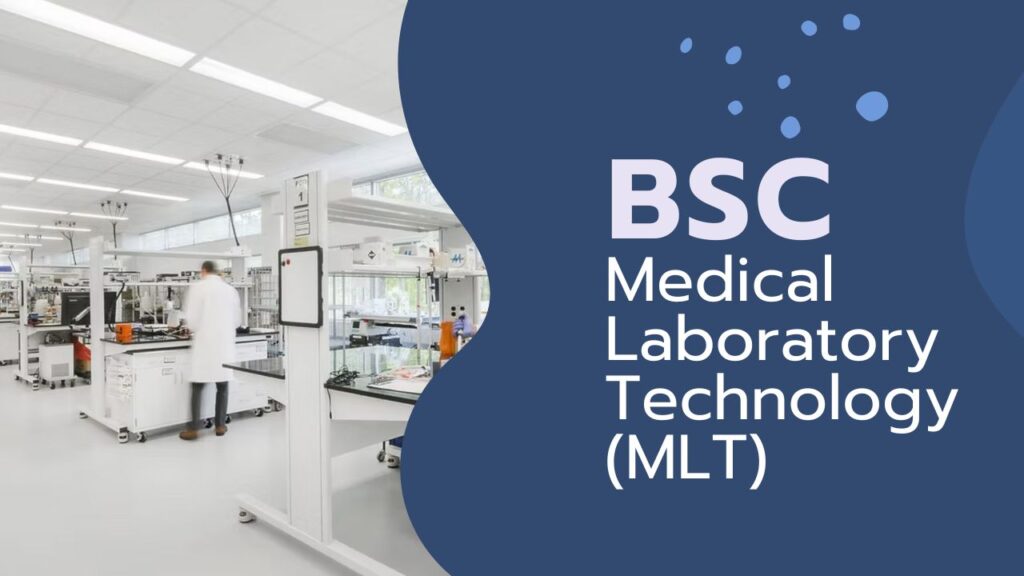
BSc Medical Laboratory Technology (MLT): Course, Fees, Career & Scope in India

BSc Medical Laboratory Technology

Imagine being the silent crusader for every correct diagnosis, working your magic inside blood samples, body fluids and tissue slides to find secrets that physicians need to know to save lives. That is the magic of BSc Medical Laboratory Technology (MLT). If you are scientific, you love precise work, and want a solid and stable career in health care, but don’t want the frenetic pace of working directly with patients, this degree could be just right for you. 

In India, where healthcare is booming, MLT professionals are highly sought after. So, here we go through all you need to know to be able to dig in to this sleeper powerhouse discipline. 

What is BSc Medical Laboratory Technology (MLT)?

The BSc MLT course is basically a three years long undergraduate course (six-month internship in some colleges) which is designed to make you a medical lab technologist. You’ll learn the art and science of analyzing body fluids, tissues, cells and microbes in clinical laboratories. Consider it detective work in a white coat: gathering samples, running tests on machines such as microscopes, analyzers and polymerase chain reaction (PCR) units, and producing results that influence treatments for everything from infections to cancer. 

The curriculum is a mix of biology, chemistry and technology. 

  • Year 1 involves Fundamentals such as human anatomy, physiology and biochemistry. 
  • Clinical microbiology, hematology (study of blood), and immunology by year 2. 
  • The final year is a rush with supplements such as histopathology (study of tissues), blood banking and molecular diagnostics. Practical laboratory sessions constitute 40-50 per cent of the course, so prepare for a lot of practicals. 
  • The best of institutions like AIIMS Delhi, Manipal University, Jipmer Pondicherry provide it with world class facilities, often including certification in lab automation. 

Who Can Jump In? Eligibility and Admission Scoop

You are considered eligible if you have obtained at least 50% in Physics, Chemistry, and Biology (PCB) from a recognized board – relaxed to 45% for reserved categories. Most private colleges don’t require NEET, while government ones may require state-level exams like KCET or MHT-CET. Most private unis are merit-based or have their own tests.

The admission season is followed after 12th boards, May-July. Apply online on the college portals– application fees range between Rs 500 to Rs 2000. Pro tip: Create a beachhead profile with science projects or volunteer work in labs; it shines in interviews. 

Fees, Scholarships, and ROI

  • Cheap but really beneficial—that’s BSc MLT for you. The fee of government colleges range around 10,000–50,000 per year, so the total fees of the course would be approximately 30,000 — 1.5 lakh.
  • The cost of private colleges is high and ranges between 1–3 lakh per year (rough 3–9 lakh in total). 4-5 lakhs can be charged by the top class institutes such as Symbiosis, Pune. In the range of ₹50,000 — ₹1 lakh per annum will be your hostel and books additional cost. 
  • Scholarships reduce the burden: Post-Matric for SC/ST from the State and Central government, merit scholarships from AICTE. 
  • Most of the institutions have 20-50% waivers for the toppers. ROI is stellar, starting salary ₹3-6 LPA, scaling to ₹8-15 LPA in 5 years. Compare that with the cost of the course, and it’s quite a smart bet. 

Skills You’ll Gain From BSc MLT Course 

This isn’t just book learning, it’s skill-building gold. You’ll learn phlebotomy (blood drawing), use high-tech equipment such as flow cytometers, learn quality control and even bioinformatics for genetic testing. 

Soft skills: Accuracy, good attention to detail, and ethics required—there is potential for misdiagnosis if a single mistake is made. 

A day in the life: Mornings are often spent collecting samples, then running tests such as CBC, ELISA, and cultures. The position also requires calibration of instruments and result reporting via LIS software. 

Hospital shifts can be demanding (8–12 hours), whereas diagnostic labs usually provide ordinary 9 to 5 hours office-based positions. 

Read More 👉 CTET Exam 2026: Check Exam City, Notice, Exam Dates, Syllabus and Eligibility Information

Future Opportunities For Students

Graduates are not left in labs for eternity. 70% of alumni are hired as lab techs or supervisors (₹25k-50k/month in the beginning) by hospitals (Apollo, Fortis). 

₹30k-60k work offer with diagnostics like Dr. Lal PathLabs or Metropolis. 

Government jobs through ssc, esic or state health services are also there with a good package of ₹35k+ along with benefits, crack exams ssc, junior paramedical.

So what about Advanced options? 

You may select from choices such as MSc MLT, PGDM in Hospital Management, or a PG Diploma in Cytotechnology, Histopathology or Forensics. A Salary of ₹10–20 LPA is possible. On the international front, the US and Canada are among the top seekers of certified MLTs. Professionals are able to make $50,000 or more per year by passing the ASCP exams. 

Career RoleAvg Starting Salary (₹ LPA)Top Employers
Lab Technician3-5Hospitals, Clinics
Medical Lab Supervisor5-8Diagnostic Chains
Blood Bank Technologist4-6Red Cross, Govt Hospitals
Research Associate4-7ICMR, Pharma Cos
Quality Control Analyst5-9Biotech Firms

Challenges and the Bright Side

There are also challenges including long hours, exposure to biohazards (so the right PPE is the must), and having to keep pace with new technology, including AI-driven diagnostics. But the advantages are clearly more than the disadvantages. 

The fact that healthcare jobs are expanding rapidly (at about 15% each year, according to NITI Aayog), private labs provide a superior work-life balance, and the soft assurance that your work really helps people, even if it’s behind the curtains. 

Conclusion

In a society that worships doctors and nurses, BSc Medical Laboratory Technology (MLT) is the silent force behind 70% of medical decisions. If you are detail oriented, love science, and want to future proof your career, then go for it. India’s healthcare industry requires an additional two million laboratory professionals by the year 2030, your spot awaits.

Check NAAC-accredited colleges and start prepping. This degree is more than just a credential, it is the key to a fulfilling life that is recession-proof in healthcare. 

Leave a Comment

Your email address will not be published. Required fields are marked *

PCS Rank Wise Post List 2025: Which Rank Gets SDM, DSP & More?

PCS Rank Wise Post List

The PCS exam is the most hardest exam in India which offers many prestigious level jobs in the government sector. PCS Rank Wise Post is allotted according to the candidates marks in the exam. It offers many higher level administrative posts like SDM, DSP, BDP, CTO, and others. This exam is held annually to recruit thousands of candidates for different posts, and prepare strategically for higher rank posts.

Let’s explore the PCS exam and posts for understanding their authority and power in administration.

What Is The PCS Exam? 

Provisional Civil Services offers a diverse range of posts in the government sector and is conducted by different State Public Services Commissions including UPPSC, BPSC, MPPSC, RPSC, etc. But the post name and exam pattern will be the same in all the states. Posts rank may slightly differ from each other but posts are related to state administration and law enforcement. The exam pattern includes: 

  • Prelims
  • Mains
  • Interview

How Are Posts Allotted in PCS Exams?

There are various factors for allotting the post on different level, let’s look into these factors:

Final rank in the merit list (Mains + Interview). Selection is based on the PCS state-level exam rank. If the two candidates have the same score then the cast-category of the candidates will decide in the selection process. The third factor is the number of vacancies in that post.  

PCS Rank Wise Post List 2025 

Likely RankPost Name
1Deputy Collector (Sub Divisional Magistrate/SDM)
2Deputy Superintendent of Police (DSP)
3Block Development Officer (BDO)
4Assistant Commissioner (Commercial Tax)
5District Commandant, Home Guards
6Subordinate Revenue Officer
7Assistant Regional Transport Officer
8District Social Welfare Officer
9District Panchayat Raj Officer
10Accounts Officer

Special PCS Posts And Their Powers 

Don’t you wonder? Why does the PCS Rank Wise Post matter? Because a candidate’s post determines their authority, power, responsibility, and salary within the state administrative system. 

The powerful posts allotted to top rankers in the PCS exam. The top three posts are Sub Divisional Magistrate (SDM), Deputy SuperIntendent of Police, and Deputy Collector are all administrative powers and control district level operations directly impact governance and policy implementation. 

Read More 👉 Meet the Best Physics Teacher for NEET Online – Top Choice for 2025

PCS Rank Wise Post Scope & Perks

Higher powers such as SDM, DSP, & CTO are placed on the top level of the government administration of the state because they are responsible for revenue management, development works, jurisdiction over law and order and public service delivery. 

Meanwhile, lower ranked positions are also responsible for government department works and administrative jurisdiction but they have less authority and power for taking decisions.

Higher positions rankers get fast promotion while initial posting and lower rankers have to face slower growth to become on the post like Indian Administrative Services (IAS). The salary and additional perks are good on a higher level with social recognition, they have more prestiges compared to lower level.

Other Top Level Posts in PCS Exam

Block Development Officer 

He has authority within the block in rural or semirural areas to lead administration for the development of projects for public welfare and implementation in government schemes. He supervises both state and central government policies in that area.

District Commandant, Home Guards

District Commandant is a head of Home Guard volunteers and works with the police and administration for law and order for handling disaster and public safety.  

Subordinate Revenue Officer

He is responsible for collecting and saving the data of land in the sub-district. Government schemes implementation also comes under the Subordinate Revenue Officer responsibility for agriculture and land reforms. These decisions are directed by the higher revenue officials and SDMs.

Assistant Regional Transport Officer

He enforces public travel law and order to resolve issues of driving license, permission for transport, and registrations of vehicles. Assistant Regional Transport officer is responsible for road safety campaigns and accident investigations.

District Social Welfare Officer 

District level authority and power to manage and implement welfare schemes for low cast and schedule tribes communities. Works as a mediator between communities and district administration for their well-being.

District Panchayat Raj Officer

Panchayat councils of villages are supervised by District Panchayat Raj Officer. Implantation for rural development schemes are monitored by him and he is responsible for these operations running smoothly in the area. 

Account Officer

Account officer handling the government department’s account and financial administration to manage budget and deliver financial reports to the government administrations. 

SDM vs DSP – Which Is Better?

SDM and DSP both positions are highly respectable but their work and authority is different from each other –

Sub Divisional Magistrate – SDM

This is the highest administrative officer post in the department to ensure the governance runs smoothly under the law and order. This involves both desk and field duties and offering great professional growth to ADM then DM level.

Deputy Superintendent of Police – DSP:

He is the head of the police subdivision and has authority for law enforcement. A very respectable uniformed post, DSP is responsible for commanding over police stations and getting promoted to SP and DIG. 

How to Get Top Rank for SDM or DSP Post?

The higher posts are responsible to change and implement governance that is why they are placed at the higher places in the state hierarchy. 

  • Your rank must lie within top 100 to get SDM or DSP post.
  • To score on that level you must focus on high-scoring subjects.
  • Practice and learn consistently for Mains.
  • Improve english grammar and take mock tests daily.
  • Keep updated with events, current affairs, and government policies.

Conclusion

PCS Rank Wise Post is important to understand if you are preparing for PCS exams because your exam scores will decide your position. If your goal is SDM or DSP then you should get 70-100 rank (General Category) and 120-160 rank (reserved category). With the right strategy you can prepare smartly for this exam and get the position.

PCS rank not just decides your job but also your future of growth, salary, and authorities. So, start aiming your goal with smart strategy and hard work.

Leave a Comment

Your email address will not be published. Required fields are marked *

UP DElEd Result 2025 Declared: Check Your 2nd, 4th Semester Result at updeled.gov.in with Direct Link

UP DElEd Result 2025 Out: 2nd, 4th Sem @updeled.gov.in

UP DElEd Result 2025 Declared by the Uttar Pradesh Regulatory Authority for 2nd and 4th semester exam. Students who want to download their result from the official website or the link mentioned in the article below. Batch 2022 and 2023 students can break their patience to see their result. 

If you have appeared in the examination then check your result from the direct link.

Exam NameUP DElEd
Exam Date (2nd sem)3–5 April 2025
Exam Date (4th sem)7–9 April 2025
Result Date9 July 2025
Official WebsiteClick Here

How to download the Result

  1. Click on the URL for the result provided here or visit the official site.
  2. Official result page will open, Log in with your credentials.
  3. Check your scores, if the server is down try sometimes later.
  4. After you submit, the result will appear then download it for future use.

Read More 👉 ICET Result 2025 Live: TS TG Rank Card Out, Download Your Scorecard Now!

Seats for DElEd 2025

There are a total of 2,33,350 seats available for the DElEd. The total number of students of batch 2023 present in the examination is 160159 but 102408 students have passed this exam and 57691 have failed. 246 students did not appear in the exam, 44 results have not been completely declared, 13 results were stopped by the council and 3 have been caught cheating.

Whereas, fourth semester students of 2022 batch are 57,415 in numbers but 45,528 students have passed in the examination. 

2nd Semester ResultClick Here
4th Semester ResultClick Here
Official WebsiteClick Here

Leave a Comment

Your email address will not be published. Required fields are marked *

Top Private Medical Colleges in South India You Shouldn’t Miss in 2025

Top Private Medical Colleges in South India You Shouldn’t Miss in 2025 with best education, facilities, and placements

Most of the students prefer to study in private colleges because of the faculty support in education, practical training, and placement opportunities. If you have completed 12th with PCB, you must pursue a medical degree from the best colleges. So, I have listed some of the Top Private Medical Colleges in South India. 

If you are from South India and confused about the college for medical studies then this guide will help you select the one. Every student must clear NEET-UG before stepping into the medical field. It is the most common entrance exam for admission to colleges.

Top Private Medical Colleges in South India 

1. St. John’s Medical College

St. John’s Medical College: This private college is situated in Karnataka and is the oldest college. If you want to study in this reputed college then you should prepare for the entrance to take admission. It has a legacy of producing some of the finest medical professionals who serve both in India and abroad. The college is known for its value-based education, strong research backing, and vast hospital network.

Admission ProcessFee (General)Placement & Package
NEET-UG required; apply via Karnataka state counseling (KEA); seats under General + Management quotaApprox ₹6.28 lakhs/yearPlacements in St. John’s Hospital or through govt postings; avg. ₹7–10 LPA (PG); ₹20k–₹25k/month internship

2. Narayana Medical College

Narayana Medical College campus with integrated hospital facilities for advanced medical training

Narayana Medical College in Andhra Pradesh. If you are a citizen of this state, you can take admission here. It also has a flow of patients as it integrates college and hospital which helps students gain real-time clinical experience. It has one of the largest private teaching hospitals in the region and offers advanced training in medicine and surgery.

Admission ProcessFee (General)Fee (Management)Placement & Package
NEET-UG mandatory; apply via Dr. NTRUHS counseling portal; management quota for non-local students₹12.50 lakhs/year₹24+ lakhs/yearGood absorption into Narayana Hospital network; avg. ₹6–8 LPA after PG; ₹15k–₹20k/month internship

3. GSL Medical College, Rajahmundry

GSL Medical College, Rajahmundry campus with modern infrastructure and hospital facilities for medical students

GSL Medical College is best for those students who want a good education but at an affordable fee. The infrastructure is modern, and the hospital on campus sees a good variety of patients, allowing students to learn practically from early on.

Admission ProcessFee (General)Fee (Management)Placement & Package
NEET-UG, Dr. NTRUHS counseling; management seats at higher fees₹12 lakhs/year₹24 lakhs/yearAndhra hospitals/PG; Avg. ₹5–6 LPA after PG; ₹18k/month internship

Also Read : Best Nursing Colleges in Lucknow with Fees, Courses & Admission 2025

4. M.S. Ramaiah Medical College

M.S. Ramaiah Medical College campus with advanced medical training facilities and hospital support

M.S. Ramaiah Medical College is offering high class education and advanced practical training to the future doctors. It’s known for high academic standards, overall world collaboration, and a strong hospital for clinical training.

Admission ProcessFeePlacementAverage Package
NEET-UG qualification is a must, Seat allotment happens through KEA-CET and All-India counseling. NRI and management quota are available.₹10.9 lakhs for one year for general students ₹40+ lakhs for the Mgmt/NRI students.Students can choose to study for further medical courses and medical opportunities also happen in the college.The salary package depends on the skills and knowledge of the students. Average salary package is ₹8–12 LPA 

5. Kempegowda Institute of Medical Sciences

Kempegowda Institute of Medical Sciences campus with hospital facilities for practical medical training

KIMS is a well-established private college with a strong hospital setup. Students have got the opportunity for practical training. The institution is affordable compared to other top private options, making it a favorite for middle-income families.

Admission ProcessFeePlacementAverage Package
Students have to clear NEET-UG and apply via KEA counseling (Karnataka). Management quota also available₹7.1 lakhs per year (General), ₹35+ lakhs (Mgmt)Self hospital offers and other hospital offers are also given to the students.Students can have a lot of opportunities from this college and average package is around ₹5–8 LPA after PG; ₹20k/month during internship

6. Jubilee Mission Medical College

Jubilee Mission Medical College campus with ethical medical education and hospital training facilities

Jubilee Mission Medical College: Jubilee Mission is a church-run institution known for its ethical approach to medicine and patient care. It offers quality education with emphasis on hands-on training and moral values.

Admission ProcessFeePlacementAverage Package
NEET-UG is required  Apply through Kerala state counseling (CEE Kerala). Management and NRI quotas available₹7.5 lakhs for one yearIt vary upon the coursesHigh number of students pursue PG; some absorbed into church-run hospitalsStudents can get the salary package around ₹6–9 LPA (post-PG); ₹22k per month internship.

7. Amala Institute of Medical Sciences

Amala Institute of Medical Sciences campus with well-equipped hospital and peaceful learning environment

Amala Institute of Medical Sciences: Amala offers medical courses such as MD, MS, and MBBS for students to establish their career in the medical field. It offers students practical training opportunities in a hospital environment. It provides a peaceful learning environment and good exposure through its well-equipped hospital.

Admission ProcessFeePlacementAverage Package
NEET-UG is mandatory.Students can apply via CEE Kerala. Seats under general, management, and NRI quotas₹7.5 lakhs for one year Moderate placements, many opt for PG₹5–7 LPA; ₹18k–₹20k/month internship

Also Read : Medical vs Engineering: Which Career Will Make You More Successful in 2025

8. Christian Medical College (CMC)

Christian Medical College (CMC) campus with advanced healthcare training and research facilities

Christian Medical College (CMC): If you want to be a doctor in India’s best hospitals, this college provides excellent healthcare education and research. Although it’s a minority institution, it offers world-wide opportunities. With its top-notch education making it extremely hard to get into.

Admission ProcessFeePlacementAverage Package
NEET-UG required
Must clear CMC’s own selection criteria after NEET
Minority Christian candidates given preference
Approx ₹48,530/year (highly subsidized)Top placements in India and abroad₹10–15 LPA (PG level); internship ₹20–25k/month

9. SRM Medical College

SRM Medical College campus with modern infrastructure and diverse student community

SRM Medical College is best in providing world class education and training to the students for improving their medical skills. It has good hostel facilities and student diversity.

Admission ProcessFeePlacementAverage Package
Admission via NEET-UG
Apply through MCC AIQ or direct via SRM
NRI quota available
₹25 lakhs/year (MBBS); ₹35–40 lakhs for PGAbsorption in SRM Hospital; good PG placements₹6–8 LPA after PG; ₹20k/month during internship

10. Apollo Institute of Medical Sciences and Research

Apollo Institute of Medical Sciences and Research campus with integrated Apollo hospital facilities for clinical training

Apollo Institute of Medical Sciences and Research: This institute offers one of the best corporate-style clinical exposures as it is connected to Apollo hospital. Students get trained under experienced doctors in a real-world hospital setting.

Admission ProcessFeePlacementAverage Package
Must qualify NEET-UG
Apply through Telangana state counseling (KNRUHS)
Management quota available
₹15.6 lakhs/year (General),Apollo Group directly hires top interns and PGs₹7–9 LPA; internship stipend around ₹25k/month

Conclusion

While deciding to grow in the medical field, the best college is the first step you consider for better opportunities and practical training. Choose according to your budget, goals, and career path among the Top Private Medical Colleges in South India. 

Leave a Comment

Your email address will not be published. Required fields are marked *

BTech vs BSc vs BA in 2025: Which Degree Offers the Best Future Scope?

BTech vs BSc vs BA in 2025: Which Degree Offers the Best Future Scope?

In today’s world, students must choose their field in which they have interest. Whether you choose BTech vs BSc vs BA in 2025, the future scope is consistently growing, if you follow the right direction. The right direction means if you are interested in teaching then BSc and BA is a good option but if you want to grow in the tech industry then BTech is the right option for you. Focus and the right college is also a matter to build your established career. 

Graduation is the first step in your career so take it wisely. The primary focus of BTech is Engineering & Technology. While BSc opens a path for you in science and research areas. BA is leading you towards further education to get a specialization in any specific subject. Students who are preparing for government exams can also pursue BA after 12th but many posts require other degrees. Before taking any action, you must check eligibility carefully for your future scope. 

Tips To Choose the Field for Graduation

Remember your passion, what you want to become in future? By acknowledging these questions, you can find the answer within yourself and then check the path to reach there. Once you know where to go, you will not get confused about your education. BA and BSc are easy courses, meanwhile BTech is hard, so if you want to become an engineer then you must pursue a BTech degree. 

If you want to become a Teacher, Journalist, Social Worker, HR, or Government Employee then BA is the best option for you. You can pursue other Technical courses and Specializations after BA. If you are interested in Teaching Science, Research, Nursing, or Higher Degrees, you can pursue a BSc. 

Comparison of BTech vs BSc vs BA

BTech (Bachelor of Technology), BSc (Bachelor of Science), and BA (Bachelor of Art) are highly demanding careers which offer a wider range of opportunities to the students. Their comparison is primarily focused on the career scope, course duration, course fees, eligibility and course curriculum.

Course Content of BTech vs BSc vs BA

BTech is a professional degree to deliver hands-on learning for engineering and technology. To advance technology with innovative minds is the motive of the industries. Colleges maintain their curriculum of BTech with application-based skills to get their students industry ready. It covers technical and applied aspects of specific engineering disciplines such as Mechanical, Civil, Computer Science, Chemical, Electrical, and Information Technology.

BSc is a graduation degree with more theoretical education in pure science like Physics, Chemistry, Zoology, Botany, Computer Science, IT, Statistics, Economic, Aeronautics, etc. It offers core concepts on the theories of science & technologies which get you focused on more research methodologies and theoretical understanding.

BA is involved in more Literature, History, Economics, Psychology, Sociology, Political Science, Geography, Journalism, Public Administration, and Social Work. It focuses on more theoretical concepts, creative writing and analytical skills, that is why it is perfect for those who want to become a professor in any of the subjects.

Read More:- SSC JE vs RRB JE: Which Govt Job Offers Better Salary, Growth & Stability in 2025?

Courses Duration 

  • BTech is entirely four years with one year internship. 
  • Standard BSc is a three year course which can be extended in specific programs such as Integrated program or BSc Honors.
  • BA standard degree is a total of three years course but BA honors is extended for four years. 

Eligibility for BTech, BSc, BA Courses

BTech & BSc graduation requires a 10+2 marksheet with science subjects including Physics, Chemistry, Biology & Mathematics. Admission in BSc can be done through an entrance test or direct admission. During BTech admission, you may have to clear JEE Mains/ Advanced which is hard to score well.

Students can take admission in BA after completing their 10+2 in any stream. It is not necessarily important to come from a science or commerce background. Students from arts, commerce, or science are eligible for BA.

Best Future Scope for BTech vs BSc vs BA

BTech Graduates are developing skills in engineering roles in departments of IT, Manufacturing, Chemical, Electrical, Production, Civil, Biomedical. After BTech, students can get a high salary in engineering roles from the top companies like Tata, IBM, Amazon, TCS, Infosys, Cisco, Godrej, and Siemens.

BSc Graduates are offering students a diverse range of opportunities to become job ready but for a higher scope, you should consider a master’s degree after BSc. There are some other specializations in technical courses, data science, and machine learning that can be helpful for getting a job in tech industries. You can also pursue higher education in pure science to become a lecturer or professor.

BA degree is offering many opportunities in further education for research, teaching, nursing, and creative arts & writing. Students can take a BA degree to establish a career in any specific field of subject. It offers many opportunities in the departments like HR, Media & Journalism, Social Work, Event Management, Hotel Management, Content Writer, Digital Marketing, Business Analyst, and Government Sector. Some of these require a diploma or certificate course for applying to the particular role.

How Can You Choose the Best Course?

There is a final answer for that because it all depends on your interest and budget. Let’s start from the lower budget course to the highest budget course:

Choose BA if:

  • You want to become a teacher, professor, analyst, content creator, digital marketing, sales executive, owning a business or preparing for a government job. 
  • You can’t afford the heavy expenses of the course.
  • You are working professionally and want to continue your education.
  • You want to pursue another degree (MA, BEd, LLB) or diploma and don’t want to burden yourself with a ton of syllabus.

Choose BSc if:

  • You are interested in science and want to research into this field.
  • You want to become a professor in a science subject.
  • You cannot afford BTech so you can choose BSc with a technical subject.
  • You are not prepared for the entrance tests, direct admission can happen in BSc.
  • You want further studies after graduation.

Choose BTech if:

  • You want to become an Engineer, interested in Physics, Chemistry, and mathematics.
  • You can afford to study from a recognized college.
  • You want the highest salary package after graduation.
  • You want a structured program to grab industry opportunities. 
  • Higher education like MTech for leadership roles in tech-driven industries. 

How do BTech, BSc, and BA degrees differ in career prospects

A comparison table will be good to observe the differences easily among them:

DegreeKey Career ProspectsTypical RolesSalary and Opportunities
BTechTechnology, engineering, IT, manufacturingSoftware engineer, mechanical engineer, data scientist, IT consultantHigher starting salaries, strong industry demand, direct recruitment in technical roles
BScResearch, academia, pharmaceuticals, environment, governmentResearch scientist, lab technician, data analyst, teacherModest starting salaries, very good with advanced qualifications, flexible career paths
BAHumanities, social sciences, media, civil servicesJournalist, teacher, public relations officer, civil servantGenerally requires higher studies for career growth, diverse but less technical roles

Conclusion

Whether it is a debate of BTech vs BSc vs BA, you can choose your degree according to your interest and need for your career scope. Let’s explore the differences in each degree’s details and career scope which can help you to decide the right degree for you. It’s a turning point of your life after 12th, you can’t decide just in a second. You have to list out your choices, interest, and budget then come back to this article to explore every detail for the BTech, BSc, and BA degree future scope.

Leave a Comment

Your email address will not be published. Required fields are marked *

HR Professional Courses: Get Complete Guide on Career Path, Salary & Growth

HR Professional Courses

If you’re curious about what it takes to be a Human Resources (HR) professional, you’re in the right place. Over the past 10 years, the HR Professional Courses has undergone significant transformation, shifting away from an administrative role to gaining importance and recognition as a strategic business partner in organizational culture, employee satisfaction and business performance. This all-in-one resource will take you through the Need to Knows of building a fulfilling HR career in India, whether you are a fresher exploring career options or a career changer seeking a meaningful direction. 

What Does an HR Professional Actually Do?

Before we get into courses and salaries, let’s demystify the day-to-day life of a HR professional. Despite the stereotype that human resources is just paperwork and policies, HR employees today wear many hats. You will participate in strategic talent acquisition to seek and recruit candidates aligned with company values and who will drive growth. You’ll design and deliver programs to upskill the employees, mentor junior staff, and help them grow their career within the company. 

On the compliance and policy side, you will be monitoring the company’s compliance with labour laws, conducting employee relations with tact, mediating disputes equitably and managing the full spectrum of employee life from hiring to offboarding. Compensation and benefits policies are your domain too: You develop the strategies, coordinate the performance reviews, and you can even assist with organizational development by working with your leaders on future staffing and succession planning. In today’s world of data and analytics, many HR professionals are also utilizing analytics to monitor indicators such as employee engagement, retention rates and hiring effectiveness to drive additional business improvements. 

The joy of human resources is that each day is different, with issues ranging from handling a difficult employee complaint to developing a creative new-hire program or spearheading an organization-wide change effort. 

Educational Roadmap To Become HR Professional

HR career paths

The great thing about HR career paths is that there is no single “correct” path. To your education and current level of career aspirations, you can add several points of entry: 

After 12th Grade

If you have completed the high school you can go for the Diploma in Human Resource Management. These 1-3 year courses are available at a cost of Rs 50,000 to Rs 2,00,000 according to the classification of institution as a government or a private one. Alternatively, you can do 3 years of Bachelor’s degree (BBA, BA, BS) in HR or something related. Government College fee is goes from ₹1-8.5 lakhs and for private college fee is from ₹3-16.25 lakhs.The eligibility criterion is generally 50-60% in 12th class. 

For Graduates

If you already hold a bachelor’s degree (in any stream as per your undergraduate major), you can go forward for professional certificates or a post graduate diploma. A professional certificate of 6-12 months costs between ₹20,000 and ₹1,00,000, while a post graduate diploma for 1-2 years is valued at ₹50,000-₹1,20,000. These courses are great if you want to make a move into HR for then a full 2 year MBA. 

MBA / PGDM Route

If you are looking for an overall business education with focus on HR, a 2 year MBA or PGDM in Human Resources fees vary from ₹ 2-27 lakhs based on the tier of the college and the location. These programs on the repel need entrance exams as CAT, SNAP, MAT, or XAT. Top tier institutions such as IIM, XLRI have higher fee yet provide excellent placement package and networking. 

Professional Certifications

Professional certification is also valuable in addition to formal education. The popular certification include CHRG (Certified Human Resource Generalist) which has fees of ₹50,000-₹2, 00,000.

The CHRM (Certificate in Human Resource Management) is priced at ₹90,000-₹8,00,000 and the CHRP (Certified Human Resource Professional) costs ₹80,000-₹4, 00,000.Two globally-oriented credentials that also have value on an international basis are the SHRM-CP (Society for Human Resource Management Certified Professional) and the aPHR (Associate Professional in Human Resources) both of which are recognized by employers in many countries around the world.   

Eligibility Requirements You Need to Know

  • For Diploma Courses: You need to pass 12th grade exam with minimum 45% in aggregate.
  • ​For Bachelor’s Degrees: Obtain 50-60% in 12 grade; some colleges require entrance exams.
  • ​For M.B.A. Directly after 10+2: Achieved a minimum of 60% in your 12th grade exams; passed entrance exams such as CAT, MAT, SNAP, or XAT.
  • ​HR-Related Certifications: Many certifications such as SHRM-CP have prerequisites of at least 3 years of HR work experience in an HR function, whereas entry-level aPHR caters to HR novices or individuals beginning their journey in HR. 

Starting Salary For HR

Entry level HR professionals in India get a good pay as per market standard. An HR fresher gets a salary in the range of ₹15,000-₹30,000 per month, which comes around ₹3-5 LPA per annum. However, this might differ drastically depending on a few things such as: 

  • By Role: HR recruiters and coordinators normally begin with salaries of ₹18,000–₹26,000 per month and HR analysts with good technical skills can make ₹25,000–₹35,000 per month from the very start.
  • By Education: Tier-1 MBA (HR) pass-outs have high salary prospects of ₹30,000–₹40,000 per month and BBA or BA grad can make ₹18,000–₹25,000 per month.
  • By Industry: It is not always that an HR company gives you a chance but you can get IT, finance and e-commerce industries offer for an HR with starting pay of ₹28, 000 to ₹35, 000. 
  • By Location: Metrocities like Bengaluru and Delhi offer great pay to HR Professionals.  

Career Growth

Indian HR salaries have increased 24% from 2019, this is higher compared to IT sector’s 6.5% CAGR. This signals the rising level of strategic importance that HR has in organizations. 

Indian HR salaries

Career Progression Timeline

Start as an HR Assistant or Coordinator (0-2 years), then advance to HR Generalist or Specialist (2-10 years) in areas such as L&D Manager or Recruiter, then go to HR Manager or HR Business Partner (5-10 years) and subsequently to executive positions which include Director, Head of HR, or CHRO (10+ years).   

Salary Growth by Experience

A fresher can typically expect a starting salary of ₹3–5 LPA. As you gain more experience, this can be anywhere from ₹11-15 LPA at HR Manager level, ₹20-25 LPA in senior specialist roles and anywhere between ₹40-150+ LPA for CHRO of a large company. The steepest rise in salary is generally seen between 10 to 13 years of experience- whereby the median CTC varies around ₹38 LPA.   

Emerging High-Growth Specializations

For maximum growth, strategic HR roles are the way to go. HR Analytics Managers earn ₹40-60 LPA, Salary & Benefits Managers earn ₹28-42 LPA, and Diversity & Inclusion Managers earn close to ₹20 LPA. These positions are growing at 15-22% per year because they have a direct effect on business results. 

Conclusion

The Job growth of approximately 7% over the next ten years will add about 17,400 new jobs and is expected for the HR occupation. Instead of being automated out of existence like some admin jobs, strategic HR roles are increasingly precious. You get to work with people, solve truly complex organizational issues, shape company culture, and have a tangible impact on whether employees are happy at work.

​”The investment, be it ₹50,000 for a diploma or ₹20 lakhs for an MBA, gets returned fast in the form of a competitive pay package and strong career growth. More than who you’re working for, it is the work, financial and personal fulfilment you are creating.

First, decide on the HR professional Courses that best matches your current qualifications and your career timeline, learn core HR skills to get started, and don’t overlook the impact certifications can have in helping you stand out. 

Leave a Comment

Your email address will not be published. Required fields are marked *

Scroll to Top