Supreme Court Law Clerk Recruitment 2026 of India announced notification released on 20 January 2026 and opened the portal to receive applications for Law Clerk-cum-Research Associate (LCRA) for the year 2026, marking a fantastic opportunity for budding legal minds. Supreme Court Law Clerk Recruitment is a paid position with 200 seats available and the stipend amounting to ₹80,000 per month, making it a prestigious and fulfilling experience.
The applications started on February 7, 2026 and should be sent through the official website of the Supreme Court of India (sci.gov.in). Interested candidates are advised to send their application before the last date 10th March 2026. This is an extraordinary opportunity to acquire priceless experience in the legal industry.
Date Schedule for Supreme Court Law Clerk Recruitment
Phase
Date/Details
Notification
20/January/2026
Application Window
20/January —- 7/Feb
Exam
10/March/2026
Interviews
June/2026
Joining
August/2026
Quick Eligibility Check
You can apply if you are a fresh LLB graduate from the 3-year or 5-year program with a cumulative score of 55% across all years and have a degree from a University/Institute recognized by NLU or from the top-10 NIRF ranked law schools (2020-2024).
In the academic department, the standard is well defined and just: you require 55% marks in graduation minimum, with relaxation to 50% for SC/ST candidates.
Age: As on 01/08/2026 Candidate should be under 32 years and above 20 years.
There’s no experience required but you have to go full-time no side hustles.
Its merit-based magic: shortlisting will be on the basis of a written exam (objective + subjective on law/constitution) followed by an interview for the toppers. Question on constitutional, IPC, current affairs.
Candidates have to fill out the application form to access the admit card for the examination. Follow the three phase selection process for Law Clerk Recruitment 2026, online MCQ test, Written test then prepare yourself for interview.
How to Fill Application and Fees
You need to register yourself on the official website of SCI.
Login with your credential to fill the entire details required to complete the form and check again.
Submit Rs. 750 via online payment to complete the process
Railway Recruitment Boards (RRB), indianrailways.gov.in has issued notification for the job vacancies for RRB Isolated Categories Recruitment 2026 now available. The recruitment is being conducted for a total of 311 vacancies for various posts such as Senior Publicity Inspector, Lab Assistant Grade III (Chemist & Metallurgist), Chief Law Assistant, Junior Translator (Hindi), Staff & Welfare Inspector, Public Prosecutor, and Scientific Assistant/Training.
The RRB CEN 08/2025 – RRB Isolated Categories Recruitment 2026 Application submission has started for this RRB vacancy online from 30/December/2025 to 29/January/2026. Interested and eligible candidates may apply online through the official RRB website.
Candidates are requested to read the full notification very carefully to clear all the essential facts of eligibility criteria, Fee, Age Limit, Salary, Selection process and other important instructions. Here is the direct link to apply online for the RRB Isolated Categories Recruitment 2026 along with detailed information.
Graduation with a diploma in Public Relations, Advertising, Journalism or Mass Communication from a recognized University/Institute.
Lab Assistant Grade III (Chemist/Metallurgist)
39
12th passed with Physics & Chemistry from a recognized board.
Chief Law Assistant
22
Bachelor’s in Law + 3 years practice as a leader at Bar from recognized university.
Junior Translator (Hindi)
202
Master’s in Hindi/English + Diploma/Certificate in Translation from recognized university.
Staff and Welfare Inspector
24
Bachelor’s + Diploma in Labour/Social Welfare/Labour Laws/LLB (Labour Laws)/PG in Personnel Mgmt/MBA(HR)/PG in HRM from recognized institutions.
Public Prosecutor
7
Bachelor’s in Law + 5 years practice as advocate at Bar from recognized university.
Scientific Assistant/Training
2
Master’s in Psychology from a recognized university.
Salary Scale For RRB Isolated Categories Recruitment 2026
The base Salary starts at Rs. 19,900/- then it can go higher up to Rs. 44,900/- per month according to the post. So, candidates can now hurry to fill the application for this golden opportunity.
Follow These Steps to Apply Online for RRB Isolated Categories Recruitment 2026
Read the Notification: Download the RRB Isolated Categories Notification 2026 (PDF) and read it thoroughly to have the eligibility criteria.
Visit the Official Website: Indian Railways Recruitment 2023 Apply Online at indianrailways.gov.in
Fill the Application Form: Fill in the application form with as your personal, educational and contact details in an accurate manner.
Upload Documents: In the specified format, upload the necessary papers including photos and signatures.
Pay the Application Fee: Pay the application fee using any of the supported online payment methods.
Submit & Print: Before submitting the application form, check it thoroughly, submit it and then take a printout of the application form for the record.
If you are the type of person who regularly moves your furniture around, cleans windows to get the perfect paint color, or critiques lighting in every restaurant you dine in, maybe you have a calling. Your Search for Courses for Interior Designing starts when the question pops up: How do you get paid to have that passion?
In these days, interior design is no longer just about “making things look pretty.” It is a complex mix of architecture, psychology, technology, and art. Whether you are a high school graduate looking to pursue a degree or a working professional residing in Lucknow wanting to make a creative pivot, this guide is your blueprint. Let’s talk about everything you need to know to about the interior design courses, colleges, and careers.
Why Formal Education Matters
Let’s be real for a second. You may have a great eye for decorating, but professional interior design is a whole other story. It deals with strength of materials, building codes, ergonomics, and space planning.
A formal course will teach you the “grammar” of design. You are taught to talk with contractors, architects and clients. You go from saying, “I think this blue looks nice,” to, “This particular shade of teal offsets the warm undertones of the timber flooring and captures the natural light coming in from the north-facing window.”
Types of Courses
Course Type
Duration
Eligibility
What You’ll Get
Bachelor’s —B.Des / B.Sc
3-4 Years
B.Sc Or B.Des require 10th & 12th marksheet from Science Stream
In-depth technical knowledge related to Designing
Diploma / Advanced Diploma
1-2 Years
Key Formula for fast entry in career
Focused on Practical more than theory, Skill Polishing
Certificate Courses
3-6 Months
Hobbyists or professionals adding a specific skill (like CAD or V-Ray).
Specific skills only. Prefer for less professional people
Professional Level (M.Des / M.Sc)
2 Years
After having a degree of B.Des/B.Arch. These masters courses offered for specific specialization
Research-oriented, higher leadership roles, and teaching opportunities.
Your course will probably be part art and part engineering. There’s a chance that you will be spending your first year hours hand-sketching and studying Color Theory. In your final year, you will be making hyper-realistic 3D renders that look like photographs.
The “Hard” Skills (Tech You Need to Master in 2025):
To make it in the business these days, you have to know your way around a computer. These are the software tools you’ll probably end up knowing inside and out when you graduate:
AutoCAD - 2D blueprints industry standard It’s non-negotiable.
SketchUp: The Simplest 3D Building Tool Out There. Consider it as digital clay.
Revit / BIM – essential on large commercial jobs where you need to work closely with architects.
AI Homestyler: more recent and cloud based AI tools that are rising in popularity as they render fast.
Hospitality Designer: Hotels, cafes, restaurants. (Very creative, high visibility).
Set Designer: Design sets for movie or tv (Big in Mumbai/Hyderabad).
Salary Expectations
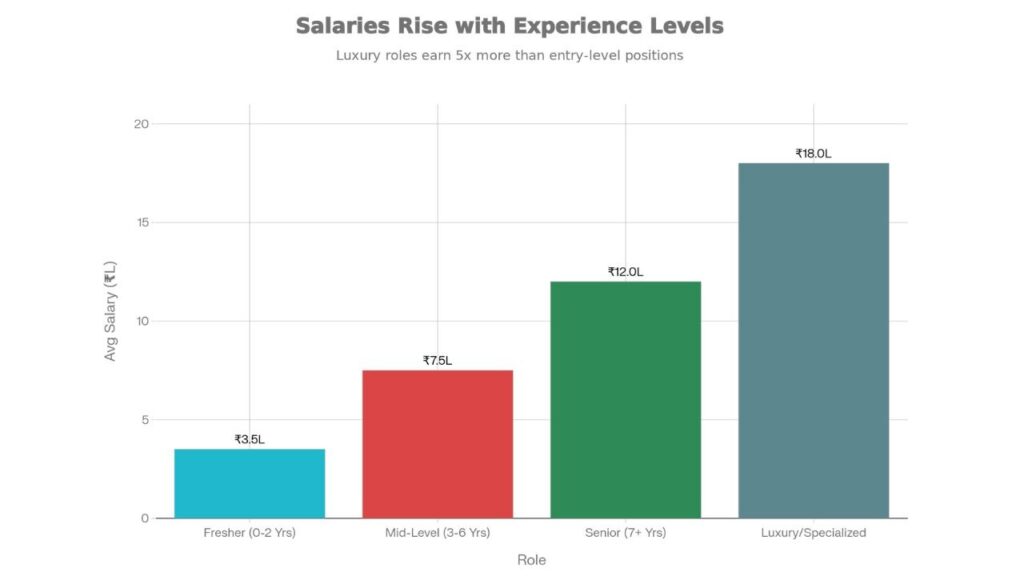
Entry-level compensation can be humdrum, but expansion is meteoric once you acquire a portfolio. Specialized positions, particularly in Luxury or Commercial sectors, offer much greater pay.
The chart exhibits how, even though you may begin as a junior at about ₹3.5 Lakhs per annum, it does pay off after all. A Senior Designer with 7+ years of experience can earn comfortably north of ₹12 Lakhs, and if you start your own firm or get into luxury consulting, the sky’s the limit (₹18 Lakhs+).
Admission Procedure For B.Des/M.Des in Major Colleges
For premiere govt colleges (like NID) you will have to appear for entrance exams like NID DAT or UCEED. They test your drawing ability, creativity, and spatial logic.
In case of private universities (such as Amity or Integral in Lucknow), admissions are essentially on the basis of marks secured in 12th and DAT (Design Aptitude Test) or portfolio review.
And build a portfolio, even if you’re not studying design. Draw a corner of your room. Redesign your kitchen on paper. Capture the textures you like. Your potential and passion matters, not perfection.
Conclusion
Courses for Interior designing are not for the weak hearted. Dusty job sites, demanding clients, and nights spent staring at a computer screen. But it is also hugely gratifying. There is a unique thrill in walking into a space you designed — watching people live, laugh and work in a place that began as a sketch in your notebook.
If you like to mix creativity with logic, and art with engineering, this is the year to look forward to for starting out. Whether you opt for a degree from Amity Lucknow or a diploma to begin your career at the earliest, the world is holding its breath for your designs.
NEET PG 2025 Admissions Exam Date Out for the advanced programs in the medical field. If you want to prepare yourself for the National Eligibility cum Entrance Test for Postgraduate (NEET PG) 2025 check the exam pattern and syllabus. Check the admit card before the examination date. Check the official notification and stay updated about the exam details. Before applying candidates must meet eligibility criteria and hold the MBBS certificate. NEET PG 2025 is one the crucial examinations for post-graduation across India. The exam is scheduled for 3 August 2025, and thousands of candidates are preparing to appear in this exam for MS/MD/PG Diploma courses.
Highlights of NEET PG 2025
Exam Conducting Body
National Board of Examination
Exam Name
NEET PG
Purpose
Entrance Exam for MS/MD/PG Diploma
NEET PG 2025 Admissions Exam
This is an entrance exam for advanced training programs for those who want growth in their medical field. You can appear in the exam if you have completed your MBBS.
Candidates must hold an MBBS degree from the Medical Council of India. Better with the proof of Pass Certificate of MBBS for this exam. It is mandatory to complete a one-year rotating internship program before applying for NEET PG 2025. There is no upper age limit for this exam so anyone can take this exam but candidates who are interested in advanced medical courses must have a valid registration certificate issued by the MCI.
NEET PG 2025 Admissions Exam Details
Exam Pattern for the NEET PG 2025
Section
No of Questions
Marks
Clinical Subjects
100
400
Pre-Clinical Subjects
50
200
Para-Clinical Subjects
50
200
The duration is 3 hours & 30 minutes for the NEET PG 2025 paper. The marking of answer in the paper is +4 for the correct answer and -1 for the wrong answer as negative marking. Students should prepare well and efficiently for this examination as it is the entrance exam for the post-medical courses. Students get admission to Medical College/University after clearing this exam.
Perks of This Exam
Specialization Opportunities: For students who want to study advanced medical courses and wish for medical training in their specific field, this is the best option for them.
Prestigious Institutions: Offers a chance to study in reputed institutions.
Career Growth: To enhance the practical ability and concepts for better job roles and salaries.
Selection Process
Written Examination
Result Declaration
Counseling Process
The First stage of this exam is a computer-based objective-type question and the level of question is hard, exam covering the MBBS syllabus
Check the NBE portal on the day of result declaration, search your name in the merit list for qualified candidates.
Counseling conducted by MCC for the qualified candidates for seat allocation in MS/MD/PG Diploma course
Syllabus for NEET PG 2025
Section
Key topics
Clinical Subjects
General Surgery, Gynecology and Pediatrics, and General Medicine
The MPSC Group C jobs include important administrative and technical staff of the state government in Maharashtra. These are non-gazetted entry-to-mid level jobs under departments of the state which appeal an annual MPSC Group C Various Post Recruitment 2026.
These jobs are in high demand among the graduates and technical diploma holders who want to have a stable career with the state government.
Here is everything you need to know before you sit down to fill the form — what the posts actually involve, who qualifies, how the selection unfolds, and the dates that matter most.
What Falls Under MPSC Group C Various Post
Group C Different Post is not a single vacancy but a multiple recruitment for variety of positions under class III (non-gazetted) posts, which government department of maharashtra require every year. This year MPSC is issued for five posts:
Clerk-Typist holds the considerable number of vacancies at 1,864 posts and it also has the maximum competition among candidates. It is a desk-based administrative role — drafting, record-keeping, correspondence, and typing work across various government offices.
Tax Assistant with 282 vacancies is a job role within the state revenue and tax departments that includes assessment support, providing documentation, and other related tasks associated with tax collection and compliance.
Assistant Motor Vehicle Inspector (AMVI) has a total of 461 vacancies. This technical field post under the Motor Vehicles Department includes inspecting vehicles, testing for safety and emission standards, and supporting road transport regulation.
Industry Inspector is open for just 9 vacancies. The work under this position includes overseeing compliance and technical inspection duties tied to industrial establishments within the Directorate of Industries.
Technical Assistant rounds out the list with 3 vacancies. This is a hybrid responsibility, desk-and-technical role requiring both a degree and typing proficiency.
So that is 2,619 seats between them that are vacant — though as always with these things, there are thousands of candidates who are ready to take these role. If you wanna beat them, you just have to prepare yourself.
Eligibility: Who Can Actually Apply
Eligibility is divided by post, and this is also the reason why so many candidates waste time in applying for which they were never going to be even remotely eligible.
Education Qualification
For Clerk-Typist, Tax Assistant, and Technical Assistant, any bachelor degree is enough to apply for these positions. In addition, a typing test is required for Clerk-Typist and Technical Assistant. So if your typing speed needs some polishing, this is the time to start practising and not after the mains exam.
AMVI works differently — it does not need a full degree. A 10th pass certificate combined with a three-year diploma in Automobile or Mechanical Engineering gets you in the door, along with the department’s specific physical standards for the role.
Industry Inspector requires a degree or diploma in Civil Engineering.
Age Requirements
Age-wise, the general category window is 18 to 38 years, calculated as on 1 October 2026, while SC, ST, OBC, EWS, and sportsperson categories get relaxation up to 43 years, in line with standard government norms. If you are applying under a reserved category, make sure that box is ticked correctly on the form — MPSC has been explicit that reservation benefits will not be extended to anyone who fails to declare their category at the time of application.
One more thing worth flagging: candidates who are still waiting on results for their qualifying degree are not eligible to apply this cycle. The qualification has to be in hand, not in progress.
Selection Process: What the Journey Looks Like
MPSC runs Group C selection through a layered process, and each stage narrows the field further.
It starts with a Preliminary Examination — a 100-mark, 100-question, computer-based test on General Awareness, to be completed in 60 minutes, with a quarter-mark deducted for every wrong answer. This is purely a screening round; it does not count toward your final merit.
Clear the prelims, and you move to the Main Examination, which is where the real evaluation happens. It is split into three papers — a Language paper testing Marathi and English (100 marks combined, one hour), a General Knowledge paper (100 marks, one hour), and a Special Knowledge paper specific to your chosen post (100 marks, one hour), covering subject matter relevant to Clerk-Typist, Tax Assistant, Technical Assistant, or Industry Inspector roles.
From there, depending on the post you applied for, candidates go through a Skill or Physical Test — typing speed checks for Clerk-Typist and Technical Assistant, and physical standards verification for AMVI. This is followed by Document Verification, a Medical Examination, and finally the Final Merit List, after which selected candidates receive their joining letters.
It is a long process by design — MPSC is filtering thousands of applicants down to a few thousand seats, so patience and steady preparation across each stage matter more than trying to peak for just one round.
To lay it out plainly, here is how the 2,619 vacancies split across posts:
Post
Vacancies
Qualification Needed
Clerk-Typist
1,864
Bachelor’s degree + typing test
Tax Assistant
282
Bachelor’s degree
Assistant Motor Vehicle Inspector
461
10th pass + diploma in Automobile/Mechanical Engineering
Industry Inspector
9
Degree/diploma in Civil Engineering
Technical Assistant
3
Bachelor’s degree + typing test
Clerk-Typist is clearly where most of the competition — and most of the opportunity — lies this year, simply on volume alone.
Important Dates You Cannot Afford to Miss
Mark these dates in your calendar to not miss the event. If you have filled the form, start preparing for the exam but make sure to check on the official website for any update.
Events
Details
Application open date & time
27 June 2026
Application close date & time
17 July 2026
Note
If reading near closing date, treat as urgent
Fee — General category
₹544 (online payment only)
Fee — SC, ST, Female
₹344 (online payment only)
Accepted payment methods
Debit card, Credit card, Net banking
The Preliminary Examination will be held on 27 September 2026 as a computer-based test at the designated centres in Maharashtra which gives the candidates enough time to prepare.
Exam Pattern of MPSC Group C in Detail
With applications closed, the real preparation starts now, and it helps to understand exactly what each stage is testing before you open a single book.
The Preliminary Examination is a single 100-mark paper of 100 objective questions, to be finished in 60 minutes, with 0.25 marks deducted for every wrong answer. It exists purely to screen candidates through to the mains; your prelims score does not carry forward into the final merit, so the goal here is simply to clear the cut-off, not to maximise the score.
The Main Examination is where selection actually happens, and it is split into three papers. Paper 1 tests language ability — 60 marks from Marathi and 40 from English, both within a single one-hour sitting. Paper 2 is General Knowledge, another 100 marks in an hour, drawing from history, geography, polity, economy, and current affairs.
Paper 3 is Special Knowledge, post-specific and worth 100 marks in an hour, testing subject matter tied directly to the role — administrative and clerical knowledge for Clerk-Typist, taxation and civics-linked topics for Tax Assistant, and technical subject knowledge for Industry Inspector and Technical Assistant.
Candidates shortlisted for Clerk-Typist and Tax Assistant then go through a typing skill test, while AMVI candidates are evaluated against the department’s physical standards, before the process moves to document verification and medical examination.
Syllabus Breakdown of MPSC Group C Posts
The syllabus for prelims is vast and the syllabus is designed that way, which includes current affairs (national and state level), history with focus on Maharashtra and the Indian freedom struggle, geography of India and Maharashtra, Indian political system and Indian constitution, general science at the level of roughly Classes 8 to 10, simple arithmetic and numerical ability, and a reasoning or intelligence test portion that looks at how fast and accurately you can think through a problem.
The Language paper in the mains exams tests Marathi and English through grammar, vocabulary and comprehension – no exotic stuff, but here depth is not as important as consistency. The General Knowledge paper is an advance on prelims on the same general areas, but demands crisper memory and more awareness of current affairs, including government plans, developments in the economy and social issues.
The post-specific Special Knowledge paper is where the syllabus branches out. Clerk-Typist and similar administrative posts draw questions from general knowledge, reasoning, basic mathematics, and general science. Tax Assistant candidates can expect civics, constitutional provisions, current affairs, and questions tied to economic reforms and laws. Technical Assistant and Industry Inspector papers lean into subject-specific technical knowledge relevant to their departments, alongside a share of general aptitude and reasoning questions.
How to Prepare for MPSC Group C Posts
Given that the prelims exam falls on 27 September 2026, you are looking at roughly two and a half months from today — enough time to build a real strategy, provided you don’t spend the first month deciding where to start.
Start by treating current affairs as a daily habit rather than a last-week cram. A brief daily read of a newspaper involving national news and developments in Maharashtra, and a monthly review in the form of a compilation, generally serves this section better than any one book could.
For History & Geography, you must be ready with both the national syllabus as well as Maharashtra related topics as MPSC places a lot of importance on the history, culture and geography of the state. Standard Indian NCERT books are a must, but having one dedicated book on Maharashtra GK will give you an upper hand.
As far as Political Science is concerned, make the Indian Constitution, governance, public administration and some important concepts of public policy should be your study focus because these topics are most asked in both, Prelims and Mains exam.
Questions on general science do not go beyond the school-level knowledge, so NCERT-class 8 to 10 science is good for preparation. Mathematics and reasoning sections require the candidates to be both fast and accurate, so daily timed practice of arithmetic and reasoning problems is much more useful than irregular long study sessions.
Once understand the core syllabus, and start revising according to the pattern by solving previous years’ MPSC Group C papers and full-length mock tests under timed conditions. It makes you familiar with the 60-minute-pressure of each paper, and lets you know specific topics MPSC tends to repeat.
Everyone is curious what they can get in MPSC recruitment at Group C level. So the salary breakdown is mentioned in round-figures as the exact salary amount is only shared by the official members of the department.
Post
Pay Level
Salary (Basic Pay)
Assistant Motor Vehicle Inspector (AMVI)
S-14
₹38,600 – ₹1,22,800
Industry Inspector
S-13
₹35,400 – ₹1,12,400
Technical Assistant
S-10
₹29,200 – ₹92,300
Tax Assistant
S-8
₹25,500 – ₹81,100
Clerk-Typist (Marathi/English)
S-6
₹19,900 – ₹63,200
Conclusion
The MPSC Group C 2026 recruitment is a huge chance for anyone looking to join the Maharashtra state government, with over 2,600 positions up for grabs. Only apply for those posts for which you are eligible and interested, keep all required documents ready and submit the application well before the last date to avoid any problem at the end. An early application and concentrated study can do wonders for your chance of success.
If you have already submitted your application, practice and revise the core syllabus of your exam and beat the competition. Wait for the results and take a seat at the state’s department to have a stable life.
The Canara Bank Apprentice Recruitment is happening right now, if you are graduated from the university then fill out the form. There are a total of 3,500 Graduate Apprentice seats. The selection doesn’t require a written test, it is based on 12th or diploma marks.
for 2026-27 offers 3,500 Graduate Apprentice seats with no written test. Selection runs on your 12th or diploma marks. The online form opened on 1 October and shuts on 17 October 2026, and there is one registration you must finish before you can even start it.
The monthly stipend of Rs 16.650 will be given to the apprentice, in-hand earning would be Rs 10,500. Fill the form now and take a seat to start your career journey in the banking sector.
Canara Bank Apprentice Recruitment 2026
Canara Bank Apprentice Recruitment will live from 1 October to 17 October 2026, it is the window to jump into the opportunity.
The 3,500 seats are split by category:
Category / State
Seats
Unreserved
1,541
OBC
845
SC
553
EWS
335
ST
226
Total (category-wise)
3,500
The seats are distributed all over India, so check your state’s figures. Karnataka has the most seats at 581, followed by Uttar Pradesh (409), Tamil Nadu (391), Andhra Pradesh (247), Kerala (240) and Maharashtra (205). But Delhi has not a much higher figure—93 and Bihar 122.
Some states have almost nothing: Manipur has 3 and Mizoram 2. You apply for one state, so pick it deliberately.
Who Is Eligible For Canara Bank Apprentice Recruitment
You need a graduation degree in any discipline from a recognised university. You must have a certification of education and age limit is given:
Candidates who are born between 1988 and 2006 are not somewhere in the 20 — 28 years. So check your date of birth because the candidate’s age must lie in this range.
Upper age relaxation is given to reserved categories in which SC/ST gets 5 years, 3 years for OBC (non-creamy layer) and 10 years for PwBD. Female candidates who are divorced and remarried, widows can also get age relaxation for 35 years (general), 38 (OBC), 40 (SC/ST).
Widows, divorced women and legally separated women who have not remarried get relaxation up to 35 years for General/EWS, 38 for OBC and 40 for SC/ST.
There is also a language condition. Be careful while selecting the state because local language is important to know. If you have studied that language in school then there is no need for a test. Everyone else is tested at document verification, and failing it means you won’t be engaged.
How Selection Works Without an Exam
The notification describes a state-wise merit list built from your marks in Class 12 (or diploma), highest first. There is a cut-off to clear: 60% for General candidates and 55% for SC/ST/PwBD. After the merit list comes document verification with the language test, then a medical examination.
Your graduation percentage doesn’t drive the ranking. Your 12th marks do. A candidate with a modest degree but 88% in Class 12 can outrank a university topper who scraped through school. Don’t fill the wrong number in the form or you’ll be rejected.
This is a 12-month apprenticeship, not a permanent job, and the bank’s notification describes it that way. The stipend is Rs 16,650 a month, made up of Rs 10,500 from Canara Bank and Rs 6,150 as the government’s share through direct benefit transfer.
Take it as training with an income and a bank name on your CV. This matters for your career rather than nothing as a working experience.
How to Fill the Canara Bank Apprentice Online Form 2026
Register on the NATS portal (nats.education.gov.in) and complete 100% of your profile to get an enrollment ID. Keep your NATS Enrollment ID ready, as it is required in the Canara Bank application form.
Visit the official Canara Bank website: canarabank.bank.in. Then go to Careers and then click Recruitment.
Open the link for “Engagement of Graduate Apprentices in Canara Bank under the Apprentices Act, 1961 for FY 2026-27.”
Click New Registration and enter your basic details, including name, mobile number, and email ID.
Open a website and click on the log in, now you have to enter credentials you have received in the message.
The application form opens, fill NATS Enrollment ID along with your other information such as personal details, educational qualification, category, and communication details carefully.
Select your preferred state where you know the local language, don’t choose according to the vacancy number.
Upload your photograph, signature, left thumb impression, and handwritten declaration in the required size and format.
Pay the application fee, if applicable, through the available online payment method.
Review every field carefully, then click Submit. And download and print the confirmation page/application form for future reference.
Don’t leave this for the last weekend. The form will probably be at its slowest in the final days.
If you got a first division in your 12th, then finish your NATS profile today and apply for Canara Bank Apprentice Recruitment 2026. Get an opportunity to start your career in banking, as this is the training for exposure.
Check the vacancies and fill the correct details in the form so you won’t get rejected later. If you’re from Uttar Pradesh and read Hindi or Urdu, the 409 UP seats make more sense than a Karnataka application you can’t support with a marksheet.