As per the Uttar Pradesh Public Service Commission, English & Biology LT Grade teacher result declaration was held on 24th feb 2026. The merit lists will be available for candidates who appeared in these examinations to check and download from the official website of uppsc. Candidates were required to authenticate the details on the portal in order to view their result. Candidates are suggested to evaluate their result and download it as soon as possible as the merit list will be accessible for a short duration.
Uttar Pradesh Public Service Commission Details at a Glance
Check the Official site of UPPSC: for Obtaining the notification when it is released.
Go to the Results Tab: At the official website, and click on the LT Grade Teacher result
Enter Details: To check your score, you must submit some information, including that related to you such as your Roll Number and Verification Code. (Make sure you submit the same information that was used in your UPPSC Application.
Save or Print Your Result: Obtain your results and take a print out for future reference.
Details Included in the Result
There are many important points of the UPPSC merit list through which the performance and eligibility of the candidates, who appeared in the examination, could be known effectively.
Candidate Roll Number: Providing the roll number of each candidate is a good practice as it facilitates verification and identification of the results.
Candidate Name: The names of qualified candidates in the merit list to be considered for the next rounds of selection process.
Category: The candidate’s category (General/ OBC/ SC/ ST) is also mentioned in the merit list which is considered while checking the rank and the eligibility of the candidate as per reservation policies.
Marks Obtained: This shows the marks obtained by each candidate in the examination, which is important for candidates to know how they performed in the exam and also for the sake of transparency.
Cut-off Marks: In addition, the cut-offs for each category are also provided, i.e., the minimum marks needed to qualify for further process.
Rank: Candidates are ranked on their performance, and such rank becomes the relative position amongst the other candidates.
GovUpdatewala is your trusted source for real-time updates on government exams and jobs in India. We provide verified info on SSC, UPSC, Banking, Railways, Defense, and Teaching exams. From syllabus and patterns to important dates and career tips — we support aspirants at every step.
If you’re recently completed your graduation you can appear in these top 10 list of exams conducted by UPSC after graduation. UPSC is responsible for recruitment in various government positions all over India. To secure a stable future and a good income salary, you can apply for the government job by cracking the exam.
This is the most popular exam of UPSC. A lot of candidates start preparing for this exam after high school because it is the toughest exam all over the world. Candidates are highly passionate to attempt the exam. The IAS and IPS positions are highly respected and consist of policymaking, welfare, public security, and administration.
Category: Group A Eligibility: Any Graduation pass candidate with any recognised board. Age Limit: It is based on the category of the candidates – General category: 21 to 32 years, OBC: max 32 years, SC/ST: max 37 years Exam Stages: Prelims, Mains, and Interview
2. Indian Forest Service Examination (IFS)
The duty of IFS officers is the protection and conservation of forest around the region. Candidates who are interested in wildlife or have a wish to protect forests for the conservation of forest can choose this field as their career. It provides stability and their interest in work but working hard to clear this exam is mandatory.
Purpose: Recruitment for Forest Service Officers Eligibility: Graduation in Science or Engineering streams. Age Limit: 21 to 32 years Exam Stages: Prelims (with CSE), Mains, and Interview
3. Combined Defence Services Examination (CDS)
Building a career in defense you need to be physically healthy and have good stamina. If you’re fine and playing sports, this career will be your best choice to secure a permanent job. It is conducted twice a year and offers permanent commission in the armed forces.
Purpose: For joining the Indian Army, Navy, and Air Force Eligibility: It depends on the job position, For Army sector (Any Stream). For Air Force, (B.E/B.Tech) is mandatory Age Limit: 19 to 25 years Exam Stages: Written Exam and SSB Interview
4. Central Armed Police Forces (CAPF) Examination
Those who want to serve in Forces such as CRPF, BSF, CISF, and ITBP can take this exam and join. It’s also required for your fitness test and medical test so your body must be fit and fine to join these forces.
Purpose: Recruitment of Assistant Commandants Category: Group A Eligibility: Any graduate Age Limit: 20 to 25 years Exam Stages: Written, Physical Test, and Interview
5. Engineering Services Examination (ESE/IES)
You have completed engineering and now you wish to join the government sector or having a government job will help you to secure a better future in IES or ISE. IES officers duties in the departments like Railways, CPWD, and Defence. This is one of the most reputed exams for engineering candidates.
Purpose: Recruitment of engineers in government departments Eligibility: B.E./B.Tech in relevant subjects Age Limit: 21 to 30 years Exam Stages: Prelims, Mains, and Interview
6. Indian Economic Service (IES)/Indian Statistical Service (ISS)
After Post Graduation you can apply for this position. The IES and ISS duties require the knowledge of statistical knowledge of analyzing data and representing it in a manner. These officers handle policy-making based on economic data.
Purpose: Recruitment for economics and statistics roles in central services Eligibility: Postgraduate in Economics/Statistics Age Limit: 21 to 30 years Exam Stages: Written Exam and Interview
7. Combined Geo-Scientist Examination
Geo-Scientist examination for the role of geologist and related roles. Candidates who pass graduation with science stream then later continue in higher studies. If they wish to enter in the research-oriented government roles can take this exam be eligible for the job role
Purpose: Recruitment for geologists, hydrogeologists, and related roles Eligibility: Master’s in Geology, Chemistry, Live science Age Limit: 21 to 32 years Exam Stages: Prelims, Mains, and Interview
8. Indian Statistical Service (ISS) Examination
Those who are best in the data analyzing and taking great responsibilities on their accuracy of the analytical work. The field is rare but has a high value of work. The job has a high paying salary so if you’re studying statistics as a subject you must consider this job role as a great future for your future.
Purpose: Recruitment in various statistical departments of the government Eligibility: Bachelor’s with Statistics + Postgrad with same field Age Limit: 21 to 30 years Exam Stages: Written Exam and Interview
9. UPSC EPFO (Enforcement or Accounts Officer)
This is a semi-administrative government job with regular hours. Those who want a stable job and not wishing to join private sectors must consider high paying salary job in government sector. If you are interested in the administration role, you can appear in this examination after graduation with any field.
Purpose: Recruitment in the Employees’ Provident Fund Organisation Eligibility: Any graduate Age Limit: 21 to 30 years Exam Stages: Written Exam and Interview
10. UPSC Combined Medical Services (CMS) Exam
Medical graduates can appear in this examination for securing a government job in medical practices. CMS is the best option for candidates who are interested in the medical field and have graduated with an MBBS degree. They have plenty of options but joining the government sector means ensuring the stability and growth for the career.
Purpose: Recruitment of doctors in various central government organizations Eligibility: MBBS Degree Age Limit: 32 years Exam Stages: Written Exam and Interview
Why Consider UPSC Exams After Graduation?
It is the hardest exam around the globe but has great value for those who clear this exam. Who crack this exam can enter the government sector and have a great life with high salary, bonuses, Job security and respect in society. You are working for the nation eventually and Scope for growth and promotion and also there are Wide range of services and job roles.
Conclusion
Top 10 List of Exams Conducted by UPSC After Graduation in 2025. So, after graduation you can take these exams mentioned in this article, some may require the masters but most of them are eligible for the graduate candidates. However, if you are interested in any of the works or departments you wish to join then take the exams and grab the opportunity to secure your position, stable career and growth. Choose wisely for the career because it depends on the knowledge and eligibility for the exam.
UP ITI Admissions 2025 is beginning now and you can apply before the last date of registration. If you’re interested in stabilizing your future with a government then this is the golden opportunity for you. It is the vocational training program to train the candidates after the 12th for both engineering and non-engineering posts. Apply online from an official website or direct link given in this article. Check out the eligibility criteria and postcode wisely before filling out the application form.
Exam Conducting by
State Council for Vocational Training (SCVT), Uttar Pradesh
Post
Engineering and non-engineering posts
UP ITI Admissions 2025 Apply Online
This is training programming for candidates who are interested in establishing their careers in the technical field
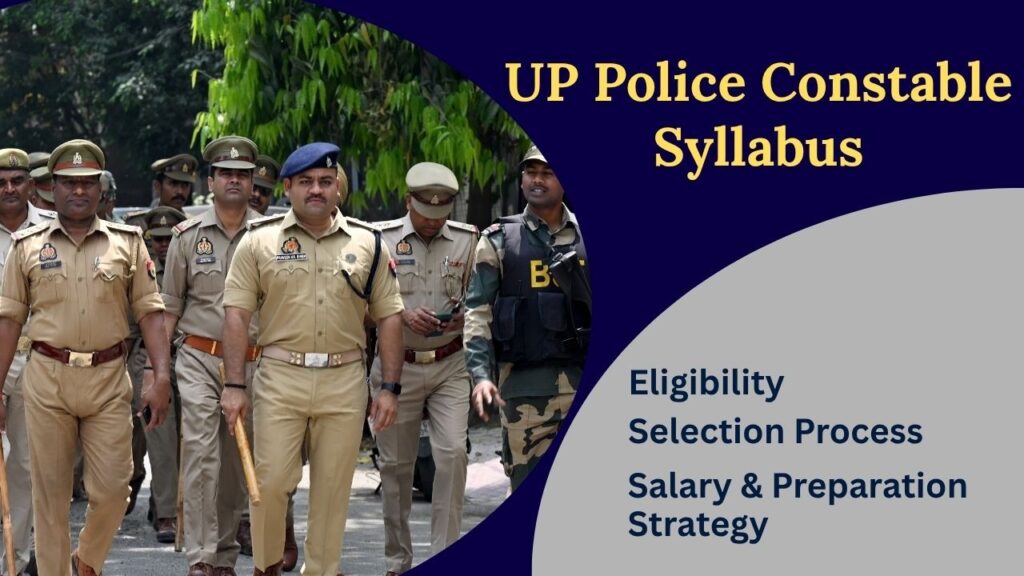
Getting a government job in India isn’t a cakewalk, and UP Police Constable exam is no exception to it. Every year, thousands of applicants vie for handful vacancies, which is making it one of the popular and toughest exams in the state. With a right approach toward UP Police Constable syllabus, and with persistent preparation, this target is of course achievable.
If you want to put on the khaki with pride or if you want a stable career with good salary and benefits, this exam could be your ticket. But these benefits asked you to work harder and get it. This breakdown—eligibility, selection process, syllabus, salary, and a practical preparation plan of UP Police Constable will help you plan to crack this exam.
Eligibility Requirement For UP Police Constable
You need to check eligibility requirements before buying books for studying UP Police Constable syllabus and doing push ups. UPPRPB is recruiting candidates for this post under strict guidelines. So you must follow before applying:
Educational Qualification
No fancy degrees are required for a UP Police Constable. Candidates must acquire 12th standard (Intermediate) marksheet from any recognized board in India.
Age Limit
Male Candidates (General)
18 to 25 years
Female Candidates (General)
18 to 28 years
Reserved category candidates can get age relaxation but you must check the latest recruitment official notification to know age relaxation.
Physical Standards (PST)
Category
UR/OBC/SC
ST
Height for Males
168 cm
160 cm
Chest for Males
79–84 cm
77–82 cm
Height for Females
152 cm
147 cm
Weight for Females
Minimum 40 kg
Minimum 40 kg
UPPRPB Selection Process For UP Police Constable
It’s not just one written exam here, you must pass all the stages to reach that position. It requires commitment and hard work for securing an honourable government job for the nation.
Stage 1: The Written Examination
It’s a written offline OMR-based exam. Candidates have to get above the cut off marks by answering all the MCQs accurately then you move on to the physical rounds. Questions come from the four main subjects (GK, Hindi, Mathematics, Reasoning).
Stage 2: Verify Docs And Physical Standard Test (PST)
Once you qualify stage 1 with preparation and hard work, you need to provide documents– 10th/12th mark sheets, caste certificates, domicile papers for verification. And your body measurements like height, weight and chest (men) will be taken to pass you on to the next stage of selection.
Stage 3: Physical Efficiency Test (PET)
PET is a mandatory exam for candidates without getting marks. This final round can throw you out of the list if you fail.
Running for a 4.8 km run in 25 minutes is a mandatory test for male candidates.
If you are a woman then you must be able to run 2.4 km in 14 minutes.
Stage 4: Detailed Medical Examination (DME)
Physical and mental health matters for this job, it has regulations if you have weak eyesight, color blindness, hearing, flat feet, knock knees.
UP Police Constable Syllabus Breakdown
The written test contains 150 questions which is of 300 marks (2 marks per question). But be careful, there’s negative marking!
The written exam is divided into four main subjects which you can qualify with right preparation on the syllabus.
I. General Knowledge (38 Questions)
Knowing about the world revolves around you, especially Uttar Pradesh is necessary. GK tests you based on the questions based on national and international current affairs, History/Civics, Geography, Science and Finance of India.
II. General Hindi (37 Questions)
If you attended a Hindi-medium school, this is your section to score. Even if you didn’t, you can get good marks by doing some basic grammar practice. Focus on Hindi Grammar (Vyakaran) , Unseen Passage, Famous writers & their work, Synonyms, Antonyms, Idioms and Phrases (Muhavare).
III. Numerical and Mental Ability (38 Questions)
Question comes from basic mathematics of 9th and 10th, if you are good at maths then practice daily on Number systems, Percentages, Profit & Loss, Ratio and Proportion, Simple & Compound Interest, Time, Work & Distance, Mensuration and Data Interpretation (Tables and Graphs).
IV. Mental Aptitude, IQ & Reasoning Ability (37 Questions)
This part examines your mind and thinking ability, and also tells you how you could potentially think in police work situations. Coding-decoding, Series, Blood Relation, Direction Sense, Syllogism, Venn Diagram, Non-Verbal (Pattern and Figure). There will also be situation based questions to test your attitude towards public interest, laws and order, communal harmony and police force.
How to Prepare For A Police Constable
Avoid beginning to study with difficult mock tests. Instead, strengthen your foundation with standard books like Lucent GK, R.S. Aggarwal (Math & Reasoning) and a good hindi grammar book.
Keep practicing last year’s question papers. They give you a clear idea about the exam level and the types of questions that are asked. UPPRPB also has a penchant for posing questions similar (even a same question sometimes) to what they had already asked.
Once you have completed about 60-70% of the syllabus, begin attempting full-length mock tests. Use a timer when you practice so you can work on your speed and accuracy. Check your mistakes to correct them each day.
Don’t neglect physical fitness. Most candidates qualify the written exam but they are unable to clear the 4.8 km run. Something as simple as a 30-minute jog each day will smoke out your stale lungs and build your stamina.
So, for the present events keep it simple. Just subscribe to a good monthly magazine (eg. the Economist) or a decent Youtube channel and don’t bother with the dailies.
Salary and Perks After Getting a Job
UP Police pays its constables quite a good salary with additional perks that makes it worth the struggle to secure a position.
Category
Amount
Pay Scale
Rs. 5,200 – 20,200
Grade Pay
Rs. 2,000
Basic Pay Matrix
Rs. 21,700
Under the 7th Pay Commission, the salary is distributed but other allowances also given to the constable which sum up to Rs. 27,000 to Rs. 32,000 per month.
Dearness Allowance (DA)
House Rent Allowance (HRA)
Travel Allowance (TA) & City Compensatory Allowance.
Ration Money & Uniform Allowance
Career Growth & Promotions
A government job is not just a job, it is a career for a lifetime. Joining as a Constable does not imply that you will retire with that rank. The UP Police is providing a transparent path for promotions along the years of services, departmental exams and your performance record.
Police Constable (Your starting point)
Senior Constable
Head Constable
Assistant Sub-Inspector (ASI)
Sub-Inspector (SI)
Inspector
If you have the ambition, you can appear for departmental exams for Sub-Inspector which will speed up your promotion rather than waiting wholly on seniority. An honest and sincere police officer can easily get retired as Inspector and in some rare cases even as DSP (Deputy Superintendent of Police) from the post of Constable with the blessing of the Almighty.
Passing the UP Police Constable exam is a challenge for mind and body. It needs a balanced approach, practicing math and checking daily news then getting up to run on the track.
Focus on UP Police Constable Syllabus and your health to secure your position. The large number of applicants is not to be discouraging. You just need to prepare yourself for one seat.
The salary and additional perks are good with lifetime growth opportunities in the department, so there’s a golden door, you just need to jump long.
It is now or never for those aspiring for an administrative job in Uttar Pradesh. On 30 March 2026 the notification of UPSSSC Lower PCS 2026 Recruitment was released to recruit candidates on various positions. A large number of candidates regard this as an excellent chance to get their foot in the door of the executive branch of the state, as opposed to merely an employment opportunity.
This recruitment drive offers 2,285 job vacancies for 11 different departments for aspiring candidates. Look out this blog for every date and details to apply.
The 2026 notification is surprisingly wide, including departments from Urban Development to Agriculture. With this range if you come from a background in Commerce, Arts or Science there is a niche for you.
Post Name
Vacancies
Assistant Treasury Accountant
548
Auditor (Lekha Parikshak)
419
Amin / Auctioneer
323
Executive Officer (Nagar Nikay)
238
Clerk-cum-Typist / Cashier
229
Assistant Consolidation Officer (Chakbandi)
168
Assistant Manager (Non-Technical)
134
Mandi Supervisor Grade-2
46
The posts of Executive Officer and Assistant Treasury Accountant are generally the most popular on account of the potential for administration and advancement.
Eligibility for UPSSSC Lower PCS Recruitment
The lower PCS threshold has a dual-eligibility gate. It’s not just about having a degree, you have to have the right “ticket” from last year.
1. The PET 2025 Mandate
In case, you possess a valid score card with non-zero marks and you didn’t appear for Preliminary Eligibility Test (PET) in 2025 then you are not eligible to apply for the Lower PCS 2026. To prepare a Initial Main exam list, the Commission consider PET scores.
2. Educational Qualifications
If you have a graduation degree from any field, you are eligible to apply for this recruitment.
Post-Specific Qualifications:
Executive Officer: Graduation is sufficient to apply, but for the purpose of regularisation, you require to have ‘O’ Level Computer Diploma from NIELIT.
Auditor: This post usually prefer candidates who are commerce background (B. Com) or post graduate diploma in accountancy.
Clerk-cum-Typist: in Hindi, 25 w.p.m. of speed is required.
3.Age Limit (As of July 1, 2026)
The starting range of age is 21 years and you are allowed till 40 years. The government expands the maximum age limit according to the candidate’s category.
The Selection Process UPSSSC Lower PCS 2026
There are not so many long detailed interviews for these jobs now. The process for choosing the 2026 hosting is now simpler and more merit based.
Shortlisting: Candidates will be shortlisted for consideration based on their normalized PET 2025 scores.
Main Written Examination: It is the most important stage and most of the times it determines your final selection.
Document Verification (DV): The last stage in which all your papers and certificates are verified for genuineness.
Exam Pattern (Mains)
Feature
Details
Total Questions
100 MCQs
Total Marks
100
Duration
2 Hours (120 Minutes)
Negative Marking
0.25 (1/4th) per wrong answer
Core Syllabus of UPSSSC Lower PCS
There are three papers in the 2026 syllabus. The secret is to find the right balance between the static general knowledge part and the dynamic UP Special part.
Part 1: Subject related & General knowledge (65 Marks)
It covers the History of India and the Indian National Movement, Polity, Constitution, World Geography, and the Indian Economy. Science, Technology and Environmental Ecology also receives a great deal of attention.
Part 2: Computer & IT (15 Marks)
With all the focus on e-governance, you will be tested on hardware/software, IT gadgets, MS Office (Word/Excel) and Internet Protocols.
Part 3: General Knowledge of Uttar Pradesh (20 Marks)
This is often where homegrown candidates excel. It deals with the history, culture, art, festivals, geography, and present administrative patterns of UP.
In 7th CPC, UPSSSC Lower PCS salary range is lucrative that lies between Pay levels 4 to 6.
Pay Scale: ₹25,500 to ₹1,12,400.
Salary range depends on region and profile of the job (Class A, B, OR C) so it can be up to ₹32,000 to ₹45,000 a month in-hand salary.
Benefits: HRA, DA, medical facilities, and the prestige of being a “Gazetted” or senior “Non-Gazetted” government officer.
Step-by-Step Instructions To Fill the Form
Sign In: Visit here and search for UPSSSC Lower PCS Online Application Form 2026. Register yourself with mobile/email or login.
Information: Your personal information (Name, DOB, Gender, Domicile, Education) are required to be filled by you carefully.
Documents: Attach all necessary documents required to validate your information.
Payment of Fees: A token application fee of Rs 25 has been imposed across all categories (General/OBC/SC/ST). Please be informed that in case you are shortlisted for the Mains, a separate exam fee has to be paid subsequently.
Print: Keep a print out of the final submitted application form at the time of Document Verification.
Conclusion
The UPSSSC Lower PCS 2026 is a great opportunity for those who want to serve the people of Uttar Pradesh with a stable and respected career. The window from May 29 to June 18 is going to be too fast for you to catch it so keep your files ready (especially your PET 2025 scorecard and caste/domicile certificates).
Candidates who are waiting to know their exam city, can now check UPSSSC PET Exam City 2025 on the official website of Uttar Pradesh Subordinate Staff Selection Commission. Candidates can check the exam centers online by clicking on the link mentioned here. The 2025 PET exam dates are 6th & 7th September, 2025, candidates must prepare themselves for this exam.
Check out the details of this exam and download notice of the exam city list 2025. If you want to know eligibility and other details in depth, you can download the official notification.