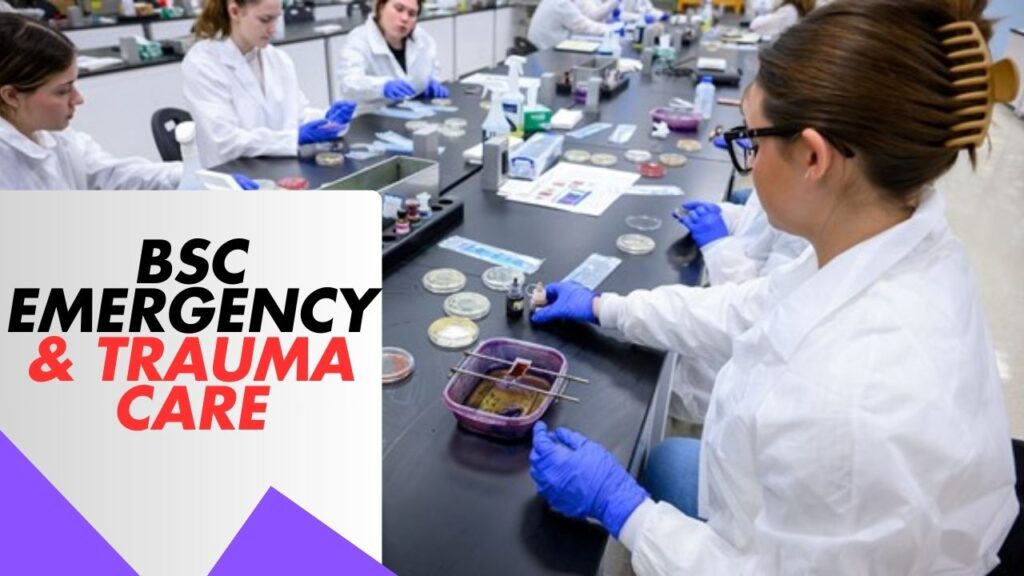
In the intense hospital setting, there is a place where seconds count and the word “routine” hasn’t been uttered in years. It’s the Emergency Room (ER) after BSc Emergency and Trauma Care. Although the faces with which we most commonly associate life saving are those of the doctors and nurses, there is an equally specialised group of para-professionals working with them: Emergency and Trauma Care Technologists.
Requirement for BSc Emergency and Trauma Care
A candidate must possess 10+2 in Science (PCMB/PCMC) & it’s important to know that some colleges asked for a 45%- 55% minimum score. This course prepares students to pursue a career on an emergency basis like when an urgent requirement of a doctor arise in an emergency room, on an operating table etc.
English is normally compulsory subject in class 12th and you should be minimum of 17 years of age at the time of the admission, medical fitness certificate is also required at times.
Duration and Course Subjects
The 3-4-year BSc Emergency and Trauma Care course enables students with the necessary skills and knowledge to deliver care to the traumatized and the emergency patient. The content sequentially increases in complexity starting with the basic sciences and advancing to clinical interventions.
The following topics are repeatedly addressed:
Basic Sciences
- Human Anatomy
- Physiology
- Biochemistry
- Pathology
- Microbiology
Emergency Care
- Emergency Medical Services
- Pre-hospital Trauma Life Support
- CPR & Airway Management
- Hemorrhage Control
Clinical Emergencies
- Medical Emergencies
- Trauma & Surgical Emergencies
- Pediatric and Special Population Emergencies
- Critical Care Technology
The program is focused on theoretical and clinical training, designed to equip students to manage high-stakes trauma environments with both assurance and thoroughness.
Semester Breakdown
| Semester | Core Subjects |
| 1st/2nd | Anatomy, Physiology, Biochemistry, Intro to EMS, Pharmacology |
| 3rd/4th | Medical Emergencies, Trauma Emergencies, Pathology, Biostatistics |
| 5th/6th | Disaster Management, Patient Monitoring, Advanced Life Support |
Mail Skill You Must Have
While the “BSc” part of the title sounds academic, the job is deeply emotional. You will become a patient’s life-saver on the worst day of their life.
Empathy in the moment is a talent they don’t always rate you on, but it’s the most important one you’ll have. You’re not just treating a body but also confronting the panic and worry and sorrow of the people surrounding it. Those relatives, too, are often in over their heads, and those patients are frightened. You’ve got to be a genuinely kindhearted person to remain calm, tell them everything will be all right and comfort them while you are doing something like firing up a ventilator.
Career Goal
The demand for graduates from the BSc Emergency and Trauma Care course continues to grow within the health care industry, with opportunities for employment with both public and private providers, transport focused roles in emergency situations, and roles such as the immediate stabilization of patients. It is one of the best courses which open your professional way with good packages because experience in this field has many different responsibilities.
Roles & Responsibility
| Role | Responsibility |
| Trauma Technician | Take part in Trauma Cases with surgeons and ER doctors to stand as a pillar on saving lives. |
| Emergency Medical Technician (EMT) | Quick Response to save life’s on the spot emergencies techniques. |
| Flight Paramedic | Working on air ambulances or rescue helicopters for remote locations. |
| Critical Care Assistant | Managing patients in the ICU who require constant monitoring. |
| Disaster Management Officer | Working with Social Work Organisations like NGOs or governments to plan responses to natural disasters. |
Top Employers
| Sector | Examples |
| Hospitals | Apollo, Fortis, Max Healthcare, Medanta |
| Ambulance Services | GVK EMRI, Air Ambulance |
| Government/Other | Indian Red Cross, Fire Department Emergencies, Disaster Organizations |
Jobs Salary After BSc Emergency & Trauma Care
The BSc Emergency and Trauma Care salary in India varies as per the job position, skills, experience, work location (metros like Delhi, Bangalore provide higher salary) and type of the company. For 3 to 5 years of experience, the salary can be 5 — 8 lakhs per year along with allowances for shifts or overtime.
Salary by Role
| Role | Fresher Salary (₹/month) | Experienced salary in LPA |
| Emergency Medical Technician | 20,000-40,000 | 3-7 |
| Trauma Care Technician | 25,000-50,000 | 5-8 |
| ER Coordinator | 30,000-55,000 | 5-9 |
| Disaster Specialist | 40,000-70,000 | 6-10 |
How to Get Government Jobs After This Degree
For government job after BSc Emergency and Trauma Care, concentrate on the paramedical recruitment in state health departments, NHM, and hospitals as these are the very places that consider this as a preferred degree for EMT and trauma-related Jobs.
Preparation includes watching portals, acquiring certifications such as BLS/ACLS, and passing written tests or interviews.
Steps to make a career in government healthcare or allied services:
- Get updated: Get into the habit of visiting the official websites regularly i.e. NHM, State Health Society, ESIC, AIIMS, and 108 Ambulance Services. These sites raise alerts for complainants for job notification, recruitment-related news and other information which might help you get one step closer to your dream job.
- Boost your profile: Having professional certification can do wonders in polishing up your resume. Courses like BLS (Basic Life Support), ACLS (Advanced Cardiovascular Life Support) and ITLS (International Trauma Life Support) bring weightage to your profile. Along with these certifications, relevant field experience 1-2 years will make a great difference in your selection.
- Apply and Prepare: Apply online for exams that generally comprise multiple choice questions (MCQs) on anatomy, emergency care, and general information.
| Recruiter | Roles | 7th CPC Salary |
| NHM/State Health Societies | EMT/Paramedic | Rs 25500—81100 at Level-4 Rs 35400—1,12,400 at Level-6 |
| AIIMS/Government Hospitals and ESIC | Trauma Technician, ER Assistant | Rs 25000—50,000 entry role |
| Armed Forces/Disaster Bodies | Ambulance Technician | Varies by level |
The Future of Emergency Care
As medicine becomes more specialized, the need for full-time trauma providers is growing exponentially. We are going from “general” care to “specialized,” rapid response. With the advent of smart ambulances and telemedicine, an BSc Emergency and Trauma Care alumnus is no longer a mere “aide”, they are a high-tech clinician leading the cutting-edge of medicine.
Read more: MPESB Group 5 Paramedical Recruitment 2026
Conclusion
A BSc Emergency and Trauma Care is not just an academic qualification; it is a key which opens the door to the human condition. It is a profession for the strong, the fast-thinking and the kind. If you’re looking for a career in which you’ll keep on learning, and where you can tell people, “You really needed me today,” this is the road for you.