UPSSSC UP Combined Lower Subordinate Services (Graduate Level) Recruitment Process, Eligibility, And Salary

UPSSSC UP Combined Lower Subordinate Services

Get ready to secure a UPSSSC Lower PCS job to enjoy purposeful life in Uttar Pradesh. UPSSSC UP Combined Lower Subordinate Services (Graduate Level) recruitment is live right now, you can fill the application now. But you must understand each phase of selection, eligibility and preparation to pass the exam.

With 2,285 vacancies up for grabs, this is one of the biggest opportunities of the year for graduates looking to secure a Group ‘C’ administrative foothold in the state.

What is UPSSSC Lower Subordinate Services? (Job Profile)

The Lower Subordinate Services recruitment fills different positions in state government offices. There are most common job roles such as executive, supervisory, and auditing that require candidates who can immediately step into the work to handle public services, implementing government schemes, and making sure rules and policies are followed properly. 

The roles are just simple desk jobs, they offer executive authority to tackle every task. Depending on your qualification and ranking, you could land any of these roles:

  • Executive Officer (Municipal Administration): Manages urban local bodies, public civic amenities, and local revenue collection.
  • Assistant Treasury Accountant / Auditor: Ensures fiscal health, monitors departmental budgets, and conducts financial audits.
  • Mandi Supervisor / Amin: Oversees agricultural market regulations, auction fair play, and revenue reporting for the Mandi Parishad.
  • Assistant Consolidation Officer (Chakbandi): Resolves land disputes, manages agricultural land redistribution, and maintains accurate land maps.

Who Can Apply? (Eligibility Criteria)

Before you hit apply, ensure you tick all the structural requirements set by the UPSSSC:

Educational Qualification

  • Mandatory Foundation: You must hold a Bachelor’s Degree from a recognized Indian university.
  • The PET Gateway: The Main exam needs a valid PET scorecard otherwise they will not let you enter in the exam hall. 
  • Post-Specific Extras:
    • For Auditor/Accountant: You must hold a B.Com degree. 
    • For Mandi Supervisor: Degree in Agriculture, Commerce, or Economics with a minimum of 50% marks.
    • Executive Officer: A computer ‘O’ Level diploma is required for service confirmation.

Age Limit (As of July 1, 2026)

Minimum 21 years
Maximum 40 years.
Age relaxation given to reserved categories ( OBC, SC, ST, )and Ex-Servicemen 

Important Dates & How to Apply

The application window is brief, so do not leave things to the final day when servers traditionally crawl to a halt.

Application Starts29/May/2026
Last Date to Apply18/June/2026
Correction Window Last Date25/June/2026
Admit CardUpdate Later

Step-by-Step Application Process

The Commission relies heavily on your existing PET data to make authentication seamless:

  1. Authentication via PET: Go to the official portal at upsssc.gov.in. Use your PET-2025 Registration Number to login for UPSSSC Lower PCS.
  2. Check Details: Information about your qualification, photograph, caste category are automatically filled from the PET database. Verify everything carefully and fill out any pending post-specific preferences.
  3. Submit Processing Fees: Pay the standard online processing fee of ₹25 for all categories via net banking, UPI, or credit/Debit cards. Note: Shortlisted candidates will pay the structural Main Exam fee later.
  4. Final Printout: Review your final application form, submit it, and download/print the confirmation form for verification rounds.

Vacancy Matrix (2,285 Posts)

The vacancies span several state departments, providing brilliant diversity in career paths. Here is how the open positions look across major segments:

Department / BoardPost NameVacancies
Directorate of Treasury, UPAssistant Treasury Accountant548
Cooperative Societies & PanchayatAccounts Inspector / Auditor419
State Agriculture Mandi ParishadAmin / Auctioneer / Clerk552
Municipal Administration DirectorateExecutive Officer238
Office of Consolidation CommissionerAssistant Consolidation Officer168
Other Allied DepartmentsTechnical Assistants / Supervisors360

Selection Process & Exam Pattern

Getting selected requires navigating a clear, objective framework. There are no interviews for these Group ‘C’ cadres. Your merit relies entirely on written execution.

Step 1: Get UPSSSC PET 2025 Scorecard first

Step 2: Give Main exam and secure good marks

Step 3: Document Verification to check all the information is valid in your application.

The Exam Blueprint

Prepare yourself with understanding the topics that are important in this exam, Lower PCS exam pattern includes:

  1. General Intelligence & Reasoning: to test your logic ability and analytical thinking.
  2. General Knowledge (GK): knowing about your Uttar Pradesh is important to handle any work regarding the state. So increase knowledge in Indian History, Geography, Polity, Economy, and Uttar Pradesh’s History, Administration, and Culture.
  3. General Science & Arithmetic: basic level physics, chemistry, biology, and math.
  4. General Hindi: Focuses on comprehensive reading, letter writing, grammar (Sandhi, Samas, Muhavare), and vocabulary translation.

Strategic Preparation Plan

The competition is high so you have to make a plan that helps you achieve good scores over fractions of marks. Here is a realistic roadmap:

  • Own the UP Specific Section: Knowledge of the state will let you secure 20-25% of GK questions. Research and keep updated with Uttar Pradesh’s budget, schemes, geography, and cultural folklore. Dedicate solid hours to local current affairs.
  • Do Not Avoid Hindi: General Hindi is highly scoring. Mastering basic grammar rules and practicing official letter formats can drastically push your score above average cut-offs.
  • Analyze Mock Tests Weekly: Build your speed and precision. Track where you lose marks to negative scoring and adjust your accuracy levels accordingly.

Read More 👉 Quick Preparation Guide for UP Polytechnic JEECUP 2026

Salary and Career Growth

Let’s talk about the rewards. Apart from massive social prestige, these positions offer financial stability governed by the 7th Pay Commission.

The salary of Uttar Pradesh. Combined Lower Subordinate Services (Graduate Level) are based on their job profile and experience but it ranges between Pay Level 4 to Level 6.

Level 4 (Clerks/Typists)₹25,500 – ₹81,100
Level 5 (Accountants/Amin)₹29,200 – ₹92,300
Level 6 (Executive Officers/ACO)₹35,400 – ₹1,12,400

In-Hand salary will increase because of the multi allowance you will get once you are assigned to your job. So the entry-level gross salaries range from ₹35,000 to ₹55,000 per month depending on city tiers.

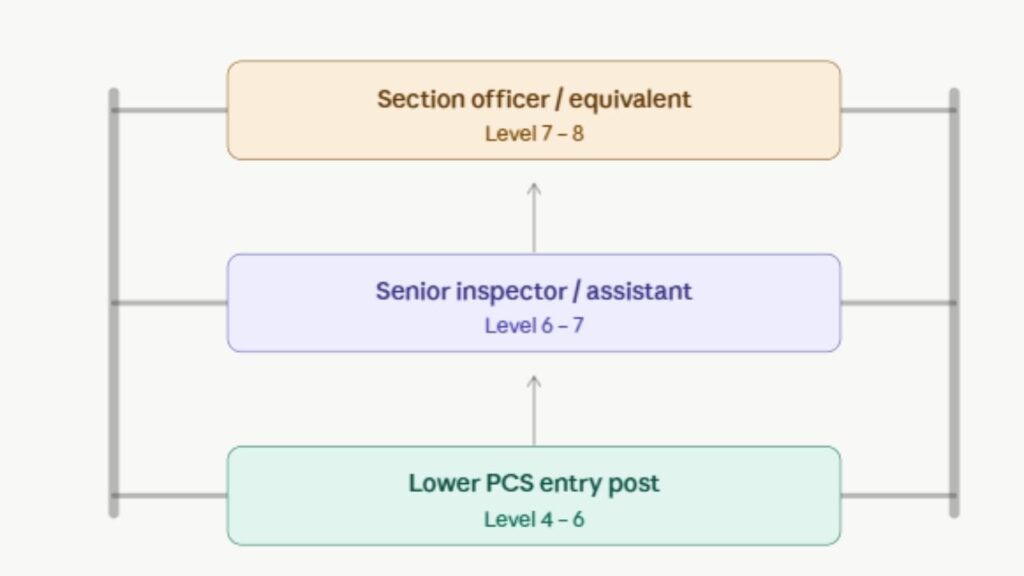
The Promotion Ladder

Your career trajectory doesn’t stall. Junior officers systematically advance through departmental reviews and service experience:
Conclusion

The UPSSSC UP Combined Lower Subordinate Services (Graduate Level) Recruitment is a cycle that ends in a few days and you need to fill the form if you don’t want to miss this opportunity to secure a career in Uttar Pradesh. The competition is very high for the 2,285 seats, so the right strategy to prepare for the exam is mandatory.

Ensure your application goes through successfully before June 18, lock down your study desk, and start structured preparation today. For a comprehensive breakdown of the syllabus, safe score metrics, and targeted departmental tactics, check out this detailed UPSSSC Lower PCS Strategy Guide which covers exactly how to maximize your score in the Mains exam.

Leave a Comment

Your email address will not be published. Required fields are marked *

Top 10 MBA Colleges in India with Fees, Ranking & Placement 2025

Top MBA Colleges in India with Fees

If you are planning to pursue an MBA in 2025, you must know that there are the most prestigious management institutes in India which acquire the best education and placement opportunities around the globe. Here’s the top 10 MBA colleges in India that provide you complete education that opens the door to global careers.

Whether you graduate in BBA/BCA or B.Com or any other degree, you can pursue Master’s in Business Administration. You must understand that holding a degree is not valuable if it’s not from colleges that opens the career goals. They provide top education, assessments, and advanced concepts for business management. They built you a job ready degree holder and companies like Accenture and Microsoft are recruiting candidates from these colleges.

IIM Ahmedabad (IIM-A) is a top-notch college for MBA program that offers opportunity at global level. Its Post Graduate Programme in Management (PGP) is highly known for global recognition. Students from IIM colleges have settled in well known industries because of their knowledge and skills. Taking admission in this college is hard, you must clear the entrance exam i.e. CAT, WAT (written Ability Test) and Personal Interview.

ParameterDetails
FeesThe IIM-A fee is around ₹25 lakhs
NIRF Ranking#1
Average Package₹35.68 LPA
Top CompaniesMcKinsey, BCG, Goldman Sachs, Bain

IIM-B is built to establish a student’s career by providing PGP. The high ranking students from this college have become successful businessmen. The courses offered by this college are PGP and EPGP. The same process goes with this college too, students have to take admission through CAT, WAT, PI. 

ParameterDetails
Fees₹24.5 lakhs
NIRF Ranking 2024#2
Average Package₹35.31 LPA
Top CompaniesAmazon, Accenture, Deloitte

Indian Institute of Management in Calcutta also high in ranking, by getting admission into this college can open gates for career growth. You must prepare hard to clear the CAT exam. It has a valuable stand off on the international industries, and you can stand a chance to work in one of them. curriculum. It offers a flagship PGP program. Admission is processed the same, CAT, followed by PI and WAT.

ParameterDetails
FeesThe IIM-C fee is around ₹27 lakhs
NIRF RankingThis college ranks in the top 5
Average PackageAround ₹35.07 LPA (last year’s top students)

If you are a professional with 2+ years experience and want to grow up your level in industry, it requires an MBA from top institutes. You can pursue a one year program from ISB, Hyderabad/Mohali. You can take admission by clearing GMAT/GRE. Academic profile, and work experience also required for the admission.

ParameterDetails
Fees₹42 lakhs
Average Package₹34.08 LPA
Top RecruitersGoogle, Kearney, Microsoft, Tata

MBA or PGP from IIM Lucknow is the best choice as it is a top management college. Taking admission in one of the best management colleges is tough but placement packages are worth it. Admission is through CAT, followed by PI.

ParameterDetails
Fees₹12 lakhs
NIRF Ranking#7
Average Package₹32.2 LPA
Top RecruitersAxis Bank, OLA, HUL, Amazon

Notable alumni like Harit Nagpal and Anupama Verma are proof that FMS, Delhi University has a reputation globally. You can take admission after clearing the CAT exam, extempore, PI, academic background is also required for admission in FMS. It offers ROI for its MBA program with less fee.

ParameterDetails
Fees₹2.32 lakhs
NIRF RankingTop Tier
Average Package₹34.1 LPA
Top RecruitersBCG, ITC, Nestle

By getting admission into XLRI college in Jamshedpur can establish your career on the next level. This is the oldest institute for management courses, still in rank due to their high quality education and placement packages. The admission process for XLRI is based on the entrance exam score. 

ParameterDetails
Fees₹15 – ₹30 lakhs (for management courses)
NIRF RankingUnder top 10
Average Package₹27 LPA
Top RecruitersTata Steel, HUL, Deloitte

NMIMS in Mumbai is the best college. This is the best choice for students who can’t afford expensive colleges. It offers management courses that include sectors like finance, marketing, analytics, and HR. The course itself is a training that polishes your mind to work in industries. Getting into this college by scoring in the NMAT entrance exam.

ParameterDetails
Fees₹12–14 lakhs
NIRF Ranking#21
Average Package₹10 LPA
Top RecruitersWipro, Infosys, and TCS

SPJIMR focuses on values-based learning. Students who want to acquire knowledge on real-time management systems can get admission into this college. It also offers practical orientation. It also offers family-managed business programs. The admission in this college happens through CAT/XAT/GMAT, followed by WAT and PI.

ParameterDetails
FeesAround ₹20.4 lakhs
NIRF Ranking#20
Average Package₹33 LPA
Top RecruitersTata, Deloitte, Godrej, BCG, and Accenture

MDI offers PGDM, PPM, HRM, and IB programs. MDI is one of the top colleges in post graduation programs especially management courses. It is a great option for students to build their career by taking admission. The admission through CAT + GD/PI.

ParameterDetails
FeesAround ₹18.5 lakhs
NIRF Ranking#11
Average Package₹26.7 LPA
Top CompaniesMaruti Suzuki, automobile companies, EY

Read More 👉 Government Job vs Private Job: Which Career Offers a Better Future in 2025?

  •    For IIMs, FMS, MDI: Take CAT (Common Admission Test) examination.
  •    For XLRI: You need to clear XAT for admission.
  •    ISB: Score in GMAT or GRE.
  •    For SPJIMR: You can take any of these exams – CAT/XAT/GMAT.
  •    Aim for 98+ percentile for top IIMs
  •    Top 95 percentile for FMS and IIM-A/B/C
  •    Above 710 score needed for the admission in SBI.

When you aim high your scores get well absolutely in the 80s but the competition is high. So, better prepare for top 90s to get shortlisted for admission in IIMs. 

  •     Written Ability Test and Personal Interview are important. 
  •     Focus on communication, current affairs, academic knowledge
  •     Get online resources for preparation to pass this last process.
  •    Good academic scores
  •    Work experience (for ISB, SPJIMR preferred)
  •    Extracurriculars, leadership roles, certifications
  •    IIMs release applications right after CAT registration
  •    ISB follows separate cycles: Early Entry, Cycle 1, and Cycle 2

The final selection is based on Score in CAT/XAT/GMAT + WAT/PI + Academics. If you are a working professional then your work experience is also considered.

These top 10 MBA colleges in India can transform your career path from student to MBA professional. They offer seamless management education that builds up your knowledge power. You can get excellent placement packages, and lifelong networking opportunities.

Admission process is challenging, you need to focus on consistency in preparing for their entrance exams. To clear Interview, you need to adapt discipline and current affairs. Whether you are a graduate student or a working professional, to get admission in these colleges by focusing on building your profile, cracking the entrance exams, and acing the interview rounds.

Leave a Comment

Your email address will not be published. Required fields are marked *

MPPGCL AE/ JE Recruitment 2025 Officially Out – Gov Update Wala Has All the Details!

MPPGCL AE JE Recruitment

MPPGCL has officially announced the release of notification for MPPGCL AE/JE Recruitment 2025 on their official website. Candidates can start filling application forms before the portal will close on 21/Aug/2025. Download the official notification for more post-vise eligibility details. You can find a direct link for the official application form link in the article below.

Short Details For MPPGCL AE/ JE Recruitment 2025

Recruitment BoardMadhya Pradesh Power Generating Company (MPPGCL)
PostAssistant Engineer, Plant Assistant, Officer Assistant, Junior Engineer, & other various post
Level of ExamState-Level
PurposeMadhya Pradesh Government is enlisting candidates through this exam for various posts.
Total Posts346
Exam ModeOnline/CBT
Official WebsiteClick Here

MPPGCL AE/ JE Recruitment Dates

Application Starts On23/July/2025
Last Date for Application21/Aug/2025
Last Date for Fee Submission21/Aug/2025
Exam DateUpdate Soon
Admit CardUpdate Soon

Read More 👉 HTET 2025 Admit Card Out: Download Now from bseh.org.in for 30-31 July Exam

MPPGCL AE/ JE Recruitment Eligibility

Candidates can apply for JE post if they are above 18 years old. The minimum age for other posts is 21 years and maximum age is 43 years

Assistant EngineerBachelor’s degree in Engineering such as BE/B.TechObtaining score must be above 65% (Gen/OBC) or 55% (Reserved Category)
Junior EngineerDiploma/Bachelor’s degree in Engineering such as BE/B.TechObtaining score must be above 65% (Gen/OBC) or 55% (Reserved Category)
Other Post10+2 is mandatory in most of the posts. 

Steps To Fill MPPGCL AE/ JE Recruitment Application Form

Step 1Click on the link to the official website. The link will redirect you to the official website of MPPCGL, Haryana.
Step 2On the Official Website, Click on Careers, the new page will open.
Step 3Click on the link “Direct Recruitment For AE/JE” 
Step 4Register yourself by entering your correct details.
Step 5Pay the Application Fee after checking all the details carefully.
Step 6Save the copy of application for future preference
Application Fee
GeneralRs. 1200
EWS/OBC/SC/STRs. 600
Payment ModeOnline
Important Links
Application LinkClick Here
Download NotificationClick Here
Official WebsiteClick Here
HomepageClick Here

Leave a Comment

Your email address will not be published. Required fields are marked *

How to Join Indian Army — Your Complete Guide to Serving the Nation

How to join Indian Army

How to join Indian Army: It’s not just a job, a profession or a service, it’s a way of life to be in the Indian Army and a lifetime commitment to the nation. For millions of young Indians, the olive-green uniform stands for honor, meaning and pride that far surpasses any regular jobs. But the path to joining the Indian Army isn’t a smooth one it requires vision, preparation, stamina and the knowledge of different entry points available. 

Whether you are a 10 or 12 student, a graduate or one aspiring to get commissioned, the Indian Army has multiple avenues to make that dream a reality. Unique in this sense, this guide shows you everything from entry schemes, through selection stages, fitness, documents, medical standards, ensuring that you can prepare as best you can to help you realise your own dream to serve the nation with pride.  

Understanding Your Entry Options

There are hardly any rigid models for recruitment of the Indian Army. The company understands that people with potential can come from anywhere educationally and that is why it has different entry schemes. If you are a class 12 passer, the Agniveer scheme is for you. If you’re a graduate or an engineer, you can apply for the Short Service Commission (SSC) or the Technical Graduate Course (TGC). For people still in class 12 with strong academics, the NDA is a well-known route that leads to officer-level commissions.

What I like about Indian Army recruitment is its open door policy. For soldiers and officers, technical and manpower roles for that matter, there is something for everyone. Your starting point might be different from your colleague’s, but the destination – serving the nation – is the same. 

The Most Popular Route: Agniveer Scheme

For most hopefuls it has become like the Agniveer scheme and this is the only option going forward. Introduced to recruit a younger, more dynamic force into the Armed Forces, the scheme is available for men and women aged 17.5 to 21 years. You must have passed class 10th/12th from a recognized board with minimum 50% marks in aggregate.

The submission of the application is easy. Go to the official site joinindianarmy.nic.in and register providing your basic details, e-mail and mobile number. You will fill up application details with your 10th certificate with as per rules. After you have submitted, you will be given a registration number—hold on to this, it is the key to the next step. 

Read More 👉 UPSSSC Lekhpal Online Form 2025: Apply Online for 7,994 Revenue Posts

The Three-Phase Selection Gauntlet

After the registration you must prepare yourself for three intense stages. The first state is the Common Entrance Exam (CEE), a written test conducted offline. This test examines your understanding of General Knowledge, Mathematics, Science and Reasoning. It’s not like you need to memorize stuff, the exam is on your logical thinking and problem solving skill.

If you clear the CEE, then you will be invited for the second stage: the Recruitment Rally. This is your physical fitness moment! The rally comprises a Physical Fitness Test (PFT) which is truly exhausting. You must run 1.6 km in 5 minutes and 45 seconds, do at least 6 pull-ups, jump a 9-foot ditch, and complete a zig-zag balance test. They’re not just random drills, they’re meant to test whether or not your body can keep up with the rigors of military life.

The third stage is the medical test and document confirmation. Medical examinations are extensive – they examine your vision, hearing, bone density, heart health, and your general well-being. The Army needs soldiers who aren’t just strong but also medically able to go where it’s hard to go. 

Physical Fitness

Being physically fit matters, and you really can’t ignore your way through it. If you really want to join, start your fitness regimen now. Running is your foundation—start with distances you can handle and slowly increase your speed and distance. Do interval training by alternating between high-intensity bursts and recovery intervals.

For pull-ups, who you are is more important than how many you can do right now. If you have no pull-ups yet, use resistance bands/assisted pull-ups or work on negatives to start building strength. Add push-ups, sit-ups and squats for full body strength. Flexibility and balance are also important for many candidates don’t realise, but it is this which is tested in the zig-zag test. Add yoga and agility drills to your training.

Nutrition-related matters are just as vital/nutrition matters are just as vital/nutrition is just as vital Nutrition & hydration are equally important Nutrition Jones in Sydney opined: “it is not only the training [that is important], nutrition is [also]. Fuel your body with protein, complex carbohydrates, fruits and vegetables. Keep hydrated as you train, and stay away from junk food that zaps your energy. 

The Officer Route: A Different Path

If you are a class 12 student with good academic record and want to join Indian Army, consider the Technical Entry Scheme (TES for NDA) or the National Defence Academy (NDA). The NDA is conducted by the Union Public Service Commission (UPSC) and the applicants must be aged between 16.5 and 19.5 years have qualified 10+2 to be eligible. The competition is stiff with only 5 to 10 percent getting selected but the reward is a three year training at the National Defence Academy and then a permanent commission in the Indian Army.

​For graduates, the Combined Defence Services (CDS) exam, which leads to Indian Military Academy (IMA). Male and female candidates who are graduates are also eligible and the selection procedure consists of a written exam and then the infamous Services Selection Board (SSB) interview.

The SSB Interview: The Ultimate Test

If there is a stage that divides the dreamers and the doers it is the SSB interview. This isn’t your run-of-the-mill job interview; you’ll be subjected to a five-day psychological and personality test to determine how officer-like you are. You will be having the Officer Intelligence Rating (OIR) test, Picture perception and discussion (PPDT), psychological tests, group discussions, outdoor tasks and a personal interview.

Leadership, teamwork, bravery, and the capacity to think on your feet are the qualities that the SSB wants. It evaluates the consistency between what you think, what you say and what you do — an idea based on the ancient “Manasa, Vacha Karmana” principle. The interviewing officer will question your background, your motivation for enlisting, your knowledge of current events, and your capacity to stress. 

Documents Required For This Position

  • 10th and 12th mark sheets and certificates
  • Domicile certificate with photograph
  • Caste certificate
  • Religion certificate
  • School character certificate
  • Unmarried certificate (if below 21 years)
  • Aadhar card or ID proof
  • 20 passport-size color photographs
  • Any NCC certificates or sports achievements

The Medical Examination

After passing the physical and mental evaluations, you will have a full medical check-up. The Army requires its soldiers to withstand harsh environments, so the standards are tough. After you cross this last barrier, you will get your joining letter and will be sent to the respective training academy. 

Conclusion

Enrolling in the Indian Army is not just about getting a job and a stable source of income. You’d be serving your country, joining a brotherhood that has stayed vigilant over the nation for generations, and doing something that’s bigger than you are. The path is tough, the competition is fierce and the training will test you to your limits.

But here is what makes it so worthwhile: the privilege of wearing the uniform, the gratification of serving one’s country, and the realization that you are a member of an organization that has influenced the future of the nation. If you have the passion, if you have the resolve, and if you can run – the Indian Army awaits you. Start today, hold fast, and who knows maybe, just maybe, a year from now you’ll be standing tall in that uniform, serving the nation with pride. 

Leave a Comment

Your email address will not be published. Required fields are marked *

BSc Dialysis Technology: Course Details, Eligibility, Salary & Career Scope

BSc Dialysis Technology

BSc Dialysis Technology course is recognized a professional course under the regimen of which the students are prepared and polished to serve in the field of renal care and dialysis. The course duration is 3 to 4 years and is a mix of theoretical concepts as well as practical training. Subjects studied include anatomy, physiology, renal pathology, dialysis techniques, biochemistry and pharmacology. Also, patient care management is stressed so that graduates will be able to function at a high level in clinical environments, such as hospitals and dialysis centers. 

Eligibility and Admission

Requirements for the Admission in BSc Dialysis Technology courses are the possession of higher secondary education with a science background. Some colleges may also demand entrance tests and/or interviews as a part of the application process. Here is the full breakdown of Eligibility for Bsc Dialysis Technology:

Educational Background:

Candidates are generally expected to have passed their 10+2 or an equivalent higher secondary education examination with science stream (with the subjects of Physics, Chemistry, and Biology (PCB)) from a recognized board.45% to 60% in aggregate in these subjects is required by most institutions coming with variations as per applicant category i.e. general,sc/st or obc. 

Entrance Exams:

BSc Dialysis Technology programs entrance examination may differ from one college to another, however, many colleges conduct B.Sc in dialysis technician examination for admission, to check the candidate’s knowledge and comprehension of basic scientific concepts related to the field of dialysis-tech. So, they accept admissions through their merit scores. 

The mentioned premier institutions including JIPMER, SGPGI and Jamia Hamdard have started admitting students on the basis of entrance exams like NEET, CUET, KCET (Karnataka Common Entrance Test), KEAM (Kerala Engineering Architecture Medical)

But most of the colleges accept students on their 10+2 scores with subjects including physics, chemistry and biology or mathematics.

Admission Process

Check the colleges that offer BSc Dialysis Technology courses then visit their official website to enroll yourself. 

  • The admission portal opens for a short period of time, mostly in April and March. Students need to apply with supportive documents which includes marksheets and certificates of qualifications. Please fill the application carefully while applying for admission.
  • If there is any entrance exam required during the admission then the notification will be released for the examination, you must check carefully.
  • Some programs may also require an interview after the entrance exam to determine if the candidate is truly interested and if he or she would be a good fit for the field of dialysis technology. 
  • Institutions generally prepare a merit list considering aggregate performance in the written-test, interview (if applicable) and the qualifying examination which is used for offering the admission to the applicants. 

BSc Dialysis Technology Syllabus Details

The educational content of the BSc Dialysis Technology syllabus is designed to be comprehensive for developing required skills in students to carry out dialysis procedures and patient care. The course duration is 3 years which may extend to 4 years including internships and practice-based activities. Important topics are:

  1. You’re going to learn the human body’s systems, mainly the renal system, so you know how dialysis works on your body.
  2. Renal Pathology: How the kidneys work, what goes wrong in the different kinds of kidney illnesses.
  3. Understanding Different Dialysis Modalities: Obtain specialized knowledge about various dialysis modalities, including hemodialysis and peritoneal dialysis, such as machine operation, procedures, and patient care during treatment.
  4. Biochemistry Metabolic alterations in patients with kidney diseases and the contribution of dialysis to these biochemical alterations.
  5. Pharmacology Medications used in renal care: Drug interactions and patient safety during dialysis.

The objective of the syllabus is to make the student well versed with the theoretical and practical aspects of the dialysis technology profession. 

Practical Training

Besides the core subjects the curriculum also includes practical modules, which enable the students to become familiar with the real work situation. This training is frequently conducted in the following settings:

  • Clinical Rotations: Students complete clinical rotations in hospitals or in specialized dialysis centers, offering hands-on experience with the dialysis processes and patient care procedures.
  • Simulation Labs: Numerous programs include simulation training to train students in a simulated environment prior to working with real patients. 

Elective Modules

In some universities, optional courses are available where students can develop their knowledge in particular fields, as:  

  • Nutritional Support in Renal Disease: This study unit focuses on the dietary management of renal patients, including those receiving dialysis.
  • Advanced Renal Nursing (Beginners) Suitable for residents who wish to further their nursing knowledge in renal care.
  • Investigations in Dialysis Technology: This section considers new developments and breakthroughs in the renal procedure. 

Assessment Methods

The syllabus often involves different methods of assessment including the following:

Written examinations: To test knowledge of theoretical subject areas.

Practical tests: At clinical rotations or labs, you will undergo testing.

Projects: To promote research and investigation on particular subjects in the field of dialysis technology. 

Skills Acquired in BSc Dialysis Technology

Dialysis Technicians are an important part of the healthcare team, especially in caring for patients with kidney disease that must undergo dialysis. What they need to learn are technical skills as well as interpersonal skills. 

Dialysis technicians require a suitable combination of technical skills and people skills. Technically, they have to operate dialysis machines, watch patient vital signs, handle vascular access and interpret lab results to deliver safe and efficient care. 

They must also be empathetic and possess the ability and skills to communicate with patients, attend to emergencies and work with medical teams. They serve an educational role, as well, teaching patients about treatment, lifestyle and managing illness, so patients can become active participants in their care. 

Career Opportunities & Future Scope

Dialysis technicians are a subset of technologists, who work with the machines located at a dialysis center, the dialysis machine. Indraprastha Apollo Hospitals (New Delhi), Fortis Memorial Research Institute (Gurgaon) and Max Hospital (Several locations) are among the best employers, offering vacancies for patient care technicians and clinical managers.

Hospitals: Dialysis Technicians may work in a hospital setting, providing care to patients who require dialysis. These specialized technicians are essential to deliver safe and effective treatment. 

Travel Placement: Something a few travel dialysis tech are able to do, is to work on a travel basis at various locations. Companies like Nephro Plus help these travel positions, typically with great pay and benefits.

Home Dialysis: Or in some cases, technicians work in the home care arena. Companies like DCDC Kidney Care aiding patients that dialyze in their own homes. They assist with instructions and follow-up care, monitoring that patients operate their equipment safely. 

Some of the top global Dialysis Hospitals and Companies that offer first class patient care, not only this but they hire in a massive figure from India too. So, students can also apply outside of India. There are few top Dialysis centers including AMN Healthcare, Aya Healthcare, Cross Country Healthcare etc.

Career Advancement

Specialization: Dialysis technicians may further specialize, and become a certified dialysis technician (CDT). This certification could improve employment opportunities and generally results in higher salaries and more advanced positions.

Additional Education: Further education, such as an associate’s degree in nursing or supplemental certifications in nephrology, may qualify you for more advanced positions as registered nurse roles.

Management Opportunities: Senior technicians or lead in-centre technicians frequently go on to management, they may manage teams, manage patient care provision, and day-to-day logistics of dialysis clinics – center operations management. 

Read More 👉 RRB ALP Admit Card 2026 Released: Download CBT-1 Hall Ticket Now

Dialysis Technician Salary Expectations

Dialysis technician salaries may be different according to various factors like the location, the experience, and the nature of the organization they work in.

Dialysis Technicians in India make about ₹2,00,000 to ₹4,00,000 a year. Our the ceiling is 5,00,000 which is not unrealistic for a technician with 8+ years of experience.

It is normal for people living in or around the cities of Delhi, Chennai etc to have a higher demand for health care. A skilled technician can make between ₹4,00,000 and ₹6,00,000 annually in these regions.

Also, earning specialized training – such as hemodialysis or peritoneal dialysis certification, salaries can also go up. They may earn the opportunity to further increase their income. 

In the US, the average dialysis technician salary is $25 per hour which is about $51,316 per year. For example, in California, the wage per hour for a dialysis technician is about $26.47

Conclusion

BSc Dialysis Technology is tailor made for Students who are aspiring to be a Backbone of Renal Healthcare Sector. This combination of theoretical and practical knowledge enables the graduate to confidently perform advanced procedures such as dialysis, patient care and clinical work. 

Due to the increasing number of patients suffering from kidney disorders in India as well as all over the world, the opportunity for trained Dialysis Technicians is also increasing. From hospitals and dialysis units to home-care agencies and world health services, job prospects are varied—and growing. 

For students seeking a secure, respected and impactful healthcare career with immense potential for growth, BSc Dialysis Technology is a winning choice that will not just help them reach their professional goals, but also provide them the satisfaction of being able to make a real difference to the lives of patients. 

Leave a Comment

Your email address will not be published. Required fields are marked *

RPF Sub-Inspector Exam: Your Complete Guide to 2025 Recruitment

RPF Sub-Inspector Exam

The RRB RPF Sub-Inspector exam is considered as one of the toughest national level exam in India and it is conducted by Railway Recruitment Board under the Ministry of Railways. The exam is held to select eligible and committed candidates for the post of Sub Inspector in Railway Protection Force, a specialized security force which ensures the safety of railway passengers, railway premises, and vital rail components in every zone of Indian Railways. 

RPF SI Recruitment is prestigious post and government job and it has good salary package, so, that is way it is most demanded exam in our country. The exam is conducted as computer based test (CBT) in 15 languages apart from English such as Hindi, Urdu, Tamil, Telugu, Kannada, Odia, Malayalam, Marathi, Gujarati, Bengali, Assamese, Punjabi, Manipuri and Konkani, for the convenience of candidates from all corners of the country. 

Eligibility Rules for RPF Sub-Inspector

Will you be entitled for the RPF Exam or not? Those who fulfill the Railway Protection Force eligibility criteria can apply for this prestigious job.

Age Limit: The upper age is 28 years on 1st July of the year of recruitment and the lower is 20 years. However, various relaxations applicable for different categories is stated as below: 

SC/ST5 years 
OBC 3 years 
domiciled Candidates from J&K and LadakhOR Central Government employeesUR/EWS – 5 yearsOBC – 8 yearsSC/ST – 10 years
WidowsUR/EWS – 2 yearsOBC – 5 yearsSC/ST – 7 years

Educational Qualification: The candidate should possess a Bachelor’s Degree in any stream from a recognized university for RPF Sub-Inspector exam. The requirement of Graduation is in place to get a basic intellectual knowledge which is required to hold duties of administration and leadership in security services. 

Nationality: You must be an Indian citizen for this recruitment.

Physical Fitness Standards: Basic eligibility does not specifically state this, nonetheless candidates have to be physically fit to meet with the standards laid down in the efficiency test and physical measurement which are critical to the selection procedure. 

Read More 👉 UPSSSC Mukhya Sevika Salary 2025 – Check Pay Level, Job Profile & Perks

RPF SI Job Recruitment Vacancies 

Posting choices are due to the candidates holding down their preferred location during the filling of the preference form as the posts are spread across multiple railway zones in India which include Eastern Railway, Southern Railway, RPSF (Railway Protection Special Force) and many other zones. Since candidates can opt for postings near their home state/region, this zonal arrangement makes the exam less inaccessible. 

Exam Pattern and Question Distribution

The knowledge of exam pattern is needed for the strategic preparation. The RPF SI exam is a single level exam which is conducted in the form of an online computer-based test, having multiple choice questions, which is of 2 hours duration. 

There are three sections in the RPF SI Exam:

General Awareness (50 Questions, 50 Marks): This section is an evaluation of your knowledge about Indian history, the Indian constitution, polity, geography, Indian economy, the general science, sports, current national and international events and also a few questions on current governments recently introduced. The questions test both your static and dynamic awareness or knowledge of current affairs. 

Arithmetic (35 Questions, 35 Marks): The arithmetic section includes questions on number systems expansion, simplification by BODMAS rule, ratio and proportion, percentage, profitable loss, interest calculation on SI and CI, time and work question average time related queries and simple topic of algebra.

General Intelligence and Reasoning (35 Questions, 35 Marks): Assess your ability to think logistically and solve problems through verbal and non-verbal reasoning and General Intelligence via questions on Analogies, Classifications, Coding Decoding, Series Completion, Blood Relations, Directions, Logical Reasoning and Pattern Recognition.

To promote accuracy rather than the recklessness of wild guesses, each correct answer is awarded one mark, while for each wrong answer one-third of a mark is deducted. The exam is available in fifteen different Indian languages but most of the candidates opt either Hindi or English.

Topic-Wise Syllabus Breakdown

General Awareness Topics

  • Domestic and International news, political scenes, social conditions, notable events and progress, awards and accolades.
  • Indian history is divided into independence movements, ancient India, medieval India, modern India and significant historical personalities.
  • Indian Constitution: Sections and their significance, process of making amendments, rights to the individuals and guiding principles of state policy
  • Physical and Global geography, environmental concerns, and Indian geography basics.
  • Economy: Goods and services inflation rate, stock market economy, macroeconomic microeconomic budgetary terms
  • Public Law — The legal institutions, gov. etc.
  • General Science: All Physics, Chemistry and Biology topics for Class 10–12
  • Athletics, such as football, great players, artistic genres, music, dance, literary, performing arts performances sport and culture. 

Arithmetic Topics

  • Number system: prime and composite numbers, divisibility, whole numbers, and HCF, and LCM
  • Simplification: BODMAS rule application, square roots, decimals, and fractions
  • Ratio and Proportion: Sharing issues, partnerships, direct and indirect proportion, and mixtures
  • Percentage: Simple percentage calculations, percentage increase or decrease
  • Cost price, selling price, profit and loss, discount and percentage of profit and loss
  • Simple and compound interest: applications of principal, rate and time, and formulae
  • Time and Work: Pipe and cistern problems, work and work efficiency, work with wages
  • Average: Weighted averages, age-related averages, and averages formulas
  • Algebra: Basics of algebraic expressions and linear equations 

General Intelligence and Reasoning Topics

Analogies: Finding relationships between word pairs

Classification: Categorizing similar items and identifying the odd one out

Coding- Decoding: Decoding the pattern of coded messages

Finding pattern in numerical or alphabetic series is called Completion of series.Blood Relations: Understanding family relationships

Directions: Solving puzzles on directions

Logical Reasoning: Understanding the statement and making the argument

Finding unseen patterns in logical or visual series 

Selection Process For RPF Sub-Inspector 

RPF SI Selection Process is the multi-level RPF SI selection process that aims to assess the candidates on various parameters. Understanding all stages enable you to be prepared in every possible way.

Computer-Based Test (CBT) at Stage 1: The initial challenge is a 90-minute pen and paper test consisting of 120 questions. A high score is required to advance to the second stage, as this round finishes off a large number of applicants. 

Stage 2: The candidates who clear the CBT are called for the Physical Efficiency Test (PET) and Physical Measurement Test (PMT). The PMT is a measurement of height and chest for male applicants, and height for female applicants. The Physical Efficiency Test examines physical stamina by way of demanding routines. 

Stage 3 Document Verification (DV): The PET/PMT qualified candidates are called for the document verification. At this stage, the information provided by the candidates is matched with the original educational certificates, caste certificate and identity proofs. 

Stage 4 involves a complete Medical Examination by CAPF/Govt. Your medical examination confirms that you have the physical ability to do your demanding job. 

Salary and Job Benefits

The RPF Sub-Inspector post is attractive for various reasons like good income, stable government job and good facility.

Salary Structure 

The 7th CPC has fixed the minimum pay for RPF SI as Rs 35,400 per month with a grade pay of Rs 4,200. Yet the net pay, after subsidy and deductions, is Rs. 43,000 and Rs. 54,162 per month.

Additional Allowances and Benefits

Medical Facilities: Comprehensive coverage for the healthcare of you and your family

Travel and Transfer Allowance: Assistance with relocating and traveling for work

Pass and Privilege Ticket Orders: Discount train travel for you and your family

Education Support: Support for your children’s education

Provident Fund (PF): A provident fund is a savings cum retirement benefit scheme available to all salaried classes of individuals

Gratuity: Lumpsum on exit 

Application Fee and Where To Apply

The fee structure is designed keeping in mind everyone and also in compliance with the government norms. Rs 500 as the fee for General, OBC, and EWS candidates. SC, ST, PH ( hearing impaired) candidates and all women candidates are required to pay only Rs.250.

You do the entire application online at the RRB site (rpf.indianrailways.gov.in). This allows you to apply from anywhere in India. 

Preparation Tips and Strategy

Success in RPF SI exam requires a solid study plan along with theoretical knowledge and that of practicing. Candidates must focus on the General Awareness section by keeping them updated with current affairs on a monthly basis, practice regular mock test for improving accuracy, and to be able to perform in a limited time. The sensible marking scheme and relatively small extent of syllabus make this test attainable with concentrated 4-6 months of preparation. 

Conclusion

The RPF SI exam provides a golden opportunity to all the educated candidates to get a respectable government job. It means steady work, good pay and a major part in keeping the nation safe. Determination, good Study material and regular Practice can make your Dream of becoming RPF Sub-Inspector into Reality. 

Leave a Comment

Your email address will not be published. Required fields are marked *

Scroll to Top