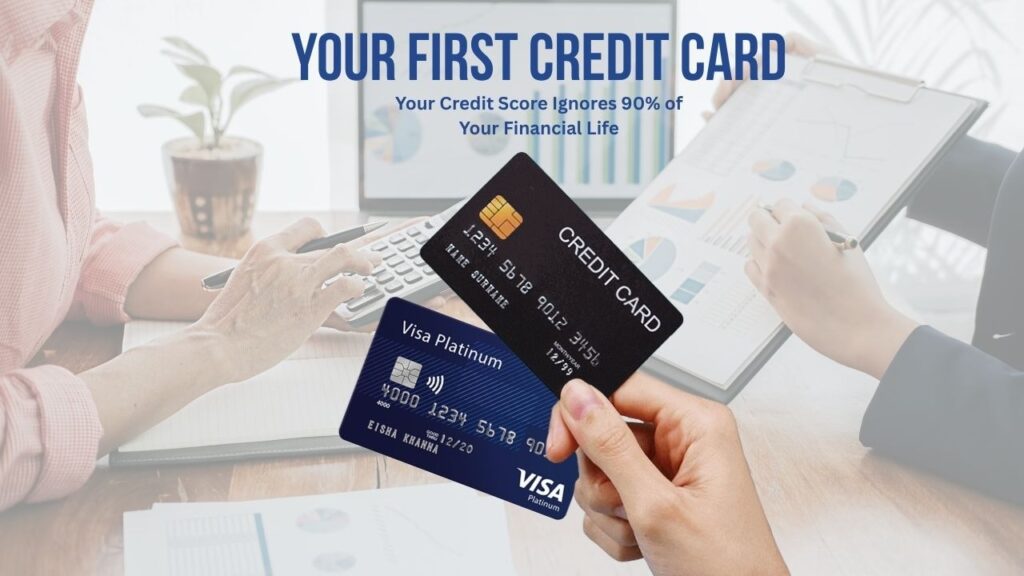
Once your first credit card is approved, you probably think that you are eligible for loan or finance. But you’re wrong because your credit score matters and it is built from repayment history not from your financial status or expenses. There are four active bureaus (CIBIL, Experian, Equifax, CRIF High Mark) in India and they all sit between 300 and 900 score.
And it doesn’t know your salary, your savings account, your mutual fund SIPs, or the fact that you’ve never once missed a rent payment. It tracks exactly one thing closely: how you’ve handled borrowed money.
That gap between what the score sees and what your financial life actually looks like is where most first-time cardholders get caught off guard.
What Your Credit Score Measures in Your Financials
A score is built almost entirely from repayment behavior. FICO, the US model most bureaus borrow their logic from, publishes its weighting: payment history (about 35%), credit utilization (about 30%), length of credit history (about 15%), credit mix (about 10%), and new credit inquiries (about 10%).
It breaks it down, the ingredients look roughly like this:
- Payment history — whether you’ve paid EMIs and card bills on time. This carries the heaviest weight, often estimated at around 30-35%.
- Credit utilization — how much of your available credit limit you’re actually using. Maxing out a card, even if you pay it off in full, can quietly hurt you.
- Length of credit history — how long your oldest active account has been open. This is exactly why closing your first credit card years later can lower your score instead of helping it.
- Credit mix — a blend of secured loans (car, home) and unsecured ones (credit cards, personal loans) reads better than having only one type.
- New credit inquiries — every time you apply for a loan or card, a “hard inquiry” gets logged, and too many in a short window signals risk to lenders.
CIBIL doesn’t publish its exact formula, but the underlying behavior it rewards and punishes is the same. None of this touches your bank balance. It only starts once you’ve borrowed something — a loan, an EMI, a credit card and shows how consistently you paid it back.
Read More 👉 Best App To Get Instant Loan Without Salary Slip
The 90% of Credit Score Never Sees Your Financial Life
Your salary doesn’t appear on your first credit card report. Neither does your savings balance, your fixed deposits, your stock or mutual fund portfolio, property you own, freelance or side income, or rent you’ve paid on time for years (unless you’ve specifically enrolled in one of the newer rent-reporting services, which are still rare in India). Utility bills and UPI spending don’t count either, since none of that is borrowed money.
This cuts both ways. Someone with a strong income and zero loans can be “credit invisible” — no score at all, simply because they’ve never borrowed. Someone drowning in personal debt but paying the minimum on time every month can carry a technically decent score while their actual finances are falling apart. The number reflects repayment discipline, not net worth.
Why This Number Still Runs Your Financial Life
Even though it’s a narrow measurement, it’s the one lenders trust most. A home loan applicant with a score above 750 might get an interest rate a full percentage point lower than someone below 650 — on a 20-year loan, that gap alone can add up to lakhs of rupees in extra interest.
Your score also decides which credit cards you qualify for and what limit you’re offered, and in some sectors — finance, banking, occasionally government roles — employers run a credit check as part of background verification.
Landlords in a few metro markets have started asking for credit reports too. None of that is about how much you earn. It’s entirely about whether you’ve paid back what you owed, on time, before.
The Mistakes That Wreck a First-Time Cardholder’s Score
Paying Only the Minimum Due
The minimum due usually around 5% of the outstanding bill — keeps your account technically current, but the remaining balance starts accruing interest immediately, typically in the range of 3 – 3.5% a month, which works out to somewhere near 36–42% annualized. It’s one of the most expensive ways to borrow money that exists, and the balance compounds faster than most first-time users expect.
Maxing Out the Limit
Spending close to your full limit every month signals risk to lenders, even if you clear the bill in full. Keeping usage under roughly 30% of your available limit protects the score far more than people assume — this is often a bigger factor than the actual bill amount.
Applying for Multiple Cards in the First Year
Every new application triggers a hard inquiry, and each one dents the score slightly while sitting on your report for a couple of years. Several applications close together read to lenders as credit hunger, not creditworthiness.
Missing the Due Date, Even Once
A single day late usually just costs a late fee. But once a payment crosses roughly 30 days overdue, it typically gets reported to the bureau and that single entry can move the score sharply and stay visible for years.
Closing the Card Too Early
Shutting down your first credit card within the first year shortens your average credit age, which is one of the more underrated factors in the score. A longer, active history — even on a card you barely use — tends to help more than starting fresh with a new one.
Read More 👉 How to Apply for an Education Loan Online
The Right Way to Spend From Your First Card
Treat it like a debit card with a receipt trail, not free money. Pick one or two recurring expenses — a mobile recharge, one subscription, fuel and route them through the card on autopay. This builds a steady, low-risk repayment pattern without tempting you into overspending.
Pay the full statement balance every cycle, not the minimum. Check your statement monthly for errors or unfamiliar charges. Avoid withdrawing cash on the card entirely — interest usually starts from the day of withdrawal with no grace period, on top of a flat fee near 2.5–3%.
And think twice before converting purchases to EMI, even “no-cost” ones; the discount you’d have gotten on the outright price is often quietly folded back into the total.
How Fast Can a Credit Score Really Move?
Scores don’t jump in percentages — there’s no such thing as a score rising “by 90%.” They move in points, and how fast depends on which factor you’re fixing.
Utilization moves quickest: pay down a high balance before your statement date, and the next reporting cycle, usually 30 to 45 days later, can reflect a meaningful jump, sometimes 50 or more points on the 900-point scale, because utilization updates almost as fast as your balance does.
Payment history moves slower and compounds instead: one on-time payment barely registers, but six to twelve months of consistent on-time payments builds a track record lenders actually trust. Bureau errors — a closed loan still showing as open, a paid card marked as defaulted, can also produce a fast correction once flagged, sometimes within a single reporting cycle.
For someone starting with a thin or nonexistent credit file, a workable, lender-friendly score in six to twelve months of disciplined use is a realistic target. Overnight is not.
Before Cardholder Swipe That First Time
Pull your free annual report from the bureau and note your starting number before you spend a single rupee. Set autopay for the full statement amount, not the minimum, and add a separate calendar reminder a few days before the due date as backup.
Pick one recurring bill to run through your first credit card and leave the rest alone for now. Then check the number again in three months, not three weeks — that’s roughly how long it takes the system to actually reflect what you did.
Read More 👉 Business Ideas for Students With Zero Investment — Easy Startup Guide
Conclusion
Your financial health doesn’t increase your Credit Score and it is important to maintain that score. It’s a way for lenders to understand how responsibly you’ve handled borrowed money, not how much you earn, save, invest, or own.
For a first-time cardholder, utilization should be lower, pay the statement balance on time, do not fill unnecessary applications, be patient and give time for your credit history to grow. Treat your first credit card as a tool for building trust with lenders, so when you actually need a bigger loan or good credit, you can get it easily.