Rajasthan High Court Peon Recruitment 2025 Out for 5670 Posts – Apply Online Now!

Rajasthan High Court Peon Recruitment 2025

Candidates who are waiting to apply for the Peon post in various departments such as Rajasthan High Court, State Judicial Academy, Legal Services, District Court, and District Legal Services can apply now. Rajasthan High Court Peon Recruitment 2025 process starts from 27 June 2025. Candidates are advised to fill out the application form before the last date of registration.  

Post Peon
OrganizationRajasthan High Court
Vacancies5670
Application Starts 27 June 2025
Application Ends26 July 2025
Initial Salary for this postRs. 17,700 to Rs. 56,200 per month
Official WebsiteClick Here

Recruitment Steps for the Rajasthan High Court Peon Recruitment 

The selection for this post happens in 5 stages – written exam, candidates who have passed the exam are eligible for the interview. Document verification, Medical examination, and when candidates have passed all these stages, his/her name is shortlisted in the list.

Read More 👉 Bihar Police Constable Admit Card 2025 Released – Download in 1 Minute from csbc.bihar.gov.in

Steps to Apply Online Form

  • Click on the link given on the official website or directly from this article.
  • Fill out the empty boxes with the required details.
  • Attach the necessary documents with the application.
  • You have to pay an application fee to complete your application and submit it.
  • Save it for future reference.

Eligibility For Rajasthan High Court Peon

Candidates must pass their 10th for applying to this position. Good knowledge of Devnagri and Rajasthan culture. Candidates are advised to check these eligibility details more from the notification.

Application Fee
Gen/OBC Rs. 640
SC/ST/PWDRs. 450
NCL (OBC/MBC/EWSRs. 550
Important Links
Online RegistrationClick Here
Download NotificationClick Here
Official WebsiteClick Here

Leave a Comment

Your email address will not be published. Required fields are marked *

RSSB Agriculture Supervisor Recruitment 2026 — Get Details & Link To Apply

Agriculture Supervisor Recruitment 2026

RSSB Agriculture Supervisor Recruitment 2026 has released the notification for 1100 Rajasthan Agriculture Supervisor Vacancy 2026. Submission of application will start from 13th/January/2026 and the deadline for submission of application is 11th/February/2026. All aspirants who want to avail this chance can visit the official website (rssb.rajasthan.gov.in) and download the detailed notification and apply through online mode for the same to check more about the eligibility, application fee, age limit, salary and selection procedure. 

Make sure to complete registration on or before the stated dates. The pay scale is between ₹29,200 and ₹92,300 per month, with allowances as per government rules. 

RSSB Agriculture Supervisor Recruitment Dates 

EventDate
Notification Date06/January/2026
Application Start Date13/January/2026
Application Last Date11/February/2026
Fee Payment Date11/February/2026
Correction Last Date14/February/2026
Admit Card DateBefore Exam
Exam Date18/April/2026
Result DateUpdateLater

Application Fee For the Online Form

CategoryFee Amount
Gen/ OBC/ EBC (CL)₹600/-
EBC/ OBC (NCL)/ EWS₹400/-
SC/ ST/ PH (Divyang)₹400/-
Correction Charge₹300/-

Rajasthan Agriculture Supervisor Age Limit & Education

Eligibility for Rajasthan Agriculture Supervisor Recruitment Exam 2026 for all candidates: 18-40 years. The applicant must be 12th Class passed with Agriculture or B.Sc. in Agriculture/Horticulture or equivalent from a recognized board/ university/ institution in India. Moreover the candidates need to know written Hindi in Devnagari script and should be familiar with Rajasthan culture. 

Read More:- Biomedical Engineering: Meaning, Scope, Career Opportunities & Future in Healthcare

Category-wise vacancy detail is as under: 

  • General: 346 
  • EWS: 93 
  • OBC: 46 
  • MBC: 195 
  • SC: 149 (79 seats reserved for Women) 
  • ST: 111 (60 seats reserved for Women) 
  • Baran District: 4

There are 944 vacancies in all out of which 156 seats are for women. For more information applicants are advised to go through the Official RSSB Rajasthan Agriculture Supervisor Recruitment Exam Notification 2026. 

Follow these Steps to Apply Online

The Rajasthan Staff Selection Board (RSMSSB) will release the detailed notification for RSSB Rajasthan Agriculture Supervisor Bharti 2026. rsmssb.nic.in) RSMSSB has started the submission of the online application from 13 January 2026. To apply for RSSB vacancies

1. Check Your Eligibility: Before file RSSB Rajasthan Agriculture Supervisor Notification 2026, To check your eligibility and requirements.

2. Go to the official website and apply online through the booking ‘Apply Online’.

3. Fill in the live RSSB Rajasthan Agriculture Supervisor Online Application Form 2026 accurately.

4. Insert the required documents as mentioned in the notification.

5. Submit the requisite application fee through the mode of payment prescribed.

6. After successful submission of the application you can take print out of the application form for future reference.

For more such resources such as mock test, practice materials, education books to help your study, and overview of government exams, check out tools to help you with your study. 

Useful Links
Apply NowClick Here
Download NotificationClick Here
Official WebsiteClick Here

Leave a Comment

Your email address will not be published. Required fields are marked *

Difference Between Central Government and State Government Jobs – Full Comparison Revealed!

Difference Between Central Government and State Government Jobs

If you are seeking a job in the public sector, it may be useful to know that there are some differences between central government and state government jobs. This guide is for you to understand these differences, Government employees are responsible for controlling and monitoring public rights, administration, and discipline within the country. State government employees work for the individual state and central government employees act at the national level. 

The government employee acts under the service laws that regulate the conditions of work including authority, recruitment, promotion, transfer, and other perks. The recruitment bodies for central government employees are UPSC, RRB, and SSC, and for state governments are UPPSC, TNPSC, and MPPSC, etc.

In the central government, employees can be transferred across the country but state government employees can serve within the state. Transfers typically happen.

State Government Objectives:

  • State governments function at the regional level, operating within the boundaries of individual states.
  • They handle police, agriculture, and public order by implementing laws.
  • According to the state’s situation, a legislative body can pass the law.
  • Each state has a Chief Minister, who leads the administration of the state.
  • He is the highest authority of an individual state that manages the budget, expenditure, and ensures the development projects run smoothly.
  • States can make their own rules but it doesn’t mean that they can violate any central laws. 
  • They have to align with the legal boundaries and National objectives.

Central Government Objectives:

  • The central government functions at a national level and administers the entire nation.
  • It makes laws on union list topics under the Constitution such as defense, foreign relations, and banking among others.
  • The prime minister is responsible for national administration as he is the executive head and holds the highest authority. 
  • State governance works have been monitored by the central government under the constitution. 
  • Central government develops and executes policies at the national level. Supports national budgets, funds, and foreign issues.

Read More 👉 Madras University Result 2025 Declared – Download Scorecard & Direct Link

Difference Between Central Government and State Government

Authority: Central government employees get more power than the state-level employees because the state-level are set to rule the state and region of the country. The central government covers the whole country’s operations.

Legal Powers: According to the Indian constitution, the state government can work in the department for the items that come under the state list. Meanwhile, the central government can take action under national security, foreign affairs, and banking. 

Powers that both have: Some powers are given to both for some important areas like healthcare, education, and criminal laws. They work together as they share responsibility and the coordination helps to run operations smoothly.

Central Government JobsState Government Jobs
Indian Administrative ServiceState Administrative Service: Tehsildar, Sub-Divisional Magistrate 
Indian Police ServiceState Police Service (DSP, SI, Constable)
Indian Revenue Service (IRS) OfficerState Public Service Commission (PSC) – Administrative & Technical posts
Indian Foreign Service (IFS) OfficerState Education Department: Government School Teacher, Lecturer, Principal
Banking Sector: Probationary Officer (PO), Clerk, Specialist Officer (SO) in nationalized banks (IBPS, SBI)State Health Department: Medical Officer, Nurse, Pharmacist, Lab Technician
Railways: Assistant Loco Pilot, Junior Engineer, Ticket Collector, Group D postsJob for State Forest: Assistant Conservator, Guard, Wildlife officer, Forest Ranger
Defence Services: Indian Army, Air Force, Indian NavyState Transport Department: Traffic Management, Transport Sub Inspector, licensing
Through Staff Selection Commission: Junior Engineer, Income Tax Officer, Multi-Tasking Staff, Lower Divisional Clerk, Translator, Assistant Section Officer,  Assistant Sub-Inspector, JSAIn the State Judiciary department: Judges, Court Clerk, Legal Assistant, Stenographer
Public Sector Undertakings: Trainee, Managers, Executive roles, Engineer, OfficersState Revenue Department: Officer, Revenue Inspector, Lekhpal, Deputy, Clerk
Central Departments: Assistant Director, Scientist, specialist, Engineer, Regional OfficerState PSUs: Engineer, Technician, Assistant in state-run corporations
Postal Services: Assistant, PostmanLocal Bodies: JE, Clerk, Sanitary Inspector
Teaching: Central University Faculty, Professor, School teacher.Agriculture Department: Agriculture Officer, Development Officer, and Extension Officer

Why Central Government Jobs Offer Better Career Growth Than State Jobs

When it comes to professional growth for long-term development and a high salary, central government jobs often have the upper hand over state-level positions. Let’s look into the factors that backed up this statement: 

1. Wider Career Scope

Central government employees usually get the chance to work on nationwide projects and schemes. The nationwide projects provided larger benefits such as expanding their work experience, providing a diverse and high-level career path for their professional growth. So, these perks come with central government jobs, not from state departments. 

2. Faster and Transparent Promotions

The larger project initiatives often provide a quality of experience to the person that can help in fast promotion. Internal promotions through departmental examination often happen and deserving candidates can usually get the chance to climb the career ladder faster. In many state services where the process can be slower or less systematic.

3. National Recognition of Experience

Another major point is that the experience of central government employees is more valued than state department employees. If someone decides to switch roles and departments then it is harder for a state-level employee than a central-level employee as it carries more weight in their resume. 

4. Exposure to a Global Network

Working in the central government, dealing with foreign affairs sometimes opens a wider range of interactions and helps build a network from various departments. This act helps them develop their mind with administrative skills and also helps build valuable connections that can support future growth and collaborations.

5. Pay Scale

State government jobs have followed the central pay commission. It may vary depending on the state’s financial growth and decisions. Meanwhile, central government jobs have to pay under the 7th Pay Commission.

Conclusion 

Whether you are preparing for a job as an engineer or officer in the government sector. You can decide which job you can apply for that aligns with your future goal after learning the difference between central government and state government jobs. Their salaries, posts, authorities, and many more. You must know the differences between the two for your career growth.

Leave a Comment

Your email address will not be published. Required fields are marked *

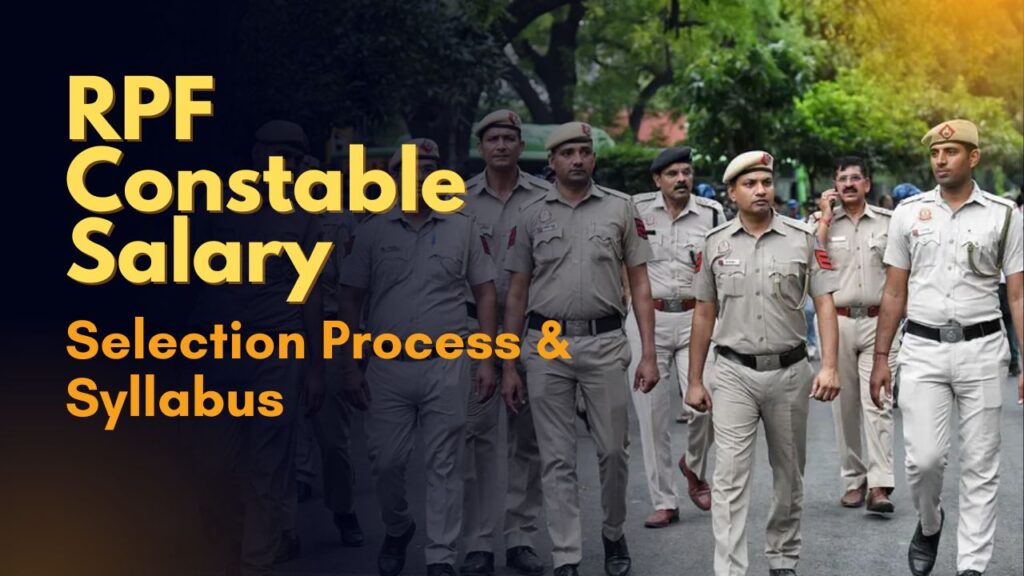
Railway Protection Force Constable: Salary, Selection, and Exam Details – complete guide

Railway Protection Force Constable

RPF is one of the most popular and important central forces of India, providing a secured career and good remuneration both for male and female aspirants. If you are dreaming of getting a prestigious government job which provides security for your job and financial stability, RPF Constable is your stepping stone for a bright future. So let’s go deep down to the bottom with everything you need to know about this great career. 

Understanding RPF Constable Salary

The compensation package is fairly competitive for those who do not have a long track record in government employment. An RPF constable gets a basic pay of Rs. 21,700 per month for an RPF constable which looks low at first, but with various allowances the total amount becomes pretty attractive. 

Your salary after allowances addition is usually between Rs.26,000 to Rs.32,000 per month with the variation being based on the city of posting and the type of allowance you are entitled to. The consolidated monthly remuneration (all-inclusive) is between Rs. 37,420 and Rs. 44,460 which is equal to Rs. 3.12 lakhs to Rs. 3.84 lakhs annually.

There are different components of salary in the salary structure that makes your take-home pay higher. You get a Dearness Allowance (DA) of Rs 10,850 which is 50 per cent of your basic pay as a you help me keep pace with inflation. The HRA depends upon your place of posting and it lies between 8 – 30 percent of your basic salary. Transport Allowance and City-wise Others benefits add further to your income. 

The RPF salary becomes more alluring because of the regular increments, which are granted at the end of every year of the service. Moreover, you also avail medical facilities, pension schemes as per 7th Pay Commission recommendations and many more benefits which ensure financial stability for life. 

Read More 👉 Top B.Tech Colleges in India: Latest Ranking & Admission Guide

The Selection Process

The process to become an RPF Constable from a wannabe has a selection process that is fairly straightforward and designed to winnow out the best and fittest. Knowing the steps will give you a strategic edge in your preparation and you can rest assured when you go through the recruitment. 

Stage 1: Computer-Based Test (CBT)

The first barrier is the Computer-Based Test, which is the entirety of the selection process. The CBT comprises a 120 marks, 120 multiple-choice questions exam, and you are given 90 minutes to take it. You get one mark for each right answer, but here is the catch: you get one-third of a mark deducted for every wrong one, so choose wisely.​

The exam is held in Hindi, English, and in some regional languages so that aspirants from all backgrounds can take it without any difficulty. The level is of 10th standard but don’t take it lightly as questions asked would be based on your overall learning not only from memorizing. 

Stage 2: Mandatory Physical Efficiency Test and Physical Measurement Test (PET & PMT) For Candidates

Only the candidates, who qualify the CBT, are called for the Physical Test, This phase has two parts, which are both important in your selection.​

The Strength, Endurance and Fitness test tries out your strength, stamina and fitness through real activities. Male candidates are required to run 1600 meters in 5 minutes 45 seconds while female candidates are required to run 800 meters in 3 minutes 40 seconds. You only get one try for the running event—no second chances here, so train hard. And you also have the long jump and high jump tests where you’re given two tries. 

Leaping 14 feet in the long jump and 4 feet in the high jump is a requisite for male candidates. Female aspirants have much relaxed parameters: 9 feet for long jump and 3 feet for high jump. Note: ex-servicemen are not required to take the PET but they do have to clear the PMT.​

The Physical Measurement Test (PMT) measures your height and chest measurements against certain standards. The male applicants must hold a minimum height of 165 cm (160 cm for SC/ST categories), with an unexpanded chest measurement of 80 cm and an expanded chest measurement of 85 cm. Height requirements for Female Candidates is 157 cm (152 cm for SC/ST Categories). These measurements are to make sure you comply with the physical standards exigent of this job. 

Stage 3: Document Verification (DV)

Those who qualify in the PET and PMT are called for document verification, where your eligibility stands verified. You need to submit the originals for age proof, educational qualification, caste certificate (if any) and identity proof. 

Stage 4: Medical Examination

The end stage in selection is a medical examination in) depth by RPF medical officers. You should be fit according to medical category ‘B-1’ as per Indian Railway medical manual in order to consider for the post. 

RPF Constable Syllabus

First analyze the syllabus then start your preparations accordingly. The RPF Constable CBT syllabus consists of three crucial components considered equal in weightage covering other aspects of your aptitude.​

General Awareness (50 questions)

Here, you will be examined on the things happening now, history of India, geography, polity, Indian economy and general science. Topics such as Indian Constitution, fundamental rights and duties, directive principles, economic theories, environment, sports, art and culture and major breakthroughs in science are part of the Topics. So keep yourself updated with the current affair and a little bit knowledge of Indian history, geography and general knowledge for this section.  

Arithmetic (35 questions)

Mathematics is not only an instrument of calculation here, nevertheless it is also a matter of thinking and reasoning. The maths section covers number system, percentage, ratio and proportion, simple and compound interest, profit and loss, mensuration, time and work, speed and distance along with elementary algebra. Most of the questions focus on testing your conceptual understanding of math that you can relate to real-life, so it’s always better to have an idea on concepts than mug up formulas.  

General Intelligence & Reasoning (35 questions)

Your Mind & Reasoning ability are tested on topics like Analogies, Coding-Decoding, Number Series, Syllogism, Blood Relations, Seating Arrangement, and Non-Verbal Reasoning. Your performance in this region will get a healthy boost from developing logical thinking and practicing pattern recognition. 

Preparing Strategically for Success

To crack RPF Constable Exam, do preparation in a systematic way. Firstly, comprehend the syllabus in depth, then solve previous year papers on a large scale. Divide your time according to the level of each question in study time since each topic has equal weight. Information is updated frequently at the official RPF website (rpf.indianrailways.gov.in/RPF), so keep visiting for more notifications.

Don’t wait until the date of the PET slowly approaching for physical preparation. Start your workout regimen now—running, jumping and strength training should be daily activities. Academics are important, but so is physical fitness in this selection. 

Your RPF Constable career is tough but highly satisfying. After all, a little planning, hard work and a bit of luck is all you need to make your way through this process and reach a coveted post that will provide you not only with financial security and job stability, but respect in society, as well. Begin preparing now and earn your living in the Railway Protection Force. 

Conclusion

Being an RPF Constable is not only a government job but a career to serve in among the most disciplined and respected central forces of India. The financial outlook is good and long-term because you get a good starting salary with allowances, plus regular increments, medical benefits and pension security.

The selection procedure, although tough, transparent is doable with the right mix of brains and brawn. Having a knowledge of syllabus, daily practice for CBT and starting physical training for PET/PMT at an early stage will help you a lot in achieving success. 

If you have the right attitude, are disciplined, and able to concentrate hard, then the RPF Constable post can provide you with the pride and social standing besides financial independence and job security. Begin your preparation today, be consistent, and march confidently towards a bright future with RPF. 

Leave a Comment

Your email address will not be published. Required fields are marked *

JEE Main Result 2026 – Eligibility, Syllabus, Dates, Pattern Explained

JEE Main Result

The JEE Main 2026 exam has been made the necessary academic test for Indian engineering aspirants since now for the engineering aspirants. On 16th February 2026, candidates who appeared for the exam will be able to check the JEE Main Result 2026 for January session. JEE Main is a system that requires one to be mentally strong, strategically enduring and regulation-tight  not only about ability. 

JEE Main Result the gateway exam for prestigious technical institutions in the country including the National Institutes of Technology (NITs), Indian Institutes of Information Technology (IIITs), and Centrally Funded Technical Institutes (CFTIs) the exam goes through a scale of participation that is unprecedented globally. Because it also serves as the single entrance path to the JEE Advanced, it represents a major turning point for the Indian education system. 

The information shows a strong increase in registrations with more than 1.35 million candidates for Session 1 alone. This demographic bulge requires a granular analysis of the test’s structural elements, including eligibility rules and the statistical normalization of scores. 

NTA Reforms & Administrative Changes in JEE Main 2026

In a bid to ensure the sanctity of the procedure, the NTA has brought in game changing measures:

  • Biometric Security : Now there is a “Live Photograph” taken during application that restricts impersonation.
  • Operative Changes: The test will be given on multiple dates and will require an advanced statistical “normalization” process to equate different levels of difficulty.
  • JEE Main Result Timeframes: Although administrative delays such as the Session 1 result postponement from February 12 to February 16, 2026 — do induce stress, they are vital for thorough validation of data. 

Examination Schedule and Timeline 

The NTA has adopted a two-tier system for the hour long sessions, offering candidates a tactical cushion. This enables students to view the January attempt as a baseline and the April attempt as a fine-tuning move.

The JEE Main Result 2026 Session 1 

Paper 1 (B.E. / B.Tech) was held on January 21, 22, 23, 24, and 28 over multiple days, while Paper 2 (B.Arch/Planning) was held on January 29.

The JEE Main Result delay is due to the complexity of the normalization process, it is now expected on February 16. For the NTA to be fair, it must normalize the scores within the millions of data points. 

Session 2 Dates 

EventSession 1 (January)Session 2 (April)
Application WindowConcluded1—25/Feb/ 2026
Exam Dates21–29/Jan/20262–9/Apr/2026
JEE Main Result Declaration16/Feb/202620/Apr/2026 (Expected)

Eligibility Architecture: The 75% Rule and Beyond

It is necessary to know the funnel of eligibility to avoid getting disqualified in the stage of admission process.

Age and Attempts Age: There is no upper age limit for JEE Main, however some institutions may have their own fixed limits.

The Three-Year Window: You should have passed Class 12 in 2024, 2025 or appearing in 2026.

Attempts: The exam can be attempted for three consecutive years by the candidates. 

The Performance Threshold

But the access to NITs, IIITs and CFTIs is limited by eligibility criteria that includes:

General/OBC-NCL/EWS: Minimum 75% in aggregate in class 12th.

SC/ST: 65% aggregate minimum.

Option 2: Be in the Top 20 percentile of your respective Board. 

State of Eligibility

Your ‘Home State Quota’ will be decided on the basis of the state of examination of your Class 12, not your residential status. For example, a student of Bihar coaching in Kota (Rajasthan) will come under Rajasthan Home State quota. 

Read More:- Railway RRB ALP Admit Card 2026: Download Now From Direct Link

Examination Pattern For JEE Main

AspectDetails
Exam ModeComputer-Based Test (CBT); focuses on application and speed.
Total Marks300
Duration3 Hours
SubjectsPhysics, Chemistry, Mathematics (each with two sections)
Section A20 Mandatory MCQs per subject
Section B10 Numerical Value Questions (NVQs) per subject; attempt any 5
Penalty Rule-1 negative marking for both MCQs and NVQs; precision required

Subject-Wise Syllabus Breakdown

Mathematics, Physics and Chemistry have strategic places where one must focus to improve performance:

Mathematics:  

Learn Calculus and Algebra well as they are the basics.Don’t ignore Vectors and 3D Geometry as these are very easy and carry good amount of marks in examinations.Also focus on Coordinate Geometry, Matrices and Statistics for high yield.

Physics:  

Concentrate on concepts and the use of the formulas. Modern Physics, Semiconductors = very good marks, not much calculation. Things are inevitably going to move around in your lab, so you need to be comfortable with experimental skills, especially Vernier Calipers and Error Analysis, handy points as well.

Chemistry:  

Chemistry is a very efficient subject for which you could save a lot of time and spend more time in Mathematics.  

Physical Chemistry: Be good at numericals to do well.  

Inorganic Chemistry: Be good in p-block trends;solidify your knowledge of Coordination Compounds.  

Organic Chemistry: Learn the reaction mechanisms and Biomolecules,bcoz they are very important.

Your study time can be better used and your score can be higher by focusing on these areas with the greatest yield. 

Post-Session 1 Roadmap to April

Reviewing how you did in January is the first step towards doing well in April.

  • Category A (98+ Percentile): Begin dedicating 70% of your time to JEE Advanced questions.
  • Category B (90-98 Percentile): Look for “low-hanging fruit.” Earn higher accuracy in Physics and Chemistry to enter the elite group.
  • Category C (<90 Precentile): Go back to basics. Concentrate your efforts on the most common chapters that ask questions instead of covering all the syllabus. 

The “Golden Window”

To Those Who Are Taking Boards In Feb-March The gap between the last Board exam and JEE on April 2 is crucial. Prepare Board to learn NCERT concepts which are directly used in the questions of Inorganic Chemistry and theoretical Physics. 

JoSAA & CSAB Counselling Process 2026

Admissions counselling for engineering in India is not limited to just ranking, as the Centralised Joint Seat Allocation (JoSAA) Authority in six rounds of seat allotment. Candidates may opt Freeze to accept and confirm their seat, Float to accept their seat and appear for seat updation in subsequent rounds, or Slide to retain the seat and try for an improved branch in the same institute. If there are still vacant seats after the JoSAA rounds, the procedure is continued by CSAB through special rounds which tend to be the last chance for many students with lower ranks to get an admission in a reputed NITs and other top institute. 

Conclusion

JEE Main 2026 is not just a good entrance exam—it is a good portal to sift through all the engineering institutes in the top Indian engineering colleges. Success is based on more than just knowledge: you also need to have a plan, be consistent, and make smart decisions. From understanding the exam pattern and eligibility criteria to utilising both attempts to the maximum and managing JoSAA–CSAB counselling effectively, every step will determine your outcome. Clarity, discipline, long term vision and direction in studying helped these students not only to qualify, but to open the right “doors” for their future. 

Leave a Comment

Your email address will not be published. Required fields are marked *

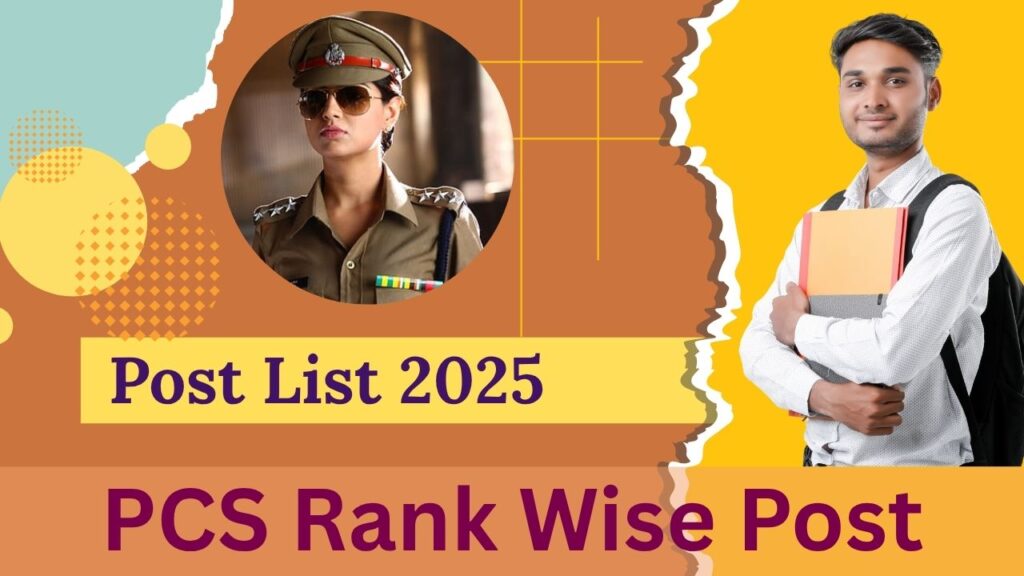
PCS Rank Wise Post List 2025: Which Rank Gets SDM, DSP & More?

PCS Rank Wise Post List

The PCS exam is the most hardest exam in India which offers many prestigious level jobs in the government sector. PCS Rank Wise Post is allotted according to the candidates marks in the exam. It offers many higher level administrative posts like SDM, DSP, BDP, CTO, and others. This exam is held annually to recruit thousands of candidates for different posts, and prepare strategically for higher rank posts.

Let’s explore the PCS exam and posts for understanding their authority and power in administration.

What Is The PCS Exam? 

Provisional Civil Services offers a diverse range of posts in the government sector and is conducted by different State Public Services Commissions including UPPSC, BPSC, MPPSC, RPSC, etc. But the post name and exam pattern will be the same in all the states. Posts rank may slightly differ from each other but posts are related to state administration and law enforcement. The exam pattern includes: 

  • Prelims
  • Mains
  • Interview

How Are Posts Allotted in PCS Exams?

There are various factors for allotting the post on different level, let’s look into these factors:

Final rank in the merit list (Mains + Interview). Selection is based on the PCS state-level exam rank. If the two candidates have the same score then the cast-category of the candidates will decide in the selection process. The third factor is the number of vacancies in that post.  

PCS Rank Wise Post List 2025 

Likely RankPost Name
1Deputy Collector (Sub Divisional Magistrate/SDM)
2Deputy Superintendent of Police (DSP)
3Block Development Officer (BDO)
4Assistant Commissioner (Commercial Tax)
5District Commandant, Home Guards
6Subordinate Revenue Officer
7Assistant Regional Transport Officer
8District Social Welfare Officer
9District Panchayat Raj Officer
10Accounts Officer

Special PCS Posts And Their Powers 

Don’t you wonder? Why does the PCS Rank Wise Post matter? Because a candidate’s post determines their authority, power, responsibility, and salary within the state administrative system. 

The powerful posts allotted to top rankers in the PCS exam. The top three posts are Sub Divisional Magistrate (SDM), Deputy SuperIntendent of Police, and Deputy Collector are all administrative powers and control district level operations directly impact governance and policy implementation. 

Read More 👉 Meet the Best Physics Teacher for NEET Online – Top Choice for 2025

PCS Rank Wise Post Scope & Perks

Higher powers such as SDM, DSP, & CTO are placed on the top level of the government administration of the state because they are responsible for revenue management, development works, jurisdiction over law and order and public service delivery. 

Meanwhile, lower ranked positions are also responsible for government department works and administrative jurisdiction but they have less authority and power for taking decisions.

Higher positions rankers get fast promotion while initial posting and lower rankers have to face slower growth to become on the post like Indian Administrative Services (IAS). The salary and additional perks are good on a higher level with social recognition, they have more prestiges compared to lower level.

Other Top Level Posts in PCS Exam

Block Development Officer 

He has authority within the block in rural or semirural areas to lead administration for the development of projects for public welfare and implementation in government schemes. He supervises both state and central government policies in that area.

District Commandant, Home Guards

District Commandant is a head of Home Guard volunteers and works with the police and administration for law and order for handling disaster and public safety.  

Subordinate Revenue Officer

He is responsible for collecting and saving the data of land in the sub-district. Government schemes implementation also comes under the Subordinate Revenue Officer responsibility for agriculture and land reforms. These decisions are directed by the higher revenue officials and SDMs.

Assistant Regional Transport Officer

He enforces public travel law and order to resolve issues of driving license, permission for transport, and registrations of vehicles. Assistant Regional Transport officer is responsible for road safety campaigns and accident investigations.

District Social Welfare Officer 

District level authority and power to manage and implement welfare schemes for low cast and schedule tribes communities. Works as a mediator between communities and district administration for their well-being.

District Panchayat Raj Officer

Panchayat councils of villages are supervised by District Panchayat Raj Officer. Implantation for rural development schemes are monitored by him and he is responsible for these operations running smoothly in the area. 

Account Officer

Account officer handling the government department’s account and financial administration to manage budget and deliver financial reports to the government administrations. 

SDM vs DSP – Which Is Better?

SDM and DSP both positions are highly respectable but their work and authority is different from each other –

Sub Divisional Magistrate – SDM

This is the highest administrative officer post in the department to ensure the governance runs smoothly under the law and order. This involves both desk and field duties and offering great professional growth to ADM then DM level.

Deputy Superintendent of Police – DSP:

He is the head of the police subdivision and has authority for law enforcement. A very respectable uniformed post, DSP is responsible for commanding over police stations and getting promoted to SP and DIG. 

How to Get Top Rank for SDM or DSP Post?

The higher posts are responsible to change and implement governance that is why they are placed at the higher places in the state hierarchy. 

  • Your rank must lie within top 100 to get SDM or DSP post.
  • To score on that level you must focus on high-scoring subjects.
  • Practice and learn consistently for Mains.
  • Improve english grammar and take mock tests daily.
  • Keep updated with events, current affairs, and government policies.

Conclusion

PCS Rank Wise Post is important to understand if you are preparing for PCS exams because your exam scores will decide your position. If your goal is SDM or DSP then you should get 70-100 rank (General Category) and 120-160 rank (reserved category). With the right strategy you can prepare smartly for this exam and get the position.

PCS rank not just decides your job but also your future of growth, salary, and authorities. So, start aiming your goal with smart strategy and hard work.

Leave a Comment

Your email address will not be published. Required fields are marked *

Scroll to Top