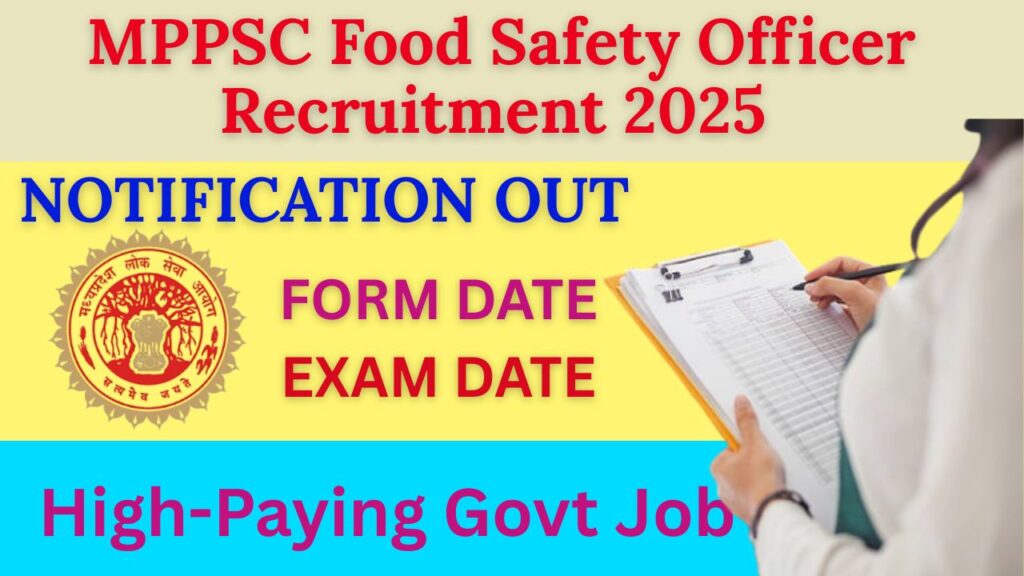
MPPSC Food Safety Officer Recruitment 2025 – High-Paying Govt Job! Apply Online Now

MPPSC Food Safety Officer Recruitment 2025

MPPSC is selecting candidates for the FSO position, which offers a high salary. The organization released a notification for MPPSC Food Safety Officer Recruitment 2025 on its official website. The Application will start on 11th July 2025. The candidates should download the notification for the details about the job. If you are interested in inspecting food to ensure your health doesn’t get affected, this role is right for you.

The Food Safety Officer is responsible for ensuring that food products meet the standard range of quality so there can be no harm to the person who eats them. The Food Safety and Standards Authority of India inspects food manufacturing details like location, hygiene, and spoiled material to protect public health.  

MPPSC Food Safety Officer Recruitment 2025 Details

OrganizationMadhya Pradesh Public Service Commission
Post NameFood Safety Officer
OverviewFood Safety Officer recruited by the MPPSC to check food quality to ensure public health safety. The selection goes through with this exam.
Vacancies67
Food Safety Officer Salary RangeRs. 35,000 to Rs. 70,000 per month
Official WebsiteClick Here

Dates to Remember For MPPSC FSO 2025 

Online Application Starts11-July-2025
Last Date for Online Application10-August-2025
Last date for Fee Submission10-August-2025
Last Date for Correction12-August-2025
Admit CardBefore Exam
Exam DateWill Update Soon
Application FeeAge Limit
General/Other State: Rs. 540/-OBC/SC/ST from MP: Rs. 290/-Portal Charges: Rs. 40/-Correction Charges: Rs. 50/-Minimum Age: 21 yearsMaximum Age: 40 years
Age relaxation is provided for the reserved categories for MPPSC FSO.

Read More 👉 UP Lekhpal Vacancy 2025 – 7994 Posts Opening Soon! Eligibility, Exam Dates & How to Apply

Eligibility For The MPPSC FSO Recruitment 2025

If you are interested in acquiring an FSO position then you must have a background in science. The undergraduate degree in Food Technology, Biotechnology, Dairy, Veterinary, Biochemistry, Microbiology, Agricultural, Pharmacy, and Chemistry are required for this job. To pursue any of these degrees you must pass 12th with PCM or PCB.

How to Fill Online Form For MPPSC FSO 2025

  • You have to wait till 11 July 2025 to fill out an application online through the official website. 
  • Login with credentials to apply online.
  • Fill in all the details and attach the necessary documents.
  • Pay the fee amount to proceed with the application.

Important Links for MPPSC Food Safety Officer Recruitment 2025

Download NotificationClick Here
Telegram ChannelClick Here
Official WebsiteClick Here

Leave a Comment

Your email address will not be published. Required fields are marked *

How to Crack State PSC Exams in First Attempt: Strategy & Resources

Govt. jobs are undoubtedly one of the most safe and respected career options in India and passing the State Public Service Commission (PSC) exam in first attempt is a dream for many aspirants. As the competition is rising and the syllabus is vast, it sometimes feels like a difficult mountain to scale. But, with the right approach, intelligent study techniques, and diligent efforts, passing the exam is not an impossible dream. The crux is to understand the syllabus in depth, follow the right resources and adhere to a disciplined schedule that would cover both prelims & mains preparation.

Quick Thoughts Gathering to Begin With

  1. Download official syllabus + all past papers of 8 years.
  2. Make a list of books you own/need (start with NCERTs).
  3. Select optional subject.
  4. Put together a weekly schedule you can live with.
  5. Create a one-pager daily current affairs file.
  6. Enroll in test series / good coaching (online/offline) and commit to weekly mocks.
  7. Start your NCERTs (goal: 2–3 chapters/day).

Big-picture study strategy (what to study & why)

Build bedrock knowledge first: NCERTs (6–12) for History, Geography, Economics, and Pol. These give a clean conceptual base.

Proceed to standard books for each subject (more below). Read for understanding, not rote.

Current affairs daily — newspaper + short notes. Link events to static syllabus.

Notes + revision cycle — Make short revision notes (1–2 pages) per topic; revise them frequently.

Practice smartly: MCQs for prelims + answer writing under time pressure for mains. Mains wins jobs — practice answer structure & linking facts to syllabus keywords.

Mocks & feedback: Do full length mocks and get answers evaluated (peer/mentor) and you improve your answer style and technique of scoring.

Recommended core resources (common, high-utility) 

(You will need to add in your state-specific books / local history that you must have from your state board / PSC Recommended Readings)

  1. Cover Basics 

NCERTs 6–12 — History, Geography, Pol. Science, Economics (start here).

Indian Polity — M. Laxmikanth (efficient + concise for governance & state-centred comparative questions).

Modern Indian History — Spectrum’s A Brief History of Modern India / Bipin Chandra (for depth).

Indian Economy — Ramesh Singh or any good concise economy book, supplemented with RBI / Economic Survey summaries.

Geography — Certificate Physical & Human Geography (G.C. Leong) or equivalent concise books.

Environment & Ecology — normal environment compendium/ class notes, track Recent Events.

State-specific history & polity — whatever books your PSC cites, in addition to local gazetteers and state government documents.

  1. Current affairs & general reading

One daily national newspaper (The Hindu / Indian Express) or their summaries. Government releases: Press Information Bureau (PIB), state government portals, official reports (for schemes and facts). Monthly magazines or current affairs compendiums (good for revision).

  1. Practice

Collection of previous years’ PSC papers (must have). A good questionbank or mock test series (free/paid) for practicing in time bound manner. Answer writing notebooks (keep one for mains answers). 

Sample schedules — choose according to the time you have

If you have 12 months

1st to 4th month: complete NCERTs + standard books for GS I–III fundamentals; decide optional & finish fundamentals.

Months 5 to 8: Complete other standard books + begin consolidating notes; begin on PYQs.

9th and 10th months: High-intensity test series – full-length prelim mock test every week; augments revision of weak topics.

Months 11–12: Final run through + daily PYQs + last-mile current affairs. Mains answer practice (if prelim cleared).

If you have 6 months

1st month: Preparation for NCERTs + syllabus mapping + optional selection.

2nd to 4th month: Read standard books, prepare short notes, solve MCQs and PYQs.

Month 5: Rigorous mock tests (prelim-benchmarked); Time management to be calibrated.

Month 6: Re-visit everything + frequent mock tests + current affairs wrap-up.

If you have three months

  • Fast NCERT reading + priority standard book chapters on some important subjects.
  • Study 7-10 hours a day: current affairs in the morning, theory in bulk in mid-day, MCQs + past papers in the evening.
  • Mocks repeatedly at intervals of 3-4 days Analyze each. 

Prelims strategy (objective test)

A good preparation strategy would be to start with the NCERTs along with one standard book per subject to establish a strong base. While learning content, same importance should be given to speed and accuracy by daily practicing MCQs gradually going to 500 – 1000 in a week. To gain maximum returns in minimum time, concentrate on high-yield topics such as Polity, the Constitution, Economy (primarily basic indices), Geography (with emphasis on map work), Environment, and Current Affairs. The Previous Year Questions (PYQs should be backbone of your preparation as it helps you to identify the areas/themes which the exam repeatedly tests). 

Also Read : Top 10 List of Exams Conducted by UPSC After Graduation in 2025

Mains strategy (subjective / descriptive)

Start writing answers from the early days of preparation, while upgrading yourself with the ability to write a good structured answer that has an introduction, a well-structured body (with headings or bullet points, if necessary) and a brief conclusion or way forward. Static knowledge and linking current affairs with theoretical knowledge need to be a part of answers as they give depth and relevance to answers. At the mid-stage of your preparation, doing a full answer paper every week – both essays and GS papers — is useful in developing regularity and you can increase the frequency as the exam comes closer. Regular assessment or peer review also is necessary, as it improves presentation as well as the density of content, leading to more effective answers. 

Interview / personality test

Prepare short biographical stories related to: accomplishments, academic projects, work experience and expertise in optional subjects. Stay informed on regional issues and national affairs. Conduct mock interviews with mentors or peers, concentrate on clear communication, serenity, and concise responses. 

Common Mistakes to Avoid

  • Learning everything superficially diminishes its utility; depth is much more valuable than breadth across different fields at surface level isn’t very rewarding.
  • Disregarding previous years’ papers is the biggest blunder as these papers bring out the themes that repeat, the patterns of questions and the areas to be concentrated.
  • Not timing yourself while you practise MCQs or while writing answers results in bad speed and poor accuracy in the exam.
  • Too many resources create noise and confusion, while focusing one’s attention on too few resources creates blind spots. A small set of high quality, reliable resources is the best bet for clarity and retention.
  • Avoiding regular revision destroys the power of retention; one should revise systematically and at frequenter intervals to be able to recite confidently and be assured of long term recall. 

Conclusion

How to Study Smart for First Attempt State PSC (Public Service Commission) Exam It is not about studying for countless hours, but it is about studying smart by keeping focus and being consistent. This trip requires a very clear mind, discipline, and a problem-solving attitude. Candidates with the right resources and guidance, along with consistent practice and revision, can not only cram for the exam but gain the confidence to ace at the Interview round. Wait for it… Success in the competitive exam is for those who start early, prepare strategically and have a firm belief till last that they will pass the exam. 

Leave a Comment

Your email address will not be published. Required fields are marked *

Meet the Best Hindi Teacher for Competitive Exams Who Can Boost Your Success

Best Hindi Teachers for Competitive Exams – SSC, UPSC, Railway & State Level

Best Hindi Teacher: If you aim to clear the competitive exams like SSC, UPSC, RRB, & state-level exam, right guidance for best scoring is important. And for that, the choice of a teacher matters. While preparing for other subjects likeGeneral Knowledge, Mathematics, Reasoning, and English. Don’t forget to focus on Hindi because it is most important in many government exams. Hindi teachers not only help you by providing the core syllabus but they will prepare strategically for the exam. These teachers have a unique teaching style that will help you understand grammar, comprehension, Letter Writing, Unseen Passages and vocabulary.  

Aspirants can learn easily through their guidance including exam pattern, mock test, and shortcut methods that will help you to memorize. Few teachers provide live sessions, recorded videos, notes, and quizzes, so you can easily prepare for the examination. 

Mock test series will help you in revision and remember that every teacher has their unique way to explain hindi. Take a demo class to select the right teacher whose explanation reaches into your mind. 

Explore best Hindi teachers, they are known for their deep knowledge, best teaching style and make complex concepts of grammar easy for students.

Nitin Sir

Nitin Sir from Study91 is known for clear explanations with a practical approach. He doesn’t just explain from books but tries to relate with real-life examples from newspapers or stories to make the hardest grammar rules easy for students to understand.

Nitin Sir Hindi Teacher Study91

Students easily memorize it, but most importantly they understand why grammar rules are used. He also gives plenty of questions to practice which is the real key to success.

Vivek Sir

Vivek Sir’s creative style of teaching makes him one of the best Hindi teachers in India. Hindi is a language of culture and creativity, according to Vivek Sir. That clearly showed his mastery of story-based teaching style which makes grammar memorable. He uses humour, short stories that don’t make students bored in Hindi classes.

Vivek Sir Hindi Teacher for SSC, Railway, TET

Ideal for those who don’t memorize anything easily and it’s hard for preparing Hindi for exams like Railway, SSC or TET. His method is effective to recall in exams quickly, so these techniques will make students remember even under pressure.

Dr. Ajay Anurag

Dr. Ajay Anurag is a best educator of Study IQ and reputed for his deep knowledge in Hindi grammar and literature. Students looking for one teacher who can teach them both grammar and literature, Ajay Sir is the best choice.

His concept-based teaching makes you understand each topic easily in minimum duration. But he doesn’t rush topics, he explains “why” behind every grammar rule.

Students who don’t just want to learn but understand Hindi topics can easily access his systematic and well-structured lessons. He also provides study material which is so detailed and exam-focused that it makes it easier for the students who are preparing for government exams.

Jitendra Soni (KGS – Khan Global Studies)

He is the best educator of KGS who is extremely popular for his Hindi Foundation Batch. Jitendra Soni is focused on friendly-tone, conduct doubt-clearing sessions, and handwritten notes.

Jitendra Soni Hindi Teacher KGS

Students can simply understand every topic due to his explanation of lengthy stories, complex topics of grammar, and comprehension. Once you have taken his demo class or follow on YouTube, you will know how interactive and energetic his sessions are.

Vishal Sir (Mission Selection) 

Vishal Sir is a well-known Hindi teacher on the growing platform Mission Selection. Vishal Sir is popular among the students because of his exam-oriented preparation method. His short explanations are impactful, he helped many students with shortcuts, tricks, and practical approaches.

Vishal Sir Hindi Teacher Mission Selection

He is the best teacher for Police, SSC GD, Railway, Constable, and state-level exams preparations. Students who want to complete this subject within less time, they can follow Vikas Sir.

Arun Sir

Arun Sir is an excellent teacher who teaches many students for the competitive exams. He focuses on Hindi grammar complex topics to provide a detailed explanation which can help students to understand Hindi in more depth. His command over vocabulary, comprehension, and writing are valuable for the exams like SSC, Railway, and UPSC. 

Arun Sir Hindi Teacher for SSC and UPSC

Students can easily understand his way of teaching as breaking complex topics into simpler parts including real-life examples. He helps students to practice mock tests and previous year questions for building their strong foundation on Hindi.

Naveen sir

Naveen Sir is a master of answer writing, if you are preparing for UPSC or state exam then you should make your descriptive writing good in Hindi. You will become an expert in essay writing, letter writing, and precise writing in Hindi with his consistent training.

Naveen Sir Hindi Teacher for UPSC Answer Writing

He is an ideal teacher for students who want to improve their writing skills and present their answers in clean, structured, and detailed.

Other Recommended Hindi Teachers

Apart from the above names, there are a few more respected teachers who can provide you best lessons for Hindi in competitive exams:

Dr Vikas Divyakirti (Drishti IAS) – He teaches Hindi Literature with depth and clarity, making him ideal for UPSC aspirants.

Alok Sir (Adda247) – Alok Sir is focused on short-trick and not go for lengthy explanations that makes him ideal for SSC aspirants

Ritesh Sir – he also helps students to prepare for the SSC exam because he makes Hindi grammar easy through continuous practice.

Read More 👉 Meet the Best Current Affairs Teacher for SSC CGL Who Can Boost Your Score

Why these teachers stand out

Apart from their unique teaching styles, they have the same common qualities that make them best Hindi teachers.

Simple explanation – they explain every topic in easy language that helps every student to understand easily.

Practical Approach – their style including examples from newspapers, current events, and daily-life that make Hindi more understandable.

Focus on Practice – continuous practice of questions from previous year and test series, they ensure that every student solves enough questions to mentally prepare for the exam.

Motivation & Support – Hindi is so difficult for some students who came from convent schools, these teachers inspire them to make learning enjoyable.

Read More: Best Online Coaching for Bank Exam: Master Every Topic for Success

Final Thoughts

When students are focusing on tough subjects to clear competitive exams, they often forget to prepare Hindi to fuel their score. With the right teacher, Hindi can become your strongest subject. These Best Hindi Teachers for Competitive Exams have already taught many successful students now you could become next.

If you give you full potential for your exam with their guidance, you can clear the most toughest exams. They focus on exam patterns and important topics that need to be prepared well for government exams.

Leave a Comment

Your email address will not be published. Required fields are marked *

Top 10 Best Medical Colleges in India with Low Fees [2025 List]

If you aim to become a doctor then choosing the right medical college is one of the most important decisions in a student’s life, especially in India, where quality education often comes with a heavy budget. However, not all top medical colleges are expensive. Some of the best government medical colleges in India offer world-class education at low fees. In this article, we’ve listed the top 10 best medical colleges in India with low fees in 2025.

You can explore all their details on courses, fees, and admission process along with their ranking among medical colleges. If you’re a NEET aspirant looking for an affordable medical college this guide will help you to choose the right college for yourself. 

We also instruct you on how to choose the right college, even among all the medical colleges delivering high-quality education. 

Top 10 Best Medical Colleges in India with Low Fees 

1. All India Institute of Medical Sciences 

Source: AIMS

Ranking#1 in NIRF Medical Rankings 2025
Annual Fees₹1,628 (MBBS)
AdmissionNEET-UG for MBBS, INICET for PG courses
CoursesMBBS, MD, MS, B.Sc. Nursing, MDS

Why AIIMS?

AIIMS Delhi is India’s most prestigious medical college. If you want to be perfect in practical training then it is the best option for you. It provides unmatched clinical exposure, research opportunities, and global recognition with low fees. It offers UG and PG medical programs that deliver enhanced biomedical concepts and training.

2. Maulana Azad Medical College – MAMC

source: MAMC

RankingAmong the top 5 
Annual Fees₹2,445
AdmissionNEET-UG + Delhi University counselling
CoursesMBBS, MD, MS, Diploma courses

Why MAMC?

MAMC is known for its excellent faculty and top-notch medical training. It’s ideal for those who want the best training for medical procedures. It offers the best clinical exposure due to its affiliation with top hospitals such as LNJP and GB Pant, giving students rich clinical exposure. It also has one of the highest PG entrance success rates in the country.

3. Armed Forces Medical College 

source: AFMC

RankingTop 3 medical college for disciplined training
Annual Fees₹31,000 (including hostel and mess)
AdmissionNEET-UG + AFMC screening (interview + medical fitness)
CoursesMBBS, Nursing, PG Diplomas

Why AFMC?

Students who want to be assured of their placement, the AFMC offers students an opportunity in the Armed Forces Medical Services after graduation. Training is best, discipline, and reputation can open up your medical career chances at the next level. However, there is a compulsory service bond after completing MBBS. Students can also get scholarships.

4. King George’s Medical University, Lucknow

Nursing students at King George’s Medical University in Lucknow during clinical training

Source: KGMU

RankingTop 10 as per NIRF 2025
Annual Fees₹54,000
AdmissionNEET-UG for MBBS or other undergraduate programs, NEET-PG for postgraduate
CoursesMBBS, BAMS, Speciality, BDS, MD, MS, Nursing

Why KGMU?

KGMU is one of the best medical colleges for practical training. Thousands of NEET aspirants try to get there for medical courses. It offers advanced labs, highly experienced faculty, and strong placements in both the government and private sectors.

5. Grant Medical College, Mumbai

Grant Medical College, Mumbai

Source: Grant Medical College

RankingAmong the top 15 government medical colleges
Annual Fees₹97,800
AdmissionNEET-UG through Maharashtra State Quota and AIQ
CoursesMBBS, MD, MS, Nursing

Why Grant?

This college is affiliated with JJ Hospital, providing excellent exposure to diverse clinical cases in Mumbai. The disciplined faculty system includes some of the best doctors in the state.

6. Bangalore Medical Research Institute 

Bangalore Medical Research Institute

Source: BMRIC

RankingTop 15 in NIRF
Annual Fees₹70,170
AdmissionNEET-UG via Karnataka KEA counselling
CoursesMBBS, MD, MS, B.Sc. Nursing

Why BMCRI?

BMCRI is one of South India’s best government colleges for NEET aspirants. It is located in Bangalore and is attached to major hospitals like Victoria Hospital and Bowring Hospital. Students mostly wanted to go to this college for postgraduate degrees. 

7. Seth GS Medical College, Mumbai

Seth GS Medical College, Mumbai

Source: Seth GS Medical College

RankingAmong the top 15 medical colleges
Annual Fees₹98,000
AdmissionNEET-UG via Maharashtra CET counselling
CoursesMBBS, MD, MS, Super Specialities

Why Seth GS?

Best medical college in Mumbai for MBBS and other medical programs with its research enhancement. Seth GS Medical College is attached to KEM Hospital, so it delivers advanced education in the medical field. To train their students in the best way possible for hospitals. 

8. Institute of Medical Sciences – Varanasi

Institute of Medical Sciences – Varanasi

Source: IMS-BHU

RankingTop 10
Annual Fees₹13,000
AdmissionNEET-UG + JoSAA/BHU internal counselling
CoursesMBBS, MD, BDS, B.Sc. Nursing

Why BHU-IMS?

BHU-IMS is an academic environment for the medical students to get  well-trained. To become a doctor is what many students dream of, now it’s possible with a low fee structure. It offers strong research support and is ideal for Uttar Pradesh aspirants.

9. Government Medical College, Kerala

Government Medical College, Kerala

Source: Government Medical College

RankingAmong top 20
Annual Fees₹22,000
AdmissionNEET-UG via Kerala KEAM counselling
CoursesMBBS, MD, MS, Paramedical

Why GMC-TVM?

One of Kerala’s oldest and most reputed medical colleges. Students who want to study in an academic environment can get admission to this college. It creates some of the highest-scoring PG aspirants and is known for its patient inflow, excellent teaching, and disciplined academic culture.

10. Madras Medical College, Chennai

 Madras Medical College, Chennai

Source: Madras Medical College

RankingAmong top 15
Annual Fees₹13,610
AdmissionNEET-UG via Tamil Nadu State Quota + AIQ
CoursesMBBS, MD, MS, Nursing, Super Speciality

Why MMC?

MMC college was founded in 1835 and is known for its best medical education. It continues to provide outstanding training and is attached to major hospitals like the Rajiv Gandhi Government General Hospital. Graduates are highly respected in both the government and private sectors.

Note: For exact fee details you can visit the official website of the college and check out.

How to Get Admission in These Colleges?

1. Clear NEET-UG: This is mandatory for all MBBS and other courses in medical admissions in India.

2. Register for Counselling: You can choose either AIQ through MCC or State Quota via the respective state portals.

3. Get your step into the Choice Filling & Seat Allotment

4. The last part after you get shortlisted is Document Verification & Admission Confirmation.

Note: For top colleges like AIIMS, AFMC, and MAMC, your NEET rank should ideally be within the top 1000–5000. 

Career Scope After MBBS

Completing MBBS from a reputed government college gives you several career options, that is the reason why choosing the right college for a medical degree is important:

  • Further studies in the medical field like MD/MS/DM in India or abroad through exams like NEET-PG, USMLE, PLAB
  • Government Jobs in various departments such as AIIMS, ESIC, Railways, State or city Hospitals, Army Hospitals, and many more. It offers you lifetime financial stability and security.
  • Become a doctor in Private Hospitals, or Join Corporate Hospitals, and own the clinic.
  • You can also choose your career in medical research.
  • Health Administration is also an option for you. As a medically certified doctor, you can be an instructor or health reporter.

Conclusion

You don’t always need to pay lakhs to get a quality medical education. These top government colleges prove that quality education, hospital exposure, and low fees can go hand-in-hand. If you’re serious about a medical career in 2025, start preparing for NEET with full dedication, and keep these Top 10 Best Medical Colleges in your target list.

Leave a Comment

Your email address will not be published. Required fields are marked *

Agniveer Answer Key 2025 Out – Download From Direct Link

Agniveer Answer Key 2025 Out

Agniveer Answer Key 2025 : The Agniveer Answer Key has now been released by the Indian Army under the recruitment process for Agniveer General Duty position. This is a common Entrance test for the Agniveer Posts which exams held from 30-June-2025 to 3 July 2025. Candidates who wish to work in uniforms can apply for this post. Be prepared to see the answer and download it to compare your answers. The link will be provided soon for the answer key once it activate on the official website. This recruitment has various roles in the armed forces, you have to check the eligibility criteria for each post in the official notification. Physical strength is necessary for these jobs, that is why a physical test is a mandatory test in the selection process.

Highlights for the Agniveer Post 2025

ExamAgniveer Exam
Conducting BodyIndian Army
Exam PurposeCandidates who aspire to join the armed forces as Agniveers are recruited by this exam.
Selection ProcessWritten Test, Physical Fitness, and Medical Fitness
PostsAgniveer General Duty
Official WebsiteClick Here

Key Dates for Agniveer Post 2025

Application Start12/March/2025
Application End25/April/2025
Exam Date30 June – 10 July 2025
Admit Card Date16/June/2025
Answer Key Date11/July/2025
Application Fee
General/OBC/EWS/SC/ST250/-
Payment ModeOnline 

Also Read: SBI Clerk Result 2025 Announced – Check Mains Result & Cut-Off Here!

Eligibility Criteria for Agniveer Post 2025

EducationDepends on the Agniveer posts, Passed 10th is mandatory, Some posts required 12th passed with 55% 
Age Limit18 – 25 years
Check the Notification for more details on eligibility for the posts.

How to Download Answer Key

  • Visit on the official website.
  • Click on the link shown “Agniveer Answer Key 2025”.
  • The answer key will be download in your PC or Mobile.  
  • View and save the answer key PDF.
  • Compare the answers from the answer key. Candidates can also raise objection if they find any error to the respective authority of the exam.

Some Useful Links

Answer Key Update Soon
Admit CardClick Here
Download Agniveer NotificationClick Here
Telegram ChannelClick Here
Official WebsiteClick Here

Leave a Comment

Your email address will not be published. Required fields are marked *

Top 10 High Salary Courses After 12th Science Without NEET – No Medical Exam Needed

Top 10 High Salary Courses After 12th Science Without NEET – No Medical Exam Needed

Many students are confused about their career choice. After completing 12th with science, if you’re looking for high paying opportunities that don’t involve NEET. Here, the top 10 High Salary Courses After 12th Science Without NEET will help you to achieve that. You need to choose the right path for your career in which you’re interested in. 

Role: This job role has a responsibility to assist doctors in diagnosing illness of the patient with the help of technological equipment for imaging the internal system. The work is crucial in healthcare, so the need for a radiologist. This is a good option if you understand the technical things easily.

Salary: The Radiology Technician pay scale is around  ₹4-6 LPA. The salary will increase with time the person gets more experience in the field. It can rise up to ₹20 LPA.
Eligibility: After 12th with PCB you can get a Diploma course or B.Sc in Radiology. For admission in the institute, there may be an entrance exam. 

Role: MLTs perform the lab tests so that the illness will be diagnosed easily at the right time. This is a crucial process in recent times and demand for the MLTs is high. If you’re interested in the job you can check the eligibility and apply for the right position to start in your career. This government job is a stable career option for you, if you understand the diagnostics and laboratory work. 

Salary: The MLTs salary is around 4 LPA at starting then it will increase with more experience and rise up to 15 LPA.
Eligibility: Students must have a Diploma in related field or B.Sc degree in Medical Lab Technology. Intermediate passing with PCB is mandatory.

Role: Pharmacists have a crucial role in medicine, good knowledge of drugs and medicine can advise in public hospitals. Pharmacists can work in the government hospitals pharmacy because they dispense medications. It is a very secure and respected profession with a lot of opportunities in various healthcare setups.

Salary: Pharmacists have a pay scale around 4-7 LPA and additional benefits also come with the salary as extra allowance. The advantage of government jobs are additional perks.
Eligibility: Students have to complete a four year degree of B.Pharma or Diploma in Pharmacy can also be accepted. Pharmacy Council certification required for pharmacists. 

Role: Patient care is under the nurse role, nurses have a good salary but not a fixed hours. Their shifts almost change and the role involves administrator medications, and assisting doctors. They are mostly taken care of by the doctors. If you have an interest in taking care of others, this job is the best option for you. 

Salary: Nurses in the government hospitals are earning up to 4-8 LPA, with additional benefits. Salary is good with a noble and stable job.
Eligibility: Students who hold the degree of B.Sc Nursing or General Nursing & Midwifery have a chance to get a job in government nursing but clearance of state or central nursing exam is crucial for this role.

Role: Occupational therapists are praised by their patients because they understand the patients inside thoughts. They help regain mobility and improve their quality of life by understanding the fear in the patients. This role is highly trendy in recent times, many people need to take rehabilitation services to improve their life.

Salary: Therapists salary ranges from 5 LPA, it will rise with more experience and on the services basis go up to 14 LPA. 
Eligibility: Bachelors in Occupational Therapy –  12th and Bachelors degree needed. Students who are interested in this role can apply for this government job after a bachelor’s degree.

Role: In the government sector, becoming a health inspector is an impactful choice. This role requires inspection skills that are needed for the job. They have to inspect the facilities and implement regulations for better working in the health sector. If you want job security and career stability then this option is best.

Salary: Health Inspector salary is starting from 3-5 LPA, and it offers professional growth and additional benefits. 
Eligibility: Students must complete their 12th with PCB, Diploma in Sanitary Health Inspector or related courses.

Role: Ayurvedic doctors have responsibility for providing the treatment that comes from an ancient time. You have to learn traditional concepts and ways of processing to cure the illness. This is a respected career path blending traditional and modern healthcare practices.

Salary: Ayurvedic Doctors in government hospitals earn 4-7 LPA and the professionals with experience can earn up to 12-15 LPA.
Eligibility: 12th and BAMS. If you want this role you need to complete the degree of BAMS.

Role: Food safety officers have responsibility to inspect the food items and pass regulations in the market. The improper food consumption can cause severe diseases so the responsibility of the food inspector ensures the safety and quality of food products by conducting inspection and enforcing regulations. 

Salary: Food Safety Officers have a starting salary of 4-6 LPA, and it will increase with time. Government jobs offer additional perks so this is a good role if you want to work in public health.
Eligibility: Completed 12th with PCB, having a Bachelor’s degree in Food Technology, Microbiology, or any related field can help you secure a job.

Role: Medical Coder translates patients data into standardized codes for healthcare billing. This is the demanding role in recent times because everything data is secured in codes especially in the hospitals. 

Salary: 4-6 LPA is the starting salary as a Medical coder and increases up to 12 LPA. So choose the path for the future security and stable income.
Eligibility: Students have to secure a certification in Medical Coding after passing 12th with PCB.

Read More 👉 UP Polytechnic JEECUP Results 2025 Declared – Check Rank, Result Date & Admission Info Now!

Role: Physiotherapists help patients recover from physical injuries or patients who have moved for a few years and now they are not able to walk. They need physiotherapists to improve their mobility. It is really a rewarding career in these times. If you are interested in rehabilitation and patient care then you must consider this role.

Salary: Physiotherapists starting salary is around 4-6 LPA and increase up to 12 LPA with more experience in this role. 
Eligibility: Students completed 12th with PCB and Bachelors in Physiotherapy BPT are eligible for this role. Physiotherapists should have good practical training even if they have the degree.

These top 10 High Salary Courses After 12th Science Without NEET are the best chance for you to secure a stable job and professional growth in the medical field without attempting the NEET exam. If you are interested in any of the programs, you can apply after pursuing the degree required for each role. First know your interest and skills then pursue the program for the specific role.

Leave a Comment

Your email address will not be published. Required fields are marked *

Scroll to Top