Candidates who want to apply for a Primary School Teacher job can now apply online through the official website. MPESB recruitment 2025 starts on 18 July 2025, and the portal will open until 01 August, 2025. There are several posts for Primary School Teachers, Apply now to secure the position. This post’s salary range is nearly Rs. 25,300 with additional benefits.
The minimum age limit is 21 years and the maximum is 40 years. Age relaxation of 5 years will be given to reserved categories. Read the official notification for full eligibility information.
MPESB Recruitment 2025 Highlights
Exam
Primary School Teacher Selection Test
Board
Madhya Pradesh Employees Selection Board
Purpose
MPESB is conducting an exam w is mandatory for Primary School Teachers. Recruitment will be based on merit list.
Vacancies
13089
Selection Process
Written Exam, Merit List, and Document Verification
Getting a government job in the healthcare and research sector is a big achievement for any competitive exam aspirant. The Central Council for Research in Ayurvedic Sciences (CCRAS) provides hundreds of vacancies in CCRAS Group A B C posts in different departments. Candidates who are interested in Ayurvedic medicines and treatments can enter this field.
If you are a doctor, nurse or a 10+2 holder aspiring to come to the administration sector, then CCRAS Group A B C is just for you with a heaping number of opportunities. Now, as the Computer-Based Tests (CBT) are over and the 2026 results are officially out, let’s take stock of these posts, know the basic eligibility requirements and give a peek into the selection process to be undergone by successful candidates.
So, let’s get into the full, simple explanation of the CCRAS Group A B C vacancies.
What is the CCRAS Recruitment Drive?
CCRAS works under the Ministry of Ayush, The Central Council for Research in Ayurvedic Sciences is a statutory body. It is the foremost national body for promotion of scientific research in Ayurveda and is responsible for evolution, standardisation, propagation of research and also funding.
For the effective functioning of its large network of institutes and centers of research, Cadre Posts were classified in three hierarchical groups according different organizational functions:
Group A: These are specialized, premier positions for advanced medical professionals and senior researchers.
Group B includes posts which require an intermediate level of technical knowledge and skills, such as nursing staff, translators and senior laboratory technicians.
Group C is at working level to perform day-to-day functions which is critical to the daily functioning of the organisation, which includes the office staff, junior assistants, pharmacists and Multi-Tasking Staff (MTS).
Eligibility CCRAS Group A B C
Struggling to understand who qualifies is one of the most befuddling parts of any mass government announcement. To make things simple and clear, here is a neat summary of essential eligibility criteria and age limits for the main posts in each group.
Group A Posts (Specialized & Medical)
For the posts of Research Officer (Ayurveda) and Research Officer (Pathology), the candidates are required to fulfill the Eligibility Conditions i.e. should possess a Postgraduate Degree (MD/MS) in the concerned discipline from a recognized university.
Further, the candidates must be eligible for registration (or registered) with the State/Central Medical Council. The upper age limit is generally 40 years.
Group B Posts (Technical & Supervisory)
The Group B posts have their own educational and professional prerequisites. For example:
Staff Nurse: B.Sc. Nursing or GNM (Diploma) is mandatory. The candidate should have an experience of minimum two years in teaching or research hospital.
Assistant Research Officer (Pharmacology): The candidate should have M.Pharm or M.Sc in Medicinal Plants specializing in pharmacology with one year of experience after degree.
Translator (Hindi Assistant): The candidate should have a Master‘s degree in the prescribed Hindi / English subject combination and a recognized translation diploma.
The general upper age limit for Group B posts is 30 years.
Group C Posts (Administrative & Support)
Group C has a different kind of job offer that you can get after your 12th or graduation. These various posts require different qualifications:
Post CCRAS Group A B C
Educational Qualification
Additional requirements / Experience
Upper Division Clerk (UDC) & Assistants
Graduate (any stream)
Basic knowledge of computers
Lower Division Clerk (LDC)
12th pass
Typing speed: 35 WPM in English or 30 WPM in Hindi
Pharmacist (Grade‑I)
– Diploma in Pharmacy / D.Pharm (Ay.) with 2 years experience, or- B.Pharm (Ay.) degree
Must be related to Ayurveda as per CCRAS norms
MTS & Laboratory Attendants
12th pass with Science (Physics, Chemistry, Biology)
1 year of relevant experience
Age Limit (General)
Must be between 25 to 30 years
Relaxations applicable as per category (SC/ST/OBC/EWS/PwD) as per official notification
Selection Process and Exam Pattern
It is important to understand the testing of candidates for the good preparation in days to come. The entire procedure of the selection was rigidly controlled and transparent by CCRAS.
1. The Computer-Based Test (CBT)
Exam Group
CBT Marks
Correct Answer (+ Mark)
Wrong Answer (- Mark)
Cities
Exam Period
Group A
70
+1
-0.25
38 cities across India
Nov-Dec 2025
Group B, C, MTS
100
+1
-0.25
38 cities across India
Nov-Dec 2025
2. Skill Tests
Aspiring candidates for the posts of LDC or Stenographer have to undergo stringent typing and shorthand tests to ascertain their practical speed and accuracy.
3. The Interview Round
For the posts of Group A, the CBT is only a part of examination. The selected candidates also have to go a specialized interview with 30 marks to judge their deep subject matter knowledge and suitability for higher research positions.
CCRAS Group A B C Cut Off Marks
Official CCRAS Group A B C cut off for the session 2025-26 has not been released in the form of a single cumulative table on the website as yet but as of April 2026 the result and cut off update is activated.
The cutoff scores are different based on categories like UR, OBC, SC, ST, EWS. Also, the cutoff depends on the post for which you have applied, i.e. Whether you are applying for LDC, UDC, MTS, Lab Attendant or any other post.
To download the CCRAS Group A B C Cut Off 2026, candidates are advised to visit the official website at https://ccras.nic.in.
Go to the “Recruitment” or “Results” tab. Search for the link or PDF file named “CCRAS Group A B C Cut Off 2026” or the merit list for the particular post.
Open the PDF to check the minimum qualifying marks which is divided into UR, OBC, SC, ST & EWS.
Conclusion
The CCRAS Group A B C will provide many posts which is an excellent chance for the individuals who desire a bright future and want to become a part of India’s AYUSH system of medicines. With a carefully crafted selection procedure – from regular CBTs to special skill assessment – the Council makes certain that they end up with the most passionate students.
The 2025–2026 cycle is already serving as a beacon for those who will come after us, even as we await our final appointment letters. Good luck in the next steps of your career journey, stay tuned and keep your paperwork in order!
The SBI Clerk Recruitment 2025 is started as it was released officially on the SBI website. You can check the notification for the entire process details of the recruitment. The examination is expected to happen on 20th September 2025, if you want to apply for this post then fill the form before the closing date.
Eligibility Criteria for SBI Clerk Recruitment 2025
Education: Candidates must have a valid graduation degree from a recognized university or college. Final year students can also apply but they must have proof of the passed graduation exam at the time of selection.
The Meghalaya Police Result 2025 has been declared on 22nd October 2025. This result is in regard to the written exam for UB Constable, UBSI, MPRO GD, Constable Handyman, MPRO Operator, AB Constable, Fireman and Mechanic posts. The examinations were conducted on 18th, 24th, 25th, 31st May and 1st June 2025 for 2968 posts. If you have applied from April 8, 2024 to May 31, 2025 and are anxious to see your scorecard, now it’s your turn. Go to the official website of Meghalaya Police and Enter your Roll number, or application number and date of birth to download the Meghalaya Police Result 2025 or Meghalaya Police Score card. Also, check the cutoff marks and merit list.
Short Description For Meghalaya Police Result 2025
Organization
Central Recruitment Board of Meghalaya Police
Exam Name
Meghalaya Police
Posts
UB Constable, UBSI, MPRO GD and other Various Post
Post Vacancies
2968
Salary Ranges
Rs. 22,200 to Rs. 52,400
Result Date
22 October 2025
Key Dates For Meghalaya Police Result
Application Dates
08 April — 31 May 2025
Admit Card Date
12 May 2025
Exam Dates
18, 24, 25, 31 May & 01 June 2025
Result Date
22 October 2025
Guide To Download Meghalaya Police Result
Go to the official website of the Meghalaya police to access the result.
Click on the link ‘Meghalaya Police 2025 Result then the next page will appear.
You need to enter your credentials to access the result.
Once you get the result, print to have an offline copy of your result.
Meghalaya Police 2025 Result have enlisted candidates for the next round of the recruitment. You should be ready for the interview and fitness round test to grab the position in various posts offered by Meghalaya Police.
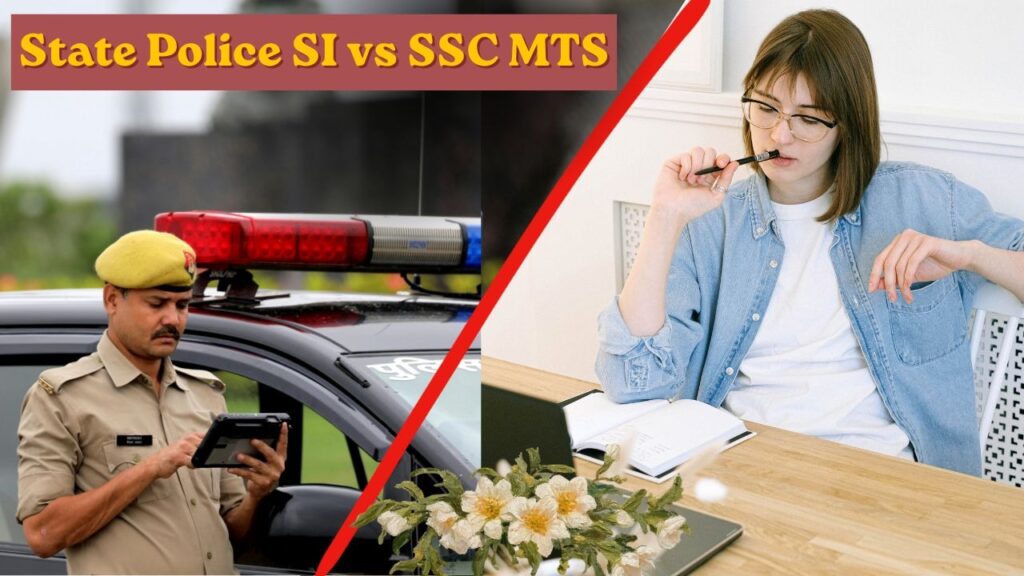
The hype and excitement for government jobs in India is vast and often overwhelming. People cut off everything just to clear competitive exams. Two most big names that pop up frequently are State Police Sub-Inspector (SI) and SSC Multi-Tasking Staff (MTS). At first glance, comparing State Police SI vs SSC MTS is like comparing apples to oranges. One is a field power stuffed job and other is a desk job as administrator.
Many students get confused to choose their field because they don’t know the responsibilities and real-time work, they’re just watching money. Ask a single question and do yourself a favor for finding the right answer.
Do you want the power and prestige of the uniform, or the stability and work-life balance of a central government desk job?
Let’s understand this through this guide which breaks down every detail from these two paths to let you decide which job aligns with your lifestyle.
Job Roles and Responsibilities in Real
State Police Sub-Inspector (SI)
A person is going to work under Police regulations at the lowest rank position. Going to the scene of a crime report or checking who breaks the law as the first investigating officer, and filing a charge sheet in court is Sub-Inspector responsibility. This position comes in Group B (Non-Gazetted) or Group C Jobs.
It is a desired job for a person who has a bulky body and good physical strength with a sense of justice, and a desire for social status. It’s a 24/7 job, changing shifts, and responsible to maintain public safety, law and order, and investigate crime scenes.
SSC Multi-Tasking Staff (MTS)
All the paperwork is required to maintain that the system works properly, MTS employees are responsible for maintaining files, photocopying, delivering couriers to provide essential support in various Central Government Ministries, Departments, and Offices.
It is a desired job for quiet and routine seeking people who want a secure position at government desk with minimal stress and ample time to prepare for higher exams (like UPSC or SSC CGL). It comes under Group C posts.
Why Compare These Two?
The comparison becomes necessary when students get confused because of Entry Barriers and Aspirant Demographics.
SSC MTS: Students can take entry in the government sector after 10th pass and take a tag on their resume.
State Police SI: Wait for the graduation to complete and then apply to take authority in their local area.
Tip: You can apply for both and become a government employee.
Eligibility and Selection Process
The requirements are different for these two positions because their responsibilities are opposite. Physical standards also matter for the SI job. Let’s take a deep look:
Feature
State Police SI
SSC MTS
Educational Qualification
Graduation (Any Stream)
10th Pass (Matriculation)
Age Limit
21 – 28 years (Varies by state)
18 – 25 or 18 – 27 years
Physical Standards
High (Height, Chest, Vision)
None (Except for Havaldar posts)
State Police SI conduct two tests — Prelims and Mains to check your knowledge in GS, Maths, Reasoning, and Language (Hindi/English). After clearing the written examination, candidates who are shortlisted will go to the next phase of Physical Efficiency Test and Physical Standard Test. These tests will check your endurance capacity while running, long jump, and high jump along with height and chest measurement.
Medical Examination for checking eyesights, flat feet and knock-knees are also mandatory to allow you to take the field job.
SSC MTS has a streamlined selection process which starts with an objective-type exam. This Computer Based Examination divided into two sessions —
Session I
Numerical and Mathematical Ability & Reasoning
Session II
General Awareness & English Language
CBT follows PET/PST but only for havaldar posts, and it has only walking test and physical measurement. You will be called for document verification once you finish all these tests.
Salary and Benefits
Most of the students decided their career according to the salary and benefits. State Police SI pay at Level 6 which means basic pay is ₹35,400. It can be around ₹55,000 to ₹75,000 total salary by including other allowances. Salary varies based on the city/state of the person.
SSC MTS pays at the Level 1 scale, basic pay is around ₹18,000 with additional benefits it can sum up to ₹28,000 to ₹32,000.
Choose wisely, because your choices impact on your lifestyle, perks and your mindset.
Preparation Strategy to Compete in Exam
Few subjects are common in both State Police SI vs SSC MTS exams. You can prepare yourself for both exams if you are still in 10th grade.
Mathematics, Reasoning, and General Awareness are mandatory subjects for both exams.
Make your basics clear by practicing on Basic arithmetic, percentages, profit & loss, and interest etc.
Try a mock test online and buy books in which Coding-decoding, blood relations, and syllogisms questions are presented.
Read newspapers and follow famous personas and good channels on youtube for Current affairs, History, Geography, and Polity.
Analyze Previous Year Questions to obtain Extreme Speed and Accuracy in every answer. Physical activity is required for SI selection, so dedicate 1 hour every morning to any game and running outside.
Career Growth and Promotions
State Police SI
Sub-Inspector (SI)
Inspector
Deputy Superintendent of Police (DSP)
Additional Superintendent of Police (ASP)
In some cases, top performers reach the rank of SP (IPS level) near retirement.
SSC MTS
Multi-Tasking Staff
Lower Division Clerk (LDC) – via Departmental Exams
Upper Division Clerk (UDC)
Assistant Section Officer (ASO)
The MTS profile is often seen as a stepping stone. Most candidates clear CGL or State PSCs while working as MTS.
Need Help To Choose Your Right Path?
Take paper and pen for side-by-side comparison for both SI and MTS jobs. In those comparison right your pros and cons:
What is your “Why”?
Pros
Cons
State Police SI
Power, uniform, field action, high paying
24/7 job, vary shifts, transfer different states, crime scenes, stressful
SSC MTS
Stable job, grow family, decent work, prepare for IAS
Low salary, ton of preparation to clear exam
If you choose SI then prepare yourself for facing crime scenes & handling dead bodies, political pressure, and angry crowds. Maintain physical stamina and strength with regular exercise.
If you choose MTS then prepare yourself for preparation for the next rank for higher posts but it is a decent job and requires less stress to manage.
The State Police SI role is a “Life Style.” It offers high pay with great authority which makes you become a man with power that has a direct impact on society. SSC MTS is a desk job for people who maintain discipline and want a peaceful life.
My advice is don’t lose the chance, if you are in 10th grade you can apply for SSC MTS and take the hit while preparing for other other options like IAS or State Police SI. you can decide after your graduation but if you are graduated then choose accordingly.
Regardless of your choice, the key is consistency. Start your preparation today, pick your syllabus, and don’t stop until you crack the examination.
Most of the students join the corporate sector but private jobs won’t provide security, high-salary, and additional perks which the government sector offers to the employees. But position matters in government jobs too if you have a higher position in the department, your salary will be more and other perks. There are many government jobs after graduation in India in the different departments.
But you must understand which department suits you best. Let’s look into the details of each government job after graduation. Don’t rush, just focus on what you want to achieve in life.
Why Government Jobs Still Matter
People who spent years working in a public sector bank or Ministry of finance described that money attracts you but the major reason is you never have to worry about if you’ll have a job next year or not.
If you watch it closely, you are going to understand — A government job in India isn’t just a paycheck. It comes with job security that private companies rarely match. It comes with a pension through the National Pension System, so the years after retirement aren’t a financial scramble. Government jobs offer fixed working hours, but there are exceptions. Defence and UPSC is tougher and no fixed hours. Most jobs are not that tough so you can give time to your family. In India, society gives more respect to government employees than private employees.
There is one more thing, if you belong to SC, ST, OBC, and EWS categories, government recruitment includes reservation benefits that make the competition a little more balanced than it is in the open private market.
None of this means government jobs are easy to get. But it explains why so many students keep this door open, even while exploring others.
Government Jobs After Graduation in India
There is no one big exam for a government job, it gives you job security and high salaries that makes it tough to compete with lakhs of students and being selected.
IBPS conducts the PO and Clerk exams for most public sector banks, while State Bank of India runs its own separate recruitment for similar roles.
If you want something closer to economic policy, RBI hires for Grade B officer and Assistant positions, and NABARD focuses specifically on rural and agricultural banking.
Job Title
Minimum Qualifications
Example Employers / Recruiting Bodies
Accountant / Junior Accountant
Bachelor’s degree in Commerce (B.Com) or equivalent; some posts accept diploma in accounting
State departments, municipal corporations, central ministries, cultural institutions
B.Com, proficiency in Tally / Govt accounting rules
Department of Economic Affairs, ministries, central govt offices
Treasury Officer / Cashier (Treasury)
B.Com; sometimes specific treasury certificates
State treasuries, municipal treasuries
Internal Revenue Agent / Revenue Inspector
Graduation; specialized departmental exams
Tax departments, revenue directorates
Central Government Jobs
The Staff Selection Commission runs several exams worth knowing. SSC CGL is the big one, opening doors to positions like Income Tax Inspector and Assistant Audit Officer. SSC CHSL leads to roles like Data Entry Operator or Lower Division Clerk.
If you studied engineering, SSC JE is built specifically for you. And if you can take dictation quickly, there’s SSC Stenographer.
Job / Exam
Minimum Qualification
Common Extra Requirement
SSC CGL
Graduation degree
Post-wise age and skill test requirements
SSC CHSL
12th pass OR Graduation
Typing/skill test for some posts
SSC MTS
10th pass OR Graduation
Age relaxation as per category
SSC JE
Diploma or B.E./B.Tech in relevant field
Technical qualification in engineering branch
SSC CPO
Graduation in any stream
Fitness and medically fit
Railways, Largest Employer in the Country
RRB NTPC opens up roles like Station Master and Traffic Assistant for general graduates. RRB ALP is for those drawn to operating trains as Assistant Loco Pilots.
RPF handles railway security and law enforcement. And RRB JE, again, is the engineering route.
Railway Job Post
Main Work
Basic Eligibility
Usual Recruitment Route
Station Master
Controls train movement and station operations
Graduation in any stream
RRB NTPC Graduate-level exam
Goods Train Manager
Manages goods train operations and coordination
Graduation in any stream
RRB NTPC Graduate-level exam
Senior Clerk cum Typist
Handles records, typing, office work, and data entry
Graduation with typing skill where required
RRB NTPC Graduate-level exam
Junior Accounts Assistant cum Typist
Accounts work, billing, clerical finance tasks
Graduation, usually commerce preferred
RRB NTPC Graduate-level exam
Commercial cum Ticket Clerk
Ticketing, passenger support, commercial counters
Graduation in any stream
RRB NTPC Graduate-level exam
Trains Clerk
Train records, movement entries, office coordination
Graduation in any stream
RRB NTPC Graduate-level exam
Traffic Apprentice
Supports railway operations and traffic control work
Graduation in any stream
RRB recruitment / NTPC-related notifications
Section Controller
Monitors train operations and sectional control
Graduation; often a high-responsibility post
RRB notification / senior railway recruitment
Junior Engineer (JE)
Technical supervision in civil, electrical, mechanical, signal, etc.
the exam that produces IAS and IPS officers. It’s open to graduates from any stream, but it’s also the toughest exam in this entire list, with three stages testing not just knowledge but stamina and patience.
Each state also runs its own version through its Public Service Commission. UP has UPPSC, Bihar has BPSC, Madhya Pradesh has MPPSC, and so on, each recruiting for state-level administrative roles.
UPSC Service / Post
Group
Main Work
Basic Eligibility
Indian Administrative Service (IAS)
All India Service
District administration, policy implementation, public welfare, law and order coordination
Graduation in any stream
Indian Police Service (IPS)
All India Service
Internal security, policing, crime control, public order
Graduation in any stream
Indian Foreign Service (IFS)
Group A
Diplomacy, foreign relations, embassies, international representation
Central government accounting and financial reporting
Graduation in any stream
Indian Defense Accounts Service (IDAS)
Group A
Defence finance, budgeting, accounts management
Graduation in any stream
Indian Railway Protection Force Service (if allotted through UPSC-related services)
Group A/B depending on cadre
Security and protection of railway property and passengers
Graduation in any stream
Central Civil Services Group A
Group A
Administration in central ministries and departments
Graduation in any stream
Central Civil Services Group B
Group B
Assistant-level administrative and policy work
Graduation in any stream
Defense Jobs
If discipline and service appeal to you more than office work, the defence sector offers CDS for officer entry into the Army, Navy, and Air Force, and AFCAT specifically for the Air Force.
Defence Job / Entry
Main Role
Basic Eligibility
Selection Route
Indian Army Officer
Lead troops, field operations, administration
Graduation in any stream
CDS / SSC (Non-Technical) / other officer entries
Indian Navy Officer
Naval operations, technical or executive duties
Graduation; engineering degree for technical entries
CDS / SSC Executive / technical entries
Air Force Officer
Flying, ground duty, administration, support roles
Graduation in any stream for many entries
AFCAT / CDS / NCC special entry
Short Service Commission Officer
Temporary officer role in Army, Navy, or Air Force
Graduation; post-specific rules apply
SSC entry routes
CDS Officer Entry
Commissioned officer in Army, Navy, or Air Force
Graduation in any stream
CDS written exam, SSB, medical
AFCAT Officer Entry
Air Force officer in flying, technical, or ground duty branches
Graduation in any stream; technical branches need relevant degree
AFCAT, interview, medical
NCC Special Entry
Officer entry for NCC cadets
Graduation + NCC certificate requirements
Direct officer selection, no written AFCAT/CDS in some cases
Teaching has its own path too. CTET or your state’s TET exam qualifies you to teach in schools, while UGC NET is for those who want to lecture at the college level. KVS and Navodaya Vidyalaya recruitment also fall in this teaching bucket.
Important Tip: You didn’t need to pick just one. Many students prepare for two or three of these at the same time, since the subjects often overlap.
Teaching Job
Level
Basic Eligibility
Main Exam / Route
Primary Teacher (PRT)
Class 1–5
Graduation in some cases, usually with D.El.Ed / B.El.Ed; CTET Paper 1 for central jobs
CTET / TET + recruitment exam
Trained Graduate Teacher (TGT)
Class 6–10
Graduation in relevant subject + B.Ed; CTET Paper 2 for central schools
CTET / TET + recruitment exam
Guest Teacher
School / institute
Graduation, sometimes B.Ed preferred
Local government recruitment / walk-in / contract basis
Special Educator
School level
Graduation + special education qualification
Recruitment through education department / DSSSB / state boards
Who Can Actually Apply
The good news is that most of these exams simply ask for a graduation degree, in any subject. You don’t need a specific stream unless the job itself is technical, like engineering posts in SSC JE or RRB JE, which obviously expect an engineering background.
Most exams accept candidates roughly between 18 and 32, though SC, ST, and OBC candidates usually get age relaxation, and the exact numbers shift slightly from year to year.
You also need to be an Indian citizen for nearly all of these roles, and for defence or paramilitary jobs like CDS or RPF, there are physical fitness standards on top of everything else.
Never assume for the exam updates. Dates are extended sometimes and shifts every year. Every government organization publishes its own official notification that declares eligibility and process. Rules shift slightly year to year, so do not rely on people’s words or what happened last year.
Once you decide which field you are going to join, you have to figure out the process itself, which felt confusing the first time but became simple once he broke it down.
It starts with tracking official notifications. Websites like ssc.nic.in,ibps.in, rrbcdg.gov.in, and upsc.gov.in post recruitment notifications which include detailed instruction and a timeline to open the portal where you can apply. It happens every year, so checking them regularly matters.
Once a notification drops, the first step is registering online, usually with just a mobile number and email. Then comes the actual application form, where personal details, educational background, category, and post preferences need to be filled in carefully.
Remember that correction windows are short, so a careless mistake here can follow you for the whole process. After that, documents like your photograph, signature, and category certificates need to be scanned and uploaded.
Then there’s the application fee, though SC, ST, PWD, and female candidates often get a waiver or discount here. Once everything is submitted, the admit card becomes available a few weeks before the exam date, and then it’s just down to showing up and going through whatever stages that particular exam has, whether that’s a single test or a longer chain of prelims, mains, and interview.
How To Prepare For Government Exams?
Once you know that these exams exist doesn’t mean you are fully prepared for it. You need to read the syllabus properly instead of skimming it.
Every exam leans on a mix of Current Affairs, Simple Mathematics, Logic and Reasoning, and English or Hindi, but the weight given to each section changes depending on the exam.
After you study the topics of a specific exam, check previous year papers, not to memorize answers, but to understand the pattern, the difficulty level, and how questions are usually framed and paired with regular mock tests.
This technique will teach you how to manage time under pressure, since most of these exams are brutally time-bound. Make Current affairs a daily habit too, especially since banking and SSC exams lean heavily on it. If your exam has more weightage on Current Affairs then prepare well for it day-by-day.
What made the real difference, though, was a basic timetable. Not a rigid one, just something that kept you showing up every day instead of cramming in bursts. And you had to decide between coaching and self-study. Most students who cracked their exams recommend choosing both. As some subjects are hard that need guidance and some are easy, you can prepare it by yourself. There’s no universal right answer here. It depends on how you learn best.
For decades, students have been doing wrong while preparing for the government exams which can be put away and made aware future generations to stop going wrong.
Some students put all their effort into one single exam and ignore everything else, which is risky given how competitive these exams are.
Others miss notification deadlines simply because they weren’t checking regularly.
A lot of students skip mock tests entirely, only to be blindsided by time pressure on the actual exam day.
And many treat current affairs as optional, which costs them marks in exams where it’s actually a major scoring section.
Conclusion
There are massive numbers of vacancies every year in government jobs after graduation in India. If you also finish your college this year or previous year, you can apply for any of the jobs which fits into your profile.
Check the official notifications daily to find the dates for application, admit card, and exam date. Some exams take multiple phases to get selected but some require a simple exam. Students who can stay consistent, give hours to study, and set their goals can achieve it by going through a tough process of selection.