SLPRB Final Result 2025 Declared – Download Constable & SI Merit List

SLPRB Final Result

The final Result 2025 for Constable, Sub-Inspector (SI) and Various Posts has been released by State Level Police Recruitment Board (SLPRB) Assam on 10th October 2025. This huge recruitment is for 6,200+ vacancies in Assam Police, Assam Commando Battalions, APRO, and other allied services among different departments. 

This is one of the biggest police recruitment drives under SLPRB Assam in 2025 which will give a major boost in the state’s security and administrative setup at multiple levels. The open selection procedure and the overall assessment guarantee that only the best applicants will be able to join the prestigious Assam Police services. 

Overview of the SLPRB Final Result 2025

Recruitment BodyState Level Police Recruitment Board
PostsConstable, Sub-Inspector and others
Vacancies 6200+
Result Date10/October/2025
Selection ProcessPhysical Fit Test, Written Exam, Interview
Official WebsiteClick Here

Important Dates For The SLPRB 2025

Result Date10/October/2025
Physical Fit Test3/October/2024
Written Exam06/April/2025
Interview09/May/2025

How to Check SLPRB Result 2025

Candidates can view their results by following the following:​

  1. Go to the official website of SLPRB mentioned in the article.
  2. Press on “SLPRB Assam Final Result 2025” link
  3. Enter required login details:
  • Application Number
  • Candidate’s Name
  • Date of Birth
  1. Hit the submit button to check your result
  2. Download the result and take a print out for future reference. 

Read More :- O Level Course 2025: Complete Guide to Fees, Syllabus, Duration & Job Benefits

SLPRB Result 2025 Post Category and Number of Vacancies

Post CategoryNumber of VacanciesDepartment
Sub Inspector (UB)144 postsAssam Police
Sub Inspector (Communication)7 postsAPRO
Sub Inspector (AB)51 postsAssam Commando Battalions
Constable (AB)164 postsAssam Commando Battalions
Assistant Deputy Controller1 postDGCD & CGHG
Grade IV Posts200+ postsVarious departments
Cook (SDRF)10 postsFire & Emergency Services

Next Steps for Selected Candidates

The selected candidates will have to get ready for the joining formalities and document verification process. They should:​

  • Check all personal information on the merit list is correct
  • Keep original documents handy (birth certificate, photographs, admit card and other relevant documents)
  • Stay tuned for Joining Instructions in the result notification
  • Report Department wise As under further orders from SLPRB. 
Useful Links
Download ResultClick Here
NoticeClick Here
Official WebsiteClick Here

Leave a Comment

Your email address will not be published. Required fields are marked *

IBPS PO MT XVI Recruitment 2026: What Every Banking Aspirant Needs to Know

IBPS PO MT XVI Recruitment

If you began your preparation for the IBPS PO with the mock tests of the last year, then your syllabus is already out of date with yesterday’s blueprint. The IBPS PO MT XVI cycle for 2026 has evolved quite a bit in terms of number of vacancies, in the Mains exam, and even in the rounds after the interview, so aspirants who do not revise their strategy might find themselves sitting in the exam hall solving a paper that is no more. 

Here are the real differences this time around and what that means for how you prepare. 

What Changed in IBPS PO MT XVI 2026

The IBPS PO MT XVI detailed notification was published on 30 June and 01 July 2026 on ibps.in, inviting applications for the posts of Probationary Officer and Management Trainee in 11 participating public sector banks for the recruitment year 2027–28. 

The total number of vacancies mentioned in the first notification was 6,715. That figure has since shifted — as per the 20 July 2026 update from IBPS, the number stands at 7,365, which is approximately 29% more than last year’s intake. 

Two banks, UCO Bank and Union Bank of India, had not yet submitted their vacancy numbers as of this update, so the final count may change once more before the end of the process. Bank of Baroda, Canara Bank, and Bank of Maharashtra currently have the largest number of vacancies. 

The date for application also got extended. It was initially scheduled to end on 21 July 2026 but IBPS extended the last date to 26 July 2026. This year also brings something new with effect: a two-day correction window post registration closure, so candidates who find an error in their form after submission are not doomed by it. 

Important Dates for IBPS PO MT XVI Recruitment 2026

MilestoneDate
Detailed notification released30 June – 1 July 2026
Online application window1 – 26 July 2026 (extended from 21 July)
Preliminary exam22 & 23 August 2026
Main exam4 October 2026
Personality Test / InterviewTo be announced

Treat the interview and personality test dates as provisional until IBPS confirms them closer to the Mains result — that stage of IBPS PO MT XVI typically gets scheduled bank-wise, so your call letter will carry the exact date and centre.

Eligibility Criteria

To apply for IBPS PO MT XVI Recruitment, you need a graduation degree in any discipline from a recognised university, with your mark sheet or provisional degree certificate in hand at the time of registration — IBPS doesn’t accept “result awaited” candidates. 

The age bracket is 20 to 30 years as on 1 July 2026; the usual government relaxations for reserved categories apply, but confirm the exact slab-wise relaxation against the official notification PDF rather than assuming it mirrors last year’s, since IBPS has been known to revise fine print between cycles.

The application fee is ₹175 for SC/ST/PwBD candidates and ₹850 for everyone else, payable online through the IBPS portal.

Salary and Pay Scale

An IBPS PO MT XVI Recruitment selected candidate shall begin at the basic pay of ₹48,480. When DA, HRA and other allowances are included, the salary comes to around ₹74,000-76,000 per month in-hand, although it may vary based on place of posting and allowances structure of individual banks. 

Read More :- UPSC Principal and Vice-Principal Recruitment 2026: Must Check Complete Details

The Exam Pattern For IBPS PO MT XVI Really Diverges From Last Year

Prelims remains the same. It’s still 100 questions for 100 marks on English Language, Quantitative Aptitude and Reasoning Ability, with 60 minutes for the duration which is divided into three separate timers of 20 minutes each. A ¼ mark will be deducted for each wrong answer and your Prelims score is only a qualifying hurdle — it is not taken into account for the final merit list. 

Mains is what makes IBPS PO MT XVI Recruitment seem an altogether different exam. The objective paper has increased from 145 questions to 170 questions, while the total marks remain 200 in a duration of 160 minutes. The English Language now asks more questions but awards fewer marks – 20, down from 40, so that each English question is worth less than it ever was.  

General/Economy/Banking/Digital/Financial Awareness has been increased to around 50 questions for 60 marks and is one of the heaviest sections in the exam and also Data Analysis & Interpretation has been given more marks.  

The subjective paper remains 25 marks for 30 minutes, although sources vary on whether it’s essay writing and comprehension or if it includes letter writing — do confirm this with your admit card and the official notice when released, don’t take either version for your final source of information. 

Selection Process: Four Stages, Not Three

Where IBPS PO MT XVI Recruitment used to run Prelims, Mains, and Interview, this cycle adds a fourth step: a Personality Test, conducted after Mains and before the interview. It’s mandatory for anyone shortlisted, but non-qualifying — its purpose is to hand the interview panel a personality profile rather than to filter candidates out on its own. 

The interview itself is still conducted by the individual participating banks, and you’ll need at least 40% to qualify (35% for SC/ST/OBC/PwD candidates). 

Final merit combines Mains and Interview scores in an 80:20 ratio — Prelims marks play no role beyond getting you through the door.

One Preparation Tip You Shouldn’t Skip 

Don’t wait until after Prelims to deal with the Mains shift. Because Banking Awareness and Data Analysis & Interpretation now carry noticeably more weight in IBPS PO MT XVI’s Mains paper, block out a fixed weekly slot — even 30 minutes, three times a week for RBI circulars, recent monetary policy changes, and current banking-sector news, starting today rather than after Prelims is done. 

Candidates who leave Banking Awareness for a last-minute cram before Mains are the ones most exposed by this year’s restructured weightage.

Read More:- MPPSC ADPO Recruitment 2026: Everything Law Graduates Need to Know 

Review These Details Before Applying

The vacancy count for IBPS PO MT XVI Recruitment isn’t fully locked yet, with two banks’ numbers still pending, and the interview-stage calendar hasn’t been released. Keep checking ibps.in directly rather than relying on secondhand vacancy figures as you get closer to results — in a cycle with this many moving parts, the official notification is the only version worth trusting completely.

Conclusion 

The IBPS PO MT XVI Recruitment 2026 notification came with more vacancies and a new selection process, so it is a good chance to grab for banking aspirants. Check your eligibility, apply online, and start preparing for Prelims and the revised Mains exam today. 

There might be updates for vacancies and schedules from IBPS’s side, so keep visiting the official site for the latest notifications and do not trust other websites. 

Leave a Comment

Your email address will not be published. Required fields are marked *

Time Management Tips for Students and Government Job Aspirants

Time Management Tips

The reality is that most people don’t have a problem with time. They have a problem with managing time. The Time Management Tips for students and government job aspirants is important. For instance, two students may have identical 24 hours, the same syllabus, and the same exam date — yet end up in completely different places on result day. It’s because almost always how they spend their hours. 

This guide analyses the time management principle that really applies for us Indians — students in school & college, competitive exam aspirants for SSC, RRB, UPSC, banking and state-level, entrance exam students aiming for IIT, NEET, or law entrances, and working professionals attempting to study after holding a full day at the office. The circumstances may vary, but the fundamental discipline is one and the same. 

Why Time Management Tips Actually Matters 

It’s not that they don’t know “time management is important,” it’s just that no one actually has time to do it, not that they need it any more than the rest of us do. For exam candidates in particular, bad time management means not only less revision. It has three very real and very specific costs. 

First, it makes your syllabus look bloated. A topic that should take roughly three weeks gets stretched out over two months, not because it’s difficult, but because you’re learning in fragmented, distracted sessions rather than in concentrated blocks. 

Second, it kills your mock test performance. Candidates who are poor at managing their prep time tend to be procrastinators and pick up the easy topics first and push the difficult topics towards the end, so that by the time mocks begin, half the syllabus feels like a stranger under exam pressure. 

Third, and this is the one no one talks about nearly enough, it destroys your confidence. When you’re always feeling “behind,” you begin to question your own competence, even though the real problem was never intelligence — it was planning. 

Effective time management is not a matter of finding more hours in the day. It’s realizing that you actually already have the time, you just need to make it work. 

Time Management Tips for Students

Students who are balancing regular academics, tuition and assignments along with personal life also need a system which is practical and not a strict timetable copied from a top scorer’s Instagram post. 

Start with a weekly map, not a daily one. Daily to-do lists come crashing down as soon as one thing goes wrong — a pop quiz, a family gathering, feeling too tired. A weekly perspective allows you to reschedule your responsibilities without thinking you are having a bad day. Block out any non-negotiable obligations (class time, work, sleeping) and then plan your study periods around those. 

Use the “two-subject rule” for evenings. Attempting to cover every topic every day tends to result in none of them being covered very well. Choose two topics each night and dive in, cycling through the week. Depth outperforms breadth in terms of real retention. 

Protect your first hour after school. Most students spend the golden hour after school on their phones scrolling “just for ten minutes” which ends up being ninety. That first hour, when the day’s lessons were still fresh, was the best time for revision — not for new topics. 

Treat sleep as part of your study plan, not separate from it. Sleep deprivation to “make more time” is the most common error students make, and it backfires almost every time. Retention falls off a cliff with poor sleep, so those extra two hours often result in less learning than one focused hour on a well-rested brain. 

Time Management Tips for Government Job and Recruitment Exam Preparation

Preparation for government exams — SSC CGL, SSC JE, RRB NTPC, RRB ALP, Agniveer, UPSSSC, banking exams, state PCS has its own trap: it has a huge, fixed syllabus that remains more or less unchanged every year, making it very easy to remain stuck in a “preparation phase” without feeling ever ready. 

Reverse-engineer your timeline from the exam date, not from the syllabus. Most aspirants begin by telling themselves “I’ll finish RC, quant, then GK” without even assessing if that speed is even sustainable till the exam. Count backwards instead: How many weeks are there until the exam, how many subjects do you have to learn, and how many practice tests do you want to do before the D-day. This one change detects date problems three months in advance rather than three weeks before the test. 

Separate “learning time” from “practice time” clearly. Many candidates confuse these two processes — theory reading and question practice in one session and slow themselves down in both. Assign some fixed duration blocks solely for concept learning, and some solely for solving past year papers & mocks in a timed environment. They develop different abilities.

Make a weekly slot for current affairs you gear towards a level, don’t squash it in as a bit of leftover time. For exams like ssc, rrb,state level recruitment exam current affairs/general awareness is often pushed to “whenever i find time to study”,which is usually never. Settle for one or two brief daily sessions instead of waiting for free moments that never come. 

Mock tests deserve a full time slot, not a rushed one. Scheduling simulation the real exam length is as important as doing the questions. Your practice test should honor that 90 minutes of pressure since it should help simulate the real exam (and the review afterward) — not just the solving. 

Time Management Tips for Entrance Exam Aspirants

Entrance exams such as JEE, NEET, CLAT, and CUET operate on a different time scale as compared to the recruitment exams – they meld board exam stress with competitive exam intensity, and that too, in the same academic year. 

Sync your school syllabus and entrance syllabus instead of running two separate tracks. An enormous portion of time is wasted due to students studying the same subject chapter twice — once for boards, and once for the entrance exam in entirely separate sittings. Studying the two simultaneously, at entrance-level depth from day one, is months ahead of the full prep cycle. 

Rotate subjects daily instead of exam-cramming one at a time. These exams cover more than one subject at a time, so you have to keep your mind warmed up in all of them and not just be sharp on one subject and rusty on the others. A steady rotation — even if uneven in the number of hours per subject, keeps all the subjects “alive” in your mind. 

Track mistakes, not just completed chapters. Sorting out what you have achieved in the syllabus feels productive, but it doesn’t tell you information about what is actually going wrong. Keep a list of mistakes you make again and again when doing practice questions — that list is your revision material that will be the most efficient in the last month. 

Read More 👉 Data Science vs AI: Which Career Is Better?  

Time Management Tips for Working Professionals Preparing Alongside a Job

This may be the most difficult version of the problem since the constraint is not motivation — it’s literally hours in the day. Working professional-level test such as a government exam or a career-switch entrance exam does not have the luxury of a 8-hour study day. 

Accept the 90-minute reality and plan around it. The majority of working people truly have only about 60 to 120 minutes of concentrated work time in a day, divided between early morning and late evening. Struggling against this reality by aiming for 5 hours a day is just setting yourself up for failure and guilt. Schedule for the attainable during a weekday, and save the heavy-duty work for weekends — full-length mocks, madly difficult topics, revision marathons. 

Use commute and break time for low-effort, high-repetition tasks. Formulas, vocabulary, current affairs and short revision notes can easily be crammed into a commute or a lunch break. Save your truly fresh, high-powered hours — typically in the morning for the subjects that actually demand thinking of the deep kind. 

Don’t try to “catch up” by sacrificing entire weekends repeatedly. Burnout for working professionals generally results from this very pattern: lean weekdays, and then trying to fit a week’s worth of goals into Saturday and Sunday. It lasts for a couple of weeks, then crumbles. A sustainable pace beats a heroic one that quits come month three.  

Tell your workplace and family what you’re doing, even loosely. Candidates who do not share details of their preparation for the exam generally end up with more distractions during their study sessions as no one with whom they dwell or live is aware that those hours are sacrosanct. A modest notice - “I study from 6 to 7:30 every day” – cuts interruptions more effectively than any planner or app could. 

The One Habit That Ties All of This Together

Across students, government exam aspirants, entrance candidates, and working professionals, the single most useful habit is the same: reviewing the week, not just planning it. Most people plan on Sunday and then never look back until the next Sunday. Spending fifteen minutes reviewing what actually got done versus what was planned and being honest about why the gap happened is what turns a time management system from a wishlist into something that actually works over months of preparation.

Time management Tips for exams was never really about finding more hours. Every aspirant, regardless of which exam they’re preparing for, is working for the same 24 hours as everyone else. What separates a good result from a missed one is usually not effort — it’s whether those hours were spent on the right things, at the right time, consistently enough to matter.

Conclusion

Time management tips for students and government job aspirants is important for sustaining consistency in preparation for SSC, UPSC, RRB, banking, work, or JEE, NEET exams. Begin with attainable goals in mind, focus on the most important things, check in on your progress each week, and then rest appropriately. Little bit of betterment you make up every day adds together over months of training. 

Leave a Comment

Your email address will not be published. Required fields are marked *

Periyar University Result 2025 Declared – Check Scores & Download Marksheet Now!

Periyar University Result 2025

Students of Periyar University’s wait is over as it declared the result 2025 on its official website. Periyar University Result 2025 is available, students can check the scores of UG & PG exams conducted in February & April 2025, and download them from the direct link given below. Courses included BA, BSc, BCom, MA, MSc, MCom, BBA, and BCA results out now. 

The Periyar University result is crucial for higher studies admissions. For Students who want to enter professional programs, or apply for a job, this mark sheet will serve as proof of your best academic qualification. 

Read More: NTA NEET UG Result 2025 Out – Click Here to Check Your Score Now!

Periyar University Result 2025 Details

ExamSeptember session exam
Conducting BodyPeriyar University
PurposeUG & PG Courses
Exam DateFebruary & April 2025
Result DateJune/2025
Result AvailableOnline
Get ResultClick Here
Official WebsiteClick Here

Steps to Check Periyar University Result 2025

  1. To see your result you must log in on the official website of the university.
  2. Go to the examination section.
  3. You have to enter your credentials such as registration number and DOB.
  4. Click on submit to get the result. 
  5. View your mark sheet and download it for future use.

Important Links 

ApplicationClick Here
Download NotificationClick Here
Get ResultClick Here
Telegram ChannelClick Here
Official WebsiteClick Here

Leave a Comment

Your email address will not be published. Required fields are marked *

RRB Technician Notification 2025 Out – Huge Vacancy! Apply Online for 6180 Posts

RRB-Technician-Notification-2025-Out

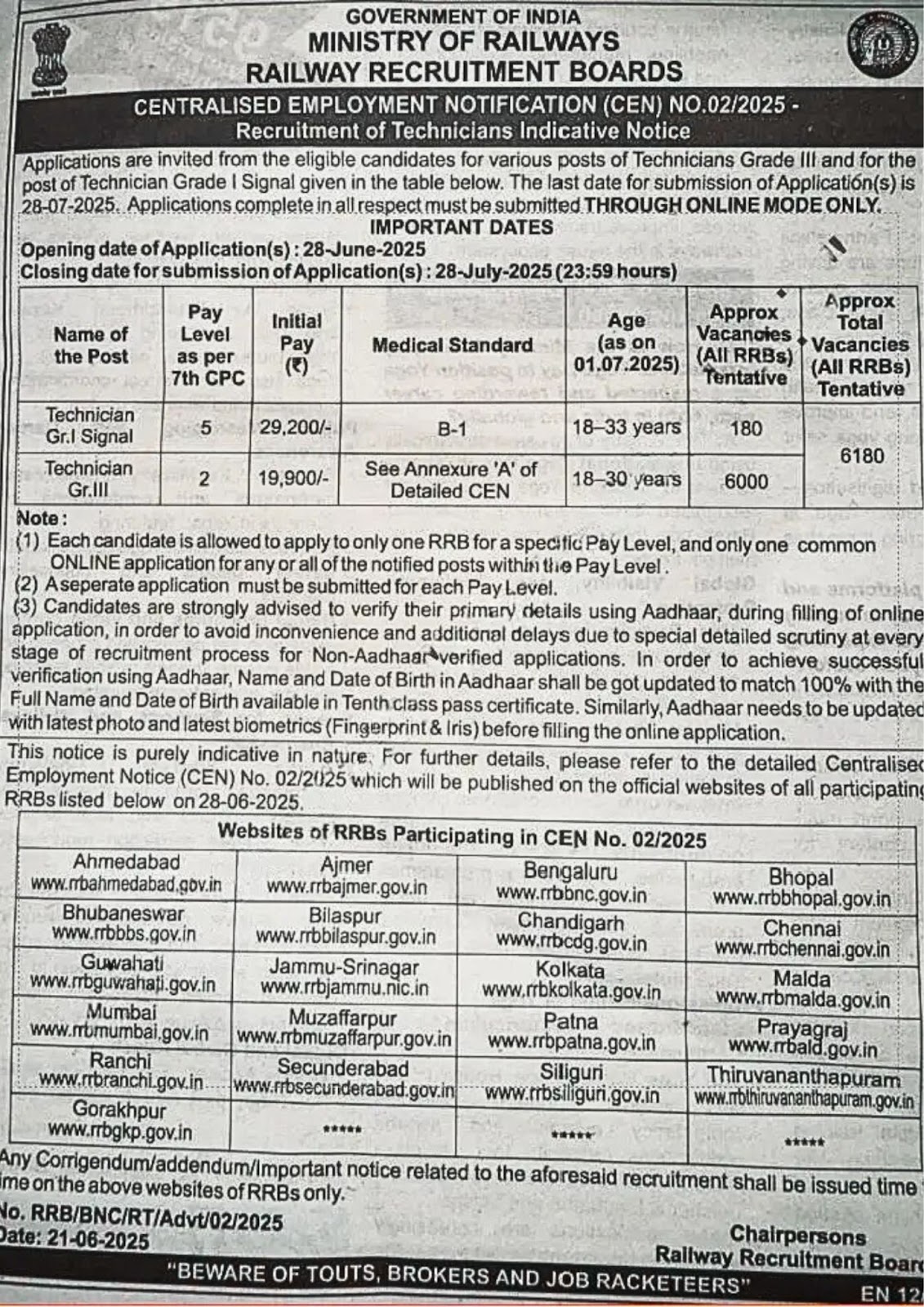
RRB Technician Notification 2025: If you’re waiting for the railway job vacancy then the wait is over as the RRB Technician Notification has been released now. If you’re interested in a technical job posting in the railway sector, you can apply now. Online application starts from 28 June, candidates should fill the form before 28 July 2025. There are a total of 6180 posts for the technician Grade-I & Grade-III. 

ExamRRB Technician
Conducting BodyRRB
PostTechnical
VacancyTechnician Grade 1: 180 | Grade 3: 6000
Mode of ExamOnline
Official WebsiteClick Here
Application Fee
General/OBC/EWS500/-
SC/ST/PH/Female (all Cat.)250/-
Correction charges250/-

The short notice for railway recruitment has been released. You can check the notification for the Grade–1 & Grade–3 Technician posts. Candidates who have been waiting should now prepare for the examination because the online application will start soon. The competition is high so you must prepare well to beat the process and get selected.

RRB Technician Key Dates

Notification dateJune-2025
Application starts28-June-2025
Application ends28-July-2025
Fee submission last date28 July 2025
Admit CardUpdated Soon
Exam DateUpdated Soon

Eligibility for RRB Technician Post

Grade–1 TechnicianBE/B.Tech in Engineering, Diploma Or EquivalentB.Sc in engineering Or equivalent
Grade–3 Technician10th Passed + ITI Equivalent or diploma
For more Detailed Information Download the Notification
CategoryAge Limit
Grade–118–33 years
Grade–318–30 years

Salary for RRB Technician 2025

Salary for Grade–1Rs. 52,297 – Rs. 46,457
Salary for Grade–3Rs. 35,654 – Rs. 31,674

Selection Process for the RRB Technician 2025

The Railway recruitment board will start the application form on 28-June-2025. The registered candidate will have to attempt the written examination online. The shortlisted candidates will be selected for further process of document verification and medical examination. The process is a gateway to the post so candidates must pass through this. Candidates must have passed all three stages only then their name will come on the final selection List.

Direct Links

Apply OnlineUpdate Soon
Telegram ChannelClick Here
Official WebsiteClick Here

Leave a Comment

Your email address will not be published. Required fields are marked *

Indian Army SSC Technical 68th Men Recruitment: Details for Engineering Graduates

Indian Army SSC Technical 68th Men Recruitment

If you’re an engineering graduate eyeing a career in uniform, the wait is over. Indian Army SSC Technical 68th Men Recruitment is going on. The Indian Army has thrown open applications for the 68th Short Service Commission (Technical) Course, Men, set to commence in April 2027. Alongside it, the 39th SSCW Tech entry has been announced for women candidates. Together, the two intakes will fill 381 vacancies, and this piece breaks down everything a male candidate needs to know before hitting submit.

How Many Seats Are Actually Available

There are overall 381 posts, out of which 350 are for SSC Tech 68th Course for male candidates and 31 posts are for SSCW Tech 39th Course for female candidates. That’s a meaningful jump from recent cycles, where vacancy counts hovered in the double digits, so this is genuinely one of the larger technical intakes the Army has floated in a while.

Important Dates You Cannot Miss

The online application portal for male candidates opens from 9/July/2026 to 7/August/2026. That’s a short window for filling out the application form. 

ItemDetails
Opening date (male)9/July/2026
Closing date (male)7/August/2026
DurationLess than 30 days

Applications are submitted exclusively through the official Join Indian Army website, joinindianarmy.nic.in. No offline forms, no third-party portals — anything else claiming to process your application should be treated as a scam.

Who Can Apply

Eligibility is fairly specific, and getting it wrong is the easiest way to get your application rejected at the shortlisting stage itself.

Age limit: Candidates must be between 20 and 27 years old as reckoned against the course commencement benchmark.

Educational qualification: You need a B.E./B.Tech degree in a relevant engineering discipline from a recognized university. Final-year students aren’t excluded either — they can apply provided they submit proof of having cleared the degree, along with semester-wise mark sheets, by the time the selection process demands it.

Marital status: The entry is open only to unmarried male candidates.

Nationality: Applicants must be Indian citizens, or in specific cases, subjects of Nepal or Bhutan, or persons of Indian origin holding the requisite eligibility certificate.

The Selection Process For Indian Army SSC Technical 68th Men Recruitment

Here’s something that surprises a lot of first-time applicants — there’s no written entrance test for SSC Tech entries. Selection runs entirely on academic merit and a structured evaluation process. Once your application is cleared based on your records which you have provided, you’re called for the Services Selection Board interview.

The SSB interview is conducted over several days that takes assessment step-by-step to check the candidate’s leadership potential and mental resilience. There are group tasks, and personal interview rounds that are structured in a way that test skills of candidates rather than just textbook knowledge. 

Those who clear the SSB are required to appear for medical examination, and the medical board recommends the merit list after taking medical fitness into consideration. 

Where and How Long the Training Runs

Candidates who qualify in the final merit list will be put through the 49 weeks training at Officers Training Academy(OTA), Gaya, Bihar. Should the course commence as planned in April 2027, the training would end in the beginning of 2028 and exact training calendar will be confirmed by the Indian Army closer to the start of the course. 

During training, cadets receive a monthly stipend of ₹56,100, which cushions the transition before commissioning.

Read More 👉 Government Jobs After Graduation in India: Complete Guide for 2026

What You Earn Once Commissioned

On successful completion of the training, candidates are commissioned as Lieutenants in Pay Level 10 having a minimum pay of ₹56,100 which can go up to ₹1,77,500 in Level 10 as per the 7th CPC Pay Matrix. With military allowances and field area pay, and other perks added, a fresh lieutenant’s effective pay package normally works out to about the ₹17-18 lakh per annum figure although that doesn’t include free medical coverage or travel concessions. 

As officers move up the ranks — Captain, Major, and beyond — pay levels rise accordingly, all the way up to the Chief of Army Staff at Level-18.

Conclusion 

If you’re an engineering graduate looking for a career that combines technical work with leadership responsibility and long-term financial security, this is one of the more accessible entry points into the Indian Army officer cadre — no written exam, a straightforward merit-based shortlisting process, and one of the larger vacancy counts seen in recent SSC Tech cycles. The application window is short, though, so candidates planning to apply should start gathering their engineering mark sheets and eligibility documents well before 9 July 2026.

Leave a Comment

Your email address will not be published. Required fields are marked *

Scroll to Top