HR Professional Courses: Get Complete Guide on Career Path, Salary & Growth

HR Professional Courses

If you’re curious about what it takes to be a Human Resources (HR) professional, you’re in the right place. Over the past 10 years, the HR Professional Courses has undergone significant transformation, shifting away from an administrative role to gaining importance and recognition as a strategic business partner in organizational culture, employee satisfaction and business performance. This all-in-one resource will take you through the Need to Knows of building a fulfilling HR career in India, whether you are a fresher exploring career options or a career changer seeking a meaningful direction. 

What Does an HR Professional Actually Do?

Before we get into courses and salaries, let’s demystify the day-to-day life of a HR professional. Despite the stereotype that human resources is just paperwork and policies, HR employees today wear many hats. You will participate in strategic talent acquisition to seek and recruit candidates aligned with company values and who will drive growth. You’ll design and deliver programs to upskill the employees, mentor junior staff, and help them grow their career within the company. 

On the compliance and policy side, you will be monitoring the company’s compliance with labour laws, conducting employee relations with tact, mediating disputes equitably and managing the full spectrum of employee life from hiring to offboarding. Compensation and benefits policies are your domain too: You develop the strategies, coordinate the performance reviews, and you can even assist with organizational development by working with your leaders on future staffing and succession planning. In today’s world of data and analytics, many HR professionals are also utilizing analytics to monitor indicators such as employee engagement, retention rates and hiring effectiveness to drive additional business improvements. 

The joy of human resources is that each day is different, with issues ranging from handling a difficult employee complaint to developing a creative new-hire program or spearheading an organization-wide change effort. 

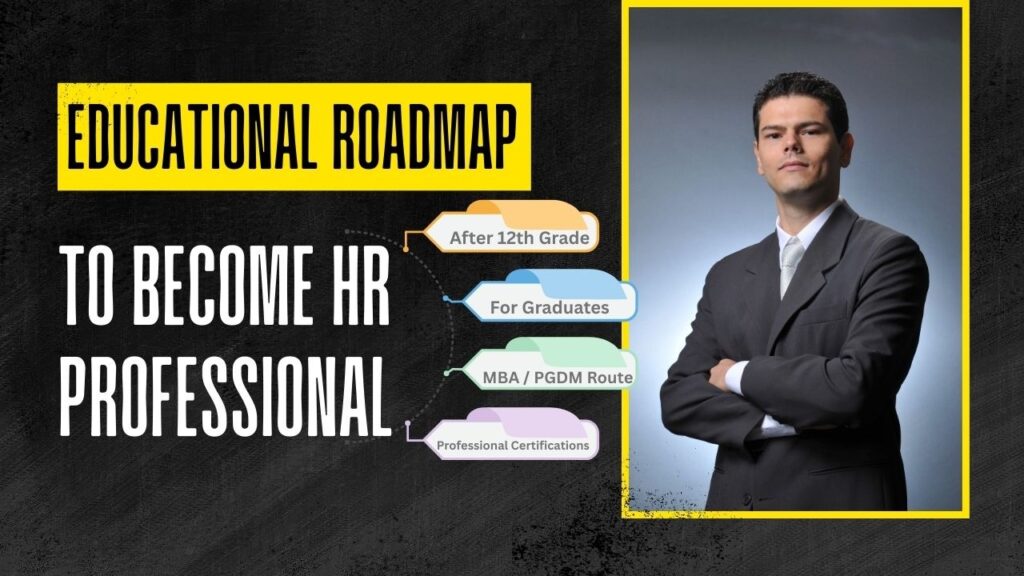
Educational Roadmap To Become HR Professional
HR career paths

The great thing about HR career paths is that there is no single “correct” path. To your education and current level of career aspirations, you can add several points of entry: 

After 12th Grade

If you have completed the high school you can go for the Diploma in Human Resource Management. These 1-3 year courses are available at a cost of Rs 50,000 to Rs 2,00,000 according to the classification of institution as a government or a private one. Alternatively, you can do 3 years of Bachelor’s degree (BBA, BA, BS) in HR or something related. Government College fee is goes from ₹1-8.5 lakhs and for private college fee is from ₹3-16.25 lakhs.The eligibility criterion is generally 50-60% in 12th class. 

For Graduates

If you already hold a bachelor’s degree (in any stream as per your undergraduate major), you can go forward for professional certificates or a post graduate diploma. A professional certificate of 6-12 months costs between ₹20,000 and ₹1,00,000, while a post graduate diploma for 1-2 years is valued at ₹50,000-₹1,20,000. These courses are great if you want to make a move into HR for then a full 2 year MBA. 

MBA / PGDM Route

If you are looking for an overall business education with focus on HR, a 2 year MBA or PGDM in Human Resources fees vary from ₹ 2-27 lakhs based on the tier of the college and the location. These programs on the repel need entrance exams as CAT, SNAP, MAT, or XAT. Top tier institutions such as IIM, XLRI have higher fee yet provide excellent placement package and networking. 

Professional Certifications

Professional certification is also valuable in addition to formal education. The popular certification include CHRG (Certified Human Resource Generalist) which has fees of ₹50,000-₹2, 00,000.

The CHRM (Certificate in Human Resource Management) is priced at ₹90,000-₹8,00,000 and the CHRP (Certified Human Resource Professional) costs ₹80,000-₹4, 00,000.Two globally-oriented credentials that also have value on an international basis are the SHRM-CP (Society for Human Resource Management Certified Professional) and the aPHR (Associate Professional in Human Resources) both of which are recognized by employers in many countries around the world.   

Eligibility Requirements You Need to Know

  • For Diploma Courses: You need to pass 12th grade exam with minimum 45% in aggregate.
  • ​For Bachelor’s Degrees: Obtain 50-60% in 12 grade; some colleges require entrance exams.
  • ​For M.B.A. Directly after 10+2: Achieved a minimum of 60% in your 12th grade exams; passed entrance exams such as CAT, MAT, SNAP, or XAT.
  • ​HR-Related Certifications: Many certifications such as SHRM-CP have prerequisites of at least 3 years of HR work experience in an HR function, whereas entry-level aPHR caters to HR novices or individuals beginning their journey in HR. 

Starting Salary For HR

Entry level HR professionals in India get a good pay as per market standard. An HR fresher gets a salary in the range of ₹15,000-₹30,000 per month, which comes around ₹3-5 LPA per annum. However, this might differ drastically depending on a few things such as: 

  • By Role: HR recruiters and coordinators normally begin with salaries of ₹18,000–₹26,000 per month and HR analysts with good technical skills can make ₹25,000–₹35,000 per month from the very start.
  • By Education: Tier-1 MBA (HR) pass-outs have high salary prospects of ₹30,000–₹40,000 per month and BBA or BA grad can make ₹18,000–₹25,000 per month.
  • By Industry: It is not always that an HR company gives you a chance but you can get IT, finance and e-commerce industries offer for an HR with starting pay of ₹28, 000 to ₹35, 000. 
  • By Location: Metrocities like Bengaluru and Delhi offer great pay to HR Professionals.  

Career Growth

Indian HR salaries have increased 24% from 2019, this is higher compared to IT sector’s 6.5% CAGR. This signals the rising level of strategic importance that HR has in organizations. 

Indian HR salaries

Career Progression Timeline

Start as an HR Assistant or Coordinator (0-2 years), then advance to HR Generalist or Specialist (2-10 years) in areas such as L&D Manager or Recruiter, then go to HR Manager or HR Business Partner (5-10 years) and subsequently to executive positions which include Director, Head of HR, or CHRO (10+ years).   

Salary Growth by Experience

A fresher can typically expect a starting salary of ₹3–5 LPA. As you gain more experience, this can be anywhere from ₹11-15 LPA at HR Manager level, ₹20-25 LPA in senior specialist roles and anywhere between ₹40-150+ LPA for CHRO of a large company. The steepest rise in salary is generally seen between 10 to 13 years of experience- whereby the median CTC varies around ₹38 LPA.   

Emerging High-Growth Specializations

For maximum growth, strategic HR roles are the way to go. HR Analytics Managers earn ₹40-60 LPA, Salary & Benefits Managers earn ₹28-42 LPA, and Diversity & Inclusion Managers earn close to ₹20 LPA. These positions are growing at 15-22% per year because they have a direct effect on business results. 

Conclusion

The Job growth of approximately 7% over the next ten years will add about 17,400 new jobs and is expected for the HR occupation. Instead of being automated out of existence like some admin jobs, strategic HR roles are increasingly precious. You get to work with people, solve truly complex organizational issues, shape company culture, and have a tangible impact on whether employees are happy at work.

​”The investment, be it ₹50,000 for a diploma or ₹20 lakhs for an MBA, gets returned fast in the form of a competitive pay package and strong career growth. More than who you’re working for, it is the work, financial and personal fulfilment you are creating.

First, decide on the HR professional Courses that best matches your current qualifications and your career timeline, learn core HR skills to get started, and don’t overlook the impact certifications can have in helping you stand out. 

Leave a Comment

Your email address will not be published. Required fields are marked *

Bank PO vs SSC CGL: Which Offers Better Salary and Career Growth?

In India, the two powerful career paths in government jobs have always been in debate — Bank PO vs SSC CGL, both are highly competitive, prestigious, and give assurance for lifetime financial stability. Students aiming for a government job will probably get confused in one question – which one is better? By exploring both Bank PO and SSC CGL post details will help you make a decision, but make sure that your interest aligns with the job.

What is Bank PO?

A Bank PO is an entry-level job in the government banks. Candidates must clear the main exams including IBPS PO and SBI PO to get selected and complete the training and probation period to become Assistant Manager. 

What is SSC CGL?

SSC CGL is offering Group B and Group C posts in different central government departments. The recruitment process is conducted by Staff Selection Commission through exams for jobs in ministries, CBI, tax department and more.

Eligibility Criteria For a Bank PO & SSC CGL

It has some eligibility criteria, for this job candidate’s must match to this criteria:

The nationality of the candidate must be Indian. Candidates subjected to Nepal/Bhutan and Tibetan refugees who came before 1 january 1962 to Indian permanently are also eligible for this post. 

Candidates completed their graduation from a recognised university or college are eligible for a Bank PO job. Age limit must vary between 20 to 30 years, as per government rules age relaxation is given to reserved category. 

For SSC CGL, candidates must have a degree of graduation in any field and age must vary between 18 and 32 years old. 

Also Read: Best Online Coaching for Bank Exam

The Financial Showdown: Salary and Allowance

This is often the main point for the comparison in these two job posts because of their attractive salaries. Here is the detailed salary structure for your help in this decision.

Bank PO Salary

The entry-level job in various ministries is offering an attractive pay, especially in leading banks like the SBI or IBPS. The initial salary for an entry-level is around Rs. 48,480. It will become higher when you add allowance and perks. 

The total monthly salary will be around Rs 70,000 to Rs 85,000 for a new Bank PO. It also provide very generous perks of this job that includes:

Dearness Allowance: Due to inflation, regular adjustment in the basic pay will happen on the basis of your salary package. 

House Rent Allowance: Banks often provided House to PO, especially on relocations.

City Compensatory Allowance: Bank will provide compensation for higher cost of living in metro cities.

Medical Finances: For any health issues, you can get 100% medical coverage.

Low-Interest Loans: Bank PO can get the most beneficial offer of availability of personal, home, and car loans with lower interest.

Other allowances like travel can also provide you.

Also Read: IBPS PO vs SBI PO Which Is Better?

SSC CGL Salary

The SSC CGL salary varies upon the level -– 7th Pay Commission. But its salary is based on the specific post and Pay Level it falls under. Overall, Pay-Level includes the highest paying job is Assistant Audit Officer and Assistant Accounts Officer offers basic pay salary around Rs 47,600 which falls under the Pay Level 8. Posts like Inspector of Income Tax or Assistant Section Officer have a basic pay around Rs. 44,900 that falls into Pay Level 7. 

In-hand salary for a high-level SSC CGL post can range between Rs. 65,000 and Rs 70,000. It can go higher with the experience and post level that will reach around Rs. 75,000 to Rs 80,000 per month. The allowance pay also given to employee:

Dearness Allowance: Based on the percentage of the basic pay.

House Allowance: It is given to almost every SSC CGL employee according to the city, it gets higher for metro cities.

Transport Allowance and Other Allowance like leave travel concession, medical coverage are also given.

Career Growth and Promotions

Aspirants need to check growth opportunities, not just paycheck because now these two paths have different roads.

Bank PO Career Growth

Career growth is fast in the banking sector as it depends on the candidate’s performance and experience. A PO can aspire to become a Manager of the Bank’s branch by clearing internal exams. The promotion can be stepped up with hard work and dedication. Candidates can reach to the higher positions like Deputy General Manager within a few years of hard work. It’s proven that most of the managing directors in public sector banks started their career as Probationary Officer (PO).

The promotion hierarchy (lowest to higher positions) for a Bank PO is as follows:

  • Probationary Officer (Assistant Manager)
  • Deputy Manager
  • Manager
  • Chief Manager
  • Assistant General Manager
  • Deputy General Manager
  • General Manager

SSC CGL Career Growth

Central government jobs have slower career growth, the promotion is based on the years of commanding and departmental exams. It varies upon the department’s number of vacancies. An Income Tax Inspector can get their first promotion after 7-9 years experience. Job security and financial stability is guaranteed but rapid promotions are not as fast as the Banking sector. SSC CGL freshers will have to spend long years to reach the highest level position.

The promotion hierarchy for SSC CGL employee as (Inspector in a department)

  • Inspector
  • Income Tax Officer/Superintendent
  • Assistant Commissioner
  • Deputy Commissioner
  • Commissioner
FeatureBank PO (SBI/IBPS etc.)SSC CGL Officer (AAO/Income Tax/Excise/Other posts)
Job ProfileManagerial, customer-facing, target-drivenMostly administrative, desk-based, or inspection-focused
Starting Salary (in-hand)₹70k – ₹85k+ with attractive perks₹65k – ₹75k+ depending on post and location
Career GrowthVery fast, performance-based. Quick promotions possibleSlower, mostly seniority-based. Predictable but gradual
Work-Life BalanceLess balanced, long hours, high pressureGenerally good, fixed hours, comparatively stress-free
TransfersFrequent, including rural postingsLess frequent, relatively more stable
Ideal For…Ambitious, dynamic individuals aiming at fast career growthThose preferring stability, work-life balance and job security

How to Make the Right Choice?

No definite answer for this because it depends on the candidate’s personal perspective and life priorities.

If a candidate wants to thrive quickly and handle a target-driven environment can choose a Bank PO job. It offers rapid career growth and high income. When the priority is work-life balance and job security, you have to patiently wait for career growth. So, candidates who are willing to settle down with a desk-job in one place can choose the SSC CGL path.

Conclusion

It has always been a Bank PO vs SSC CGL because both offer respectable career paths and financial stability for entire life. This article will provide you with detailed information on the salary and career growth for both professional paths. It helps you to make the right decision for your career. The right choice will shape your life, so make it correct.

Leave a Comment

Your email address will not be published. Required fields are marked *

Top 6 Best Engineering Colleges in Varanasi You Must Know in 2025

Best Engineering Colleges in Varanasi with admission, fees, and placement details 2025

After completing 12th with Physics, Chemistry and Mathematics, students are looking for engineering colleges to secure their seat early in Top 6 Best Engineering Colleges in Varanasi. Whether you are a citizen of Varanasi or another city, these best colleges will help you get quality education, faculty support, industry exposure, and exquisite training with their quality resources. They provide a strong curriculum for students to assess every knowledge and get ready for a job in top companies. 

Explore the full details on these colleges admission insights, fee and placement record. It will help you decide to choose the one for yourself.

1.IIT BHU (Indian Institute of Technology, Banaras Hindu University) 

IIT BHU : The oldest university in Varanasi which is well-known for its specializations and academic values. It offers world-class education in every field of students. The largest university for technical studies, students from other states came to study here because of their strong curriculum and placement opportunities. 

Admission Insights

For B.Tech: JEE Main and JEE Advanced exam is mandatory to clear, 12th completed with at least 75% score in Physics, Chemistry, Math. admission is also based on JoSAA counselling, seat allocated according to the counseling.

For MTech: GATE score is necessary for the proceedings of admission which followed COAP counseling to allocate seats. 

Other courses: Entrance exams like IIT JAM for MSc required for the admission. 

Specializations Offered

IIT offers a wider range of programs in each field, some of them are incredibly popular due to their worldwide demand. The various specializations are Computer, Electronics, Mechanical, Electrical, Chemical, Metallurgy, Mining, Ceramic, Pharmaceutical, Civil engineering. 

These specializations come on both undergraduate or postgraduate level. Undergraduate degree (B.Tech) is a 5 year course and postgraduate degree (M.Tech) is a 2 year course. Many other courses including MSc, BPharma, MPharma, and PhD programs are also offered in this college.

Placement and Fees

For BTech: Fee is approximately Rs. 8.35 lakhs for the entire program, it may vary on the course’s specializations. Hostel and extra fee are excluded from the entire fee.

Its placement record is good, and offers opportunities around the globe for engineering students. The salary packages vary depending on the students’ placement, ranging from 7 LPA to 14 LPA.

2.Kashi Institute of Technology (KIT)

Kashi Institute of Technology is popular among students for delivering a strong curriculum and training sessions for engineering students. It offers technology, science, and management courses for students to establish their career in their respective field.

Admission Insights

JEE Main is accepted for BTech admission. Another entrance exam is required for the specific courses in this university. 12th percentage must be above 45% with physics, chemistry, math at least to get an admission in BTech. 

Specializations Offered

Undergraduate: B.Tech in various specializations including CS, Mechanical, Civil, Machine Learning, Biotechnology, IT, AI, Electronics, and Electrical engineering. MCA, BCA courses are also available in Kashi Institute of Technology. Diploma in engineering are also available in CS, electrical, and IT at low fees.

Also Read : Top 10 High Salary Courses After 12th Science Without NEET

Placement and Fees

B.Tech fee is around Rs. 1.25 Lakhs for a year and it varies on the specific field of specialization. Diploma courses cost you around Rs. 1.8 lakhs for the entire course.

Placement opportunity for all the students is higher, recorded around 70% placement done in previous year. The salary package for BTech graduates in any specific field ranges between Rs. 3.36 – 4.8 LPA. The package is also dependent on the company size and specialization course of the students, it can go up to 18 LPA. 

3.Ambition Institute of Technology

Ambition Institute of Technology is a well-known university for engineering courses. Many students prefer to get a higher education in specific specializations. Polytechnic and diploma courses are available in this institute for engineering. 

Admission Insights

For admission in this institute, students must meet the eligibility criteria of university. It requires 35% in 10th marksheet and entrance exams should be cleared by the students like JEECUP. 

Specializations Offered

Polytechnic and diploma courses in various specializations included computer science, electrical, mechanical, electronic, chemical, electrical, automobile, production engineering, and information technology. These courses duration is 3 years. 

Placement and Fees

The total fee for the 3 year diploma course is around Rs. 1,00,800. Placements are offered for every student with a good percentage from the top companies. Major industries like Suzuki Motor, Bajaj, and Reliance offer salary packages around Rs. 3 LPA but international companies can offer up to Rs. 20 LPA.

4.Ashoka Institute of Technology and Management

Ashoka Institute of Technology and Management was established in 2010 offering engineering and management courses across various fields. It is affiliated with A.P.J. Abdul Kalam University and approved by AICTE. It provides good infrastructure with labs, smart classrooms, library, auditorium, and sports field, medical facility, and cafeteria. Strong curriculum with experienced faculty to deliver quality education.

Admission Insights

JEE Main and advanced scores are mandatory for engineering programs and AKTU counselling is a final selection round for admission in BTech. 10+2 with PCM percentage must be above 60% for general and above 55% for reserved category. 

For Postgraduation: Graduation degree is necessary with 50% score, UPCET PG and CUET score are required for the admission in master program

Specializations Offered

BTech in various Specializations — Computer Science, Civil, Mechanical, Electronics, Electrical, Biotechnology / Artificial Intelligence & Machine Learning. 

Placement and Fees

B.Tech fee for the entire course is around Rs. 5.16 lakhs. Training and soft skills fee is included but it may fluctuate as it depends on the specific courses. Check the official website of the college for exact details.

Placement offers are high, around Rs. 4.5 LPA but salary package depends on the recruiters that can be up to Rs. 7.6 lakhs.

5.MP Institute of Management and Computer Application

MP is a private institution providing Management and Computer Application advanced education. It was established in 2004 in Varanasi and approved by AICTE. It is well-known for high-quality education delivered through various programs.

Admission Insights

Admission in BCA is done on the merits of students. It is mandatory to complete 10+2 with a good score and Mathematics as a subject in 12th. 

Specializations Offered

MP Institute of Management and Computer Application offers Bachelor of Computer Science and postgraduation in Data Science and Artificial Intelligence. PGDM courses available to open further opportunities.

6.Saraswati Higher Education and Technical College of Engineering

Saraswati Higher Education and Technical College of Engineering is a private college with a wider range of courses. It was established in 2008 and approved by AICTE to provide world-class education. It offers not only theoretical lectures but Lab projects and workshops to develop students’ skills. The college also provides a huge library, sports field, cafeteria, shuttle services, medical and ATM facilities. 

Admission Insights

Admission is based on the scores of entrance exams such as UPSEE or AKTU entrance test for BTech and MTech.

The seat allotted after the examination results through counseling. For BTech, students must complete their 10 and 12th with above 60% and Math, Physics, Chemistry must have as a subject in 12th. GATE or UPSEE score is required for MTech program, it must be above 50%.

Specializations Offered

BTech offers various specializations: Civil, Electrical, Electronics, Mechanical, Computer Science & Information Technology. The college also provided these specializations at the post graduate level. 

Diploma courses are also available in the engineering field but admission process and fee may differ to each other.

Placement and Fees

BTech fee depends on the specific specialization, it varies from Rs. 3 Lakh to Rs. 15 lakh. BCA fee is around Rs. 3.40 lakh for 3 year degree program.

This college performs placement drives for students after training modules, mock interviews, and prepares them to connect with recruiters such as TCS, Banks, Bajaj, Reliance etc. Previous year students got placement packages around Rs. 6.42 LPA from HikeEdu and the highest package around Rs. 12 LPA from Tata. 

Conclusion

Choosing the right college totally depends on your budget and preferences, while these Top 6 Best Engineering Colleges in Varanasi will provide strong syllabus, excellent teaching style, and real-world projects to assess every knowledge for the specific field. BTech or MTech is not an easy degree, it requires focus and right support to score well and understand every concept of the deeper topics to become an engineer. That is why the right college is important to choose for engineering.

Leave a Comment

Your email address will not be published. Required fields are marked *

TS EAMCET Counselling 2025 Released – Registration, Link & Docs You Need!

AP EAMCET Counselling Dates 2025 Released

Students applying for admission for Engineering, Agriculture and Medical in Telangana can check their counselling dates for further process to complete their admission process. Telangana Council of Higher Education has conducted online counselling, AP EAMCET Counselling Dates 2025 Released started on 28 June 2025. 

It is important to know the event dates, you can lose your chance for admission in various colleges, without completing all the necessary steps. You can download notifications through the link mentioned in the important links section.

Let’s look into the counselling dates to follow up and important documents that are required for the admission. 

TS EAMCET 2025 – Counselling Dates 

Basic information filling, Fee Payment, Slot Booking through helpline, Certificate verification.28 June – 7 July, 2025
Certificate verificationJuly 1 – July 8, 2025
Exercising of options after certificate verificationJuly 6 – July 10, 2025
Freezing of options10 July 2025
Display of mock seat allocationOn or before 13 July, 2025
Any ModificationJuly 14 – July 15
Freezing of options for first round of seat allotment15 July 2025
Provisional seat allotment for first phaseOn or before 18 July 2025
Online payment for tuition fee and reporting18 July to 22 July, 2025

Counselling Fee for TS EAMCET Candidates

General/OBC/EWSRs. 1200/-
SC/STRs. 600/-

Also Check: MMMUT 2025 B.Tech Cutoff List Released – Check Branch-Wise Closing Ranks!

TS EAMCET 2025 Required Documents for Verification

Carry your original document and photocopies of each document (at least 2 copies).

  • TS EAMCET rank card & hall ticket
  • Aadhaar card (ID)
  • Class 10 marksheet
  • Class 12 marksheet & pass certificate
  • Class 6 to 12 study certificate
  • Transfer certificate
  • Income certificate (if required)
  • EWS certificate (candidates from EWS category must have)
  • Caste certificate 

Important Links

Download NotificationClick Here
Download Counselling DatesClick Here
Official WebsiteClick Here

Leave a Comment

Your email address will not be published. Required fields are marked *

Top Courses After 12th Arts With High Salary – Best Career Paths Revealed!

Top Courses After 12th Arts With High Salary – Best Career Paths Revealed!

Students might get confused with their career after completing 12th. If you’ve completed your 12th with Art’s stream then here are the top courses after 12th arts that will enhance the knowledge required for the competitive exams. It ensures job security, career stability and high salary. For a brighter future, you must choose the right career for yourself.

Other courses offer a lot of opportunities for high salaries. After 12th arts students can select the course that aligns with their interest. Whether you’re interested in journalism, fashion designing, or social working, the pay scale is higher than any corporate jobs.

Before introducing the top courses, I want to clear one thing for you, if you’re interested in a government job then these courses will help you learn the concepts which also help you clear the exams. By developing particular skills that are required for your path can help get a high salary. 

The course involves a syllabus related to the governance and public administration which is crucial to understand for the government department. Students must learn about the operations of government institutions, policies, and administrative processes. 

Career Opportunities: After BA in Public Administration can open up many career paths for you. This opens up for you a chance to be an IAS officer or IPS officer, it is not just a job but a pride to serve a nation, there are a lot of opportunities for you. 
Government Roles: IAS, IPS, IFS come in civil services, Government Administrative Services, Public Relations Officer, Administrative Officer, Public Policy and Research.
Salary Expectations: starting pay for the roles is ₹50,000 and rise up with experience to ₹2,50,000 per month

This course improves the understanding of management processes in the government department. Students must learn and focus on tasks and functions in the economics foundation so that they can understand these concepts and clear the recruitment process while the government bodies conduct competitive exams for various post related managerial departments.

Career Opportunities: You can work in both government or non-government organizations. But working in a government organization will enhance your chance of additional perks and future stability, management and entrepreneurship roles are required in the organizations to handle larger projects.

Government Roles: Administrative Officer, Finance Officer, Clerk, Assistant Manager, and Project Coordinator.
Salary Expectations: Starting Pay is ₹30,000 with level of positions, salary will increase to 1,00,000 per month

A law degree is very beneficial and has a lot of opportunities for career growth in the government sector. Students who are interested in law and justice can pursue this degree. It involves the legal system and laws.

Career Opportunities: From Advocacy in courts to the legal advisory in state government, there are multiple roles with higher salaries. Law and governance are big paths to achieve but focusing on the preparation for the exam can help you achieve your goal.

Government Roles: Judge, Magistrate, Legal Officer, Legal Advisor, Law Officer, Advocate for Central or State Government.
Salary Expectations: Salary is around ₹50,000 and raises to ₹1,00,000 per month.

If you want to become a teacher in a government school, you can pursue a Bachelor of Education which allows you to become a professional in teaching and make a stable career. This job pays on a high scale with additional benefits. Students can consider choosing this path with a specific subject so that they can teach in higher standards. This degree developed teaching skills and support with placement from many colleges.

Career Opportunities: Teaching roles in school, colleges, and universities, consultancy, administrative position in institutions. 
Government Roles: Primary Teacher, Assistant Professor, Lecturer, Trained Graduate Teacher, Post Graduate Teacher, Principal.
Salary Expectations: ₹40,000 to ₹70,000 per month. With experience it will increase up to  ₹1,50,000 per month.

Read More 👉 Top 10 High Salary Courses After 12th Science Without NEET – No Medical Exam Needed

Students who are interested in broadcasting, engaging in writing, observing, and also debating can choose this path. It requires people who investigate and write about it in an eye-catching way. However, old traditional ways for reporting news are changed now. Students more often have knowledge on digital media such as social platforms, web portals, or any other channel to report and engage in broadcast journalism.

Job Roles: Reporter, editor, News anchor, Photojournalist, Media Director, Social media manager, and Content writer.
Salary Expectations: 4-10 LPA, based on the experience and level of the journalists. 

Bachelor of Design (B.Des)

Students with the creative mind and designing skills can focus on this degree. It offers multiple opportunities in government departments dealing with culture programs, urban planning, and designs. Specializations include interior design, fashion design, and many more.

Government Roles: Designer required for heritage projects, cultural projects, Urban Planner.
Salary Expectations: ₹40,000 to ₹1,00,000 per month.

Students can pick this course, if they want to work for poor childrens and disabled people. It prepares students for roles to handle welfare programs and events for any organizations that helps to achieve their motives of building community.

Government Roles: Social Welfare Officer, Community Development Officer.
Salary Expectations: ₹30,000 to ₹75,000 per month.

The key is to align your career goals with your interests and natural skills. It totally depends on the efforts, strength, and your weaknesses. Research about the job roles and career scope with particular courses. Whether it is BA, BBA, Law, or Journalism without knowing the scope you can’t decide. 

Take career counselling, it helps many students to choose the right path for themselves. Don’t waste time by pursuing a degree with no scope for you.

By getting this, you can choose the right course and prepare for the path so you can beat their examination for entering into the field. Sometimes the path is tough to clear out but with the focus and right pattern, you can achieve your goal.

By choosing the right course and preparing for the competitive exam, Arts students can achieve their goal. For high salary roles students must have developed their skills under these programs so they can build a rewarding career with job security and financial stability. 

Leave a Comment

Your email address will not be published. Required fields are marked *

SSC JE vs RRB JE: Which Govt Job Offers Better Salary, Growth & Stability in 2025?

SSC JE vs RRB JE

The debate between SSC JE vs RRB JE occurs between the engineering graduates who want government jobs. Both paths offer good packages with future growth. Aspirants must know about their selection process and job roles before stepping into the path. 

The Staff Selection Commission is conducting an exam for selecting candidates in Central government departments and ministries such as CPWD, CWS, and MES for the Junior Engineer role. The exam structure consists of two papers – Paper 1 & Paper 2 with 200 and 300 marks respectively.

Railway Recruitment Boards is conducting an exam for recruiting Junior Engineers for Indian Railways. This exam structure varies on – CBT 1, 2, document, and medical test for ensuring that you are able for field work or not. The competition is high in RRB JE recruitment so it is hard to beat it.

Understanding of Importance for SSC JE and RRB JE Comparison?

Both jobs have some similar benefits but there are other differences which makes them unique in their area of work. 

Similarities: Both RRB JE and SSC JE offer the same salary packages of around Rs. 50,000 to Rs. 60,000 (7th pay commission). Additional perks are the same including Housing Allowance, Dearness, Travel, Medical, Pension. A degree or diploma in engineering is required for these positions.

Differences: SSC JE engineering posted in departments of government while RRB JE works in Indian Railways. Frequent transfer, fast promotion, and field work mostly in the RRB. SSC offers slower promotion, desk & field work, no frequent transfers. 

Read More 👉 RRB JE Syllabus 2025: CBT 1 & CBT 2 Exam Pattern Explained

Major Departments Covered Under SSC JE and RRB JE

Every year SSC and RRB conduct exams for junior engineers recruitment for various departments. CPWD, MES, Central Water Commission, National Technical Research, BRO by the SSC. Indian Railways departments are in all zones from Northern to Southern and Eastern to Western.

Job Role & Work Environment

SSC JE roles are majorly related to the desk work with some supervision. If candidates have the ability to work in the office environment daily which needs skills such as planning, reporting, administrative then it is the best choice. Some tasks may need technical on-site work but not as much as RRB JE.

RRB JE offers field and operational work which is on-ground tasks. The engineers in the railway sector are expected to be involved in maintenance and operational duties.

Salary Structure in 2025

The salary structure for RRB JE and SSC JE in 2025 by level 6th (7th pay commission). Here is the detailed overview of the structure:

Pay LevelLevel 6 (Group B, Non-Gazetted)
Basic Pay₹35,400
Pay Scale Range₹35,400 – ₹1,12,400
Grade Pay (Old system)₹4,200
Dearness Allowance (DA)Around 17%-50% (varies; example 17% ≈ ₹6,000)
Travel AllowanceCities = ₹3,600Other Places = ₹1,800
Gross Salary RangeApprox. ₹46,000 to ₹63,700 (depending on city & allowances)
In-Hand Salary₹50,000 to ₹60,000 per month (after deductions such as PF, tax)

Career Growth & Promotions

SSC JE has more senior level positions and performance based promotion that offer you long-term benefit. Each promotion gives you an increment in your salary and offers diverse roles in various departments.

RRB JE is highly secure but offers fewer higher positions. Mostly need technical specialization within railways and promotion through different exams.

Posting Location & Transfers

SSC JE is less frequent in postings so it is best for those who want to settle down in one place with family. If you want fixed hours of working this path is guaranteed to provide you that. No changes in regular life but sometimes project-specific relocation happens in urban areas.

RRB JE postings are unpredictable as they can offer you rural areas and frequent changes in the location may be problematic for someone who doesn’t want regular changes in life. 

Job Stability & Security

SSC JE is a very stable job which offers security for the role and no elimination from the post until something serious misconduct occurs. RRB JE also offers job security because there are no layoffs in the government sector. And the need for staff is essential for safety and functioning Indian railways.

Read More 👉 RRB Group D Exam Date 2025 Out Soon – Check Syllabus, Admit Card & Hall Ticket Link

Work Culture & Facilities

SSC JE Work Culture

Most departments have fixed hours of working with professional, disciplined, and well-defined roles. Day-to-day responsibilities for reporting and documentation are basically a part of the job. Employees are satisfied with terms of stability, salary, promotions, and additional benefits. But what attracts them most is their work environment and professionalism. 

RRB JE Work Culture & Facilities

Working employees are showing satisfaction level while their passion meets with the largest sector of India. Technical and field workers experience additional perks of traveling and community culture which is not applicable in most of the jobs. But some people might have problems with disturbing locations.

Which is Better for You?

Seeing your friend or any relative working in SSC or RRB is good but making your life decision based on looking for them having a great life isn’t good. Try to find out your abilities and interests which are important to meet the needs of the job. 

If you are passionate about traveling and exploring new challenges while experiencing some issues such as away from hometown and not stable work-life balance. If you are okay with this then you can choose RRB JE job otherwise, go for the second option i.e. SSC JE. 

SSC JE offers stability and working in departments which offer mostly office-based technical jobs. You can have the same perks as railways but can actually have a life with your family.

What Should Aspirants Aim for?

Prefer SSC JE if:

  • You need to maintain balance in your work and personal life.
  • You are an engineer & a woman and want to have a good government job.
  • You want a mix of both on-ground and desk jobs.
  • Work culture is quite impressive, it is well-structured, faster promotions, and wider career growth.

Prefer RRB JE if:

  • You prefer to work in railways, field work, and fully operational duties.
  • You want a challenging life and are passionate about travelling.
  • Unique railways additional perks like medical facilities, and railway passes.

Conclusion

Both have vast opportunities for you and both are government jobs. It depends on you to choose which sector aligns with your interest and skills. The debate for SSC JE vs RRB JE is consistently growing as their salary and job security is high. In 2025, if you are deciding for your future after engineering then this guide will help you to explore details for both of them.

Leave a Comment

Your email address will not be published. Required fields are marked *

Scroll to Top