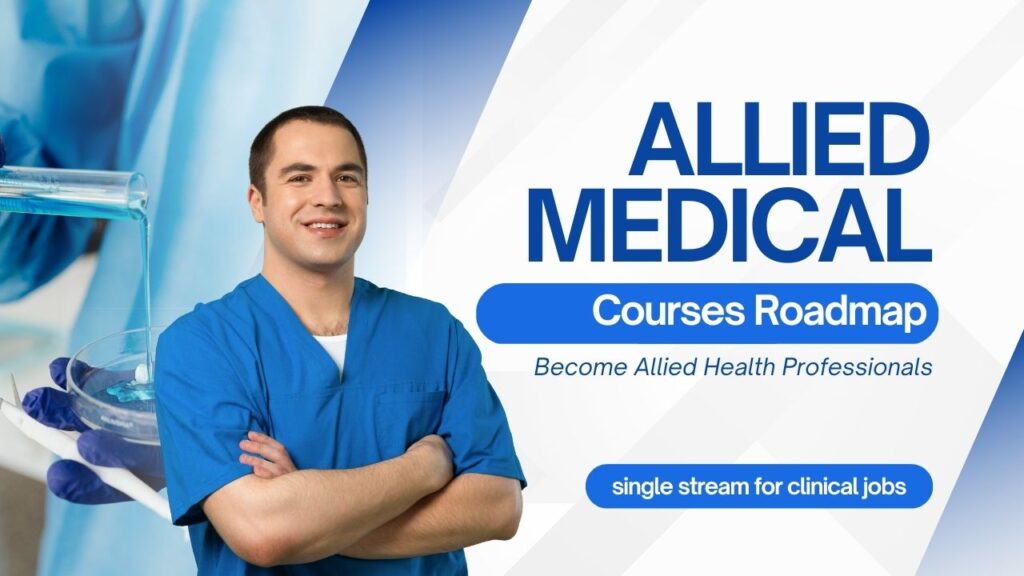
In the constantly changing healthcare environment, the focus is changing. Doctors and nurses may be the public face of medicine, but there is a whole engine room of professionals holding the system together: the Allied Health Professionals. To become one, you need to break down the Allied Medical Courses Roadmap.
If you have ever asked yourself questions like “who runs that fancy MRI machine?”, “who handles the complex chemistry of a pathology lab?”, or “who assists a runner to walk again after a devastating injury?”, you have now become the proud owner of a glimpse into the world of Allied Health.
As the 2026 Union Budget announced the addition of ten new allied health disciplines and targets to train one lakh professionals in five years, there is no better time to chart your path in this domain.
What are Allied Medical Courses?
Allied Health Sciences (AHS) are career options in the healthcare sector where professionals work in tandem with doctors and provide diagnostic, technical, therapeutic and other support services. These courses are specialized rather than comprehensive like an MBBS. They’re the hands-on, practical side of medicine—taking the technology and therapy and making them work to save lives.
Who Can Choose Allied Medical Courses?
These are the courses that are available for science stream students after 12th, and they consist of theory, practicals and also internships. Unlike MBBS, they are open (3-4 years), cheap (₹50k-₹5 lakhs total), and now NEET-compulsory under NCAHP for uniformity. Perfect for students looking at colleges like King George’ Medical University or the privates.
Allied Medical Courses Roadmap
Charting a course for this vocation from high school to the hospital is going to be a bit of a balancing act, particularly with new rules set to be implemented in 2026.
1. The Foundation (Class 12)
Allied health programs require a science core including physics, chemistry, and biology (PCB). Although certain diploma courses earlier admitted students from other streams, the drift in 2026 is towards making science a single stream for clinical jobs.
2. The Entrance Era (NEET 2026 onwards)
As per the notification of National Commission for Allied and Healthcare Professions, NCAHP dated 31st May 2023 NEET UG is going to be made compulsory for admissions in various undergraduate allied courses from 2026-27. It implies that the “non-NEET” option to some of the best institutes is being gradually closed, which will help enhance the quality and professional recognition of the graduates.
3. Choosing Your Path: Degree vs. Diploma
Bachelor’s Degree (B.Sc./BPT): Normally 3 to 4.5 years. They offer more theoretical knowledge and are oftentimes necessary for obtaining work permits in other countries.
Diploma (DMLT/DRT): 2 years in general. These “accelerated” tracks offer a practical focus on talent for students interested in moving quickly into the workforce.
Read More:- UPSC Civil Services IAS/IFS Pre Recruitment 2026: Notification, Dates & Apply Complete Guide
Top Allied Medical Specializations for 2026
| Course | Focus Area | Role |
| BSc (MLT) — Medical Lab Technology | Studying samples like blood, tissue, and other body fluids. | Lab Technologist |
| Bachelor of Physiotherapy — BSc (BPT) | Helping in regaining strength through Physical rehabilitation | Physiotherapist |
| BSc with Radiology & Imaging | Scanning through X-rays, CT scans, and MRIs to detect injuries | Radiology Technologist |
| B.Sc. Anaesthesia & OT Tech | Supporting surgeons and managing ICUs. | OT Technician |
| B.Sc. Cardiac Care Technology | Monitoring heart health and ECGs. | Cardiac Technician |
Why Choosing an Allied Medical Courses Roadmap is Right?
Entry to workforce more quickly
While an MBBS requires 5.5 years (plus specializations), most allied health programmes make you career-ready within 3 to 4 years. This is your lane if you just want to start making a difference and earning sooner.
High Demand
There is a massive demand for healthcare technicians worldwide and skilled professionals capable of meeting that demand are difficult to find, making it a path to high opportunity around the globe. Expansion of the Regional Medical Hubs (introduced in 2026 Budget) is expected to generate thousands of jobs in diagnostics and rehabilitation in India alone.
Technological Integration
If you’re a gadget geek or tech enthusiast, then Allied Health is the way to go. You don’t just read charts, you’re running some of the most sophisticated AI-enabled machines on the earth.
Future Scope and Salary
The era when Allied Health was considered a “plan B” is behind us. By 2026, the starting salaries of freshers can vary from ₹2.5L per annum to ₹5L per annum based on the specialization. Specialized positions such as Perfusionists or Cardiac Technicians also attract even higher premiums.
Additionally these degrees have great international mobility. Countries such as the UK, the UAE and Canada have specific visa tracks for Allied Health workers, so this is really your ticket to a global career.
Conclusion
The Allied Medical Courses Roadmap isn’t a secret trail anymore — it’s a fast moving highway. With a government emphasis on skilling and the standardization of entrance exams, these professions are enjoying a newfound prestige.
If you love science but don’t want to go to medical school for ten years, the Allied Health track is a balanced, tech-forward, and profoundly satisfying way to go.