Quick Preparation Guide for UP Polytechnic JEECUP 2026

UP Polytechnic

Whether you are a student who studied the whole year for UP Polytechnic JEECUP 2026 exam or just started to prepare, if you approach the right strategy then you can clear the exam and become a future engineer. There has been a small change in the schedule as the Joint Entrance Examination Council Uttar Pradesh (JEECUP) has revised the exam dates from mid-May to June 2 to June 9, 2026.  

This means you still have enough time to prepare and crack this exam. Diplomas are efficient to find a job in your respective field easily but you can only select college in your preferences and score good to take an admission. The authorities will decide the final selections and provide you college. 

Let’s take a look at this guide that will help you understand where you need to focus more and least to push your luck.

Quick Update on The Examination

  • The exam will be held on June 2 to June 9, 2026 which means you have little more time to prepare. 
  • Admit Cards for UP Polytechnic JEECUP 2026 are available now on the official website.
  • You can download it by entering your credentials and taking out a print out.
  • The exam is totally online on a computer, no need to fill OMR sheets with black pens! 
EventDate 
Apply Start 15/January/2026
Last Date for Apply 10/May/2026 (Extended)
Last Date Fee Payment10/May/2026
Exam Date02–09/June/2026
Admit Card27/May/2026 — Available Now
Result DeclaredWill be updated here soon

Decoding the JEECUP 2026 Exam Pattern 

You can quickly prepare for the exam if you know the pattern which tells you exactly what to expect when you sit down in front of that computer screen. 

FeatureThe Details You Need to Know
Exam ModeOnline (Computer-Based Test)
Exam Duration2 hours 30 minutes (150 minutes)
Total Questions100 Multiple Choice Questions (MCQs)
Language OptionsEnglish and Hindi (you can choose what you are comfortable with)
Marks Per Correct Answer+4 Marks
Negative Marking-1 Mark for every incorrect answer
Unanswered Questions0 Marks (No penalty, no reward)

Many educators suggest that if you don’t know the answer then leave it because if you answer it wrong, you can lose hard-earned marks. Only take an educated guess if you can confidently eliminate two of the four options. 

The Subject Breakdown (Focusing on Group A) 

There are multiple fields to choose in polytechnic divided in groups A–K. Group A (Diploma in Engineering & Technology) will have questions heavily focused on science from Class 10th syllabus:

50 questions from Mathematics, 50 from Physics and Chemistry means half the questions depend on your maths. And the pattern will be the same in other groups too but subjects will be changed. If you choose Group E (Diploma in Pharmacy) then major questions come from chemistry and biology. 

Quick Preparation Strategy For UP Polytechnic JEECUP

Since we are just days away from the exam, you can approach a different strategy than looking at a 500-page textbook. Do the smart work and maximize your score in the remaining days.

Step 1: Stop Reading New Topics

Keep your mind fresh and solve easy questions first, take your maths previous year question or mock test and revise it. Don’t stick to one complex topic for hours and waste your time. New topics take time and you don’t have much so double down on the topics you already know.

Step 2: The Power of Mock Tests

This is the time for mock tests which can test your knowledge and make your speed fast to solve. 

  • Don’t skip any answer in the mock test. Daily practice makes it easier to understand questions easily. 
  • Do not allow unnecessary distraction for straight 2 hours and 30 minutes.
  • Take mock tests from the best apps and websites to familiarize with the UI and provide you with repeated questions.

Step 3: Analyze Your Mistakes

Check all your answers and take deep analysis where you get stuck, check where you make mistakes and lose most of the marks. Identify your patterns of errors and fix them. 

Step 4: Revise Formulas and Short Tricks

Remembering formulas is tough but it solves half of the problem for Mathematics and Physics. Create a “cheat sheet” of all the important formulas, theorems, and chemical equations so you can revise it 10 times in a day. 

Subject-Wise Quick Hacks 

Mathematics (50% Weightage): Prepare major subject first because it covers 50% of the Group A paper, Focus heavily on High-Value Topics like Algebra, Surface Area and Volume, Trigonometry, and Coordinate Geometry.

Use shortcuts for percentages, profit and loss, and simple/compound interest to calculate and it is very easy at the 10th-grade level. But don’t get stuck on one problem, resolve which takes less time first then come back to lengthy questions.

Physics (25% Weightage): Physics in JEECUP focuses on Light, Reflection, Refraction, Electricity, Magnetism, and the Laws of Motion. And units always matter in physics. Sometimes questions are just asking simple basic definitions and direct formulas. 

Chemistry (25% Weightage): Chemistry questions are time saving and they are not lengthy like physics and maths. Most valued topics are Metals and Non-Metals, Periodic Table, Acids, Bases, and Salts.

Common names and chemical formulas of the element and compound. Practice balancing basic chemical equations, as these are easy marks to grab. 

Managing Time Inside the Exam Hall 

Go through the entire paper from question 1 to 100 and answer those questions which you are 100% sure about within the first 45 Minutes. Chemistry names and formula or physics quick answers.

Then go to the questions that take some calculation but you can easily solve them within 60 minutes. After that, spend the next 30 minutes on tricky questions. If a question is still completely alien to you, leave it. You don’t want your marks to get deducted.

Use the last 15 minutes to review your answers. Check that you tick the right answers on the computer screen.

Read More 👉 Ultimate Guide to KTET Scores, Kerala TET Result 2026, Eligibility, Career, and Salary

What Happens After the Exam?

The JEECUP authorities will release the answer key so you can check the answers and calculate your score. If you know that you have given the right answer then you can raise an objection.

The result is expected to be released in late July 2026. You can check the official website regularly for the result.

Once you clear this exam, you will be called for a document verification and counselling process. Admission to polytechnic colleges is based purely on your rank and the choices you fill during the online counselling process. 

Conclusion

Getting ready for UP Polytechnic JEECUP may seem like scaling a mountain but keep in mind that every engineer began from where you are at this point. Focus on the easy topics first to memorize them perfectly. Manage your time accordingly for preparation because it’s a big chance to start your bright career. 

Don’t ruin your mentality by provoking negative thoughts, just try to learn and prepare with quick notes and daily mock tests. Test yourself regularly as you already study everything in your 10th grade. So there’s nothing new that you can’t beat that up.


Leave a Comment

Your email address will not be published. Required fields are marked *

RRB Section Controller 2026: Job Role, Eligibility, Salary, and How to Apply

RRB Section Controller 2026

RRB Section Controller is the one who monitors every train to keep them on track without turning it into a chaos. The responsibility is hard but the salary is very good which comes with additional benefits. To hold the position, you must meet the eligibility criteria and understand everything about the job before applying for its application.

The good thing is this is the right time to know about this role and selection process because the Railway Recruitment Board is opening a fresh cycle for 2026.

Who Is an RRB Section Controller?

A Section Controller job is to handle the schedule of running trains. They are the ones who decide which train gets priority at a junction and which one has to wait on a line. The train moves on a signal, that signal is given by the section controller. Indian Railways trust only section controllers to move and stop the train.

It is a desk job with a practical responsibility, it comes with high punctuality and safety of the passengers. So sitting in a control room and making decisions in real time needs the full attention and focus of the person.

Indian Railways put this role under the Operating department and considered as mistakes are non-negotiable terms in this. 

RRB Section Controller Eligibility 2026

This post has higher eligibility criteria compared to other RRB non technical posts as this post demands good judgement and coordination which is a higher requirement. 

Educational qualification: You need a graduate degree from a recognised university, and the discipline does not matter. No matter if you are from commerce, arts, science, or engineering, you are eligible as long as the degree is completed. Aspirants awaiting their final year results cannot apply this cycle, so if your degree is ongoing, this will not be your chance now. 

Age limit: The age of the candidates should be between 20 and 33 years (as on 1st January, 2026), standard age relaxation shall be applicable for reserved categories as per government rules. If you are near either limit, it is worth verifying the exact cutoff date once the detailed notification is out, since a few weeks can make/break eligibility. 

Medical standard: candidates must meet the A2 medical standard to hold this position as it requires sustained attention and quick decision-making which includes specific vision and hearing benchmarks. This is more strict than a lot of other railway positions so it is worth getting a basic medical check up early on rather than be surprised later on in the process. 

Nationality: Applicants should be Indian nationals or subjects of Nepal or Bhutan, Tibetan refugees who came to India before 1962.

Selection Process for RRB Section Controller

To become an RRB Section Controller, involves clearing four distinct stages. Each stage evaluates different skills and reduces the number of applicants.

It begins with a Computer-Based Test (CBT) that tests candidates on general awareness, reasoning, mathematics and general science and also the subject knowledge related to railway operations. 

The aspirants who qualify the CBT are eligible to appear for Computer Based Aptitude Test (CBAT), a stage exclusive for posts of safety and control. This is not a test of theoretical knowledge, rather an examination of your ability to make decisions, maintain situational awareness and stay calm under pressure – all important attributes for a Section Controller. 

Candidates who clear both rounds are called for Document Verification in which original certificates, proofs of category, and date of birth are verified with respect to the application. 

The last step is a Medical Examination to ascertain the level of A2 fitness. Only those candidates who successfully clear all the stages are considered for the final merit list and merit is decided based on the aggregate performance in the CBT and fulfilling all the eligibility criteria at each stage. 

Read More 👉 How To Prepare For Railway RRB ALP Exam And Secure High-Paying Government Job

Work Responsibility of a Section Controller

On a daily basis, a Section Controller keeps track of trains running in their section with control charts and communication devices and remains in continuous communication with station masters, loco pilots, and other controllers on the route. 

In case of a delay, a breakdown, or an unusual event such as a signal failure, it is the controller who makes the decisions in terms of rerouting or reprioritising trains to reduce the impact of disturbances not on the immediate line but on the total traffic. 

It’s also a job with real accountability. The decisions a controller makes influence on-time performance statistics, freight movement goals, and, in certain cases, passenger safety itself. 

It is a position that rewards those who can think multiple moves ahead and keep their composure when multiple things are going wrong at once, and that’s precisely why the CBAT phase is part of the selection process. 

RRB Section Controller Salary and Benefits

The selected individuals are appointed on Pay Level 6 of 7th CPC having the starting basic pay of Rs. 35,400/month. In addition to the basic salary, employees are eligible for Dearness Allowance, House Rent Allowance, Travel Allowance, and other railway-related benefits such as free or concessional journey passes for the staff and their dependents. 

ComponentDetails
Pay LevelLevel 6, 7th CPC
Basic PayRs. 35,400 per month
Job TypePermanent, Central Government
PerksDA, HRA, TA, railway travel passes, pension benefits

Advantages of Becoming a Section Controller

Apart from the pay, this is a Central Government job which brings the usual job stability, pension benefits and future security, which is what makes the railway recruitment a preferred choice for most of the graduates to begin with. 

Section controllers can be promoted to senior controller and divisional posts in due course and the operational experience obtained at this level is highly regarded throughout the Traffic branch. For those who are looking for a government job that involves intellectually engaging, this post is like the best option through RRB. 

Latest RRB Section Controller Recruitment 2026

The Railway Recruitment Board has confirmed 119 approved vacancies for this cycle under CEN 03/2026, spread across railway zones such as East Central Railway, which currently holds the highest zone-wise allocation. 

Events Details
Recruitment cycleRailway Recruitment Board CEN 03/2026
PostSection Controller
Approved vacancies119
Highest zone-wise allocationEast Central Railway
Short notice released23 June 2026
Detailed notification released14 July 2026
Online application start date15 July 2026
Online application last date14 August 2026

This year vacancies are lesser than previous year for Section Controller so candidates should treat this as a genuinely competitive recruitment and prepare with the right strategy to beat the exam.

Read More 👉 RRB RPF New Vacancy Notification 2026: Details Explained For RPF Constable

How to Apply for RRB Section Controller 2026

You need to apply entirely online through the website of the Railway Recruitment Board of your region. When you visit the official website, you can find this notification on the homepage or in the recruitment section. 

  • Open Section Controller notification link and read all the necessary points before clicking on the apply now button.
  • Login with registration number and DOB, if you are new then register yourself with a valid phone number or email ID. 
  • Don’t forget your password, write it somewhere to login again and fill the entire application with correct information for yourself.
  • Upload the required photograph and signature, pay the applicable examination fee around INR 250–500, and submit the form before the deadline. 
  • It is worth downloading and saving a copy of the final submitted application and payment receipt for your own records.

Conclusion

The RRB Section Controller job is among those railway jobs which never get discussed as much as RRB NTPC or Group D, but it really should as it has more workload, salary, and long term job stability. 

With 119 vacancies open under CEN 03/2026 and applications starting 15th July 2026, graduates who meet the eligibility criteria have a real window to build a serious career inside Indian Railways. The preparation period is brief, so if this position aligns with your interests, the best place to start is now for the CBT rather than later when the notification fully sinks in. 

Leave a Comment

Your email address will not be published. Required fields are marked *

Paramedical Courses Career Roadmap After 12th: Jobs, Salary & Scope

Paramedical Courses

The domain of paramedical sciences is an exciting path for students who have completed high school to explore the diverse aspects of the healthcare sector. In line with increasing need for trained personnel, Paramedical Courses Career Roadmap consist of specific training on diagnostics, emergency care, treatment and rehabilitation. 

These Paramedical Courses aim not only to provide technical knowledge but also to train students to overcome professional challenges in an ever-changing healthcare environment, which is the reason why this is such a popular career path for young aspirants.

Here, we provide a full-fledge career guide for all the high school graduates who aspire to establish a career in paramedical services in the near future. Here, we will discuss your eligibility, the course, different specializations, the procedure to move into the sector and a variety of attractive career options after you complete it. 

Why Choose a Paramedical Courses?

Types of paramedical jobs have also been included in the lists of healthcare occupations. What questions do you have about paramedics? They also play a vital role in critical diagnosis, emergency and outpatient treatment as well as in patient rehabilitation.Reasons to choose a job in paramedical science include: 

  • In high demand: Health care is growing. The reports state that the need for paramedical technicians will increase by 20-25% over the next few years, especially in the developing countries.
  • Endless Career Paths: There are endless career paths in paramedic including Emergency Medical Technician (EMT), Medical Laboratory Technologist, or taking a leap into new-age disciplines like telemedicine and health informatics.
  • Personal and Social Satisfaction: In direct patient care and its positive impact on society, the paramedical professionals have the greatest chance for both professional fulfillment and job security permanently. 

This has opened up a window of opportunity for high school graduates to make a career in the healthcare sector through paramedical courses. 

Eligibility and Requirements for High School Graduates

The path to a good paramedical career begins with the right academic background. For class 12 board takers, the online eligibility criteria for admission are as follows:

  • Educational qualifications: A high school diploma with science subjects like biology, chemistry and physics is mandatory. Many paramedical centers have the expectation that students will excel in those subjects because they are the basis of the more difficult material taught in further courses.
  • Basic Certifications:You can get some extra certifications like basic life support (BLS) or CPR Training which can help you stand out. These credentials not only prepare candidates for the hands-on practical aspects of healthcare, but also attest to their dedication to the field.
  • Entry Exams and Selection Process: A few courses may have an entrance exam or an aptitude test, and have an admission process that involves showing your enthusiasm for the science and health care.

These essential qualifications allow high school graduates to pursue a variety of Paramedical Courses, and so the door is opened to a multifaceted education. 

Read More:- RRB Group D Recruitment 2026 — Check Vacancy and Link

Courses and Specializations in the Paramedical Field

There are various types of Paramedical Courses that you can opt for—certificate and diploma courses to full degree courses. Theoretical as well as practical knowledge is imparted, so students gain a good understanding of what is required at workplaces in hospitals and other healthcare facilities. 

Below is a table with a brief summary of some of the specializations with the work they do and place of work: 

SpecializationRoleWork Settings
Medical Laboratory TechnologistBlood, Blood Fluids, Tissues Testing Diagnostic center, Hospitals, Research Facility
Radiology TechnicianX-rays, MRIs, CT scans using machinesRadiology Center
Emergency Medical Technician (EMT)Provide First-Aid in EmergencyER, Ambulance
PhysiotherapistEngage with Patients for Rehab and guide themRehabilitation Clinics and Hospitals
Anesthesia TechnologistAssisting with AnesthesiaOperation room
Other Roles (Optometrist, Dental Hygienist, Speech Therapist, Occupational Therapist)Patient Special CareMostly private clinics

This table is a sample of the multiple occupations which are available for the paramedical candidates but, all of them may vary in their complexity and challenges. The courses in these disciplines usually consist of lectures and laboratories and/or clinical rotations and or paid or unpaid work placements that provide students with hands-on experience required to work in their chosen field. 

Steps to a Successful Paramedical Career

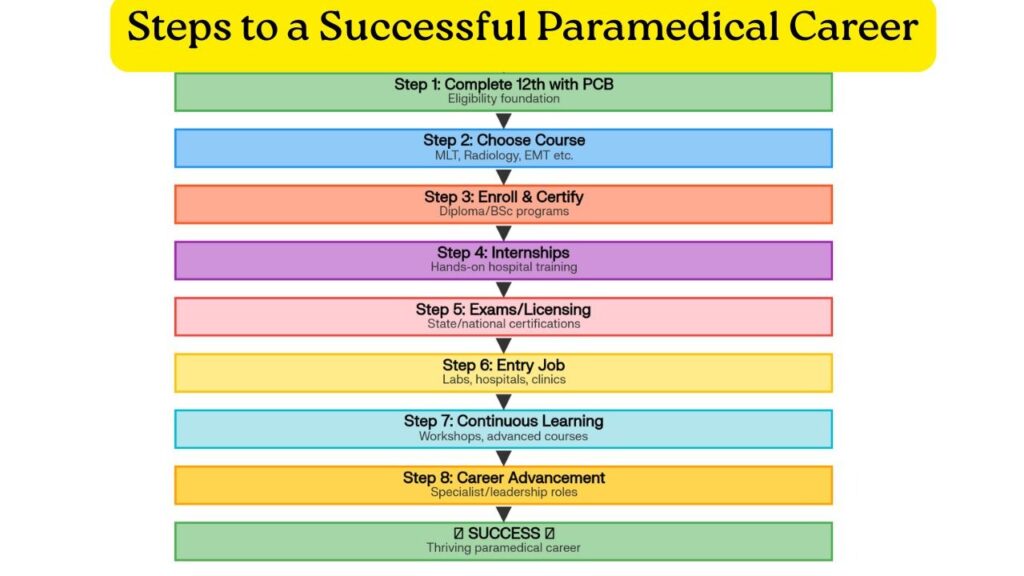
A step-by-step advance is necessary for a career in paramedical work. The given flowchart depicts the straightforward career opportunity for the regular high school pass outs: 

The flowchart of Paramedical Courses shows the process step by step: Begin with a solid academic foundation, apply practical experience, get certified, and then specialize or move into management. Each phase relies on the previous one to build depth and breadth of skills in the professionals. 

Career Opportunities in the Paramedical Courses

Paramedical professions have a wealth of options and opportunities that go well beyond the usual roles. After completing their education, students can work in multiple fields such as: 

  • Hospital Environments: A large portion of paramedical professionals employed in hospitals include them in the diagnosis, patient care, and testing.
  • Diagnostic and Imaging Centers: Medical Laboratory Technologist, Radiology Technician and other allied health professionals play an essential role in identifying and diagnosing countless diseases.
  • EMS: EMTs and Paramedics are needed now as much as ever in ambulance services and emergency departments, where making split-second decisions in a pump-driven environment is part of the job.
  • Trend Trailers: As telemedicine and health informatics matures, more jobs are likely to emerge for people focused on the convergence of healthcare and technology.
  • Own Business: Many practitioners have transitioned from practicing to owning their own clinic, laboratory, or home healthcare service, and some contribute to the field by working in their own business while enjoying the personal freedom associated with being your own boss. 

The positive growth in the healthcare industry along with technology enhancements is expected to create additional jobs, which makes it a promising field for people looking to build a career in this industry. 

Benefits of a Paramedical Career

Benefits of a career in paramedics are numerous and high school graduates can look forward to a great future (Check out some of the pros and cons about joining this career below):

  • Employment Security: Increasing Paramedic jobs healthcare needs worldwide ensure a stable and promising future for paramedical practitioners.
  • High Salary: The salaries for a number of these positions are competitive, commensurate with their unique skill set and important responsibilities.
  • Variety of Opportunities: You can find job opportunities to suit your interest, whether that be hands-on with patient care, supporting diagnostics or working with new technology.
  • Personal Satisfaction: A career in paramedicine not only is financially rewarding, but it can positively affect the lives of thousands of patients and the community at large.
  • Career Advancement: Many health services have in place a career progression (e.g. the Paramedic Practice Advancement Ladder) to include rewarding experience and ongoing professional development. 

Institutional Support for Aspiring Paramedical Professionals

There are many reputed colleges which offer good facilities and infrastructure for students who want to make a career in paramedical. For example:

  • Belarani Institute of Paramedical & Allied Sciences: The Training provided is more practical oriented by the experts with well experienced trainers and Placement Support to the students on completion of their Training.
  • LifeLine EMS: Nowhere is this more true than in Southern California where LifeLine EMS provides seamless EMT to Paramedic pathways, comprehensive training, mentorship programs and well-defined internal career promotion tracks.
  • Colleges like Foothill College and The George Washington University: The programs which run the gamut from short-term, intensive 11.5-month programs to long-term degree programs include classroom instruction, skills labs, clinical rotations and field internships designed to fully prepare students to meet the challenges of the profession.

These schools do more than train students in the latest tools and technology, they create cultures where a commitment to lifelong learning and professional success is ingrained. 

Conclusion

Paramedical Courses Career Roadmap: High school graduates opting for a profession in paramedical sciences not only ensure a bright and stable career but also play an important role in the advancement of global healthcare. With the right skills and commitment, as the industry continues to grow, there will be countless opportunities for those dedicated to pursuing a career path with endless potential.

So whether you’re interested in the accuracy of laboratory diagnostics, the life-saving measures of emergency services, or the professional practice of physiotherapy and more, there’s no doubt that your career in the paramedical sector will be fulfilling and rich with opportunity. Begin your journey today and discover the opportunity to have a real impact on the lives of many. 

Leave a Comment

Your email address will not be published. Required fields are marked *

Top 10 Mistakes to Avoid While Preparing for UPPSC RO/ARO

UPPSC RO/ARO

Each year, countless graduates in Uttar Pradesh enroll in a coaching center or app, purchase a ton of GS books, and convince themselves this is the year they will make it to RO/ARO. Many of them will fail because they commit the same mistakes that could be avoided, even if they finish the entire syllabus. There are 10 mistakes to avoid while preparing for UPPSC RO/ARO.

If you want to earn your Samiksha Adhikari badge, the best thing you can do before opening one more book is to get a clear sense of what goes wrong for most aspirants. 

What Is UPPSC RO/ARO, Exactly?

RO/ARO stands for Review Officer and Assistant Review Officer, two of the most respected Group B posts recruited through the Uttar Pradesh Public Service Commission. These officers are posted at the state secretariat, the UP legislature secretariat, different government departments where they work on file inspection, preparation of policies, writing official letters in Hindi and English, etc. It isn’t a flashy, headline-grabbing post like PCS, but it comes with something many aspirants value even more — genuine job security, a respectable pay scale, steady promotions, and a real seat inside the machinery of state governance.

The examination, which is held in three parts, consists of a Preliminary examination (for aspirant screening), a Mains examination (which prepares the merit list) and a Skill or Typing Test (which packs the final selection). Sounds straightforward on paper. In practice, each of these three stages tests a completely different skill set, and that’s exactly where most preparation strategies fall apart.

Why This Exam Demands Full Dedication, Not Part-Time Effort

Here’s the part most aspirants underestimate: RO/ARO isn’t just a general knowledge test. It’s a rare combination of GS depth, Hindi language mastery, drafting precision, and typing speed, all rolled into one recruitment cycle. You could have Polity and Economy on your fingertips and still get eliminated at the typing test stage. You could ace your Prelims and then lose the plot in Mains because your Hindi essay writing was never taken seriously.

Add to this the sheer competition — UPPSC RO/ARO regularly draws hundreds of thousands of applicants for a few hundred vacancies. In a pool that dense, small inefficiencies in your preparation don’t just cost you marks, they cost you your entire attempt. That’s why this exam isn’t something you can prepare for in stray hours between other commitments. It needs a dedicated, structured block of time where GS, Hindi, current affairs, and typing practice all get their fair share, week after week.

Read More 👉 Government Jobs After Graduation in India: Complete Guide for 2026

How Early Should You Actually Start?

If you’re starting from scratch — no prior GS foundation, no typing practice, Hindi grammar rusty since school gives yourself a minimum of 10 to 12 months before the expected Prelims date. This gives you enough runway to build NCERT-level GS foundations, work through UP-specific static topics, develop a daily current affairs habit, and still leave 3 to 4 months purely for revision and mock tests.

If you already have a General Studies base from a previous PCS or SSC attempt, 6 to 8 months of focused preparation is realistic, provided you’re consistent. What you should never do is wait for the official notification to start preparing. UPSC RO/ARO is not conducted as per a fixed year, so there can be a short duration between notification and Prelims. Candidates who begin their preparation just after the release of the notification are almost always muggers and mugging does not survive a 200 question, negative marking paper. 

Eligibility Criteria You Need to Meet

You must have completed a bachelor’s from a recognized university in any subject and there is no specific stream requirement, which is one of the reasons why the exam has such a broad range of applicants. 

As regards age limit, the candidates belonging to General category are required to be 21 to 40 years of age as on the cut-off date with age relaxations applicable to upper age limit for OBC, SC/ST and other reserved categories as per Rules of UP Domicile. Indian nationality is mandatory, and candidates must meet UPPSC’s standard physical and character eligibility norms laid out in the official notification.

Note: exact eligibility requirements, age limit and relaxation, and total vacancy numbers are confirmed for every cycle in the UPPSC official notification for that cycle, so always cross-check on the UPPSC website before filling your form.

How Selection Actually Works for UPPSC RO/ARO

The journey to becoming an RO or ARO runs through three checkpoints, and clearing one doesn’t guarantee comfort in the next.

The Preliminary exam is a 200-mark objective paper covering General Studies and General Hindi, with a negative marking penalty of one-third mark for every wrong answer. It’s a qualifying stage only — your Prelims score doesn’t carry forward into the final merit, but a wrong strategy here (guesswork, poor time management, ignoring the negative marking) can knock you out before the real test even begins.

The Mains exam is where the actual merit list takes shape. It includes multiple descriptive and objective papers covering General Studies, General Hindi and Drafting, and a dedicated Hindi Essay paper. This stage rewards candidates who can write with clarity, structure their answers logically, and demonstrate genuine command over formal Hindi — not just candidates who’ve memorized facts.

Finally comes the Skill or Typing Test, a qualifying round where candidates must demonstrate a minimum typing speed, typically around 25 words per minute in Hindi typewriting. It sounds like a formality until you meet someone who cleared Mains comfortably and then lost their selection purely because they never practiced typing.

Read More 👉 Time Management Tips for Students and Government Job Aspirants

10 Mistakes to Avoid While Preparing for UPPSC RO/ARO

1. Treating Hindi as a formality instead of a scoring subject. A huge number of candidates assume Hindi will “sort itself out” because it’s their mother tongue. But it’s not true, original Hindi is tough and not like we speak in real life. UPPSC examines the formal grammar, vocabulary, comprehension and drafting at a level in Hindi paper which most of us have not reached since our school days. Skipping this section is one of the quickest ways to lose easy marks that other test takers are eagerly grabbing. 

2. Delaying typing practice until after Mains. This is possibly the costliest mistake in the entire selection process. Candidates pour a year into GS and Hindi, clear Prelims, clear Mains, and then discover in the last few weeks that their Hindi typing speed isn’t anywhere close to the required benchmark. Typing is a motor skill — it needs weeks of daily, disciplined practice, not a last-minute crash course. Start practicing typing from month one, in parallel with your GS preparation, not after.

3. Ignoring UP-specific General Studies content. Don’t cover everything in GS, UPPSC RO/ARO exam heavily rely on state-specific current events. So start gaining more knowledge of Uttar Pradesh’s history, geography, culture, government schemes, and current affairs. Skipping UP-specific content means leaving guaranteed marks on the table that a well-prepared local candidate will happily pick up.

4. Underestimating the negative marking in Prelims. With a one-third mark penalty for every wrong answer, blind guessing can do real damage to your score. Aspirants who walk into the exam hall without a clear elimination strategy — attempting only questions they’re reasonably confident about — often end up with a lower score than candidates who attempted fewer questions but did so smartly.

5. Not practicing descriptive writing and drafting. The Mains exam isn’t an extension of the objective Prelims. It demands structured essay writing, formal letter drafting, and precise official-language usage. Those who are doing full year ‘solely on objective style MCQ’ practice and who are not writing a full-length descriptive answer in timed conditions would get a rude shock when they finally sit for Mains. 

6. Studying in isolation without solving previous year papers. Studying alone without practicing past year papers. Reading the notes and highlighting the textbooks is productive, but it does not tell you how UPPSC formulates questions. Aspirants who do not go through previous year papers and full-length mock tests, usually end up entering the exam for real without ever having been under genuine pressure of exam-hall conditions. 

7. Chasing too many sources instead of trusting a core few. It’s very tempting to gather every available resource, be it YouTube playlists, telegram channels, coaching PDFs, when everyone around you is following a different resource. In actual fact, this divides your training and encroaches on time for revision. The same message from toppers is relentlessly repeated: choose a handful of trustworthy sources for GS, Hindi and current affairs and keep going through these for multiple revision cycles, rather than “starting afresh” with new material every couple of weeks.  

8. Neglecting current affairs until the final months. Current affairs isn’t something you can compress into a 30-day sprint before the exam. UPPSC draws questions from developments spread across the entire preparation window, particularly those tied to Uttar Pradesh’s state government initiatives. Aspirants who ignore monthly current affairs and try to cram a year’s worth of news in the final weeks usually retain very little of it under exam pressure.

9. Skipping revision in favor of constantly consuming new content. There’s a strange guilt many aspirants feel when they’re “just revising” instead of learning something new. But retention comes from repetition, not from the volume of fresh material you’ve covered once. Without scheduled revision cycles, most of what you studied eight months ago simply won’t be accessible to you on exam day, even if you technically “covered” it once.

10. Not building a realistic, disciplined daily routine. Perhaps the most common mistake of all — starting preparation with enthusiasm, studying erratically for a few weeks, then losing momentum entirely once motivation dips. RO/ARO preparation spans many months, and inconsistent, mood-driven study almost never survives that distance. A realistic daily timetable that balances GS, Hindi, current affairs, and typing practice, even if it’s just 4 to 5 focused hours a day, will consistently outperform sporadic 10-hour study binges followed by days of burnout.

Conclusion 

UPPSC RO/ARO gives its aspirants an actual chance to prepare for the exam with 3-stage evaluation of knowledge, language and skill, rather than the exam they assume it to be. The candidates who clear are not necessarily the ones with maximum hours of study put in, but  the ones who follow these 10 mistakes to avoid while preparing for UPPSC RO/ARO. 

Start your journey early to make it possible to select for this position. Only the ones who dedicate themselves for the preparation can beat the exam. 

Leave a Comment

Your email address will not be published. Required fields are marked *

CTET Exam 2026: Check Exam City, Notice, Exam Dates, Syllabus and Eligibility Information

CTET Exam 2026

The golden opportunity is announced for all the Teachers in India through CTET exam 2026. Organized by CBSE, this country level examination is for teaching jobs in government and private schools for Class 1 to 8. Candidates who apply in December 2025 for this examination should get ready for the exams.

Notification Details

Exam notice is released for CTET exam 2026, you can also get official notification on the official website for all the details about the exam. Candidates who filled the forms in November — 18 December 2025 can prepare themselves for the examinations in prior time to avoid panic at the end.

CTET February 2026 Exam Dates and Format 

FeatureDetails
Exam Date7 & 8 /February /2026 (Saturday & Sunday)
Mode of ExamOffline (Pen & Paper / OMR Sheet)
Number of Cities132 to 140 Cities Nationwide
Total PapersFor 1-5 Standard: Paper I;  For 6-8 standard: Paper II
Question Type150 Multiple Choice Questions 
Total Marks150 Marks per paper
Duration150 Minutes (2.5 Hours)
Negative MarkingNone
Language OptionsBilingual (Hindi/English) + 20 Regional Languages

Syllabus Overview

Paper 1 consists of questions from Child Development & Pedagogy, Language I & II, Science (for Science group), Social Studies (for Social studies group), Mathematics, and Environmental Studies, the emphasis is primarily on assessing the capability to teach at mali-ly school children. 

Paper 2 deals with Child Development, Language I and II and options such as Maths/Science or Social Studies for senior levels. 

Subjects stress pedagogy, theories of learning, and content of subjects based on guidelines of NCTE. 

Pass requirement is 60% for general (55% for reserved). 

Education and Age Limit Rule

  • There is no age limit here—everyone is welcome to apply, if you are Indian or you have Indian roots. 
  • For Paper 1, you should have a minimum of 50% in 10+2 with a 2-year Diploma in Elementary Education (D.El.Ed) or graduation with B.Ed. 
  • Paper 2: Graduation with minimum 50% marks and B.Ed or its equivalent like B.Ed (Special Education) is essential. . 
  • Reserved Category (SC/ST/OBC/PwD) Candidates can get Relaxations of 5% less in qualifying marks. 
  • Candidates who are appearing in the last year of their course are also eligible. 

CTET exam 2026 Admit Card Download Step-by-Step Instructions

  1. Go to the Important links section below and click on the Admit Card option.
  2. Enter your login details correctly to avoid interruptions and download your admit card
  3. Admit Card will appear 3-4 days before the exam, kindly wait for it.
  4. After the CTET admit card has been issued, get print out from here to carry a copy with you to the exam centre. 
Important Links
Exam NoticeClick Here
Date & City of examClick Here
Admit CardClick Here
Official WebsiteClick Here

Leave a Comment

Your email address will not be published. Required fields are marked *

MPESB Group 5 Paramedical Recruitment 2026: Complete Guide to 291 Government Jobs in MP

MPESB Group 5 Paramedical

After a long wait, it’s now or never for those aspiring for a government job in the healthcare and paramedical sector in Madhya Pradesh. The Madhya Pradesh Employees Selection Board — commonly referred to as MPESB has released the notification for its MPESB Group 5 Paramedical Recruitment 2026, and it is the one among the state’s highest job hirings this year. You definitely don’t want to snooze on this one – 291 vacancies are up for grabs in multiple departments.

Are you a just qualified diploma holder, an experienced lab technician, or a trained staff nurse seeking to go into government service, this MPESB Group 5 Paramedical Recruitment 2026

 has the right opportunity for you. Let’s break down all the details for you to understand.

What is MPESB?

Madhya Pradesh Employees Selection Board is also known as (MP Vyapam) and it is the right platform for the unbiased and merit based recruitment in Government Job in the State. Located in Bhopal – Chayan Bhawan, it conducts exams from Group 1 to Group 5 across various domains like education, healthcare, police and so on.

MPESB Group 5 Paramedical

It brings the notification, make the online registrations, issue the hall tickets, answer key and result – everything in the name of transparency. MPESB facilitates the recruitment process, From technical and administrative posts to health service and field posts, MPESB conducts thousands of recruitment every year.  

Quick Overview For MPESB Group 5 Paramedical Recruitment 2026

DetailInformation
Conducting BodyMadhya Pradesh Employees Selection Board (MPESB)
Recruitment NameMPESB Group 5 Paramedical Recruitment 2026 
Total Vacancies291 Posts
Application Start Date13/March/2026
Application End Date27/March/2026
Correction Window13/March/2026 – 01/April/2026
Exam Date15/April/2026 onwards
Official Websiteesb.mp.gov.in
Application ModeOnline Only

Posts Available and Vacancy Breakdown

The 291 posts are spread over 9 departments in Madhya Pradesh and consist of a good blend of clinical and non clinical work in the department of health. The following positions are available: 

Post NameDepartment/LocationTotal Vacancies
Ayurveda CompounderDirectorate of AYUSH125
Unani CompounderDirectorate of AYUSH30
Homeopathy CompounderDirectorate of AYUSH20
Lab AttendantGMC Ratlam/Vidisha18
Staff NurseESI Services Indore7
Pharmacist Grade-2Various15+
Others (Technician, Dresser, etc.)Multiple MCs/ESIRemaining 76

Who Can Apply? 

Qualification

Completed 12th grade with subjects including Phy, Che, and Bio and any diploma or certificate in the field of Paramedical by the recognized government of India.

This eligibility criteria makes sure that the aspirants have the basic academic as well as the professional training needed for paramedical field. 

MPESB Group 5 Paramedical Qualification

Further, you must have valid registration with the Madhya Pradesh Para-Medical Council (MP Sah-Chikitsiya Parishad). The detailed eligibility criteria are post-wise and are given in the official notification. 

Age Limit 

  • Age Minimum: 18 years (s) as on date of Advt.
  • Max Age: 40 years (General/Unreserved candidates)
  • Maximum Age Limit is 45 Years for SC, ST, OBC, Women, PwD, Gov. Employees, Home Guard of MP and Ex-Servicemen

The age has been calculated as per your date of birth mentioned in the High School or Higher Secondary certificate. No candidate shall be above 45 years of age as on the last date for receipt of application under any circumstance, except certain contractual employees and categories notified under Rule 14 of the MP government rules. 

Nationality

Under the MP Civil Services Recruitment Rules 1961, the candidate must be a citizen of India or a Citizen of Nepal. Non-MP resident candidates can apply only for OPEN/UR category posts and shall not be entitled to any kind of reservation or age relaxation. 

How to Apply — Step by Step

Application process is going online for MPESB Group 5 Paramedical Recruitment 2026, so you must follow these steps to apply:

  1. Open the official website of MPESB to apply for this recruitment.
  2. Join the recruitment tab and now click on the Recruitment Notification for the subject MPESB Group 5 Paramedical Post Recruitment 2026
  3. Sign up with your mobile number, Email ID, and some personal information
  4. Enter your name, parents’ name, education qualification and other required details in the application form.
  5. Upload a photograph, signature and your certificates if you are from a relevant category
  6. Make payment either online/offline for application/Examination fee.
  7. After submitting the form, keep your application no for future use. 

Read More:- BSc Emergency and Trauma Care

Application Fee

CategoryExam FeePortal FeeTotal
General/Other State₹500₹60₹560
SC/ST/OBC/PWD (MP Domicile)₹250₹60₹310
Direct BacklogNil₹60₹60

The fee is non-refundable and the fee amount is different for each category. You may pay online with Credit Cards, Debit Cards, Net Banking, IMPS, Cash Cards, or Mobile Wallets. 

How Will You Be Chosen?

The method of selection is simple and on the basis of meritorious:

  • Online Written Examination: The online written examination will consist of one objective type paper of 100 marks. The examination will be held from 15 April 2026 in two shifts.
  • Document Verification: The shortlisted candidates will be intimated for the verification of the original certificates.
  • The final candidates will have to go through a medical fitness test for the post as a part of the last selection stage.

There is no interview for this recruitment because selection is based on the Merit score of exam, so prepare well for the examination.

Exam Pattern & Syllabus

The test is a test of both general awareness and technical know-how. It has 100 questions and all questions carry 1 mark which means that the time duration of 2 hours would need to be utilized to solve a total of 100 questions. 

The exam is conducted in both online, or OMR sheets mode and the best part is that there is no negative marking, so go ahead and attempt every question without worrying about losing marks. 

General Section (25 Marks):

This section is for your general knowledge and talent. It contains questions from GK, Hindi, English, Maths, Science, Logical/Interest based reasoning. 

Technical Section (75 Marks):

This is the major part of the exam and tailors subject-specific knowledge of the post you have applied for. such as candidates applying for the posts of Lab Technician may get questions from Pathology and Biology or for Nursing candidates may ask questions from Anatomy, Pharmacology and other medical related subjects. 

In the GK section, questions are broadly asked from history and geography of mp and India, Govt. schemes, and Today Updates. 

Tips for Applicants

Here are some words of friendly advice so you don’t get caught up in this:­

  • Don’t wait for the last date, apply as soon as possible because there is a huge competition out there.
  • Verify all information twice before submitting. Corrections are allowed only up to 01.04.2026 with a fee for modification.
  • It is necessary to have that your MP Para-Medical Council Registration is Active and Valid before applying.
  • Before you begin, keep scanned copies of your photo, signature and all certificates ready.
  • Start preparing for the written exam – 100marks, objective type, no second chance after the window closes. 

Conclusion

MPESB Group 5 Paramedical Recruitment 2026 is indeed good news for all the healthcare professional and paramedical job seekers of Madhya Pradesh. It is not every day that you get an opening where there are 291 vacancies, a clean merit-based selection process, and the support of a reputable Government board.

Submit your application between 13 to 17/March/2026 and read the official notification properly and collect your documents then apply. Jobs in government health care are stable, provide a well-defined career path, and allow you to truly serve your community. This could be your moment.

Best of luck to everyone. Good preparation and no error in your application! 

Leave a Comment

Your email address will not be published. Required fields are marked *

Scroll to Top