Planning MBBS or Master’s Abroad? Country-Wise Costs, Loan Limits and Lenders

MBBS

A Bangalore family recently signed collateral papers for a ₹42 lakh loan to send their daughter to a Canadian university — three months before Canada cut its 2026 study permit intake by 7% and tightened who qualifies for a post-graduation work permit. Nobody at the bank mentioned it. The loan got sanctioned anyway, because the bank’s job is to assess your repayment capacity, not your visa odds. That gap between “the loan is approved” and “the degree pays for itself” — is where most families researching an MBBS or Master’s abroad get their planning wrong. 

This piece walks through what six years of MBBS or two years of a Master’s actually costs by country in 2026, what banks and NBFCs will actually lend you, which government subsidy schemes are real versus discontinued, and one tax rule that changes whether you should even self-fund if you can afford to.

See: How to Apply for a Student Loan to get a higher education

MBBS Abroad Costs in 2026 — Country-Wise Breakdown

An MBBS costs around ₹60 lakh to ₹1.5 crore for the full course of 4-5 years in any private Indian medical college. It is precisely the reason why 25,000 Indian students leave every year for Russia, Uzbekistan, US, Canada, and Georgia instead.

For more than 22 lakh NEET applicants per year, India has about 1.28 lakh MBBS seats is a second reason to leave for study abroad.  

CountryTotal 6-year cost (tuition + hostel + basic living)
Kazakhstan₹15–25 lakh
Uzbekistan / Kyrgyzstan₹15–25 lakh
Philippines (5.5 years)₹15–25 lakh
Russia₹18–40 lakh
Georgia₹20–35 lakh
Ukraine ₹18–35 lakh 
United States ₹1.5–3.0+ crore (tuition + living; varies widely) 
United Kingdom ₹2.0–4.7 crore total 
Canada ₹1.1–3.0+ crore total (CAD 20k–80k/year tuition; top schools higher) 
Australia ₹2.5–4.5+ crore total 
Germany ₹60 lakh–1.2+ crore total 
Armenia ₹17–40 lakh (private to top government like YSMU) 

Two facts matter more than the fee sticker. First, the National Medical Commission lays down several conditions for students planning to study medicine abroad. There are rules that require a minimum 54 months into the course, be taught entirely in English, and include a 12-month internship at the same institution.

More importantly, students must qualify NEET-UG before leaving India and clear Next test after returning to practice medicine in India.

See Full Detail: Best Loan for College Students

Recent NExT/FMGE pass rates for foreign medical graduates have hovered around 18–30%. Budget for NExT coaching (₹50,000–₹1.5 lakh) as a separate line item, and start preparing from year one of the course, not the final semester. 

Second, any agency quoting a full six-year package under ₹10 lakh is almost certainly hiding hostel, insurance, or exam-coaching costs — verify the NMC-approved college list and the all-in fee in writing before you sign anything.

MBBS

Master’s Abroad Costs in 2026

The country-wise spread for a Master’s is wider than most students expect, and the headline annual tuition number often hides how long you’re actually paying it.

CountryCommon CoursesProgramme lengthTotal cost (tuition + living)
GermanyMS/ MSc /MBA 2 years₹17–28 lakh
UKMSc/MA /MBA 1 year₹35–60 lakh
CanadaMS/MASc/MEng / MSc / MBA/ MFin, MGMT 2 years₹50–80 lakh
IrelandMSc / MBAmostly 1 year₹45–70 lakh
AustraliaMS/Master of Engineering / Master of Data Science, AI, IT / MBA 2 years₹55–90 lakh
USAMS / MBA2 years₹65 lakh–1.8 crore

Germany’s number looks like an outlier until you understand why: public universities charge close to zero tuition for most Master’s programmes, with students paying only a semester contribution of €150–350. That’s also why Germany is drawing more Indian applicants who’d otherwise have defaulted to the UK or Canada purely on cost. 

The UK’s one-year format keeps its total lower than Canada or Australia despite a higher per-year cost — worth factoring in if you’re comparing total loan exposure rather than annual fees. 

Also built in currency risk: the rupee has moved from roughly ₹70/USD in 2021 to the ₹85–88/USD range through 2026, and that alone has added 20%+ to effective costs for anyone who was locked in a budget a few years ago.

Education Loan Limit For Study Abroad

The base case under RBI/IBA guidelines hasn’t changed: any bank will give you an unsecured loan up to ₹7.5 lakh with no collateral. Everything above that is where the real decision-making happens.

LenderUnsecured limitSecured limitStarting rate (floating, indicative 2026)
SBI (Global Ed-Vantage)Up to ₹50 lakh (collateral‑free for premier overseas institutions)Up to ₹3 crore (with collateral)~8.65%–9.15% for secured; ~9.15% for unsecured
HDFC CredilaUp to ₹75–80 lakh (USA); ~₹50 lakh for many other countriesUp to ₹1.5 crore+ (no hard cap with strong collateral/profile)~9.95% secured; ~10.25%+ unsecured (profile & college‑linked pricing; can go higher)
AvanseUp to ~₹1–1.25 crore (varies by country/course; often comparable to Credila)Up to ~₹1.25 crore+ (case‑by‑case)~10%–13%+ effective; base rate around 14.55% with discounts, so final rate depends heavily on profile 
ICICI BankUp to ₹1 crore (for “Premium Select” universities; otherwise ₹20–50 lakh)Up to ₹2–3 crore (collateral; depends on scheme)~9%–10.5% for best‑tier unsecured; ~10.5%–12.75%+ for others; secured ~9%–11% 
Bank of Baroda (Baroda Scholar)Up to ₹7.5 lakh (standard collateral‑free threshold)Up to ₹1.5 crore (premier institutions) / ~₹60 lakh (others)~8.7%–10.45% for abroad (floating; female concession ~0.5%) 
Axis BankUp to ₹7.5 lakh (typical unsecured threshold)Up to ₹1–1.5 crore (varies by scheme & profile)~9.5%–12%+ floating for abroad 
IDFC FIRST BankUp to ₹7.5–20 lakh (unsecured, profile dependent)Up to ₹1–1.5 crore (secured)~10.5%–13%+ floating for overseas education
Punjab National Bank / Canara Bank / other PSUsTypically ₹7.5 lakh unsecuredUp to ₹1–1.5 crore (secured, scheme dependent)~8.5%–11% floating for abroad (often slightly above SBI/BoB best rates) 

There are a few details that education-loan brochures often leave out. SBI’s secured education loans require collateral which needs to be near 90% of the loan value. For instance, a ₹60 lakh loan needs roughly ₹54 lakh in pledged assets. 

While female applicants get a concession of 0.5% from public sector banks and co-applicant with a CIBIL score above 750 also get a chance for 0.25 – 0.5% off.

Processing fees have a huge difference: SBI charges a flat ₹10,000, loan size doesn’t matter as it’s a processing fee for all. On a ₹50 lakh loan size, Credila charges 1–1.25% plus GST, Avanse put 1.25–1.75% plus GST. So, when you calculate the percentage on the amount of loan it will be around ₹60,000–₹1 lakh which is way over a ₹10,000 fee at SBI.

NBFCs earn that gap back in speed: sanction in 7–15 days against 3–4 weeks at a public bank, which matters when your visa interview is already booked.

One RBI change from January 1, 2026 is worth building into your strategy: floating-rate loans to individual borrowers can no longer carry foreclosure or prepayment penalties. That makes a two-stage approach viable — take the faster NBFC loan now to lock in your visa timeline, then refinance into a cheaper public-bank loan later once your collateral or profile is stronger, with zero penalty for closing the first loan early. A 100-basis-point rate cut on a ₹50 lakh, 15-year loan saves roughly ₹7.5 lakh in total interest, so this isn’t a marginal optimization.

One Active Government Schemes That Offers Education Loan For Study Abroad

Students must check every scheme validity before signing anything. The Padho Pardesh scheme is closed now, which gave full interest subsidies on loans to students who belong to minority communities for study abroad. 

The PM-Vidyalaxmi scheme is live where you can search and visit online since it offers collateral-free loans up to ₹10 lakh with a 3% interest. Students with ₹8 lakh a year family income can assess this loan but it’s for admission to Quality Higher Education Institutions in India, not abroad. 

The Central Sector Interest Subsidy Scheme (CSIS), a 100% interest subsidy on loans up to ₹10 lakh for families earning under ₹4.5 lakh, is also India-only. 

For study abroad, this is the only government scheme Dr Ambedkar Central Sector Scheme, which offers OBCs (family income ₹3 lakh) and EBC (₹2.5 lakh income) students interest subsidy. While general-category students going abroad are financing at full market rates through the Vidya Lakshmi portal’s partner banks.

MBBS

Tax Rule That Can Change Your Study‑Abroad Budget 

Under the Liberalised Remittance Scheme, self-funded education remittances above ₹10 lakh now attract 2% TCS from April 1, 2026 (down from 5% previously). But remittances funded through a qualifying education loan from a specified financial institution — one that qualifies for Section 80E interest deduction — carry zero TCS, regardless of amount. This is reclaimable against your tax liability if you do pay it, so it isn’t lost money, but it is a cash-flow hit at the exact moment you’re wiring tuition. 

If your family can technically self-fund but the loan route avoids an upfront 2% TCS bite on a ₹50 lakh remittance — that’s ₹1 lakh running at least part of the cost through a bank loan is worth pricing against the interest cost before deciding to pay cash.

Loan Approval Isn’t the Same as ROI

A 15-year loan assumes years of post-study foreign income to service comfortably, and the post-study runway for Indian students has been shrinking across the destinations people borrow the most for. 

US F-1 visa refusal rates for Indian applicants were reported at around 61% in 2025, up from roughly 36% two years earlier. The UK’s Graduate Route, currently 24 months of post-study work, shrinks to 18 months for anyone starting from January 2027. Canada capped 2026 study permits at 408,000 — a 7% cut from 2025 and narrowed PGWP eligibility toward specific fields rather than any programme. Australia has tightened its subclass 485 post-study visa caps in parallel.

None of this means don’t borrow — it means don’t build your repayment plan on the assumption that you’ll be working abroad within a year of graduating. Model your EMI against an India-return salary as the conservative case, not the best case.

How to Choose the Right Education Loan For Study Abroad

If cost and visa stability matter more than prestige, Germany for a Master’s and Kazakhstan or Uzbekistan for MBBS (with rigorous NMC-list verification) carry the lowest financial and immigration risk. 

If you’re set on the US, UK, Canada, or Australia, price in the shrinking post-study work window before you sign a ₹50 lakh-plus loan, and structure it in two stages — a fast NBFC sanction to meet your visa deadline, refinanced into a cheaper bank loan once you’re settled, using the RBI’s new zero-penalty prepayment rule. 

Confirm your actual eligibility for the Dr Ambedkar scheme before assuming no subsidy applies to you, and ignore anything that still mentions Padho Pardesh. Get at least three loan quotes through the Vidya Lakshmi portal before committing to the first one your consultant recommends — on a 15-year loan, a half-percent difference in rate is worth lakhs.

Conclusion 

Choosing to study abroad in 2026 is no longer hard and student visa is not an actual obstacle, its financing decision for tuition fees, living cost, and rising currency movement among countries. check post-study work window, loan interest rates, and repayment options is mandatory before signing anything.

For an MBBS, Kazakhstan and Uzbekistan is best if you wanna keep the fees cost lower but university should meet NMC requirements. For MBA, MS, MSc in finance, economics, engineering, data science, AI, etc. Germany stands out on total cost, while the UK’s one-year format can limit the overall amount you need to borrow.

On taking education loan, compare everything from 2-3 lenders then decide so you don’t have to suffer later. Most importantly, don’t confuse loan approval with affordability. Build your repayment plan around a conservative scenario. Don’t think after a degree, you get a job abroad and repay the amount quickly, verify every government-scheme claim, and calculate the full cost in rupees before signing the loan papers.

Leave a Comment

Your email address will not be published. Required fields are marked *

BTSC Laboratory Assistant Recruitment Details For Engineers Entry-Level Jobs

BTSC Lab Assistant Recruitment

Securing a government job is tough but once you commit to your goal with the right strategy, you can beat any exam. Right now, BTSC Lab Assistant Recruitment is alive and you can also apply if you are interested in tech and science. Make your career stable, secure and well-paid with Bihar Technical Service Commission (BTSC) massive recruitment drive for the post of Laboratory Assistant. 

Total vacancies are 1091 but there are various roles which you can get after clearing the exam, it may require different skills or eligibility. The mandatory requirement is a diploma in engineering or a science degree from a recognized university. This opportunity is designed to bring skilled individuals into the state’s educational framework.

Dive deep into the more detailed information on BTSC Laboratory Assistant Recruitment for securing a job.

BTSC Lab Assistant Recruitment Overview

BTSC Lab Assistant Recruitment is for filling the crucial support posts in Engineering Colleges and Polytechnics across the State. This facility is to bridge the gap for technical skilled staff in educational hubs as well as for eager candidates who wish to shape their career in government sector for life. 

ParameterDetails
Recruiting bodyBihar Technical Services Commission (BTSC) 
Post nameLaboratory Assistant 
Total vacancies1091 posts 
Pay scalePay Level‑6, Entry Pay: ₹35,400 per month
Online apply datesStart: 06‑04‑2026; Last date: 06‑05‑2026 
Selection processWritten exam (Computer‑Based Test) followed by Document Verification and Merit list 
Mode of applicationOnline through BTSC / notified portals (from 06‑04‑2026) 
Exam / admit cardExam date & admit card availability to be notified later 

Date To Remember For BTSC Laboratory Assistant

Application Starts06/April/2026
Application Ends06/May/2026
Exam DateUpdate Later
Result DateUpdate Later

Eligibility For This Recruitment

Age Requirements

The minimum age to apply is 18 years as on 1st August, 2026. Candidates can apply till 37 years. This requirement applies on both Male and Female candidates belonging to the General category and BC and EBC candidates and they get age relaxation up to 40 years.

The maximum age limit is further relaxed up to 42 years for SC/ST candidates which gives a good chance for experienced individuals to make into the government. 

Educational Qualifications

That’s when the BTSC Lab Assistant Recruitment becomes beautifully open to everyone. The 1091 posts are separated into various advt numbers (Advt. No. 02/2026 to 13/2026), each relating to a particular academic area. 

Working in a field like Civil, Mechanical, Electrical, Computer Science, Electronics, your focus must align with your past education, having a 3 year regular Diploma in the specific branch from a recognised institute under AICTE will open the door for you.  

For the Science discipline (Advt. No. 12/2026) which alone has 164 vacancies, aspirants who hold a regular Bachelor’s Degree in Physics, Chemistry, or Mathematics from a UGC recognized university can apply. 

Statistical Breakdown of BTSC Lab Assistant Recruitment Vacancies

The amount of posts is staggering, and the allocation is very beneficial for modern technological fields. This broad allocation means that no matter what your technical discipline is, there is probably a place with your name on it. 

Engineering DisciplineNumber of Posts
Computer Science and IT252
Civil Engineering166
Mechanical Engineering166
Electrical Engineering166
Electronics Engineering146
Textile Engineering20
Automobile Engineering4
Chemical Engineering2
Printing Engineering2
Ceramics Engineering2

Selection Process BTSC Laboratory Assistant Recruitment 

Those days are gone when the recruitment process was very confusing and unpredictable. But now BTSC opted for a transparent 2-tier selection process.

A computer-based test of 75 marks and 25 marks are dedicated to Work Experience. So, the total marks is 100 which tests your technical knowledge. The questions are made from the syllabus that aligns strictly with your diploma or degree curriculum. You have already cleared your foundational concept and now you can crack this exam with a simple revision.

If you have professional bihar government contract work experience in the relevant field, you are awarded bonus marks – usually at the rate of 5 marks for each successful year of service. This gives some advantage to experience people in the business, but the heavy 75% weighting on the CBT makes it so that newcomers, well informed candidates can easily make the cut by doing well on the written exam. 

How to Secure Your Application Smoothly

  1. Head over to the official BTSC portal at btsc.bihar.gov.in
  2. Search for the Advertisement of BTSC Lab Assistant Recruitment and click on it.
  3. The registration page will open, now you have to put in a valid email or phone to create an account.
  4. Then login back to complete the application form with correct details.
  5. Once you carefully fill out the educational, personal, and communication sections. Attach all your necessary documents before submitting it.
  6. Scanned photo, signature, marksheets and certificates in a correct format and size.
  7. Pay the application fee of Rs. 100 online after submitting the application.
  8. Make a copy of this application for proof in future.

Salary and Benefits to Secure a Laboratory Assistant Position

Getting a job as a Laboratory Assistant under BTSC Lab Assistant Recruitment is to have a very competitive salary scale. Most of the positions related to this are Level-6 in the pay matrix. Basic pay is at ₹35,400

Taking into account the usual government allowance like the Dearness Allowance (DA), House Rent Allowance (HRA) and traveling allowance, your in-hand salary will probably be a fat ₹40,000 to ₹45,000 every month. It’s a better opportunity than private jobs at this time.

But career contentment is about more than the money. You will be working in fast-paced technical environments, running advanced labs, and playing a direct role in the practical education of future engineers and scientists. It offers an unusual combination of hands-on technical work, a standard work schedule and the absolute job security that only a state government position can provide. 

Read More:- Delhi Police vs Railway Group D: Complete Guide to Decide Your Job in Government Sector

Strategic Preparation Tips

You need a focused strategy to clear the CBT. First of all download the official syllabus for your trade. Don’t bother studying general aptitude if the emphasis is very much on core technical disciplines. Gather your old textbooks from college – they’re your best friends right now. Practicing past years’ papers for similar state/junior/junior exams in similar subjects will actually give you a big boost in dealing with the Question Pattern. Finally, as time handling plays an important role in a CBT, practicing online mock exams will enable you increase your speed and accuracy to attain a high rank. 

Conclusion

BTSC Lab Assistant Recruitment is not another employment notification, it is a life-defining moment for the technical graduates in Bihar. Surely there will be a lot of competition, at least for such a good paying and secure post. Dust off your old notebooks, make up a strict study regimen, and focus yourself on conquering the CBT. 

Leave a Comment

Your email address will not be published. Required fields are marked *

UP GNM Entrance Test UPGET: Eligibility, Syllabus, and Selection Process

UP GNM Entrance Test UPGET

UP GNM Entrance Test UPGET is conducted for the aspiring Nurse. Nursing is a field of taking care of injured, weakened, and fighting for life in the hospital or private care center. It is considered as the most respected and important field in the medical field. If you enjoy helping people, being a nurse can provide a lot of personal reward and job security. 

In the case of students of Uttar Pradesh who want to pursue this noble field, it is the best way to begin with the General Nursing and Midwifery (GNM) diploma course. 

But how to get admission in the best nursing college in UP? That is exactly where the UP GNM Entrance Test (UPGET) enters the scene. 

If you are a student perplexed about the UPGET, thinking who is it for, for what reason is it conducted or what to prepare, you have landed at the right place. In this complete guide for UPGET, we will cover each and every information regarding the UPGET exam, which will provide you with the latest updates as well as a clear path for your career. 

What Is The UPGET Exam? 

UP GNM Entrance Test UPGET is a way to proceed admission for those selected candidates who prefer to study 3 years General Nursing and Midwifery (GNM) diploma course.

Earlier the norms for GNM course admission were merit-wise based on the marks a student scored in their 10th and 12th board exams in uttar pradesh. But now, in a bid to make the admissions process more transparent and uniform, the Atal Bihari Vajpayee Medical University (ABVMU), Lucknow has been given the responsibility to conduct the UPGET. 

This examination is for one time for all. After passing the UPGET, students will be admitted to any of the Government GNM Training Centers and Private Nursing Colleges. 

(Latest Update: ABVMU officially conducting UPGET 2026 for the students, form portal is active from 29th April 2026 and exam will be held on 16th June 2026.)

Who Is This Test For? 

UPGET is conducted for those candidates who aspire for a career in nursing and healthcare but not for 4-year B.Sc. Nursing degree. The UPGET is designed for the candidates who want to pursue a career in nursing and healthcare but do not wish to take the route for a four years B.Sc.Nursing course or are not qualified for the same.  

Recent 12th Graduates: Those who have completed 12th standard (Intermediate) recently and want to enter the healthcare workforce at the earliest by opting for a 3-year diploma. 

Students from Diverse Academic Backgrounds: Science students are the most preferred for medical fields, but through UPGET the GNM course opens doors for students belonging to Arts and Commerce stream too to apply for the same if they have English as one of the core subject and other minimum percentage bar is met. 

Registered ANMs: Registered Auxiliary Nurse Midwives (ANMs) who wish to upgrade their qualification and career path can take this exam to shift to the higher GNM post. 

Why Is The UPGET Conducted? 

You may be thinking why an additional entrance examination is necessary when 12th-board marks are already there. Changing from a merit-based system to an entrance-exam system (UPGET) went through for several very compelling reasons: 

  • Different education boards (CBSE, ICSE, UP Board) follow their own set of marking schemes. Some are very strict, some a bit lazy. UPGET is a fair examination where all candidates are assessed on the same question paper. 
  • Nurses are going to deal with human lives. The government also wants to test students for a basic proficiency in science, logical thinking and English before they can enter government-run hospitals and the best private ones. 
  • Students though would no longer have to run from private college to private college seeking to pay heavy donation fees, UPGET ushers a system of centralized counselling. You appear for one exam, get one rank and then you choose your college online on the basis of merit. 

Eligibility Criteria For UP GNM Entrance Test UPGET

  • You must be above 17 years old and have no max age limit for this exam.
  • Intermediate passed candidates are eligible for this exam, with above scoring of 40% marks. 
  • You must know basic English or study it as a subject in 12th.

Alternative Eligibility for ANMs 

If you have passed the vocational course of ANM with a minimum of 40% marks or if you are registered as ANM and have qualifying marks, then you can apply for the UPGET. 

Citizenship 

Only Indian citizens are eligible for this exam. Possession of a valid Uttar Pradesh domicile certificate also assists in availing the benefits of state-sponsored reservations (SC/ST/OBC/EWS). 

Syllabus: What To Study For UPGET? 

The good thing about UPGET is that the syllabus is manageable, as opposed to NEET. It evaluates your fundamentals. Try each question (100 MCQs) as there is no negative marking.

Syllabus breakdown for right preparation:

1. General Science (Class 10th Level) 

Basic aspects of Physics, Chemistry and Biology are discussed in this section. Nurses therefore understand the human body and chemicals at a fundamental level, so focus heavily on Biology (human anatomy, diseases, nutrition, cells) with a bit of basic Physio as well. 

The questions on physics and chemistry are very basic—like motion, light, simple chemical reactions, and acids/bases. NCERT Science textbooks from Class 9 and Class 10 are very helpful to prepare yourself.

2. English (Class 12th Level)

A nurse needs to read medical charts, know what a prescription says and talk to people. Basic grammar rules, vocab, syno/anto-nyms, and correcting the sentences basically checks your ability to check the fundamentals of English.

3. General Knowledge & Current Affairs (Class 12th Level)

This part tests your general knowledge. It is on basic Indian history, geography, civics and some of the major current affairs(especially in health, science, and national news). Specially focus on healthcare schemes launched by the UP Government and the Central Government that are currently in progress.

Passing Marks & Required Score 

Due to no negative marking for the UPGET exam, the average marks are on the higher side. But the criteria vary for the Government College and for a Private College. 

There are required marks for the admission, 50% for Unreserved/General categories candidates and 40% for those who belong to SC/ST/OBC category.

You need to secure a seat with a higher score, Out of 100, aiming for a score of 75 to 85+ to take a chance. Private institutes will take you if you pass the cutoff marks along with the counseling process.

Step-by-Step Selection Process

Step 1: Candidates should visit the ABWMU Official website when the notification is out (Expected in April/May). You have to register,mention your personal and educational details,upload a live photograph and signature and pay the examination fee. 

Step 2: Admit cards are mandatory as they act as an entry card in the examination. Candidates need to download them when the official release is declared a few days before the exam and visit their allotted examination center. 

Step 3: The results will be declared by ABVMU on their portal. According to the scores, a state-wide Merit List is formed. Your position in this list is everything. 

Step 4: Qualified applicants will apply for online counseling. You need to fill your “Choices” (Colleges you want to opt in the order of preference). 

Step 5: Your college will be allotted to you on the basis of your rank, category and the options submitted. You have to accept the seat and then go to the college along with your original documents (12th mark sheet, Aadhar Card, Caste Certificate, Domicile) for verification and submission of fee. 

What to Do If You Don’t Clear UPGET?

Failing an entrance exam can seem like the end of the world but in medicine, setbacks are par for the course. You have plenty of good backup options if you don’t get a high enough score for admission: 

  • Take a Drop and Re-attempt, a dedicated 6-month preparation plan will almost guarantee a great rank next year. 
  • You can also consider a 2-year ANM diploma course which is actually easier to get into. 
  • There are other diploma courses which are highly demanded and are offered by the UP State Medical Faculty, including D.Pharma, DMLT, X-Ray Technician, or Physiotherapy. 
  • If you are willing to pay a slightly higher fee, you can approach private institutions directly to inquire if they accept direct admissions without a top UPGET rank  

Conclusion 

The UP GNM Entrance Test UPGET is a big chance for the one who wants to make career in nursing and serving the people in the state of Uttar Pradesh. As the state government switches to entrance test system, it would now be merit-based and allowing students from diverse background to compete and make it to the top nursing institutions. 

The way to success in UPGET is to know the syllabus, read the basic 10th science, refresh your English and keep updated with GK.

Leave a Comment

Your email address will not be published. Required fields are marked *

BSc Emergency and Trauma Care: Get Trained to Serve in Emergencies

BSc Emergency and Trauma Care

In the intense hospital setting, there is a place where seconds count and the word “routine” hasn’t been uttered in years. It’s the Emergency Room (ER) after BSc Emergency and Trauma Care. Although the faces with which we most commonly associate life saving are those of the doctors and nurses, there is an equally specialised group of para-professionals working with them: Emergency and Trauma Care Technologists.

Requirement for BSc Emergency and Trauma Care

A candidate must possess 10+2 in Science (PCMB/PCMC) & it’s important to know that some colleges asked for a 45%- 55% minimum score. This course prepares students to pursue a career on an emergency basis like when an urgent requirement of a doctor arise in an emergency room, on an operating table etc.

English is normally compulsory subject in class 12th and you should be minimum of 17 years of age at the time of the admission, medical fitness certificate is also required at times. 

Duration and Course Subjects

The 3-­4-year BSc Emergency and Trauma Care course enables students with the necessary skills and knowledge to deliver care to the traumatized and the emergency patient. The content sequentially increases in complexity starting with the basic sciences and advancing to clinical interventions.

The following topics are repeatedly addressed:

Basic Sciences

  • Human Anatomy 
  • Physiology 
  • Biochemistry 
  • Pathology 
  • Microbiology

Emergency Care 

  • Emergency Medical Services 
  • Pre-hospital Trauma Life Support 
  • CPR & Airway Management 
  • Hemorrhage Control

Clinical Emergencies 

  • Medical Emergencies 
  • Trauma & Surgical Emergencies 
  • Pediatric and Special Population Emergencies 
  • Critical Care Technology

The program is focused on theoretical and clinical training, designed to equip students to manage high-stakes trauma environments with both assurance and thoroughness. 

Semester Breakdown

SemesterCore Subjects
1st/2ndAnatomy, Physiology, Biochemistry, Intro to EMS, Pharmacology
3rd/4thMedical Emergencies, Trauma Emergencies, Pathology, Biostatistics
5th/6thDisaster Management, Patient Monitoring, Advanced Life Support

Mail Skill You Must Have

While the “BSc” part of the title sounds academic, the job is deeply emotional. You will become a patient’s life-saver on the worst day of their life.

Empathy in the moment is a talent they don’t always rate you on, but it’s the most important one you’ll have. You’re not just treating a body but also confronting the panic and worry and sorrow of the people surrounding it. Those relatives, too, are often in over their heads, and those patients are frightened. You’ve got to be a genuinely kindhearted person to remain calm, tell them everything will be all right and comfort them while you are doing something like firing up a ventilator.  

Career Goal 

The demand for graduates from the BSc Emergency and Trauma Care course continues to grow within the health care industry, with opportunities for employment with both public and private providers, transport­ focused roles in emergency situations, and roles such as the immediate stabilization of patients. It is one of the best courses which open your professional way with good packages because experience in this field has many different responsibilities. 

Roles & Responsibility 

RoleResponsibility
Trauma TechnicianTake part in Trauma Cases with surgeons and ER doctors to stand as a pillar on saving lives.
Emergency Medical Technician (EMT)Quick Response to save life’s on the spot emergencies techniques. 
Flight ParamedicWorking on air ambulances or rescue helicopters for remote locations.
Critical Care AssistantManaging patients in the ICU who require constant monitoring.
Disaster Management OfficerWorking with Social Work Organisations like NGOs or governments to plan responses to natural disasters.

Top Employers

SectorExamples
HospitalsApollo, Fortis, Max Healthcare, Medanta
Ambulance ServicesGVK EMRI, Air Ambulance
Government/OtherIndian Red Cross, Fire Department Emergencies, Disaster Organizations

Jobs Salary After BSc Emergency & Trauma Care

The BSc Emergency and Trauma Care salary in India varies as per the job position, skills, experience, work location (metros like Delhi, Bangalore provide higher salary) and type of the company. For 3 to 5 years of experience, the salary can be 5 — 8 lakhs per year along with allowances for shifts or overtime. 

Salary by Role

RoleFresher Salary (₹/month)Experienced salary in LPA
Emergency Medical Technician20,000-40,0003-7
Trauma Care Technician25,000-50,0005-8
ER Coordinator30,000-55,0005-9
Disaster Specialist40,000-70,0006-10

How to Get Government Jobs After This Degree

For government job after BSc Emergency and Trauma Care, concentrate on the paramedical recruitment in state health departments, NHM, and hospitals as these are the very places that consider this as a preferred degree for EMT and trauma-related Jobs.

Preparation includes watching portals, acquiring certifications such as BLS/ACLS, and passing written tests or interviews. 

Steps to make a career in government healthcare or allied services: 

  1. Get updated: Get into the habit of visiting the official websites regularly i.e. NHM, State Health Society, ESIC, AIIMS, and 108 Ambulance Services. These sites raise alerts for complainants for job notification, recruitment-related news and other information which might help you get one step closer to your dream job.
  2. Boost your profile: Having professional certification can do wonders in polishing up your resume. Courses like BLS (Basic Life Support), ACLS (Advanced Cardiovascular Life Support) and ITLS (International Trauma Life Support) bring weightage to your profile. Along with these certifications, relevant field experience 1-2 years will make a great difference in your selection. 
  3. Apply and Prepare: Apply online for exams that generally comprise multiple choice questions (MCQs) on anatomy, emergency care, and general information. 
RecruiterRoles7th CPC Salary
NHM/State Health Societies EMT/ParamedicRs 25500—81100 at Level-4 Rs 35400—1,12,400 at Level-6 
AIIMS/Government Hospitals and ESICTrauma Technician, ER AssistantRs 25000—50,000 entry role
Armed Forces/Disaster BodiesAmbulance TechnicianVaries by level

The Future of Emergency Care

As medicine becomes more specialized, the need for full-time trauma providers is growing exponentially. We are going from “general” care to “specialized,” rapid response. With the advent of smart ambulances and telemedicine, an BSc Emergency and Trauma Care alumnus is no longer a mere “aide”, they are a high-tech clinician leading the cutting-edge of medicine.

 Read more: MPESB Group 5 Paramedical Recruitment 2026

Conclusion

A BSc Emergency and Trauma Care is not just an academic qualification; it is a key which opens the door to the human condition. It is a profession for the strong, the fast-thinking and the kind. If you’re looking for a career in which you’ll keep on learning, and where you can tell people, “You really needed me today,” this is the road for you. 

Leave a Comment

Your email address will not be published. Required fields are marked *

BSc Operation Theatre Technology: Course Guide, Fees, Career & Salary

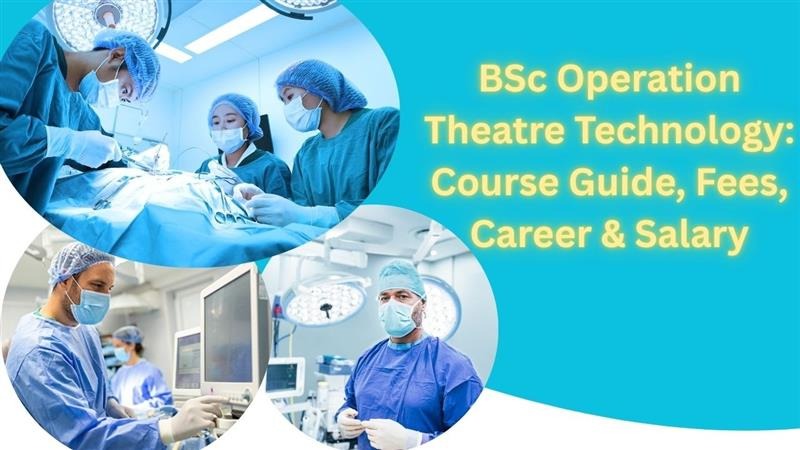
BSc Operation Theatre Technology

If you’ve ever seen a surgical scene in a film, the camera almost always lingers on the surgeon. While behind every successful operation, there is a team, who make everything run smoothly silently in the background. One of the most vital members of the team is Operation Theatre Technologists. Degree in BSc Operation Theatre Technology (BSc OTT) trains students to undertake this pivotal position in the healthcare organisation. 

It is a professional undergraduate course for aspirants who wish to collaborate with surgeons, anesthesiologists and nurses within the operating room. From instrument preparation to ensuring sterility to direct procedure support, OT technologists are paramount to patient safety and managing successful surgeries.

For the students who are interested in medicine but do not want to do MBBS, BSc Operation Theatre Technology course has emerged as a very lucrative career option with rising demand in hospitals across India and abroad. 

What is BSc Operation Theatre Technology About?

BSc OTT (BSc Operation Theatre Technology) is an undergraduate course which makes you ready to be the backbone of surgeries. OT professionals ensure the operating theater is clean, equipment works flawlessly and patients are protected during their surgical journey, above and beyond what the surgeons have time to do themselves. The training enables you to work as a surgical technologist with surgeons and anesthesiologists in the operating room, as a surgical instrument sterilizer, and an assistive user of the advanced technology on which today’s surgical procedures rely.Consider it the technical conductor of an orchestra where every instrument must play perfectly in time. 

Course Duration and Structure: What to Expect

This is the interesting part and also the part you should keep a very close eye on because it changes depending on where you study.

Standard Duration: BSc Operation Theatre Technology is a 3-year course and accompanied by the attendance of a 6 month to 1 year mandatory internship.However, a few top listed universities such as SRM University, Apollo University provide the option of pursuing it as a 4 year course.Professional training in anesthesia technology is provided along with OT management. 

Welcome to Year 1, Are you ready to make a start all you need to do is dust off your knowledge for the big four; Anatomy, Physiology, Biochemistry and Microbiology. But it’s not like just cramming textbooks. You will also begin to understand more general nursing principles, as well as the language that healthcare professionals really speak on a daily basis. Think of it as learning to walk before you run.

The second year is when things start to get a bit more “real”. You’ll advance into pharmacology, gain surgical skills, and for the first time — enter the realm of OT management and sterilization techniques. That’s when you start to realize how all that stuff you learned in Year 1 actually relates to what takes place in an operating room.

Year 3 is where it gets real. You will be learning advanced surgical procedures, anesthetic methods and intensive care. There’s a similar emphasis on quality control, because in medicine, precision and responsibility aren’t optional, they are everything.

Then you do the Internship and that is where everything changes. No more simulations. No more hypotheticals. You’ll be in a real hospital operating theatre, assisting in real surgeries on real patients. Yes, it’s intense. And I was tested in ways I never thought I would be. After all, it is the final stage of your training, but also the most important one, because this is when you stop being a trainee and start becoming a practitioner.  

Are You Eligible For BSc Operation Theatre Technology?

Check your qualification before applying for the admission into this course, Here’s what you need based on official university guidelines:

Educational Background: You need to have done Class 12 (10+2) in Science stream with Physics, Chemistry And Biology (PCB) as core subjects. Some universities allow Mathematics instead of Biology, but the latter is the better choice.

Minimum Marks: Most organizations expect you to have minimum 50% aggregate marks in your PCB. While 55% and 60% needed for the top colleges like AIIMS Delhi and Brainware University.

Age Limit: Starting from 17 and the upper age limit is usually 40 years, with 5% relaxation for reserved categories.

Medical Fitness: A compulsory medical certificate of fitness from a government medical officer must make sense since you’ll be hectoring life. 

Admission Process: How to Get In

If you’ve been panicking over entrance exams, here’s some relief. The cut throat competition is not that much higher as compared to BSc Operation Theatre Technology when it comes to MBBS seats. It’s really not too bad if you know what to expect.

For most colleges, both government and private, it all boils down to your Class 12 PCB percentage. That’s it. If you work hard in your board exams, that work directly opens doors for you here. No complicated formulas, no years of entrance prep — just your actual academic performance talking.

A few universities want to play it their own way. There is no one all India entrance test for BSc Operation Theatre Technology but a few institutions/universities conduct their own tests or they accept students based on their CUET scores for admission. 

Course Fee

As we all presume that it’s not always a career choice that’s based on passion, but also what makes practical sense for you and your family. 

BSc Operation Theatre Technology fees: The good news here is BSc Operation Theatre Technology is really one of the less costly healthcare courses you will find anywhere, more so if you get a government college seat. We’re talking anywhere from ₹10,000 to ₹50,000 per annum and that is fairly affordable when you compare with most private medical courses. For a lot of students, this is what separates the dream from the doable. 

Private colleges have, as one would expect, a more varied selection. Most are in the range of ₹50,000 to ₹2,50,000 per annum, but among the premium institutions the total cost of the course can go up to ₹10 lakhs for the entire programme. 

That’s a big cost, so you should consider what you’re getting in return — facilities, faculty, hospital partnerships, and placement assistance all make a difference. Other expenses like books and hostel costs are not included in these fees.

A majority of the government hospitals and colleges provide scholarships or stipends for pursuing internships. It is helpful for taking ideas on how things work. So look into what assistance you’re eligible for before you commit anything. That one conversation or Google search could save you a pretty meaningful amount of money over four years. 

Where Can Your Career Take You?

Here’s where your heart might skip a beat (and I mean that in the best possible way). The Indian healthcare sector is booming and OT technologists are highly demanded.

  • OT Technician/Technologist: Your main role will be to assist in surgeries and help in the theatre
  • Anesthesia Technologist: Role required to keep monitor patients and machines.
  • Surgical Assistant: Assisting doctors/surgeons during operations.
  • CSSD Technician: Crucial industrial service in central sterile supply departments
  • Emergency Care Technician: Managing Critical Care and Trauma Cases 

Salary Expectations

You can have a good career in this field and it no doubt grows much better with intense experience. For freshers 0-1 years experienced, they get paid from 15k to 25k in government hospitals with job security, pension and all other benefits.

Private hospitals salary ranges from minimum 20k to 35k and maximum 40k in top corporate chains.

₹ 30,000 to ₹ 50,000 per month – With 2 to 5 years Experience Team leader Position holders And Private sector job holders.

Senior Experienced – If you are a senior with 5+ years of experience, you can earn anywhere between 50,000 to 80,000+ Rs per month, be it managerial role or any other specialized area. So, this just build up that how much you can get financial support and more out of this career.  

Read More:- Bihar BPSC APO Recruitment 2026: Eligibility, Vacancy & Apply Online

The Next Step After BSc Operation Theatre Technology Course

Having gained experience in BSc Operation Theatre Technology, expanses of job associated with go up in professional life are endless. Experts may become teachers to mentor and educate students who want to become OT technologists, or they may apply their skills in medical equipment sales, with firms such as Siemens or GE Healthcare, which can be quite rewarding. 

Also, a career in hospital management through MBA in Hospital Management can lead to the door to the top management. 

Specialization is also a viable option for career growth with specialized certifications in robotic surgery, endoscopy and critical care. Learning always pays off for career growth. 

Postgraduate studies such as MSc in Operation Theatre Technology or Anesthesia Technology allow individuals to take on advanced clinical roles, while MBA in Hospital Administration qualifies one for leadership opportunities. 

PG Diplomas in Critical Care or specific Surgical Procedures, along with Certifications in Robotic Surgery, Laparoscopy or Medical Coding, also enhance the career prospects. It is through these career paths that professionals can grow both personally and professionally but at the same time make a meaningful impact on the healthcare sector. 

Conclusion

BSc Operation Theatre Technology is not only a degree, it’s an opportunity to be a crucial part of life saving surgeries. With the healthcare industry in India expected to grow to $638 billion by 2025 and the medical device market expanding at 28% per year, the need for talented OT practitioners is strengthening.

You’ll be at the heart of the hospital, seeing medical miracles every day, and have a stable, respectable career with real upward mobility. If you envisage a career in India’s best AIIMS hospitals or want to work abroad, this degree takes you there.

The operating room isn’t for everyone—it’s stressful, physically and mentally exhausting, and you have to be totally exact. But for those who have the passion for healthcare and the disposition to work in a high-pressure set-up, BSc Operation Theatre Technology provides a career path, that allows you to make a difference in the lives of patients — each and every day. 

Leave a Comment

Your email address will not be published. Required fields are marked *

CCRAS Group A B C Eligibility, Selection Process and Other Details

CCRAS Group A B C

Getting a government job in the healthcare and research sector is a big achievement for any competitive exam aspirant. The Central Council for Research in Ayurvedic Sciences (CCRAS) provides hundreds of vacancies in CCRAS Group A B C posts in different departments. Candidates who are interested in Ayurvedic medicines and treatments can enter this field.

If you are a doctor, nurse or a 10+2 holder aspiring to come to the administration sector, then CCRAS Group A B C is just for you with a heaping number of opportunities. Now, as the Computer-Based Tests (CBT) are over and the 2026 results are officially out, let’s take stock of these posts, know the basic eligibility requirements and give a peek into the selection process to be undergone by successful candidates. 

So, let’s get into the full, simple explanation of the CCRAS Group A B C vacancies. 

What is the CCRAS Recruitment Drive?

CCRAS works under the Ministry of Ayush, The Central Council for Research in Ayurvedic Sciences is a statutory body. It is the foremost national body for promotion of scientific research in Ayurveda and is responsible for evolution, standardisation, propagation of research and also funding. 

For the effective functioning of its large network of institutes and centers of research, Cadre Posts were classified in three hierarchical groups according different organizational functions: 

Group A: These are specialized, premier positions for advanced medical professionals and senior researchers.

Group B includes posts which require an intermediate level of technical knowledge and skills, such as nursing staff, translators and senior laboratory technicians. 

Group C is at working level to perform day-to-day functions which is critical to the daily functioning of the organisation, which includes the office staff, junior assistants, pharmacists and Multi-Tasking Staff (MTS).  

Eligibility CCRAS Group A B C 

Struggling to understand who qualifies is one of the most befuddling parts of any mass government announcement. To make things simple and clear, here is a neat summary of essential eligibility criteria and age limits for the main posts in each group. 

Group A Posts (Specialized & Medical)

For the posts of Research Officer (Ayurveda) and Research Officer (Pathology), the candidates are required to fulfill the Eligibility Conditions i.e. should possess a Postgraduate Degree (MD/MS) in the concerned discipline from a recognized university.  

Further, the candidates must be eligible for registration (or registered) with the State/Central Medical Council. The upper age limit is generally 40 years. 

Group B Posts (Technical & Supervisory)

The Group B posts have their own educational and professional prerequisites. For example:

  • Staff Nurse: B.Sc. Nursing or GNM (Diploma) is mandatory. The candidate should have an experience of minimum two years in teaching or research hospital.  
  • Assistant Research Officer (Pharmacology): The candidate should have M.Pharm or M.Sc in Medicinal Plants specializing in pharmacology with one year of experience after degree.  
  • Translator (Hindi Assistant): The candidate should have a Master‘s degree in the prescribed Hindi / English subject combination and a recognized translation diploma.

The general upper age limit for Group B posts is 30 years. 

Group C Posts (Administrative & Support)

Group C has a different kind of job offer that you can get after your 12th or graduation. These various posts require different qualifications:

Post CCRAS Group A B CEducational QualificationAdditional requirements / Experience
Upper Division Clerk (UDC) & AssistantsGraduate (any stream)Basic knowledge of computers
Lower Division Clerk (LDC)12th passTyping speed: 35 WPM in English or 30 WPM in Hindi
Pharmacist (Grade‑I)– Diploma in Pharmacy / D.Pharm (Ay.) with 2 years experience, or- B.Pharm (Ay.) degreeMust be related to Ayurveda as per CCRAS norms
MTS & Laboratory Attendants12th pass with Science (Physics, Chemistry, Biology)1 year of relevant experience
Age Limit (General)Must be between 25 to 30 yearsRelaxations applicable as per category (SC/ST/OBC/EWS/PwD) as per official notification

Selection Process and Exam Pattern

It is important to understand the testing of candidates for the good preparation in days to come. The entire procedure of the selection was rigidly controlled and transparent by CCRAS. 

1. The Computer-Based Test (CBT)

Exam GroupCBT MarksCorrect Answer (+ Mark)Wrong Answer (- Mark)CitiesExam Period
Group A70+1-0.2538 cities across IndiaNov-Dec 2025
Group B, C, MTS100+1-0.2538 cities across IndiaNov-Dec 2025

2. Skill Tests

Aspiring candidates for the posts of LDC or Stenographer have to undergo stringent typing and shorthand tests to ascertain their practical speed and accuracy. 

3. The Interview Round

For the posts of Group A, the CBT is only a part of examination. The selected candidates also have to go a specialized interview with 30 marks to judge their deep subject matter knowledge and suitability for higher research positions. 

CCRAS Group A B C Cut Off Marks

Official CCRAS Group A B C cut off for the session 2025-26 has not been released in the form of a single cumulative table on the website as yet but as of April 2026 the result and cut off update is activated. 

The cutoff scores are different based on categories like UR, OBC, SC, ST, EWS. Also, the cutoff depends on the post for which you have applied, i.e. Whether you are applying for LDC, UDC, MTS, Lab Attendant or any other post. 

Read More:- UPSSSC Lower PCS Recruitment 2026: Notification, Vacancy, Eligibility & Apply Online

How to check exact cut‑offs

  1. To download the CCRAS Group A B C Cut Off 2026, candidates are advised to visit the official website at https://ccras.nic.in. 
  2. Go to the “Recruitment” or “Results” tab. Search for the link or PDF file named “CCRAS Group A B C Cut Off 2026” or the merit list for the particular post. 
  3. Open the PDF to check the minimum qualifying marks which is divided into UR, OBC, SC, ST & EWS. 

Conclusion

The CCRAS Group A B C will provide many posts which is an excellent chance for the individuals who desire a bright future and want to become a part of India’s AYUSH system of medicines. With a carefully crafted selection procedure – from regular CBTs to special skill assessment – the Council makes certain that they end up with the most passionate students.

The 2025–2026 cycle is already serving as a beacon for those who will come after us, even as we await our final appointment letters. Good luck in the next steps of your career journey, stay tuned and keep your paperwork in order! 

Leave a Comment

Your email address will not be published. Required fields are marked *

Scroll to Top