Bihar School Teacher Recruitment Exam 2026 

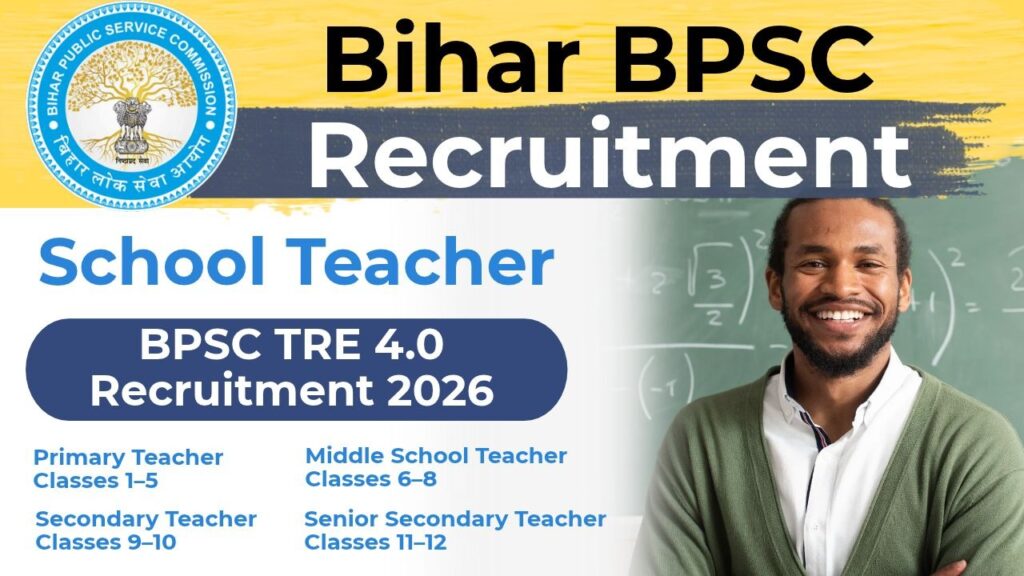
Bihar School Teacher

Candidates who still don’t fill the form of Bihar School Teacher Recruitment Exam 2026 can fill up now. The application window will be closed on 3 November 2026. Check if you fall into the eligible candidates, if not then apply when you get eligible. If yes, then don’t let this opportunity go away. 

Check the vacancy breakdown, eligibility column, application fee, selection process and exam pattern to apply for BPSC TRE 4.0 Recruitment 2026. 

ParticularsDetails
Recruitment nameBPSC TRE 4.0 / School Teacher Recruitment Examination 2026
Conducting bodyBihar Public Service Commission (BPSC)
Advertisement number15/2026
PostsPrimary, Middle, Secondary and Senior Secondary School Teachers
Classes coveredClasses 1–12
Total vacancies33,320 posts, as per the revised/updated recruitment reports 
Official websitebpsc.bihar.gov.in

Bihar BPSC School Teacher TRE Recruitment 2026 Dates 

EventDate
Official notification release22 September 2026
Online application start date25 September 2026 
Last date to pay application fee2 November 2026 (extended) 
Last date to submit online application3 November 2026 (extended) 
Written examinationDecember 2026–January 2027, expected

Application Fee For Bihar School Teacher Recruitment Exam

Rs 100 for all the category students but there is ₹200 biometric fee which means the total fee amount will be Rs 300 to pay online to proceed with the application.

Candidates Post-wise Eligibility 

There are four multiple level teaching posts which require that level of knowledge and education qualification so the table below mentions the necessary qualifications which must be in your resume to allow you for this exam.

PostKey qualification
Primary TeacherClass 12 with D.Ed/JBT/B.El.Ed and CTET/BTET Paper-I
Middle School TeacherGraduation with B.Ed/B.El.Ed and CTET/BTET Paper-II
Secondary TeacherGraduation with B.Ed/B.El.Ed and STET Paper-I
Senior Secondary TeacherPostgraduate degree with B.Ed/B.El.Ed and STET Paper-II 

Age is given to few categories as per Bihar government norms. But the age limit for Bihar School Teacher Recruitment Exam ranges between 21–37 years. 

How to Apply For Bihar School Teacher Recruitment

  1. Visit the official BPSC website and complete One-Time Registration (OTR).
  2. Fill in personal, educational and category details.
  3. Upload photograph, signature and required certificates.
  4. Pay the application fee online by 2 November 2026.
  5. Review and submit the application by 3 November 2026.

What is The Post-wise Vacancy Breakdown

There are a total 33,320 teacher posts under BPSC TRE 4.0 2026 recruitment drive. Check the post-wise vacancy breakdown to know the competition heat.

Teaching postClassesVacancies
Primary Teacher1–53,847
Middle School Teacher6–88,563
Secondary Teacher9–104,370
Senior Secondary / Higher Secondary Teacher11–1216,540
Total1–1233,320

BPSC revised the vacancy number with adding 493 posts for Classes 9–10 and 439 posts for Classes 11–12. 

Selection Process and Exam Pattern 

There are four stages in the Bihar School Teacher Recruitment selection process. First candidates have to pass the written test when they get a good score and find their name in the merit list, document verification and medical examination happen to verify your details you put in the application. fitness and health also require you to teach students. 

You are notified through the official website of the recruitment organisation. The final merit list will be declared and if you have passed all three stages then you are eligible for teaching in a Bihar government school. 

Bihar School Teacher Recruitment Exam pattern will help you understand how you are going to attempt the question and complete it on time. Also prepared according to the sections.

Teaching levelPaper structureQuestions / MarksDuration
Primary Teacher, Classes 1–5Language (qualifying) + General Studies30 + 120 = 1502 hours 30 minutes
Middle School Teacher, Classes 6–8Language (qualifying) + General Studies + Concerned Subject30 + 40 + 80 = 1502 hours 30 minutes
Secondary Teacher, Classes 9–10Language (qualifying) + General Studies + Concerned Subject30 + 40 + 80 = 1502 hours 30 minutes
Senior Secondary Teacher, Classes 11–12Language (qualifying) + General Studies + Concerned Subject30 + 40 + 80 = 1502 hours 30 minutes
  • The language section carries 30 marks and it’s easy so you can secure it first. 
  • General studies carries 40 marks for 6 — 12 classes teachers and 120 marks for primary teachers so keep yourself updated with the current events that especially happened in Bihar. 
  • Concerned subject means your choice of subject which carries 80 for 6—12 marks teachers so prepare your preferred subject well enough to secure full marks. 
  • All questions are multiple-choice/objective type. 

Candidates should always check the notification updates and admit card release so they won’t miss anything.

Apply Now 👉 UPPSC RO/ARO Online Form 2026 – Apply Online for 501 Posts

Conclusion

If you are heading towards your teaching career then the Bihar School Teacher Recruitment Exam is an opportunity to secure a seat to become eligible to teach in a government school. But you must carry the necessary documents in your hand and be willing to beat the competition. Check instructions on how to apply for BPSC TRE 4.0 Recruitment 2026.


Leave a Comment

Your email address will not be published. Required fields are marked *

PA, DEO, LDC & Steno Posts Exam Date 2026 is Out Check Bihar Vidhan Parishad Site

Bihar Vidhan Parishad

For Bihar students, a stable, prestigious government job is what defines success in life and as such many are drawn to the Bihar Vidhan Parishad (Legislative Council) for it. It’s been a long preparation but finally, the air is starting to clear. If you have been constantly refreshing the official website and browsing notification bars, you have already filled the application forms.

Now the exam dates for the recruitment for the posts of Personal Assistant (PA), Data Entry Operator ( DEO ), Lower Division Clerk ( LDC ), and Stenographer are now declared. 

Schedule for Exam

The preliminary exam is being held on 05/April/2026 for PA, DEO, and LDC posts which is being filled with the aspirants who score best in this exam.

Starts Apply 28/November/2025
Ends on 05/January/2026
Last Date For Fee07/January/2026
Exam Date05/April/2026

Eligibility For Exam

Applying for Personal Assistant (PA): You must have a degree of a valid university in your hand from any stream and Stenography speed of 100 words per minute (wpm).

For the Stenographer: Stenography speed of 80 wpm with the degree of graduation.

Data Entry Operator (DEO): 8000 words with accuracy per hour speed of typing is required with 12th Certification.

Applying for Lower Division Clerk (LDC): You must have 12th marksheet and 30 wpm of typing speed in both Hindi and English.

Vacancy and Salary Level

This single-day agenda offers some clarity for the 64 vacancies that thousands have applied for. Although the application process ended in January 2026 following a number of extensions, the attention is now firmly on the home straight of revision. 

Post NameTotal VacanciesPay Scale (Level)Key Qualification
Personal Assistant (PA)07Level-07 (₹44,900–1,42,400)Graduate + 100 wpm Steno
Data Entry Operator (DEO)35Level-04 (₹25,500–81,100)12th Pass + 8000 key-depressions/hr
Stenographer12Level-04 (₹25,500–81,100)Graduate + 80 wpm Steno
Lower Division Clerk (LDC)10Level-02 (₹19,900–63,200)12th Pass + 30 wpm Typing

Selection Process

It is not only a written test competition in this recruitment; it is also a competition of knowing the technique of running on the ground. Since these posts are of administrative and technical nature, the Bihar Vidhan Parishad conducts the following stages:

  1. Preliminary/Written Examination: This is the first hurdle. It is basically a general awareness general arithmetic, reasoning and language (Hindi or English).
  2. Skill Tests For PA and Stenographers: You will appear for a shorthand (Stenography) test which is tough as it requires 80–100 wpm.

For DEO, and LDC: Must clear Typing Tests and Computer Tests. Be it key depressions of the hour or the words per minute, accuracy is equally important as speed.

  1. Document Verification & Medical: The end of the road to qualify for meeting all legal and physical condition for the state government. 

Admit Card Download

The admit card is going to be released in March 2026 before the exam so students can download it from the official website. It is a ticket to your exam which is not going to appear on your doorstep. 

Follow these Steps to download: 

  1. Check out to the official site
  2. Login to check your admit card.
  3. Put in your Registration Number and Date Of Birth/Password to login.
  4. Download, have it laminated and get a colour print out.

Note: It will be available five days before the exam so keep checking on the site. It may not show sometimes due to high traffic on the server. 

Read More:- UPPSC APO Admit Card 2026 Out: Check Exam Center and Date

Preparation Strategy

If you have a little time for preparation or you want to revise over three weeks. Here are a few things you can do to beat this examination:

  • Keep A Watch On Current Affairs: Bihar related current affairs and Indian polity are all time favorites in Vidhan Parmanch exams. Revise the recent laws and the state’s schemes.
  • Practice Typing/Steno Daily: The pressure of the exam hall is different from doing practice at home.
  • Practice Papers: Begin untimed with full-length test papers with the clock ticking. This will allow you to make during the General Awareness, Reasoning and Time Sessions.
  • Revise Computer fundamentals: For DEO and LDC posts, questions on MS Office shortcuts, internet protocols, and basic hardware are frequently asked. 

What to Carry to the Exam Center?

  • Admit Card with fully laminated
  • Adhaar or Pan Card copy
  • Passport photo of yours

Conclusion

Bihar Vidhan Parishad Recruitment Exam 2026 is very important for those aspirants who want to make their career in Government Sector. Now that the exam date is out, the entire attention should be on smart revision, regular practice and time management. PA, DEO, LDC, and Stenographer post in UPSC documents, each form is precise and fast at each stage of the application process. Follow the instructions and stay up to date with official notifications, download your admit card on time and have all necessary documents ready. If you eat the right strategy and commitment, this could be your door for a successful career in the Bihar legislative arm. 

Leave a Comment

Your email address will not be published. Required fields are marked *

Online or Offline Coaching Which is Better For You? 

Coaching

No matter how much you’re confused while choosing Online or Offline Coaching for your exam preparation, there is no one word answer for that. The better option is which one fits for you and your studies. Whether you are living in a rural or urban area, this choice totally depends on your lifestyle, learning habits, and mind adaptability.

If you understand from recorded sections, you can easily adapt to online coaching. Some students have doubts and need motivation to study, offline coaching works best for them.

Understanding the Purpose of Your Coaching?

Ask yourself, “I want to join a coaching for study content?” or you wanted a structure and motivation that comes from studying with peers. The purpose of your coaching will help you direct in the right path, try to find out that answer. There is no debate left for Online Learning vs Offline Learning.

If you can set your own deadlines to finish the syllabus and search answers to clear your doubts on your own then Online Coaching can be a highly effective option for you. However, if you need someone to keep you accountable and your mind is more attentive in a physical classroom environment then offline coaching is best for you.

Considering Online Coaching is poor is a biggest myth because some subjects find more better content such as faculty access, recorded lectures, and mock test quality in online coaching than offline. 

Advantages of Online Coaching

The online coaching landscape in India has completely transformed over the last five years. One of the best advantages of online coaching is the exposure of great teachers and their lectures through Youtube and learning apps. Students can join classes of best IAS, Mathematics or Science Teachers from different states though platforms like Unacademy, Physics Wallah etc., without having to relocate.

Online Learning vs Offline Learning Strengths

Online Coaching StrengthOffline Coaching Strength
Less expensive and easily affordableMaintain consistency for your studies
You can rewatch lecture in your free timeTrigger competition reflect and motivates through entire period
No need to relocate for best faculty to learnFace-to-face interaction allows better understanding of doubts
Most platform has mock tests, performance tracking and dashboard to monitor your studiesNo distraction from the house or anywhere, the environment is set and more focused on study.
Traveling time is saved and used for studiesPeer support and discussion can improve understanding and keep motivation high 

Fact About Offline Coaching That Nobody Talks About

So many students spend lakhs of rupees to pay the coaching fees, move to an unfamiliar city and live away from their parents, but success is still not guaranteed. Offline coaching does not automatically lead to better results. Be careful while choosing offline coaching, it must have the best teachers that get you, quality study and overall consistency. 

There is also a hidden cost in offline coaching: your traveling money and time. If you travel everyday and your coaching is far from your home then it will waste both your time and money. That valuable time could instead be used for revision, practice, or self-study. 

Which One Should You Choose?

Understand yourself and purpose for the coaching then make a decision for .

Choose Online Coaching If:

  • You are a working professional and wanted to prepare for exams
  • You live in a small town or rural area and don’t wanna move to the city where the best teachers are easily accessible.
  • You have a tight budget and want a cost-effective option. 
  • You are just comfortable with self-study and manage yourself to stay consistent.

Today, high-quality online content is available for major competitive exams like JEE Main, NEET, and UPSC, making online learning a strong choice for many students.

Choose Offline Coaching If:

  • You don’t keep yourself motivated and get easily distracted.
  • You are in Class 11 or 12 and surrounded with a lot of doubts.
  • You have the financial support to attend classroom coaching.
  • You want interaction with teachers and other students, and motivated by a competitive peer environment.

For some exams, especially medical entrance preparation, the quality of certain offline coaching batches is still considered among the best.

Hybrid Learning – Best Coaching Method for Students

Opt for hybrid learning because it combines structured routine of offline coaching with the flexibility of online resources, that gives you everything to crack the exam. With recorded lectures and test series, you can revise the topic whenever you get free or clear any doubts you have. Many top-performing students follow this strategy as it helps to keep them consistent and competitive by attending physical classes while getting extra practice and revision from online learning. It offers the best of both worlds. 

Exam categoryExample exams / authoritiesBest modeWhy (short)Stage note
Engineering EntranceJEE Main (NTA)OnlineHigh-quality online content (PW, Unacademy, Allen Online), much cheaper; superior mock analyticsFinal 3 months: add offline test series for exam-hall pressure practice
Engineering EntranceJEE Advanced (IITs)HybridNeeds deep problem-solving, peer discussion, instant doubt clearing—online alone misses thatBest combo: offline class batch + online for revision/extras; choose offline batch with top peers (Top 5% JEE Main scorers)
Medical EntranceNEET (UG – NTA/UGNMC)HybridBiology often benefits from offline teaching; top online platforms strong (PW NEET, Aakash Digital)Class 11: prefer offline; Class 12 & droppers: hybrid efficient; Physics & Chem may need offline doubt clearing
Civil ServicesUPSC CSE (Prelims, Mains, Interview)OnlineVast syllabus, comprehensive online materials; saves relocation costJoin local/offline test series for Mains answer-writing feedback; Interview prep must be offline mock panels
State PSCsUPPSC, MPPSC, BPSC, etc.HybridState-specific GS and current affairs covered better locally; general subjects onlineHindi-medium students often prefer offline; depends on state — e.g., Lucknow has strong UPPSC institutes
Banking & SSC (Banking)SBI/IBPS PO & ClerkOnlinePattern-based; purpose-built mock platforms (Oliveboard, Testbook, Adda247)Invest in mock test subscriptions rather than classroom fees
SSC (Staff Selection)SSC CGL / CHSLOnlineHighly pattern-driven; aptitude practice > concept depthTier 1: online mock platforms and YouTube suffice; offline often overpriced
RailwaysRRB NTPC / ALPOnlineBasic aptitude + GK; strong online resources availableUse Unacademy Railway, Testbook; self-study with mocks works well
DefenceNDA / CDS (written) + SSB (interview)HybridWritten exam: online prep fine; SSB: offline required for GTO and psych practiceSplit budget: online for written; offline only for SSB coaching

The Honest Pitfalls of Online Coaching

Online coaching actually fails when students start collecting videos instead of actually studying them. Self study is needed in both modes of education, downloading dozens of lectures without watching, revising, or practicing creates the illusion of preparation. In common languages, it’s a fake preparation trap when you have all the study material but you are not practicing or learning it.

No matter how premium the platform you got, online coaching is a waste for you. If you have 50 videos and don’t even watch properly any one of them. You can enroll in any of the best online learning platforms under your the best teacher classes, create a weekly study schedule, and commit to completing each week’s material on time.

Read More:- What Is Distance Education? Benefits, Learning Programs, and Career Opportunities

Conclusion 

Online or Offline Coaching just provides the structure, study content and ways to crack it easily. But you have to work hard on practicing it daily, understanding the topic, maintaining discipline and consistency. Lack of commitment will let you fall in your life whether you are taking Online or Offline Coaching.

Before selecting a coaching style, do an honest self evaluation. Understand your purpose of coaching and exams you are going to pitch for. In the end, it is consistent effort and discipline that counts more than the way you are learning. 

Online Learning vs Offline Learning, Best Coaching Method for Students, Online Education vs Traditional Education

Leave a Comment

Your email address will not be published. Required fields are marked *

IBPS PO MT XVI Recruitment 2026: What Every Banking Aspirant Needs to Know

IBPS PO MT XVI Recruitment

If you began your preparation for the IBPS PO with the mock tests of the last year, then your syllabus is already out of date with yesterday’s blueprint. The IBPS PO MT XVI cycle for 2026 has evolved quite a bit in terms of number of vacancies, in the Mains exam, and even in the rounds after the interview, so aspirants who do not revise their strategy might find themselves sitting in the exam hall solving a paper that is no more. 

Here are the real differences this time around and what that means for how you prepare. 

What Changed in IBPS PO MT XVI 2026

The IBPS PO MT XVI detailed notification was published on 30 June and 01 July 2026 on ibps.in, inviting applications for the posts of Probationary Officer and Management Trainee in 11 participating public sector banks for the recruitment year 2027–28. 

The total number of vacancies mentioned in the first notification was 6,715. That figure has since shifted — as per the 20 July 2026 update from IBPS, the number stands at 7,365, which is approximately 29% more than last year’s intake. 

Two banks, UCO Bank and Union Bank of India, had not yet submitted their vacancy numbers as of this update, so the final count may change once more before the end of the process. Bank of Baroda, Canara Bank, and Bank of Maharashtra currently have the largest number of vacancies. 

The date for application also got extended. It was initially scheduled to end on 21 July 2026 but IBPS extended the last date to 26 July 2026. This year also brings something new with effect: a two-day correction window post registration closure, so candidates who find an error in their form after submission are not doomed by it. 

Important Dates for IBPS PO MT XVI Recruitment 2026

MilestoneDate
Detailed notification released30 June – 1 July 2026
Online application window1 – 26 July 2026 (extended from 21 July)
Preliminary exam22 & 23 August 2026
Main exam4 October 2026
Personality Test / InterviewTo be announced

Treat the interview and personality test dates as provisional until IBPS confirms them closer to the Mains result — that stage of IBPS PO MT XVI typically gets scheduled bank-wise, so your call letter will carry the exact date and centre.

Eligibility Criteria

To apply for IBPS PO MT XVI Recruitment, you need a graduation degree in any discipline from a recognised university, with your mark sheet or provisional degree certificate in hand at the time of registration — IBPS doesn’t accept “result awaited” candidates. 

The age bracket is 20 to 30 years as on 1 July 2026; the usual government relaxations for reserved categories apply, but confirm the exact slab-wise relaxation against the official notification PDF rather than assuming it mirrors last year’s, since IBPS has been known to revise fine print between cycles.

The application fee is ₹175 for SC/ST/PwBD candidates and ₹850 for everyone else, payable online through the IBPS portal.

Salary and Pay Scale

An IBPS PO MT XVI Recruitment selected candidate shall begin at the basic pay of ₹48,480. When DA, HRA and other allowances are included, the salary comes to around ₹74,000-76,000 per month in-hand, although it may vary based on place of posting and allowances structure of individual banks. 

Read More :- UPSC Principal and Vice-Principal Recruitment 2026: Must Check Complete Details

The Exam Pattern For IBPS PO MT XVI Really Diverges From Last Year

Prelims remains the same. It’s still 100 questions for 100 marks on English Language, Quantitative Aptitude and Reasoning Ability, with 60 minutes for the duration which is divided into three separate timers of 20 minutes each. A ¼ mark will be deducted for each wrong answer and your Prelims score is only a qualifying hurdle — it is not taken into account for the final merit list. 

Mains is what makes IBPS PO MT XVI Recruitment seem an altogether different exam. The objective paper has increased from 145 questions to 170 questions, while the total marks remain 200 in a duration of 160 minutes. The English Language now asks more questions but awards fewer marks – 20, down from 40, so that each English question is worth less than it ever was.  

General/Economy/Banking/Digital/Financial Awareness has been increased to around 50 questions for 60 marks and is one of the heaviest sections in the exam and also Data Analysis & Interpretation has been given more marks.  

The subjective paper remains 25 marks for 30 minutes, although sources vary on whether it’s essay writing and comprehension or if it includes letter writing — do confirm this with your admit card and the official notice when released, don’t take either version for your final source of information. 

Selection Process: Four Stages, Not Three

Where IBPS PO MT XVI Recruitment used to run Prelims, Mains, and Interview, this cycle adds a fourth step: a Personality Test, conducted after Mains and before the interview. It’s mandatory for anyone shortlisted, but non-qualifying — its purpose is to hand the interview panel a personality profile rather than to filter candidates out on its own. 

The interview itself is still conducted by the individual participating banks, and you’ll need at least 40% to qualify (35% for SC/ST/OBC/PwD candidates). 

Final merit combines Mains and Interview scores in an 80:20 ratio — Prelims marks play no role beyond getting you through the door.

One Preparation Tip You Shouldn’t Skip 

Don’t wait until after Prelims to deal with the Mains shift. Because Banking Awareness and Data Analysis & Interpretation now carry noticeably more weight in IBPS PO MT XVI’s Mains paper, block out a fixed weekly slot — even 30 minutes, three times a week for RBI circulars, recent monetary policy changes, and current banking-sector news, starting today rather than after Prelims is done. 

Candidates who leave Banking Awareness for a last-minute cram before Mains are the ones most exposed by this year’s restructured weightage.

Read More:- MPPSC ADPO Recruitment 2026: Everything Law Graduates Need to Know 

Review These Details Before Applying

The vacancy count for IBPS PO MT XVI Recruitment isn’t fully locked yet, with two banks’ numbers still pending, and the interview-stage calendar hasn’t been released. Keep checking ibps.in directly rather than relying on secondhand vacancy figures as you get closer to results — in a cycle with this many moving parts, the official notification is the only version worth trusting completely.

Conclusion 

The IBPS PO MT XVI Recruitment 2026 notification came with more vacancies and a new selection process, so it is a good chance to grab for banking aspirants. Check your eligibility, apply online, and start preparing for Prelims and the revised Mains exam today. 

There might be updates for vacancies and schedules from IBPS’s side, so keep visiting the official site for the latest notifications and do not trust other websites. 

Leave a Comment

Your email address will not be published. Required fields are marked *

DECE-LE Admission Form 2026: Apply Online, Eligibility, Exam Date & Full Details

DECE-LE Admission Form 2026

If any student of Bihar is eager to get admission to the polytechnic colleges from second year by lateral mode, DECE-LE Admission Form 2026 is the channel for them through which they can fulfill their dreams. The Bihar Combined Entrance Competitive Examination Board (BCECEB) offers an opportunity to eligible candidates to take a leap of faith into the second year of the diploma engineering courses in various polytechnic colleges of the state of Bihar.

Be it a fresh 12th pass with science subject or a 10th pass ITI graduate, you bet this exam will be the game changer in your technical education. So, here’s going to have everything you need to know about from filling out that crucial application form to putting your worrying hat away and marking your calendar with key dates.  

The Application Window is Open

Excitement grows as DECE-LE Admission Form 2026 application process is live now from 20th March 2026. If you’re reading this and you still haven’t applied, no panic — but yes, do hurry. The last Date to Apply Online is 23-04-2026, so you have a good amount of time to apply.

Here is something practical to remember: you have until the 23rd to file your form, but you do have an extra day to make your payment The deadline for payment is April 24, 2026. Life happens and sometimes we let deadlines slip by a whisker. BCECEB is aware of this and that’s why they have announced the application correction window from 25th to 26th April 2026. This is your little buffer — in case you made a typo in your name or your personal details or if you uploaded the wrong document, two days later is when you can fix that stuff, no questions asked. 

The fee to apply is ₹2,200 for all categories: General, BC, EBC, SC, ST, PD candidates. Equal fees in all categories is reflective of the equal opportunity principle the board wants to convey. You can pay using various online methods including credit card, debit card, net banking or UPI. No more waiting in never-ending bank queues or stressing over demand drafts. 

Who Can Apply?

Route 1: The 12th Grade Route

You just need to complete the 12th with relevant subjects. The board also allows an unexpectedly wide range of subjects Physics, Mathematics, Chemistry, Computer Science, Electronics, IT (Information Technology), Biology, Informatics Practices, Bio technology, Technical Vocational subjects, Agriculture, Engineering Graphics, Business Studies or Entrepreneurship. This broad-based philosophy reflects an understanding that engineering potential can be nurtured through different academic paths and not just the conventional PCM (Physics-Chemistry-Math) stream. 

Pathway 2: Through the ITI Route

Have you passed 10th standard and then did a 2 year ITI course? We would love to have you. This route recognizes the hands on training that an ITI student gets and provides them with a formalized pathway to progress into diploma engineering courses. 

Age is Just a Number

There is no age limit for the DECE-LE Admission Form 2026 entrance exam. You’re welcome, whether you’re a seasoned professional returning to school or a fresh out of high school eighteen year old. 

The board also said that adequate bridge courses in maths, physics and engineering drawing will be provided to students of all streams by the affiliating body. It is to allow for all who take the diploma, no matter what their pre-entry academic background, will be more or less (academically) the same.  

Key Dates for DECE-LE Admission Form 2026

EventDate
Application Start Date20/March/2026
Last Date to Apply23/April/2026
Fee Payment Deadline24/April/2026
Application Correction Window25—26/April/2026
Admit Card Release15/May/2026
Exam Date24/May/2026

Print and read all the information on your Admit card in advance of the examination. The admit cards were released on 15/May/2026. If the suggested exam date of 24/May/2026 is finalized, then that will leave about two months to study. 

Step-by-Step Guide to Fill the DECE-LE Admission Form 2026

Although the online application process at official website is simple enough, a lot of us do get frustrated when using government websites but is what it is. Here’s how to breeze through it:

Step 1: Registration

Register using a valid email ID and mobile number. That information will be your lifeline going forward. Use an email address that you check regularly and a phone number that is not going to change over the next couple of months. Once registered, these cannot be changed.

Step 2: Fill in Your Details

Provide false ID proofs and other details, educational qualifications, contact information, etc. Upload your photograph, signature and thumb impression as per the instructions given that it relates to official notice. 

Step 3: Review and Submit

This is your final opportunity to correct mistakes before the form is sent to the system. So review it carefully.

Step 4: Pay the Fee

Make the payment of ₹2,200 through any online mode which you find convenient. Retain the proof of payment – don’t just trust email confirmations.

Step 5: Download Confirmation

Post your successful submission and fee payment, you may download and take a printout of the Confirmation Page. Keep several copies. You”ll need it all along your admission trip. 

Read More:- Your Ultimate Guide to Apply for the UP B.Ed JEE 2026 Online Form

The Next Step After Submitting the Application

Use the time to your advantage to get ready for the test. The DECE-LE Admission Form 2026 test is held offline in pen and paper mode and the duration of the test is 2 hours and 15 minutes. The question paper consists of 150 objective questions from Physics, Chemistry and Mathematics. 

Old question papers are the ultimate resource to make preparation easier. They give you an idea about the examination pattern, difficulty level and how to manage the time. Various educational portals provide them for practice.

Answer keys will be released by the board after examination, followed by results in the form of rank cards. Your rank is what positions you for counselling and seat allotment. 

The process goes on with: 

  • Registration, 
  • Choice filling, 
  • Choice locking, 
  • Seat allotment, 
  • Document verification 
  • And finally reporting to your allotted college.

Conclusion

DECE-LE Admission Form 2026 is not just any other entrance exam- it is a stepping stone from your current credentials to your engineering dreams. For these nursing students around Bihar, this exam is chance, light, and the promise of a technical career.

When you go through the process, know that thousands of students are pacing up and down this floor. If you feel stumped, ask for help— from teachers, successful seniors, or the official BCECEB helpdesk. The candidates also have the option to contact the department in case of any queries.

Leave a Comment

Your email address will not be published. Required fields are marked *

Medical Courses After 12th PCB in India: Complete Roadmap, NEET, MBBS & Career Options

Medical Courses After 12th PCB in India

To become a medical sciences professional in India, students have to opt for the Bachelor of Medicine, Bachelor of Surgery (MBBS) degree, which is an arduous and comprehensive five-year program that aims to develop the students into healthcare professionals. But the path to Medical Courses After 12th PCB in India is a confusing maze of courses and entrance exams (the most important is National Eligibility-cum-Entrance Test (NEET).

NEET entrance exam has played a pivotal role in making the process of admission of MBBS more transparent and ensuring the method of admission on merit basis and curbing malpractices in India. 

The usual path through medical training is to go straight from medical school into a foundation program, then core training, higher specialty training and then either general practice or hospital specialist/consultant. This lengthy, complex training process exists to make certain that doctors have the critical foundational knowledge, the practical skills unique to their specialty, and the clinical understanding needed to safely contribute to patient care. 

Other than MBBS, there are plenty of other medical and paramedical courses out for students PCB which are Bachelor of Dental Surgery (BDS), Bachelor of Ayurvedic Medicine and Surgery (BAMS) and Bachelor of Homeopathic Medicine and Surgery (BHMS). 

Medical Courses After 12th PCB in India

Most Popular and Hard-Level Courses

These courses offer a variety of specializations in the healthcare domain for the interested and the ambitious. For example, MBBS is a course on allopathic medicine while BAMS and BHMS are courses on Indian and homeopathy systems of medicines respectively which have profound history in India. Such classic systems, such as Ayurveda, are conceptually coherent and dynamically insightful intellectual traditions with unique theories of physiology.  

The content in medical education is constantly being updated to reflect advances in science and to prepare students adequately for clinical practice. For instance, personalized medicine is more and more being implemented in undergraduate medical education by using spiraled learning approaches. This design exposes undergraduates to evidence-based and clinically pertinent personalized medicine principles during all four years in medical school. 

Easy Courses in Biomedical Science

In the same vein, growing awareness of the need to incorporate artificial intelligence (AI) – a tool that enhances patient management and care in specialties like radiology and pathology in biomedical science education to foster healthcare education advancement is emerging. 

EBM Courses in Medical Courses After 12th PCB

Today’s medical education demands that students gain scientific foundational knowledge and not only practical exposure and clinical reasoning skills. Pragmatic EBM courses, such as the one at our institution, are intended to prepare students to sift through large bodies of evidence to answer clinical questions preparing them for the transition from undergraduate to graduate medical education. 

Cultivating systems thinking in medical education may contribute to educating scientists and clinicians of the future by counteracting dwindling interests in science through early involvement, hands-on experience, and improved coordination between educational phases. 

Professional Exams — Membership of the Royal Colleges of Surgeons

Medical education is organized into levels that sequentially increase in complexity. Following primary medical education, a phase of practical training under supervision, e.g. postgraduate residency training, is essential in order to convert theoretical knowledge into applied skills in the delivery of care to patients. 

This stage is said to be a formalised apprenticeship, to guarantee that practitioners are ready to work on their own. Passing professional exams, such as the Intercollegiate Membership of the Royal Colleges of Surgeons (MRCS) exam, is required for candidates to begin advanced specialty training in a number of specialties. 

Practical Specialization in Medical Science

Practical Specialization in Medical Science

The number of specialties open to students is huge and they can focus on general practice or pursue a highly specialised field. For instance, these are pediatric rehabilitation medicine physicians who are subspecialists working to optimize the health and function of children with disabilities across the lifespan. 

Specialties can also provide their own focus training on particular aspects, such as behavioral health, as behavior disorders are frequently seen in children and pediatric residency training in India is now having integrated behavioral health modules. Consideration is also being given to global health challenges of the future, for example increasing paediatric surgery provision in low and middle-income countries. 

Other Specializations Paths

There are also other specialist routes besides the core medical degrees. The radiation biology, dosimetry, and imaging aspects of medical physics intertwine with biology, anatomy, and physiology, and are subject to the rigorous education and training that is needed for safe and quality patient care. 

Medical physics educational programs range from undergraduate to doctoral level to facilitate the collaborative practice of physicists and physicians in a clinical environment. Likewise, clinical chemistry and biochemistry are recognized specialties requiring dedicated postgraduate training.

Choosing The Right Path in Medical is Important

Becoming a health care provider is challenging, and continuous learning and adaptation are necessary. Medical education curricula are regularly revised to be more integrated and competency based with an emphasis on the application of knowledge and on the development of problem-solving skills. This prepares future clinicians to manage complex medical knowledge and varied patient demands. 

Students need to be provided with necessary information to help them make right decisions regarding their career option after 12th class as choosing the right course is a crucial decision which will determine their future. 

In addition to MBBS being a popular-choice, it is also important to know different career options in healthcare and non-healthcare fields. Different admissions routes are being introduced into Medical Courses After 12th PCB, which enable students from under-represented groups to access medicine and aim to widen participation in the selection process are being developed. 

Conclusion

The path of Medical Courses After 12th PCB in India is the jack of all trades’ requiring preparation for entrance exams like NEET and dedication towards lifelong specialized training. The curriculum is changing as constantly evolving science, including personalized medicine and AI, is being introduced and the next generation of healthcare professionals will take on the challenges of the modern medical field. 

The option isn’t only MBBS, now there are other streams like dentistry, Ayurveda, Homeopathy and scientific specializations under Medical Courses After 12th PCB which can be integrated into healthcare. 

Leave a Comment

Your email address will not be published. Required fields are marked *

Scroll to Top