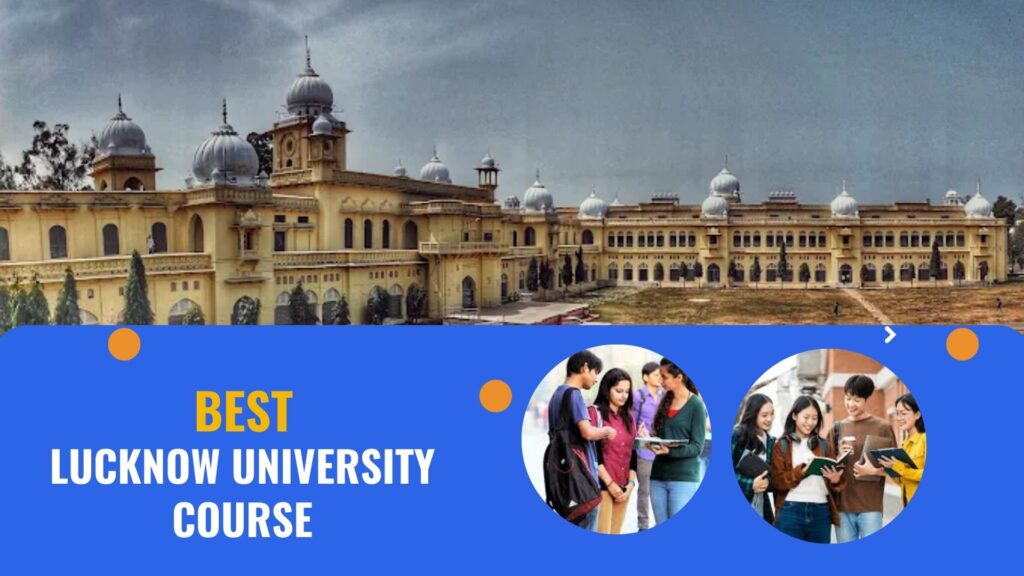
Discover the Best Lucknow University Courses in 2025 – UG, PG, Diploma & More!

Best Lucknow University Courses – Top UG, PG, Diploma & Professional Programs 2025

Lucknow University is one of the oldest and most respected universities in India. Many students dream of studying here. If you want to know about the best Lucknow University courses in 2025, this article is for you. We will talk about the main courses at undergraduate (UG), postgraduate (PG), and diploma levels. We will also look at some popular professional courses. This guide will help you find the right course for your future.

Main Types of Lucknow University Courses

  • Undergraduate (UG) Courses
  • Postgraduate (PG) Courses
  • Professional and Vocational Courses
  • Diploma and Certificate Courses

Let’s explore each type.

Undergraduate (UG) Courses at Lucknow University

Undergraduate courses start after class 12. These courses help you build basic knowledge for your career. Here are some of the best UG Lucknow University courses:

Bachelor of Arts (BA)

The BA is a famous course. You can choose subjects like:

  • Hindi
  • English
  • History
  • Political Science
  • Sociology
  • Economics

The course is for three years. There are many subject combinations, so you can pick what suits your interest best.

Bachelor of Science (BSc)

This course is good for students who love science. The BSc at Lucknow University comes with many subjects like:

  • Physics
  • Chemistry
  • Mathematics
  • Botany
  • Zoology
  • Statistics

BSc is a three-year full-time course. There are also special groups like BSc (Physics, Chemistry, Mathematics) or BSc (Botany, Zoology, Chemistry).

Bachelor of Commerce (BCom)

BCom is best for students interested in business, finance, or accounting. At Lucknow University, you learn subjects like:

  • Accountancy
  • Business Law
  • Economics
  • Management

BCom is a three-year course and gives you great career options in banking, finance, and business.

Bachеlor of Computеr Applications (BCA)

BCA is for thosе who want to work in computеrs and IT. You lеarn softwarе, programming, and computеr basics. It is a popular Lucknow Univеrsity coursе for tеch lovеrs. Thе coursе is for thrее yеars.

Bachеlor of Businеss Administration (BBA)

If you drеam of managing a businеss or bеing a lеadеr, BBA is thе right choicе. You will study businеss, markеting, financе, human rеsourcе, and morе. BBA is a thrее-yеar coursе at Lucknow Univеrsity.

Bachеlor of Laws (LLB and BA LLB)

LLB is for studеnts who want to bеcomе lawyеrs. Lucknow Univеrsity offеrs both thrее-yеar (aftеr graduation) and fivе-yеar (aftеr class 12) coursеs. You will lеarn about Indian law, constitution, criminal law, human rights, and othеr law-rеlatеd topics.

Bachеlor of Education (BEd)

If you want to tеach, BEd prеparеs you for a carееr in schools. This is a two-yеar coursе aftеr graduation. It tеachеs you about tеaching mеthods, child psychology, and classroom managеmеnt.

Bachеlor of Finе Arts (BFA)

BFA is for crеativе studеnts intеrеstеd in painting, sculpturе, or appliеd art. It is a four-yеar coursе. Lucknow Univеrsity givеs you modеrn and classical art training. 

Bachelor of Journalism and Mass Communication (BJMC)

BJMC teaches skills for journalism, mass media, and communication. It is a great course for students who want to become reporters, news editors, or work in media houses.

Postgraduate (PG) Courses at Lucknow University

After graduation, you can do PG courses. These courses give you deeper knowledge and better job options. Here are some of the popular PG Lucknow University courses:

Master of Arts (MA)

You can choose from subjects like:

  • Hindi
  • English
  • History
  • Political Science
  • Sociology
  • Psychology
  • Economics

MA is usually a two-year course. It gives you in-depth subject knowledge.

Master of Science (MSc)

MSc is best for science graduates. Subjects include:

  • Physics
  • Chemistry
  • Mathematics
  • Zoology
  • Botany
  • Statistics

This course sharpens your skills for research or teaching careers.

Master of Commerce (MCom)

MCom is for students who want to work in finance, banking, or accounts. The course covers subjects like advanced accountancy, business management, and financial studies.

Master of Business Administration (MBA)

MBA helps students take up high-level jobs in business, marketing, or management fields. You learn about Human Resources, Finance, Marketing, International Business, and more. MBA is a top-rated Lucknow University course and has high value.

Master of Computer Applications (MCA)

MCA is good for tech and computer graduates. It teaches about advanced computer programming, networks, and software. MCA is a two-year PG course.

Master of Laws (LLM)

This PG course is for law graduates. Students can select specializations like:

  • Constitutional Law
  • International Law
  • Corporate Law
  • Criminal Law
  • Environmental Law

LLM helps in building expert knowledge in law.

Master of Social Work (MSW)

MSW is for those who want to help people and do social service. The course trains you in working with communities, helping children, and working for social causes.

Master of Education (MEd)

For those who already have a BEd, MEd makes you an expert in education and teaching.

Popular Professional Lucknow University Courses

Lucknow University has many professional courses. These courses are designed for fast jobs and skilled work.

  • Bachelor of Pharmacy (BPharma): For working in medical and pharma companies.
  • Bachelor of Technology (BTech): Lucknow University offers Computer Science and Artificial Intelligence as main branches.
  • Bachelor of Law (LLB/BA LLB): For legal practice or judiciary.
  • Bachelor and Master of Business Administration (BBA/MBA): For careers in business, human resources, retail, and finance.
  • Bachelor of Computer Applications (BCA): For software and IT industry.
  • Bachelor of Journalism and Mass Communication (BJMC): For media, public relations, and journalism careers.
  • Master of Social Work (MSW): For social service, NGOs, and government roles.

These Lucknow University courses give you practical skills that are needed in jobs right after graduation.

Engineering and Technology Courses

Lucknow University offers BTech courses in fields like:

  • Computer Science and Engineering
  • Artificial Intelligence

These engineering courses are in high demand. You get updated labs, good teachers, and industry exposure. BTech at Lucknow University is a four-year course and opens doors to IT, government, and private jobs.

Read More 👉 Best Nursing Colleges in Lucknow with Fees, Courses & Admission 2025

Management Programs

If you want to lead teams or companies, these are popular choices:

  • BBA: For business basics at UG level.
  • MBA: For high-level management, finance, marketing, and HR skills.

Lucknow University’s MBA program is known for good placements and modern teaching.

Law Programs

Law is one of the oldest faculties at Lucknow University. These are major law Lucknow University courses:

  • LLB (Three Years): For graduates.
  • BA LLB (Five Years): After class 12.
  • LLM: For those who want to do research or become experts in the legal field.

Students can learn about Indian law, legal techniques, and courtroom skills.

Computer and IT Courses

Computers and information technology are important today. These courses include:

  • BCA: Basics of computer applications for UG students.
  • MCA: For PG students who want deep knowledge in computers.

You learn computer languages, programming, and web development.

Science Courses

Science has many UG and PG courses. Lucknow University offers:

  • BSc: Physics, Mathematics, Botany, Zoology, Chemistry, and Statistics.
  • MSc: The same branches are available at PG levels, with more focus on research and practicals.

These Lucknow University courses are best for students who want to work in labs, hospitals, research centers, or teach in schools.

Arts and Humanities Courses

If you like literature, history, or languages, you can choose:

  • BA: Hindi, English, History, Economics, Psychology, Philosophy, and Political Science.
  • MA: Any of those subjects for advanced study.

These courses help you prepare for teaching, civil service, or further research.

Commerce and Management Courses

Commerce students can study:

  • BCom: UG level, building basics in commerce, accountancy, and business.
  • MCom: PG level, advanced studies in finance, accounts, and management.

Many students pick these Lucknow University courses to work in business, banking, or government jobs.

Diploma and Certificate Courses

Lucknow University offers diplomas and certificates in many fields. These short courses give you job skills fast. Some diploma courses include:

  • Diploma in Computer Applications
  • Diploma in Yoga
  • Diploma in Business Management
  • Certificate courses in foreign languages like French and German

These Lucknow University courses are good for skill-building in a short time.

PhD and Research Programs

If you want to do research, Lucknow University offers PhD programs in arts, sciences, commerce, law, management, and engineering. You need a master’s degree to apply. Lucknow University has modern research labs and good guides for researchers.

Special Facilities and Student Life

Lucknow University has many facilities:

  • Modern libraries
  • Computer centers
  • Science labs
  • Hostels for boys and girls
  • Sports grounds
  • Medical care

Campus life is active and full of different events. You can join clubs, sports, or cultural activities.

Which Lucknow University Course is Right for You?

It depends on your interest. Here are some tips:

  • If you like science, choose BSc or MSc.
  • If you like business, pick BBA, MBA, or BCom.
  • Law students can go for LLB or BA LLB.
  • Computer lovers can do BCA or MCA.
  • Future teachers can select BEd or MEd.
  • Art and literature fans should choose BA or MA.
  • Those looking for quick jobs can select diploma or certificate courses.

Talk to teachers or University counselors if you are confused.

Admission Process

To get into most Lucknow University courses, you need to:

  • Fill the online form
  • Meet the eligibility (pass class 12 for UG, have a graduation degree for PG)
  • Take entrance tests for some courses like BBA, MBA, LLB, B.Ed, and BCA
  • Appear for counseling in some professional and PG courses

Read all University rules while applying.

Important Points about Lucknow University Courses

  • Lucknow University is known for many options, from regular degrees to expert professional courses.
  • It has great links with companies for placements.
  • Fees are pocket-friendly. Most courses are affordable for everyone.
  • Courses change from time to time, and new ones are added as needed.
  • Old and new subjects mix to give you the best of both worlds.

Placement and Career Options

Lucknow University students get good jobs after finishing their courses. Many companies visit the campus to hire graduates. You can get jobs in:

  • Government offices
  • Private companies
  • Banks
  • Schools and colleges
  • Hospitals and labs
  • Law firms and courts

Some students also start their own business after studying Lucknow University courses.

Scholarships and Support

There are many scholarships for both meritorious and needy students. If you do well in studies or have problems in paying fees, you can get help through University schemes.

Tips to Succeed in Lucknow University Courses

  • Attend your classes every day.
  • Take part in extra activities.
  • Practice writing answers and speaking in English.
  • Use the University library for more learning.
  • Talk to teachers if you have doubts.

Conclusion: Your Pathway Starts With Lucknow University Courses

With good quality education, and good career outcomes, Lucknow University is a smart choice for students. With a range of Lucknow University courses in arts, science, commerce, computers, technology, law, management, and health sciences, there is something for everyone at Lucknow University. Whether you are looking for a simple degree, professional qualification, or a fast diploma, you will find the go to Lucknow University courses for you.


Leave a Comment

Your email address will not be published. Required fields are marked *

List of Government Jobs for Commerce Students You Must Know in 2025

Government Jobs for Commerce Students

It is confusing to choose the right path for your career being a commerce student, here is the list of government jobs for commerce students. If you want to establish a stable career for your future growth and high salary consider this is an opportunity to apply to any of these government jobs. Let’s take a look into eligibility, salary, and perks of having a government job in any sector. 

List of government jobs in India for commerce student 

Income Tax Officer 

If you are interested in financial or economic content you can apply for the income tax officer role as it is a high level job and offer big perks of the role. Being an income tax officer, your responsibility is heavy because it becomes nasty sometimes and needs a strict rule followed under the law. The respect and power are worth for this hectic job.

DepartmentIncome Tax Department
EligibilityB.Com
How to applyThrough SSC CGL Exam
Approx Salary₹44,900/month + allowance

Assistant Audit Officer

One of the most paying jobs in India and recruitment for this job role is through the SSC exam. Those who are interested in Auditing and checking government expenditure can apply for this. The work is not hectic and anyone can do the job if they pass the exam. 

DepartmentComptroller & Auditor General 
EligibilityB.Com
How to applyThrough SSC CGL Exam
Approx Salary₹47,600/month + housing allowance + dearness allowance

Bank Probationary Officer

This job was that hectic but nowadays it becomes a more critical and pressurized job because it has sales targets, but it is some relief in the government sector. Government sector offers good work and high salary, also great professional growth. 

BanksRBI, CBI, Canara, and Punjab Bank
EligibilityB.Com
How to applyThrough IBPS PO / SBI PO exam
Approx Salary₹41,960/month + allowance

Chartered Account in Government sector 

Other than corporate, CA is required to handle the work in public sectors and ministries. If you are CA qualified and looking for a stable career, consider this a golden opportunity for you. Organizations like GAIL and ONGC are recruiting candidates to fill the vacancies in the department.

DepartmentPublic Sector Undertakings
EligibilityCA from ICAI
RecruitmentBy BHEL, ONGC, GAIL, Indian Railways
Approx Salary₹50,000 to ₹1,20,000/month

Finance Officer

This job role is very valuable for your future if you have a bachelor’s or Masters in Finance. The work is related to the management of budgets, accounts and government expenditure. This work is office related so it is peaceful for women too as it require skilled mind who can be able to use numbers perfectly and good in accounting

DepartmentRailways, DRDO, ISRO
EligibilityB.Com, MBA in Finance, M.Com
How to applyThrough UPSC, State PSC
Approx Salary₹45,000 – ₹75,000/month

UPSC Civil Services

There is a future for you to become IAS, IRS, and IES. YES, you can apply for this position if you are interested in serving the nation but recruitment for this position is through UPSC Exam and it is the most toughest exam across the globe.

DepartmentUnion Public Service Commission
EligibilityB.Com
How to applyThrough UPSC Exam
Approx Salary₹56,100 – ₹2,50,000/month

RBI Grade B Officer

Individuals who have interest in finance and are passionate about working in RBI should consider to lay a hand on this job role. This is not just a bank but a monetary policy that works for the country. This is beneficial for a long-term career so is a highly respectable position in India. You can get a job in banks if you have a better understanding of accounting. 

DepartmentReserve Bank of India
EligibilityB.Com with 60% marks
How to applyExam for recruitment 
Approx Salary₹83,254/month 

PSU Jobs in Account and Finance

Your career is set if you are thinking about getting a job in PSUs but it is highly competitive so you have to prepare well to be selected in this job role. The recruitment happens through exams like GATE or UGC NET so, you have to prepare well in this exam and score high. After clearing these exams, you become qualified for this job opportunity and check the vacancies on the official website of the organizations.

DepartmentSAIL, GAIL, NTPC
EligibilityB.Com, M.Com, CA (finance related)
How to applyThrough GATE or UGC NET Exam
Approx Salary₹50,000 to ₹1.5 lakh per month

State Govt Clerk Jobs

The Tax Assistant and Clerk job posts are the simple jobs, more like less stressful and have a great work balance for the future. These roles have one flaw for those candidates who want fast promotions. However, it is a great opportunity for those who want to settle in their hometown.

DepartmentState PSCs
EligibilityB.Com
How to applyRecruited by UPPSC, MPPSC
Approx Salary₹25,000 – ₹60,000 per month

SSC Auditor 

This job offers a great pay in regular hours of working. If you want a peaceful job and fixed hours consider this job is for you. The recruitment is processed by SSC. Various departments need good auditors so if you have done your B.com you can apply for this job.

DepartmentRailways, Ministries
EligibilityB.Com
How to applyThrough SSC CGL Exam
Approx Salary₹29,200 – ₹92,300/month

Preparation Tips 

  • Choose the department or job post wisely before you start preparing for the recruitment exam. 
  • Use online resources and previous year questions for the exam pattern understanding.
  • Solve test series and schedule your time for your studies.
  • Go on slowly but consistently and stay focused.
  • Keep updated on vacancies so you do not miss any application process before the exam.
  • Start revising yourself before the exam.

Exams for Commerce students 

SSC CGL

This exam has a static syllabus but is lengthy. So you can take this exam if you have clear concepts in basics because it is a safe option. It is not as hard as the banking or UPSC exam but opens up many opportunities in the government sector for commerce students. You must start preparing along with your graduation so you can pass the exam.

Banking Exam 

This is highly competitive and you have to prepare for it with full focus and sharp mind. It contains topics related to finance, and policies. You prepare yourself well atleast give 1 to 2 years for preparation. It has arithmetic, general awareness, and reasoning questions but you can get high scores when your answer will be correct, the negative marking in these questions will deduct your score.

UPSC

It is the hardest exam so you must give 2 or 3 years to prepare yourself for this exam. It is time taking but worth it. If you want to grab a high reward of your full potential then you can take this exam. Focus on easy topics first because negative marking in the exam will deduct your score and you will not be able to crack this exam. 

Conclusion

As a commerce student you have a vast amount of opportunities in the government sector. You have to prepare your skills in Finance, Accounting, Taxation, and Policy Execution for securing a government job after graduation or Master’s. Here the list of government jobs for commerce students but choose the right path for yourself. The career in which you are passionate and skilled.

Leave a Comment

Your email address will not be published. Required fields are marked *

10 Best IIT College to Target for Engineering Success in 2025

The Indian Institutions of Technology (IITs) are top institutes to provide advanced education in technology, business, and research to produce the country’s most world-class scientists, engineers, and technologists. These 10 Best IIT Colleges are best for engineering after Intermediate. Choosing IIT for your higher education is an excellent option for your career scope. 

It provides you the chance to get selected in the top IT companies. Millions of students are preparing hard to secure a seat in IIT to make their future divine. 

IIT was established in 1951 in Kharagpur by the Indian Government, now there are a total of 23 institutes all over India. Students who do not want to study in just engineering college but want an environment like innovation hubs for developing more critical thinking. IITs provide their students with real-world problems and a chance to contribute to society through research, entrepreneurship, and leadership.

10 Best IIT College to Target for Engineering

These institutes are marvelously distributing education to produce engineers. The Top 10 ranked IIT institutes are below for providing education consistently in Engineering, Technology, and Business.

IIT Madras

Top IIT college for engineering in Chennai, Tamil Nadu. Best institute for providing engineering courses. If you want to study at IIT Madras, good option! Clear out the entrance exam for admission. Students are selected for jobs with high pay because they also tie up with large companies to solve their problems.

IIT Delhi

IIT Delhi

IIT Delhi is highly ranked nationally and internationally, with institutes having vibrant students from all over India. It is a highly respected institute for providing top-level education for millions of students.

IIT Bombay

IIT Bombay is also an old institute and has a good reputation across the world. The old institute has a very good ranking all over the world as it provides various engineering disciplines such as Aerospace, Chemical, Civil, Computer, Electrical, and more. It provides students a chance to grow around establishing an environment of research and innovation.

IIT Kanpur

IIT Kanpur started in a small room at Harcourt Butler Technological Institute in Kanpur and later moved on to a large campus which you can see currently. This is the first institute among IITs that started to offer computer science education to their students for advanced technology demand. 

IIT Kharagpur

This institute holds a special status of National Importance for its academic programs and rich history. This was built after World War 2, and since then it has been developing and maintaining its education qualification. Notable Alumni of IIT Kharagpur like Kejriwal and Vinod Gupta.

IIT Roorkee

This institute has 22 departments that include education in engineering, applied science, and management. IIT Roorkee is the best option for students who want to command in their engineering subjects.

IIT Guwahati

This institute is also one of the best IIT institutes that provides programs like nanotechnology, biotechnology, and artificial intelligence. Students can build a strong foundation in these fields in this institute.

IIT Hyderabad

IIT Hyderabad is highly strong on programs in science, technology, and humanities. It offers engineering with real-world concepts to provide students to think logically and innovate things.

IIT Varanasi

IIT BHU: It was founded in 1919 as Benares Engineering College (BHU), Varanasi students mostly wanted to study in this college because of their advanced educational concepts for engineering students.

IIT ISM Dhanbad

IIT ISM Dhanbad expanded its academic programs like petroleum engineering, applied geophysics, and electronics engineering. Students with high skills and abilities can go to IIT College to enter the industry.

NIRF Rank Name of IIT Location
1IIT MadrasChennai, TN
2IIT DelhiNew Delhi
3IIT BombayMumbai
4IIT KanpurKanpur
5IIT-KharagpurKharagpur, WB
6IIT RoorkeeRoorkee, UK
7IIT-GuwahatiGuwahati, AS
8IIT HyderabadHyderabad 
9IIT VaranasiVaranasi
10IIT ISM DhanbadDhanbad, JH

Courses Offered at IITs

B.Tech: It is a 4 years professional program with specializations such as Mechanical, Civil, Computer Science, Electrical, and more. 

Dual Degree: This offers B.Tech + M.Tech, a total 5-year integrated program, containing both UG and PG degrees.

B.Sc, B.Des, B.Arch: IITs offer bachelor’s programs in science, design, and architecture. Students can have a degree for the best career opportunities.

M.Tech: Students who already have a B.tech or BCA degree can acquire a professional degree in technology.

M.Sc, M.Des, MBA: These are the master’s programs, students who already have graduated in science, design, or business programs can apply for these courses.

PhD: Doctoral research program, this degree holds value in many areas like engineering, science, humanities, and social sciences.

Who Studies at IITs?

Students belonging to urban, and rural, and from abroad come to study here as they have the potential to qualify for entrance and get admission here. Their hard work is making them unite under the passion for science, technology, and innovation. 

IITs are selected through the JEE Advanced exam, this entrance test is hard and includes questions from basic academic, logical thinking, analytical, and perseverance. IIT alumni are today’s top scientists, entrepreneurs, CEOs, professors, and policymakers, leaders.

Read More 👉 Top High Salary Courses After 12th Science PCM You Must Know in 2025

10 Best IITs Campus Life Beyond Academics

The best facilities are provided to the students at IIT, and the community supports innovation and technology. From Coding to AI, dancing and debates. There is something for every field of students. 

Some technical festivals like IIT Bombay’s Techfest, and Delhi’s Tryst are organized by IITians. Also, sports competitions can provide a focus on physical fitness. Entrepreneurship cells that support start-ups by the IITians related to any field.

Why Choosing IT For UG & PG Programs?

Excellent education involves strong building concepts on real-world problems. Research chances for practical learning, enhance the ability to think out of the box and deliver the best solutions. 

The worldwide value of IIT, you can get a placement in big tech companies like Infosys, Cognizant, Wipro, and many more. 

Conclusion

10 Best IIT Colleges to Target for Engineering to secure your chance to work in large companies. IITians can get jobs in multinational and international companies. Students who want to establish their careers as engineers can pursue courses like B.Tech, M.Tech, Or integrated programs with a strong innovative environment for mind growth.

Leave a Comment

Your email address will not be published. Required fields are marked *

Which Entrance Exam Is Best for MBA Abroad in 2025? 

Best for MBA Abroad

For too many future leaders, a foreign MBA is not just an academic ambition—it is the gateway to a global career, prestige, and personal growth. If an international MBA is at the top of your 2025 goals, you must have asked yourself “Which entrance exam do Is Best for MBA Abroad in 2025? 

The major MBA Entrance Exams for Studying Abroad in 2025 include GMAT, GRE, IELTS, TOEFL and each vary on the basis of the eligibility, scope and impact on career. Prestigious universities overseas need you to have good percentile score in GMAT or GRE for taking MBA admissions and also IELTS or TOEFL as a proof of your English language proficiency. The decision on which exam to take depends on your educational background, the universities you want to apply to, and your career aspirations. 

Let’s travel to a geographical imagination in this important choice to keep it straight forward and practical in a way that fits today’s environment. 

Why Entrance Exams Matter for MBA Abroad

Why do these tests matter so much? Top schools abroad like Harvard and Wharton, London Business School and INSEAD, use standardized test scores as a way to compare applicants from every country, profession and educational background. And they have to make sure that a student can handle a tough workload, add to the class and succeed in a cutthroat atmosphere.

So, selecting your entrance test is one of the major early decisions you’ll have to make in your MBA journey. 

GMAT: The Classic Choice, Still Reigning in 2025

The Graduate Management Admission Test (GMAT) has been the MBA admissions boss for decades—and it remains the best option this year. GMAT scores are accepted by more than 2,400 business schools worldwide. The test’s emphasis on critical thinking, quantitative ability and analytical writing is tailored to the needs of typical business classes. 

Who should choose GMAT?

  • Applicants with the clear intent to attend a full time MBA program, particularly in the USA, UK, Canada, Europe, and Asia Pacific.
  • Those ready to put some effort into business logic, data sufficiency, and analytical writing—the very same writing and logical thinking skills that B-school professors rave about.
  • Students who want their competitive nature captured in a single score. Top schools tend to like GMAT scores ranging from 700 to 740.

The GMAT is tough, but it’s a fair test. It consists of Quantitative Reasoning, Verbal Reasoning, Integrated Reasoning and Analytical Writing. A number of dedicated test-takers have reported that their GMAT studying not only helped with admissions, but with classwork as well. 

GRE: The Flexible, Multi-Path Option

The Graduate Record Examination (GRE) used to be the obscure relative in business school admissions. Now it’s a key competitor — particularly at top schools. Why? Universities seek more diverse cohorts and numerous candidates are considering multiple programs — from MBA to MS, PhD, or even public policy or engineering degrees. 

Why pick GRE?

  • You’re also applying to other graduate programs (not the MBA) that require GRE scores.
  • You have strong verbal and analytical skills – the verbal section of the GRE is more vocabulary intensive than the GMAT.
  • You like math a little more straight forward as you don’t get the infamously tricky data sufficiency section in GRE quant questions.

The tide of data is turning: 41% of Harvard Business Schools have recently begun to admit a larger proportion of students with GRE scores, an increase from 12% just seven years ago. Almost all top MBA schools in the world accept both exams now. That being said, look up the individual trends at each school before you apply to see if they are more GMAT or GRE score friendly. 

Executive Assessment for Experienced Professionals

If you are a busy professional seeking an Executive MBA (EMBA) program, here is a new and growing alternative—the Executive Assessment (EA). The EA is more than 100 top business schools, is much shorter (90 minutes), and is designed for people with advanced professional expertise as opposed to those who have recently been involved in academic study. 

Should you choose EA?

  • You are applying for an EMBA, not the regular full-time MBA.
  • You have been working for at least 8 to 10 years, maybe even more, a few might already have some leadership roles.
  • Select your target schools list that includes EA among accepted exams and don’t rely on it as a backup option.

The best EA scores are around 155-160 for the top programs of the world, but always check the averages for each school as you would for GMAT or GRE. 

A New Trend: Test Waivers for Qualified Candidates

Here’s good news for many candidates — The number of MBA colleges offering waivers for GMAT, GRE, or EA in 2025 is expected to increase even further in 2025 after the pandemic and with the overwhelming number of mature professionals desirous of getting seats for the next batch. Well-ranked schools, including MIT Sloan, NYU Stern, Michigan Ross and others, now waive requirements for applicants with strong academic backgrounds, advanced degrees, major professional certifications (such as CFA or CPA), or significant work experience.

A waiver isn’t a sure admission. but it can help you save some precious time, take some pressure off and get your focus on other parts of what you need to apply—like essays and interviews. 

No Test Is Complete Without Language Proficiency

In addition to GMAT, GRE or EA, nearly all foreign MBA programs will require evidence of your English language ability. This is in the form of TOEFL, IELTS, or PTE results. Minimum requirements vary, but top schools generally want 100-110 in TOEFL and 7.0-7.5 in IELTS.

A few MBA colleges are now also offering waivers for the language test if you have studied predominantly in English in your undergraduate program or have got high verbal scores in GMAT / GRE. 

Read More 👉 PhD Entrance Exam Eligibility 2025: Everything You Must Know About Qualifications, Age Limit & Admission Rules

How Should You Decide? 

With all these options, how do you decide what’s right for you for your future?

Step 1: Narrow down your list to a few target schools. See which tests they need, like, and the average grades they posted last year.

Step 2: Take practice GMAT and GRE exams on the Internet. Find out which one plays to your strengths.

Step 3: Determine you may be eligible for test waivers based on your transcripts, degrees, certifications, and professional experience.

Step 4: Set your timeline Schedule for the size Up Keep in mind that the GMAT / GRE can be taken more than once (after a waiting period of 16 days, and 21 days for the GRE), so start your preparation early for maximum results. 

Step 5: Don’t forget about English proficiency and TOEFL/IELTS waiver possibilities. 

Personalizing Your Strategy: GMAT vs GRE vs IELTS vs TOEFL

  • GMAT is the most sought after exam for global MBA programs, more so for full-time MBA at the top universities. It tests the fundamental quantitative, reasoning, and analytical writing abilities necessary to study management of business. Most top schools such as Stanford, Harvard, London having Business School and INSEAD, expect scores in excess of 720.
  • GRE is now accepted at all top MBA programs, as well as thousands of other graduate programs (MS, PhD). That said, it’s not just business schools that it caters to: It’s a good choice for those who want more options. GRE’s verbal section tests your vocabulary, while its quantitative section is simpler than GMAT for many test takers.
  • The exams are necessary for non-native English speakers. IELTS is more popular in the UK, Europe, Canada and Australia due to the fact that it has a face-to-face speaking part and is more flexible in its format. It’s the standard for US and Canadian institutions, and now it’s fully computer-based.
  • Executive Assessment (EA) — The Executive Assessment is tailored for busy professionals who are considering EMBA or mid-career MBA programs, recognized by over 100 leading schools around the globe. Test Waivers- Several business schools these days also waive the GMAT/GRE/EA and English language proficiency examinations for candidates with outstanding academic qualifications or work experience. Always verify with each school, since policies change regularly. 

MBA Abroad Entrance Exams: Comparison Table

ExamEligibilityScope/UseStructure/ScoreCareer Tips/Impact
GMATGraduates; 2+ yrs work often preferredGlobal MBA and business schoolsQuant, Verbal, IR, AWA; 200-800, valid 5 yrsWidely accepted at top B-schools, strong quantitative and reasoning skills valued
GREGraduates; flexible for dual-applicantsMBA, MS, PhD, other grad coursesVerbal, Quant, Writing; 260-340, valid 5 yrsUseful for multi-program applicants; check school preference for MBA
IELTSFor non-native English speakersAll study levels, visa, jobsReading, Writing, Listening, Speaking; bands 1–9, valid 2 yrsUK, Canada, Australia, Europe prefer IELTS. Face-to-face speaking section
TOEFLFor non-native English speakersUS/Canada, global schoolsReading, Listening, Speaking, Writing; 0–120, valid 2 yrsUS, Canada schools favor TOEFL; computer-based format
EAExperienced professionals Executive MBA Condensed GMAT-style testAccepted at EMBA programs; short exam

Which Entrance Exam Is Best for MBA Abroad in 2025?

  • The GMAT remains the gold standard for the traditional MBA aspirant, especially for those targeting the best programs globally. 
  • GRE is more suitable for candidates with wider graduate options, or who have strength in vocabulary/verbal reasoning.
  • IELTS is suitable for applying to the UK, Australia, Canada and Europe; TOEFL is good for the US/Canada and other regions that have a preference for digital format.
  • Executive Assessment (EA) is a specialised exam for seasoned professionals applying for an EMBA.
  • For those with outstanding credentials, test waivers may be granted – always check the latest rules of each university. 

Conclusion

Select the exams based on your MBA target location, school requirements, personal strengths, and the Zukunftscope of your career. Develop your application as a whole, starting with strong test scores, and then building compelling essays and a vibrant profile to maximize your chances for admission and career success. 

Leave a Comment

Your email address will not be published. Required fields are marked *

RPF Sub-Inspector Exam: Your Complete Guide to 2025 Recruitment

RPF Sub-Inspector Exam

The RRB RPF Sub-Inspector exam is considered as one of the toughest national level exam in India and it is conducted by Railway Recruitment Board under the Ministry of Railways. The exam is held to select eligible and committed candidates for the post of Sub Inspector in Railway Protection Force, a specialized security force which ensures the safety of railway passengers, railway premises, and vital rail components in every zone of Indian Railways. 

RPF SI Recruitment is prestigious post and government job and it has good salary package, so, that is way it is most demanded exam in our country. The exam is conducted as computer based test (CBT) in 15 languages apart from English such as Hindi, Urdu, Tamil, Telugu, Kannada, Odia, Malayalam, Marathi, Gujarati, Bengali, Assamese, Punjabi, Manipuri and Konkani, for the convenience of candidates from all corners of the country. 

Eligibility Rules for RPF Sub-Inspector

Will you be entitled for the RPF Exam or not? Those who fulfill the Railway Protection Force eligibility criteria can apply for this prestigious job.

Age Limit: The upper age is 28 years on 1st July of the year of recruitment and the lower is 20 years. However, various relaxations applicable for different categories is stated as below: 

SC/ST5 years 
OBC 3 years 
domiciled Candidates from J&K and LadakhOR Central Government employeesUR/EWS – 5 yearsOBC – 8 yearsSC/ST – 10 years
WidowsUR/EWS – 2 yearsOBC – 5 yearsSC/ST – 7 years

Educational Qualification: The candidate should possess a Bachelor’s Degree in any stream from a recognized university for RPF Sub-Inspector exam. The requirement of Graduation is in place to get a basic intellectual knowledge which is required to hold duties of administration and leadership in security services. 

Nationality: You must be an Indian citizen for this recruitment.

Physical Fitness Standards: Basic eligibility does not specifically state this, nonetheless candidates have to be physically fit to meet with the standards laid down in the efficiency test and physical measurement which are critical to the selection procedure. 

Read More 👉 UPSSSC Mukhya Sevika Salary 2025 – Check Pay Level, Job Profile & Perks

RPF SI Job Recruitment Vacancies 

Posting choices are due to the candidates holding down their preferred location during the filling of the preference form as the posts are spread across multiple railway zones in India which include Eastern Railway, Southern Railway, RPSF (Railway Protection Special Force) and many other zones. Since candidates can opt for postings near their home state/region, this zonal arrangement makes the exam less inaccessible. 

Exam Pattern and Question Distribution

The knowledge of exam pattern is needed for the strategic preparation. The RPF SI exam is a single level exam which is conducted in the form of an online computer-based test, having multiple choice questions, which is of 2 hours duration. 

There are three sections in the RPF SI Exam:

General Awareness (50 Questions, 50 Marks): This section is an evaluation of your knowledge about Indian history, the Indian constitution, polity, geography, Indian economy, the general science, sports, current national and international events and also a few questions on current governments recently introduced. The questions test both your static and dynamic awareness or knowledge of current affairs. 

Arithmetic (35 Questions, 35 Marks): The arithmetic section includes questions on number systems expansion, simplification by BODMAS rule, ratio and proportion, percentage, profitable loss, interest calculation on SI and CI, time and work question average time related queries and simple topic of algebra.

General Intelligence and Reasoning (35 Questions, 35 Marks): Assess your ability to think logistically and solve problems through verbal and non-verbal reasoning and General Intelligence via questions on Analogies, Classifications, Coding Decoding, Series Completion, Blood Relations, Directions, Logical Reasoning and Pattern Recognition.

To promote accuracy rather than the recklessness of wild guesses, each correct answer is awarded one mark, while for each wrong answer one-third of a mark is deducted. The exam is available in fifteen different Indian languages but most of the candidates opt either Hindi or English.

Topic-Wise Syllabus Breakdown

General Awareness Topics

  • Domestic and International news, political scenes, social conditions, notable events and progress, awards and accolades.
  • Indian history is divided into independence movements, ancient India, medieval India, modern India and significant historical personalities.
  • Indian Constitution: Sections and their significance, process of making amendments, rights to the individuals and guiding principles of state policy
  • Physical and Global geography, environmental concerns, and Indian geography basics.
  • Economy: Goods and services inflation rate, stock market economy, macroeconomic microeconomic budgetary terms
  • Public Law — The legal institutions, gov. etc.
  • General Science: All Physics, Chemistry and Biology topics for Class 10–12
  • Athletics, such as football, great players, artistic genres, music, dance, literary, performing arts performances sport and culture. 

Arithmetic Topics

  • Number system: prime and composite numbers, divisibility, whole numbers, and HCF, and LCM
  • Simplification: BODMAS rule application, square roots, decimals, and fractions
  • Ratio and Proportion: Sharing issues, partnerships, direct and indirect proportion, and mixtures
  • Percentage: Simple percentage calculations, percentage increase or decrease
  • Cost price, selling price, profit and loss, discount and percentage of profit and loss
  • Simple and compound interest: applications of principal, rate and time, and formulae
  • Time and Work: Pipe and cistern problems, work and work efficiency, work with wages
  • Average: Weighted averages, age-related averages, and averages formulas
  • Algebra: Basics of algebraic expressions and linear equations 

General Intelligence and Reasoning Topics

Analogies: Finding relationships between word pairs

Classification: Categorizing similar items and identifying the odd one out

Coding- Decoding: Decoding the pattern of coded messages

Finding pattern in numerical or alphabetic series is called Completion of series.Blood Relations: Understanding family relationships

Directions: Solving puzzles on directions

Logical Reasoning: Understanding the statement and making the argument

Finding unseen patterns in logical or visual series 

Selection Process For RPF Sub-Inspector 

RPF SI Selection Process is the multi-level RPF SI selection process that aims to assess the candidates on various parameters. Understanding all stages enable you to be prepared in every possible way.

Computer-Based Test (CBT) at Stage 1: The initial challenge is a 90-minute pen and paper test consisting of 120 questions. A high score is required to advance to the second stage, as this round finishes off a large number of applicants. 

Stage 2: The candidates who clear the CBT are called for the Physical Efficiency Test (PET) and Physical Measurement Test (PMT). The PMT is a measurement of height and chest for male applicants, and height for female applicants. The Physical Efficiency Test examines physical stamina by way of demanding routines. 

Stage 3 Document Verification (DV): The PET/PMT qualified candidates are called for the document verification. At this stage, the information provided by the candidates is matched with the original educational certificates, caste certificate and identity proofs. 

Stage 4 involves a complete Medical Examination by CAPF/Govt. Your medical examination confirms that you have the physical ability to do your demanding job. 

Salary and Job Benefits

The RPF Sub-Inspector post is attractive for various reasons like good income, stable government job and good facility.

Salary Structure 

The 7th CPC has fixed the minimum pay for RPF SI as Rs 35,400 per month with a grade pay of Rs 4,200. Yet the net pay, after subsidy and deductions, is Rs. 43,000 and Rs. 54,162 per month.

Additional Allowances and Benefits

Medical Facilities: Comprehensive coverage for the healthcare of you and your family

Travel and Transfer Allowance: Assistance with relocating and traveling for work

Pass and Privilege Ticket Orders: Discount train travel for you and your family

Education Support: Support for your children’s education

Provident Fund (PF): A provident fund is a savings cum retirement benefit scheme available to all salaried classes of individuals

Gratuity: Lumpsum on exit 

Application Fee and Where To Apply

The fee structure is designed keeping in mind everyone and also in compliance with the government norms. Rs 500 as the fee for General, OBC, and EWS candidates. SC, ST, PH ( hearing impaired) candidates and all women candidates are required to pay only Rs.250.

You do the entire application online at the RRB site (rpf.indianrailways.gov.in). This allows you to apply from anywhere in India. 

Preparation Tips and Strategy

Success in RPF SI exam requires a solid study plan along with theoretical knowledge and that of practicing. Candidates must focus on the General Awareness section by keeping them updated with current affairs on a monthly basis, practice regular mock test for improving accuracy, and to be able to perform in a limited time. The sensible marking scheme and relatively small extent of syllabus make this test attainable with concentrated 4-6 months of preparation. 

Conclusion

The RPF SI exam provides a golden opportunity to all the educated candidates to get a respectable government job. It means steady work, good pay and a major part in keeping the nation safe. Determination, good Study material and regular Practice can make your Dream of becoming RPF Sub-Inspector into Reality. 

Leave a Comment

Your email address will not be published. Required fields are marked *

Bihar Police Constable Admit Card 2025 Released – Download in 1 Minute from csbc.bihar.gov.in

Bihar Police Constable Admit Card 2025

The Admit card has been released for the Bihar Police Constable examination scheduled for 16 June 2025. You must download the admit card before the exam because without it, you cannot enter the examination hall. You can download the Bihar Police Constable Admit Card 2025 from the official website and print a hard copy to get into the examination hall.

The Admit Card contains information about your registration number, exam center, exam name, etc. You cannot download the admit card after 16 July at 10:30 AM. You can check & download the admit card for each exam, it is usually released four days before the exam.

You are required to enter your registration number, DOB, and phone number to access the card. 

Also Read: Best Government Jobs in Bihar – Top Posts in 2025

Steps-by-Step download Bihar Police Constable Admit Card 2025

  1. Go to the official website of CSBC.
  2. Check the notice on the homepage, click on the link for Admit Card Download.
  3. To access the admit card you must enter your credentials.
  4. Download it and get the hard copy of it before the examination. 

OR 

  1. You can directly download from the link mentioned in this article. 
  2. Click on the link mentioned in the article.
  3. The page will appear in your browser, now enter the credentials.
  4. Download your admit card and print it out.
Examination DatesExamination Fee
16 July 2025General/ EWS/ OBC: Rs. 675
20 July 2025SC/ST: Rs. 180
23 July 2025Payment Mode: Online
27 July 2025
30 July 2025
03 August 2025
Links Here
Download Admit CardClick Here
Exam CityClick Here
Official WebsiteClick Here

Leave a Comment

Your email address will not be published. Required fields are marked *

Scroll to Top