The NTA has announced the release of the UGC NET June 2025results on its official website. Candidates who have taken the UGC NET exam to secure a career as Assistant Professor, Junior Research Fellows, and admission to PhD programs can check their results on the official website once it is released.
To qualify, the National Testing Agency has set some rules – 40% marks is the least to qualify for this exam by general category candidates. However, a minimum of 35% marks is needed to qualify for the UGC NET exam if you belong to the OBC-NCL, SC, ST, PWD category.
Highlights for UGC NET June 2025
Exam Name
UGC NET
Conducting Body
National Testing Agency
Result Mode
Online
Posts
Junior Research Fellowship, Assistant Professor, PhD Admission
As per the Uttar Pradesh Public Service Commission, English & Biology LT Grade teacher result declaration was held on 24th feb 2026. The merit lists will be available for candidates who appeared in these examinations to check and download from the official website of uppsc. Candidates were required to authenticate the details on the portal in order to view their result. Candidates are suggested to evaluate their result and download it as soon as possible as the merit list will be accessible for a short duration.
Uttar Pradesh Public Service Commission Details at a Glance
Check the Official site of UPPSC: for Obtaining the notification when it is released.
Go to the Results Tab: At the official website, and click on the LT Grade Teacher result
Enter Details: To check your score, you must submit some information, including that related to you such as your Roll Number and Verification Code. (Make sure you submit the same information that was used in your UPPSC Application.
Save or Print Your Result: Obtain your results and take a print out for future reference.
Details Included in the Result
There are many important points of the UPPSC merit list through which the performance and eligibility of the candidates, who appeared in the examination, could be known effectively.
Candidate Roll Number: Providing the roll number of each candidate is a good practice as it facilitates verification and identification of the results.
Candidate Name: The names of qualified candidates in the merit list to be considered for the next rounds of selection process.
Category: The candidate’s category (General/ OBC/ SC/ ST) is also mentioned in the merit list which is considered while checking the rank and the eligibility of the candidate as per reservation policies.
Marks Obtained: This shows the marks obtained by each candidate in the examination, which is important for candidates to know how they performed in the exam and also for the sake of transparency.
Cut-off Marks: In addition, the cut-offs for each category are also provided, i.e., the minimum marks needed to qualify for further process.
Rank: Candidates are ranked on their performance, and such rank becomes the relative position amongst the other candidates.
GovUpdatewala is your trusted source for real-time updates on government exams and jobs in India. We provide verified info on SSC, UPSC, Banking, Railways, Defense, and Teaching exams. From syllabus and patterns to important dates and career tips — we support aspirants at every step.
As India steadily moves forward with its vision of becoming Viksit Bharat by 2047, the year 2025 serves as a milestone of double-speak reflecting the government’s developmental agenda. The central government has announced an array of progressive and inclusive Government Schemes this year to boost the economy, enhance social welfare and ensuring that the fruits of development reach the last mote of the country.
These interventions cover the full spectrum of agriculture, education, employment, entrepreneurship and skill development indicating a comprehensive approach to building the nation. For lobbying farmers and upskilling youth to backing gig workers and opening up education, the 2025 policy roadmap aims to fortify India’s base for enduring growth.
All these schemes have transformative aspirations – generating millions of jobs, reforming technical education, raising rural productivity levels, and increasing access to health care and research. They collectively reflect a clear intent to inclusive development and self-reliance in ensuring that the story of India’s progress touches each and every citizen.
Pradhan Mantri Viksit Bharat Rozgar Yojana
Among the most challenging 2025 job schemes is the Pradhan Mantri Viksit Bharat Rozgar Yojana (PMVBRY) launched on 15 August 2025, with a whopping outlay of Rs. If successful, this employment-linked incentive scheme would lead to the creation of 3.5 crore jobs in two years, with maximum benefit going to first time job seekers entering workforce.
The new scheme is aimed at the youth who makes up 68 percent of the country’s population first-time employees would be eligible to receive up to Rs 15,000 in two installments and the employers will get an incentive of up to Rs 3,000 per month for the hire of new staff. The scheme has a special emphasis on manufacturing and MSME sectors and extends financial assistance by way of direct benefit transfer to incentivise formal employment and cover social security.
MERITE Scheme: Transforming Technical Education
The MERITE Scheme is expected to provide around 7.5 lakh students the benefits of enhanced quality, equity and governance in technical education in line with National Education Policy 2020. Major interventions comprise internship options, updation of curriculum aligned with the industry, faculty development programmes, research centres and skill labs for increasing the employability and diminishing the unemployment of engineering graduates.
The PM Dhan-Dhaanya Krishi Yojna was announced by prime minister Narendra Modi in October 2025. Inspired from Aspirational Districts Programme, this scheme focuses on 100 low-productivity districts of the country covering around 1.7 crore farmers, of which the majority are small and marginal.
The schema subsumes 36 existing schemes of agriculture and allied sectors and is being implemented through 11 ministries with focus on districts which have low crop productivity, medium cropping intensity and have been identified as “having languishing status of credit flow”. The programme is expected to enhance irrigation facilities, increase crop productivity, facilitate greater access to credit and storage facilities and promote sustainable farming practices.
PM Internship Scheme
The Prime Minister’s Internship Scheme was launched on 3 October, 2024 with an aim to provide 1 crore paid internship in top 500 companies of India for a period of five years. The scheme provides 1.25 lakh seats for institutions which are of 12 months duration during 2024-25 and out of that duration, 6 months is to be spent in gaining practical experience. Interns in the age group 21-24 years get a monthly stipend of Rs. 5,000 and a one-time assistance of Rs.6,000 along with industry exposure in 24 sectors, ranging from IT, banking, automotive, manufacturing to hospitality.
One Nation One Subscription
From January 1, 2025, the One Nation One Subscription scheme for students and faculty will cover 13,000 international scholarly journals from 30 leading publishers, allowing 1.8 crore students and researchers of 6,500+ government higher education and R&D institutions to access these journals. Backed by Rs.6000 crore for 2025-2027, ONOS is set to remove subscription barriers and duplication, providing free access to research of publishers including that of Oxford, Cambridge and Elsevier, thus making it easier to conduct interdisciplinary research and democratising knowledge in all Indian institutions – including those in tier 2 and tier 3 cities.
Healthcare for Gig Workers
In a major social security boost, the government also said it had registered 1 crore gig and platform workers on the e-Shram portal, offering them healthcare coverage under PM Jan Arogya Yojana (Ayushman Bharat). The program acknowledges the expanding workforce in the gig economy and offers some formal social security protection to workers in ride sharing, food delivery and other platform-based services who, until now, were without universal health insurance coverage.
Conclusion
The 2025 government schemes seem to be focused on the overall development of a nation including employment generation, skill building, farm output, excellence in education, support to entrepreneurs and social welfare. These schemes pitch in billions of dollars in investments and underline the government’s dedication to realising Viksit Bharat by 2047. If you are a farmer, student, entrepreneur, job seeker or researcher, these schemes can help you find paths to empowerment, prosperity and inclusive growth. Keep track of the eligibility requirements and how to apply through the official portals to make the most out of these programmes that are transforming the future of India.
If you have been eyeing a career for yourself in Bihar’s judiciary, then your wait is now over. Bihar BPSC APO Recruitment 2026 has already started Bihar Public Service Commission is inviting applications for 300 posts in the Prosecution Department. Apply Now for BPSC APO, if you are a fresh law graduate or an advocate in search for stability with government, then this may be the perfect job opportunity for you!
Important Dates You Can’t Miss
Close Schedule for Bihar BPSC APO Recruitment 2026, So Please Mark Your Calendar Accordingly. The online submission of application was commenced on 27 February 2026 following the issuance of notification dated 25 February 2026. The essential thing was that until 20 March 2026 (date of closing of application) you can only make your application via the official site.
Exam Schedule is important to remember by those who are applying for this application because preparation goes along the way accordingly. It’s a smart move if you consider dividing your syllabus to this timetable until 15 JULY 2026, the date of the preliminary exam. That means if you begin now, you have about four months to get ready for it. It is a tough competitive post for government exams, so every day is important, so don’t waste this head start.
Event
Date
Notification Release
25/February/2026
Application Start
27/February/2026
Application End
20/March/2026
Prelims (Tentative)
15/July/2026
Breaking Down the Bihar BPSC APO Recruitment 2026 300 Vacancies
Let’s get numerical since knowing the distribution of vacancies already gives you an idea of your competitors. The 300 posts of Bihar BPSC APO Recruitment 2026 are evenly distributed with a particular emphasis on gender representation across the categories. Here’s what the landscape looks like:
The Unreserved (UR) category is allotted the maximum number of 129 posts, out of which 41 are for women. Next is the category by EBC (Extremely Backward Class) which comes at 64 posts (22 for women), followed by the SC aspirants that can avail 42 posts (15 for women). EWS candidates can contest 29 posts (10 for women), BC candidates can challenge for 25 posts (9 for women), while ST candidates are left with 7 posts (2 for woman). There’s also a special BC Women category with 4 posts.
Category
Posts
Women Reserved
UR
129
41
EWS
29
10
SC
42
15
ST
7
2
EBC
64
22
BC
25
9
BC Women
4
–
Total
300
99
What is more significant is the 35% horizontal reservation for women, which means 99 posts are specifically earmarked for women candidates. It is a big leap for equal representation of women in the prosecution services and also showcases Bihar’s stand for women empowerment in the legal profession.
Who is Eligible For BPSC APO?
Before you get too excited about the numbers, let’s make sure you qualify. The eligibility criteria are simple – you need an LLB degree from a recognized university, and you have to be eligible to practice as an advocate. Qualified means recognized Your law degree should be recognized and valid as per the Bar Council.
Students who cross the age of 21 are eligible as of 1 August 2026. The maximum age limit varies from category to category. The relaxed age limits are indeed a boon for aspirants from reserved categories as it allows them a bit more time, a bit more space to prepare, a bit more time to mature and seamlessly enter their career.
Getting chosen as an APO is a marathon, not a sprint, with three separate phases. First is the Preliminary examination – an objective test which is qualifying in nature. Think of it as the gatekeeper, you have to pass it and go to the next step, it is not counted towards final credit.
Then begins the real fight: the Mains Examination. This essay type of test has 1000 marks and here the real merit list is prepared. Personal Interview is the last step for your personality which is for 100 marks and it’s important to have good performance in both Mains and Interview rounds to be a part of the final merit list.
Exam Pattern for Bihar BPSC APO Recruitment 2026
The Prelims paper is a 4-hour marathon of 250 marks, split between General Studies (100 marks) and Law (150 marks). This 40:60 figure is a guide as to where to put your emphasis – although general knowledge is important, it’s your legal knowledge that will make you stand out.
The Mains exam is tougher, with 8 papers in General Studies, Hindi, English, Bharatiya Nyaya Sanhita 2023, Bharatiya Sakshya Adhiniyam 2023, Criminal and Civil Procedure, Constitutional Law and other applicable laws. Take note of the focus on recent legal changes such as the Bharatiya Nyaya Sanhita 2023 – this is not just about memorising old laws, but keeping abreast with India’s changing legal system.
Attractive Paycheck
So, let’s get to the practicalities – the pay. The chosen applicants will be placed in Pay Level-9 with a salary of ₹53,100 to ₹1,67,800 plus allowances including Dearness Allowance (DA) and House Rent Allowance (HRA). This, in Bihar’s context, is a cushy government package that provides financial security along with professional prestige.
How to Apply: The Digital Route
The entire process of applying to Bihar BPSC APO Recruitment 2026 is online at bpsc.bihar.gov.in.
First of all you have to make the OTR (One Time Registration) then you can fill the main application form.
To ensure a smooth and paperless process, submit your documents via DigiLocker.
You will receive a confirmation after submitting your form and paying the application fee, save it for your reference.
Pro tip: Don’t wait until the last week. Last-minute bugs and server crashes, are to be expected in the hot recruitments. Apply early, double check your details and keep a copy of the official notification pdf for your reference.
Conclusion
The Bihar BPSC APO Recruitment 2026 is not just an opportunity for one to grab any of those 300 posts, but an avenue towards serving justice, making a good career, and assisting the legal system of Bihar. Last date to receive the applications is 20th March 2026, so hurry now. Sharpen your legal acumen, brush up on current affairs and treat this examination with respect. Your path to becoming an Assistant Prosecution Officer begins with one step — a click on an official website link and Make it count!
IDBI Bank has officially announced the IDBI Bank Specialist Officer Recruitment 2026 in which Professionals who are looking for fresh opportunities in India’s leading private sector banks can apply. They are recruiting experienced candidates for multiple posts across multiple departments, including Information Technology, Audit, Legal, Risk Management, Infrastructure, and Security.
Candidates are shortlisted based on their qualifications, relevant work experience, and performance in the interview unlike the other banking recruitments where the selection process includes a written examination.
IDBI Bank released the notification on 10 July 2026 and the online application window opened on 14 July 2026 but only until 26 July 2026. That’s a short runway, so if this role fits your background, the smart move is to stop scrolling other job portals and get your documents in order today.
Event
IDBI Bank Specialist Officer Recruitment Dates
Applications open
14 July 2026
Last date to apply
26 July 2026
Total vacancies
31 Specialist Officer posts
Selection mode
No written exam — screening, GD/Interview, medical test
What This IDBI SO 2026 Recruitment Is Actually For
IDBI Bank is hiring 31 Specialist Officers across four functional areas: Audit (Information Systems), Infrastructure Management Department (Premises), Legal, and Security. The posts span three grades — Deputy General Manager (Grade D), Assistant General Manager (Grade C), and Manager (Grade B), which tells you this is a lateral entry drive built for people who already have domain experience, not fresh graduates hoping to break into banking.
That distinction matters more than most people realize. A lot of aspirants see “Bank Specialist Officer” and assume it works like the IBPS SO exam, complete with online tests and months of mock-paper practice. This one doesn’t. IDBI Bank is screening candidates directly on qualifications and verified work experience, then moving shortlisted applicants straight to Group Discussion and Personal Interview.
Post-Wise Vacancy Overview
Functional Area
Grade
Who Should Apply
Audit – Information Systems
Manager / AGM / DGM
IT, Computer Science, or Cyber Security background with IS audit experience
Infrastructure Management (Premises)
Manager / AGM / DGM
Civil or Electrical Engineers with infrastructure or project management experience
Legal
Manager / AGM / DGM
Law graduates with relevant banking or corporate legal experience
Security Officer
Manager (Grade B)
Candidates with a background in security operations, often ex-defence or law enforcement
Age requirements vary by post and grade, generally falling between 25 and 45 years as on 1 July 2026, with the usual government-mandated relaxations for reserved categories. What’s worth flagging is that age relaxation applies only to the IS Audit, IT & MIS, and Risk Management posts — it doesn’t extend to the Security Officer (Grade O) category, so double-check your eligibility window against the specific post you’re targeting rather than assuming a blanket rule applies.
On the qualification side, IDBI Bank has kept things fairly specific to each domain.
For Audit-IS roles, you’ll need a B.E./B.Tech in Information Technology, Computer Science, Electronics, or a closely related discipline, ideally paired with certifications and hands-on audit experience.
For IMD-Premises, a Civil or Electrical Engineering degree with real infrastructure project exposure is the baseline.
Legal posts expect a law degree along with courtroom or corporate legal experience relevant to banking.
And here’s something candidates often overlook: experience gained purely through internships, training programs, apprenticeships, graduate trainee roles, or contractual and outsourced payroll arrangements will not be counted. IDBI Bank wants confirmed, full-time professional experience, not project stints.
Selection Process: No Written Exam, But No Shortcuts Either
The absence of a written test doesn’t mean the process is easier — it just shifts where the pressure sits. IDBI Bank’s Specialist Officer selection unfolds in four stages, and each one filters harder than the last.
Preliminary Screening comes first, where the bank shortlists applications based on declared age, educational qualifications, and work experience. This is where an incomplete or vaguely worded application gets quietly dropped, so precision in how you describe your experience actually matters here.
Document Verification follows, checking every declared detail against your original certificates. Anything that doesn’t match on paper becomes a problem at this stage, which is exactly why the bank has been explicit that training, internship, or contractual experience won’t be accepted as valid.
Candidates who clear both stages move to Group Discussion and/or Personal Interview, where only a limited number are called based on how strong their qualifications and experience look on paper. This is genuinely where the selection gets decided — panels are typically senior bank officials assessing domain depth, not general aptitude.
Finally, there’s the Pre-Recruitment Medical Test (PRMT). Clearing the interview isn’t the finish line; your final offer still depends on being certified medically fit under the bank’s standards.
How to Apply for IDBI Bank Specialist Officer SO Recruitment 2026
The entire process runs online, and IDBI Bank has been clear that no other mode of application will be entertained.
Here’s how the steps break down in practice:
Start by visiting the IDBI Bank careers page and navigating to Current Openings, where you’ll find the notification titled “Recruitment of Specialist Officer – 2026-27 (Advt. No. 03/2026-27).”
Register using a valid personal email ID and mobile number — the bank will use these for all future communication, so it needs to stay active through the entire process.
Fill in your personal, educational, and experience details carefully, since this is the same data that gets checked line by line during document verification later.
You’ll then need to upload a photograph, signature, thumb impression, a handwritten declaration, and a scribe declaration if applicable, all in the exact size and format specified in the notification.
Once your form is complete, review it thoroughly before hitting final submit — IDBI Bank does not allow edits after that point. Pay the application fee online which is around Rs. 1050 for general and Rs. 250 for reserved category, wait for server confirmation, and save your e-receipt along with the Provisional Registration Number and password sent to your email and phone. Print your final application and confirmation for future reference, because you’ll likely need it at the document verification stage.
Candidates must know that they are allowed to apply for only one post and if they try to apply for multiple posts then it leads to outright rejection. The fee won’t be refunded. So if you see yourself eligible for more than one position then take a break to think which one suits your strongest experience before you apply.
Salary, Perks & Career Prospects
Beyond the pay scale attached to each grade, selected candidates get access to allowances, perquisites, and Performance Linked Variable Pay under the bank’s policy, which is periodically revised.
Every appointee joins on a one-year probation and gets covered under the IDBI Bank Ltd. New Pension Scheme (IBLNPS) Rules, 2011. It’s also worth knowing that IDBI Bank reserves the right to post you anywhere across its branches, offices, or associate institutions based on organizational need, and it can offer a grade one level lower than what you applied for depending on suitability and vacancy availability. Neither of these should be dealbreakers, but they’re worth factoring into your decision before you apply.
How to Actually Prepare for This Recruitment
Since there’s no written paper to study for, preparation here looks completely different from a typical bank exam. Your real work is making sure your professional story holds up under scrutiny because that’s exactly what the interview panel is going to test.
Go through your own experience letters and appointment records before you fill the form, and make sure the dates, designations, and responsibilities you’re about to declare match what’s on paper. Any mismatch surfaces during document verification, and there’s no recovering from it at that stage.
If you’re applying for the Audit-IS post, be ready to speak in depth about specific systems you’ve audited, frameworks you’ve worked with, and findings you’ve closed — vague answers don’t hold up against a panel of senior audit professionals. The same logic applies across Legal, Infrastructure, and Security roles: panels in specialist recruitment drives ask pointed, experience-based questions, not textbook definitions.
It also helps to read up on IDBI Bank itself — its recent financials, its position as a LIC-backed private sector bank, and any developments in the department you’re applying to. Interviewers often gauge genuine interest by asking why a candidate specifically wants to join IDBI Bank over sticking with their current organization, and a generic answer here tends to stand out for the wrong reasons.
The IDBI Bank Specialist Officer recruitment 2026 rewards people who’ve already put in the years, not people looking for an exam. If your background genuinely fits one of these four functional areas, then this opportunity is for you: a stable banking sector role, a defined pay scale, and a faster route than the traditional written-exam route most candidates are used to. The only real risk right now is running out of time before 26 July 2026, so if you’re eligible, get the application moving today rather than next week.
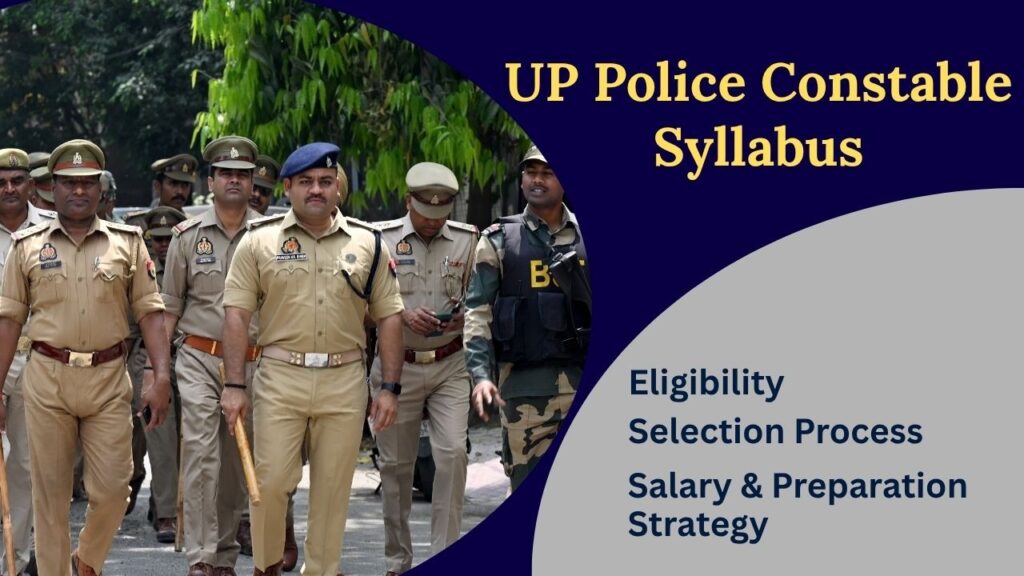
Getting a government job in India isn’t a cakewalk, and UP Police Constable exam is no exception to it. Every year, thousands of applicants vie for handful vacancies, which is making it one of the popular and toughest exams in the state. With a right approach toward UP Police Constable syllabus, and with persistent preparation, this target is of course achievable.
If you want to put on the khaki with pride or if you want a stable career with good salary and benefits, this exam could be your ticket. But these benefits asked you to work harder and get it. This breakdown—eligibility, selection process, syllabus, salary, and a practical preparation plan of UP Police Constable will help you plan to crack this exam.
Eligibility Requirement For UP Police Constable
You need to check eligibility requirements before buying books for studying UP Police Constable syllabus and doing push ups. UPPRPB is recruiting candidates for this post under strict guidelines. So you must follow before applying:
Educational Qualification
No fancy degrees are required for a UP Police Constable. Candidates must acquire 12th standard (Intermediate) marksheet from any recognized board in India.
Age Limit
Male Candidates (General)
18 to 25 years
Female Candidates (General)
18 to 28 years
Reserved category candidates can get age relaxation but you must check the latest recruitment official notification to know age relaxation.
Physical Standards (PST)
Category
UR/OBC/SC
ST
Height for Males
168 cm
160 cm
Chest for Males
79–84 cm
77–82 cm
Height for Females
152 cm
147 cm
Weight for Females
Minimum 40 kg
Minimum 40 kg
UPPRPB Selection Process For UP Police Constable
It’s not just one written exam here, you must pass all the stages to reach that position. It requires commitment and hard work for securing an honourable government job for the nation.
Stage 1: The Written Examination
It’s a written offline OMR-based exam. Candidates have to get above the cut off marks by answering all the MCQs accurately then you move on to the physical rounds. Questions come from the four main subjects (GK, Hindi, Mathematics, Reasoning).
Stage 2: Verify Docs And Physical Standard Test (PST)
Once you qualify stage 1 with preparation and hard work, you need to provide documents– 10th/12th mark sheets, caste certificates, domicile papers for verification. And your body measurements like height, weight and chest (men) will be taken to pass you on to the next stage of selection.
Stage 3: Physical Efficiency Test (PET)
PET is a mandatory exam for candidates without getting marks. This final round can throw you out of the list if you fail.
Running for a 4.8 km run in 25 minutes is a mandatory test for male candidates.
If you are a woman then you must be able to run 2.4 km in 14 minutes.
Stage 4: Detailed Medical Examination (DME)
Physical and mental health matters for this job, it has regulations if you have weak eyesight, color blindness, hearing, flat feet, knock knees.
UP Police Constable Syllabus Breakdown
The written test contains 150 questions which is of 300 marks (2 marks per question). But be careful, there’s negative marking!
The written exam is divided into four main subjects which you can qualify with right preparation on the syllabus.
I. General Knowledge (38 Questions)
Knowing about the world revolves around you, especially Uttar Pradesh is necessary. GK tests you based on the questions based on national and international current affairs, History/Civics, Geography, Science and Finance of India.
II. General Hindi (37 Questions)
If you attended a Hindi-medium school, this is your section to score. Even if you didn’t, you can get good marks by doing some basic grammar practice. Focus on Hindi Grammar (Vyakaran) , Unseen Passage, Famous writers & their work, Synonyms, Antonyms, Idioms and Phrases (Muhavare).
III. Numerical and Mental Ability (38 Questions)
Question comes from basic mathematics of 9th and 10th, if you are good at maths then practice daily on Number systems, Percentages, Profit & Loss, Ratio and Proportion, Simple & Compound Interest, Time, Work & Distance, Mensuration and Data Interpretation (Tables and Graphs).
IV. Mental Aptitude, IQ & Reasoning Ability (37 Questions)
This part examines your mind and thinking ability, and also tells you how you could potentially think in police work situations. Coding-decoding, Series, Blood Relation, Direction Sense, Syllogism, Venn Diagram, Non-Verbal (Pattern and Figure). There will also be situation based questions to test your attitude towards public interest, laws and order, communal harmony and police force.
How to Prepare For A Police Constable
Avoid beginning to study with difficult mock tests. Instead, strengthen your foundation with standard books like Lucent GK, R.S. Aggarwal (Math & Reasoning) and a good hindi grammar book.
Keep practicing last year’s question papers. They give you a clear idea about the exam level and the types of questions that are asked. UPPRPB also has a penchant for posing questions similar (even a same question sometimes) to what they had already asked.
Once you have completed about 60-70% of the syllabus, begin attempting full-length mock tests. Use a timer when you practice so you can work on your speed and accuracy. Check your mistakes to correct them each day.
Don’t neglect physical fitness. Most candidates qualify the written exam but they are unable to clear the 4.8 km run. Something as simple as a 30-minute jog each day will smoke out your stale lungs and build your stamina.
So, for the present events keep it simple. Just subscribe to a good monthly magazine (eg. the Economist) or a decent Youtube channel and don’t bother with the dailies.
Salary and Perks After Getting a Job
UP Police pays its constables quite a good salary with additional perks that makes it worth the struggle to secure a position.
Category
Amount
Pay Scale
Rs. 5,200 – 20,200
Grade Pay
Rs. 2,000
Basic Pay Matrix
Rs. 21,700
Under the 7th Pay Commission, the salary is distributed but other allowances also given to the constable which sum up to Rs. 27,000 to Rs. 32,000 per month.
Dearness Allowance (DA)
House Rent Allowance (HRA)
Travel Allowance (TA) & City Compensatory Allowance.
Ration Money & Uniform Allowance
Career Growth & Promotions
A government job is not just a job, it is a career for a lifetime. Joining as a Constable does not imply that you will retire with that rank. The UP Police is providing a transparent path for promotions along the years of services, departmental exams and your performance record.
Police Constable (Your starting point)
Senior Constable
Head Constable
Assistant Sub-Inspector (ASI)
Sub-Inspector (SI)
Inspector
If you have the ambition, you can appear for departmental exams for Sub-Inspector which will speed up your promotion rather than waiting wholly on seniority. An honest and sincere police officer can easily get retired as Inspector and in some rare cases even as DSP (Deputy Superintendent of Police) from the post of Constable with the blessing of the Almighty.
Passing the UP Police Constable exam is a challenge for mind and body. It needs a balanced approach, practicing math and checking daily news then getting up to run on the track.
Focus on UP Police Constable Syllabus and your health to secure your position. The large number of applicants is not to be discouraging. You just need to prepare yourself for one seat.
The salary and additional perks are good with lifetime growth opportunities in the department, so there’s a golden door, you just need to jump long.