Rajasthan Public Service Commission Recruitment 2025 has been announced for various posts such as Sub Inspector, Lecturer PGT Teacher, Sr Teacher TGT Teacher, Veterinary Officer, and Assistant Agriculture Engineer. You can download the notification for full details on these posts. Thetotal number of vacancies are 12,121, to apply you must fill the application online from the official website of RPSC.
The RRB RPF Sub-Inspector exam is considered as one of the toughest national level exam in India and it is conducted by Railway Recruitment Board under the Ministry of Railways. The exam is held to select eligible and committed candidates for the post of Sub Inspector in Railway Protection Force, a specialized security force which ensures the safety of railway passengers, railway premises, and vital rail components in every zone of Indian Railways.
RPF SI Recruitment is prestigious post and government job and it has good salary package, so, that is way it is most demanded exam in our country. The exam is conducted as computer based test (CBT) in 15 languages apart from English such as Hindi, Urdu, Tamil, Telugu, Kannada, Odia, Malayalam, Marathi, Gujarati, Bengali, Assamese, Punjabi, Manipuri and Konkani, for the convenience of candidates from all corners of the country.
Eligibility Rules for RPF Sub-Inspector
Will you be entitled for the RPF Exam or not? Those who fulfill the Railway Protection Force eligibility criteria can apply for this prestigious job.
Age Limit: The upper age is 28 years on 1st July of the year of recruitment and the lower is 20 years. However, various relaxations applicable for different categories is stated as below:
SC/ST
5 years
OBC
3 years
domiciled Candidates from J&K and LadakhOR Central Government employees
UR/EWS – 5 yearsOBC – 8 yearsSC/ST – 10 years
Widows
UR/EWS – 2 yearsOBC – 5 yearsSC/ST – 7 years
Educational Qualification: The candidate should possess a Bachelor’s Degree in any stream from a recognized university for RPF Sub-Inspector exam. The requirement of Graduation is in place to get a basic intellectual knowledge which is required to hold duties of administration and leadership in security services.
Nationality: You must be an Indian citizen for this recruitment.
Physical Fitness Standards: Basic eligibility does not specifically state this, nonetheless candidates have to be physically fit to meet with the standards laid down in the efficiency test and physical measurement which are critical to the selection procedure.
Posting choices are due to the candidates holding down their preferred location during the filling of the preference form as the posts are spread across multiple railway zones in India which include Eastern Railway, Southern Railway, RPSF (Railway Protection Special Force) and many other zones. Since candidates can opt for postings near their home state/region, this zonal arrangement makes the exam less inaccessible.
Exam Pattern and Question Distribution
The knowledge of exam pattern is needed for the strategic preparation. The RPF SI exam is a single level exam which is conducted in the form of an online computer-based test, having multiple choice questions, which is of 2 hours duration.
There are three sections in the RPF SI Exam:
General Awareness (50 Questions, 50 Marks): This section is an evaluation of your knowledge about Indian history, the Indian constitution, polity, geography, Indian economy, the general science, sports, current national and international events and also a few questions on current governments recently introduced. The questions test both your static and dynamic awareness or knowledge of current affairs.
Arithmetic (35 Questions, 35 Marks): The arithmetic section includes questions on number systems expansion, simplification by BODMAS rule, ratio and proportion, percentage, profitable loss, interest calculation on SI and CI, time and work question average time related queries and simple topic of algebra.
General Intelligence and Reasoning (35 Questions, 35 Marks): Assess your ability to think logistically and solve problems through verbal and non-verbal reasoning and General Intelligence via questions on Analogies, Classifications, Coding Decoding, Series Completion, Blood Relations, Directions, Logical Reasoning and Pattern Recognition.
To promote accuracy rather than the recklessness of wild guesses, each correct answer is awarded one mark, while for each wrong answer one-third of a mark is deducted. The exam is available in fifteen different Indian languages but most of the candidates opt either Hindi or English.
Topic-Wise Syllabus Breakdown
General Awareness Topics
Domestic and International news, political scenes, social conditions, notable events and progress, awards and accolades.
Indian history is divided into independence movements, ancient India, medieval India, modern India and significant historical personalities.
Indian Constitution: Sections and their significance, process of making amendments, rights to the individuals and guiding principles of state policy
Physical and Global geography, environmental concerns, and Indian geography basics.
General Science: All Physics, Chemistry and Biology topics for Class 10–12
Athletics, such as football, great players, artistic genres, music, dance, literary, performing arts performances sport and culture.
Arithmetic Topics
Number system: prime and composite numbers, divisibility, whole numbers, and HCF, and LCM
Simplification: BODMAS rule application, square roots, decimals, and fractions
Ratio and Proportion: Sharing issues, partnerships, direct and indirect proportion, and mixtures
Percentage: Simple percentage calculations, percentage increase or decrease
Cost price, selling price, profit and loss, discount and percentage of profit and loss
Simple and compound interest: applications of principal, rate and time, and formulae
Time and Work: Pipe and cistern problems, work and work efficiency, work with wages
Average: Weighted averages, age-related averages, and averages formulas
Algebra: Basics of algebraic expressions and linear equations
General Intelligence and Reasoning Topics
Analogies: Finding relationships between word pairs
Classification: Categorizing similar items and identifying the odd one out
Coding- Decoding: Decoding the pattern of coded messages
Finding pattern in numerical or alphabetic series is called Completion of series.Blood Relations: Understanding family relationships
Directions: Solving puzzles on directions
Logical Reasoning: Understanding the statement and making the argument
Finding unseen patterns in logical or visual series
Selection Process For RPF Sub-Inspector
RPF SI Selection Process is the multi-level RPF SI selection process that aims to assess the candidates on various parameters. Understanding all stages enable you to be prepared in every possible way.
Computer-Based Test (CBT) at Stage 1: The initial challenge is a 90-minute pen and paper test consisting of 120 questions. A high score is required to advance to the second stage, as this round finishes off a large number of applicants.
Stage 2: The candidates who clear the CBT are called for the Physical Efficiency Test (PET) and Physical Measurement Test (PMT). The PMT is a measurement of height and chest for male applicants, and height for female applicants. The Physical Efficiency Test examines physical stamina by way of demanding routines.
Stage 3Document Verification (DV): The PET/PMT qualified candidates are called for the document verification. At this stage, the information provided by the candidates is matched with the original educational certificates, caste certificate and identity proofs.
Stage 4 involves a complete Medical Examination by CAPF/Govt. Your medical examination confirms that you have the physical ability to do your demanding job.
Salary and Job Benefits
The RPF Sub-Inspector post is attractive for various reasons like good income, stable government job and good facility.
Salary Structure
The 7th CPC has fixed the minimum pay for RPF SI as Rs 35,400 per month with a grade pay of Rs 4,200. Yet the net pay, after subsidy and deductions, is Rs. 43,000 and Rs. 54,162 per month.
Additional Allowances and Benefits
Medical Facilities: Comprehensive coverage for the healthcare of you and your family
Travel and Transfer Allowance: Assistance with relocating and traveling for work
Pass and Privilege Ticket Orders: Discount train travel for you and your family
Education Support: Support for your children’s education
Provident Fund (PF): A provident fund is a savings cum retirement benefit scheme available to all salaried classes of individuals
Gratuity: Lumpsum on exit
Application Fee and Where To Apply
The fee structure is designed keeping in mind everyone and also in compliance with the government norms. Rs 500 as the fee for General, OBC, and EWS candidates. SC, ST, PH ( hearing impaired) candidates and all women candidates are required to pay only Rs.250.
You do the entire application online at the RRB site (rpf.indianrailways.gov.in). This allows you to apply from anywhere in India.
Preparation Tips and Strategy
Success in RPF SI exam requires a solid study plan along with theoretical knowledge and that of practicing. Candidates must focus on the General Awareness section by keeping them updated with current affairs on a monthly basis, practice regular mock test for improving accuracy, and to be able to perform in a limited time. The sensible marking scheme and relatively small extent of syllabus make this test attainable with concentrated 4-6 months of preparation.
Conclusion
The RPF SI exam provides a golden opportunity to all the educated candidates to get a respectable government job. It means steady work, good pay and a major part in keeping the nation safe. Determination, good Study material and regular Practice can make your Dream of becoming RPF Sub-Inspector into Reality.
RRB NTPC 2026 short notice comes along with an opening of 5,165 Non-Technical Popular Categories posts. But the exact dates will be released after the official notification release. The Railway Recruitment Board announced both Graduate and Undergraduate levels posts. RRB NTPC 2026 Online Form will start on 15 October 2026.
That detailed PDF, which will spell out final eligibility, exam pattern, and post-wise zone allocation, is scheduled for 7 October 2026 for Graduate posts and 14 October 2026 for Undergraduate posts. Until those land, treat today’s numbers as reliable but not final — RRB has occasionally revised vacancy counts and dates through corrigenda in past cycles.
Important Dates of RRB NTPC 2026
Event
Graduate Level (CEN 06/2026)
Undergraduate Level (CEN 07/2026)
Indicative / Short Notification Release
21–26 September 2026
21–26 September 2026
Detailed Notification PDF
7 October 2026 (tentative)
To be notified
Online Application Start
8 October 2026
15 October 2026
Last Date to Apply Online
6 November 2026 (23:59 hrs)
13 November 2026 (23:59 hrs)
Last Date for Application Fee Payment
8 November 2026 (as per short notice)
To be notified
Application Correction Window
To be notified
To be notified
CBT-1 Exam Dates
To be announced
To be announced
CBT-2 / Further Stages
To be announced
To be announced
Age Calculation Cut-off Date
1 January 2027 (as per notice)
1 January 2027 (as per notice)
RRB NTPC Graduate 2026 (CEN 06/2026)
RRB NTPC Graduate 2026 is offering 3,477 seats this year, covering posts like Station Master, Goods Train Manager, Chief Supervisor. Typing is also required if the job is Junior Accounts Assistant cum Typist, and Senior Clerk cum Typist but they all sit under the Pay Level 5 and 6 of the 7th CPC matrix.
Online applications open on 8 October 2026 and most sources have the window closing on 6 November 2026 at 11:59 PM, though a couple of reports list 11 November — worth confirming against the detailed CEN once it drops, since a five-day gap matters if you’re planning document uploads around a tight schedule.
For context, the last Graduate cycle (CEN 06/2025) pulled in over 58 lakh applications for 5,810 posts. This year’s pool is smaller — 3,477 against that backdrop — so competition per seat is realistically going to be tighter, not looser.
RRB NTPC Undergraduate posts (which require only a Class 12 pass) opens for 1,688 vacancies. The posts candidates will get are Commercial cum Ticket Clerk, Accounts Clerk cum Typist, Junior Clerk cum Typist, and Trains Clerk which falls under Pay Level 2 and 3.
Applications open on 15 October 2026 after a week of graduate level window — and close on 13 November 2026. Age for UG applicants is being cited as 18 to 30 years, calculated as on 1 January 2027, though this too should be treated as tentative until the detailed notification confirms it.
Eligibility For NTPC UG and Graduate Candidates
Graduate posts need a bachelor’s degree from a recognised university; a couple of roles, like JAA and Senior Clerk cum Typist, additionally require typing proficiency in English or Hindi.
UG posts need a 12th pass certificate from a recognised board — no further qualification required at entry.
On nationality, RRB accepts Indian citizens, subjects of Nepal and Bhutan, and Tibetan refugees who settled in India before 1 January 1962, along with a few other categories that need a government eligibility certificate before applying.
One thing last cycle’s notification did that’s worth watching for again: RRB gave Graduate-level candidates a one-time age relaxation, pushing the upper limit from 33 to 36. Whether that repeats for CEN 06/2026 isn’t confirmed yet — it’s the kind of detail that changes who’s even eligible to apply, so don’t finalize your own age-limit calculation until the detailed PDF is out.
Selection Process
Both levels follow the same broad structure: a First Stage CBT, a Second Stage CBT, a Typing Skill Test or Computer-Based Aptitude Test where the post requires it, and finally document verification with a medical exam.
The first-stage CBT typically runs 90 minutes covering General Awareness, Mathematics, and General Intelligence & Reasoning, with a one-third negative mark for each wrong answer — that penalty structure alone is why guessing blind on NTPC papers tends to backfire more than it helps.
Based on RRB’s standard structure across recent cycles, expect ₹500 for General and OBC candidates and ₹250 for SC/ST/PwBD/women/ex-servicemen/EBC candidates, with a partial refund issued to those who actually appear for CBT-1.
Confirm the exact figure once the detailed CEN is published, since fee structures are one of the few things RRB does occasionally tweak between cycles.
How to Apply For RRB NTPC 2026 Online Form
Applications go through the official RRB portal at rrbapply.gov.in — not through any single national link, since each of the RRB zones runs its own regional application window.
You’ll register with basic details, upload your photograph, signature, and required documents in RRB’s specified format.
Pay the fee online, and submit before the deadline for your category.
Save your registration number; you’ll need it for every step afterward, including admit card download.
One Preparation Move Worth Making Now
Don’t wait for the detailed notification to start preparing — the CBT-1 syllabus for NTPC has stayed structurally consistent across cycles, so pull last year’s CEN 06/2025 CBT-1 question pattern and start timed practice sets on Mathematics and Reasoning now. Those two sections are where most candidates lose time, not marks, and three extra weeks of practice before the form even opens is three weeks your competition isn’t using.
The detailed notification will settle the open questions — final age limits, exact fee, zone-wise vacancy splits. Don’t wait for that, get ready your official documents including educational certificates, ID, cast certificate, and photo so your time doesn’t waste when the application opens.
RRB NTPC 2026 brings 5,165 Graduate and Undergraduate vacancies, with applications starting in October. Since some details are still subject to the detailed notification, candidates should keep their documents ready and begin CBT preparation now rather than waiting for the final dates.
Get ready to secure a UPSSSC Lower PCS job to enjoy purposeful life in Uttar Pradesh. UPSSSC UP Combined Lower Subordinate Services (Graduate Level) recruitment is live right now, you can fill the application now. But you must understand each phase of selection, eligibility and preparation to pass the exam.
With 2,285 vacancies up for grabs, this is one of the biggest opportunities of the year for graduates looking to secure a Group ‘C’ administrative foothold in the state.
What is UPSSSC Lower Subordinate Services? (Job Profile)
The Lower Subordinate Services recruitment fills different positions in state government offices. There are most common job roles such as executive, supervisory, and auditing that require candidates who can immediately step into the work to handle public services, implementing government schemes, and making sure rules and policies are followed properly.
The roles are just simple desk jobs, they offer executive authority to tackle every task. Depending on your qualification and ranking, you could land any of these roles:
Executive Officer (Municipal Administration): Manages urban local bodies, public civic amenities, and local revenue collection.
Mandi Supervisor / Amin: Oversees agricultural market regulations, auction fair play, and revenue reporting for the Mandi Parishad.
Assistant Consolidation Officer (Chakbandi): Resolves land disputes, manages agricultural land redistribution, and maintains accurate land maps.
Who Can Apply? (Eligibility Criteria)
Before you hit apply, ensure you tick all the structural requirements set by the UPSSSC:
Educational Qualification
Mandatory Foundation: You must hold a Bachelor’s Degree from a recognized Indian university.
The PET Gateway: The Main exam needs a valid PET scorecard otherwise they will not let you enter in the exam hall.
Post-Specific Extras:
For Auditor/Accountant: You must hold a B.Com degree.
For Mandi Supervisor: Degree in Agriculture, Commerce, or Economics with a minimum of 50% marks.
Executive Officer: A computer ‘O’ Level diploma is required for service confirmation.
Age Limit (As of July 1, 2026)
Minimum
21 years
Maximum
40 years.
Age relaxation given to reserved categories ( OBC, SC, ST, )and Ex-Servicemen
Important Dates & How to Apply
The application window is brief, so do not leave things to the final day when servers traditionally crawl to a halt.
Application Starts
29/May/2026
Last Date to Apply
18/June/2026
Correction Window Last Date
25/June/2026
Admit Card
Update Later
Step-by-Step Application Process
The Commission relies heavily on your existing PET data to make authentication seamless:
Authentication via PET: Go to the official portal at upsssc.gov.in. Use your PET-2025 Registration Number to login for UPSSSC Lower PCS.
Check Details: Information about your qualification, photograph, caste category are automatically filled from the PET database. Verify everything carefully and fill out any pending post-specific preferences.
Submit Processing Fees: Pay the standard online processing fee of ₹25 for all categories via net banking, UPI, or credit/Debit cards. Note: Shortlisted candidates will pay the structural Main Exam fee later.
Final Printout: Review your final application form, submit it, and download/print the confirmation form for verification rounds.
Vacancy Matrix (2,285 Posts)
The vacancies span several state departments, providing brilliant diversity in career paths. Here is how the open positions look across major segments:
Department / Board
Post Name
Vacancies
Directorate of Treasury, UP
Assistant Treasury Accountant
548
Cooperative Societies & Panchayat
Accounts Inspector / Auditor
419
State Agriculture Mandi Parishad
Amin / Auctioneer / Clerk
552
Municipal Administration Directorate
Executive Officer
238
Office of Consolidation Commissioner
Assistant Consolidation Officer
168
Other Allied Departments
Technical Assistants / Supervisors
360
Selection Process & Exam Pattern
Getting selected requires navigating a clear, objective framework. There are no interviews for these Group ‘C’ cadres. Your merit relies entirely on written execution.
Step 1: Get UPSSSC PET 2025 Scorecard first
Step 2: Give Main exam and secure good marks
Step 3: Document Verification to check all the information is valid in your application.
The Exam Blueprint
Prepare yourself with understanding the topics that are important in this exam, Lower PCS exam pattern includes:
General Intelligence & Reasoning: to test your logic ability and analytical thinking.
General Knowledge (GK): knowing about your Uttar Pradesh is important to handle any work regarding the state. So increase knowledge in Indian History, Geography, Polity, Economy, and Uttar Pradesh’s History, Administration, and Culture.
General Science & Arithmetic: basic level physics, chemistry, biology, and math.
General Hindi: Focuses on comprehensive reading, letter writing, grammar (Sandhi, Samas, Muhavare), and vocabulary translation.
Strategic Preparation Plan
The competition is high so you have to make a plan that helps you achieve good scores over fractions of marks. Here is a realistic roadmap:
Own the UP Specific Section: Knowledge of the state will let you secure 20-25% of GK questions. Research and keep updated with Uttar Pradesh’s budget, schemes, geography, and cultural folklore. Dedicate solid hours to local current affairs.
Do Not Avoid Hindi: General Hindi is highly scoring. Mastering basic grammar rules and practicing official letter formats can drastically push your score above average cut-offs.
Analyze Mock Tests Weekly: Build your speed and precision. Track where you lose marks to negative scoring and adjust your accuracy levels accordingly.
Let’s talk about the rewards. Apart from massive social prestige, these positions offer financial stability governed by the 7th Pay Commission.
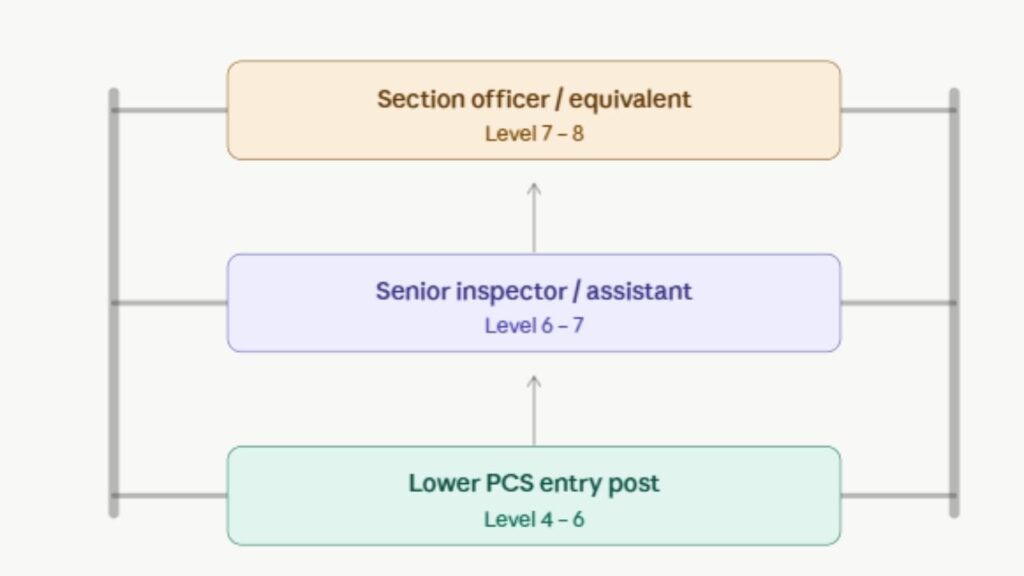
The salary of Uttar Pradesh. Combined Lower Subordinate Services (Graduate Level) are based on their job profile and experience but it ranges between Pay Level 4 to Level 6.
Level 4 (Clerks/Typists)
₹25,500 – ₹81,100
Level 5 (Accountants/Amin)
₹29,200 – ₹92,300
Level 6 (Executive Officers/ACO)
₹35,400 – ₹1,12,400
In-Hand salary will increase because of the multi allowance you will get once you are assigned to your job. So the entry-level gross salaries range from ₹35,000 to ₹55,000 per month depending on city tiers.
The Promotion Ladder
Your career trajectory doesn’t stall. Junior officers systematically advance through departmental reviews and service experience:
Conclusion
The UPSSSC UP Combined Lower Subordinate Services (Graduate Level) Recruitment is a cycle that ends in a few days and you need to fill the form if you don’t want to miss this opportunity to secure a career in Uttar Pradesh. The competition is very high for the 2,285 seats, so the right strategy to prepare for the exam is mandatory.
Ensure your application goes through successfully before June 18, lock down your study desk, and start structured preparation today. For a comprehensive breakdown of the syllabus, safe score metrics, and targeted departmental tactics, check out this detailed UPSSSC Lower PCS Strategy Guide which covers exactly how to maximize your score in the Mains exam.
TheBoard of Technical Education Uttar Pradesh has released the 2025 result for the even-semester examination which was held between May–June 2025. Candidates who are present in this exam can check the BTEUP Result 2025. Go to the official website to download your scorecard or go through the direct link for the main exam result 2025 mentioned in the article.
Students must know their registration number and date of birth to enter on the login page. After logging, your result will be shown. Candidates can also visit the login page with a direct result link.
Go to the official website of BTEUP.
BETUP Result 2025 will be displayed on the homepage of the website.
Click on it and enter your necessary details.
Submit the details to log in to your account.
The result will be shown on the screen, and you can download and save it on your device.
Candidate’s Name, Roll Number, Exam Name & Centre, Marks Total & Obtained, Percentage, Result Status. Candidates must have entered the correct details to get their results.
On November 26, 2025, the BSEB Bihar DElEd Result 2025 was formally announced by the authority. Candidates who filled the applications in a period from January 11, 2025, to February 5, 2025 can check their result for Bihar D.El.Ed 2025 from the link given below. You need the date of birth and roll number to access the scorecard. Now the result is here of those applicants, so visit the official website to download the scorecard and check merit list/cut off marks or copy the link given below & paste it in the new tab of the window.
Application Start Date
11/January/2025
Application Last Date
05/February/2025
Fee Payment Last Date
06/February/2025
Correction Date
13 —- 17 May/2025
Exam Date
26/August/2025
Answer Key Date
11 —- 13/October/2025
Result Date
26/November/2025
Eligibility & Application Fee Key Details For BSEB DElEd
The two-year Bihar DElEd course is open to the candidates who have passed 12th standard or an equivalent examination from a recognized board or institution in India. Candidates who are above 17 years old can apply and there is no age limit.
Reserved category candidates are required to pay ₹760, and those belonging to the General/OBC/EWS categories are required to pay ₹960. It is advised to read BSEB Bihar DElEd Exam Notification 2025 for full fledged details.
The result of the diploma is on The Bihar School Examination Board (BSEB) Patna official website. For the marks print out you need to kindly follow these steps:
1. Go to the official website which is mentioned in the below section.
2. Link with naming “BSEB Bihar DElEd Result 2025” is posted, you can find and click on it.
3. Fill in the roll number/ application number and date of birth.
4. Press the “Submit” button.
5. Now BSEB Bihar DElEd Result 2025 will be appeared on your screens.
6. Download and take a printout of your scorecard or keep it for future reference.
Make sure to have all the necessary credentials in order to make the process hassle-free.