Delhi Police Vacancy 2025: Apply Online for 7565 Constable Posts

Staff Selection Commission is recruiting candidates for filling out the Delhi police vacancy 2025. This organization officially announced the recruitment process and the official notification is also released for the candidates to check every detail regarding the post or online application. There are a total of 7565 positions vacant for this post, candidates can apply for this till 21 October 2025. You can find the direct link for the application in the article. 

Delhi Police Vacancy 2025 Short details

OrganizationStaff Selection Commission
Exam NameDelhi Police Constable
PostConstable 
VacanciesFemale: 2496, Male: 5069Total: 7565
Online Application Date22 September – 21 October 2025
SalaryRs. 21,700 – Rs. 69,100/-
Official websiteClick Here

Dates to Remember for delhi police vacancy 2025

Notification release22 September 2025
Application Starts on22 September 2025
Application Ends on21 October 2025 
Online fee submission22 October 2025
Correction Date29–31 October 2025
Admit Card Update Soon
Exam DateUpdate Soon

How to apply for Delhi Police Constable

Candidates who are applying for the Delhi police vacancy 2025 could meet the eligibility criteria for this position. Must apply for this position before the last day of registration or else he or she will not be able to apply anymore.

Follow these steps to apply online:

  1. Visit Delhi police official website which is mentioned in the article.
  2. After visiting the official page, search for the New Registration option to click.
  3. Once you click that, the box will appear on your screen.
  4. Fill them with your correct information and carefully check again.
  5. After registration, you can login with your registration number and password, then you can fill out the application form for delhi police vacancy 2025
  6. Preview the form before the final submit and download the copy for reference.

Read More 👉 IBPO PO Preliminary Examination Result Out Soon – Check 2025 Updates

Eligibility for delhi police vacancy 2025

Educational Qualification10+2 passed with a proven marksheet from a recognised board. 
Age limitMaximum: 25 yearsMinimum: 18 years
Age relaxationCheck the official notification for age relaxation to reserved category.
Quick Links 
Notification DownloadClick Here
Application Online Click Here
Official WebsiteClick Here

Leave a Comment

Your email address will not be published. Required fields are marked *

UPSSSC Agriculture Technical Assistant Preparation: Complete Guide to Cracking AGTA Exam

UPSSSC Agriculture Technical Assistant preparation

If you are an agriculture graduate from UP and want to grab a secure government job, then UPSSSC Agriculture Technical Assistant Preparation is crucial to get this golden opportunities. With 3,446 posts announced recently in the recruitments, this Group-C job with the Department of Agriculture not only offers you secure job in India’s largest state but also a meaningful work in serving the farmers of the state.

But here is the reality check: clearing this exam is not just about being B.Sc. The competition is stiff, the syllabus is vast and the exam pattern itself has some quirks that can take you by surprise. Having reviewed the new notification and strategies adopted by the successful candidates, I have tried to make this guide exhaustive to help you in your preparation journey. 

Are You Qualified?

You must fulfill the UPSSSC Eligibility Criteria to apply for the UPSSSC. As on the date of notification, your age should be 21 years to 40 years. But the SC/ST/OBC candidates are allowed to get the relaxation on age as per the rule of the state government. Applications received from ineligible candidate(s) will be rejected, so check your eligibility before applying. 

Degree: Graduation in the Agricultural field is required as your knowledge is beneficial for a job. It must come from a recognized university or college.

List of course are good choice for your degree:

  • B.Sc. (Hons.) Agriculture
  • B.Sc. Horticulture / B.Sc. (Hons.) Horticulture
  • B.Sc. Forestry / B.Sc. (Hons.) Forestry
  • B.Tech (Agriculture Engineering)
  • B.Sc. (Hons.) Science from a University of Agriculture and Technology

The PET catch: Since 2022, UPSSSC has made the UP Preliminary Eligibility Test (PET) mandatory for every candidate to pass this exam with required score then applying for any main exam of AGTA.

Exam Pattern Decoded

There are no multiple phases for the AGTA, you just have to clear this one and the powerful UPSSSC Agriculture Technical Assistant recruitment exam with document verification and grab your chance for a government job. 

  • Total Questions: 100 objective-type MCQs
  • Total Marks: 100 
  • 1 Question = 1 Mark
  • Duration: 2 hours 
  • For incorrect answer, ¼ mark will be deduct

This marking system indicates that you need accuracy in your answer rather than attempting.

Subject-wise Distribution

SubjectQuestionsMarks
Crop Science2525
Biotechnology, Plant Breeding & Crop Physiology1010
Soil & Water Conservation1515
Agriculture Extension55
Agriculture Economics & Schemes55
Dairy & Animal Husbandry55
Computer Concepts & IT1515
General Information of Uttar Pradesh2020
TOTAL100100

What You Actually Need to Study

Part 1: Core Agriculture (65 Marks)

Crop Science involves the Study of various cereals, pulses, and oilseeds and also covers modern agricultural practices such as integrated, natural and organic farming. So you have to know about seed production, about pest management, about post-harvest technology and storage systems. Let’s get real—what is a field officer going to tell farmers?

Biotechnology & Plant Breeding covers Genetics Concepts, Photophosphorylation, Respiration, and Plant Metabolism. ISE don’t memorize definitions; actually understand what biotechnology is and how it works, and how it’s used in agriculture now.

Soil & Water Conservation involves Master soil properties, erosion control, fertilizer classification, irrigation, and watershed management.. I think the 15 questions are generally easy if you have your basics clear.

Agriculture Extension covers rural development concepts, farmer’s schemes issued by the Government, and training methods. This ties right into what you’re doing in your future job.

Agricultural Economics has MBA contents such as MSP (Minimum Support Price) of various Crops, Agriculture commodities trading, import-export strategies and UP’s One Trillion Economy plan. Be a regular user of agri policies.

Dairy & Animal Husbandry includes a lot of practical training but what’s the right way to do Animal Breeds, Feed management, Milk production, Poultry farming, Diseases management. Even if you were a crop science major, don’t sleep on this 5-mark question. 

Part 2: Computer and IT (15 Marks)

This isn’t just basic computer know-how anymore. The syllabus cover crucial IT related questions which means you need study hard:

  • It involves from Hardware, software and operating system to MS Word and MS Excel operations
  • Internet Protocol and Email Management
  • Digital financial instruments and e-Governance
  • New technologies – AI, Machine Learning, Big Data, IOT and India’s IT feats

You don’t have to think that new technologies are not needed, the first rule for the tech engineer is opting for new technologies every year. So, AI and Machine Learning are now part of an agriculture exam. The UPSSSC needs officers with a flair for technology who can put traditional farming together with digital India. 

Part 3: UP General Knowledge of 20 marks

To succeed in this field, one should have deep knowledge of history, culture, art and architecture of Uttar Pradesh. A good understanding of its physical geography with its climatic differences, soil groups, forest, wild life and mineral resources, will be found helpful. 

Also, a good knowledge of the state economy in terms of agriculture, industry and commercial conditions is essential. Keeping abreast with the day’s news and the work of the state government you shall further enrich yourself and make yourself even more capable. 

Selection Process

After clarifying the written test, candidates need to verify their documents (ID, Marksheets, DOB certificate, etc). The written test passing score is depending on your category. Final merit list will be made upon these scores not on interview as there is no interview.

UPSSSC Agriculture Technical Assistant Preparation Strategy

Crop Science and Soil Science is a very important part as they hold maximum marks in the exam. So, prepare well with understanding, not rote learning. BSc notes and NCERT agriculture textbooks are very helpful as resources for your study.

  • After clearing your basics, dive deeper with “A Textbook of Agricultural Field Crops” by V. Venkataraman to prepare for the Crop Science subject. 
  • And “Soil Science” by D.K. Das is a perfect option for Soil Science.
  • Many students recommended “Uttar Pradesh General Knowledge” by Dr. C.L. Khanna for increasing UP knowledge.
  • Try Youtube or free resources online to learn about Computers assets and other new techs related to the agriculture field.

The last Months 4-6 is given for the Practice & Revision of previous year papers for making a speed to solve fast in the exam. Weekly mock tests are best for your preparations. Everything is available on the internet, so do not stress about the resources. To avoid mark deduction, master to Maintain an error log.

Read More:- BSNL Recruitment 2026: Apply Online for 120 SET Vacancies, Eligibility & Full Details

What Makes This Exam Challenging?

There is a strategy and of course general scoring strategies are applicable too that candidates must follow to win in this agriculture based exams. What several candidates tend to miss is the fact there are non-agricultural parts like Computer (15 marks) and UP GK (20 marks), which have a big weightage of marks. Disregarding these can drastically hit your overall results.

How to approach the Stage II exams, Time Management is very helpful for Effective preparation. Although two hours is more than enough time, candidates often find themselves stuck on difficult questions, for instance in biotechnology, with not enough time left at the end to tackle items such as UP GK. so that way you can avoid that.

Also, academic knowledge from one’s degree is no place to rely on. The focus is not on theoretical understanding, but on practical application and problem-solving at field level. 

Before you start preparing for the AGTA exam, you must be aware that you must meet all the eligibility requirements (like qualifying the PET) for the same. Non-compliance of such requisites may result in jeopardizing a candidate’s whole preparation and risk that nothing has been achieved in all those years toiling. A complete scan of the eligibility dates is hence highly recommended to avoid any last minute surprises. 

Conclusion

The UPSSSC Agriculture Technical Assistant is one such post which will help in this regard. The active UPSSSC Agriculture Technical Assistant Recruitment 2026 Advertisement is a good opportunity for the job seekers. You should go for 6-8 Months UPSSSC Agriculture Technical Assistant Preparation to increase your chances of selection and should Follow the Syllabus Strictly. Your position on the merit list can be decided by the marks obtained. Get started on your preparation now with full dedication and consistency to get success in this very competitive selection. 

Leave a Comment

Your email address will not be published. Required fields are marked *

Best Books & Online Resources for Banking Exam Preparation 2025

The preparation of banking exams starts with the best books banking exam because it is a hard task and at the same time interesting for the aspirants who want to establish their career in the finance domain. Every year 1 lakhs plus aspirants appear for these competitive exams like IBPS, SBI, RBI and other banking exams at state level. What can you do to give yourself the best chance to succeed among such fierce competition? 

What Started Out as a 100% Prep for the 2025 Exam Has Now Evolved Into a Prep with Traditional Materials and a Little Bit of Technology of the Digital Age.. If you are seeking professional-endorsed textbooks or want to enjoy online courses, apps for mobile or interactive, view these product selections loaded with high quality. 

The banking exams are considered to be the toughest competitive exam in India. The way to success is to choose the right study books and make use of the good online study materials. Here is a complete list of the best books and online resources that you can use to enhance your chances of success in banking exams 2025.

Essential Books for Banking Exam Preparation

Quantitative Aptitude & Data Interpretation

R.S. Aggarwal’s “Quantitative Aptitude for Competitive Examinations” is the only quantitative exam preparation guidebook for competitive exam preparation. This all-inclusive book comprises all the basic topics from arithmetic, algebra, geometry and data interpretation along with a plethora of practice problems with their solutions and explanations. The updated 2025 edition features more than 10,000 practice questions and 40 video lessons.

Rajesh Verma’s “Fast Track Objective Arithmetic” is a very good book for shortcuts and tricks which are very important for time limited banking exams. The strength of the book is based on tricks and shortcuts which have vital importance in success in competitive exam.

Arihant’s “Data Interpretation & Data Sufficiency” also ensures depth preparation for the techniques to solve DIs based on Pie charts, Bar charts, Line charts, Caselets. This approach is more result-oriented and can help candidates to perform better in or break this one of the highest scoring sections of banking exams. 

English Language

S.P. Bakshi “Objective General English” is a step by step guide to grammar and comprehension which help the students to understand the way of writing and based on that How to use. This is the most appreciated and recommended book for the topic Sentence Correction and Reading Comprehension.

“Word Power Made Easy” – Norman Lewis is Still the Best Vocab Builder. A Quick Review of. Its drill-and-kill approach to vocabulary building will help anyone crushing banking exams.

High School English Grammar and comprehension. Wren and Martin This book contains basic grammar which is needed for the banking exam. This classic text strengthens and solidifies essential grammatical principles, both simple and complex, that serve as the foundation of English language mastery. 

Reasoning Ability

R.S. Aggarwal’s A Modern Approach To Verbal & Non-Verbal Reasoning is a very good book which covers the whole verbal and non verbal reasoning topics in depth with good number of questions. This complete coverage of the book allows you to attempt all kinds of reasoning question in the banking exams.

M.K. Pandey’s “Analytical Reasoning” is all about analytical reasoning with detailed solutions and higher order problems. This book is great for most challenging puzzles and most difficult seating arrangements.

Kiran Prakashann Reasoning Books comprises of topic wise syllabus specifically for banking exams with solutions which are easy to understand and tricks to save the time in solving. 

Banking Awareness & General Knowledge

“Banking Awareness” published by Arihant is the best book to study from for the section of banking awareness, it covers all the topics related to banking, financial awareness and general current affairs. The revised edition 2025 includes Union Budget 2025-26 and Economic Survey 2024-25 and is very useful for today’s exam patterns.

Now “Banking Awareness” by Disha Experts is all new revised content with solutions of previous years’ questions. This book is written specifically for the banking exams with live examples of the banking sector.

The latest national and international affairs are like annotated with his General Knowledge Books Manohar Pandey. These books will enable the aspirants to keep pace with the fast-moving current affairs. 

Read More 👉 Top BCA Colleges in Noida with Fees, Courses & Admission Details 2025

Online Resources for Banking Exam Preparation

Mock Test Platforms

Testbook provides a complete mock test series including thousands of tests for different types of banking examinations. Their platform consists of a wealth of information with analysis of performance, tests for each section and simulations with unlimited tries possible along with guidance of professionals.

Oliveboard powers analytics using AI and enables adaptive learning on their mock test platform. The exam style tests are meticulously prepared for the candidates to practice with simulated environment to enhance their speed, accuracy and confidence.

PracticeMock provides candidates with the opportunity to practice with a series of full-length and section-wise tests, each simulating the actual test with explanations and other features to assist you in your preparation for the exam. 

Video Learning Platforms

Adda247 is the most sought after Indian government exam preparation platform with more than 9 million subscribers on Youtube. They provide well-structured courses, live classes, class recordings and all subject study materials for banking exams.

Unacademy lets you study from the best teachers in India and courses for various languages. Their platform features live and recorded classes and provides very good explanations and a detailed coverage of banking exam syllabus.

Physics Wallah (PW) has dedicated courses for banking – IBPS, SBI, RBI, and NABARD with live classes, video lectures, mock tests, and study materials.Their Bank Mahapack caters to 20+ exams comprising of 100+ batches and 2000+ live classes. 

Free Online Resources

Youtube has offered a wider range of tutorials on Banking Exam Preparations. Students can start preparing for free with a good internet connection and dedication. Some of the most popular tutorials are — Saurav Sir from Adda247,  Ashish Arora from Studified, BE BANKER, Bankers Point and BANKERS BUDDY cover everything about banking exam preparation through free video content. These channels give you live session regularly concept explanation and current affairs.

Free Mock Tests and PDFs

Download PDFs and take daily mock tests for free from Smartkeeda & Cracku. IIKD Online is offering free coaching classes for the students through more than 200 video lectures, 20+ mock tests and 5,000+ practice questions. 

Conclusions

Succeeding in a banking exam is not a cup of tea, it requires a lot of hard work but not just hard work as strategizing is also very important. The best books banking exam and online resources featured in this article will provide a comprehensive base material for your study process starting from conceptual clarity to timed practice.

Select your study material carefully according to the exam you want to take – IBPS, SBI, RBI and so on, and what learning mode works best for you. Take the best of traditional reading and the best of technology and you can’t go far wrong.

Remember: Consistency + Quality = Success

With a seemingly right mindset and study plan, your dream for banking exam in 2025 is definitely achievable. 

Leave a Comment

Your email address will not be published. Required fields are marked *

Meet the Best Current Affairs Teacher for SSC CGL Who Can Boost Your Score

For the students preparing for the SSC CGL exam, the Current Affair section is important to cover up. Many students think that it is an easy section and it will get your score with a little preparation and strategy. These Best Current Affairs Teachers for SSC CGL will help you make every update remember their context. 

They’re not only helping you in keeping updated but they also gave you SSC CGL relevant current events which can come in the exam. Check news daily, read newspaper or e-news, follow social media news channels, read magazines and make revision for each topic.

Previous year papers might be not helpful so try mock quizzes and practice questions daily. These teachers have also shared a lot of MCQs, you can try and improve your speed and accuracy.

You better be consistent through your preparation, otherwise it won’t be helpful if you forgot everything you learn.

Gaurav Sir (Adda247)

Gaurav Sir (Adda247) best current affairs teacher for SSC CGL preparation

Gaurav Sir is known for his ability of connecting current events to static GK which help students to memorize everything. He encouraged a comprehensive understanding of current events rather than just rote memorization. His engaging and interactive teaching style involves deep explanations and real-life examples to elaborate concepts that help understanding complex topics easily.

Ideal for those students who want to understand the “why” behind the news. Gaurav Sir will help you to understand every topic beyond the headline. He is teaching serious topics in a friendly way that will be remembered by every student with a deep understanding of context. He also provides revision classes to keep tracking the previous sessions.

Richa Sharma (Parcham Classes)

Richa Sharma is best to help SSC aspirants for concise and exam-oriented preparation. Richa Ma’am’s teaching style is clear and structured which helps every student to understand current events that are relevant to SSC CGl. She specifically makes point-to-point notes for easy memorization and applies other techniques such as mnemonics to help in revision.

Richa Sharma (Parcham Classes) best current affairs teacher for SSC CGL

She is best for those students who prefer to prepare the current affair section with less time & efforts. It’s hard for many students to remember dates, names, and numbers. Richa Ma’am fits them because she uses simple flowcharts and bullet points to simplify the topic. You can easily remember them and cover all the topics within a short period of time.

Bhunesh Sharma (Class24)

Bhunesh Sharma is experienced and popular for his lucid explanation which helps to understand complex topics of current affairs easily. He uses visuals and diagrams in its teaching to memorize every concept. Most importantly, it’s easily available for every student who is preparing for the SSC CGL Exam. 

Bhunesh Sharma (Class24) best current affairs teacher for SSC CGL

If you have a problem in understanding current affairs then Bhunesh Sir is best, he simplifies every topic with his friendly teaching style. Be ready for the In=depth analysis on a complex topic which can help you understand its core reasons, making you able to solve every question confidently.

Gaurav Maurya from Testbook

For daily current affairs updates, watch Gaurav Maurya sir lectures because he gives updates in a very good explanation which helps many students to understand it. The factual accuracy and exam relevant topic in his sessions makes it a more precise choice for SSC CGL aspirants. He will prepare you for the exam in a short period of time.

Gaurav Maurya from Testbook best current affairs teacher for SSC CGL

He focuses on relevant information which can come in the SSC’s objective exam. Students can score well in current affairs sections if they cover all the Gaurav Maurya sessions. He prepares students for the competition with quizzes and practice questions in his classes. You can get all the daily information in one place. 

Krati Ma’am by SSC Wallah

Krati Ma’am by SSC Wallah best current affairs teacher for SSC CGL

Krati Ma’am is a perfect teacher for students who get bored easily. Her intrusive way of teaching can help SSC CGL aspirants to memorize each current affairs topic with interactive elements and discussion. She keeps you motivated for your preparation and guides you through the entire session. 

Her fun and energetic session is excellent for students who get distracted easily. Krati Ma’am focuses on motivating and encouraging students to follow their journey with focus and positivity. Her teacher methods including storytelling, playing quizzes, and interactions are excellent. 

Finding Your Ideal Current Affairs Guru: A Personalized Approach

It is hard to find the best teacher for current affairs. This section seems easy but it is not, many students try so hard to remember each event but can’t help themselves. A short guide to help you make a right choice:

Know Your Needs

Level of Understanding: Current affairs is your weakness or you are a  beginner then understanding each and every thing with deep-analysis is important.

Time Commitment: Each subject needs time but decide how much time you can give to the Current Affairs section to cover every topic.

Learning Style: Know which teaching style helps you understand complex topics easily — engaging, visualising, or quick facts.

Exam Focus: These SSC CGL focused teachers can help you prepare fast and easily, you just have to know which one can simplify fast for you. 

Explore and Experiment

Watch Demo Lectures: if you are still confused which one is right for you, watch demo sessions of a few teachers so you can see their teaching style.

Check Reviews and Testimonials: Many students who have already taken their lectures have shared their feedback on social media. You can have their opinion.

Consider Multiple Sources: once you select any teacher, it doesn’t mean you can’t access another teacher’s resources or study material. You can take one or two teachers’ lessons and notes to get well-rounded daily updates.

Evaluate Effectiveness

Assess Your Retention: practice questions and solve test series to know about your memorization. It helps to understand if you forgot the information taught by the teacher.

Track Your Progress: observing changes in your current event knowledge and performance in mock test

Stay Updated on Exam Trends: It’s important that your teacher prepares you for the SSC CGL new exam pattern. 

Conclusion

If you are thinking about clearing SSC CGL examination and score well, focus on every section including current affairs is important. Best Current Affairs Teacher for SSC CGL will help you get ahead on the preparation and enhance your chances of success in the examination. You must understand the fact that each teacher brings a unique strength to the table and the “best” one for you is the one that aligns with your preferences. 

Leave a Comment

Your email address will not be published. Required fields are marked *

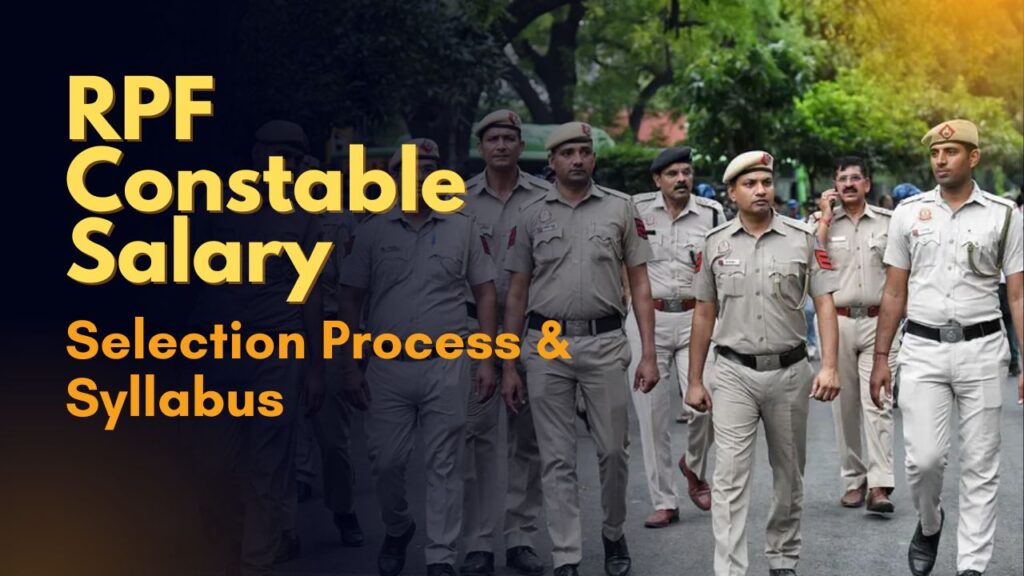
Railway Protection Force Constable: Salary, Selection, and Exam Details – complete guide

Railway Protection Force Constable

RPF is one of the most popular and important central forces of India, providing a secured career and good remuneration both for male and female aspirants. If you are dreaming of getting a prestigious government job which provides security for your job and financial stability, RPF Constable is your stepping stone for a bright future. So let’s go deep down to the bottom with everything you need to know about this great career. 

Understanding RPF Constable Salary

The compensation package is fairly competitive for those who do not have a long track record in government employment. An RPF constable gets a basic pay of Rs. 21,700 per month for an RPF constable which looks low at first, but with various allowances the total amount becomes pretty attractive. 

Your salary after allowances addition is usually between Rs.26,000 to Rs.32,000 per month with the variation being based on the city of posting and the type of allowance you are entitled to. The consolidated monthly remuneration (all-inclusive) is between Rs. 37,420 and Rs. 44,460 which is equal to Rs. 3.12 lakhs to Rs. 3.84 lakhs annually.

There are different components of salary in the salary structure that makes your take-home pay higher. You get a Dearness Allowance (DA) of Rs 10,850 which is 50 per cent of your basic pay as a you help me keep pace with inflation. The HRA depends upon your place of posting and it lies between 8 – 30 percent of your basic salary. Transport Allowance and City-wise Others benefits add further to your income. 

The RPF salary becomes more alluring because of the regular increments, which are granted at the end of every year of the service. Moreover, you also avail medical facilities, pension schemes as per 7th Pay Commission recommendations and many more benefits which ensure financial stability for life. 

Read More 👉 Top B.Tech Colleges in India: Latest Ranking & Admission Guide

The Selection Process

The process to become an RPF Constable from a wannabe has a selection process that is fairly straightforward and designed to winnow out the best and fittest. Knowing the steps will give you a strategic edge in your preparation and you can rest assured when you go through the recruitment. 

Stage 1: Computer-Based Test (CBT)

The first barrier is the Computer-Based Test, which is the entirety of the selection process. The CBT comprises a 120 marks, 120 multiple-choice questions exam, and you are given 90 minutes to take it. You get one mark for each right answer, but here is the catch: you get one-third of a mark deducted for every wrong one, so choose wisely.​

The exam is held in Hindi, English, and in some regional languages so that aspirants from all backgrounds can take it without any difficulty. The level is of 10th standard but don’t take it lightly as questions asked would be based on your overall learning not only from memorizing. 

Stage 2: Mandatory Physical Efficiency Test and Physical Measurement Test (PET & PMT) For Candidates

Only the candidates, who qualify the CBT, are called for the Physical Test, This phase has two parts, which are both important in your selection.​

The Strength, Endurance and Fitness test tries out your strength, stamina and fitness through real activities. Male candidates are required to run 1600 meters in 5 minutes 45 seconds while female candidates are required to run 800 meters in 3 minutes 40 seconds. You only get one try for the running event—no second chances here, so train hard. And you also have the long jump and high jump tests where you’re given two tries. 

Leaping 14 feet in the long jump and 4 feet in the high jump is a requisite for male candidates. Female aspirants have much relaxed parameters: 9 feet for long jump and 3 feet for high jump. Note: ex-servicemen are not required to take the PET but they do have to clear the PMT.​

The Physical Measurement Test (PMT) measures your height and chest measurements against certain standards. The male applicants must hold a minimum height of 165 cm (160 cm for SC/ST categories), with an unexpanded chest measurement of 80 cm and an expanded chest measurement of 85 cm. Height requirements for Female Candidates is 157 cm (152 cm for SC/ST Categories). These measurements are to make sure you comply with the physical standards exigent of this job. 

Stage 3: Document Verification (DV)

Those who qualify in the PET and PMT are called for document verification, where your eligibility stands verified. You need to submit the originals for age proof, educational qualification, caste certificate (if any) and identity proof. 

Stage 4: Medical Examination

The end stage in selection is a medical examination in) depth by RPF medical officers. You should be fit according to medical category ‘B-1’ as per Indian Railway medical manual in order to consider for the post. 

RPF Constable Syllabus

First analyze the syllabus then start your preparations accordingly. The RPF Constable CBT syllabus consists of three crucial components considered equal in weightage covering other aspects of your aptitude.​

General Awareness (50 questions)

Here, you will be examined on the things happening now, history of India, geography, polity, Indian economy and general science. Topics such as Indian Constitution, fundamental rights and duties, directive principles, economic theories, environment, sports, art and culture and major breakthroughs in science are part of the Topics. So keep yourself updated with the current affair and a little bit knowledge of Indian history, geography and general knowledge for this section.  

Arithmetic (35 questions)

Mathematics is not only an instrument of calculation here, nevertheless it is also a matter of thinking and reasoning. The maths section covers number system, percentage, ratio and proportion, simple and compound interest, profit and loss, mensuration, time and work, speed and distance along with elementary algebra. Most of the questions focus on testing your conceptual understanding of math that you can relate to real-life, so it’s always better to have an idea on concepts than mug up formulas.  

General Intelligence & Reasoning (35 questions)

Your Mind & Reasoning ability are tested on topics like Analogies, Coding-Decoding, Number Series, Syllogism, Blood Relations, Seating Arrangement, and Non-Verbal Reasoning. Your performance in this region will get a healthy boost from developing logical thinking and practicing pattern recognition. 

Preparing Strategically for Success

To crack RPF Constable Exam, do preparation in a systematic way. Firstly, comprehend the syllabus in depth, then solve previous year papers on a large scale. Divide your time according to the level of each question in study time since each topic has equal weight. Information is updated frequently at the official RPF website (rpf.indianrailways.gov.in/RPF), so keep visiting for more notifications.

Don’t wait until the date of the PET slowly approaching for physical preparation. Start your workout regimen now—running, jumping and strength training should be daily activities. Academics are important, but so is physical fitness in this selection. 

Your RPF Constable career is tough but highly satisfying. After all, a little planning, hard work and a bit of luck is all you need to make your way through this process and reach a coveted post that will provide you not only with financial security and job stability, but respect in society, as well. Begin preparing now and earn your living in the Railway Protection Force. 

Conclusion

Being an RPF Constable is not only a government job but a career to serve in among the most disciplined and respected central forces of India. The financial outlook is good and long-term because you get a good starting salary with allowances, plus regular increments, medical benefits and pension security.

The selection procedure, although tough, transparent is doable with the right mix of brains and brawn. Having a knowledge of syllabus, daily practice for CBT and starting physical training for PET/PMT at an early stage will help you a lot in achieving success. 

If you have the right attitude, are disciplined, and able to concentrate hard, then the RPF Constable post can provide you with the pride and social standing besides financial independence and job security. Begin your preparation today, be consistent, and march confidently towards a bright future with RPF. 

Leave a Comment

Your email address will not be published. Required fields are marked *

Indian Revenue Service: India’s Most Underrated Career Path

Indian Revenue Service

When you are dreaming about passing the Indian Revenue Service exam, many of them aspire to three letters: IAS. But among the tens of thousands of them, there is a quieter, sharper posse that it looks like the mainstream hasn’t quite tuned into yet – the Indian Revenue Service could well be the best career choice in the entire civil services ecosystem. 

What is the Indian Revenue Service?

When most people hear Indian Revenue Service they think of someone sitting with a bunch of papers behind a dusty desk, stamping tax returns. That couldn’t be further from the truth.

The Indian Revenue Service is, at bottom, a law enforcement and policy-making juggernaut. It is also the financial backbone of India — the body that raises the funds that pay for hospitals, highways, schools, and defence. The service was formed in its current style in 1953 and is divided into two significant arms, the IRS (Income Tax) and the IRS (Customs and Indirect Taxes). 

Nearly 9,775 officers, the two branches of the chargeable revenue service are testament to a cadre that pervades nearly every facet of the Indian economy. 

Eligibility

  1. Applicants must be Indian citizens or belong to certain categories of Persons of Indian Origin (PIO) to apply for the IRS. 
  2. The basic educational qualification is a Bachelor’s degree in any stream from any recognized university by the Government. 
  3. UPSC is quite flexible in this regard as it permits the students pursuing the final year of University to appear in the Preliminary examination for the CSE examination on a provisional basis, however, they are required to submit the passing certificates before joining the Mains exam. 
  4. The age limit is 21 — 30 years, you can check further below. 
Applicant CategoryMinimum AgeMaximum Age LimitPermitted Examination Attempts
General21 Years32 Years6 Attempts
Economically Weaker Section (EWS)21 Years32 Years6 Attempts
Other Backward Classes (OBC)21 Years35 Years9 Attempts
Scheduled Castes / Scheduled Tribes (SC/ST)21 Years37 YearsUnlimited (up to maximum age limit)
Persons with Benchmark Disability (PwBD – General/EWS)21 Years42 Years9 Attempts
Disabled Defence Services Personnel / Ex-Servicemen21 Years35 to 37 Years9 Attempts

Work Responsibility

These are the people who appear and plunder the offices of billionaires at the break of dawn. They follow cryptocurrency tracks across borders. They capture drugs off the shore. They bust shell companies that hide thousands of crores in black money. And yes, they also sit in hearings, argue byzantine tax law before tribunals and help shape the very policies that dictate how India earns its revenue.

This is not a desk job. This is one of the most intellectually challenging, operationally thrilling and financially rewarding career in Indian public service. 

Participate & Crack IRS

Hacking the Indian Revenue Service is tough but then, nothing good ever is. The only avenue of entry is through the UPSC Civil Services Examination, which is attempted by about 1.1 million aspirants every year. The exam takes place in three stages, all tough. 

  • The first is the Preliminary exams – a two-paper objective test to weed out the unprepared. 
  • Then there is Mains, nine descriptive papers penned down over a period of a few days, examining one on history and geography, ethics and economics, and so on. 
  • A final interview by a panel of seasoned bureaucrats and scholars. 
Mains Examination PaperSubject Focus and Syllabus ParametersMaximum Marks
Paper I (Essay)Multiple topics requiring analytical and philosophical discourse.250
Paper II (GS I)Indian History, national Geography and geo of the World and culture.250
Paper III (GS II)Law & Constitution, Social Science, and International Affairs.250
Paper IV (GS III)Tech, hacking, Economic Development, Bio-diversity, and crisis management.250
Paper V (GS IV)Ethics, Integrity, and Aptitude (Case studies on administrative morality).250
Paper VI (Optional I)Subject chosen by the candidate from a predefined list of 48 disciplines.250
Paper VII (Optional II)Second paper of the chosen Optional Subject.250

Top Recommendations for Exam Preparation

The whole process, beginning to end, can take years of preparation. Most of the toppers are second-time IAS aspirants and they spend 2-4 years mugging up the NCERT textbooks, M Laxmikanth Indian Polity, Ramesh Singh Indian Economy and reading daily newspapers like The Hindu. They write answers daily in practice. Join offline coachings or attend world-class online platforms such as Vision IAS or Vajiram & Ravi from wherever they live. 

Cutoff Marks Needed for Selection

A candidate from general category is usually required to rank between 239-379 to get IRS (Income Tax). For IRS (Customs and Indirect Taxes), the range is a little wider — something like 265 to 497. They are excellent ranks, well within the top 0.5% of all candidates. But unlike the IAS cut-off which is near impossible, the IRS is a realistic and achievable target for those who seriously prepare. 

ServiceGeneral Category (Last Rank)OBC Category (Last Rank)SC Category (Last Rank)ST Category (Last Rank)
IAS (2024 Trends)78 —- 96435 —- 457567—- 629528 —- 625
IPS (2024 Trends)225 — 252480 —-656638 — 865645 — 867
IRS (Income Tax)239 — 379485 — 706602 — 969674 — 1032
IRS (Customs & IT)265 —- 497515 — 823649 — 970680 —- 1053

The “big three” services—consisting of the Indian Administrative Service (IAS), the Indian Foreign Service (IFS) and the Indian Police Service (IPS)—are in the topmost Tier 1 class. These services traditionally take the bulk of the top 150 candidates. The IAS is the undisputed king of the civil services, with unparalleled executive powers, while the IFS has the glamour of global diplomatic representation, and the IPS has the unmatched power of the uniform.

The Indian Revenue Service holds the very prestigious Tier 2 bracket and is known for its unbeatable power in financial affairs along with a good urban living. With a bigger cadre size and distinct preference pattern giving priority to metro stability rather than rural administration, the IRS (IT) and IRS (C&IT) take a large chunk of the successful candidates which are ranked between 240 and 650 in the general category. 

What Happens After the IRS Exam?

IRS (Income Tax) officers are on their way to Nagpur’s National Academy of Direct Taxes (NADT) — a sprawling green-fitted campus, where a 16-month professional course converts the generalist officers into financial experts. The content is demanding: income tax law, corporate accounting, forensic investigation, international taxation, transfer pricing. It’s not just classroom theory, either. Officers labor months in the trenches, conducting real assessments and audits with seasoned veterans.

IRS (Customs and Indirect Taxes) officers are trained at the brand new NACIN campus in Palasamudram, Andhra Pradesh — a breathtaking 500-acre establishment which also serves as a World Customs Organization regional training centre for the Asia-Pacific region. The syllabus here includes GST, customs law, border management, narcotics control and contemporary areas such as data analytics and artificial intelligence.

Holistic development is taken seriously in both academies. Morning physical training, evening cultural programmes and personal hobbies. The objective is to produce officers who are not just technically competent but mentally tough, well rounded human beings who can manage in high-pressure environments without losing their cool. 

Read More:- Railway RRC WR Apprentice Recruitment 2026 – Apply Online

Pay Scale and Future Opportunities

The pay of IRS officers is very good and is governed by the 7th central pay commission (CPC). Financial estimates for the 8th CPC, as the pay commission is next in line, indicate a possible 2.25 multiplier to the basic pay, which would again make being in the service financially attractive. Officers join the service at Pay Level 10 ( Junior Time Scale ) and can rise in 30 years of service through the ranks to the Apex Scale at Pay Level 17. 

The following outlines the elaborate and comprehensive financial and hierarchical system: 

IRS DesignationPay LevelBasic Pay (7th CPC)Estimated Gross Monthly SalaryCareer Timeline (Approx.)
Assistant CommissionerLevel 10Rs 56100Rs 85000 0 – 4 Years
Deputy CommissionerLevel 11Rs 67700Rs 100,000 5 – 8 Years
Joint CommissionerLevel 12Rs 78800Rs  1,25,0009 – 12 Years
Additional CommissionerLevel 13Rs 118500Rs 1,60,000 13 – 16 Years
CommissionerLevel 14Rs 1,44,200Rs 2,00,00017 – 20 Years
Principal CommissionerLevel 15Rs 1,82,200Rs 2,40,00020+ Years
Chief CommissionerLevel 16Rs 2,05,400Rs 2,80,000 25+ Years
Principal Chief CommissionerLevel 17 (Apex)Rs 2,25,000Rs 3,20,000Apex Career Stage

In cases where government accommodation is either not available or refused within the government-officer circle, the officers are paid a handsome House Rent Allowance (HRA) of 8% to 24% of their basic pay based on the tier categorization of the city in which they are posted. 

Conclusion

Indian Revenue Service is not just a career option but a vocation for those who want to make a real difference and are willing to work in the shadows and not in the spotlight. It is a combination of power and responsibility, brain and brawn, permanence and challenge. IRS officers at the national and state level are, quite literally, the core of India’s power but theirs is an unobtrusive, unshowy, and often unacknowledged influence.

In a culture where the IAS, IPS and IFS reign supreme in public imagination, the IRS gets overlooked not because it does not hold enough power or prestige or purpose but because it doesn’t shout about it. And yet, for those with the time to can see its nuances, it provides one of the most rounded existences in Indian public service — professional esteem, financial security, urban postings, intellectual stimulation, and tangible national outcomes. 

GovUpdatewala is your trusted source for real-time updates on government exams and jobs in India. We provide verified info on SSCUPSCBankingRailwaysDefense, and Teaching exams. From syllabus and patterns to important dates and career tips — we support aspirants at every step.

Leave a Comment

Your email address will not be published. Required fields are marked *

Scroll to Top