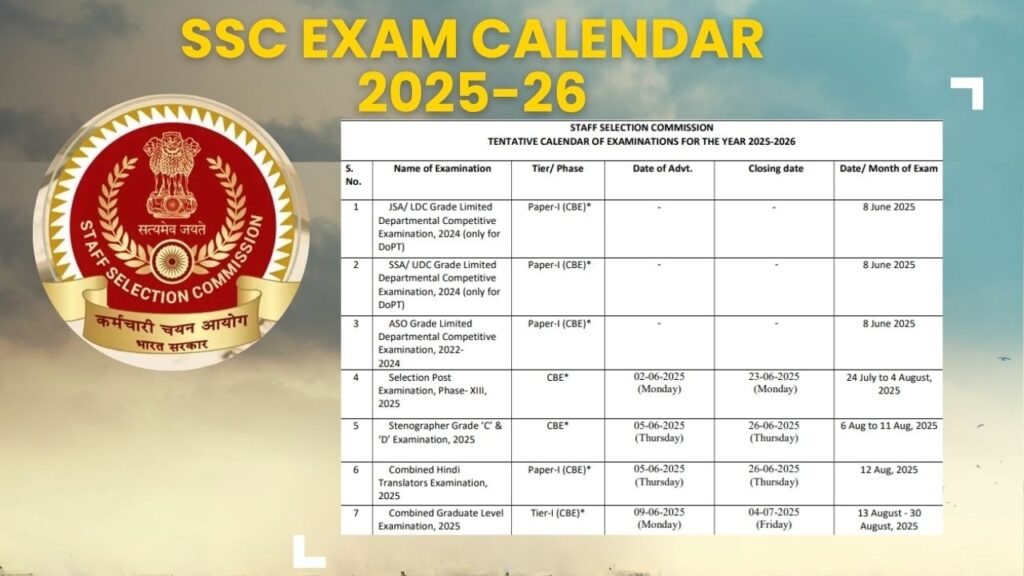
The SSC has announced the SSC Exam Calendar 2025–26 on its official website, so start preparing for the upcoming exams. More than 10 lakh candidates appear out of 50 exams conducted by the SSC every year after 10th, 12th or graduation for jobs in various central government departments and ministries.
This year SSC Calendar (Important Dates) for SSC Exam 2025 (20, 25, 26) contains all info regarding SSC Exams for CGL, CHSL, JE GD Constable, Delhi Police, Steno orga, Stenographer post holders. Candidate can check important events such as notification release date, application dates, exam dates from the schedule to know about the upcoming events which should be useful in your preparation.
Check Out The SSC Exam Calendar 2025-26
More than five million candidates take the SSC exams for government jobs once in a year after either 10th, 12th or graduation. The revised SSC calendar includes all notification, application, and exam dates for the 2025-26 cycle, providing transparency and a clear path for the candidates.
Exam Name
Schedule Period
SSC Constable (Driver)-Male in Delhi Police Exam
July to December 2025
Head Constable (Ministerial) in Delhi Police
July to December 2025
Head Constable (AWO/TPO)
July to December 2025
Constable (Executive)
July to December 2025
Grade C Stenographer
July to February 2026
Constables and Rifleman in Assam
October to February 2026
JSA/LDC
January to March 2026
SSA/UDC
January to March 2026
ASO
January to March 2026
Key Details for Aspirants
All SSC examinations are held at the designated centers across all over India in Online mode only.
Updates are posted on the official SSC website (https://ssc.gov.in). Aspirants are advised to track the notifications and deadlines for application.
Dates of the examination are liable to change due to unforeseen circumstances, keep watching official notifications for updates if travelling or taking study leaves.
There are more levels/phases to the selection process; CGL, CHSL and JE have additional rounds after Tier 1.
Admit cards, syllabus and other directions for the candidates are issued just before the exam, so keep visiting the official website of SSC regularly.
Follow the Guide to Download the SSC Exam Calendar 2025-26
1. Go To The Official Website of SSC, which is mentioned in this article.
2. Now Search for the SSC exam calendar in the Notification on SSC Exam Schedule 2025-26.
3. Open the link and download the calendar in pdf file OR you can just download it directly from the link section of this article.
4. Download the pdf file in your device.
5. Keep this file save or print for future uses.
The SSC timetable for the 2025-26 session is designed as per the pattern of previous years and it clearly indicates that there are 5 stages in the exam process.Changes or modifications, if any, will be notified on the official website of SSC.
Staff Selection Commision is a governmental organization which recruits candidates for various posts in the government sector. SSC Multi Tasking Staff MTS Recruitment 2025 notification is released, if you are waiting to apply for this position download its notification for all the details. Application Form will start on 26 June 2025. Make sure to fill out an online form before the closing date of registration.
The SSC MTS exam is a process for recruitment for havildar positions and other multi-tasking positions like Daftari, Junior Operator, Peon, Jamadar, Chowkidar, and Mali. If you are interested in working in the government sector, you can apply for these positions after the 10th but prepare well to clear the examination.
SSC Multi Tasking Staff MTS Recruitment 2025 Details
Organization
Staff Selection Commission
Post
Multi Tasking Staff
Overview
SSC MTS is a recruitment process for various roles such as Havaldar, Peon, Chowkidar, etc.
Between Bank job vs SSC job which one to choose, this is the real matter of dilemma for all the Government Job aspirants in India. The two career paths are stable, respected, and come with good perks—but that’s about where the similarity ends. Work culture, salary structure, growth, work life balance, everything, Banking jobs and SSC jobs are quite different and these differences can have a telling impact on your lifestyle and long term goals. It is necessary to know about these differences, before you active your years of preparation in for either path.
Work Culture of Banking Job vs SSC Job
If you live for adrenaline and aren’t afraid of a high velocity environment, banking may be for you. As a Probationary Officer (PO) or a Clerk, you are the face of the bank. You’ll be handling customers, you’ll be handling cash flows, you’ll be giving and clearing loans.
New challenges and new people every day. However, let’s not sugarcoat it — it’s a high-stress job in banking. The stereotypical “9-to-5” government job doesn’t really exist here anymore. Now there are targets including loan targets, account opening targets, insurance cross-selling. And you will be responsible for branch performance.
SSC, on the other hand, is the very embodiment of bureaucracy. If you clear SSC CGL, you get very lucrative posts in central ministries, the CBI, Income Tax or Customs.
This place has a very different culture of working. It is predominantly administrative. You are part of the massive machinery that runs the country. You will be drafting policies, keeping records, or maybe even conducting field inspections if you pick an Inspector profile. It’s more even-tempered, the deadlines aren’t as crazy, and you almost never have to field irate customers hollering about a failed UPI transaction.
Salary And Allowances For Bank job vs SSC job
Both Bank job vs SSC job offer good salary and allowances to their employees in the government sector but a small difference is the right perks with right duty is a great combo.
Right from the beginning, a Bank PO generally earns more than a starting SSC CGL officer, more so if you get into SBI. The allowance is fantastic. You get lease accommodation (which is huge in metro cities), medical benefits, petrol allowances and even newspaper allowances.
Bank Employee Salary
Government Banks
Monthly Salary
Probationary Officer (PO)
₹52,000 to ₹60,000
₹30,000 (Perks)
Clerk
₹30,000 and ₹35,000
Specialist Officer (SO)
₹52,000 to ₹58,000
But the single biggest perk of being a banker? If you’re buying a house, a car, or paying for an education, you get loans at wildly subsidized interest rates. Over the course of a lifetime, that’s lakhs of rupees you save.
The SSC salary is decent and the deciding factor for that matter is the Central pay commission only. Though the starting salary you take home may be a little lesser compared to a Bank PO, the perks are out of the world.
SSC CGL Salary
Pay Level
Entry Basic Pay
Typical Posts
Approx. In-Hand (Metro)
Level 8
₹47,600
Assistant Audit/Accounts Officer
₹75,000 – ₹85,000
Level 7
₹44,900
ASO, Income Tax Inspector, Excise Inspector
₹65,000 – ₹72,000
Level 6
₹35,400
Divisional Accountant, Sub-Inspector (NIA)
₹52,000 – ₹58,000
Level 5
₹29,200
Auditor, Accountant
₹42,000 – ₹48,000
Level 4
₹25,500
Tax Assistant, UDC
₹36,000 – ₹42,000
Then there is the Central Government Health Scheme (CGHS), which offers almost free medical treatment in premier private hospitals to you and your dependents. You get exact DA hikes, HRA, travel concessions(Domestic and International). Additionally, the salary structure in SSC rises exponentially with higher pay bands and ranks.
SSC CHSL Salary
Post
Pay Level
Approx. In-Hand Salary
LDC / JSA
Level 2
₹27,000 – ₹32,000
DEO (Grade A)
Level 4
₹37,000 – ₹42,000
DEO (Level 5)
Level 5
₹40,000+
Work-Life Balance and Peace of Mind
This is where the divergence between the Bank job vs SSC job paths becomes painfully obvious.
In banking, it’s easy to feel like work-life balance is a myth, particularly in your first few years as a PO. You could be clocking out of your branch at 7 or 8 PM on busy days. And then there is the fact that bank jobs mean you get shifted around frequently. You will be shifting base and moving to a new city, at times to a rural village, for your mandatory rural posting every three to five years.
SSC wins the work-life balance debate of Bank job vs SSC job, hands down. The majority of jobs in ministries are Monday to Friday and you have full, undisturbed weekends. You are out of the office at 5:30 p.m., and the work stays in the office. There are transfers, of course, in SSC, but not anything like in banking, and many secretariat posts can see you through an entire career in Delhi.
Career Growth
Bank job vs SSC job have good growth options as the field is huge and it has senior posts as well.
If you want to become a general manager before you get old, go for banking. The pace of promotion in public sector banks is quick and depends on merit to a great extent. Do well, clear your internal JAIIB/CAIIB exams and opt for tough postings, and you can scale the ladders really fast. The Chairman of SBI usually begins their journey as a normal Probationary Officer.
Advancement in SSC is generally end of term and largely seniority based with the number of vacancies available. It’s a slow burn. You can come in as an ASO (Assistant Section Officer) and retire as a Joint Secretary after 30 years. It’s a respectable place to be and you know you’re never going to be laid off, but don’t expect to be leapfrogging up the ladder because you worked extra-hard one year.
Inspector (Level 7)
Superintendent/ITO (Level 8) — 5–8 years
Assistant Commissioner (Level 10) — 12–15 years
Deputy/Joint Commissioner (Level 11–13) — 18–25 years
Eligibility of Public Sector Banks And SSC Jobs
Nationality: Citizen of India
Educational Qualification for Public Sector Banks : A Bachelor’s Degree for any bank post, for clerk post, you must hold a Computer certificate.
Age Required : 20 years is minimum and maximum is based on the role, for PO, it is 30 years. And for Clerk, it is a 28 years limitation. Now, you have given a chance to work for more years if you belong any of the categories:
SC/ST: 5 years.
OBC (Non-Creamy Layer): 3 years.
PwBD: 10 years.
Educational Qualification for SSC Jobs : In SSC CGL, candidates are required to have any degree, but for Junior Statistical Officer roles required Math in 12th and Statistics in graduation as a subject.
Age required : 18 to 32 years.
Meanwhile, SSC CHSL candidates required 12th class marksheet, but Data Entry Operator role requires Science stream with Mathematics.
18 to 27 years is an age criteria for most posts.
So, every position needs some additional skills, it’s better to check official notification for eligibility in specific posts.
Skills You Need For These Jobs
Both Bank job vs SSC job need particular skills for the job responsibilities to ensure a smooth workflow.
All of these are about speed and accuracy. The questions aren’t necessarily absurdly difficult, but you only have a few seconds to answer each one. It involves a lot of calculation and data interpretation, some reading comprehension and complex seating arrangement. If you have quick reflexes and don’t mind a ticking clock, bank exams are definitely for you.
SSC tests your depth of knowledge. Time is a factor, not nearly as brutal as in banking. Here you have to know high-level maths (trigonometry, geometry, algebra), English grammar rules by heart and a ton of Static GK and Current Affairs. If you enjoy memorising a lot and love researching topics, SSC is your playground.
So, there is no one answer to which one is right for you between Bank job vs SSC job. If you like to work in a dynamic environment, and take pressure with great pay then banking is for you. But if you like to work in a stable environment with predictable timings and want to have a balanced life with job security, SSC jobs surprisingly are best.
Ultimately, the one you should go between Bank job vs SSC job depends on your own personality, priorities and future plans for your career – so you take a little time to think about what’s most important to you, and then make an informed decision.
For decades, a government job has been the most lucrative career option in India. These SSC Job List 2026 will help you to take the right direction of your career. As we head into 2026, the Staff Selection Commission (SSC) still remains the dream gate for lakhs of aspirants to get their foot into stability, respect and serving the nation.
If you are preparing your career roadmap for this year, then getting to know about the huge range of SSC jobs is step one! From the Central Secretariat to paramilitary forces, desk-bound jobs to high-octane field jobs, the SSC 2026 calendar is bulging.
So, here is the detailed information of Your SSC Job List 2026 by Exams and Qualification.
SSC Combined Graduate Level (CGL)
The SSC CGL which is popularly known as ‘Mini-IAS’ exam is the most reputed exam for selection to Group B and C posts in various SSC Job List 2026 in ministries and departments. Candidates need to have a Bachelor’s Degree in any stream to be eligible.
Some of the SSC Job List 2026 under SSC CGL are:
1. Assistant Section Officers (ASOs) watchful policy realization in the Central Secretariat Service (CSS) in the Ministry of External Affairs (MEA), or Intelligence Bureau (IB) or the ASOs business is largely on one’s table at any rate!Desk based post of execution policy.
2. Roles in the Ministry of Finance related to taxation that are high-paying and profitable are Income Tax Inspector and GST Inspector.
3. AAO or Assistant Audit Officer – Indian CAG This is the Gazetted post In SSC CGL under the Indian Comptroller and Auditor General (CAG) and working with the Indian Comptroller & Auditor General this post is unique.
4. Sub-Inspector in CBI: This post is for those who are willing to serve in the National Investigative Agency.
SSC Combined Higher Secondary Level
SSC CHSL is a great opportunity for 12th pass candidates to get an entry level post in the government sector.
Job Roles:
1. These posts (Junior Secretariat Assistant and Lower Divisional Clerk) are the best paying jobs at entry level which are the backbone of office administration and are indispensable to the smooth working of the office.
2. Data Entry Operator (DEO): Hold the responsibility for maintenance of essential Government files, up-to-date and complete, with accuracy.
This examination leads to secure and respectable employment within government organizations.
SSC MTS & Havaldar
This is an excellent opportunity to enter in the Multi Tasing Staff job role or Havaldar, 10th pass candidates can get a central government job/staff.
Job Roles:
MTS (Multi Tasking Staff): It serves as a kind of general office support, some such duties include, running files, pushing files from one desk to another, housekeeping in office space, across various government ministries.
Havaldar: Havaldar post Candidate Should belong to Central Board of Indirect Taxes & Customs (CBIC) and Central Bureau of Narcotics (CBN). The duties of the security personnel are all field-based i.e. they are related to security and watch and ward.
SSC GD Constable
The SSC GD Constable 2026 Recruitment if you would like to serve in uniform and keep yourself physically fit, then consider it. The exam is held for recruitment to various Paramilitary forces like:
BSF —-Border Security Force
CISF —-Central Industrial Security Force
CRPF —-Central Reserve Police Force
ITBP —-Indo-Tibetan Border Police
SSB —-Sashastra Seema Bal
AR —Assam Rifles
Qualification Criteria: The applicants must have cleared 10th standard with some physical standards in order to be eligible for the recruitment.
SSC CPO
The SSC CPO exam is a good chance for the ones who want to be a Sub-Inspector (SI). It is a tough but rewarding path to take. Candidates are required to have a graduation degree and Qualify Physical Endurance Test to be eligible.
Selected candidate have the opportunity to serve in prestigious position like Sub-Inspector in Delhi Police (which is considered one of the most orderly police service) or Sub-Inspector in Central Armed Police Forces (CAPFs) – BSF, CRPF and more.
SSC Specialized Exams
Stenographer (Grade C & D)
If you are good at shorthand typing and can crack SSC Exam then SSC Stenographer may be a door for you to enter into government jobs.
Via this exam candidate is selected for the post of Stenographer in various ministries, departments and organizations of Government.
The core responsibilities of this role involve providing dictation assistance to senior officials, drafting official documents, processing correspondence and carrying out administrative tasks.
They frequently are called upon to assist higher-ranking officers, making it a key supporting position in the government system. You can get a great pay from this job role as it requires your skills.
Junior Engineer
The SSC Junior Engineer exam is disputed for the candidates who have a Diploma/Degree from the recognized board in a relevant field of engineering i.e. Civil, Mechanical, Electrical etc.
The result of SSC Junior Engineer Exam contains qualified candidates who are selected for appointment in various government departments, organizations such as public works, infrastructure, etc.
They also oversee such projects as cleaning and maintaining government buildings and roads, write technical reports, and verify that engineering projects conform to safety and quality requirements.
SSC Selection Posts (Phase XIV):
The Staff Selection Commission Selection Post Exam is a good opportunity to get a government job for the person who has educational qualification of 10th pass 12th pass and Graduates.
Unlike other SSC exams which appoint the candidates for common posts, this exam appoints candidates for distinct and specialised posts in various central government departments.
These posts can be for Scientific Assistant or Laboratory Attendant or even Library Clerk, Data Entry Operator or Technical Assistant. Every post has different eligibility criteria and different skills that are needed as per the requirement of department.
Due to the wide range of posts, the Selection Post examination is an ideal platform for the people who are having professional or vocational qualifications and interested to work in a particular domain in the government sector.
Job Security: Students can rely on their jobs for lifetime as it is not like private jobs undisputed, particularly in times of economic downturn.
Work-Life Balance: There are public holidays and weekends leave can be more relaxful and also on the weekdays you have to work only 9 to 5.
Salary and Perks: The salary is very competitive with the 7th Pay Commission norms. Benefits such as HRA (House Rent Allowance), DA (Dearness Allowance) and medical benefits for family are some of the major highlights.
Social Prestige: It is a centrally administered ministry, so it has a good standing in society to serve in it or the national police force.
SSC Job List 2026 Exam Timeline
The SSC Job List 2026 exam timeline is given for the students to take an idea to begin their journey, accurate date and time are declared by the official website of SSC. Students who are interested in any of these job posts can check the official notice of the exam on the official website.
Exam Name (2026)
Notification Date (Expected)
Exam Month
CGL
March/2026
May—June/2026
CHSL
April/2026
July—Sept/2026
MTS
June/2026
Sept—Nov/2026
CPO
May/2026
Oct–-Nov/2026
GD
Sept//2026
Jan—March/2027
Conclusion
Whether you are a 10th-pass student or a postgraduate engineer, the SSC Job List 2026 has all the opportunities for you. The only question you must ask yourself is which post defines my personality better? If you love discipline and being outdoors, go for CPO or GD, if you love a quiet office and wielding admin powers, go for CGL.
If you are someone who always ends up correcting the English grammar of the English movies or newspapers’ headlines/trailers in Hindi and English languages be it at office or traveling or on vacation then this time your hobby can help you earn some good bucks. Enter the Junior Hindi Translator Recruitment.
It’s one of those “hidden gem” professions. It doesn’t always get the loud buzz of the administrative services, but for language lovers, it’s a wonderful route to stability, respect, and an actually compelling day-to-day work life. So, let’s decode all you need to know about Junior Hindi Translator Recruitment without the wordy, government jargon.
What Does a Junior Hindi Translator Recruitment Do?
As a Junior Hindi Translator, you are not just sitting in a room with a dictionary collecting dust. Are you the linguistic bridge for the Government of India.
The Government of India functions in Two-Languages Hindi and English. Each and every official document, press release, circular and policy has to be impeccably worded in both. As a JHT you will be primarily responsible for translating these official documents into Hindi and English.
But this is more than the translation of words. You have to be sure the Rajbhasha(official language) policies are properly executed in all the central government departments, ministries and offices under them. You’re basically the gatekeeper of official communication. It’s a desk job, yes, but it’s one that calls for a quick brain, cultural awareness and a flawless vocabulary.
SSC Junior Hindi Translator Recruitment Exam
Although different agencies also have their own jobs listings, the undisputed king of Junior Hindi Translator Recruitment is the Staff Selection Commission (SSC).
The SSC conducts the Combined Open Competitive Examination for the post of Junior Hindi Translators, Junior Translators and Senior Hindi Translators for the recruitment of Ministry offices, Departments and Organizations of the Government of India on yearly basis. If this career path is something you very seriously want to pursue, then the SSC JHT notification is the one to watch out for.
Dates to Remember
Event
Date
Notification Release
23/April/2026
Application Start Date
23/April/2026
Last Date to Apply
14/May/2026
Last Date for Fee Payment
15/May/2026
Correction Window
19–20/May/2026
Are You Eligible?
This is the point at which crowds start to thin out, which is actually great for you. Not like general exams that are open to all the bachelor degree holders, the Junior Hindi Translator Recruitment has minimum educational qualifications.The criteria for eligibility are usually as follows:
You are required to have a Master’s degree from a recognized university in Hindi with English as a compulsory/optional subject (or as the medium of examination in the degree course).
OR
A Master’s degree in English with Hindi a compulsory/elective subject.
If you are without a Master’s in either of the two mentioned, it is still possible to get in with a Master’s in any subject, given that you took Hindi and English as either your core or elective subjects at the undergraduate level.
Apart from the degrees, the SSC in general also asks for a Recognised Diploma/Certificate course in translation from Hindi to English and vice versa. If you do not have the diploma, you can also qualify with two to three years experience working as a translator from Hindi to English (and vice versa) in a Central or State Government Office.
Exam Pattern SSC JHT exam
The Junior Hindi Translator Recruitment exam is conducted in 2 stages: Paper 1 and Paper 2. Let’s check what really is in store for you.
Paper 1: The Computer-Based Test (Objective)
General Hindi (100 Marks)
General English (100 Marks)
You usually get two hours for this. The syllabus includes everything from grammar, vocabulary, synonyms and antonyms to sentence formation, idioms and phrases. It’s meant to measure your fundamental knowledge of each language.
Paper 2: The Descriptive Test
If you qualify for the cutoff in Paper 1, welcome to the big league. Paper-2 is offline descriptive with a pen and in-answer sheet containing 200 marks in 2 hours.
This paper assesses your real translation skills and writing. You will typically be asked to:
Translate a passage from Hindi into English.
From English to Hindi.
Write an essay in Hindi.
Write an essay in English.
This is the part when genuine language buffs glow. Rote memorization will not help you here – you need natural flow, good handwriting and the ability to express complex thoughts clearly.
Salary and Lifestyle
The post of Junior Hindi Translator is generally in pay level-6 of 7th CPC. It means your basic pay begins at ₹35,400. But that’s just the base. With the addition of Dearness Allowance(DA), House Rent Allowance (HRA) and Transport Allowance(TA), the gross in hand salary you get is around ₹50,000 to ₹70,000 per month which varies depending on the city of your posting (X, Y, or Z category cities).
Apart from the finances, the way of life is very attractive. It’s a white-collar respected desk job with fixed hours dictated by the government. You get all the perks of central government: medical facilities, pension schemes (NPS), job security, and a predictable promotion ladder moving up to Senior Translator, Assistant Director, and beyond.
Junior Hindi Translator recruitment is a testament to the fact that you don’t need to be a maths wizard or a coding genius to land a great job with a stable career. If you have an affinity for words, sentence structures and the lovely nuances of Hindi and English, then this one is right for you.
It’s commitment and constant practice and a real respect for language. Watch the SSC schedule, start translating your favorite articles now, and get ready to transform your love of language into a career for life.
GovUpdatewala is your trusted source for real-time updates on government exams and jobs in India. We provide verified info on SSC, UPSC, Banking, Railways, Defense, and Teaching exams. From syllabus and patterns to important dates and career tips — we support aspirants at every step.
The SSC CPO SI CAPF Online Form 2026 finally went live on 10 September, now you can go on the official website to fill it. The official notification of SSC CPO brings fewer seats and a reshuffled exam pattern. The Staff Selection Commission has opened applications for CPO Sub-Inspector posts in Delhi Police and Central Armed Police Force (CAPF) Exam 2026.
The window runs from 10 September to 30 September 2026, 11 PM, and if past years are anything to go by, the SSC server tends to buckle in the last 48 hours. Registering early isn’t just good advice, it’s basic risk management.
Details
Information
Exam name
SSC Sub-Inspector in Delhi Police and CAPFs Examination 2026
There are a total 1,871 vacancies for 2026 announced by SSC which is less in numbers from last year. Even after CISF’s new Fire wing added 234 posts to the count. Still it doesn’t beat last year’s vacancy count.
SSC CPO SI male seats rose from 142 to 205 and SI female vacancies doubled from 70 to 112 this year. CAPF SI (GD) postings, which usually get higher in number, have shrunk considerably this year.
Sub-Inspector in CAPF seats for male are 1173 and 147 for females. So the total empty seats in CAPF are 1320.
Sub-Inspector (Fire) in CISF also vacant for 234 male candidates. The category-wise distribution of seats is also accessible from the official notification. The conclusion is general category male seats are more in numbers than other categories or females.
Eligibility For SSC CPO in 2026
Education and Age Limit For SI: Any bachelor degree from a recognised university is accepted. Candidates’ age must lie between 20 to 25 years for Delhi Police SI and CAPF SI. The age relaxation is given for 3-years (OBC) and 5 years (SC/ST).
CISF SI (Fire) runs on a separate, wider band of 18 to 30 years, so if you’ve aged out of the general SSC CPO bracket, this is worth a second look.
Male applicants for Delhi Police SI (Executive) must hold a valid LMV driving licence — both motorcycle and car — on the day of the physical test, not on the day of application. If you don’t have one yet, start the process now; RTOs aren’t fast.
Candidates from specified hill areas, North-Eastern States and Sikkim
165 cm
80 cm unexpanded, 85 cm expanded
155 cm
Scheduled Tribe candidates
162.5 cm
77 cm unexpanded, 82 cm expanded
154 cm
Physical Endurance Test for SI Post
Candidate
Event
Requirement
Male
100-metre race
16 seconds
Male
1.6-kilometre race
6.5 minutes
Male
Long jump
3.65 metres in 5 attempts
Male
High jump
1.2 metres in 3 attempts
Female
100-metre race
18 seconds
Female
800-metre race
4 minutes
Female
Long jump
2.7 metres in 3 attempts
Female
High jump
0.9 metre in 3 attempts
What’s Changed in the SSC CPO SI CAPF Online Form 2026 Exam Pattern
SSC has restructured both papers for this cycle, and different question counts and marks splits for Paper I and Paper II.
Paper I remains the general screening test covering Reasoning, General Awareness, Quantitative Aptitude, and English Comprehension, and Paper II is the English Language and Comprehension paper, with negative marking of 0.25 for wrong answers carried over from the previous pattern.
For the exact number of questions and marks per section, go to the official notification PDF provided by the Staff Selection Commission.
How To Apply — SSC CPO SI CAPF Application Form
Visit on the official website mentioned in the above overview.
If you already have a One Time Registration (OTR) profile, log in and apply directly against the SSC SI in Delhi Police and CAPFs Examination, 2026 listing.
New applicants need to register first.
SSC is pushing Aadhaar-based authentication hard this cycle — opt into it, because it exempts you from photo and signature rejections on formatting grounds and saves you from carrying printed photo ID to the exam centre.
The photograph itself has to be captured live through the application at the time of registration; you can’t upload an old passport photo.
Signatures go in as a JPEG between 10 and 20 KB.
General, OBC, and EWS candidates pay a ₹100 application fee; women, SC/ST, PwBD, and ex-servicemen candidates are exempt, as usual.
Once you’ve paid and submitted, use the preview option before final submission of SSC CPO SI CAPF online form— corrections later are limited to a fixed window (8 to 10 October, per current reporting) and won’t cover every field.
Salary of Sub-Inspector in Delhi Police and Central Armed Police Force
Salary is given under Pay Level 6 of the 7th Pay Commission, candidates who get selected for SI post going to earn up to ₹35,400 which rise up to ₹1,12,400. The total in-hand salary of a SSC CPO SI CAPF is somewhere between ₹55,000 and ₹75,000 a month by adding allowances.
The fixed salary of Sub-Inspector is shared with you after the selection depending upon the location of your post, as metro postings pull the number toward the higher end because of city-category HRA.
Fill SSC CPO SI CAPF Online Form 2026 now to secure your seat because waiting for the last hour means you can make a mistake while filling the form in hurry or the site will crash down at the last minute and you’ll miss the chance.
So don’t take that risk and apply now for Sub-Inspector, prepare for the theory examination as well as physical standards. Check the eligibility and get your documents ready before going to fill the form.