
How AI Could Change India’s Digital Public Infrastructure

Digital Public Infrastructure 

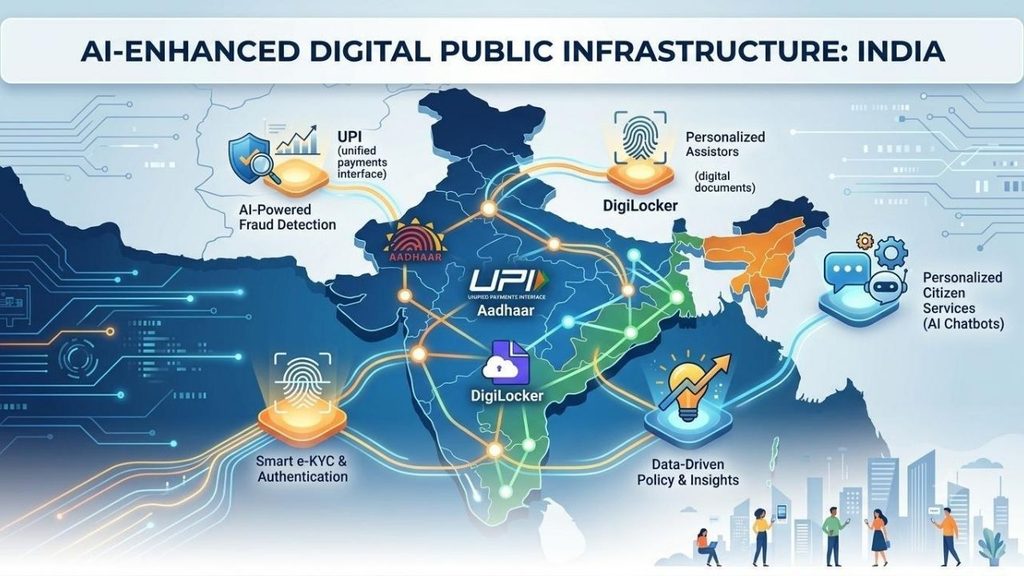
The shift from traditional systems to Digital India raises concerns about public privacy and security, as greater reliance on digital systems can create new opportunities for fraud and scams. Aadhaar is one pillar of what the government now calls India’s Digital Public Infrastructure and how AI could change that DPI for making it faster and more reliable is the biggest evolution.

Every month, close to 20 million people across India get turned away by a fingerprint scanner or a face-authentication camera that’s supposed to hand them a subsidised ration bag, a pension, or a bank withdrawal. That failure rate — a little over 6% of roughly 312 million Aadhaar-based authentications attempted monthly has stayed almost unchanged for a decade, according to UIDAI’s own parliamentary disclosures. 

It’s a strange fact to sit with, because DPI includes the stack of identity, payments, and data-sharing rails — Aadhaar, UPI, DigiLocker, Account Aggregator, ONDC — that more than a billion Indians touch, often without realising it. AI is now being wired into nearly every one of those rails. Some of it is already live and working. 

What Is India’s Digital Public Infrastructure 

Aadhaar is the identity layer — a biometric ID held by nearly every adult in the country. UPI is the payments layer, the real-time system that lets any bank app talk to any other. DigiLocker and Account Aggregator are the document and data-sharing layers, letting people share verified paperwork or consented financial records instead of photocopies. 


ONDC is the newest piece, an attempt to do for e-commerce what UPI did for payments: an open network any app can plug into, rather than one company owning the marketplace. 

Each of these was built as plumbing — deliberately boring, interoperable infrastructure. AI is the first layer being added on top that isn’t boring at all, and it’s arriving fastest in fraud detection, credit, language, and now shopping.

Fraud Detection at a Scale No Human Team Can Watch

UPI now clears more than 750 million transactions a day, a number NPCI expects to keep climbing toward a billion. At that volume, catching fraud after the money has moved is close to useless — NPCI’s fraud-detection platform processes roughly 2 terabytes of transaction data daily and needs to score risk within about 20 milliseconds, fast enough to block a payment before it settles. 

Its MuleHunter AI tool has already flagged more than 4.7 lakh mule accounts — the disposable, borrowed accounts fraud rings use to bounce stolen money through four to six hops before cashing out. 

NPCI is now piloting what it calls a “federated model” with three or four banks: instead of pooling everyone’s raw transaction data in one place, banks and NPCI compare AI-generated risk scores on a customer, getting the benefit of shared pattern-matching without centralising anyone’s actual financial history. 

NPCI’s leadership has said openly that the next leg of UPI’s growth depends on AI doing three jobs at once — catching fraud, extending credit based on payment history, and onboarding the next half-billion users through voice and regional-language interfaces instead of English-only screens.

Half of India Still Can’t Access Bank Credit

For decades, an MSME owner without three years of clean, bankable paperwork was mostly invisible to formal lenders — not un-creditworthy, just un-scoreable. 

The Account Aggregator framework, built on the RBI’s 2016 Master Direction and NITI Aayog’s Data Empowerment and Protection Architecture, changed the plumbing: with a customer’s explicit consent, a lender can now pull real bank statements, GST filings, and insurance records through a single encrypted pipe instead of chasing PDFs. 

As of the framework’s fourth anniversary in 2025, 112 financial institutions had gone live on both sides of that pipe, with hundreds more connected as data providers or users. AI models sit on top of that data flow, and lenders report the payoff is real: industry estimates put improvements in default-prediction accuracy at 15 to 25%, and processing times that used to run one to three weeks are increasingly settled same-day. 

This isn’t unregulated black-box lending, though — RBI’s digital lending rules require a lender to explain, in terms a risk officer or auditor can actually interrogate, why a model approved or rejected an application, which puts a real ceiling on how opaque these systems are allowed to get.

Read More 👉 Apple iPhone Duo Changes the Cost Effectively With These Methods

No More Language Barrier: Treating Language Like Infrastructure

India has more than one language and an AI layer that drops the barrier between languages is Bhashini. In India, MeitY’s National Language Translation Mission became fully AI-powered translation engines and it now sits underneath every government services app from January 2026. Portals like DigiLocker, UMANG, e-Shram running into 22 Indian languages. 

A Bhashini-powered voice assistant called Kumbh Sahaiyak used a Llama-based model to field pilgrim questions in 11 languages in real time — arguably the clearest proof yet that a DPI project can meet people in their own language at genuine crowd scale, not just in a pilot deck. If India’s Digital Public Infrastructure’s whole promise was ever about reaching people who can’t fill out an English form, Bhashini is the piece actually doing that, one API call at a time.

The Part AI Might Not Fix: Aadhaar’s Exclusion Problem

The government’s current bet is that AI-driven face authentication — rather than fingerprint or iris scanning, which struggle with a manual labourer’s worn fingerprints or an elderly person’s cataracts — will close that 6.5% failure gap. 

It’s already been tested at real scale with UIDAI ran a face-authentication proof of concept at NEET-UG 2025 exam centres with the NTA and NIC, and by 2026 similar AI-camera verification, backed by liveness checks and a fingerprint or manual fallback, was standard at UPSC exam halls. Officials describe the results as promising. 

Researchers who’ve actually gone door to door are less convinced: a survey across 32 villages in Jharkhand by economist Jean Drèze and co-authors found exclusion errors running as high as 20% in areas where biometric authentication was required for every ration purchase — and critics note that swapping fingerprints for face scans doesn’t remove the underlying design flaw, which is that a single biometric check, controlled by a ration dealer or bank teller rather than the beneficiary, decides whether someone eats that month. 

There’s a second, quieter concern sitting alongside is the more AI systems sit on top of Aadhaar-linked data — UPI payments, SIM registrations, app logins — the easier it becomes to assemble a detailed behavioural profile of someone, usually described publicly as fraud prevention rather than surveillance. Both things can be true at once. 

AI-based face authentication may genuinely cut into the 20-million-a-month failure count, and the same infrastructure may quietly expand what the state and private platforms can see about a person’s life. That tension, not a clean technical fix, is the actual story here.

Agents That Could Soon Shop and Transact for You

The newest layer is barely a layer yet. ONDC, India’s government-backed alternative to Amazon and Flipkart, runs on the open-source Beckn protocol, which had onboarded more than 900 network participants across grocery, food delivery, mobility, and financial services by 2026. 

FIDE, the nonprofit behind Beckn, has already demonstrated BecknGPT — an experimental agent that lets a ChatGPT-style assistant browse and complete an ONDC purchase on a shopper’s behalf and mainstream apps including Swiggy, BigBasket, and Flipkart have started exposing their catalogues directly to AI shopping assistants. 

It’s genuinely early, more demo than daily habit right now. But the direction matters: if UPI proved India could build a public payments rail that private apps compete on top of, ONDC plus AI agents is the government’s bet that the same model can work for commerce itself, without any single platform owning discovery.

Read More 👉 Bihar STET 2026 Online Form Out: Check Exam Syllabus and Pattern To Get Teacher Job

Why Other Countries Are Copying India’s Homework

Whatever India’s Digital Public Infrastructure domestic wrinkles, India has turned it into one of its more effective diplomatic exports. 

During its 2023 G20 presidency, India pushed Digital Public Infrastructure as a global development model, the framework receiving endorsement from 20 member nations. By 2026, the cooperation agreements between India and other 23—24 countries have been signed for helping them build their own version of Aadhaar, UPI, or DigiLocker by sharing open-source blueprints rather than selling a finished product. 


UPI itself is already live in eight-plus countries, from the UAE and Singapore to France and Mauritius, and Kenya is reportedly building a national digital-identity stack directly modelled on India’s approach. 

Analysts who track this call it the “Aadhaar Paradox”: India is exporting a model with real, unresolved problems at home — the exclusion numbers above, heavy market concentration in UPI apps, ongoing data-protection debates — alongside genuine, population-scale successes that few other countries have managed. 

Both halves of that sentence are true, and any AI layer India bolts onto its own DPI will likely travel abroad along with everything else.

What Determines Changing India’s Digital Public Infrastructure With AI Goes Well

A few concrete things to watch over the next year, rather than general optimism about AI transforming governance. 

First, whether NPCI’s 30% market-share cap for individual UPI apps — currently set to take effect December 31, 2026 — actually holds this time, since two apps still control more than 80% of transaction volume and AI-driven credit and voice features could widen that gap further or finally give smaller players something to compete on. 

Second, whether UIDAI’s AI-based face authentication measurably moves the 6.5% Aadhaar failure rate in its next couple of annual disclosures, or whether as analyzer expect — it just changes which biometric ends up failing people. 

None of these are settled yet. Both will tell you, faster than any government press release, whether AI made India’s Digital Public Infrastructure more inclusive, or just faster at doing the same thing to the same people.

Read More 👉 NBEMS NEET PG Answer Key 2026: How To Download & Calculate Your Score

Conclusion 

AI could make India’s Digital Public Infrastructure faster, more accessible, and better at handling problems that humans simply cannot manage at this scale. From spotting fraud across UPI transactions to helping lenders understand small businesses and breaking language barriers, the benefits are already becoming visible. 

But the bigger question isn’t whether AI can make India’s Digital Public Infrastructure more efficient. It’s whether it can make it more inclusive without creating new problems along the way. Aadhaar’s authentication failures, concerns around data profiling, and the risk of AI-powered systems becoming harder to challenge show why speed alone isn’t enough.

India has already built the digital rails. The next phase is about deciding how intelligently, transparently, and fairly AI runs on top of them. The success of that shift will depend not just on better models, but on whether the people using these systems actually have fewer barriers when they need them most.


Leave a Comment

Your email address will not be published. Required fields are marked *

SSC CPO SI CAPF Online Form 2026

SSC CPO SI CAPF

The SSC CPO SI CAPF Online Form 2026 finally went live on 10 September, now you can go on the official website to fill it. The official notification of SSC CPO brings fewer seats and a reshuffled exam pattern. The Staff Selection Commission has opened applications for CPO Sub-Inspector posts in Delhi Police and Central Armed Police Force (CAPF) Exam 2026.

The window runs from 10 September to 30 September 2026, 11 PM, and if past years are anything to go by, the SSC server tends to buckle in the last 48 hours. Registering early isn’t just good advice, it’s basic risk management.

DetailsInformation
Exam nameSSC Sub-Inspector in Delhi Police and CAPFs Examination 2026
Conducting bodyStaff Selection Commission
Total vacancies1,871
Application modeOnline
Online application begins10 September 2026
Last date to apply30 September 2026
Official websitessc.gov.in
Application fee₹100 for applicable candidates
Fee exemptionWomen, SC, ST and Ex-Servicemen candidates

Vacancies SSC CPO Are Numbered This Year

There are a total 1,871 vacancies for 2026 announced by SSC which is less in numbers from last year. Even after CISF’s new Fire wing added 234 posts to the count. Still it doesn’t beat last year’s vacancy count. 

SSC CPO SI male seats rose from 142 to 205 and SI female vacancies doubled from 70 to 112 this year. CAPF SI (GD) postings, which usually get higher in number, have shrunk considerably this year.

Sub-Inspector in CAPF seats for male are 1173 and 147 for females. So the total empty seats in CAPF are 1320.

Sub-Inspector (Fire) in CISF also vacant for 234 male candidates. The category-wise distribution of seats is also accessible from the official notification. The conclusion is general category male seats are more in numbers than other categories or females.

Eligibility For SSC CPO in 2026 

Education and Age Limit For SI: Any bachelor degree from a recognised university is accepted. Candidates’ age must lie between 20 to 25 years for Delhi Police SI and CAPF SI. The age relaxation is given for 3-years (OBC) and 5 years (SC/ST).

CISF SI (Fire) runs on a separate, wider band of 18 to 30 years, so if you’ve aged out of the general SSC CPO bracket, this is worth a second look.

Male applicants for Delhi Police SI (Executive) must hold a valid LMV driving licence — both motorcycle and car — on the day of the physical test, not on the day of application. If you don’t have one yet, start the process now; RTOs aren’t fast. 

Read More 👉 Your Dollar Income Isn’t Fixed: How INR Volatility Changes Freelancers Earning 

Physical Standards For SSC CPO SI Post 

Candidate categoryMale heightMale chestFemale height
General/OBC/SC/EWS170 cm80 cm unexpanded, 85 cm expanded157 cm
Candidates from specified hill areas, North-Eastern States and Sikkim165 cm80 cm unexpanded, 85 cm expanded155 cm
Scheduled Tribe candidates162.5 cm77 cm unexpanded, 82 cm expanded154 cm

Physical Endurance Test for SI Post

CandidateEventRequirement
Male100-metre race16 seconds
Male1.6-kilometre race6.5 minutes
MaleLong jump3.65 metres in 5 attempts
MaleHigh jump1.2 metres in 3 attempts
Female100-metre race18 seconds
Female800-metre race4 minutes
FemaleLong jump2.7 metres in 3 attempts
FemaleHigh jump0.9 metre in 3 attempts

What’s Changed in the SSC CPO SI CAPF Online Form 2026 Exam Pattern

SSC has restructured both papers for this cycle, and different question counts and marks splits for Paper I and Paper II. 

Paper I remains the general screening test covering Reasoning, General Awareness, Quantitative Aptitude, and English Comprehension, and Paper II is the English Language and Comprehension paper, with negative marking of 0.25 for wrong answers carried over from the previous pattern. 

For the exact number of questions and marks per section, go to the official notification PDF provided by the Staff Selection Commission.

How To Apply — SSC CPO SI CAPF Application Form

  1. Visit on the official website mentioned in the above overview.
  2. If you already have a One Time Registration (OTR) profile, log in and apply directly against the SSC SI in Delhi Police and CAPFs Examination, 2026 listing. 
  3. New applicants need to register first. 
  4. SSC is pushing Aadhaar-based authentication hard this cycle — opt into it, because it exempts you from photo and signature rejections on formatting grounds and saves you from carrying printed photo ID to the exam centre. 
  5. The photograph itself has to be captured live through the application at the time of registration; you can’t upload an old passport photo. 
  6. Signatures go in as a JPEG between 10 and 20 KB. 
  7. General, OBC, and EWS candidates pay a ₹100 application fee; women, SC/ST, PwBD, and ex-servicemen candidates are exempt, as usual.
  8. Once you’ve paid and submitted, use the preview option before final submission of SSC CPO SI CAPF online form— corrections later are limited to a fixed window (8 to 10 October, per current reporting) and won’t cover every field.

Salary of Sub-Inspector in Delhi Police and Central Armed Police Force

Salary is given under Pay Level 6 of the 7th Pay Commission, candidates who get selected for SI post going to earn up to ₹35,400 which rise up to ₹1,12,400. The total in-hand salary of a SSC CPO SI CAPF is somewhere between ₹55,000 and ₹75,000 a month by adding allowances.

The fixed salary of Sub-Inspector is shared with you after the selection depending upon the location of your post, as metro postings pull the number toward the higher end because of city-category HRA.

Read More👉 UP SuperTET Vacancy Notification 2026: Check Out Details, Dates, & Eligibility

Conclusion

Fill SSC CPO SI CAPF Online Form 2026 now to secure your seat because waiting for the last hour means you can make a mistake while filling the form in hurry or the site will crash down at the last minute and you’ll miss the chance.

So don’t take that risk and apply now for Sub-Inspector, prepare for the theory examination as well as physical standards. Check the eligibility and get your documents ready before going to fill the form.

Leave a Comment

Your email address will not be published. Required fields are marked *

Switching Jobs? Don’t Ignore Your EPF, NPS, and Mutual Fund Investments 

Jobs

Your resignation letter is signed, the new offer is accepted, and you’re ready for switching Jobs but what happens to the EPF account and should the new company’s NPS enrollment change anything about how you’re already investing through mutual funds? Don’t Ignore your EPF, NPS and Mutual Fund which most people already are doing.

The EPF vs NPS vs mutual funds decision isn’t really one choice — it’s three separate accounts with three different rules, and a job switch is exactly the moment most people either transfer things correctly or lose track of money they’ve already earned.

What Is EPF, NPS, and Mutual Funds

EPF — 8.25% for FY 2025-26, third year running at that rate, govt-backed, EEE (contribution, interest, withdrawal all tax-free if you cross 5 years’ continuous service). Mandatory for salaried staff at covered establishments; you don’t really “choose” this one, you’re already in it.

NPS — Market-linked, mix of equity/debt/govt bonds you can allocate; extra ₹50,000 deduction under 80CCD(1B) on top of the 80C limit. At exit, minimum 40% of the corpus must go into an annuity — you don’t get the whole pot in cash, and annuity payout rates in India have historically been mediocre (5–6% range).

Mutual funds — No lock-in except ELSS (3 years); LTCG/STCG taxed, no EEE treatment. Best long-run equity return potential of the three, but zero forced discipline — nothing stops you from redeeming during a panic.

Don’t Ignore Your EPF, NPS, and Mutual Funds After Switching Job

Your EPF doesn’t “carry over” automatically. A lot of people assume EPF just follows them to the new job. It doesn’t — not unless you actually transfer it.

When you leave a company, your EPF account under that employer becomes inactive. Your new employer opens a fresh account. If you don’t link the two using your UAN (Universal Account Number), you end up with multiple EPF accounts scattered across your career. Each one earns interest for a while, but an account that stays inactive for 36 months stops earning interest altogether.

How To Set Up Your EPF Account After Job Switch

  • Use the “One Employee One EPF Account” (OEEOA) transfer request on the EPFO portal, or let your new employer initiate it.
  • Don’t withdraw your EPF just because it feels like “extra cash” during the job switch. Withdrawing before 5 years of continuous service makes it taxable, and you lose out on decades of compounding.
  • Check your UAN is correctly linked to Aadhaar and your new employer’s establishment ID — half of all transfer delays come from mismatched KYC details.

The instinct to cash out is understandable when you’re between Jobs and expenses are piling up. But EPF is one of the few instruments giving you a stable, tax-free return over the long run. Treat withdrawal as a last resort, not a bonus.

Read More 👉 Your Credit Score Ignores 90% of Your Financial Life — What Your First Credit Card Changes 

Check Your NPS Before Leaving the Company

Your NPS account isn’t tied to your employer at all. It’s tied to you, through your PRAN (Permanent Retirement Account Number). So technically, nothing needs to be “transferred.”

But there’s a catch. If your NPS contribution was happening through your employer under the corporate NPS model, that contribution stops the day you resign. Your new employer may or may not offer an NPS benefit. If they don’t, your account doesn’t close but it goes silent unless you start contributing on your own through the eNPS platform or a POP (Point of Presence).

What to check:

  • Confirm your new employer’s NPS deduction is active and linked to your existing PRAN — don’t let them create a second one by mistake.
  • If your new company doesn’t offer NPS, decide if you want to keep contributing voluntarily. Many people simply let it sit, which defeats the purpose of consistent, long-term retirement investing.
  • Update your bank and nominee details after the switch — this is the most commonly skipped step.

NPS rewards discipline more than any other retirement product because of how compounding and low fund management costs stack up over 20-30 years. A gap of even a couple of years in contributions has a real, measurable impact on your final corpus.

Mutual funds: the SIPs nobody remembers to check

Job switches usually come with a change in salary account, and that’s where mutual fund SIPs quietly break. If your SIP auto-debit was linked to your old salary account and you close that account (or stop maintaining the minimum balance), your SIP simply fails. Most people don’t notice for months — until they check their portfolio and realize three or four SIP cycles never went through.

What to do immediately after switching:

Re-link your SIP mandates to your new primary bank account, or keep enough balance in the old one until the transition is smooth.

Review your asset allocation. A new job often means a new salary, new expenses, maybe new financial goals (relocation, higher rent, a shorter or longer commute cost). Your SIP amounts should reflect your current life, not your old one.

If you got a signing bonus or relocation allowance, resist the urge to let it sit in a savings account. Even a lump sum top-up into an existing fund puts that money to work instead of losing value to inflation.

What Happens If You Neglect These Procedures

None of this is complicated. It’s just easy to postpone because nothing about it feels urgent in the middle of a job change. But delayed EPF transfers lose interest. Paused NPS contributions lose compounding years you can’t get back. Broken SIPs mean missed market cycles.

A Jobs switch is one of the few moments where you’re forced to look at your entire financial setup at once — new salary, new perks, new expenses. Use that moment. Spend one weekend afternoon logging into EPFO, checking your PRAN, and confirming your SIPs are active. It’s boring, unglamorous work. It’s also the difference between a retirement corpus that actually reflects your career and one that has quiet, unexplained gaps in it.

Your new job deserves your excitement. Your old investments deserve five minutes of your attention before you move on.

Read More 👉 Collateral vs No Collateral Loan Amount Where Collateral Starts Making Financial Sense

Conclusion

Switching Jobs is exciting but don’t ignore your EPF, NPS, and mutual funds investment as it is a chance to reset your financial checklist. Your EPF needs to be transferred, your NPS needs to stay linked to your PRAN, and your mutual fund SIPs need to keep running without interruption.

You don’t have to choose between EPF vs NPS vs mutual funds, understanding the role each plays in your long-term financial plan is important. EPF provides retirement stability, NPS adds a dedicated retirement investment option, while mutual funds offer greater flexibility and growth potential.

Leave a Comment

Your email address will not be published. Required fields are marked *

Best Laptops for Coding and Programming: Top Picks for Every Budget

Best Laptops for Coding and Programming

If you are in the last semester of B.Tech or you got the first internship, and it requires VS Code, three Docker containers, Android Studio’s emulator, and eighteen Chrome tabs open at once on a laptop your parents bought you in 2021 with 4GB of RAM. That’s the moment most Indian coders realise their machine is the bottleneck, not their skills. And they started looking for the Best Laptops for Coding and Programming.

A gaming laptop’s RTX 4070 is dead weight if you’re building REST APIs all day, and a fanless ultrabook will choke the moment you spin up a local Postgres instance alongside two VMs. What actually matters for most development work — web, app, backend, data — is RAM headroom, a fast NVMe SSD, sustained CPU performance, and a keyboard you can survive eight hours on. A dedicated GPU only earns its price tag if you’re doing CUDA-based ML work, training models locally, or running the Android Studio emulator constantly.

Make sure that your laptop has 16GB RAM, not 8GB — Chrome alone with dev tools open can eat 4-6GB. Picking 24-32GB when you’re running Docker and VMs together. If there are SDKs, node_modules folders, and Android SDK files that take up to 50 GB itself then pick 512GB NVMe SSD. The best CPUs of current-gen are Intel Core Ultra 5, AMD Ryzen 5/7, or Apple M-series and these are the best options for IDEs and compilers. Coders don’t need a higher-end chip unless they’re compiling large codebases consistently. 

You must understand that laptop prices in India move fast, sometimes 8-10% within a few weeks around sale events. Every price below is what these models were listed at in the first half of August 2026 on Flipkart, Amazon, or the brand’s own India store — treat them as a strong reference point, not gospel, and check the live price before you check out.

Common Mistakes Indian Buyers Make When Choosing a Coding Laptop

The “i5 always beats i3” assumption costs people money every single sale season. Code compilation goes smoother in a 13th Gen Core i3 with 16GB RAM laptop than 11th Gen i5 with 8GB, because for coding, RAM headroom and SSD speed is more important than processor tag on it. Check the generation and RAM on it. 

The second mistake is buying a gaming laptop “just in case” you need the GPU later. Unless you already know you’re headed into machine learning, computer vision, or heavy Android emulator work, that RTX card is dead weight adding to the price, the heat, and the battery drain — money better spent on RAM or storage.

The third mistake which most ‘students and I’ made was to pick a laptop with a good processor and ignore the screen size and keyboard which is necessary for coding. They bothered a lot when you sit for 8 hours with it and fix errors. If you are shopping online then check practical reviews or sit with it on a story.

Read More 👉 Top Lightweight Student Laptops to Buy in 2026

The 11 Best Laptops for Coding in India 

1. Apple MacBook Air 13 (M4, 16GB/256GB)

This is the finest and most expensive laptop but offers excellent performance with Apple M4 chip, 16GB unified memory, 256GB SSD, that help running programs smoothly. It doesn’t get shut down when you are working in a campus because 18 hours of battery life makes it possible with no fan noise.

With price around ₹89,990-97,900, macOS delivers a Unix-based environment — a native terminal, Homebrew, and zero WSL workarounds. So there is no need for WSL during your production, you can just focus on your development tools. However, if you are installing Xcode, Docker Desktop, and multiple projects then a 256GB SSD is less than you need for your project. The files are big and you need more space so pick 512GB version if your budget allows.

Students enrolled in a Full-stack and iOS development programs that require macOS and not Windows can select this laptop for their best use.

2. ASUS Vivobook S16 OLED (Core Ultra 5 225H, 16GB/512GB) 

ASUS offers not just a laptop but a digital book with 16-inch OLED display for ₹85,990. With Intel Core Ultra 5 225H processor, 16GB LPDDR5X, 512GB SSD, of space it runs every software and program very smoothly. You can use this machine for multi-tasking and production on a genuinely large, colour-accurate screen that helps in working in a single laptop with split-pane coding without an extra monitor on one side. 

You must be aware that OLED panels are more prone to burn-in with static IDE toolbars left on screen for hours so be careful with that. Most people recommend to dim the brightness or use auto-hide dock settings. Otherwise it’s the best machine for developers who want big screens on work or on campus without lugging a 17-inch brick.

3. ASUS Zenbook 14 OLED (Core Ultra 7 255H, 32GB/1TB) 

Raise the budget and buy ASUS Zenbook 14 OLED at ₹1,31,990. If you need to run large codebases and softwares like Docker, two VMs, and a browser with 20 tabs simultaneously then you need a system that is built on Intel Core Ultra 7 255H, 32GB LPDDR5X, 1TB SSD. Not any other laptop is worth at this price point than ASUS with 14-inch 3K OLED, Thunderbolt 4

There is no drawback than its premium price for a 14-inch laptop. But this is the best piece for Data Scientists and Backend Engineers doing heavy multitasking who are not planning to buy another laptop for the next four years.

4. Lenovo IdeaPad Slim 5 (Ryzen AI 5 330, 16GB/512GB)

If your budget allows, you can check out the Lenovo IdeaPad Slim 5 laptop specs. An AMD Ryzen AI 5 330 processor which gives excellent performance, 16GB RAM, 512GB SSD in  ₹97,890. Best for coders with 14-inch display, and an integrated NPU for on-device AI tasks. 

Its value is increasing day-by-day because AMD’s price-to-performance here beats most Intel equivalents at this exact price point. But the issue is RAM is soldered on some variants so carefully check the exact model and the upgradation system before you buy it. Either way this is the best laptop for developers who want better performance.

5. Lenovo ThinkPad E14 Gen 5 (13th Gen Core i5-1335U, 16GB/512GB) 

If your budget is low and you want a laptop on which you can easily run large codebases then this ₹74,990 Lenovo ThinkPad E14 Gen 5 is best for you. It built on Intel Core i5-1335U and offering space of 16GB RAM, 512GB SSD which makes it perfect for backend and enterprise developers. 

When you sit for hours on coding and typing then you realize ThinkPad keyboards with spill-resistant are amazing and 14-inch WUXGA IPS display for working on multiple softwares. But it won’t be good in integrated graphics and also plain IPS panels feel dated next to the OLED competition at this price.

6. HP OmniBook 3 (AMD Ryzen AI 300 series) 

HP OmniBook 3 is available at just ₹69,999 with features that any coder needs for their production. AMD Ryzen AI 300 processor with a 50 TOPS NPU which remarkably out-performs every task and other laptop at this price point. The big display of 14-inch and 15.6-inch, both are available with FHD display, HP True Vision camera. 

But the power that the display consumes is high, it tops out at 250 nits so this is not good for working outdoors where you can’t get a power source. Overall laptop performance is good enough for students and early-career developers who have less budget.

7. Dell Inspiron 15 3520 (12th Gen Core i5-1235U, 16GB/512GB) 

Intel Core i5-1235U (12th Gen) laptop is fantastic for web developers or early backend developers who want the nearest service center and have less budget. It comes with 16GB DDR4, 512GB SSD which is good for handling compilation with a big screen of 15.6-inch but 120Hz brightness of display is not good enough to see for 8 hours or outside. That doesn’t matter for coders because they mostly do coding inside and in-office so modern AI-focused processor at this competitive price is a good choice.

8. Acer Aspire Lite AL15-41 (Ryzen 5 5625U, 16GB/512GB) 

AMD Ryzen 5 5625U is good but the U series might get stuck during multi-tasking so it is good only for college students who started learning coding. Space is given for running IDE smoothly and compilation with 16GB DDR4, 512GB SSD but do not run any task simultaneously. The 15.6-inch FHD display and metal body is convenient for students to carry it for college.

One thing about the Acer Aspire Lite is good that they give a proper 16GB configuration, not 8GB at just ₹56,990. It is rare to find this kind of laptop which supports Docker and multiple IDE instances open without raising any issue.

9. Acer Aspire 3 A324-53 (13th Gen Core i3, 16GB/512GB) 

Acer Aspire 3 offers 13th Gen i3 with 16GB RAM, provides sufficient performance for coding and beats older i5 laptops in day-to-day development work. The newer processor matters more than the i5 badge because coding needs a system who handles new libraries and data. The tech evolves every year that’s why upgrades or new versions support more tasks and software easily than older models.

Specifications are Intel Core i3 13th Gen, 16GB RAM, 512GB SSD are given at ₹46,900 which is affordable for most of the students and new developers who need VS Code, Python, and Java to run smoothly. 15.6-inch FHD IPS is good for coding so it won’t affect on eyes but there is no discrete graphics and a plain plastic chassis, it’s designed for work rather than premium looks. 

10. Lenovo LOQ 15ARP9 (Ryzen 7 7435H, 24GB RAM, RTX 4060 8GB)

The RTX 4060 is a great pick for developers who are working for CUDA-based machine learning, local AI models, andAndroid Studio emulator running full-speed with hardware acceleration. As ML engineers, Android developers who lean on the emulator daily need AMD Ryzen 7 7435H, 24GB RAM, 512GB SSD, NVIDIA RTX 4060 8GB, all of it.

Anyone doing local AI/GPU work can afford it in ₹1,03,290. But it’s actually built for gaming purposes and battery life is shorter so it is difficult to work without sitting near a power source. 

11. HP OmniBook 5 (Snapdragon X Elite, 16GB/1TB) 

You can get a Qualcomm Snapdragon X Elite X1-26-100 processor, 16GB RAM, 1TB SSD for ₹87,990 from HP. don;t get confused because it uses an ARM-based processor so you can expect issues of compatibility while running some development tools. Its always-on connectivity, and Copilot+ PC support is amazing with excellent battery life that can easily last through a full workday. You can buy it if you work mostly in browser-based IDEs, lightweight scripting, or cloud-hosted dev environments but check your specific toolchain before buying.

MacBook Air M4 vs ASUS Vivobook S16 OLED: The Real Choice Most Buyers Face

Most people narrow this list down to “Mac or Windows,” so here’s the direct comparison:

MacBook Air M4 (16GB/256GB)ASUS Vivobook S16 OLED (16GB/512GB)
Price₹89,990-97,900₹85,990
Storage256GB (upgrade recommended)512GB
Battery lifeUp to 18 hoursRoughly 8-10 hours real-world
OS/toolingmacOS, native Unix terminalWindows 11, WSL2 for Linux tooling
Best trade-offBattery and build quality, less storageMore storage and screen real estate, shorter battery

And if your stack includes iOS, native Unix tools, or you’re often travelling without a charger, the MacBook Air wins. If you’re on Windows-only enterprise tools, need the extra storage right away, or want a larger screen for the same price, the Vivobook S16 is the superior purchase. 

Which One Should You Actually Buy?

If you are a first year budget student then Acer Aspire 3 A324-53 is the decent option. Its 16GB RAM and price under ₹47,000 make it more appropriate for coding than a costlier i5 laptop with just 8GB RAM. If you want better all-round performance and more potential to grow, the Acer Aspire Lite AL15-41 or Lenovo IdeaPad Slim 5 are decent choices for Docker and running multiple IDEs without breaking the bank at under ₹80,000. 

If you’re doing CUDA, local ML training, or heavy Android emulator work, skip everything else and get the Lenovo LOQ with the RTX 4060 — no other laptop here will keep up. And if you want a machine that will still feel fast in three years and don’t mind paying for it, it comes down to the MacBook Air M4 for Unix-native workflows or the ASUS Zenbook 14 OLED if you’re staying on Windows and want 32GB as standard.

A quick note on operating system, since it comes up in every comments section: Linux dual-boot is still viable on nearly every Windows laptop on this list if you’d rather skip WSL2 entirely, though ThinkPads and the Acer/Dell budget picks tend to have the smoothest driver support for that route. 

macOS gives you native Unix without the dual-boot hassle, but locks you out of any Windows-only enterprise software your future employer might require — worth checking if you’re already targeting a specific industry like banking or government-adjacent IT, where Windows is still often mandated.

Check current pricing on Flipkart, Amazon.in, Croma, or the brand’s official India store before buying — several of these models moved 8% or more in the past month alone, in both directions. And if a listing shows a price noticeably below everything here, treat it as a flag to double-check the seller and warranty terms rather than an automatic win.

Read More 👉 Best Student Laptops for School and University in 2026

Conclusion 

When you are searching for the Best Laptops for Coding and Programming, you are expecting one simple answer but it isn’t. The best one is the one which fits in your budget, works efficiently, and is durable to handle all your workload. So make a list of 2-3 laptops which come into your budget and work needs then compare their pricing and look for a special discount offer before buying it.

If you are buying online then check practical reviews and videos from people who have actually used it before and work on it so you can get an idea whether it is good for you or not.

Leave a Comment

Your email address will not be published. Required fields are marked *

Foreign Education Loan Currency Explained: How INR Depreciation Can Increase Your Loan Cost 

Education Loan

A student who took an SBI Education Loan in early 2024, when the rupee was trading around ₹83 to the dollar, is repaying that same loan today at a rate closer to ₹94–95. If you understand Foreign Education Loan Currency, it will be easy for you to save yourself from extra loss. Nobody changed the interest rate on the loan or the tuition fee either. 

What changed is the number of rupees it takes to buy one dollar and that single variable can add lakhs to the real cost of an Education Loan that was sanctioned in Indian rupees. 

Most Indian education loans for study abroad are disbursed and repaid in INR, but the expense they’re funding — tuition, hostel fees, living costs is billed in a foreign currency. The loan itself doesn’t have currency risk. The gap between what you borrowed and what the university actually charges does.

How the Education Loan Currency Gap Works

When a bank sanctions a loan of ₹40 lakh for a one-year master’s programme in the UK, that sanction amount is usually based on the exchange rate at the time of approval. But the loan is disbursed in tranches — often per semester and each tranche gets converted from INR to the foreign currency at whatever the rate is on that transfer date. 

If the rupee has weakened between sanction and disbursement, your ₹40 lakh will convert into fewer pounds or dollars than it did when the loan was approved. Families either dip into savings to cover the shortfall or go back to the bank for a top-up, which restarts part of the paperwork and interest calculation.

For instance, a $50,000 annual tuition bill works out to around ₹42.8 lakh at an exchange rate of ₹85.64 to the dollar. If the rupee falls to ₹91.5 per dollar, that same tuition bill rises to about ₹45.75 lakh — nearly ₹3 lakh more, with tuition itself unchanged. That’s the currency gap, and it compounds every year the course runs and every year the loan is repaid after the student starts working, especially if the borrower’s income doesn’t move at the same pace as the exchange rate.

Read More 👉 Planning MBBS or Master’s Abroad? Country-Wise Costs, Loan Limits and Lenders

Why Currency Risk Matters More In 2026

As of September 2026, USD/INR has been trading mostly in the 94–96 range, after hitting a record low of nearly ₹96.6 in May. In the starting of 2026, the rupee is nearly ₹90 to the dollar but depreciation occurred in the first quarter due to crude oil prices, the Fed–RBI rate gap and dollar outflows — roughly a 4–5% decline in three months. It affects everything, even students’ education who planned expenses at ₹83/USD, which creates a ₹10–12 per dollar gap. That means education loans also pushed from ₹50 lakh to ₹56+ lakh without any increase in tuition fees.

Some institutions expect rupee to recover modestly toward the ₹90–91 range while others firms like Goldman Sachs and Bank of America suggest USD/INR could remain in the ₹96–99 band over the next couple of years. These numbers are always moving so students should keep that in mind while taking an Education Loan.

Students must check the live USD/INR rate before finalising any loan math, rather than anchoring to a snapshot number 

What Is a TCS Rule For Education Loan Abroad

Under the Finance Act 2026, remittances for education funded through a loan from a notified bank or financial institution are exempt from Tax Collected at Source (TCS) entirely — no TCS even above the ₹10 lakh threshold, as long as the loan qualifies under Section 80E. That’s a meaningful change from the older 5% TCS regime, and it only applies when the money is routed as loan disbursement, not as a self-funded remittance from savings. 

Self-funded transfers above ₹10 lakh now attract 2% TCS (down from 5%), reclaimable as a credit when filing your ITR. Bank sources still describe a 2% rate for loan-funded remittances too, so this is worth confirming directly with your bank’s forex desk before you rely on it — TCS rules on LRS have changed twice in two budget cycles, and banks are usually the fastest to have the current interpretation.

What an Actual Loan Costs Today

SBI’s Global Ed-Vantage scheme, one of the more commonly used routes for study-abroad financing, currently covers loan amounts from ₹7.5 lakh up to ₹3 crore across 28 countries, with interest rates starting around 8.65% for female applicants and 9.15% for male applicants, and collateral-free borrowing up to ₹50 lakh for students admitted to a list of recognised foreign universities. 

Repayment tenure runs up to 15 years, with a moratorium covering the course duration plus one year. These figures move with RBI’s repo rate and SBI’s internal benchmark, so treat them as a starting reference and verify against the bank’s published rate sheet before quoting them to a reader as final.

Practical Ways To Manage Currency Risk 

None of this means avoiding a Foreign Education Loan as it’s still the only realistic way to fund an overseas degree for most families. It means treating the exchange rate as a cost variable, not a fixed number. 

What actually determines what you pay back is that rate plus processing fees, the forex margin the bank quietly builds into every disbursement, and how your moratorium is structured — and those three add-ons can separate two “9% loans” by lakhs.

Take a ₹60 lakh abroad loan from a public sector bank at a floating 9.65%, a flat ₹10,000 processing fee, and a 2% forex margin on each tuition transfer — a fairly standard structure in 2026. Run that through a typical 10-year repayment and the interest alone comes to roughly ₹33.6 lakh; add the ₹1.2 lakh forex margin and the real payback lands near ₹94.8 lakh on a ₹60 lakh loan, before anyone factored in a repo rate hike.

Move the same ₹60 lakh to an unsecured NBFC loan at 11.5%, where interest capitalises through a full moratorium instead of being serviced as simple interest, and the principal you start repaying against can already have grown to ₹66–68 lakh by the time EMIs begin. Layers on the 1.25%-plus-GST processing fee NBFCs typically charge — around ₹88,000–90,000 on that loan size — and the same ₹60 lakh commitment can end up closer to ₹1.05 – 1.15 crore in total outgo.

There’s one real way to shrink this gap rather than just track it: SBI’s Scholar Loan, reserved for IIT/IIM/NIT admits, has been quoted around 6.9%–7.65% in 2026 — well below the standard Global Ed-Vantage rate, and worth checking eligibility for before assuming the general scheme is the only door open. 

Read More 👉 UP Anganwadi Bharti 2026 — District-Wise Vacancies & Recruitment Details

Conclusion 

Foreign Education Loan Currency is not a risk for getting a degree abroad. Once you get a job there, you might be able to repay on time but paying more than extra can crash you over. So understand how INR Depreciation Can Increase Your Loan Cost to save yourself from heavy risks.

The families who get burned aren’t the ones who took a foreign currency risk — every rupee-denominated loan funding a dollar or pound expense carries that risk by default. It’s the ones who assumed the sanctioned loan amount was the final cost, when the exchange rate on the day of each disbursement was always going to have the final word.

Leave a Comment

Your email address will not be published. Required fields are marked *

iPhone 18 Pro on EMI: A Complete Buying Guide

iPhone 18 Pro

Apple hasn’t confirmed a single detail about the iPhone 18 Pro yet, but that hasn’t stopped Indian buyers from searching iPhone 18 Pro EMI options months before launch — and for good reason. With expected pricing starting north of ₹1,34,000, paying the full amount upfront isn’t realistic for most people. 

The real question isn’t whether you should use EMI. It’s which EMI actually saves you money, and which one just makes an expensive phone feel cheaper than it is for a few months.

When Is the iPhone 18 Pro Launching in India?

Every recent report points to September 2026, alongside the iPhone 18 Pro Max and for the first time — Apple’s foldable iPhone. What’s changed this year is the rest of the lineup. Bloomberg’s Mark Gurman reported that Apple is splitting its release schedule for the 18 series: only the Pro, Pro Max, and the foldable arrive this September, while the standard iPhone 18 and a new iPhone 18e get pushed to spring 2027. If that holds, this is the first year in a while where the “regular” iPhone won’t launch alongside the Pro models.

Going by Apple’s usual pattern (the iPhone 17 event was held on September 9, 2025, with sales opening ten days later), a keynote in the first two weeks of September 2026 is the safest bet, with stock hitting stores roughly a week to ten days after that. Some trackers are floating September 8–9 specifically; others leave more room, up to September 10. Take the exact date as a placeholder until Apple sends out invites, which usually happens about three weeks ahead of the event.

Expected iPhone 18 Pro Price in India

Price leaks are all over the place right now, which is normal this far out. Here’s the range being reported across sources as of this writing:

VariantExpected India price
iPhone 18 Pro, 256GB₹1,34,900 – ₹1,44,900
iPhone 18 Pro, 512GB₹1,52,500 – ₹1,69,990
iPhone 18 Pro Max, 256GB (starting)₹1,49,900 – ₹1,60,000

A few sources argue Apple will hold pricing close to the iPhone 17 Pro’s ₹1,34,900 launch price, citing “aggressive supplier negotiations” to protect India pricing. Others expect a hike tied to the RAM bump (12GB is the rumored figure) and camera hardware upgrades — the iPhone 18 Pro is rumored to carry a triple 48MP setup with a periscope telephoto lens and a variable-aperture main camera, on a 2nm A20 Pro chip. Rumors are also split on whether Face ID moves under the display this generation or stays as-is; one supply chain report specifically says it won’t happen this year due to production delays.

Budget for the ₹1,34,900–1,44,900 band on the base 256GB Pro, and don’t be surprised if the number lands closer to the top of that range once Apple accounts for import duty and GST on the final config.

What’s the Actual Difference In No-Cost EMI vs Standard EMI? 

This is where most buyers get it wrong. “No-cost EMI” doesn’t mean the bank is doing you a favour — it means the retailer or Apple absorbs the interest that would normally apply, so you pay roughly the sticker price split into installments instead of sticker price plus interest. Depending on the bank, this shows up in one of two ways: the interest is stripped out at checkout, or you’re charged interest upfront and it comes back to you as cashback within about 90 days (this is how ICICI’s scheme works on longer tenures). Either way, you’ll still pay a processing fee, GST on that fee, and — if you close the loan early — a foreclosure charge, typically around 3% of the outstanding principal plus the next month’s interest.

Standard EMI is the version without the safety net: real interest, usually in the 12–16% per annum range on credit card conversions, on top of the base price.

The gap adds up fast. On a ₹1,34,900 iPhone 18 Pro, a 24-month standard EMI at 14% p.a. works out to roughly ₹6,477 a month — about ₹20,500 more than the phone’s actual price by the time you’re done paying. The same tenure under a genuine no-cost scheme costs ₹5,621 a month, with no premium at all. That ₹20,500 difference is the entire reason to check which scheme you’re actually being offered before you tap “confirm” at checkout.

Read More👉 Best Laptops for Coding and Programming: Top Picks for Every Budget

Where You’ll Be Able to Buy iPhone 18 Pro on EMI

You’ll have more than one route in, and it’s worth comparing before you commit to any single one. Apple’s own online store runs its no-cost EMI tie-ups directly with Bajaj Finance, HDB Financial Services, ICICI Bank, IDFC First Bank, and TVS Credit — the current scheme window on Apple’s authorised platforms runs through late September 2026, which should carry into the 18 Pro’s launch. Apple Authorised Resellers such as iStore, Unicorn, Croma, Reliance Digital, and Vijay Sales layer their own instant cashback offers on top for Axis Bank, ICICI Bank, and SBI Card users, usually on 6-month no-cost tenures with low-cost EMI kicking in beyond that.

Amazon and Flipkart are the other major channels, particularly around sale events — Amazon’s Great Freedom Sale and Flipkart’s Freedom Sale both ran in early August 2026, and both platforms typically repeat similar EMI-plus-bank-discount stacking for major flagship launches. Flipkart also supports the Bajaj Finserv Instant EMI Card for buyers without a traditional credit card. Debit card EMI is more limited — HDFC, Axis, and ICICI extend it to pre-approved debit cardholders, but the pool of eligible customers is smaller and interest rates run similar to credit card EMI.

Whichever channel you pick, check the fine print on tenure caps — 6-month no-cost EMI is nearly universal, but 12- and 24-month no-cost schemes are usually restricted to specific banks and specific card tiers.

How Much Will Your Monthly EMI Be?

Based on the expected price bands above, here’s what a genuine no-cost EMI would look like at common tenures:

Tenure256GB Pro (~₹1,34,900)512GB Pro (~₹1,52,500)Pro Max 256GB (~₹1,54,900)
3 months₹44,967₹50,833₹51,633
6 months₹22,483₹25,417₹25,817
9 months₹14,989₹16,944₹17,211
12 months₹11,242₹12,708₹12,908
24 months₹5,621₹6,354₹6,454

These are straight divisions of the expected MRP with no interest added — that’s what “no-cost” is supposed to mean. If a bank quotes you anything higher than these figures for the same price and tenure, ask specifically whether interest is being charged, because it likely is.

Exchange Offer + EMI Combo — Lowering Your Effective EMI

Trading in your current phone reduces the amount you actually finance, which lowers every EMI figure above. As an example: on a ₹1,44,900 iPhone 18 Pro, a mid-range trade-in like a working iPhone 13 128GB might fetch around ₹15,000 in exchange value plus a ₹6,000 exchange bonus — a combined ₹21,000 off, bringing the amount you’d actually put on EMI down to ₹1,23,900. Financed over 12 months no-cost, that’s roughly ₹10,325 a month instead of ₹12,075.

The catch is that the trade-in values swing enormously based on the model, storage, and physical condition of your old device, and different assessors don’t agree with each other. Apple’s own trade-in estimate, a reseller’s in-store quote, and a third-party service like Cashify can differ by several thousand rupees for the same phone. 

Get quotes from at least two sources before you finalise, and remember that exchange bonuses on top of the base trade-in value are usually time-limited promotions, not permanent policy — they’re the kind of thing that disappears the week after a big sale ends.

Step-by-Step Guide To Buying iPhone 18 Pro on EMI

  1. Shortlist your retailer first, not the phone colour. Compare what Apple’s own store, your nearest authorised reseller, Amazon, and Flipkart are each offering on EMI tenure and bank tie-ups — the same phone can carry different effective costs depending on where you buy it.
  2. Check your card’s pre-approved EMI limit. Most banks let you check this via SMS or net banking before you shop, so you’re not caught out at checkout with a card that can’t support the tenure you want.
  3. Get an exchange quote in advance if you’re trading in. Apple’s trade-in tool and your reseller’s in-store estimate both take a few minutes and give you a real number to plan around.
  4. Select the EMI option at checkout that matches your card and target tenure. No-cost options are usually listed separately from standard EMI — don’t assume the first EMI option shown is the no-cost one.
  5. Confirm the breakdown before you pay. Look for a line item showing interest and processing fee separately. If the total EMI amount adds up to more than the phone’s price divided by the number of months, you’re paying interest somewhere.
  6. Read the foreclosure terms. If there’s a chance you’ll want to pay off the balance early, know the foreclosure charge upfront rather than finding out later.
  7. Save your EMI schedule and transaction confirmation. You’ll need these if a cashback-style no-cost EMI scheme (like ICICI’s) hasn’t been credited on schedule.

Read More👉 iPhone 18 Pro Launching Next Month: 12 New Features Worth Knowing About

Conclusion 

The iPhone 18 Pro’s price and launch date will stay rumors until Apple actually sends out event invites, and it’s worth waiting for that confirmation before you lock in a purchase decision — leaked pricing has moved by thousands of rupees between reports even in the past few weeks. 

But the EMI math you plan around today will hold regardless of the exact final price: the difference between a genuine no-cost scheme and a standard one is real money, often ₹15,000–20,000 over a two-year tenure, and it has nothing to do with which bank has the nicest app. 

Compare the tenure and the bank before you compare the storage variant, get your exchange quote sorted early if you’re trading in, and read the checkout screen closely enough to know exactly what you’re signing up for, not just what the monthly number says.

Leave a Comment

Your email address will not be published. Required fields are marked *

Scroll to Top