MPPSC is selecting candidates for the FSO position, which offers a high salary. The organization released a notification for MPPSC Food Safety Officer Recruitment 2025 on its official website. The Application will start on 11th July 2025. The candidates should download the notification for the details about the job. If you are interested in inspecting food to ensure your health doesn’t get affected, this role is right for you.
The Food Safety Officer is responsible for ensuring that food products meet the standard range of quality so there can be no harm to the person who eats them. The Food Safety and Standards Authority of India inspects food manufacturing details like location, hygiene, and spoiled material to protect public health.
If you are interested in acquiring an FSO position then you must have a background in science. The undergraduate degree in Food Technology, Biotechnology, Dairy, Veterinary, Biochemistry, Microbiology, Agricultural, Pharmacy, and Chemistry are required for this job. To pursue any of these degrees you must pass 12th with PCM or PCB.
How to Fill Online Form For MPPSC FSO 2025
You have to wait till 11 July 2025 to fill out an application online through the official website.
Login with credentials to apply online.
Fill in all the details and attach the necessary documents.
Pay the fee amount to proceed with the application.
Important Links for MPPSC Food Safety Officer Recruitment 2025
Uttar Pradesh is one of the most agriculturally capable states in India and its Top Agriculture Colleges in Uttar Pradesh are a testimony to this heritage. Whether you are a student passionate about sustainable farming, agricultural innovation, or agribusiness, Uttar Pradesh state has some of the best centers to develop your career in this important sector. If you want to study agriculture in UP, this blog is for you to see the list of top colleges, know about courses, fee structure and the admission process.
Why Choose Agriculture Education in Uttar Pradesh?
Farming in Uttar Pradesh isn’t just small-scale ploughing anymore. The state’s agricultural schools combine research and state-of-the-art technology with practical work in the field to give students the skills necessary for 21st-century farming.
In areas such as crop science, agricultural engineering, agribusiness and sustainable farming methods, these colleges provide students with the tools to become leaders in the agricultural industry.
The Top Agriculture Colleges in Uttar Pradesh
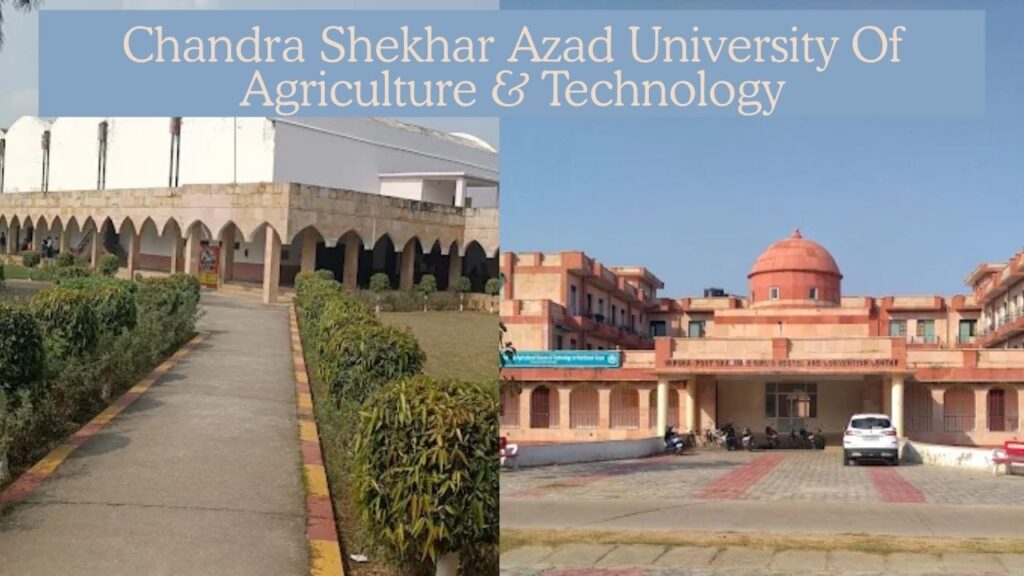
1. Chandra Shekhar Azad University — (CSAUAT), Kanpur
The CSAUAT is a leading Indian agricultural university and played a pivotal role in laying the foundation for the development of the university system of agriculture in the state right from the beginning in 1975. Located in the heart of the agro-based state of Uttar Pradesh, this Government institute has built a name for itself for a long time now.
Courses Available –B.Sc.(Hons) Agriculture, B.Tech in Dairying Technology, B.Tech Dairying, M.Sc. Agri in different specializations like Agronomy, Plant Pathology, Soil Science, and Ph.D. courses.
Fees: The B.Sc. (hons.) The annual fees of B.Sc Agriculture is about ₹1.07 lakhs per semester (The total fee is ₹4.28 lakhs for 4 years), which is very reasonable under this course. B.Tech courses are charged at about ₹1.50-1.64 lakhs per annum.
Admission: Applicants can apply if they are passed 10+2 with 50% minimum marks (with PCM/PCB subjects) and applicable for the UPCATET entrance exam. The counseling procedure is on merit.
Placement & Career Growth: It will let you earn around ₹3-5 LPA package which is quite enough for freshers. Some even receive packages as high as ₹7 LPA, depending on their skills.
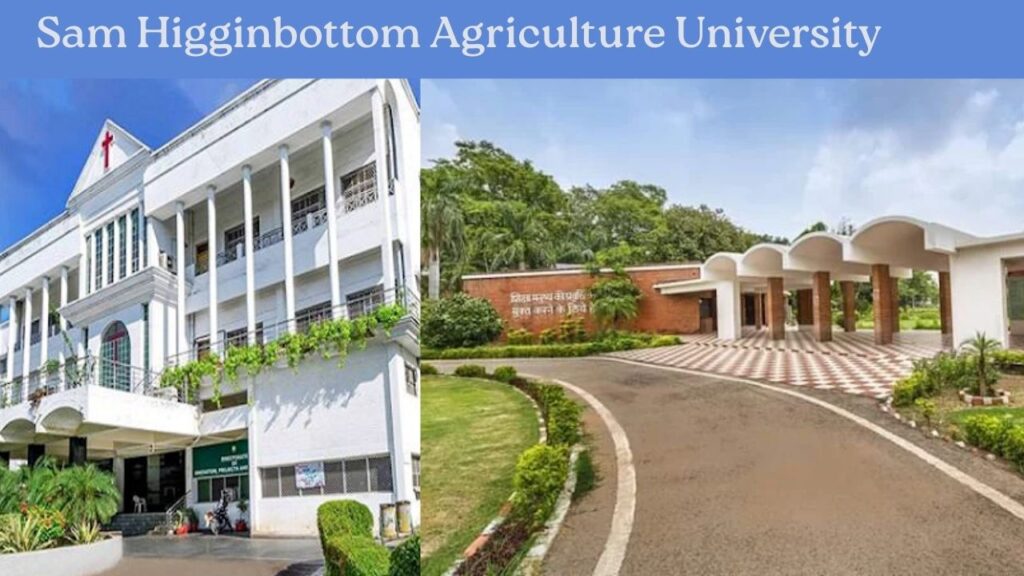
2. Sam Higginbottom Agriculture University, Prayagraj
A leading private deemed university, SHUATS is recognized for its integrated approach of farming systems and industry relevant curriculum. The campus is located at Prayagraj and has state of the art infrastructure for imparting agricultural education.
Courses are B.Sc Agriculture, B.Tech in Agricultural Engineering, M.Sc Agriculture in various disciplines, PG Diploma/ Diploma in food technology.
Fees: B.Sc. (Hons.) Agriculture fees is ₹1,08,000-1,20,000 per year at various universities in India. But SHUATS is much better when it comes to scholarships, candidates who are eligible can get waivers ranging from 30-40% on the fees, plus additional concessions for christian students.
Eligibility: Candidates must have passed 10+2 in PCM/PCMB/PCB with minimum of 45% marks. The admission is merit based on an entrance test conducted by the university, usually in the month of May.
Placement & Career Prospects: The salary package is exceptional, the one can earn around ₹6.20 lakhs. The package is based on the skills of the students that can be up to ₹3 LPA.
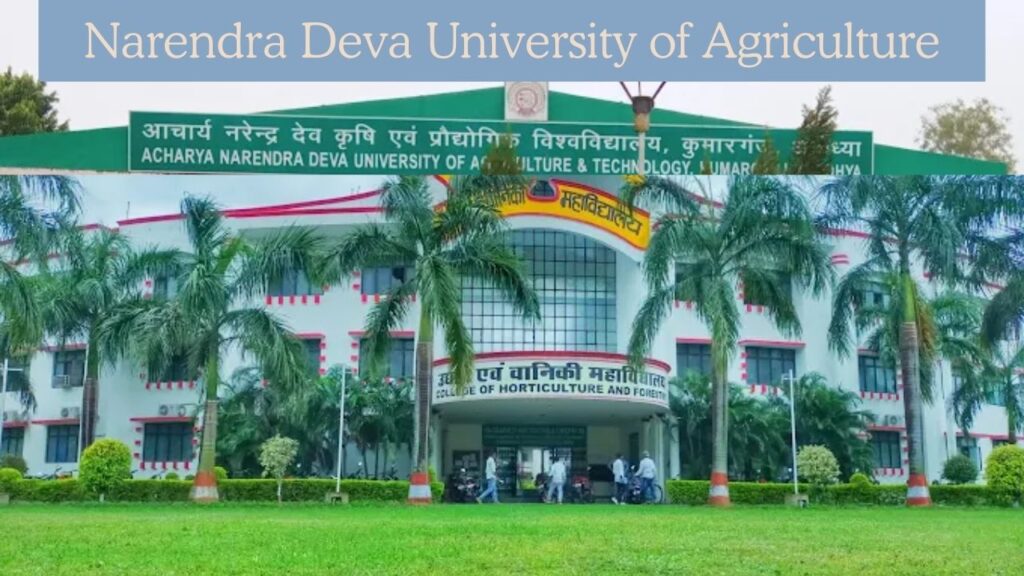
3. NDUAT — Narendra Deva University of Agriculture
The NDUAT is an agricultural university, It focuses primarily on horticulture and crop science. It is a government institution in Ayodhya and provides good quality education at low cost.
Courses available: B.Sc. (Hons) in Agriculture, B.Tech specialisations, M.Sc. courses in B.V.Sc. & A.H. (Veterinary), as well as B.F.Sc. (Forestry).
Fees: The B.Sc. (Hons.) Agriculture course fee is around ₹1.05 lakhs for 4 years, while B.Tech fees range between ₹1.64-1.70 lakhs.
Admissions: The minimum qualification is 10+2 with 50% marks in the PCB/PCM group of subjects. Admission is based on UPCATET entrance examination and then counseling on merit.
Placement & Career Prospects: The candidates who graduated have a placement with an average package of ₹3 LPA in both private and government sectors.
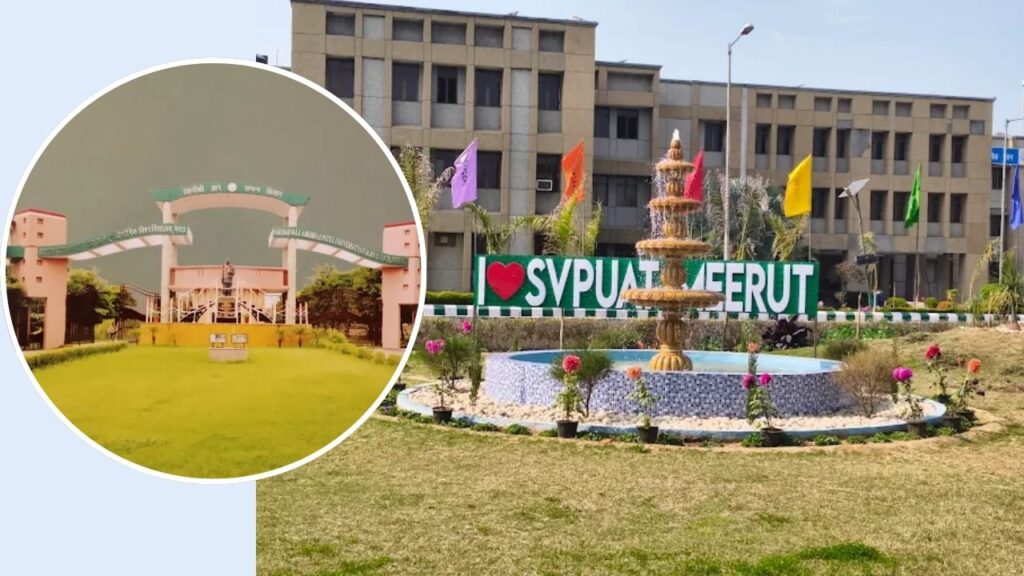
4. Sardar Vallabhbhai Patel Agriculture University
SVPUAT is the best university which is located in Meerut, making it easy for students. With all the government funding support, SVPUAT is known for its research on crop improvement and agriculture mechanization.
Fees: The fees for the whole course in AY is around ₹45,000 which is one of the cheapest in the state.
Placement: The strong ties with agribusiness companies, research institutes and government agencies enable graduates to obtain good placements.
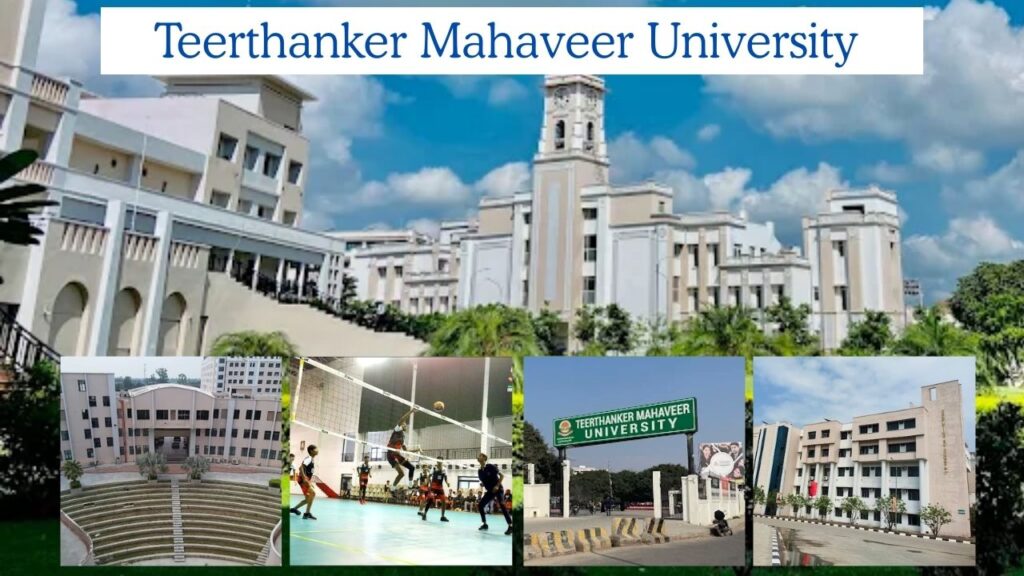
5. Teerthanker Mahaveer University (TMU), Moradabad
TMU is one of the best private universities in uttar pradesh with world class infrastructure and industry oriented syllabus.
Course Offered: B.Sc. Agriculture, M.Sc. Agriculture courses based on ICAR norms.
Fees details: The total duration of B.Sc. (Hons. ) Agriculture at TMU is 4 years The fees for B.Sc. (Hons.) The duration of B.Sc Agriculture is 3 years and for M.Sc. Agriculture 2 years. The tuition fee is Rs 45,000 per semester for MSc Agronomy.
Facilities: There are world-class labs, practical training, and strong linkages with the industry, in the university.
Understanding the UPCATET Entrance Exam
Most of the government agricultural universities in Uttar Pradesh take their admissions via UPCATET(Uttar Pradesh Combined Agriculture and Technology Entrance Test).
Here’s what you need to know:
Exam Details: The exam is held every year in offline mode by the universities. For UG courses, the exam is generally conducted in June.
Eligibility: 10+2 passed students having science subject (PCM, PCB or with Agriculture subject) with a minimum of 50% marks are eligible to apply. There is a benefit for reserved category students, they can get marks relaxation up to 5%.
Exam Pattern: The UPCATET contains 200 questions from general knowledge, agriculture science, mathematics, and English. The examination will last for 3 hours.
Age Limit: Applicants must be aged between 16-22 years for UG courses at the time of admission.
The first years of agriculture in UP colleges are generally the basic courses in crop production, soil science, plant pathology, entomology and agricultural economics. Students specialize as well, choosing from such options as horticulture, seed technology, agricultural extension, agricultural engineering.
A number of courses have fieldwork components and the Rural Agricultural Work Experience (RAWE) allows students to work with farmers as they confront challenges of farming in the field.
Career Growth & Salary Package
There are many opportunities for the graduates of agriculture. For the freshers agriculture college students —- the packages will be near about ₹20,000-35,000 per month for job profiles like agricultural assistant and farm supervisor etc in the entry level The amount varies with the university from which students have passed.
Professionals at an intermediate level with 2-3 years of experience can earn around ₹40,000-60,000 per month. The salary of Agriculture Officer or Agriculture Development Officer in the government lies between 35,000 – 60,000 Rs per month.
Conclusion
Selecting an agriculture college in Uttar Pradesh is all about shaping the future of India. Be it a renowned government college like CSAUAT or a up-to-the-minute private university like SHUATS, you will find a route that leads you both with practical experience in the real world of life and a theoretical academic purity.
With manageable fees, quality faculty, research opportunities and robust placements, the agriculture colleges in UP prove to be the best when it comes to anyone with a zeal and passion to bring a change in the agriculture scenario of India.
TheBoard of Technical Education Uttar Pradesh has released the 2025 result for the even-semester examination which was held between May–June 2025. Candidates who are present in this exam can check the BTEUP Result 2025. Go to the official website to download your scorecard or go through the direct link for the main exam result 2025 mentioned in the article.
Students must know their registration number and date of birth to enter on the login page. After logging, your result will be shown. Candidates can also visit the login page with a direct result link.
Go to the official website of BTEUP.
BETUP Result 2025 will be displayed on the homepage of the website.
Click on it and enter your necessary details.
Submit the details to log in to your account.
The result will be shown on the screen, and you can download and save it on your device.
Candidate’s Name, Roll Number, Exam Name & Centre, Marks Total & Obtained, Percentage, Result Status. Candidates must have entered the correct details to get their results.
Students of Periyar University’s wait is over as it declared the result 2025 on its official website. Periyar University Result 2025 is available, students can check the scores of UG & PG exams conducted in February & April 2025, and download them from the direct link given below. Courses included BA, BSc, BCom, MA, MSc, MCom, BBA, and BCA results out now.
The Periyar University result is crucial for higher studies admissions. For Students who want to enter professional programs, or apply for a job, this mark sheet will serve as proof of your best academic qualification.
The Indian Institutes of Technology (IITs) have yet again proven their exceptional placement performance in 2025, with Top Companies in IIT vying for the brightest minds from India’s top engineering colleges. This year’s placement season has seen a wide range of records being broken, record high salary packages, more international offers, and companies from more diverse sectors attending the campus recruitment drives. So here’s a (rough) full picture of which companies are recruiting picking up on which salary issues, and the trends within the ever-morphing IIT scene.
Record-Breaking Numbers and Overall Trends
The very fact the 2024-25 placement season has been outstanding for IIT students appears to be an under-statement. As per the latest official figures, top IITs like IIT Delhi and Bombay have received over 1,200 job offers each, and more than 1,150 unique students have been placed in the first phase alone. What’s more heartening is the jump in offers in all salary buckets including the premium packages of more than one crore per annum. For instance, IIT Bombay has received 22 offers beyond the one crore mark in 2024-25 as against 16 in the previous year, a stupendous rise of 37.5%.
The highest salary package in India among IITs hovered at a staggering ₹2.2 crore per annum, offered by Da Vinci Derivatives, an IIT Bombay CSE student for a position at Amsterdam. Meanwhile, the international packages have gone even higher at the top IITs, with the highest international offer at IIT Bombay at ₹3.67 crore per annum. These figures signify an exceptionally lucrative market for the IIT graduates in India as well as abroad.
The Tech Giants Lead the Charge
With reference to hires from IITs, the large tech firms continue to dominate. Microsoft, Google, Amazon, Apple, Meta and Qualcomm are the biggest recruiters in pretty much all the IITs. These companies — known as the MAANG or FAANG firms — compete fiercely for talent and are willing pay top packages for it.
At IITB, it was again Google, Microsoft, Amazon and NVIDIA that turned out to be the biggest hiring companies. IITB reports suggest, M.Tech CSE students from IIT Bombay got offers in the range of ₹30 to ₹46 LPA with an average of ₹30 LPA. The CSE students at IIT Delhi received even higher average packages, hovering at around ₹34 LPA and with maximum figures reaching as high as ₹48 LPA from Google, Microsoft and Atlassian.
Emerging Sectors and Diverse Opportunities
While technology continues to dominate recruitment, the 2025 placements season saw a considerable number of hiring from the finance, consulting, and core engineering domains. At IIT Delhi, the placement breakup shows that 34% of the total placement was in core technical companies, followed by
IT – 20%,
Consulting – 14% and
Management – 13%.
This diversification is indicative of a changing career landscape for IIT graduates.
In the finance and consulting arena, companies such as Goldman Sachs, BCG (Boston Consulting Group), McKinsey, JP Morgan Chase, Barclays and American Express are well represented on IIT campuses. These firms provide typical packages between ₹35 and ₹45 LPA for beginners, with substantial growth in the money for high performers.
There is now a trend in salaries in 2025 toward increasing when compared to past years. The average package offered by IIT Bombay rose from ₹21.8 LPA in 2023-24 to ₹23.5 LPA in 2024-25 – an increment of 7.7%. The average package reported by IIT Delhi is around ₹32 LPA for all programmes with an average of around ₹21.9 LPA being offered to BTech students and ₹32 LPA to MTech students. Students at IIT Kanpur were offered an average package of ₹ 26.27 LPA and IIT Madras continues to keep its average package competitive at approximately ₹17-20 LPA for all its programmes.
Interesting is also how salaries differ depending on branch. The best packages are still offered to Computer Science and Engineering (CSE), for which the median predefined offers also exceed ₹30 LPA at top IITs. After that comes Electrical Engineering and then mechanical, civil engineering students generally get packages between ₹15-25 LPA based on which sector they go for.
Global Opportunities and International Offers
Among the most eye-popping trends in the 2025 placement season has been the uptick in overseas offers. With all-India (national) offers counting towards overall highest packages, IIT Delhi witnessed more than 50 international offers in Phase 1 from over 15 companies across countries including USA, Japan, Netherlands, South Korea, Taiwan, UAE, and the UK. This indicates rising global demand and better pay packages for graduate-level engineers from India, as well as multinational companies increasingly hiring IIT graduates for global roles.
The salaries of firms providing roles for the international are notably higher, which is between 30-50% increase on domestic norms especially for roles in developed countries. The offer by Da Vinci Derivatives of ₹3.67 crore for an Amsterdam is an illustration of this trend.
Recruitment has gotten more and more multifaceted. Although software development engineers and data scientists are paid the most in the tech industry, core engineering roles, especially at companies such as Tata, Reliance, BPCL and Schlumberger, lure students focused on manufacturing, energy and infrastructure.
Public sector undertakings (PSUs): Organisations PSU are – ISRO, DRDO, BARC they always remain to be answer to bring in the best brains, it’s just the pay package is slightly low, but they offer Job Security, Prestige, and for those who want to make a long term career they offer Career Growth.
Zomato, Ola, Swiggy, Flipkart and other startups/unicorns have also been leading recruiters, especially for those students who are attracted to growing-stage companies and entrepreneurial environments. These companies usually have competitive packages including stock options and have energetic work cultures.
Lowest Packages and Market Reality For IITians
While the highest salaries make the headlines, it is essential to look at the overall picture. At IIT Bombay, the lowest packages were reported at ₹4 LPA for the year 2024-25, a steep fall from the ₹5.4 LPA in the previous year. This decrease is indicative of the tightening recruitment at entry level by companies and the influence of economic cycles on entry-level jobs in certain industries.
Tips for IIT Students in the Current Job Market
IIT students now who are about to go in for placements can glean quite a few pointers from 2025 trends.
For one, technical excellence and programming ability especially would be unlikely to diminish for technology roles.
Second, gaining domain knowledge through internships greatly enhances placement potential– internship conversion rates to PPOs (Pre-Placement Offer) continue to be robust at most IITs.
Third, the increasing number of AI and data analytics positions means that skills in machine learning and data science can be extremely useful.
And finally, don’t forget that foreign opportunities may lead to significantly better paychecks and career advancement.
Conclusion
The placement seasons of IIT’s in 2024-25 can undoubtedly be called as a landmark year with the highest ever packages, varied sectoral participation and opportunities extending across the globe. With companies such as Microsoft, Google, Amazon, and Goldman Sachs battling for top talent and average pay packages trending upward, IIT graduates continue to be among the most in-demand professionals in India and beyond.
Adaptable, knowledgeable, and able to think critically—even in the face of rapidly changing landscapes in higher education and the corporate world— these qualities among others that IIT students possess which ensures that they are valuable assets to employers across the globe.
For prospective engineers dreaming of trying out for IIT admissions, these placement trends act as a strong inspiration showing how great career and financial benefits await them, down the line, if they make it to these premier institutions.
Students must be aware of the entire IIT BHU fee structure if they are planning to pursue the B.Tech degree for 4 years, as the Institute operates on an income- and category-based system. IIT BHU is considered one of the best value for money engineering colleges in India with good placements and govt backed fee waivers and the fee is moderate as compared to many other IITs.
The overall academic fee for four years for General/OBC/EWS students having an annual family income of more than ₹5 lakh is almost ₹10.4 lakh, while due to hefty tuition fee waivers, the students coming from lower income groups or reserved categories are charged a lot less. Students should also keep in mind that in addition to tuition realistic these fees are as well as hostel and mess charges while calculating up the actual four-year budget.
IIT BHU B.Tech Fees Overview
IIT BHU (Varanasi) has a caste cum income-based fee structure and hence what you have to pay depends both on your caste category as well as your annual income. Academic fees include the fees for tuition, examination, registration, hostel seat rent and other institutional charges, but mess fees must be paid separately every semester.
For a General/OBC/EWS student with income above ₹5 lakh per annum, the total academic cost for 4 years of B.Tech (not including mess and personal expenses) comes to around ₹10.41 lakh. The addition of hostel and mess makes the true 4 year cost regularly cross ₹11.5-12 lakh, based on yearly revisions and your lifestyle.
IIT BHU B.Tech Fees Fee Structure Table
The following is the approximate fee structure of B.Tech course of IIT BHU for 4 years for various categories and income slabs (Mess charges are not included). These figures are for indicative purpose for 2025-entry students and are subject to minor changes in future circulars.
Category
Admission Cost
Semester Fee
First-Year Total
4-Year Total
GEN/OBC/EWS with Income less than ₹5L
₹15,750
₹1,06,350
₹1,21,600
₹10,00,000
GEN/OBC/EWS with Income less than ₹1-5L
₹15,750
₹39,683
₹54,933
~₹3,20,000
GEN/OBC/EWS with Income less than ₹1L
₹15,750
₹6,350
₹21,600
~₹50,000
SC/ST/PwD with no income limitations
₹15,750
₹6,050
₹21,300
~₹48,000
Fee Structure in More Detailed Way
One-Time Charges at Admission
₹5,750
Refundable Deposits at Admission
₹9,000
Tuition Fee
₹1,00,000
Additional Charges
₹16,500 per semester
Realistic Budget: Academic + Hostel + Mess
While academic fees only are quoted in brochures, parents should calculate fees with hostel and mess included so as to not suffer a financial shock later. IIT BHU Hostel fee (seat rent plus utilities) is very nominal compared to fees, but mess bills are a hefty recurring cost.
Seat rent for the hostel and utilities: a few thousand rupees per semester (added to the normal semester fee).
Mess advance: usually ₹15,000–17,000 a semester – rates depend on the mess committee.
Estimated four-year mess cost: ₹1.2–1.4 lakh (based on eight regular semesters and modest inflation has been taken into account).
General/OBC/EWS Candidates who have their house income less than 5 lakh have a good all inclusive practical 4 year budget (academics+hostel+mess) would be around 12 lakh.
This is the lower fee budget particularly for those who receive full or partial tuition waivers, students with lower-income can have a shot at IIT BHU.
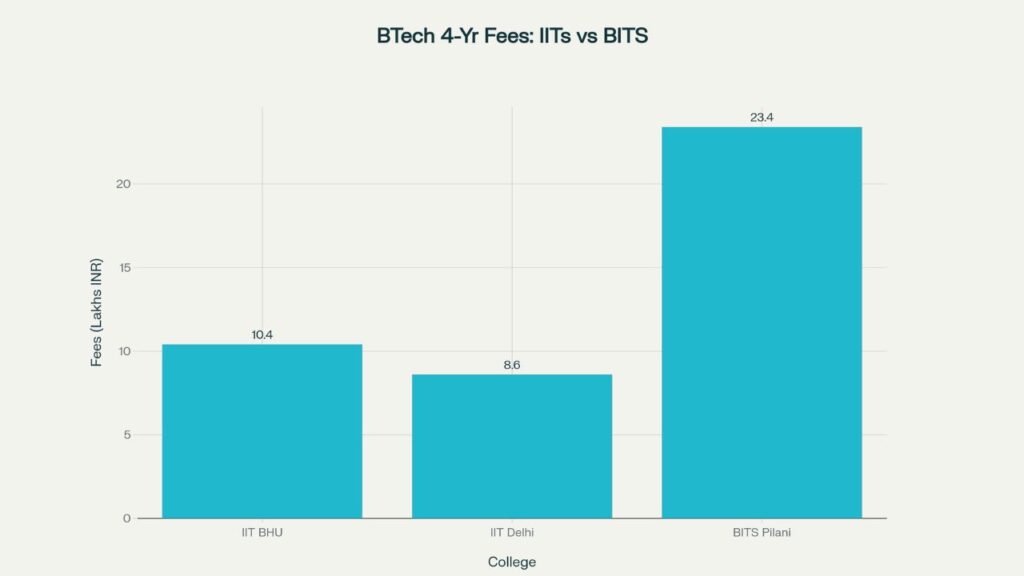
In order to get a sense of how affordable IIT BHU is, it makes sense to compare its 4-year B.Tech fee with that at other reputed institutes like IIT Delhi and BITS Pilani. The following amounts (approximates) are for General/OBC/EWS students with income above ₹5 lakh per year and do not include hostel/mess.
Both IIT BHU and IIT Delhi receive government subsidies that make the cost of tuition approximately ₹8–10 lakh for 4 years.
Since BITS Pilani is a private deemed institution the fees are much higher, the total cost for 4 years (including hostel and mess) can easily cross ₹22-24 lakh.
Fee Comparison With IIT Delhi And BITS Pilani
4-year BTech Academic Fee Comparison (2025)
IIT BHU and IIT Delhi 4-year fees are about ₹10.4 lakh and ₹8.6 lakh respectively for the same duration. Meanwhile, tuition fees at BITS Pilani vary from ₹19 lakh to ₹22 lakh for 4 years, not inclusive of inflation and full residential expenses.
For students who are granted income-based fee waiver or belong to SC/ST/PwD categories, IIT BHU becomes significantly better option over private colleges, as their burden of tuition fees is substantially reduced or waived off. This balance of modest fees, good placements and central government support is what makes IIT BHU one of the best ROI engineering options now available in India.
Conclusion
The B.Tech fee at IIT BHU is kept as per the income slabs of students, Hindi Medium assistance patches are provided. With substantial waivers for economically backward sections and SC/ST/PwD students, and government subsidies making the aggregate academic fee lesser than most of the premier institutes, IIT BHU promises one of the best ROI among the top engineering colleges.
The bottomline is that the 4-years cost of attendance remains affordable when compared to private institutes like BITS Pilani, whose fees can run to almost twice this amount, even after adding hostel and mess charges. If you are a student who wants a good mix of fees, quality education with good placements, IIT BHU is a very cost-effective and future proof bet.