NTA UGC NET JRF Online Form 2026: Last Date, Fees, Eligibility and How to Apply

NTA UGC NET JRF Online Form

NTA UGC NET JRF online form is open for candidates who have Master’s degree or equivalent through the official NTA website. The form will not be accepted after 28 October 2026 so fill the form quickly if you also want to sit in the exam. The exam will be held after two months when the application gets closed.

The National Testing Agency released the notification and opened the application on 8 October 2026. Anyone who misses it can still apply between 29 and 31 October by paying a late fee of ₹500, with the last successful transaction on 31 October. After that, there is no form to fill at all.

NTA opens a correction window after all the applications are submitted so any mistakes in the application form can be fixed between 2 and 4 November. But try to fill in the correct information at once because some fields are usually locked during correction.

The computer-based test runs from 14 to 19 December 2026. NTA has not yet announced exam city intimation, admit card release, answer key or result dates. Those will appear on the official site. The dates are also described as tentative in the notification, so keep checking the NTA site.

EventDate
Online applications openOctober 8, 2026
Regular application and fee deadlineOctober 28, 2026
Late application window (₹500 late fee)October 29–31, 2026
Form correction windowNovember 2–4, 2026
UGC NET December 2026 examDecember 14–19, 2026
Exam city and admit card datesTo be announced

Who Can Fill the NTA UGC NET JRF Online Form

The basic requirement is a Master’s degree or equivalent. General, General-EWS and unreserved candidates need at least 55% marks, without rounding off. OBC-NCL, SC, ST, PwD/PwBD and third-gender candidates need 50%.

Final-year Master’s students and those awaiting results can apply too. They are admitted provisionally and get JRF or Assistant Professor eligibility only after passing with the required percentage.

Age matters only for the fellowship. Upper limit for JRF — 30 years

Age relaxation of OBC-NCL, SC, ST, PwD/PwBD and third-gender, women, and experienced get 5 years. An LL.M. degree earns 3 years. Assistant Professor eligibility and Ph.D. admission have no upper age limit.

NET is not a recruitment drive, and there is no fixed vacancy count. NTA qualifies roughly 6% of the candidates who appear for Assistant Professor eligibility. Within that group, the JRF cutoff is higher, so a “pass” can still leave you without the fellowship.

Read More 👉 ITBP Head Constable Education & Stress Counsellor Recruitment 2026 Online Form For 16 Post

JRF Online Form Fees

General/unreserved₹1,150
General-EWS and OBC-NCL₹600
SC, ST, third-gender and PwD/PwBD₹325

The fees will not be refunded by NTA once the form is filled and submitted successfully. So fill carefully and don’t try to fill at the last minute.

How to Fill the NET JRF Online Form

  1. Start on ugcnet.nta.nic.in and open the December 2026 application link. 
  2. You need a mobile number and email that belong to you, since NTA sends all communication there, along with your Master’s marksheet.
  3. Registration now runs through the Meri Pehchaan (National Single Sign-On) platform, so create or log in to that account first. 
  4. Enter your personal and educational details, upload a live photograph and signature, review everything, pay the fee, and submit. 
  5. Download the confirmation page and keep it. You’ll need it later.

Keep your documents ready before you begin: 

A photograph of 10-200 KB showing about 80% of your face, ears included, on a white background is required. The signature file must be 10-50 KB. Category or disability certificates go in as PDFs, and the disability certificate must be 50-300 KB. Rejected uploads are the commonest reason for a stalled form, so resize files before you start.

Documents and payment must be submitted carefully without any error. Only completing Step 1 and 2 leave your application ignored.

Exam Pattern and Preparation 

The question paper has two parts. One part is covered with common questions to access the knowledge and research of teachers. There are a total of 50 questions that come from aptitude, reasoning, reading comprehension, and general knowledge. The second part is covered with 100 questions from the subject you select. There is no negative marking so don’t leave the question and the test is worth 200 marks altogether.

If you wanna finish in time then try to solve each question in 72 seconds. Check previous year papers and practice mock tests because it will increase your time to solve one question. You will get only 180 minutes for this paper.

Read More 👉RRB Station Master: Syllabus, Exam Pattern & Selection Process

Conclusion

Complete the application form by October 28. Upload the documents first and your information on the desk. Complete the application form by submitting the fee and prepare for the exam. The examination city will be announced soon on the official website. 

Check out their time-to-time for latest updates and admit cards because it is the entry card for your entrance in the examination hall. Give the exam carefully and wait for the result.
Leave a Comment

Your email address will not be published. Required fields are marked *

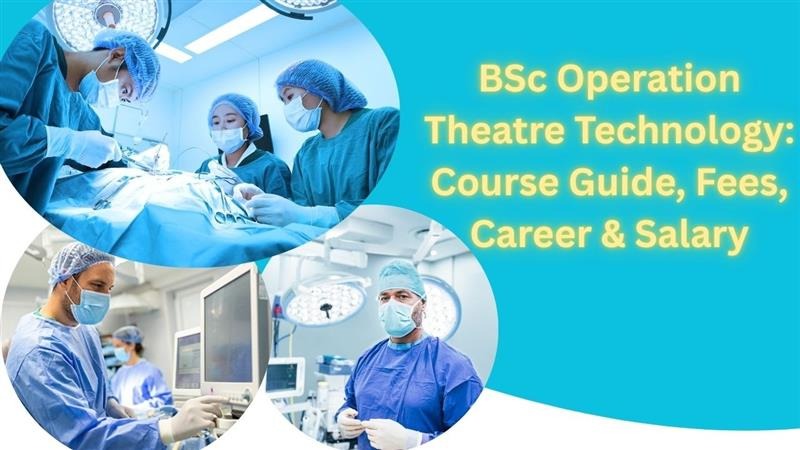
BSc Operation Theatre Technology: Course Guide, Fees, Career & Salary

BSc Operation Theatre Technology

If you’ve ever seen a surgical scene in a film, the camera almost always lingers on the surgeon. While behind every successful operation, there is a team, who make everything run smoothly silently in the background. One of the most vital members of the team is Operation Theatre Technologists. Degree in BSc Operation Theatre Technology (BSc OTT) trains students to undertake this pivotal position in the healthcare organisation. 

It is a professional undergraduate course for aspirants who wish to collaborate with surgeons, anesthesiologists and nurses within the operating room. From instrument preparation to ensuring sterility to direct procedure support, OT technologists are paramount to patient safety and managing successful surgeries.

For the students who are interested in medicine but do not want to do MBBS, BSc Operation Theatre Technology course has emerged as a very lucrative career option with rising demand in hospitals across India and abroad. 

What is BSc Operation Theatre Technology About?

BSc OTT (BSc Operation Theatre Technology) is an undergraduate course which makes you ready to be the backbone of surgeries. OT professionals ensure the operating theater is clean, equipment works flawlessly and patients are protected during their surgical journey, above and beyond what the surgeons have time to do themselves. The training enables you to work as a surgical technologist with surgeons and anesthesiologists in the operating room, as a surgical instrument sterilizer, and an assistive user of the advanced technology on which today’s surgical procedures rely.Consider it the technical conductor of an orchestra where every instrument must play perfectly in time. 

Course Duration and Structure: What to Expect

This is the interesting part and also the part you should keep a very close eye on because it changes depending on where you study.

Standard Duration: BSc Operation Theatre Technology is a 3-year course and accompanied by the attendance of a 6 month to 1 year mandatory internship.However, a few top listed universities such as SRM University, Apollo University provide the option of pursuing it as a 4 year course.Professional training in anesthesia technology is provided along with OT management. 

Welcome to Year 1, Are you ready to make a start all you need to do is dust off your knowledge for the big four; Anatomy, Physiology, Biochemistry and Microbiology. But it’s not like just cramming textbooks. You will also begin to understand more general nursing principles, as well as the language that healthcare professionals really speak on a daily basis. Think of it as learning to walk before you run.

The second year is when things start to get a bit more “real”. You’ll advance into pharmacology, gain surgical skills, and for the first time — enter the realm of OT management and sterilization techniques. That’s when you start to realize how all that stuff you learned in Year 1 actually relates to what takes place in an operating room.

Year 3 is where it gets real. You will be learning advanced surgical procedures, anesthetic methods and intensive care. There’s a similar emphasis on quality control, because in medicine, precision and responsibility aren’t optional, they are everything.

Then you do the Internship and that is where everything changes. No more simulations. No more hypotheticals. You’ll be in a real hospital operating theatre, assisting in real surgeries on real patients. Yes, it’s intense. And I was tested in ways I never thought I would be. After all, it is the final stage of your training, but also the most important one, because this is when you stop being a trainee and start becoming a practitioner.  

Are You Eligible For BSc Operation Theatre Technology?

Check your qualification before applying for the admission into this course, Here’s what you need based on official university guidelines:

Educational Background: You need to have done Class 12 (10+2) in Science stream with Physics, Chemistry And Biology (PCB) as core subjects. Some universities allow Mathematics instead of Biology, but the latter is the better choice.

Minimum Marks: Most organizations expect you to have minimum 50% aggregate marks in your PCB. While 55% and 60% needed for the top colleges like AIIMS Delhi and Brainware University.

Age Limit: Starting from 17 and the upper age limit is usually 40 years, with 5% relaxation for reserved categories.

Medical Fitness: A compulsory medical certificate of fitness from a government medical officer must make sense since you’ll be hectoring life. 

Admission Process: How to Get In

If you’ve been panicking over entrance exams, here’s some relief. The cut throat competition is not that much higher as compared to BSc Operation Theatre Technology when it comes to MBBS seats. It’s really not too bad if you know what to expect.

For most colleges, both government and private, it all boils down to your Class 12 PCB percentage. That’s it. If you work hard in your board exams, that work directly opens doors for you here. No complicated formulas, no years of entrance prep — just your actual academic performance talking.

A few universities want to play it their own way. There is no one all India entrance test for BSc Operation Theatre Technology but a few institutions/universities conduct their own tests or they accept students based on their CUET scores for admission. 

Course Fee

As we all presume that it’s not always a career choice that’s based on passion, but also what makes practical sense for you and your family. 

BSc Operation Theatre Technology fees: The good news here is BSc Operation Theatre Technology is really one of the less costly healthcare courses you will find anywhere, more so if you get a government college seat. We’re talking anywhere from ₹10,000 to ₹50,000 per annum and that is fairly affordable when you compare with most private medical courses. For a lot of students, this is what separates the dream from the doable. 

Private colleges have, as one would expect, a more varied selection. Most are in the range of ₹50,000 to ₹2,50,000 per annum, but among the premium institutions the total cost of the course can go up to ₹10 lakhs for the entire programme. 

That’s a big cost, so you should consider what you’re getting in return — facilities, faculty, hospital partnerships, and placement assistance all make a difference. Other expenses like books and hostel costs are not included in these fees.

A majority of the government hospitals and colleges provide scholarships or stipends for pursuing internships. It is helpful for taking ideas on how things work. So look into what assistance you’re eligible for before you commit anything. That one conversation or Google search could save you a pretty meaningful amount of money over four years. 

Where Can Your Career Take You?

Here’s where your heart might skip a beat (and I mean that in the best possible way). The Indian healthcare sector is booming and OT technologists are highly demanded.

  • OT Technician/Technologist: Your main role will be to assist in surgeries and help in the theatre
  • Anesthesia Technologist: Role required to keep monitor patients and machines.
  • Surgical Assistant: Assisting doctors/surgeons during operations.
  • CSSD Technician: Crucial industrial service in central sterile supply departments
  • Emergency Care Technician: Managing Critical Care and Trauma Cases 

Salary Expectations

You can have a good career in this field and it no doubt grows much better with intense experience. For freshers 0-1 years experienced, they get paid from 15k to 25k in government hospitals with job security, pension and all other benefits.

Private hospitals salary ranges from minimum 20k to 35k and maximum 40k in top corporate chains.

₹ 30,000 to ₹ 50,000 per month – With 2 to 5 years Experience Team leader Position holders And Private sector job holders.

Senior Experienced – If you are a senior with 5+ years of experience, you can earn anywhere between 50,000 to 80,000+ Rs per month, be it managerial role or any other specialized area. So, this just build up that how much you can get financial support and more out of this career.  

Read More:- Bihar BPSC APO Recruitment 2026: Eligibility, Vacancy & Apply Online

The Next Step After BSc Operation Theatre Technology Course

Having gained experience in BSc Operation Theatre Technology, expanses of job associated with go up in professional life are endless. Experts may become teachers to mentor and educate students who want to become OT technologists, or they may apply their skills in medical equipment sales, with firms such as Siemens or GE Healthcare, which can be quite rewarding. 

Also, a career in hospital management through MBA in Hospital Management can lead to the door to the top management. 

Specialization is also a viable option for career growth with specialized certifications in robotic surgery, endoscopy and critical care. Learning always pays off for career growth. 

Postgraduate studies such as MSc in Operation Theatre Technology or Anesthesia Technology allow individuals to take on advanced clinical roles, while MBA in Hospital Administration qualifies one for leadership opportunities. 

PG Diplomas in Critical Care or specific Surgical Procedures, along with Certifications in Robotic Surgery, Laparoscopy or Medical Coding, also enhance the career prospects. It is through these career paths that professionals can grow both personally and professionally but at the same time make a meaningful impact on the healthcare sector. 

Conclusion

BSc Operation Theatre Technology is not only a degree, it’s an opportunity to be a crucial part of life saving surgeries. With the healthcare industry in India expected to grow to $638 billion by 2025 and the medical device market expanding at 28% per year, the need for talented OT practitioners is strengthening.

You’ll be at the heart of the hospital, seeing medical miracles every day, and have a stable, respectable career with real upward mobility. If you envisage a career in India’s best AIIMS hospitals or want to work abroad, this degree takes you there.

The operating room isn’t for everyone—it’s stressful, physically and mentally exhausting, and you have to be totally exact. But for those who have the passion for healthcare and the disposition to work in a high-pressure set-up, BSc Operation Theatre Technology provides a career path, that allows you to make a difference in the lives of patients — each and every day. 

Leave a Comment

Your email address will not be published. Required fields are marked *

Technical Government Jobs in India: A Complete Guide for Engineers and Diploma Holders

Technical Government Jobs in India

If you are looking for Technical Government Jobs in India, that means you must prepare yourself for a high salary, additional benefits, respect from society, and a secure future. But it does cost you fun and time since absolute dedication is the key for securing a position among lakhs of aspiring candidates. 

SSC JE, RRB JE, state PWD recruitment happen every year to fill thousands of vacancies. But the paths of every engineer is different, someone who wants a Railway JE posting is preparing for a completely different life than someone chasing an ISRO Scientist/Engineer role. This guide will help you understand these paths and what fits you right.

SSC JE (Junior Engineer): The Most Common Entry Point

The Staff Selection Commission’s Junior Engineer exam is where most Civil, Mechanical, and Electrical engineering graduates start. It recruits for departments like CPWD, MES, BRO, and the Central Water Commission. The exam runs in two stages — Paper 1 is objective (general knowledge, reasoning, and technical subjects), Paper 2 is a more detailed technical paper based on your branch.

The appeal of SSC JE is its predictability. The syllabus barely changes year to year, previous papers are widely available, and postings tend to be closer to home compared to Railways or Defence roles. Pay lands in the Level-6 pay matrix, roughly ₹35,000–₹40,000 in-hand after allowances, depending on posting city and department. The catch is that promotions are slow — a JE can spend eight to ten years before moving to Assistant Engineer, and that stagnation is the number one complaint from people already in the role.

RRB JE and RRB ALP: Railways’ Technical Backbone

Railways run two separate technical recruitment tracks that people often confuse. RRB JE (Junior Engineer) is for those wanting supervisory technical roles maintaining tracks, signals, electrical systems, or bridges. RRB ALP (Assistant Loco Pilot) is a different animal entirely — it’s the entry point to actually driving trains, and it comes with its own physical and psychometric tests beyond the written exam.

Railways technical postings come with perks civilians don’t always factor in — free or discounted travel passes, quarters in many postings, and a pension structure that’s still meaningfully better than most PSU jobs. But the tradeoff is posting uncertainty. A Railway JE from Lucknow could easily end up posted in a remote section in Northeast Frontier Railway for the first few years, and that’s something aspirants researching only the syllabus tend to overlook.

Read More 👉 Government Jobs After Graduation in India: Complete Guide for 2026

Defence Technical Entries: Army, Navy, and Air Force

This is where things diverge sharply from civilian technical jobs. The Indian Army’s SSC Technical entry (the batch numbering keeps advancing — the 68th course cycle, for instance, recruits engineering graduates directly as officers into the Corps of Engineers, Signals, or EME, skipping the JCO/NCO route entirely). Unlike SSC JE or Railways, this isn’t a desk-adjacent technical job — it’s a commissioned officer role with military training at OTA Chennai before the technical posting even begins.

The Navy and Air Force run parallel technical officer entries — the Navy’s Short Service Commission (Executive/Technical branches) and the Air Force’s Technical Branch through AFCAT. Pay here is structured differently too — officers get a fixed pay scale plus Military Service Pay and allowances that push in-hand compensation well above equivalent civilian technical roles, sometimes crossing ₹1 lakh a month for junior officers once field and flying allowances are added. What people don’t talk about enough is the SSC (Short Service Commission) design itself — these are typically 10-14 year engagements, not permanent careers, and the transition back to civilian technical work afterward needs its own planning.

PSU Technical Recruitment: ONGC, NTPC, ISRO, DRDO

Public Sector Undertakings run their own technical recruitment, separate from SSC or UPSC, and this is genuinely the highest-paying bracket in government technical work. ONGC and NTPC recruit through GATE scores directly — no separate written exam, which is a huge relief for anyone who’s already invested a year preparing for GATE for M.Tech admissions anyway. 

Starting packages at Maharatna PSUs like ONGC or NTPC can cross ₹10-12 lakh per annum for a fresh Graduate Engineer Trainee, which is a different league from the ₹4-5 lakh range typical of SSC JE roles.

ISRO and DRDO sit in their own category — Scientist/Engineer ‘SC’ recruitment through GATE or their own written exam (ISRO doesn’t accept GATE scores for most positions and runs an independent test). These aren’t just jobs, they’re research-adjacent careers, and the selection bar reflects that — competition is brutal, and the interview process digs deep into core subject knowledge rather than generic aptitude.

Read More 👉 Indian Army SSC Technical 68th Men Recruitment: Details for Engineering Graduates

State Engineering Services: PWD, Irrigation, and Jal Nigam

Every state runs its own Assistant Engineer (AE) and Junior Engineer (JE) recruitment through its Public Service Commission or a dedicated recruitment board — UP has UPPSC and UPSSSC running parallel tracks, for instance. These roles are attractive to candidates who prioritize staying within their home state over chasing an all-India posting, and the pay, while modest at the JE level, comes with strong long-term security and a clearer path into the state’s engineering cadre hierarchy.

The tradeoff here is exam frequency and vacancy unpredictability — state-level technical recruitment doesn’t run on the same predictable annual cycle as SSC or Railways, and vacancies can be sparse in years when the state government is tightening hiring.

Which Path Actually Fits You?

If you want to enter a government sector for a stable career, choose SSC JE which is best for everyone. If you are looking for a higher salary and you can secure a good GATE score then PSU roles are good options. 

If leadership, discipline, and a fixed-term high-intensity career appeal to you, Defence technical entry is a completely different but rewarding route — just go in knowing it’s a commission, not a permanent civilian job. And if roots matter more than reach, state engineering services quietly remain the most underrated option on this list.

Conclusion of Technical Government Job

Technical Government Job in India offer a secure future which can be prestigious in this time. Private jobs don’t give high salary and long-term stability but the government sector offers engineering roles in every department including the country’s infrastructure, transportation, defence, and scientific progress.

Before beginning your preparation, understand every detail that is required to beat the exam. It will also help you pick the path that aligns with your strengths and interests. Staying consistent is the key for rewarding a technical career.

Leave a Comment

Your email address will not be published. Required fields are marked *

Data Science vs AI: Which Career Is Better?  

Data Science vs AI

Students in this generation really got stuck on choosing a stable career. In India, the choice is not limited between doctor or engineer anymore, there are a lot of options such as Data Science and Artificial Intelligence. Both are growing fields that offer wider opportunities. Continue reading to understand why Data Science vs AI comparison is important.

Most students couldn’t differentiate these two courses since they are somehow interconnected, every AI engineer needs data science fundamentals, and every good data scientist today is expected to know basic machine learning but work responsibilities, eligibility, and salary is different.

What Data Science Really Involves

Data Science, at its core, is about making sense of information that already exists. You’re looking at sales numbers, customer behaviour, hospital records, whatever the industry, and pulling out patterns that help a business make a decision. 

Data scientists at Paytm or JPMorgan often involve arranging raw data using manual coding and models to analyze trends, behaviour, and developing dashboards that allows managers to anticipate what might happen in the following quarter. The job depends a lot on statistics, SQL, Python and increasingly on data visualization tools to turn complex datasets into actionable insights. 

What AI Really Involves

Artificial Intelligence, on the other hand, is a trained model to automatically read data and process it without needing to be handled manually by any human. If Data Science is about interpreting the past, AI is about building machines that can act in the present or future. 

This includes machine learning models, deep learning, computer vision, natural language processing, and now heavily, generative AI and agentic systems. An AI engineer is more of a software builder than an analyst because constructing an AI model that not only reads data but also processes it with its own brain. 

Eligibility: Who Can Actually Get In

For Data Science Courses

The eligibility bar is comparatively relaxed. If you’ve cleared class 12 with Maths, Statistics, or Computer Science as a core subject, you can walk straight into a B.Tech, BSc or BCA in Data Science. 

For postgraduate programs, you need a bachelor’s degree in engineering, science, commerce, or even economics, along with basic statistics knowledge. This is why so many commerce and arts graduates in India are successfully switching into data roles through PG diplomas.

For AI Courses

AI is stricter about your technical background. Most AI degree programs, especially the IIT B.Tech in Artificial Intelligence, expect you to clear JEE Advanced, which means your foundation in Maths and Physics has to be genuinely strong from school itself. 

For M.Tech and PG-level AI programs, GATE scores are usually mandatory, and the cutoffs at institutes like IIT Patna and IIT Kharagpur are competitive. 

If you’re coming from a non-technical background, entering AI usually means starting with an online certification first and building up your programming and linear algebra skills before you can even think about a formal AI degree.

Best Courses for Data Science

If you want the government-institute route, the IIT Madras BS in Data Science and Applications is one of the most respected options right now, since it’s fully online and doesn’t require JEE, only a qualifier exam. 

IIT Roorkee & Kanpur, and IIIT Bangalore also offer certificate programs for both Data Science and AI. Other private universities like Christ University, NMIMS, and Symbiosis are recommended highly from former students and educators across India for offering BSc or MSc in Data Science.

If you are working professional and want to upgrade your career skills without spending three years to get a degree then shorter bootcamp-style programs from Scaler, DataTrained, and Great Learning are the best options for you. They provide courses that are designed specifically for getting a job within six to twelve months.

Best Courses for AI

If you have cleared JEE Advanced, B.Tech in Artificial Intelligence from IIT Hyderabad, IIT Madras, IIT Kharagpur, and IIT Gandhinagar are the right options for you to start your career journey in AI.

If you are a working professional, the IIT Roorkee Executive Program in Applied Data Science and AI, delivered through Jaro Education, has become a common pick because it doesn’t require you to quit your job. IIM and ISB executive AI programs are aimed specifically at managers who want to lead AI-driven teams rather than build models themselves, so that’s a different crowd entirely.

If you’re just testing the waters before committing money, NPTEL’s free AI and ML courses through IIT Madras are a genuinely good starting point, and they carry an official certificate for a token fee.

Read More 👉 Technical Government Jobs in India: A Complete Guide for Engineers and Diploma Holders

Fees: What You’ll Actually Pay

Data Science Courses Fees 

  • A Data Science course in India can be found at every possible cost. Free learning options are NPTEL, YouTube, and financial-aid courses on Coursera. 
  • Short online certification programs generally cost around ₹30,000, while structured postgraduate programs from training institutes typically range from ₹70,000 to ₹1.6 lakh. 
  • If you are looking for a degree such as BSc, MSc, or MBA in Data Science, the fees will be in the range of ₹1.5 lakhs to ₹4 lakhs. 
  • Certificate courses offered by IITs are generally in the range of ₹80,000 to ₹2.5 lakh, varying with the course content and duration. 

AI Courses Fees

  • AI courses are typically a little more expensive than Data Science courses since they may provide access to high-end computing resources or specialized labs, plus more industry-relevant training. 
  • Short online certification courses usually range from ₹20,000 to ₹50,000 and structured professional programmes—like the executive certification from the IIT—come at a cost of around ₹1.5 lakh and upwards. 
  • The fee for a four-year B.Tech in Artificial Intelligence at an IIT ranges from Rs 8.8 lakh to Rs 12 lakh, institute and fee structure wise. 
  • The executive AI programs of top business schools including IIMs and ISB are meant for the working professionals and usually vary from ₹3 lakh to ₹5 lakh for six to twelve months duration courses. 

So if budget is your biggest constraint right now, Data Science is genuinely the more affordable entry point, especially if you go the online-certificate-plus-portfolio route instead of a full degree.

Data Science vs AI Career Scope that Leads Better Opportunities

An entry-level data scientist in India can expect to earn from ₹3.5 LPA to ₹6 LPA in companies as data analyst, business intelligence analyst, junior data scientist. With 3 to 5 years experience and expertise in machine learning or big data tools like Spark, a candidate’s salary can go up to ₹15 LPA to ₹25 LPA.

Typically, the starting salary for AI roles is a bit higher at around ₹6 LPA to ₹10 LPA for a fresher AI or ML engineer, and experts working in NLP, computer vision, or generative AI at senior level are drawing ₹20 LPA to ₹40 LPA, sometimes more if they are working with LLM-based systems at a product company. 

Why does AI pay more at the top end? 

It’s not magic, it is because there are less people who can actually build these systems, and deploy these systems than there are people who look at a data set and analyse it. 

What Should You do After Completing the Course

Finishing the course is the easy part. If you have completed a Data Science course, your first step should be creating 3 to 4 real projects using publicly available datasets from Kaggle, preferably related to Indian industries like retail, fintech, or agriculture, as recruiters in this region love to see work that’s locally relevant. 

Learn to use SQL a little more than just the basics, learn how to tell a business story with your visualisations in Power BI or Tableau, and start applying for data analyst positions even before you feel “ready” because they all expect you to be learning on the job anyway. 

If you have recently completed an AI course, then your attention should be on deploying models rather than merely training models. You should write code on a Jupyter notebook and be able to turn it into an actual production run using tools like Docker and some minimal MLOps. 

Also publish the codes on GitHub because interviewers trust your hard work and concepts more than your certificate. And for where the industry is going, get serious about generative AI frameworks and agentic workflows, because that’s where the strongest demand for new hires is today, not in vanilla supervised learning, alone. 

Which One Should You Actually Pick

If you enjoy working with numbers that already exist, you like storytelling through data, and you want a lower-cost, faster entry into a paying job, Data Science is the safer and quicker route. If you’re strong in maths and coding, you’re patient enough to handle a steeper learning curve, and you want to be closer to building the technology rather than interpreting it, AI offers a higher ceiling, both in salary and in long-term relevance, but it demands more from you upfront, in both eligibility and course investment.

There isn’t a universally “better” choice here, there’s only the one that matches what you’re good at and what you’re willing to put in over the next two to three years. Most people building serious careers today don’t pick one and abandon the other anyway, they start in Data Science to build the foundation, and move into AI once they’ve got the fundamentals locked in.

Read More 👉 How To Prepare Current Affairs For Government Exams: A Complete Strategy

Conclusion

It’s better to understand the difference between Data Science vs AI before getting more confused. There is no single factor, but your budget, schedule, eligibility, and level of knowledge might affect your decision. 

Most importantly, your interests also matter. Getting confused in them is easy because they are somehow connected but work, courses, fees, and salary are totally different.  

Leave a Comment

Your email address will not be published. Required fields are marked *

Time Management Tips for Students and Government Job Aspirants

Time Management Tips

The reality is that most people don’t have a problem with time. They have a problem with managing time. The Time Management Tips for students and government job aspirants is important. For instance, two students may have identical 24 hours, the same syllabus, and the same exam date — yet end up in completely different places on result day. It’s because almost always how they spend their hours. 

This guide analyses the time management principle that really applies for us Indians — students in school & college, competitive exam aspirants for SSC, RRB, UPSC, banking and state-level, entrance exam students aiming for IIT, NEET, or law entrances, and working professionals attempting to study after holding a full day at the office. The circumstances may vary, but the fundamental discipline is one and the same. 

Why Time Management Tips Actually Matters 

It’s not that they don’t know “time management is important,” it’s just that no one actually has time to do it, not that they need it any more than the rest of us do. For exam candidates in particular, bad time management means not only less revision. It has three very real and very specific costs. 

First, it makes your syllabus look bloated. A topic that should take roughly three weeks gets stretched out over two months, not because it’s difficult, but because you’re learning in fragmented, distracted sessions rather than in concentrated blocks. 

Second, it kills your mock test performance. Candidates who are poor at managing their prep time tend to be procrastinators and pick up the easy topics first and push the difficult topics towards the end, so that by the time mocks begin, half the syllabus feels like a stranger under exam pressure. 

Third, and this is the one no one talks about nearly enough, it destroys your confidence. When you’re always feeling “behind,” you begin to question your own competence, even though the real problem was never intelligence — it was planning. 

Effective time management is not a matter of finding more hours in the day. It’s realizing that you actually already have the time, you just need to make it work. 

Time Management Tips for Students

Students who are balancing regular academics, tuition and assignments along with personal life also need a system which is practical and not a strict timetable copied from a top scorer’s Instagram post. 

Start with a weekly map, not a daily one. Daily to-do lists come crashing down as soon as one thing goes wrong — a pop quiz, a family gathering, feeling too tired. A weekly perspective allows you to reschedule your responsibilities without thinking you are having a bad day. Block out any non-negotiable obligations (class time, work, sleeping) and then plan your study periods around those. 

Use the “two-subject rule” for evenings. Attempting to cover every topic every day tends to result in none of them being covered very well. Choose two topics each night and dive in, cycling through the week. Depth outperforms breadth in terms of real retention. 

Protect your first hour after school. Most students spend the golden hour after school on their phones scrolling “just for ten minutes” which ends up being ninety. That first hour, when the day’s lessons were still fresh, was the best time for revision — not for new topics. 

Treat sleep as part of your study plan, not separate from it. Sleep deprivation to “make more time” is the most common error students make, and it backfires almost every time. Retention falls off a cliff with poor sleep, so those extra two hours often result in less learning than one focused hour on a well-rested brain. 

Time Management Tips for Government Job and Recruitment Exam Preparation

Preparation for government exams — SSC CGL, SSC JE, RRB NTPC, RRB ALP, Agniveer, UPSSSC, banking exams, state PCS has its own trap: it has a huge, fixed syllabus that remains more or less unchanged every year, making it very easy to remain stuck in a “preparation phase” without feeling ever ready. 

Reverse-engineer your timeline from the exam date, not from the syllabus. Most aspirants begin by telling themselves “I’ll finish RC, quant, then GK” without even assessing if that speed is even sustainable till the exam. Count backwards instead: How many weeks are there until the exam, how many subjects do you have to learn, and how many practice tests do you want to do before the D-day. This one change detects date problems three months in advance rather than three weeks before the test. 

Separate “learning time” from “practice time” clearly. Many candidates confuse these two processes — theory reading and question practice in one session and slow themselves down in both. Assign some fixed duration blocks solely for concept learning, and some solely for solving past year papers & mocks in a timed environment. They develop different abilities.

Make a weekly slot for current affairs you gear towards a level, don’t squash it in as a bit of leftover time. For exams like ssc, rrb,state level recruitment exam current affairs/general awareness is often pushed to “whenever i find time to study”,which is usually never. Settle for one or two brief daily sessions instead of waiting for free moments that never come. 

Mock tests deserve a full time slot, not a rushed one. Scheduling simulation the real exam length is as important as doing the questions. Your practice test should honor that 90 minutes of pressure since it should help simulate the real exam (and the review afterward) — not just the solving. 

Time Management Tips for Entrance Exam Aspirants

Entrance exams such as JEE, NEET, CLAT, and CUET operate on a different time scale as compared to the recruitment exams – they meld board exam stress with competitive exam intensity, and that too, in the same academic year. 

Sync your school syllabus and entrance syllabus instead of running two separate tracks. An enormous portion of time is wasted due to students studying the same subject chapter twice — once for boards, and once for the entrance exam in entirely separate sittings. Studying the two simultaneously, at entrance-level depth from day one, is months ahead of the full prep cycle. 

Rotate subjects daily instead of exam-cramming one at a time. These exams cover more than one subject at a time, so you have to keep your mind warmed up in all of them and not just be sharp on one subject and rusty on the others. A steady rotation — even if uneven in the number of hours per subject, keeps all the subjects “alive” in your mind. 

Track mistakes, not just completed chapters. Sorting out what you have achieved in the syllabus feels productive, but it doesn’t tell you information about what is actually going wrong. Keep a list of mistakes you make again and again when doing practice questions — that list is your revision material that will be the most efficient in the last month. 

Read More 👉 Data Science vs AI: Which Career Is Better?  

Time Management Tips for Working Professionals Preparing Alongside a Job

This may be the most difficult version of the problem since the constraint is not motivation — it’s literally hours in the day. Working professional-level test such as a government exam or a career-switch entrance exam does not have the luxury of a 8-hour study day. 

Accept the 90-minute reality and plan around it. The majority of working people truly have only about 60 to 120 minutes of concentrated work time in a day, divided between early morning and late evening. Struggling against this reality by aiming for 5 hours a day is just setting yourself up for failure and guilt. Schedule for the attainable during a weekday, and save the heavy-duty work for weekends — full-length mocks, madly difficult topics, revision marathons. 

Use commute and break time for low-effort, high-repetition tasks. Formulas, vocabulary, current affairs and short revision notes can easily be crammed into a commute or a lunch break. Save your truly fresh, high-powered hours — typically in the morning for the subjects that actually demand thinking of the deep kind. 

Don’t try to “catch up” by sacrificing entire weekends repeatedly. Burnout for working professionals generally results from this very pattern: lean weekdays, and then trying to fit a week’s worth of goals into Saturday and Sunday. It lasts for a couple of weeks, then crumbles. A sustainable pace beats a heroic one that quits come month three.  

Tell your workplace and family what you’re doing, even loosely. Candidates who do not share details of their preparation for the exam generally end up with more distractions during their study sessions as no one with whom they dwell or live is aware that those hours are sacrosanct. A modest notice - “I study from 6 to 7:30 every day” – cuts interruptions more effectively than any planner or app could. 

The One Habit That Ties All of This Together

Across students, government exam aspirants, entrance candidates, and working professionals, the single most useful habit is the same: reviewing the week, not just planning it. Most people plan on Sunday and then never look back until the next Sunday. Spending fifteen minutes reviewing what actually got done versus what was planned and being honest about why the gap happened is what turns a time management system from a wishlist into something that actually works over months of preparation.

Time management Tips for exams was never really about finding more hours. Every aspirant, regardless of which exam they’re preparing for, is working for the same 24 hours as everyone else. What separates a good result from a missed one is usually not effort — it’s whether those hours were spent on the right things, at the right time, consistently enough to matter.

Conclusion

Time management tips for students and government job aspirants is important for sustaining consistency in preparation for SSC, UPSC, RRB, banking, work, or JEE, NEET exams. Begin with attainable goals in mind, focus on the most important things, check in on your progress each week, and then rest appropriately. Little bit of betterment you make up every day adds together over months of training. 

Leave a Comment

Your email address will not be published. Required fields are marked *

UPSSSC PET Syllabus 2026 PDF: Subject-wise Topics & Exam Pattern

UPSSSC PET Syllabus

If you are among the lakhs of aspirants who are going to appear in the UPSSSC PET Syllabus 2026 exam, you are already aware of the procedure — this exam is the filter. Clear it and a plethora of Group B and Group C government jobs in Uttar Pradesh awaits you. If you fail to clear it, and none of those Mains exams even become an option. 

This is why having a proper understanding of the syllabus From day one is more important than just diving in and doing some random practice sets. 

So, let’s analyze the UPSSSC PET Syllabus 2026. What is asked in the exam, marks distribution of each section and how you should prepare to crack the exam. 

What Exactly Is UPSSSC PET?

UPSSSC PET refers to the Preliminary Eligibility Test, which is organized by the Uttar Pradesh Subordinate Services Selection Commission. Think of it less as a “final” recruitment test and more as a preliminary screen. 

It’s compulsory — you cannot even fill out the application form without a valid PET scorecard. If you pass the PET test, your score is good for three years, so you can use it to apply for multiple positions during that period without having to retake the test. 

The examination is offline on pen and paper using OMR sheet and it is for basic level aptitude and general awareness and not for anything very technical or domain specific. 

Exam Pattern: The Numbers You Need to Know

Before diving into subjects, it helps to understand the shape of the paper:

FeatureDetails
Total questions100
Total marks100 (1 mark per question)
Duration2 hours
Negative marking0.25 marks deducted for every wrong answer
Question typeObjective, multiple-choice with four options

That quarter of a mark negative marking is worth remembering — guessing blindly can damage your score, so accuracy is as important as speed here. 

Subject-Wise Breakdown

The UPSSSC PET Syllabus is spread across roughly 15 sections, each with a fixed number of questions and marks. Here’s how it typically looks:

Indian History & Indian National Movement (5 questions, 5 marks each — 10 total) This spans a broad history, including the Indus Valley Civilization, Vedic culture, Jainism/ Buddhism, and leaves off at the Maurya, Gupta, Mughal dynasties and the freedom struggle. Questions on the Swadeshi Movement, Civil Disobedience Movement and the rise of revolutionary nationalism, the Quit India Movement, personalities like Netaji Subhash Chandra Bose and the Azad Hind Fauj. 

Geography (5 questions, 5 marks) Topography of India and the world, lakes and rivers and their valleys, underground water, Himalayas, deserts, minerals, political mapping, weather conditions, India Times, and population trends and movements of people. 

Indian Economy (5 questions, 5 marks) This is a narrative of India’s economic path from 1947 to 1991 and thereafter — the Five-Year Plans, the mixed economy model, the green revolution, bank nationalization, the 1991 economic reforms, and more recently GST and post-2014 structural/sector reforms. 

Indian Constitution & Public Administration (5 questions, 5 marks) The Fundamental Rights and Duties, Directive Principles, parliamentary and federal system, relations between the Union and the States, the judiciary, and local government through Panchayati Raj institutions. 

General Science (5 questions, 5 marks) Basic Physics, Chemistry, and Biology — roughly at a Class 12 difficulty level, so nothing too advanced, but you do need conceptual clarity.

Elementary Arithmetic (5 questions, 5 marks) Integers, percentages, basic calculations, square and cube roots, powers, means and such basic and general topics in math. 

General Hindi (5 questions, 5 marks) Grammar-related — synonyms, antonyms, one-word substitutions, gender differentiation, homophones, idioms, and proverbs, frequent mistakes, and quizzes on famous writers and their productions. 

General English (5 questions, 5 marks) Basic grammar rules along with an unseen passage to test comprehension.

Logical Reasoning (5 questions, 5 marks) A fairly mixed bag — blood relations, coding-decoding, number series, syllogisms, venn diagrams, direction sense, puzzles, statement-conclusion questions, and hysteresis. .

Current Affairs (10 questions, 10 marks) World and national events — that’s where being on top of the recent news really serves you well. 

General Awareness (10 questions, 10 marks) A miscellany of neighboring countries, capitals and currencies, Indian states and UTs, national and international day, sports, art and culture, awards, famous books and authors and environment related issues. 

Hindi Unseen Passages (10 questions, 10 marks) Two comprehension passages in Hindi to test reading and interpretation skills.

Graph Interpretation (10 questions, 10 marks) Two graphs, testing your ability to read and analyze data quickly.

Table Interpretation (10 questions, 10 marks) Similar to graph analysis, but with tabular data instead.

The following three sections — passages in Hindi, graphs and tables — carry 30 marks in total. That’s almost a third of your total marks, and it’s often the section that candidates underestimate the most. 

Read More 👉 Best BTech Colleges in Lucknow: Fees, Placements, and Admission Reality for 2026

How to Approach Your Preparation

Considering how dispersed this syllabus is, trying to learn everything at the last minute is just not going to cut it. A better way to think about this is to think of this as a marathon, not a sprint: 

  • Prioritize the data interpretation sections. As graphs, tables and Hindi passages are for 30 marks, regular practice in this section can give you an advantage over other candidates who concentrate only on GK. 
  • Don’t skip static GK for the sake of current affairs. History, geography, economy, and polity constitute 20 marks, and these topics remain static — once you study them thoroughly, they are yours forever. 
  • Revise Hindi grammar rules actively. Many candidates, especially those confident in Hindi, tend to get careless here. Small grammatical nuances trip people up more often than expected.
  • Practice with a timer. Two hours for 100 questions sounds comfortable, but data interpretation and comprehension sections eat up time fast if you’re not used to them.
  • Use previous year papers. They’re one of the best ways to understand the actual difficulty level and question framing, rather than relying purely on assumptions about what “might” come.

Read More 👉 IBPS PO MT XVI Recruitment 2026: What Every Banking Aspirant Needs to Know

Conclusion

The UPSSSC PET Syllabus isn’t designed to be intimidating — it’s designed to test whether you have a well-rounded, functional understanding of general knowledge, basic aptitude, and language skills. The trick isn’t studying harder in isolation; it’s studying smart, giving weight to sections based on their actual mark share, and revising consistently rather than in bursts.

Leave a Comment

Your email address will not be published. Required fields are marked *

Scroll to Top