MP Anganwadi Bharti 2025 Out – District-Wise Vacancies & Online Form Now Live!

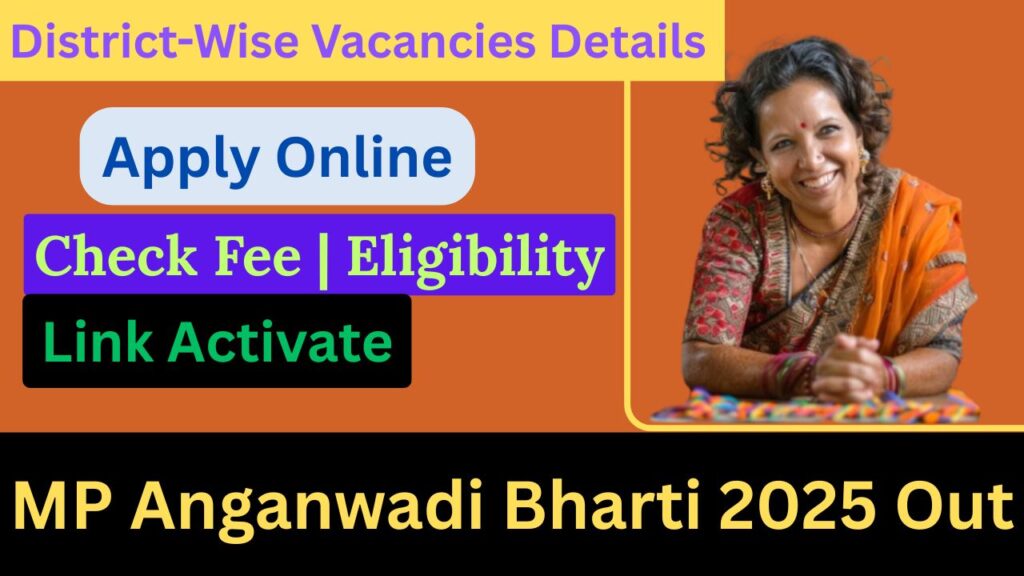
MP Anganwadi Bharti 2025 Out – District-Wise Vacancies

MP Anganwadi Bharti application link is open for 2027 posts for workers and 17477 posts for assistants. Candidates can apply online early to secure a job because the application portal opens for 10 days. Go through the link to check official notification on the official website. 

By paying an online application fee of Rs.100 before closing the online portal, you can proceed with your application form. If you want to establish a career in Public service, you can fill the form for a total of 19504 vacancies. The recruitment started on an online portal on 20 June-2025 and closed on 4 JUly-2025. 

OrganizationWomen and Children Development Department
PostMP Angadwadi Workers & Assistants
Vacancies19504
Apply OnlineClick Here
Official WebsiteClick Here

Key Date for MP Anganwadi Bharti 2025

Online Application Start20-June-2025
Online Application Last Date4-July-2025
Fee Payment Last Date4-July-2025
Correction Last DateNotify Later
Exam DateNotify Later
Application Fee
General/OBC/EWS/SC/STRs. 100/-
Payment ModeOnline

ReaD More 👉 Top 10 High Salary Courses After 12th Science Without NEET – No Medical Exam Needed

MP Anganwadi Bharti 2025 District Wise Vacancy Detail

DivisionDistrictVacancies for WorkersVacancies for Assistant
BhopalBhopal32289
BhopalRaisen27450
BhopalRajgadh28502
BhopalSihor27270
BhopalVidisha57528
ChambalBhind31469
ChambalMuraina47633
Chambalsheopur56375
GwaliorAshoknagar51260
GwaliorDatiya42228
GwaliorGuna51544
GwaliorGwalior44231
GwaliorShivpuri95611
IndoreAlirajpur36839
IndoreBadhwani50244
IndoreBurhanpur1894
IndoreDhar54539
IndoreIndore32196
IndoreJhabua51890
IndoreKhandwa45168
IndoreKhargone55356
JabalpurBalaghat45271
JabalpurChhindwara53341
JabalpurDindora59348
JabalpurJabalpur35422
JabalpurKatni28252
JabalpurMandala58524
JabalpurNarsinghpur32134
JabalpurPanna1245
JabalpurSivni43310
Narmadapuram Baitul50177
Narmadapuram Harda21122
Narmadapuram Narmadapuram24264
RewaMaihar14125
RewaMauganj6281
RewaRewa32390
RewaSatna25324
RewaSidhi30121
RewaSinghrauli18200
SagarChhatarpur44322
SagarDamoh31321
SagarNiwadi1371
SagarPanna13328
SagarSagar66483
SagarTikamgarh21223
ShahdolAnuppur30150
ShahdolShahdol53276
ShahdolUmriya39155
UjjainAgar Malwa16124
UjjainDevas30252
UjjainMandsaur23297
UjjainNimach22169
UjjainRatlam39508
UjjainShajapur28138
UjjainUjjain45292
Total202717477

Eligibility Criteria MP Anganwadi Bharti 2025

Applying for Aganwadi Assistant, Candidates must have passed 5th class from any recognized board in India. For MP Anganwadi Worker, Candidates must have passed 12th from any recognized board or have any equivalent qualification. Completed 10th class from a recognized board, these certificates are important for this Anganwadi Worker position. Candidate’s minimum age should be 18 years and maximum 35 years, age relaxation will be provided.

Important Link for MP MP Anganwadi Bharti 2025

Apply OnlineClick Here
Download NotificationClick Here
Join Telegram ChannelClick Here
Official WebsiteClick Here

Leave a Comment

Your email address will not be published. Required fields are marked *

BSc Medical Laboratory Technology (MLT): Course, Fees, Career & Scope in India

BSc Medical Laboratory Technology

Imagine being the silent crusader for every correct diagnosis, working your magic inside blood samples, body fluids and tissue slides to find secrets that physicians need to know to save lives. That is the magic of BSc Medical Laboratory Technology (MLT). If you are scientific, you love precise work, and want a solid and stable career in health care, but don’t want the frenetic pace of working directly with patients, this degree could be just right for you. 

In India, where healthcare is booming, MLT professionals are highly sought after. So, here we go through all you need to know to be able to dig in to this sleeper powerhouse discipline. 

What is BSc Medical Laboratory Technology (MLT)?

The BSc MLT course is basically a three years long undergraduate course (six-month internship in some colleges) which is designed to make you a medical lab technologist. You’ll learn the art and science of analyzing body fluids, tissues, cells and microbes in clinical laboratories. Consider it detective work in a white coat: gathering samples, running tests on machines such as microscopes, analyzers and polymerase chain reaction (PCR) units, and producing results that influence treatments for everything from infections to cancer. 

The curriculum is a mix of biology, chemistry and technology. 

  • Year 1 involves Fundamentals such as human anatomy, physiology and biochemistry. 
  • Clinical microbiology, hematology (study of blood), and immunology by year 2. 
  • The final year is a rush with supplements such as histopathology (study of tissues), blood banking and molecular diagnostics. Practical laboratory sessions constitute 40-50 per cent of the course, so prepare for a lot of practicals. 
  • The best of institutions like AIIMS Delhi, Manipal University, Jipmer Pondicherry provide it with world class facilities, often including certification in lab automation. 

Who Can Jump In? Eligibility and Admission Scoop

You are considered eligible if you have obtained at least 50% in Physics, Chemistry, and Biology (PCB) from a recognized board – relaxed to 45% for reserved categories. Most private colleges don’t require NEET, while government ones may require state-level exams like KCET or MHT-CET. Most private unis are merit-based or have their own tests.

The admission season is followed after 12th boards, May-July. Apply online on the college portals– application fees range between Rs 500 to Rs 2000. Pro tip: Create a beachhead profile with science projects or volunteer work in labs; it shines in interviews. 

Fees, Scholarships, and ROI

  • Cheap but really beneficial—that’s BSc MLT for you. The fee of government colleges range around 10,000–50,000 per year, so the total fees of the course would be approximately 30,000 — 1.5 lakh.
  • The cost of private colleges is high and ranges between 1–3 lakh per year (rough 3–9 lakh in total). 4-5 lakhs can be charged by the top class institutes such as Symbiosis, Pune. In the range of ₹50,000 — ₹1 lakh per annum will be your hostel and books additional cost. 
  • Scholarships reduce the burden: Post-Matric for SC/ST from the State and Central government, merit scholarships from AICTE. 
  • Most of the institutions have 20-50% waivers for the toppers. ROI is stellar, starting salary ₹3-6 LPA, scaling to ₹8-15 LPA in 5 years. Compare that with the cost of the course, and it’s quite a smart bet. 

Skills You’ll Gain From BSc MLT Course 

This isn’t just book learning, it’s skill-building gold. You’ll learn phlebotomy (blood drawing), use high-tech equipment such as flow cytometers, learn quality control and even bioinformatics for genetic testing. 

Soft skills: Accuracy, good attention to detail, and ethics required—there is potential for misdiagnosis if a single mistake is made. 

A day in the life: Mornings are often spent collecting samples, then running tests such as CBC, ELISA, and cultures. The position also requires calibration of instruments and result reporting via LIS software. 

Hospital shifts can be demanding (8–12 hours), whereas diagnostic labs usually provide ordinary 9 to 5 hours office-based positions. 

Read More 👉 CTET Exam 2026: Check Exam City, Notice, Exam Dates, Syllabus and Eligibility Information

Future Opportunities For Students

Graduates are not left in labs for eternity. 70% of alumni are hired as lab techs or supervisors (₹25k-50k/month in the beginning) by hospitals (Apollo, Fortis). 

₹30k-60k work offer with diagnostics like Dr. Lal PathLabs or Metropolis. 

Government jobs through ssc, esic or state health services are also there with a good package of ₹35k+ along with benefits, crack exams ssc, junior paramedical.

So what about Advanced options? 

You may select from choices such as MSc MLT, PGDM in Hospital Management, or a PG Diploma in Cytotechnology, Histopathology or Forensics. A Salary of ₹10–20 LPA is possible. On the international front, the US and Canada are among the top seekers of certified MLTs. Professionals are able to make $50,000 or more per year by passing the ASCP exams. 

Career RoleAvg Starting Salary (₹ LPA)Top Employers
Lab Technician3-5Hospitals, Clinics
Medical Lab Supervisor5-8Diagnostic Chains
Blood Bank Technologist4-6Red Cross, Govt Hospitals
Research Associate4-7ICMR, Pharma Cos
Quality Control Analyst5-9Biotech Firms

Challenges and the Bright Side

There are also challenges including long hours, exposure to biohazards (so the right PPE is the must), and having to keep pace with new technology, including AI-driven diagnostics. But the advantages are clearly more than the disadvantages. 

The fact that healthcare jobs are expanding rapidly (at about 15% each year, according to NITI Aayog), private labs provide a superior work-life balance, and the soft assurance that your work really helps people, even if it’s behind the curtains. 

Conclusion

In a society that worships doctors and nurses, BSc Medical Laboratory Technology (MLT) is the silent force behind 70% of medical decisions. If you are detail oriented, love science, and want to future proof your career, then go for it. India’s healthcare industry requires an additional two million laboratory professionals by the year 2030, your spot awaits.

Check NAAC-accredited colleges and start prepping. This degree is more than just a credential, it is the key to a fulfilling life that is recession-proof in healthcare. 

Leave a Comment

Your email address will not be published. Required fields are marked *

PNB LBO Application Form 2025 — Apply Online For Local Bank Officers 

PNB LBO Application Form 2025

Punjab National Bank (PNB) has officially released the notification for the recruitment of Local Bank Officers (LBO) for 2025. Candidates who are waiting for this position can apply now through the official website of PNB. Application Schedule, What is the Application Schedule for BO 2025? This recruitment drive is 750 vacancies. For the eligibility criteria, age limit, education, job profile, syllabus, exam pattern and other important information, the candidates should go through the detailed notification. 

A direct link for notification download and further updates on recruitment process will be provided on the official website. Applicants are advised to submit their applications at the earliest and ensure that they fulfill all the criteria as mentioned in the notification. 

Quick Info About PNB LBO Recruitment

OrganizationPunjab National Bank
Exam NamePNB LBO 2025
PostBank Officers
Post Vacancy750
Application Last Date23/November/2025
Official WebsiteClick Here

General Dates For PNB Local Bank Officers Recruitment

EventDate 
Application Begin03/November/2025
Application Ends On23/November/2025
Last Date for Fee Payment23/November/2025
PNB LBO Admit Card AvailableBefore Exam
PNB LBO Exam DateDecember 2025 OR January 2026
PNB LBO Result 2025Update Soon

Category Wise Application Fee

CategoryFee
General / OBC / EWSRs. 1180
SC / ST / PHRs. 59

Read More:- RPF Sub-Inspector Exam: Your Complete Guide to 2025 Recruitment

Guide To Apply Online For PNB LBO Recruitment

Candidates need to read the official notification and apply for PNB recruitment 2025. Candidates must have a graduation degree in any course and age criteria must meet the age limit (20–30 years) of this post.

  • You must read the notification before you start to apply. 
  • To avoid errors, candidates are recommended to ensure that they fill in all required information including name, parents’ names, date of birth, address and educational qualifications properly in the application form. 
  • Ensure you upload all the documents in the right size and format( pdf or jpeg) if required by the application form. 
  • Before you submit the form, check that all the details you have entered and the documents you have uploaded are correct. 
  • When you have submitted your application successfully, it is advised to take print out of application form or save in pdf format for future reference. 

The following tips will make your Punjab National Bank Recruitment 2025 application easier. 

Useful Links
Apply OnlineClick Here
Download NotificationClick Here
Official WebsiteClick Here

Leave a Comment

Your email address will not be published. Required fields are marked *

UP Scholarship 2025 – Apply Online Now & Check Status Instantly!

UP Scholarship 2025

UP Scholarship 2025 Application Process Details

UP students who are waiting to apply for the scholarship to continue their education can fill out the application now. Registration for the scholarship starts for all the students of class 10th, 12th, graduation, and post-graduation. Interested candidates from Uttar Pradesh can apply. 

When to Apply?

You can apply for the UP Scholarship form from 10 July to 20 December 2025.

Where to Apply?

Apply through the official website of Uttar Pradesh.

UP Scholarship Important Dates to Follow

Program/ActivityStart DateLast Date
Student Registration/Online Application10 July 202520 December 2025
Students to Take Final Print12 July 202523 December 2025
Submission of Hard Copy with Required Attachments by Students at School12 July 202524 December 2025
Online Verification and Forwarding of Application by School11 July 202510 December 2025
Verification of Actual Students by District School Inspector07 November 202515 November 2025
Scrutiny by NIC11 December 202522 December 2025
Correction of Defective Applications by Students/Institutions18 November 202521 November 2025
Submission of Corrected Applications by Students at School23 December 202510 January 2026

Documents required for the Scholarship

  • Aadhaar Card 
  • Income Certificate
  • Birth Certificate
  • Domicile Certificate 
  • Marksheet of Last Year
  • Fee Receipt from the School/College
  • Photocopy of Bank Passbook
  • Caste Certificate
  • Passport-size Photograph

How to Apply for the UP Scholarship

  1. Apply through the Official website of UP Scholarship, link is mentioned in the article.
  2. Click on Pre-Matric or Post-Matric Registration.
  3. Enter your details carefully to complete the registration.
  4. Once the registration is complete, log in again and fill out the entire application form.
  5. Once you fill in the details correctly, take a printout.
  6. Upload the required documents and take a hard copy to your college and submit it there with all the documents.
Important Links
Registration Click Here
Official WebsiteClick Here
Renewal Login LinksFresh Login 
Prematric Student LoginIntermediate Student LoginPostmatric Other Than Inter Student LoginPostmatric Other State Student LoginPrematric Student LoginIntermediate Student LoginPostmatric OtherThan Inter Student LoginPostmatric Other State Student Login

Leave a Comment

Your email address will not be published. Required fields are marked *

How to Crack State PSC Exams in First Attempt: Strategy & Resources

Govt. jobs are undoubtedly one of the most safe and respected career options in India and passing the State Public Service Commission (PSC) exam in first attempt is a dream for many aspirants. As the competition is rising and the syllabus is vast, it sometimes feels like a difficult mountain to scale. But, with the right approach, intelligent study techniques, and diligent efforts, passing the exam is not an impossible dream. The crux is to understand the syllabus in depth, follow the right resources and adhere to a disciplined schedule that would cover both prelims & mains preparation.

Quick Thoughts Gathering to Begin With

  1. Download official syllabus + all past papers of 8 years.
  2. Make a list of books you own/need (start with NCERTs).
  3. Select optional subject.
  4. Put together a weekly schedule you can live with.
  5. Create a one-pager daily current affairs file.
  6. Enroll in test series / good coaching (online/offline) and commit to weekly mocks.
  7. Start your NCERTs (goal: 2–3 chapters/day).

Big-picture study strategy (what to study & why)

Build bedrock knowledge first: NCERTs (6–12) for History, Geography, Economics, and Pol. These give a clean conceptual base.

Proceed to standard books for each subject (more below). Read for understanding, not rote.

Current affairs daily — newspaper + short notes. Link events to static syllabus.

Notes + revision cycle — Make short revision notes (1–2 pages) per topic; revise them frequently.

Practice smartly: MCQs for prelims + answer writing under time pressure for mains. Mains wins jobs — practice answer structure & linking facts to syllabus keywords.

Mocks & feedback: Do full length mocks and get answers evaluated (peer/mentor) and you improve your answer style and technique of scoring.

Recommended core resources (common, high-utility) 

(You will need to add in your state-specific books / local history that you must have from your state board / PSC Recommended Readings)

  1. Cover Basics 

NCERTs 6–12 — History, Geography, Pol. Science, Economics (start here).

Indian Polity — M. Laxmikanth (efficient + concise for governance & state-centred comparative questions).

Modern Indian History — Spectrum’s A Brief History of Modern India / Bipin Chandra (for depth).

Indian Economy — Ramesh Singh or any good concise economy book, supplemented with RBI / Economic Survey summaries.

Geography — Certificate Physical & Human Geography (G.C. Leong) or equivalent concise books.

Environment & Ecology — normal environment compendium/ class notes, track Recent Events.

State-specific history & polity — whatever books your PSC cites, in addition to local gazetteers and state government documents.

  1. Current affairs & general reading

One daily national newspaper (The Hindu / Indian Express) or their summaries. Government releases: Press Information Bureau (PIB), state government portals, official reports (for schemes and facts). Monthly magazines or current affairs compendiums (good for revision).

  1. Practice

Collection of previous years’ PSC papers (must have). A good questionbank or mock test series (free/paid) for practicing in time bound manner. Answer writing notebooks (keep one for mains answers). 

Sample schedules — choose according to the time you have

If you have 12 months

1st to 4th month: complete NCERTs + standard books for GS I–III fundamentals; decide optional & finish fundamentals.

Months 5 to 8: Complete other standard books + begin consolidating notes; begin on PYQs.

9th and 10th months: High-intensity test series – full-length prelim mock test every week; augments revision of weak topics.

Months 11–12: Final run through + daily PYQs + last-mile current affairs. Mains answer practice (if prelim cleared).

If you have 6 months

1st month: Preparation for NCERTs + syllabus mapping + optional selection.

2nd to 4th month: Read standard books, prepare short notes, solve MCQs and PYQs.

Month 5: Rigorous mock tests (prelim-benchmarked); Time management to be calibrated.

Month 6: Re-visit everything + frequent mock tests + current affairs wrap-up.

If you have three months

  • Fast NCERT reading + priority standard book chapters on some important subjects.
  • Study 7-10 hours a day: current affairs in the morning, theory in bulk in mid-day, MCQs + past papers in the evening.
  • Mocks repeatedly at intervals of 3-4 days Analyze each. 

Prelims strategy (objective test)

A good preparation strategy would be to start with the NCERTs along with one standard book per subject to establish a strong base. While learning content, same importance should be given to speed and accuracy by daily practicing MCQs gradually going to 500 – 1000 in a week. To gain maximum returns in minimum time, concentrate on high-yield topics such as Polity, the Constitution, Economy (primarily basic indices), Geography (with emphasis on map work), Environment, and Current Affairs. The Previous Year Questions (PYQs should be backbone of your preparation as it helps you to identify the areas/themes which the exam repeatedly tests). 

Also Read : Top 10 List of Exams Conducted by UPSC After Graduation in 2025

Mains strategy (subjective / descriptive)

Start writing answers from the early days of preparation, while upgrading yourself with the ability to write a good structured answer that has an introduction, a well-structured body (with headings or bullet points, if necessary) and a brief conclusion or way forward. Static knowledge and linking current affairs with theoretical knowledge need to be a part of answers as they give depth and relevance to answers. At the mid-stage of your preparation, doing a full answer paper every week – both essays and GS papers — is useful in developing regularity and you can increase the frequency as the exam comes closer. Regular assessment or peer review also is necessary, as it improves presentation as well as the density of content, leading to more effective answers. 

Interview / personality test

Prepare short biographical stories related to: accomplishments, academic projects, work experience and expertise in optional subjects. Stay informed on regional issues and national affairs. Conduct mock interviews with mentors or peers, concentrate on clear communication, serenity, and concise responses. 

Common Mistakes to Avoid

  • Learning everything superficially diminishes its utility; depth is much more valuable than breadth across different fields at surface level isn’t very rewarding.
  • Disregarding previous years’ papers is the biggest blunder as these papers bring out the themes that repeat, the patterns of questions and the areas to be concentrated.
  • Not timing yourself while you practise MCQs or while writing answers results in bad speed and poor accuracy in the exam.
  • Too many resources create noise and confusion, while focusing one’s attention on too few resources creates blind spots. A small set of high quality, reliable resources is the best bet for clarity and retention.
  • Avoiding regular revision destroys the power of retention; one should revise systematically and at frequenter intervals to be able to recite confidently and be assured of long term recall. 

Conclusion

How to Study Smart for First Attempt State PSC (Public Service Commission) Exam It is not about studying for countless hours, but it is about studying smart by keeping focus and being consistent. This trip requires a very clear mind, discipline, and a problem-solving attitude. Candidates with the right resources and guidance, along with consistent practice and revision, can not only cram for the exam but gain the confidence to ace at the Interview round. Wait for it… Success in the competitive exam is for those who start early, prepare strategically and have a firm belief till last that they will pass the exam. 

Leave a Comment

Your email address will not be published. Required fields are marked *

Rajasthan High Court Peon Recruitment 2025 Out for 5670 Posts – Apply Online Now!

Rajasthan High Court Peon Recruitment 2025

Candidates who are waiting to apply for the Peon post in various departments such as Rajasthan High Court, State Judicial Academy, Legal Services, District Court, and District Legal Services can apply now. Rajasthan High Court Peon Recruitment 2025 process starts from 27 June 2025. Candidates are advised to fill out the application form before the last date of registration.  

Post Peon
OrganizationRajasthan High Court
Vacancies5670
Application Starts 27 June 2025
Application Ends26 July 2025
Initial Salary for this postRs. 17,700 to Rs. 56,200 per month
Official WebsiteClick Here

Recruitment Steps for the Rajasthan High Court Peon Recruitment 

The selection for this post happens in 5 stages – written exam, candidates who have passed the exam are eligible for the interview. Document verification, Medical examination, and when candidates have passed all these stages, his/her name is shortlisted in the list.

Read More 👉 Bihar Police Constable Admit Card 2025 Released – Download in 1 Minute from csbc.bihar.gov.in

Steps to Apply Online Form

  • Click on the link given on the official website or directly from this article.
  • Fill out the empty boxes with the required details.
  • Attach the necessary documents with the application.
  • You have to pay an application fee to complete your application and submit it.
  • Save it for future reference.

Eligibility For Rajasthan High Court Peon

Candidates must pass their 10th for applying to this position. Good knowledge of Devnagri and Rajasthan culture. Candidates are advised to check these eligibility details more from the notification.

Application Fee
Gen/OBC Rs. 640
SC/ST/PWDRs. 450
NCL (OBC/MBC/EWSRs. 550
Important Links
Online RegistrationClick Here
Download NotificationClick Here
Official WebsiteClick Here

Leave a Comment

Your email address will not be published. Required fields are marked *

Scroll to Top