Pursuing a BPharma means you are going to enter in the drugs and medicine fields. Students can make their career bright by choosing the best college for their further education because the best college not only offers a degree but also offers industry knowledge, support in their training, and strong curriculum. Top 7 Best B Pharma Colleges in Lucknow stand a chance to provide you placement opportunities in pharmaceutical companies with good salary packages.
Lucknow is a growing education hub in almost every field. So, let’s look into the college’s details to help you decide which one aligns with your requirement and meets the budget area.
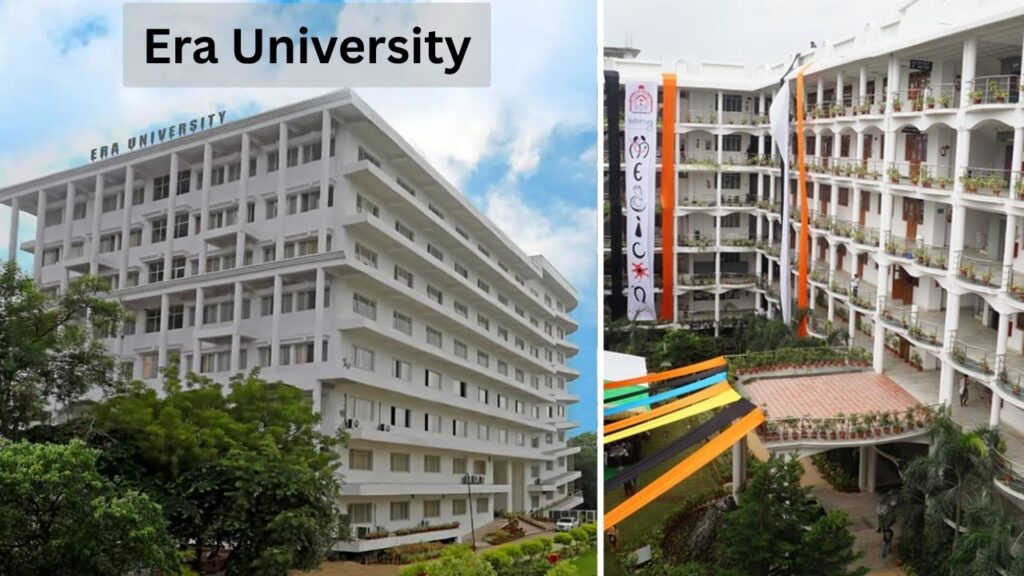
ERA University
Most of the students prefer to get admission in Era University for medical and pharmacy courses including B.Pharma. It is the best college in Lucknow for providing quality education with both theory and practical knowledge. BPharma
Era University fee, placement record, and admission process:
BPharma Total Fee
₹5,60,000
Placement
₹4 lakh per annum (achieve 90% placement rate)
Admission Process
10+2 in Science stream (Biology, Physics, Chemistry)Test-based selection
Integral University
Integral University offers various courses across diverse fields. It has become the best university in Lucknow and offers a four year BPharma program with a quality education, practical assessments, and good placement to most of the students.
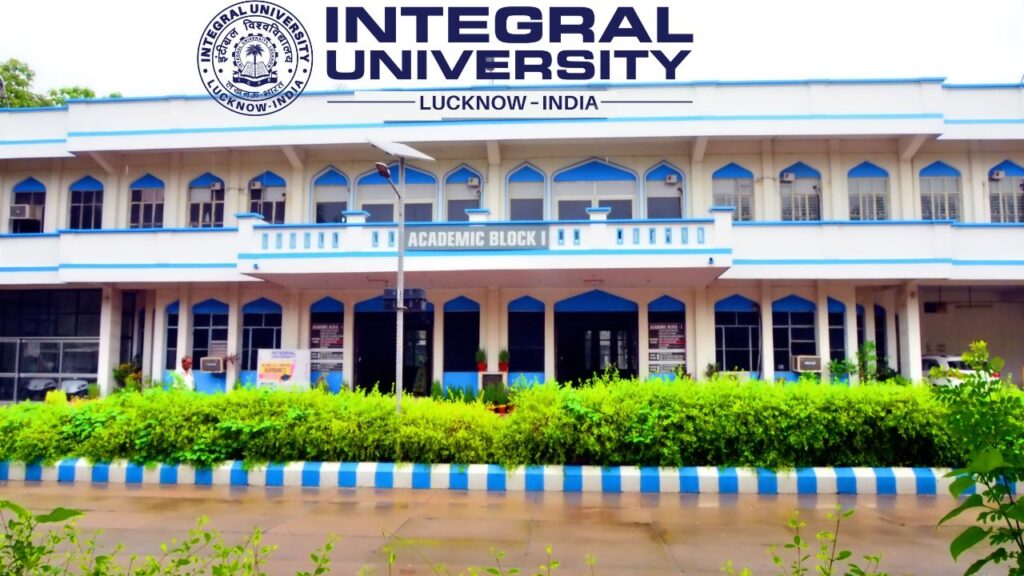
Integral University fee, placement record, and admission process:
BPharma Total Fee
₹5,20,000 (additional fee may vary the final amount)
Placement
₹3–4 lakh per annum (achieve 85% placement rate)Highest package can go up to ₹32.57 LPA
Admission Process
10+2 in Science stream (Biology, Physics, Chemistry)Entrance: IUET (Integral University Entrance Test)100 seats for BPharma every year
Saroj Institute of Technology & Management
Saroj Institute of Technology is a private college which offers pharmacy courses that make your career shine in pharmaceuticals. Many companies hired students from this college through placement drives. Students can take admission in the popular programs including B.Pharma, D.Pharma, and M.Pharma.
Saroj Institute of Technology & management fee, placement record, and admission process:
BPharma Total Fee
₹2.82 lakh (additional fee may vary the final amount)
DPharma Total Fee
₹1 lakh
M.Pharma Total fee
₹1.5 lakh
Placement
₹3.8–4.2 LPA (achieve 90% placement rate)Highest package can go up to ₹7 lakh LPA
Admission Process
10+2 in Science stream (Biology, Physics, Chemistry)Entrance: CUET scoreCounselling after selection
University of Lucknow
This well-known University of Lucknow offers students a better scope in their pharmacy field. This government university offers a four year BPharma program with a strong curriculum, training, and placement opportunities. Curriculum includes pharmacy practices, human anatomy, pharmaceutical analysis etc.
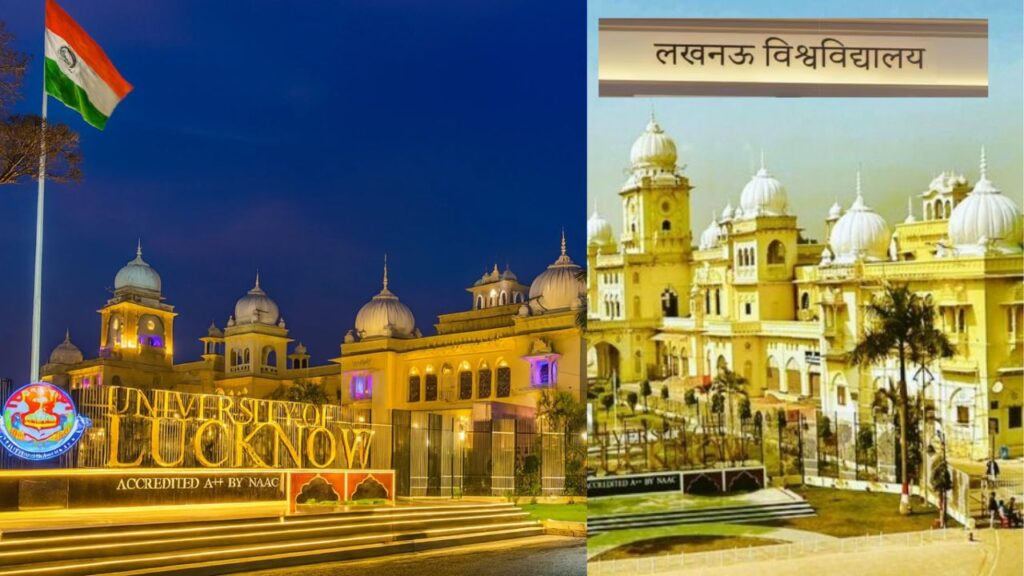
University of Lucknow fee, placement record, and admission process:
BPharma Total Fee
₹4.8 lakh (additional fee may vary the final amount)
Placement
₹3–4 LPA
Admission Process
10+2 with Physics, Chemistry, Biology/MathematicsEntrance: UPTAC counseling & UPSEE score
Amity University Lucknow Campus
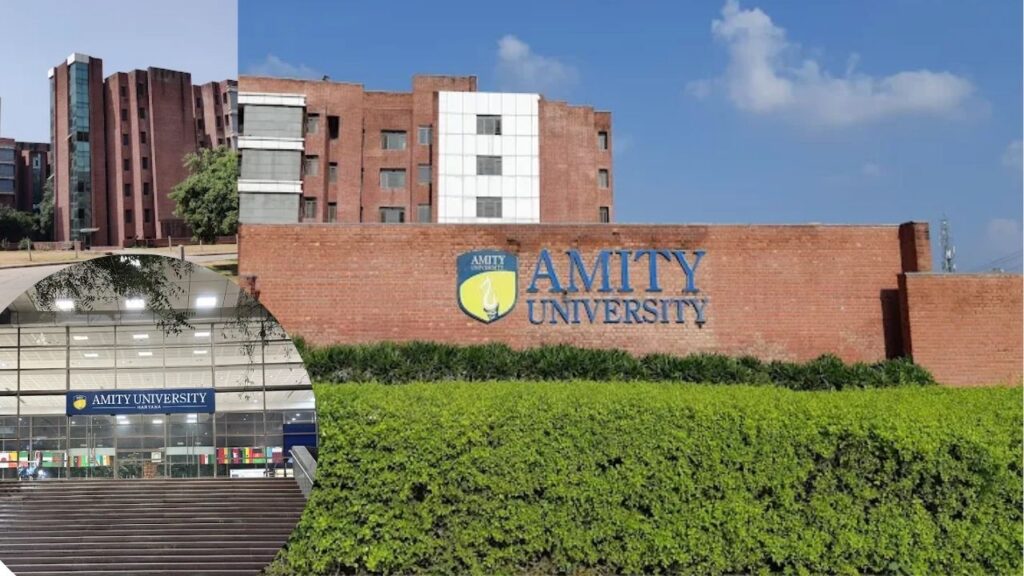
Amity University is the most prestigious university of India which offers a diverse range of courses. Students can make their future brighter by pursuing BPharma course from this college. It can open up their opportunity in the pharmaceutical industry. It offers a strong curriculum with pharmacognosy, pharmaceutical analysis, health education, hospital training and placement support including skill-building workshops, strong industry connections, and internship opportunities.
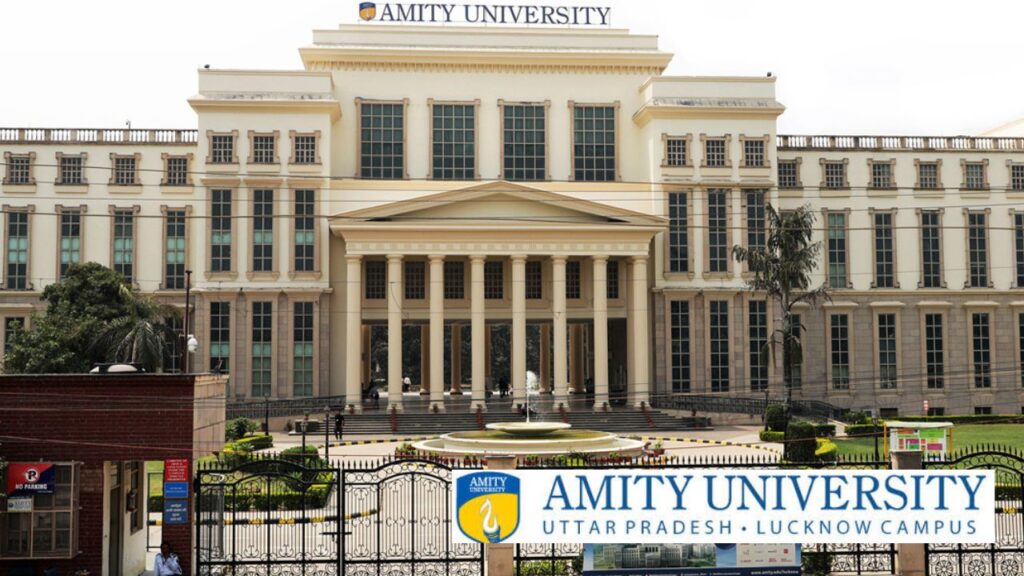
Amity University Lucknow Campus fee, placement record, and admission process:
BPharma Total Fee
₹6.8 (additional fee may vary the final amount)
Placement
₹3–4 LPA it can go up to ₹6 LPAmajor pharmaceutical firms take part in Amity’s placement drives
Admission Process
10+2 with Physics, Chemistry, Biology/MathematicsEntrance: scores from Amity JEE or any other national/state-level entrance exam score
Babu Banarasi Das University
BBDU is considered as Lucknow’s best college which offers many programs including BPharma. It is a four year program designed for providing pharmaceutical careers to the students who are interested in pharmacy and drugs.
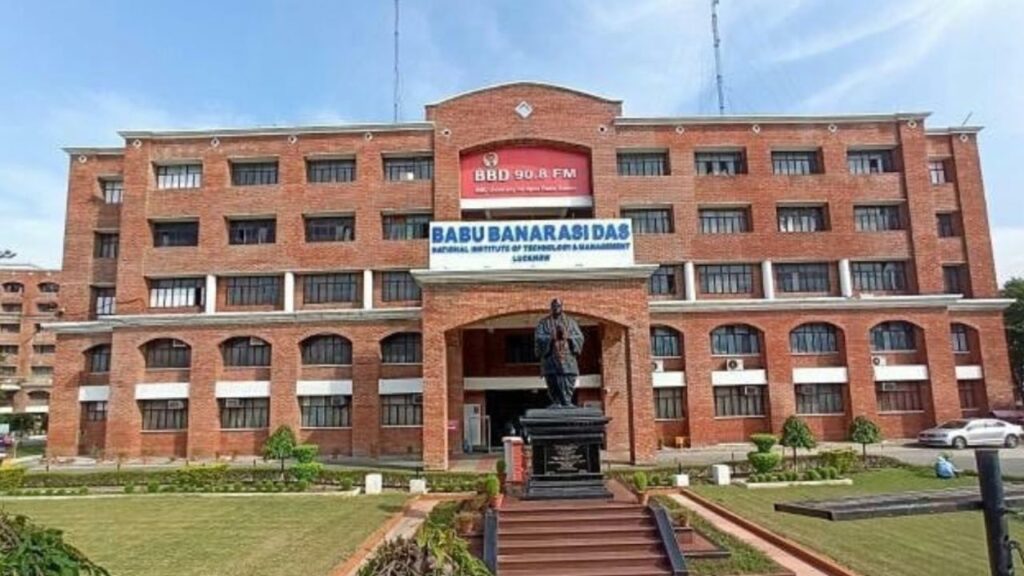
Babu Banarasi Das University fee, placement record, and admission process:
BPharma Total Fee
₹5.2–5.8 lakh (additional fee may vary the final amount)
Placement
₹3–4 LPA it can go up to ₹6 LPAmajor pharmaceutical firms take part in Amity’s placement drives
Admission Process
Minimum 50% in 10+2 with Physics, Chemistry, Biology/MathematicsEntrance: scores from NEET, UPSEE or any other national/state-level entrance exam score 100 seats for BPharma every year
T.S.Mishra University, Lucknow
T.S Mishra University is a well-known university for BPharma course due to its strong curriculum, experienced faculty members, and practical approach. It produced industry-ready professionals with their designed course. It offers a 4 years BPharma course with 3 months of compulsory hospital training and 1 month of industrial training.
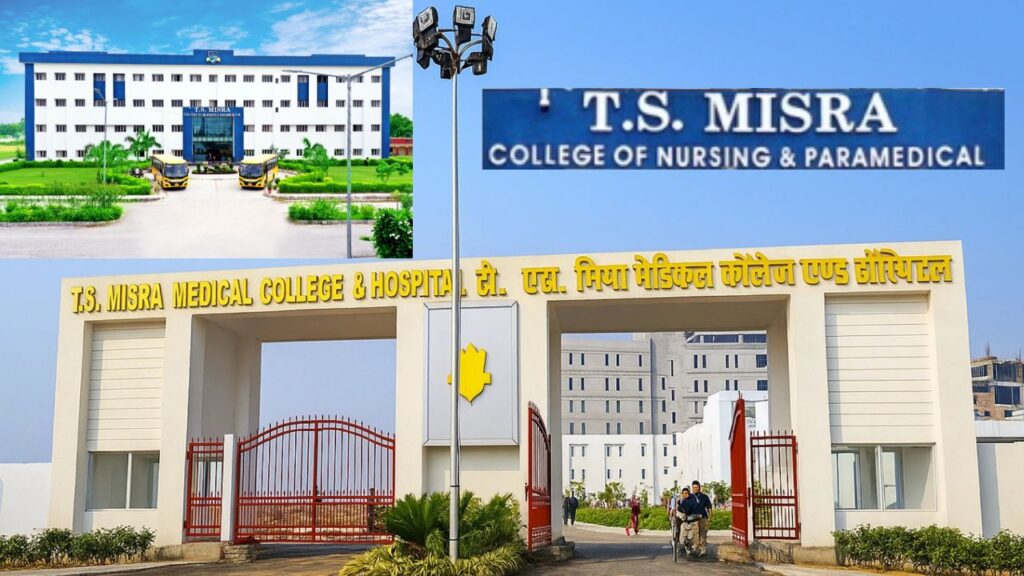
T.S.Mishra University fee, placement record, and admission process:
BPharma Total Fee
₹4.1 lakh (additional fee may vary the final amount)
Placement
₹3–4 LPA it can go up according to your resume
Admission Process
10+2 with Physics, Chemistry, Biology/MathematicsEntrance: merit-based selectionUniversity’s entrance tests60 seats for BPharma every year
Conclusion
Students can see all the best BPharma colleges in Lucknow in detail and choose the right one. These colleges offer practical and theoretical knowledge for pharmaceutical sciences which can help students to build their foundation in the field of medicine & Drugs.

If you are the type of person who regularly moves your furniture around, cleans windows to get the perfect paint color, or critiques lighting in every restaurant you dine in, maybe you have a calling. Your Search for Courses for Interior Designing starts when the question pops up: How do you get paid to have that passion?
In these days, interior design is no longer just about “making things look pretty.” It is a complex mix of architecture, psychology, technology, and art. Whether you are a high school graduate looking to pursue a degree or a working professional residing in Lucknow wanting to make a creative pivot, this guide is your blueprint. Let’s talk about everything you need to know to about the interior design courses, colleges, and careers.
Why Formal Education Matters
Let’s be real for a second. You may have a great eye for decorating, but professional interior design is a whole other story. It deals with strength of materials, building codes, ergonomics, and space planning.
A formal course will teach you the “grammar” of design. You are taught to talk with contractors, architects and clients. You go from saying, “I think this blue looks nice,” to, “This particular shade of teal offsets the warm undertones of the timber flooring and captures the natural light coming in from the north-facing window.”
Types of Courses
Course Type
Duration
Eligibility
What You’ll Get
Bachelor’s —B.Des / B.Sc
3-4 Years
B.Sc Or B.Des require 10th & 12th marksheet from Science Stream
In-depth technical knowledge related to Designing
Diploma / Advanced Diploma
1-2 Years
Key Formula for fast entry in career
Focused on Practical more than theory, Skill Polishing
Certificate Courses
3-6 Months
Hobbyists or professionals adding a specific skill (like CAD or V-Ray).
Specific skills only. Prefer for less professional people
Professional Level (M.Des / M.Sc)
2 Years
After having a degree of B.Des/B.Arch. These masters courses offered for specific specialization
Research-oriented, higher leadership roles, and teaching opportunities.
Your course will probably be part art and part engineering. There’s a chance that you will be spending your first year hours hand-sketching and studying Color Theory. In your final year, you will be making hyper-realistic 3D renders that look like photographs.
The “Hard” Skills (Tech You Need to Master in 2025):
To make it in the business these days, you have to know your way around a computer. These are the software tools you’ll probably end up knowing inside and out when you graduate:
AutoCAD - 2D blueprints industry standard It’s non-negotiable.
SketchUp: The Simplest 3D Building Tool Out There. Consider it as digital clay.
Revit / BIM – essential on large commercial jobs where you need to work closely with architects.
AI Homestyler: more recent and cloud based AI tools that are rising in popularity as they render fast.
Hospitality Designer: Hotels, cafes, restaurants. (Very creative, high visibility).
Set Designer: Design sets for movie or tv (Big in Mumbai/Hyderabad).
Salary Expectations
Entry-level compensation can be humdrum, but expansion is meteoric once you acquire a portfolio. Specialized positions, particularly in Luxury or Commercial sectors, offer much greater pay.
The chart exhibits how, even though you may begin as a junior at about ₹3.5 Lakhs per annum, it does pay off after all. A Senior Designer with 7+ years of experience can earn comfortably north of ₹12 Lakhs, and if you start your own firm or get into luxury consulting, the sky’s the limit (₹18 Lakhs+).
Admission Procedure For B.Des/M.Des in Major Colleges
For premiere govt colleges (like NID) you will have to appear for entrance exams like NID DAT or UCEED. They test your drawing ability, creativity, and spatial logic.
In case of private universities (such as Amity or Integral in Lucknow), admissions are essentially on the basis of marks secured in 12th and DAT (Design Aptitude Test) or portfolio review.
And build a portfolio, even if you’re not studying design. Draw a corner of your room. Redesign your kitchen on paper. Capture the textures you like. Your potential and passion matters, not perfection.
Conclusion
Courses for Interior designing are not for the weak hearted. Dusty job sites, demanding clients, and nights spent staring at a computer screen. But it is also hugely gratifying. There is a unique thrill in walking into a space you designed — watching people live, laugh and work in a place that began as a sketch in your notebook.
If you like to mix creativity with logic, and art with engineering, this is the year to look forward to for starting out. Whether you opt for a degree from Amity Lucknow or a diploma to begin your career at the earliest, the world is holding its breath for your designs.
The upcoming recruitment for Tehsildar and Lekhpal has been announced on the official website ( http://upsssc.gov.in/). The application form for the UP Lekhpal vacancy 2025 will be available soon. Candidates can apply for the position through the link once the link will be activated. Subordinate Service Selection Commission recruited candidates through PET score and Written exam for Uttar Pradesh Chakbandi Lekhpal.
The Uttar Pradesh Lekhpal purpose is to survey and collect data on land & revenues. Implementing government schemes like crop insurance or land distribution. The purpose of collecting data is to help resolve matters of land through law & justice.
If you are interested in surveys, analysis, or collecting data then this is the right job for you. You have to apply online once the link activates on the official website. Clear the examination to get shortlisted in the selected candidate’s list.
Post
Lekhpal
Organization
Uttar Pradesh Subordinate Service Selection Commission
Purpose
UP Lekhpal plays a role in maintaining Land records and Revenue data from rural areas.
Statik GK, Basic of Physics, Chemistry, Biology, Indian Economy, Nation & International Affairs, Constitution, Public Policy, Geography of India, UP specific Geography, Indian History, Independence Movement.
Rural Development & Rural Society
Rural Development Programs & schemes, Society & Institutions in Rural Areas, Land Records, Revenue System UP specific, Agriculture, Rural Development, Rural Economy.
UP Lekhpal Vacancy 2025
In the total number of vacancies around 9640, the maximum number of vacancies will be at Lekhpal Post. So, be ready to apply online and prepare to clear out the examination for this post. Lekhpal recruitment can come out on around 7531 posts.
Most of the students join the corporate sector but private jobs won’t provide security, high-salary, and additional perks which the government sector offers to the employees. But position matters in government jobs too if you have a higher position in the department, your salary will be more and other perks. There are many government jobs after graduation in India in the different departments.
But you must understand which department suits you best. Let’s look into the details of each government job after graduation. Don’t rush, just focus on what you want to achieve in life.
Why Government Jobs Still Matter
People who spent years working in a public sector bank or Ministry of finance described that money attracts you but the major reason is you never have to worry about if you’ll have a job next year or not.
If you watch it closely, you are going to understand — A government job in India isn’t just a paycheck. It comes with job security that private companies rarely match. It comes with a pension through the National Pension System, so the years after retirement aren’t a financial scramble. Government jobs offer fixed working hours, but there are exceptions. Defence and UPSC is tougher and no fixed hours. Most jobs are not that tough so you can give time to your family. In India, society gives more respect to government employees than private employees.
There is one more thing, if you belong to SC, ST, OBC, and EWS categories, government recruitment includes reservation benefits that make the competition a little more balanced than it is in the open private market.
None of this means government jobs are easy to get. But it explains why so many students keep this door open, even while exploring others.
Government Jobs After Graduation in India
There is no one big exam for a government job, it gives you job security and high salaries that makes it tough to compete with lakhs of students and being selected.
IBPS conducts the PO and Clerk exams for most public sector banks, while State Bank of India runs its own separate recruitment for similar roles.
If you want something closer to economic policy, RBI hires for Grade B officer and Assistant positions, and NABARD focuses specifically on rural and agricultural banking.
Job Title
Minimum Qualifications
Example Employers / Recruiting Bodies
Accountant / Junior Accountant
Bachelor’s degree in Commerce (B.Com) or equivalent; some posts accept diploma in accounting
State departments, municipal corporations, central ministries, cultural institutions
B.Com, proficiency in Tally / Govt accounting rules
Department of Economic Affairs, ministries, central govt offices
Treasury Officer / Cashier (Treasury)
B.Com; sometimes specific treasury certificates
State treasuries, municipal treasuries
Internal Revenue Agent / Revenue Inspector
Graduation; specialized departmental exams
Tax departments, revenue directorates
Central Government Jobs
The Staff Selection Commission runs several exams worth knowing. SSC CGL is the big one, opening doors to positions like Income Tax Inspector and Assistant Audit Officer. SSC CHSL leads to roles like Data Entry Operator or Lower Division Clerk.
If you studied engineering, SSC JE is built specifically for you. And if you can take dictation quickly, there’s SSC Stenographer.
Job / Exam
Minimum Qualification
Common Extra Requirement
SSC CGL
Graduation degree
Post-wise age and skill test requirements
SSC CHSL
12th pass OR Graduation
Typing/skill test for some posts
SSC MTS
10th pass OR Graduation
Age relaxation as per category
SSC JE
Diploma or B.E./B.Tech in relevant field
Technical qualification in engineering branch
SSC CPO
Graduation in any stream
Fitness and medically fit
Railways, Largest Employer in the Country
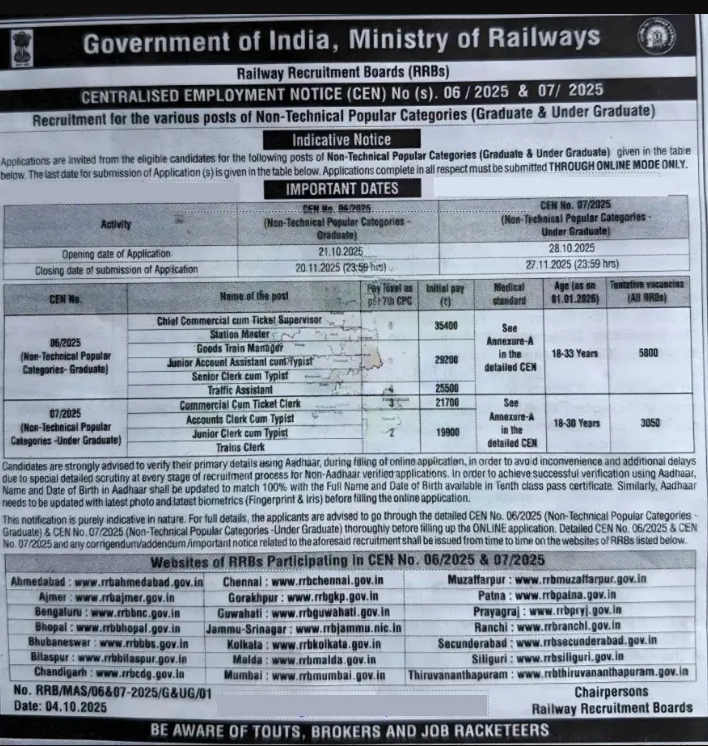
RRB NTPC opens up roles like Station Master and Traffic Assistant for general graduates. RRB ALP is for those drawn to operating trains as Assistant Loco Pilots.
RPF handles railway security and law enforcement. And RRB JE, again, is the engineering route.
Railway Job Post
Main Work
Basic Eligibility
Usual Recruitment Route
Station Master
Controls train movement and station operations
Graduation in any stream
RRB NTPC Graduate-level exam
Goods Train Manager
Manages goods train operations and coordination
Graduation in any stream
RRB NTPC Graduate-level exam
Senior Clerk cum Typist
Handles records, typing, office work, and data entry
Graduation with typing skill where required
RRB NTPC Graduate-level exam
Junior Accounts Assistant cum Typist
Accounts work, billing, clerical finance tasks
Graduation, usually commerce preferred
RRB NTPC Graduate-level exam
Commercial cum Ticket Clerk
Ticketing, passenger support, commercial counters
Graduation in any stream
RRB NTPC Graduate-level exam
Trains Clerk
Train records, movement entries, office coordination
Graduation in any stream
RRB NTPC Graduate-level exam
Traffic Apprentice
Supports railway operations and traffic control work
Graduation in any stream
RRB recruitment / NTPC-related notifications
Section Controller
Monitors train operations and sectional control
Graduation; often a high-responsibility post
RRB notification / senior railway recruitment
Junior Engineer (JE)
Technical supervision in civil, electrical, mechanical, signal, etc.
the exam that produces IAS and IPS officers. It’s open to graduates from any stream, but it’s also the toughest exam in this entire list, with three stages testing not just knowledge but stamina and patience.
Each state also runs its own version through its Public Service Commission. UP has UPPSC, Bihar has BPSC, Madhya Pradesh has MPPSC, and so on, each recruiting for state-level administrative roles.
UPSC Service / Post
Group
Main Work
Basic Eligibility
Indian Administrative Service (IAS)
All India Service
District administration, policy implementation, public welfare, law and order coordination
Graduation in any stream
Indian Police Service (IPS)
All India Service
Internal security, policing, crime control, public order
Graduation in any stream
Indian Foreign Service (IFS)
Group A
Diplomacy, foreign relations, embassies, international representation
Central government accounting and financial reporting
Graduation in any stream
Indian Defense Accounts Service (IDAS)
Group A
Defence finance, budgeting, accounts management
Graduation in any stream
Indian Railway Protection Force Service (if allotted through UPSC-related services)
Group A/B depending on cadre
Security and protection of railway property and passengers
Graduation in any stream
Central Civil Services Group A
Group A
Administration in central ministries and departments
Graduation in any stream
Central Civil Services Group B
Group B
Assistant-level administrative and policy work
Graduation in any stream
Defense Jobs
If discipline and service appeal to you more than office work, the defence sector offers CDS for officer entry into the Army, Navy, and Air Force, and AFCAT specifically for the Air Force.
Defence Job / Entry
Main Role
Basic Eligibility
Selection Route
Indian Army Officer
Lead troops, field operations, administration
Graduation in any stream
CDS / SSC (Non-Technical) / other officer entries
Indian Navy Officer
Naval operations, technical or executive duties
Graduation; engineering degree for technical entries
CDS / SSC Executive / technical entries
Air Force Officer
Flying, ground duty, administration, support roles
Graduation in any stream for many entries
AFCAT / CDS / NCC special entry
Short Service Commission Officer
Temporary officer role in Army, Navy, or Air Force
Graduation; post-specific rules apply
SSC entry routes
CDS Officer Entry
Commissioned officer in Army, Navy, or Air Force
Graduation in any stream
CDS written exam, SSB, medical
AFCAT Officer Entry
Air Force officer in flying, technical, or ground duty branches
Graduation in any stream; technical branches need relevant degree
AFCAT, interview, medical
NCC Special Entry
Officer entry for NCC cadets
Graduation + NCC certificate requirements
Direct officer selection, no written AFCAT/CDS in some cases
Teaching has its own path too. CTET or your state’s TET exam qualifies you to teach in schools, while UGC NET is for those who want to lecture at the college level. KVS and Navodaya Vidyalaya recruitment also fall in this teaching bucket.
Important Tip: You didn’t need to pick just one. Many students prepare for two or three of these at the same time, since the subjects often overlap.
Teaching Job
Level
Basic Eligibility
Main Exam / Route
Primary Teacher (PRT)
Class 1–5
Graduation in some cases, usually with D.El.Ed / B.El.Ed; CTET Paper 1 for central jobs
CTET / TET + recruitment exam
Trained Graduate Teacher (TGT)
Class 6–10
Graduation in relevant subject + B.Ed; CTET Paper 2 for central schools
CTET / TET + recruitment exam
Guest Teacher
School / institute
Graduation, sometimes B.Ed preferred
Local government recruitment / walk-in / contract basis
Special Educator
School level
Graduation + special education qualification
Recruitment through education department / DSSSB / state boards
Who Can Actually Apply
The good news is that most of these exams simply ask for a graduation degree, in any subject. You don’t need a specific stream unless the job itself is technical, like engineering posts in SSC JE or RRB JE, which obviously expect an engineering background.
Most exams accept candidates roughly between 18 and 32, though SC, ST, and OBC candidates usually get age relaxation, and the exact numbers shift slightly from year to year.
You also need to be an Indian citizen for nearly all of these roles, and for defence or paramilitary jobs like CDS or RPF, there are physical fitness standards on top of everything else.
Never assume for the exam updates. Dates are extended sometimes and shifts every year. Every government organization publishes its own official notification that declares eligibility and process. Rules shift slightly year to year, so do not rely on people’s words or what happened last year.
Once you decide which field you are going to join, you have to figure out the process itself, which felt confusing the first time but became simple once he broke it down.
It starts with tracking official notifications. Websites like ssc.nic.in,ibps.in, rrbcdg.gov.in, and upsc.gov.in post recruitment notifications which include detailed instruction and a timeline to open the portal where you can apply. It happens every year, so checking them regularly matters.
Once a notification drops, the first step is registering online, usually with just a mobile number and email. Then comes the actual application form, where personal details, educational background, category, and post preferences need to be filled in carefully.
Remember that correction windows are short, so a careless mistake here can follow you for the whole process. After that, documents like your photograph, signature, and category certificates need to be scanned and uploaded.
Then there’s the application fee, though SC, ST, PWD, and female candidates often get a waiver or discount here. Once everything is submitted, the admit card becomes available a few weeks before the exam date, and then it’s just down to showing up and going through whatever stages that particular exam has, whether that’s a single test or a longer chain of prelims, mains, and interview.
How To Prepare For Government Exams?
Once you know that these exams exist doesn’t mean you are fully prepared for it. You need to read the syllabus properly instead of skimming it.
Every exam leans on a mix of Current Affairs, Simple Mathematics, Logic and Reasoning, and English or Hindi, but the weight given to each section changes depending on the exam.
After you study the topics of a specific exam, check previous year papers, not to memorize answers, but to understand the pattern, the difficulty level, and how questions are usually framed and paired with regular mock tests.
This technique will teach you how to manage time under pressure, since most of these exams are brutally time-bound. Make Current affairs a daily habit too, especially since banking and SSC exams lean heavily on it. If your exam has more weightage on Current Affairs then prepare well for it day-by-day.
What made the real difference, though, was a basic timetable. Not a rigid one, just something that kept you showing up every day instead of cramming in bursts. And you had to decide between coaching and self-study. Most students who cracked their exams recommend choosing both. As some subjects are hard that need guidance and some are easy, you can prepare it by yourself. There’s no universal right answer here. It depends on how you learn best.
For decades, students have been doing wrong while preparing for the government exams which can be put away and made aware future generations to stop going wrong.
Some students put all their effort into one single exam and ignore everything else, which is risky given how competitive these exams are.
Others miss notification deadlines simply because they weren’t checking regularly.
A lot of students skip mock tests entirely, only to be blindsided by time pressure on the actual exam day.
And many treat current affairs as optional, which costs them marks in exams where it’s actually a major scoring section.
Conclusion
There are massive numbers of vacancies every year in government jobs after graduation in India. If you also finish your college this year or previous year, you can apply for any of the jobs which fits into your profile.
Check the official notifications daily to find the dates for application, admit card, and exam date. Some exams take multiple phases to get selected but some require a simple exam. Students who can stay consistent, give hours to study, and set their goals can achieve it by going through a tough process of selection.
Candidates who applied for the assistant engineer post can now download their admit card through the link here. Candidates should check their exam dates to be well-prepared. BPSC AE Admit Card 2025 has elements such as Name, Father’s name, DOB, Examination Centre, Exam Date, Roll Number, etc. Candidates can download the notification for the examination.
Candidates should download their admit card for examination on 17, 18, & 19 July. They have to get a card to enter the examination hall. After the exam, candidates who pass the exam can be eligible for the interview round.
Short Detail For BPSC AE Admit Card 2025
Post Name
Assistant Engineer
Exam Conducting Body
Bihar Public Service Commission
Purpose
BPSC is selecting candidates through this exam for 1024 vacancies as Assistant Engineers for various departments.
If you began your preparation for the IBPS PO with the mock tests of the last year, then your syllabus is already out of date with yesterday’s blueprint. The IBPS PO MT XVI cycle for 2026 has evolved quite a bit in terms of number of vacancies, in the Mains exam, and even in the rounds after the interview, so aspirants who do not revise their strategy might find themselves sitting in the exam hall solving a paper that is no more.
Here are the real differences this time around and what that means for how you prepare.
What Changed in IBPS PO MT XVI 2026
The IBPS PO MT XVI detailed notification was published on 30 June and 01 July 2026 on ibps.in, inviting applications for the posts of Probationary Officer and Management Trainee in 11 participating public sector banks for the recruitment year 2027–28.
The total number of vacancies mentioned in the first notification was 6,715. That figure has since shifted — as per the 20 July 2026 update from IBPS, the number stands at 7,365, which is approximately 29% more than last year’s intake.
Two banks, UCO Bank and Union Bank of India, had not yet submitted their vacancy numbers as of this update, so the final count may change once more before the end of the process. Bank of Baroda, Canara Bank, and Bank of Maharashtra currently have the largest number of vacancies.
The date for application also got extended. It was initially scheduled to end on 21 July 2026 but IBPS extended the last date to 26 July 2026. This year also brings something new with effect: a two-day correction window post registration closure, so candidates who find an error in their form after submission are not doomed by it.
Important Dates for IBPS PO MT XVI Recruitment 2026
Milestone
Date
Detailed notification released
30 June – 1 July 2026
Online application window
1 – 26 July 2026 (extended from 21 July)
Preliminary exam
22 & 23 August 2026
Main exam
4 October 2026
Personality Test / Interview
To be announced
Treat the interview and personality test dates as provisional until IBPS confirms them closer to the Mains result — that stage of IBPS PO MT XVI typically gets scheduled bank-wise, so your call letter will carry the exact date and centre.
Eligibility Criteria
To apply for IBPS PO MT XVI Recruitment, you need a graduation degree in any discipline from a recognised university, with your mark sheet or provisional degree certificate in hand at the time of registration — IBPS doesn’t accept “result awaited” candidates.
The age bracket is 20 to 30 years as on 1 July 2026; the usual government relaxations for reserved categories apply, but confirm the exact slab-wise relaxation against the official notification PDF rather than assuming it mirrors last year’s, since IBPS has been known to revise fine print between cycles.
The application fee is ₹175 for SC/ST/PwBD candidates and ₹850for everyone else, payable online through the IBPS portal.
Salary and Pay Scale
An IBPS PO MT XVI Recruitment selected candidate shall begin at the basic pay of ₹48,480. When DA, HRA and other allowances are included, the salary comes to around ₹74,000-76,000 per month in-hand, although it may vary based on place of posting and allowances structure of individual banks.
The Exam Pattern For IBPS PO MT XVI Really Diverges From Last Year
Prelims remains the same. It’s still 100 questions for 100 marks on English Language, Quantitative Aptitude and Reasoning Ability, with 60 minutes for the duration which is divided into three separate timers of 20 minutes each. A ¼ mark will be deducted for each wrong answer and your Prelims score is only a qualifying hurdle — it is not taken into account for the final merit list.
Mains is what makes IBPS PO MT XVI Recruitment seem an altogether different exam. The objective paper has increased from 145 questions to 170 questions, while the total marks remain 200 in a duration of 160 minutes. The English Language now asks more questions but awards fewer marks – 20, down from 40, so that each English question is worth less than it ever was.
General/Economy/Banking/Digital/Financial Awareness has been increased to around 50 questions for 60 marks and is one of the heaviest sections in the exam and also Data Analysis & Interpretation has been given more marks.
The subjective paper remains 25 marks for 30 minutes, although sources vary on whether it’s essay writing and comprehension or if it includes letter writing — do confirm this with your admit card and the official notice when released, don’t take either version for your final source of information.
Selection Process: Four Stages, Not Three
Where IBPS PO MT XVI Recruitment used to run Prelims, Mains, and Interview, this cycle adds a fourth step: a Personality Test, conducted after Mains and before the interview. It’s mandatory for anyone shortlisted, but non-qualifying — its purpose is to hand the interview panel a personality profile rather than to filter candidates out on its own.
The interview itself is still conducted by the individual participating banks, and you’ll need at least 40% to qualify (35% for SC/ST/OBC/PwD candidates).
Final merit combines Mains and Interview scores in an 80:20 ratio — Prelims marks play no role beyond getting you through the door.
One Preparation Tip You Shouldn’t Skip
Don’t wait until after Prelims to deal with the Mains shift. Because Banking Awareness and Data Analysis & Interpretation now carry noticeably more weight in IBPS PO MT XVI’s Mains paper, block out a fixed weekly slot — even 30 minutes, three times a week for RBI circulars, recent monetary policy changes, and current banking-sector news, starting today rather than after Prelims is done.
Candidates who leave Banking Awareness for a last-minute cram before Mains are the ones most exposed by this year’s restructured weightage.
The vacancy count for IBPS PO MT XVI Recruitment isn’t fully locked yet, with two banks’ numbers still pending, and the interview-stage calendar hasn’t been released. Keep checking ibps.in directly rather than relying on secondhand vacancy figures as you get closer to results — in a cycle with this many moving parts, the official notification is the only version worth trusting completely.
Conclusion
The IBPS PO MT XVI Recruitment 2026 notification came with more vacancies and a new selection process, so it is a good chance to grab for banking aspirants. Check your eligibility, apply online, and start preparing for Prelims and the revised Mains exam today.
There might be updates for vacancies and schedules from IBPS’s side, so keep visiting the official site for the latest notifications and do not trust other websites.