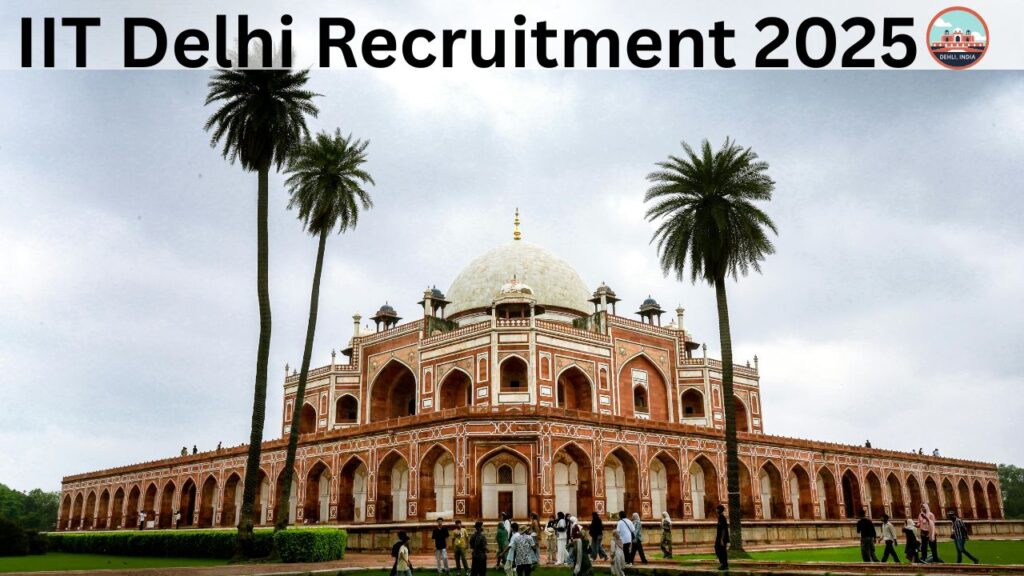
IIT Delhi Recruitment 2025: Latest Job Vacancies, Eligibility, and Application Process

IIT Delhi Recruitment 2025

Do you aspire to work at India’s leading institutions? The Indian Institute of Technology IIT Delhi Recruitment 2025is a golden chance for engineers, scientists, and academicians to excel in research, teaching or technical support. This year’s recruitment drive has plenty of jobs for freshers as well as experienced professionals. Here’s all you need to help build a great application. 

The Opportunity Awaits

Tuck yourself in among the green corridors of IIT Delhi, bookended by the finest brains in India. The hiring there is more than just filling vacancies. It is interested in motivated individuals who will advance science and technology.  

The institute have positions ranging from Senior Project Scientist to Project Attendant and faculty positions including Assistant Professor.Whether you are a senior seasoned professional or a new graduate, there is a role that could spark your career 

Decoding the Vacancies

The announcement describes eight project vacancies for several technical positions. Here’s a snapshot:

  • Senior Scientist: If you’ve got an M.Tech in Computer Science and a flair for pioneering work, this is your ticket. ​
  • Senior Assistant/Junior Assistant: For B.Tech or BE in Computer Science holders, these are stepping stones to a research oriented future.​
  • Scientist (Civil Engineering): If civil structures are your passion and you have a minimum of 3 years experience in the field, you’re in!​
  • Attendant: Just like aspirants of the position of Technician in the IITs, this is also an inclusive call considering even those with an experience of three years post 12th standard, which makes it easy to apply for a lot of people.​
  • Project Manager: If you’ve 8–12 years of experience & leadership is your essence, then you have a chance in there. 

There are vacancies for faculty, mainly Assistant Professors, in numerous departments (with Grade distinctions according to experience) for those holding a doctorate and possessing teaching skills. 

Selection: More than Just a Test

The scrutiny at Iit Delhi is but a fair one. Project posts are decided on the basis of your academic record, past experience and by how you come across in the personal interview. For numerous jobs in technology, the walk-in interview style is straightforward and more fun, no drawing it out. 

Academic and certain administrative roles have a two-stage process: testing and a presentation and a panel interview, to assess your knowledge of the subject and your teaching style. Good time management and clear communication also go a long way here. 

Are You Eligible?

Every position has different educational requirements. Senior positions require you to possess a Master’s or a PhD. B.Tech/BE candidates apply for project posts, while support posts offer chances to all those who have completed their 12th standard, provided they have work experience. This kind of approach is coming IIT Delhi’s ecosystem with a diverse team. 

The faculty and executive positions involve not only academic milestones but also practical experience in well-known organizations or the industry. Be sure to read the notification properly — this is the key to losing out on your dream job on a technicality. 

Read More 👉 WBSSC Result 2025 Declared – Direct Link to Check Your Score & Rank

How to Apply: Step-by-Step Guide

Follow Notification: Initially you can grab the official notification from the IIT Delhi site.​

Get your documents in order: You should have your educational certificates, mark sheets, experience letters, and ID proofs in a file that you can submit.

Attend the Interview: For most project posts, walk-in interviews mean that you just need to appear at the institute’s address on a particular date.

Online/Offline Application: Certain positions require online applications—access the application form using the recommended browser, and complete the form with exact details as mentioned in the notification. For special notifications (e.g. Project Manager) please attend the offline process before deadlines.

Check the Eligibility: Before applying make sure that you fulfill all the eligibility criteria- it will save your time as well as disappointment. 

Tips for Success

  • Walk in interviews for which you need to Arrive early; Punctuality always makes a good first impression.
  • If you’re invited for an interview, have crisp answers ready about your projects, your strengths, and your goals.
  • Study technical topics related to your position, as the interviewers will like that you know more than the basics.
  • Have your documents all in order, in both digital and hard copy format. 

The Promise of IIT Delhi

Work at IIT Delhi is the perfect combination of rigorous academics and real social impact. You will be joining new projects, training new leaders, and collaborating with experts from abroad. The transparent and objective selection process assesses each candidate on skills, past work, and goals. 

The Closing date for IIT Delhi Recruitment 2025 Application is on the way. So get ready, give it your all and prepare to be transformed. 

Conclusion

The IIT Delhi placement 2025 will give you an opportunity to get into one of the best institutes in India. The result is a spirit of innovation, excellence and focus that permeates every aspect of daily activity. Whether you’re a new graduate seeking your first research position or an experienced professional ready to lead teams, the numerous job opportunities cater to all skill sets. The fair wages, solid job growth, and inspiring work place make this more than just a job. It enables you to contribute to creating a narrative which directs India’s science and tech development. Be prepared well, keep visiting for updates and all the best for a bright career at IIT Delhi. 

Leave a Comment

Your email address will not be published. Required fields are marked *

Medical vs Engineering: Which Career Will Make You More Successful in 2025

Medical vs Engineering

If you are an Indian student in Class 10, 11, or 12, chances are you’ve heard a version of this line at least a dozen times. The age-old battle between Medicine and Engineering is a part of our DNA. For generations, these two streams have been seen as the ultimate tickets to a successful, secure, and respectable life.

The world is rapidly changing in 2025 with a lot of new career options for students. But when it comes to choosing between two different careers, everyone gets confused: Which path is better? Medical or Engineering? 

It’s a big decision of your life, both careers need your full potential whether you are preparing for NEET or JEE. It affects your life and your parent’s life too. Choose your path which aligns with your interest and skills.

The First Hurdle: The Challenging Road of Education

Before you can even dream of a stethoscope or a high-tech lab, you have to cross the battlefield of entrance exams. This is the first and most critical difference.

NEET (for Medical): The Marathon of Memory

  • The Exam: This is a single entrance exam for admission in MBBS. In 2024, over 23 lakh students fought for just over 1 lakh MBBS seats. The competition is insane.
  • The Challenge: Tons of topics to cover in Physics, Chemistry, and especially Biology, inside and out. It’s less about complex problem-solving and more about incredible memory, accuracy, and speed.
  • The Journey: The path is long. The time period is 5.5 years for MBBS with an internship certificate. After becoming a doctor at beginner level. You must do a postgraduate degree (MD/MS) to become professional, which is another 3 years after clearing another tough entrance exam, NEET-PG.
  • The Cost: Government medical colleges are very affordable (a few lakhs for the entire course). But getting a seat is like winning a lottery. You must be ready to invest ₹50 lakh to over ₹1 crore for MBBS course and more for postgraduation.

JEE (for Engineering): The Sprint of Logic

  • The Exam: This is a two-step process. JEE Main is the first filter. If you clear it, you can get into NITs and other good colleges. Admission in IITs is tough, you need to clear JEE Advanced.
  • The Challenging Step: If you are interested and have deep understanding in Maths, chemistry and physics, preparing for JEE isn’t that hard for you. But you must prepare with right strategy to beat the competition and get a chance for better college option. Because without a valuable degree, you will not get a high package of jobs. 
  • The Journey: A B.Tech degree is 4 years long. After this, you are an engineer and can start working immediately. A postgraduate degree (M.Tech) is an option, not a necessity, unless you want to get into research or specialised teaching roles.
  • The Cost: The fee for IITs and NITs is around ₹8-12 lakhs for the entire course, which is much more affordable than private medical colleges. Private engineering colleges have a huge range, from a few lakhs to ₹20-25 lakhs.

The stress of Kota coaching factories, the pressure from family, the fear of “wasting a year” – it’s real for both aspirants. A medical journey requires your time and money to become a doctor. You have to make commitments for this career.

Read More 👉 Top Engineering Govt Jobs in India 2025 – High Salary

Career Scope & Opportunities in 2025?

Engineering: it offers a diverse range of opportunities on national and international level.

The word ‘engineer’ is broad. The opportunities in 2025 depend heavily on your branch.

  • Computer Science & IT: This is the king of the jungle right now. With AI, Machine Learning, Data Science, and Cybersecurity booming, a skilled software engineer from a good college can land a job even before their final exams. 
  • Electronics & Communication: This field also requires engineers for running a network, designing for semiconductors, and automation. ECE engineers can get a lot of opportunities with a good salary package.
  • Mechanical & Civil: These are ‘evergreen’ branches. If students have skills and ability to construct, manufacture, and renewable energy then they can pick this career for their career.
  • Abroad: IIT or NIT qualified engineers are well-respected globally. With the right skills you can work on large projects abroad such as the US, Europe, and Australia.

Medical: Job security, secure future, and Respect in society

With an increasing health crisis, everyone needs a doctor who can cure and treat them. After MBBS, Medical training is also mandatory for every student. India has a huge shortage of doctors, with a doctor-patient ratio far below WHO recommendations.

  • In India: A doctor will never be jobless. You can have plenty of options like your own clinic, work in government or private hospitals. After specialization (e.g., cardiologist, dermatologist, oncologist), you will be demanded everywhere. The respect you get from society is unparalleled.
  • Abroad: MBBS degree is a door to open many options abroad but to work in countries like the US or UK, you need to clear their licensing exams (USMLE for the US, PLAB for the UK). Indian doctors can apply for them after a few years of experience in India because it is tough and expensive but the financial rewards and quality of life can be extraordinary.

Salary & Financial Growth

This is where the paths differ significantly.

  • Engineering: if you have done engineering in computer science from a reputed college or IIT, you can get a good placement package from top companies. IITs can get a starting package of ₹20-30 LPA. For other branches and colleges, it might be in the ₹6-12 lakh range. Your professional growth depends on how fast you can update your skills.
  • Medical: The financial journey is a slow burn. During your internship and PG residency, you earn a stipend, not a salary (around ₹25,000 to ₹80,000 per month depending on the state and college). The real earning starts after you are nearly 30 years old. But once you are a specialist, your earning potential is immense and stable. A successful specialist in a city can earn lakhs per month, far surpassing most engineers.

The Verdict: Engineering gives you a 6-8 year head start in earning. Medicine promises higher and more stable lifetime earnings, but you have to wait for it.

Read More 👉 Top 10 Central Universities in India 2025 – NIRF Ranking with Full Details

Work-Life Balance & Job Satisfaction

Success isn’t just about your bank balance. It’s about being happy.

A Doctor’s Life:

Heavy responsibility of a patient, being available for emergencies. So, this is not just a regular desk job. You need deal with many new things:

  • The Bad: The hours are brutal. Health crises can happen anytime-anywhere but being a doctor it’s your responsibility to be available for your patients. There are no weekends or festivals when there’s an emergency. Be ready to deal with everyday life and death situations. The small mistake can cost a life, so being focused and emotionally stable is mandatory to handle.
  • The Good: The job satisfaction is on another level. The feeling of saving a life or healing someone is a reward that money can’t buy. The trust and respect you receive from your patients and community are profound.

An Engineer’s Life:

Being an engineer is about creating and solving problems.

  • The Bad: Especially in the IT sector, there’s pressure of deadlines, project delivery, and constantly learning new technologies to stay relevant. Burnout is a real risk. Your job security is often tied to the performance of your company and the economy.
  • The Good: You often have more predictable work hours (though this can vary wildly). You have your weekends off. The work sometimes gives you hard challenges, but a lot of benefits like you can start your own side business after years of experience. You get to build things that millions of people might use, which is a great feeling.

What Should YOU Choose?

Forget about your friend’s suggestions. Forget about what your relatives will say. Ask yourself these questions with an honest heart.

Choose Engineering if:

  • You are fascinated by how things work. You are able to solve complex problems within less time and have a logical and analytical mind.
  • You love to solve quizzes from Maths and Physics.
  • Quickly understands new technologies and skills throughout your life. You don’t have a problem with quick changes in your professional world.
  • You want a faster entry into the professional world and want to start earning relatively early.
  • You are a creator and a builder at heart, whether it’s software, machines, or bridges.

Choose Medical if:

  • You have a deep, genuine desire to help people directly. Your primary motivation is service.
  • You have incredible patience and are prepared for a decade-long educational journey before you are fully settled.
  • You have quickly memorized diagrams and names of the phenomenon. You must adapt a habit to study consistently for very long hours.
  • You love to care about others and have strength to handle the pressure of life and death situations calmly. 
  • You want lifelong respect and a long-term future for your career.

In the end, there is no “better” field. There is only a “better fit” for you. A happy and successful engineer will always do better in life than a frustrated and burnt-out doctor, and vice-versa.

Success in 2025 and beyond will not come from choosing the most popular or the highest-paying stream. It will come from choosing the path where your natural interests and skills lie. It will come from choosing a profession that you won’t just ‘do’ for a living, but one that you will be proud to live every single day. So, talk to your parents, talk to people from both fields, and most importantly, listen to your own heart. The right answer is right there.e-old battle between Medicine and Engineering is a part of our DNA. For generations, these two streams have been seen as the ultimate tickets to a successful, secure, and respectable life.

Leave a Comment

Your email address will not be published. Required fields are marked *

SSC JE vs RRB JE: Which Govt Job Offers Better Salary, Growth & Stability in 2025?

SSC JE vs RRB JE

The debate between SSC JE vs RRB JE occurs between the engineering graduates who want government jobs. Both paths offer good packages with future growth. Aspirants must know about their selection process and job roles before stepping into the path. 

The Staff Selection Commission is conducting an exam for selecting candidates in Central government departments and ministries such as CPWD, CWS, and MES for the Junior Engineer role. The exam structure consists of two papers – Paper 1 & Paper 2 with 200 and 300 marks respectively.

Railway Recruitment Boards is conducting an exam for recruiting Junior Engineers for Indian Railways. This exam structure varies on – CBT 1, 2, document, and medical test for ensuring that you are able for field work or not. The competition is high in RRB JE recruitment so it is hard to beat it.

Understanding of Importance for SSC JE and RRB JE Comparison?

Both jobs have some similar benefits but there are other differences which makes them unique in their area of work. 

Similarities: Both RRB JE and SSC JE offer the same salary packages of around Rs. 50,000 to Rs. 60,000 (7th pay commission). Additional perks are the same including Housing Allowance, Dearness, Travel, Medical, Pension. A degree or diploma in engineering is required for these positions.

Differences: SSC JE engineering posted in departments of government while RRB JE works in Indian Railways. Frequent transfer, fast promotion, and field work mostly in the RRB. SSC offers slower promotion, desk & field work, no frequent transfers. 

Read More 👉 RRB JE Syllabus 2025: CBT 1 & CBT 2 Exam Pattern Explained

Major Departments Covered Under SSC JE and RRB JE

Every year SSC and RRB conduct exams for junior engineers recruitment for various departments. CPWD, MES, Central Water Commission, National Technical Research, BRO by the SSC. Indian Railways departments are in all zones from Northern to Southern and Eastern to Western.

Job Role & Work Environment

SSC JE roles are majorly related to the desk work with some supervision. If candidates have the ability to work in the office environment daily which needs skills such as planning, reporting, administrative then it is the best choice. Some tasks may need technical on-site work but not as much as RRB JE.

RRB JE offers field and operational work which is on-ground tasks. The engineers in the railway sector are expected to be involved in maintenance and operational duties.

Salary Structure in 2025

The salary structure for RRB JE and SSC JE in 2025 by level 6th (7th pay commission). Here is the detailed overview of the structure:

Pay LevelLevel 6 (Group B, Non-Gazetted)
Basic Pay₹35,400
Pay Scale Range₹35,400 – ₹1,12,400
Grade Pay (Old system)₹4,200
Dearness Allowance (DA)Around 17%-50% (varies; example 17% ≈ ₹6,000)
Travel AllowanceCities = ₹3,600Other Places = ₹1,800
Gross Salary RangeApprox. ₹46,000 to ₹63,700 (depending on city & allowances)
In-Hand Salary₹50,000 to ₹60,000 per month (after deductions such as PF, tax)

Career Growth & Promotions

SSC JE has more senior level positions and performance based promotion that offer you long-term benefit. Each promotion gives you an increment in your salary and offers diverse roles in various departments.

RRB JE is highly secure but offers fewer higher positions. Mostly need technical specialization within railways and promotion through different exams.

Posting Location & Transfers

SSC JE is less frequent in postings so it is best for those who want to settle down in one place with family. If you want fixed hours of working this path is guaranteed to provide you that. No changes in regular life but sometimes project-specific relocation happens in urban areas.

RRB JE postings are unpredictable as they can offer you rural areas and frequent changes in the location may be problematic for someone who doesn’t want regular changes in life. 

Job Stability & Security

SSC JE is a very stable job which offers security for the role and no elimination from the post until something serious misconduct occurs. RRB JE also offers job security because there are no layoffs in the government sector. And the need for staff is essential for safety and functioning Indian railways.

Read More 👉 RRB Group D Exam Date 2025 Out Soon – Check Syllabus, Admit Card & Hall Ticket Link

Work Culture & Facilities

SSC JE Work Culture

Most departments have fixed hours of working with professional, disciplined, and well-defined roles. Day-to-day responsibilities for reporting and documentation are basically a part of the job. Employees are satisfied with terms of stability, salary, promotions, and additional benefits. But what attracts them most is their work environment and professionalism. 

RRB JE Work Culture & Facilities

Working employees are showing satisfaction level while their passion meets with the largest sector of India. Technical and field workers experience additional perks of traveling and community culture which is not applicable in most of the jobs. But some people might have problems with disturbing locations.

Which is Better for You?

Seeing your friend or any relative working in SSC or RRB is good but making your life decision based on looking for them having a great life isn’t good. Try to find out your abilities and interests which are important to meet the needs of the job. 

If you are passionate about traveling and exploring new challenges while experiencing some issues such as away from hometown and not stable work-life balance. If you are okay with this then you can choose RRB JE job otherwise, go for the second option i.e. SSC JE. 

SSC JE offers stability and working in departments which offer mostly office-based technical jobs. You can have the same perks as railways but can actually have a life with your family.

What Should Aspirants Aim for?

Prefer SSC JE if:

  • You need to maintain balance in your work and personal life.
  • You are an engineer & a woman and want to have a good government job.
  • You want a mix of both on-ground and desk jobs.
  • Work culture is quite impressive, it is well-structured, faster promotions, and wider career growth.

Prefer RRB JE if:

  • You prefer to work in railways, field work, and fully operational duties.
  • You want a challenging life and are passionate about travelling.
  • Unique railways additional perks like medical facilities, and railway passes.

Conclusion

Both have vast opportunities for you and both are government jobs. It depends on you to choose which sector aligns with your interest and skills. The debate for SSC JE vs RRB JE is consistently growing as their salary and job security is high. In 2025, if you are deciding for your future after engineering then this guide will help you to explore details for both of them.

Leave a Comment

Your email address will not be published. Required fields are marked *

MP Police Vacancy 2025: 7500 Constable Posts, Apply Fast!

Candidates can fill the application form of MP Police Vacancy 2025 for Constable posts. Candidates will apply online until the last date of submission. You can download the official notification to check every detail according to this selection. There are several vacancies around 7500 that will be filled through this selection process. Please check the eligibility criteria and age limit before applying for the constable post (General Duty). 

Candidates must be physically fit and have no health issues because after the written examination you are summoned for the physical and medical test. It is mandatory to pass these tests for the job role. 

MP Police Vacancy 2025 Highlights and Important Dates

OrganizationMadhya Pradesh Employee Selection Board
PostConstable
Number of Vacancies7500
Last date of Application29th September 2025
Selection ProcessWritten Exam → Physical → Fitness Test Medical Test
Official WebsiteClick Here
Application Starts On15th September 2025
Application Ends On29th September 2025
Exam Date30th October 2025
Admit CardUpdate Soon
ResultUpdate Soon

Eligibility Criteria

Educational QualificationClass 10th marksheet with a good score or 10+2 marksheet from a recognized board.
Age limitGen (male): 18 – 33 yearsReserved category got age relaxation up to 38 years

Read More 👉 CAT Exam Syllabus 2025: Complete Section-Wise Guide to Crack the Test

Application Fee 

General Category Rs. 500
SC, ST, OBC, EWSRs. 250

Instructions to Fill The MP Police Constable Application

Before applying for the MP Police Constable Bharti in 2025, candidates should know the instructions and eligibility criteria. This application will register your name for the examination that will happen in October. You will get selected after clearing this examination and then you are summoned for the next procedure. 

Let’s read this instruction to apply online:

  1. Visit on the official website where the link of the application is open.
  2. Click on that link and add your details in the form that appears on your screen on MPESB website. 
  3. Attach your valid documents with the application form and click to submit.
  4. Before the final submit, check all the filled details of yours to make sure everything’s correct.
  5. Save the copy of the application for your future reference.
Useful Links
Application FormClick Here
Official NotificationClick Here
Official Website Click Here

Leave a Comment

Your email address will not be published. Required fields are marked *

How to Crack UPPSC RO/ARO Without Coaching  

Crack UPPSC RO/ARO Without Coaching

Every year, lakhs of students in Uttar Pradesh start their RO/ARO preparation the same way — by joining a coaching institute the moment they decide to attempt the exam. It feels like the safe choice. Everyone around you is doing it, the institutes promise structured guidance, and the fear of “missing something important” pushes you toward enrolling even before you’ve opened a single book on your own.

I can’t speak for your specific goals, but what a lot of successful RO/ARO candidates will tell you once they’ve actually passed the test is: coaching never made the difference. What mattered was whether they understood the exam, built a routine around it, and stayed consistent long enough to see results. 

If you fall into the category of not being able to afford coaching or if you’re just an individual who likes to learn on his own terms, there’s no issue in attempting RO/ARO exams. You can start your preparations by yourself with the right guide. Proper syllabus, exam pattern, right schedule, responsibility are the core steps to take to prepare for the exam.

1. Understand Exam Pattern to Make the Right Strategy

You probably saw or heard that self-study failed many students not because they lacked intelligence but because they didn’t understand the exam’s purpose and importance. There are stages in the exams to clear and each one requires a different kind of preparation.

  1. UPPSC RO/ARO has a Preliminary exam to check how well you know General Studies and General Hindi and it rewards speed and accuracy over depth. 
  2. The Mains, on the other hand, wants you to write with clarity and present arguments, not just recall facts. 
  3. And the Typing Test, ignored by most aspirants until the last month, has quietly ended the dreams of candidates who cleared both written exams but never practiced typing seriously.

Before you buy a single book, spend two or three days just going through the official syllabus and the last five years of question papers. You’ll notice patterns almost immediately — certain topics from Indian History, Indian Polity, and UP-specific General Knowledge repeat in some form every year. This is the kind of pattern-recognition that coaching institutes charge lakhs to hand you on a platter. You can get there yourself with a notebook and some patience.

2. Build a Study Routine That Doesn’t Depend on Motivation

Coaching institutes work partly because they impose a schedule on you — classes at fixed times force a kind of discipline that self-study doesn’t naturally have. When you’re preparing alone, motivation runs out fast, usually within the first three weeks. What replaces it is routine.

Pick a time of day when your mind is sharpest — for most people, that’s early morning — and treat that slot as non-negotiable, exam day or not. Break up your week so that you have each subject in a chunk of the day, instead of bouncing around among all of them every day. A general division that helps for RO/ARO is General Studies in the morning, Hindi grammar and comprehension in the afternoon, and revision and mock tests in the evening. The exact hours matter less than the consistency of showing up.

What trips up most self-study candidates isn’t laziness — it’s the absence of a feedback loop. In a coaching class, a teacher tells you when you’re falling behind. Alone, you have to build that feedback into your own routine. Keep a simple tracker, even a basic notebook works, where you log what you studied and how confident you feel about it. Revisit that tracker every Sunday and be honest about the gaps.

Read More 👉 Data Science vs AI: Which Career Is Better?  

3. Choose the Right Books Instead of Too Many Books

One of the biggest traps for self-study aspirants is book overload. When you ask about which books toppers used, they might give you different answers. But each one of them has the topics which are frequently asked in the previous question papers. So, choose the book which you can understand when you read. Stick to that particular book per subject rather than jumping between multiple books hoping one of them “clicks.”

For General Studies, a common NCERT-based core syllabus in History, Geography, Polity and Economy is a much better option than jumping straight into exam-specific guides. Once your basics are solid, move to a UP-specific General Knowledge book, since a noticeable chunk of the RO/ARO paper focuses on state-level facts that national-level books simply don’t cover. For Hindi, focus heavily on grammar rules and previous year papers rather than generic Hindi literature books — the exam tests application, not literary depth.

Newspapers are non-negotiable, but read them with intent. Don’t read every article; scan for anything related to government schemes, UP-specific developments, and national events with policy implications. Ten focused minutes with a newspaper beats an hour of aimless reading.

4. Practice Like the Exam Is Already Tomorrow

Self-study candidates often make the mistake of treating mock tests as an afterthought — something to do once the syllabus is “finished.” In reality, mock tests should start early, even when you know only half the syllabus. Testing yourself regularly does two things coaching classes usually do for you: 

  • It shows you where your weak areas actually are 
  • And it trains your brain to work under time pressure

Solve at least one previous year’s paper or a full-length mock every week, and don’t just check your score — go through every wrong answer and understand why you got it wrong. Was it a factual gap, a silly mistake, or a comprehension issue? Each of these needs a different fix, and lumping them together as “I need to study more” won’t get you anywhere.

The typing test deserves its own separate practice schedule starting at least two months before your written exams are clear, not after. Waiting until results are declared to start practicing typing is one of the most common and avoidable mistakes RO/ARO aspirants make.

5. Find Your Community, Even Without a Classroom

The one genuine advantage of coaching is the peer group — people preparing for the same exam, sharing doubts, comparing notes, and keeping each other accountable. You can recreate this without paying for it. Online communities of RO/ARO aspirants, study groups on messaging apps, and even a couple of serious friends preparing for the same exam can replace this function almost entirely.

Use these groups to clarify doubts, share useful resources, and occasionally test each other. Just be careful they don’t turn into distraction hubs — the goal is accountability, not endless discussion about strategy that never converts into actual studying.

Read More 👉 Top 10 Mistakes to Avoid While Preparing for UPPSC RO/ARO

The Real Difference Between Coached and Self-Taught Candidates

Coaching gives structure to people who can’t build it themselves. If you can build that structure on your own — a study routine, the right books, regular self-testing, and a support system for accountability then there’s genuinely nothing coaching offers that you can’t replicate. 

What ends up separating candidates who clear RO/ARO from those who don’t isn’t whether they paid for classes. It’s whether they stayed consistent long enough, tested themselves honestly, and treated every mock test result as information rather than judgment.

Self-study for RO/ARO isn’t the harder path. It’s simply the path that asks more of your discipline instead of your wallet — and for a lot of aspirants across UP, that trade has worked out just fine.

Conclusion — How to Crack UPPSC RO/ARO Without Coaching

Clearing the UPPSC RO/ARO exam without coaching is entirely achievable if you get started with the right attitude and strategy. The course, past year papers, textbooks, sample tests, and current affairs are all available online nowadays. Because in the end, your success is going to be determined by the work that you do every day, not by how much money you spend on prep. The real challenge isn’t finding resources—it’s using them consistently.

Leave a Comment

Your email address will not be published. Required fields are marked *

PhD Entrance Exam Eligibility 2025: Everything You Must Know About Qualifications, Age Limit & Admission Rules

Are you ready to dive headfirst into the world of research and academia? If you are planning for a PhD in 2025, then be ready to know about the PhD Entrance Exam Eligibility 2025! This guide will offer you all the information regarding Phd entrance exam eligibility. From fundamental academic qualifications to the newest information on entrance exams, so you should prepare according to the eligibility criteria and entrance exams. Whether you’ve just graduated and wanted to get into the research field and make your future brighter, or you’re a working professional thinking about a part-time PhD, we’ve got your back. Let us decode the eligibility criteria for you and help you pave your path for a doctorate!

Core Academic Qualification

The applicant should have one of the following qualifications from a recognized board/institution:

  • 2-year/ 4-semester Master’s degree post a 3-year Bachelor’s degree or a 1-year/ 2-semester Master’s degree post a 4-year Bachelor’s degree.
  • Comparable foreign qualifications if recognized by the relevant bodies.
  • The M.Phil. is also being at least partly phased out in select instances M.Phil. degree holders may apply directly for PhD programmes, albeit. 

Minimum Marks Required

55% marks in aggregate (or its equivalent grade in the relevant subject(s) of study). 

Reserved category relaxation 5% relaxation in the marks (i.e. minimum 50%) is applicable to SC/ST/OBC (non-creamy layer)/PWD/EWS and other similar categories as per UGC policy. 

New Direct Admission Pathways

If you are a 4-year bachelor’s degree holder and sold a minimum of 75%, you are lucky! You can go directly for the PhD without Doing a master’s degree. The catch? You just have to crack the entrance exam to get the seat. So if you’re eager to go right into researching after your undergrad, this might be a good way to skip ahead in your academic career. Just make sure you’re prepared and your grades are good! 

Entrance Exam Requirement For PhD

Major National-Level Entrance Exams for PhD Admission — From 2025 on, the majority of universities and institutes in India will adopt UGC NET scores for PhD admissions, instead of institutional entrance exams. Science, Engineering and Medical PhD- Exam like CSIR NET, GATE, ICMR JRF, DBT JRF, JEST is still flagged. 

Also, some institutions may consider GRE/GMAT scores for management-related disciplines. This change will also help in unifying the process of admission throughout the country. 

Exemption Provision — Those candidates who have qualified national fellowship like NET-JRF, CSIR-JRF, GATE, etc. are usually not required to write the entrance exam but they need to take the interview. 

Interview and Proposal

Admission to PhD programs is usually followed by a personal interview where the research potential and preparedness of the student is assessed, and where the student is questioned about his/her Statement of Purpose (SOP) or a draft research proposal. 

Age Limit

No upper age limit: Adopting a relaxation for the age bar for pursuing a PhD, all those having the requisite academic qualifications will be able to apply for a PhD in India in 2025, there is no age bar for UGC NET or institution-based examinations.

Certain courses or universities (for instance, a few IIMs) may have an upper age limit (typically 40 years).

Part-Time and Full-Time PhD 

Part-time PhD programs are indeed recognized, especially for working professionals, as long as they can provide a No Objection Certificate (NOC) from their employer. 

However, full-time PhD programs demand regular attendance on campus so students must attend regular classes, the minimum 75% attendance is mandatory. Most universities offer hostel accommodations to support students during their studies.

Read More:- Best Books & Online Resources for Banking Exam Preparation 2025

Coursework and Duration for PhD

  • Minimum length of stay: 3 years (coursework included).
  • Maximum Duration: 6 years (up to one year extension in exceptional circumstances for full-time students). 
  • Compulsory propaedeutic course work on research methodology and core courses in the first terms.

Recent UGC Updates for 2025

NET score is compulsory for the admission from the session 2025, replacing the majority of university-level entrance examinations.

Professional/part-time mode with NOC with distance education allowed.

Direct PhDs from four-year undergraduate studies for deserving students. 

Important Takeaways for 2025 Applicants

Most phd admissions are focused on NET scores.

  • It is mandatory to have a Master’s degree with an aggregate of 55% marks or equivalent, else the maximum marks will be relaxed by 5% for reserved categories.
  • There is no age limit for applying for most of the courses.
  • The provisions for Part-Time and Interdisciplinary Research are being promoted under NEP-2020.
  • Interviews and research proposals are required following preliminary screening.
  • Please refer to the individual university portals for detailed and discipline oriented parameters.
  • Regulations are evolving; always check university details before applying. 

Conclusion

Remembering this as you gear up for your PhD journey: the ground is always shifting. Two new direct admission options, and a common entrance test for all, make 2025 the year to watch out for all research aspirants. Keep up with developments, watch out for your marks and check out to universities for fresher information. The dream of having a PhD is a bit nearer for you, and with a little guidance about PhD Entrance Exam Eligibility 2025, you will be able to take a first step towards making your mark in the world of academics. So, get excited, stay motivated and you know what it’s time to make that PhD dream a reality! 

Leave a Comment

Your email address will not be published. Required fields are marked *

Scroll to Top