Best IIT College in Uttar Pradesh – Complete Ranking & Admission Guide

Best IIT College in Uttar Pradesh

Selecting the Best IIT Colleges in Uttar Pradesh is the largest challenge to face any engineering aspirant. The state has only two IITs – IIT Kanpur and IIT (BHU) Varanasi – but its institutions have perennially churned out India’s top engineers, researchers, innovators and global leaders. The two colleges have excellent reputations on both national and international scales, world-class faculties, state-of-the-art labs, and one of the best placement records in the nation.

Whether you’re shooting for a top-300 JEE Advanced rank or making your way to a legacy-rich IIT with great future prospects, this guidance narrates rankings, fees, application process, placements and career outcomes, helping you make a smart and informed choice. So, let’s take a look at the top engineering colleges in Uttar Pradesh. 

IIT Kanpur: The Engineering Powerhouse

Founded in 1959, IIT Kanpur is now the best engineering school in UP. Ranked #4 in NIRF Engineering Rankings 2025, It always manages to be among the best universities making it as top engineering schools in India. The institute provides a high quality of education with its sprawling 1037-acre campus in Kalyanpur, Kanpur. 
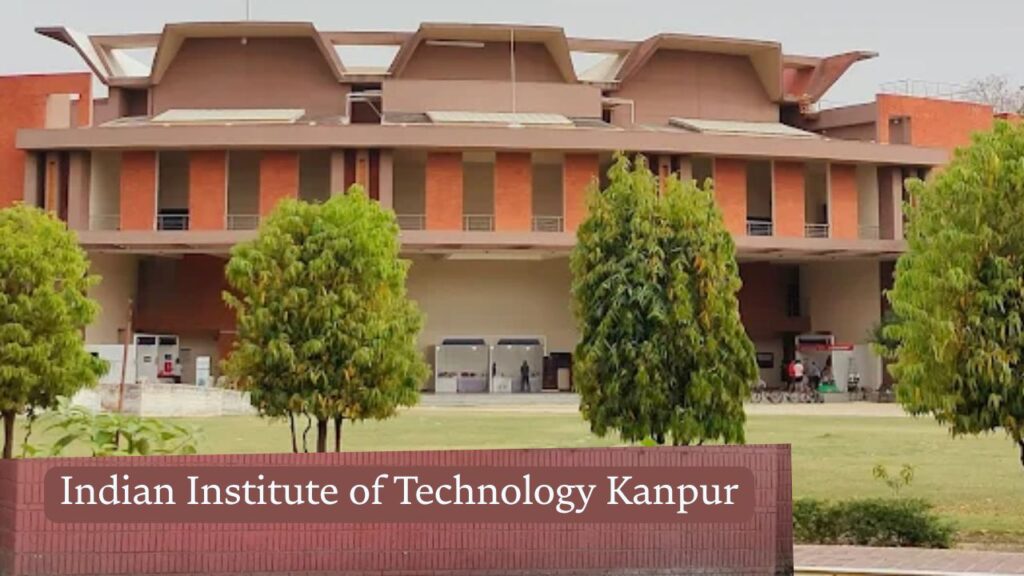
IIT Kanpur
Image credit: IIT Kanpur

Admission and Eligibility

The admissions in the undergraduate B.Tech courses of IIT Kanpur are through JEE Advanced only. The cutoff for cse (computer science and engineering) for the year 2025 was 271 in very high competitions. Along with your JEE Advanced score you should have a minimum of 75% in Class 12 (65% for SC/ST categories). The institute accepts GATE scores for some of the postgraduate programmes (depending on the discipline), as well as IIT JAM and CAT scores. 

Fee Structure 

B.Tech fees is ₹ 2.30 – 2.50 lakhs per year, and ₹ 20,000 to ₹ 30,000 a semester for mess and hostel. So, a higher secondary B.Tech Degree will cost around Rs 8.6 lakhs, which is reasonable for quality education. Apart from these the institute has several other scholarships such as Merit-cum-Means (MCM) Scholarship, schemes for SC/ST students etc. 

Career Prospects & Placements  

Placement record of IIT Kanpur is known to be excellent. The average package for the B.Tech graduates is between ₹ 26.90 and ₹ 30.86 LPA while the highest package is ₹ 1.9 crore per annum. Top recruiters such as Google, Microsoft, Amazon, Tata Steel etc. ensure good options in core and tech industries. 

IIT (BHU) Varanasi: The Heritage Institution

IIT (BHU) Varanasi was formed in 1919 to deliver vast education to new generations and is still doing it. Its one purpose is served well as everyone can see with their own eyes on the alumni network of IIT BHU. It is also grounded in a tradition of academic excellence spanning centuries, even now it actually tops on the edge and holds 10th position, according to NIRF Engineering Rankings 2025.
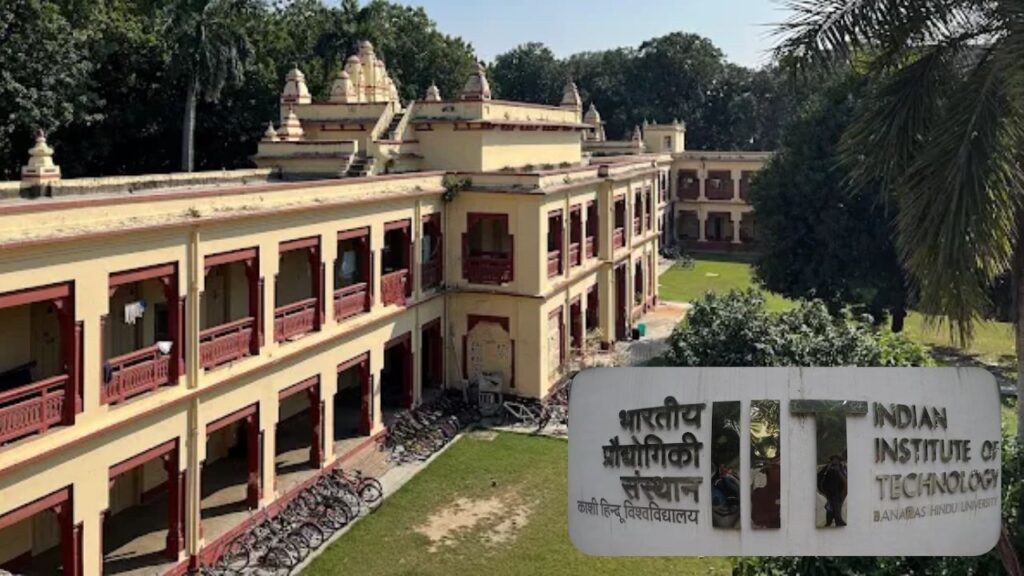
IIT (BHU) Varanasi
Image credit: BHU

Admissions Process & Eligibility Requirement

BHU conducts admissions through JEE Advanced as well, similar to IIT Kanpur. The closing rank for CSE in 2025 was around 2,500, however the cutoff is significantly lower. This means that if you take the JEE via BHU, you could get into a good IIT even if you don’t make a very high rank. For students of general category, minimum 75% is required in class 12 fulfilling the eligibility criteria. 

BHU B.Tech Fees

Banaras Hindu University B.Tech program fees range from 3.17 L to 8.51 L for full course, whereas tuition fee is in the range of 1,00,000 to 1,20,000 per semester and hostel fee ranges between 25,000 to 28,000. With this, it rates somewhere around or even less expensive than IIT Kanpur, depending on the branch. 

Career Prospects & Placements

BHU has no less amazing placement figures. The highest package is ₹1.68 crore per annum and the average package is ₹22.77 LPA. Over 80% of students were placed in 2024, and the CSE average lies within ₹25-₹28 LPA. Google, Qualcomm, Uber and Goldman Sachs are the top recruiters. 

Read More 👉 Bihar DElEd Entrance Result 2025 OUT: Check Marks, Rank & Admission Status

Making Your Choice

The selection is on the basis of your JEE Advanced score but both colleges are great for education. IIT Kanpur has a slightly better average package as well as branding if you fall under the top 300–400. Then, IIT (BHU) Varanasi is your best bet if your rank lies between 1,500 and 3,000. It combines legacy with excellent career outcomes. In both situations you are paying for the brightest engineering futures in India, twice. 

Comparison Between IIT BHU & IIT Kanpur

The top JEE advanced students looking for a slightly better average package and brand name in a tier 2 engineering college should go with IIT Kanpur. It has a good number of students with a rank below 500, as the the #4 ranking for NIRF along with the world class facilities attracts students from all over the country.

IIT BHU Varanasi is equally competitive and is a great choice, though it does have a lower ranking (#15). Owing to a much lower cutoff rank (~2,500 as compared to ~271 for CSE), a lot more students qualify for it and yet it boasts great placement stats. The history of the institution is over 100 years and that provides some historical prestige but that many applicants doesn’t value. 
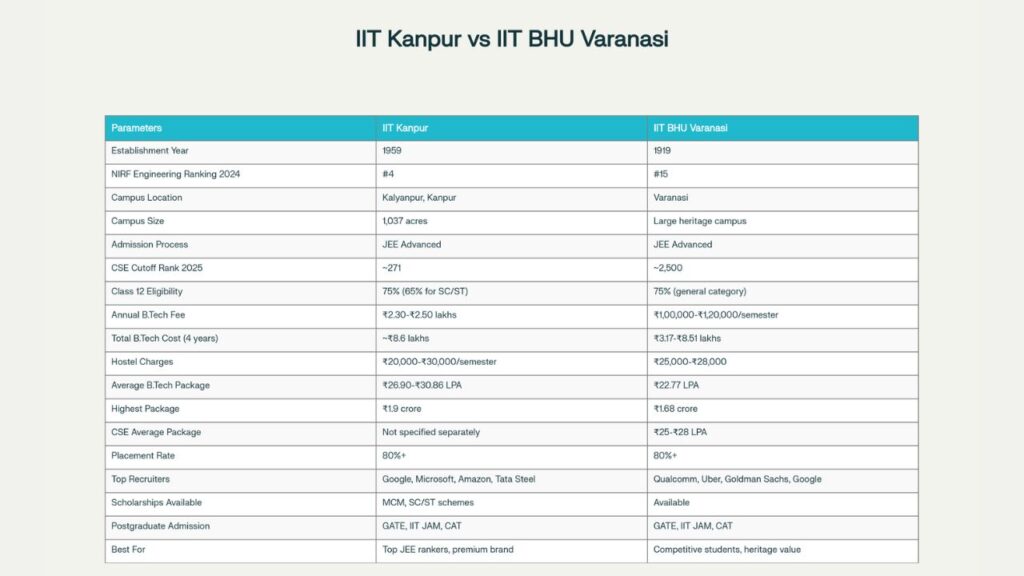
Comprehensive Comparison of IIT Kanpur and IIT BHU Varanasi

Both universities provide good scholarship opportunities, have good placement and see participation from best global companies. Your decision should be based on your JEE Advanced rank, finances, and if you place more value in brand (Kanpur) or accessibility + heritage (BHU Varanasi). 

Conclusion

These are the best IIT colleges in Uttar Pradesh which offer outstanding core academics, research, placements, and student life. If you are a high ranked aspirant and looking for an elite brand name with more research options and slightly higher average packages then IIT Kanpur is the clear winner.

But for hot IIT rank holders in the range of 1,500–3,000 and who want an IIT that combines tradition with bang for your bucks, a rock solid faculty and stellar placements year in and year out, IIT (BHU) Varanasi is the way to go. 

Whichever institution you opt for, both pave the way to brilliant careers, worldwide prospects and a life-changing four-year experience of engineering. 

Leave a Comment

Your email address will not be published. Required fields are marked *

ITI Admission Fees in Government College: Complete Fee Structure Guide

ITI Admission Fees in Government College: Complete Fee Structure Guide Are you interested in Technical and Vocational Education Training (TVET) as a career option? A good Industrial Training Institutes(ITI) is a great way to learn a practical skill and get a job in a short span of time. How much does it really cost to join a government ITI? is probably among the most frequent questions that are buzzing in your mind if you have been looking for ITI courses. So let's get started with the full ITI Admission Fees in Government College details before jumping on the admission portal. Quick Overview of Fee Breakdown This is the fee structure in short for an Electrician course at a typical government ITI to make your career brighter. This will help you understand the budget of the two year course. Charge Amount Admission Fee –Given one time ₹100 Registration Fee –Given one time ₹50 Monthly Tuition ₹2,400 (₹100 × 24 months) Caution Money – given back later ₹250 Examination Fees ₹200 Student Welfare Funds ₹300 Total Approximate Cost ₹3,300 Note: The caution deposit is refundable on successful completion and your effective expenditure comes to approximately ₹3,050 for two years — Now that’s reasonably priced! Understanding the ITI Fee Structure The nice thing about government ITIs is that they are hilariously cheap when compared to private ones. With private ITI colleges charging fees ranging from ₹5,000 to more than ₹1,000,000 per year, fees of the government ITI colleges are affordable and it goes from ₹1,000 to ₹20,000 per year. So, students from all financial backgrounds can get quality technical education. But it's not just a single figure for the fee structure to pay and forget about it. The fees in government ITIs are divided into several heads, each of which is for a certain purpose. Knowing what all these entails will allow you to plan your finances so you don’t get a shock when it is time for admission. Tuition Fee: The Core Cost The tuition fee is the staple of your yearly outgoings. It is from ₹100 to ₹150 per month at most government ITIs in India which works out to be from ₹1,200 to ₹1,800 per year. For reference, the West Bengal government ITIs charge a total fee of ₹30 per month as a tuition fee, implying that you will be spending only ₹180 for the entire six-month course. These vary from state to state and institution to institution, so be mindful!​ The annual tuition fee for regular trainees, however, is Rs 1,800 (Rs 150 per month) at some government institutions such as the National Skill Training Institute (NSTI) in Patna. Yet if you are from SC/ST, you pay a lot less – just Rs 600 per year (Rs 50 per month). It is indicative of the government’s resolve to open the door of education to the underprivileged sections of the society. Admission Fee: One-Time Payment Consider the entry to the admission fees for the institution you are wants to apply. This is a one-time fee that you pay once you join and not every year. The admission fee is usually around ₹100 to ₹300 for most government ITIs. This is phenomenally low, and includes the cost of processing your application, verification of your documents, and the registration procedures.​ Interestingly, some institutes offer concessions to SC/ST students. For example, SC/ST students will have to pay Rs 25 instead of Rs 100 as admission fee. Registration Fee There is also a registration fee separate from the admission fee and the registration fee is usually between ₹30 to ₹200. This is for registering your enrolment with the records of the institute and getting you listed with the official registers. It’s a non-refundable fee which is paid generally at the time of verification of admission.​ Again, if you belong to SC/ST category you may get waived off from paying this fee in some institutes. Caution Money: A Security Deposit Important to understand: Caution money isn’t a fee that you are wasting. It’s a security deposit that is refunded. You pay it once (usually between ₹ 100 to ₹ 500) while admitting and you get it on successfully completing the course. This sum of money serves as a kind of insurance to keep students finishing their training and disciplined. Additional Funds and Charges In addition to the basic fees, the Govt ITI s also levies different student welfare and infrastructure enhancement funds which may be used for welfare activities of the students, for up-gradation or improvement in infrastructure. These might include: Gymkhana Fee Up to ₹100 To get along with sports and extracurricular activities Student Welfare Funds ₹50 to ₹375 Contributing to overall student development programs Placement Registration Fee Approximately ₹50 Helping the institute organize campus placements Smart Card Fund Around ₹200 For issuing digital identity cards Examination Fee At the time of examination, an institute usually levies a test fee of ₹25 to ₹100 per attempt. This includes the cost of holding exams, drafting question papers and conducting tests. Total Annual Cost For ITI Government Add all this up and see what the real number you’re looking at is. For a normal engineering trade class (say Electrician or Fitter) in a government ITI. First Year Fee is in range between ₹2,400 — ₹3,500 Subsequent Years As it vary on state, ₹1,500 to ₹2,000/year Delhi institute registration fee is Rs.200, so if you are applying there then this is the amount you have to pay at the time of verification along with the other applicable fees, which is quite nominal. Special Provisions and Exemptions For Girl Students A large number of Government ITIs provide relaxation to female trainees. Girl students are exempted from tuition fees as well as examination fees at institutes such as Patna's NSTI, rendering the course free for girls (the only exception being other compulsory deposits and fees). A few states have adopted similar policies to incentivize women to take up technical trades. For Reserved Categories There are hefty discounts for students who belong to the SC, ST, OBC or EWS category. Tuition is often waived or discounted to a token sum. In the ITIs of Odisha, the admission fees are waived for the trainees from SC, ST and women category whose family annual income is less than `2.5 lakhs, they have to pay only the caution money. For Persons with Disabilities (PwD) The government ITIs are said to extend exemptions and concessions to the special needs students, because 'they are handicapped and the financial burdens of study should be thrown off from their shoulders'. State-Wise Variations For the Fee of ITI One should note that the ITI fees vary according to states since education is a subject of state in Indian federalism. For instance, in Tamil Nadu, government ITIs charge anywhere between ₹5,000 and ₹7,000 per year, while in Himachal Pradesh, they charge between ₹6,000 and ₹8,000. With competition fees, states such as Bihar, Uttar Pradesh, and Rajasthan have the biggest network of government ITIs. Conclusion When you take into account that you are learning practical skills that are directly applicable to jobs in the public and private sectors, that is a huge amount of bang for your buck. Whether you are just finishing school and want to start your career or are planning a career change, government ITI courses provide a cost-effective, quality route to technical proficiency. The best way to get the most update on ITI Admission Fees in Government College is to go on your state’s ITI official website, check under what category you fit under for exemptions and email the best would be to the lucky one you want to attend for any questions. Your path to a rewarding career might be more affordable than you think! Meta title : ITI admission fee in government college. full fee guide 2025 Meta desc : Complete guide on ITI admission fees in government colleges: tuition, admission, exam fees, concessions for girls and reserved categories. Cost details for full 2 ​​years. Url : iti-admission-fees-in-government-college Focus Keyword : ITI Admission Fees in Government College Government ITI Fee Structure ITI Government College Fees 2025 ITI Course Fees in Government Institute ITI Fees for Girls & Reserved Category

Are you interested in Technical and Vocational Education Training (TVET) as a career option? A good Industrial Training Institutes(ITI) is a great way to learn a practical skill and get a job in a short span of time. How much does it really cost to join a government ITI? is probably among the most frequent questions that are buzzing in your mind if you have been looking for ITI courses. So let’s get started with the full ITI Admission Fees in Government College details before jumping on the admission portal.

Quick Overview of Fee Breakdown

This is the fee structure in short for an Electrician course at a typical government ITI to make your career brighter. This will help you understand the budget of the two year course.

ChargeAmount
Admission Fee –Given one time₹100
Registration Fee –Given one time₹50
Monthly Tuition ₹2,400 (₹100 × 24 months)
Caution Money – given back later₹250
Examination Fees₹200
Student Welfare Funds₹300
Total Approximate Cost₹3,300

Note: The caution deposit is refundable on successful completion and your effective expenditure comes to approximately ₹3,050 for two years — Now that’s reasonably priced! 

Understanding the ITI Fee Structure

The nice thing about government ITIs is that they are hilariously cheap when compared to private ones. With private ITI colleges charging fees ranging from ₹5,000 to more than ₹1,000,000 per year, fees of the government ITI colleges are affordable and it goes from ₹1,000 to ₹20,000 per year. So, students from all financial backgrounds can get quality technical education.

But it’s not just a single figure for the fee structure to pay and forget about it. The fees in government ITIs are divided into several heads, each of which is for a certain purpose. Knowing what all these entails will allow you to plan your finances so you don’t get a shock when it is time for admission. 

Tuition Fee: The Core Cost

The tuition fee is the staple of your yearly outgoings. It is from ₹100 to ₹150 per month at most government ITIs in India which works out to be from ₹1,200 to ₹1,800 per year. For reference, the West Bengal government ITIs charge a total fee of ₹30 per month as a tuition fee, implying that you will be spending only ₹180 for the entire six-month course. These vary from state to state and institution to institution, so be mindful!​

The annual tuition fee for regular trainees, however, is Rs 1,800 (Rs 150 per month) at some government institutions such as the National Skill Training Institute (NSTI) in Patna. Yet if you are from SC/ST, you pay a lot less – just Rs 600 per year (Rs 50 per month). It is indicative of the government’s resolve to open the door of education to the underprivileged sections of the society. 

Admission Fee: One-Time Payment

Consider the entry to the admission fees for the institution you are wants to apply. This is a one-time fee that you pay once you join and not every year. The admission fee is usually around ₹100 to ₹300 for most government ITIs. This is phenomenally low, and includes the cost of processing your application, verification of your documents, and the registration procedures.​

Interestingly, some institutes offer concessions to SC/ST students. For example, SC/ST students will have to pay Rs 25 instead of Rs 100 as admission fee. 

Read More 👉 CAT 2025 Exam Analysis: Difficulty Breakdown for VARC, DILR & QA

Registration Fee

There is also a registration fee separate from the admission fee and the registration fee is usually between ₹30 to ₹200. This is for registering your enrolment with the records of the institute and getting you listed with the official registers. It’s a non-refundable fee which is paid generally at the time of verification of admission.​

Again, if you belong to SC/ST category you may get waived off from paying this fee in some institutes.

Caution Money: A Security Deposit

Important to understand: Caution money isn’t a fee that you are wasting. It’s a security deposit that is refunded. You pay it once (usually between ₹ 100 to ₹ 500) while admitting and you get it on successfully completing the course. This sum of money serves as a kind of insurance to keep students finishing their training and disciplined.

Additional Funds and Charges

In addition to the basic fees, the Govt ITI s also levies different student welfare and infrastructure enhancement funds which may be used for welfare activities of the students, for up-gradation or improvement in infrastructure. These might include: 

Gymkhana FeeUp to ₹100To get along with sports and extracurricular activities
Student Welfare Funds₹50 to ₹375Contributing to overall student development programs
Placement Registration FeeApproximately ₹50Helping the institute organize campus placements
Smart Card FundAround ₹200For issuing digital identity cards

Examination Fee

At the time of examination, an institute usually levies a test fee of ₹25 to ₹100 per attempt. This includes the cost of holding exams, drafting question papers and conducting tests. 

Total Annual Cost For ITI Government

Add all this up and see what the real number you’re looking at is. For a normal engineering trade class (say Electrician or Fitter) in a government ITI. 

First YearFee is in range between ₹2,400 — ₹3,500
Subsequent YearsAs it vary on state, ₹1,500 to ₹2,000/year 

Delhi institute registration fee is Rs.200, so if you are applying there then this is the amount you have to pay at the time of verification along with the other applicable fees, which is quite nominal.  

Special Provisions and Exemptions

For Girl Students

A large number of Government ITIs provide relaxation to female trainees. Girl students are exempted from tuition fees as well as examination fees at institutes such as Patna’s NSTI, rendering the course free for girls (the only exception being other compulsory deposits and fees). A few states have adopted similar policies to incentivize women to take up technical trades. 

For Reserved Categories

There are hefty discounts for students who belong to the SC, ST, OBC or EWS category. Tuition is often waived or discounted to a token sum. In the ITIs of Odisha, the admission fees are waived for the trainees from SC, ST and women category whose family annual income is less than `2.5 lakhs, they have to pay only the caution money. 

For Persons with Disabilities (PwD)

The government ITIs are said to extend exemptions and concessions to the special needs students, because ‘they are handicapped and the financial burdens of study should be thrown off from their shoulders’. 

State-Wise Variations For the Fee of ITI

One should note that the ITI fees vary according to states since education is a subject of state in Indian federalism. For instance, in Tamil Nadu, government ITIs charge anywhere between ₹5,000 and ₹7,000 per year, while in Himachal Pradesh, they charge between ₹6,000 and ₹8,000. With competition fees, states such as Bihar, Uttar Pradesh, and Rajasthan have the biggest network of government ITIs. 

Conclusion

When you take into account that you are learning practical skills that are directly applicable to jobs in the public and private sectors, that is a huge amount of bang for your buck. Whether you are just finishing school and want to start your career or are planning a career change, government ITI courses provide a cost-effective, quality route to technical proficiency. 

The best way to get the most update on ITI Admission Fees in Government College is to go on your state’s ITI official website, check under what category you fit under for exemptions and email the best would be to the lucky one you want to attend for any questions. Your path to a rewarding career might be more affordable than you think! 

Leave a Comment

Your email address will not be published. Required fields are marked *

Data Science vs AI: Which Career Is Better?  

Data Science vs AI

Students in this generation really got stuck on choosing a stable career. In India, the choice is not limited between doctor or engineer anymore, there are a lot of options such as Data Science and Artificial Intelligence. Both are growing fields that offer wider opportunities. Continue reading to understand why Data Science vs AI comparison is important.

Most students couldn’t differentiate these two courses since they are somehow interconnected, every AI engineer needs data science fundamentals, and every good data scientist today is expected to know basic machine learning but work responsibilities, eligibility, and salary is different.

What Data Science Really Involves

Data Science, at its core, is about making sense of information that already exists. You’re looking at sales numbers, customer behaviour, hospital records, whatever the industry, and pulling out patterns that help a business make a decision. 

Data scientists at Paytm or JPMorgan often involve arranging raw data using manual coding and models to analyze trends, behaviour, and developing dashboards that allows managers to anticipate what might happen in the following quarter. The job depends a lot on statistics, SQL, Python and increasingly on data visualization tools to turn complex datasets into actionable insights. 

What AI Really Involves

Artificial Intelligence, on the other hand, is a trained model to automatically read data and process it without needing to be handled manually by any human. If Data Science is about interpreting the past, AI is about building machines that can act in the present or future. 

This includes machine learning models, deep learning, computer vision, natural language processing, and now heavily, generative AI and agentic systems. An AI engineer is more of a software builder than an analyst because constructing an AI model that not only reads data but also processes it with its own brain. 

Eligibility: Who Can Actually Get In

For Data Science Courses

The eligibility bar is comparatively relaxed. If you’ve cleared class 12 with Maths, Statistics, or Computer Science as a core subject, you can walk straight into a B.Tech, BSc or BCA in Data Science. 

For postgraduate programs, you need a bachelor’s degree in engineering, science, commerce, or even economics, along with basic statistics knowledge. This is why so many commerce and arts graduates in India are successfully switching into data roles through PG diplomas.

For AI Courses

AI is stricter about your technical background. Most AI degree programs, especially the IIT B.Tech in Artificial Intelligence, expect you to clear JEE Advanced, which means your foundation in Maths and Physics has to be genuinely strong from school itself. 

For M.Tech and PG-level AI programs, GATE scores are usually mandatory, and the cutoffs at institutes like IIT Patna and IIT Kharagpur are competitive. 

If you’re coming from a non-technical background, entering AI usually means starting with an online certification first and building up your programming and linear algebra skills before you can even think about a formal AI degree.

Best Courses for Data Science

If you want the government-institute route, the IIT Madras BS in Data Science and Applications is one of the most respected options right now, since it’s fully online and doesn’t require JEE, only a qualifier exam. 

IIT Roorkee & Kanpur, and IIIT Bangalore also offer certificate programs for both Data Science and AI. Other private universities like Christ University, NMIMS, and Symbiosis are recommended highly from former students and educators across India for offering BSc or MSc in Data Science.

If you are working professional and want to upgrade your career skills without spending three years to get a degree then shorter bootcamp-style programs from Scaler, DataTrained, and Great Learning are the best options for you. They provide courses that are designed specifically for getting a job within six to twelve months.

Best Courses for AI

If you have cleared JEE Advanced, B.Tech in Artificial Intelligence from IIT Hyderabad, IIT Madras, IIT Kharagpur, and IIT Gandhinagar are the right options for you to start your career journey in AI.

If you are a working professional, the IIT Roorkee Executive Program in Applied Data Science and AI, delivered through Jaro Education, has become a common pick because it doesn’t require you to quit your job. IIM and ISB executive AI programs are aimed specifically at managers who want to lead AI-driven teams rather than build models themselves, so that’s a different crowd entirely.

If you’re just testing the waters before committing money, NPTEL’s free AI and ML courses through IIT Madras are a genuinely good starting point, and they carry an official certificate for a token fee.

Read More 👉 Technical Government Jobs in India: A Complete Guide for Engineers and Diploma Holders

Fees: What You’ll Actually Pay

Data Science Courses Fees 

  • A Data Science course in India can be found at every possible cost. Free learning options are NPTEL, YouTube, and financial-aid courses on Coursera. 
  • Short online certification programs generally cost around ₹30,000, while structured postgraduate programs from training institutes typically range from ₹70,000 to ₹1.6 lakh. 
  • If you are looking for a degree such as BSc, MSc, or MBA in Data Science, the fees will be in the range of ₹1.5 lakhs to ₹4 lakhs. 
  • Certificate courses offered by IITs are generally in the range of ₹80,000 to ₹2.5 lakh, varying with the course content and duration. 

AI Courses Fees

  • AI courses are typically a little more expensive than Data Science courses since they may provide access to high-end computing resources or specialized labs, plus more industry-relevant training. 
  • Short online certification courses usually range from ₹20,000 to ₹50,000 and structured professional programmes—like the executive certification from the IIT—come at a cost of around ₹1.5 lakh and upwards. 
  • The fee for a four-year B.Tech in Artificial Intelligence at an IIT ranges from Rs 8.8 lakh to Rs 12 lakh, institute and fee structure wise. 
  • The executive AI programs of top business schools including IIMs and ISB are meant for the working professionals and usually vary from ₹3 lakh to ₹5 lakh for six to twelve months duration courses. 

So if budget is your biggest constraint right now, Data Science is genuinely the more affordable entry point, especially if you go the online-certificate-plus-portfolio route instead of a full degree.

Data Science vs AI Career Scope that Leads Better Opportunities

An entry-level data scientist in India can expect to earn from ₹3.5 LPA to ₹6 LPA in companies as data analyst, business intelligence analyst, junior data scientist. With 3 to 5 years experience and expertise in machine learning or big data tools like Spark, a candidate’s salary can go up to ₹15 LPA to ₹25 LPA.

Typically, the starting salary for AI roles is a bit higher at around ₹6 LPA to ₹10 LPA for a fresher AI or ML engineer, and experts working in NLP, computer vision, or generative AI at senior level are drawing ₹20 LPA to ₹40 LPA, sometimes more if they are working with LLM-based systems at a product company. 

Why does AI pay more at the top end? 

It’s not magic, it is because there are less people who can actually build these systems, and deploy these systems than there are people who look at a data set and analyse it. 

What Should You do After Completing the Course

Finishing the course is the easy part. If you have completed a Data Science course, your first step should be creating 3 to 4 real projects using publicly available datasets from Kaggle, preferably related to Indian industries like retail, fintech, or agriculture, as recruiters in this region love to see work that’s locally relevant. 

Learn to use SQL a little more than just the basics, learn how to tell a business story with your visualisations in Power BI or Tableau, and start applying for data analyst positions even before you feel “ready” because they all expect you to be learning on the job anyway. 

If you have recently completed an AI course, then your attention should be on deploying models rather than merely training models. You should write code on a Jupyter notebook and be able to turn it into an actual production run using tools like Docker and some minimal MLOps. 

Also publish the codes on GitHub because interviewers trust your hard work and concepts more than your certificate. And for where the industry is going, get serious about generative AI frameworks and agentic workflows, because that’s where the strongest demand for new hires is today, not in vanilla supervised learning, alone. 

Which One Should You Actually Pick

If you enjoy working with numbers that already exist, you like storytelling through data, and you want a lower-cost, faster entry into a paying job, Data Science is the safer and quicker route. If you’re strong in maths and coding, you’re patient enough to handle a steeper learning curve, and you want to be closer to building the technology rather than interpreting it, AI offers a higher ceiling, both in salary and in long-term relevance, but it demands more from you upfront, in both eligibility and course investment.

There isn’t a universally “better” choice here, there’s only the one that matches what you’re good at and what you’re willing to put in over the next two to three years. Most people building serious careers today don’t pick one and abandon the other anyway, they start in Data Science to build the foundation, and move into AI once they’ve got the fundamentals locked in.

Read More 👉 How To Prepare Current Affairs For Government Exams: A Complete Strategy

Conclusion

It’s better to understand the difference between Data Science vs AI before getting more confused. There is no single factor, but your budget, schedule, eligibility, and level of knowledge might affect your decision. 

Most importantly, your interests also matter. Getting confused in them is easy because they are somehow connected but work, courses, fees, and salary are totally different.  

Leave a Comment

Your email address will not be published. Required fields are marked *

Best Private University in India for Quality Education and Innovation

Best Private University in India

The scenario of higher education in India has been a significant transfigurement in last 10 years. It is no longer the case that the best private universities in India are the only standard setters for excellence. Private universities today are reinventing the world-class education allowing them to differentiate in quality academics, through leading-edge innovation and creating environments where students are not just learning but also creating, discovering and leading. 

Well, if you are looking for higher education in India then it is important to know what the differences are in the top private universities. They are not simply teaching bodies but they are breeding grounds for tomorrow’s captains of industry, researchers and innovators who will chart courses through industries and address global challenges. 

The Top Contenders

In the NIRF 2025 rankings, the private university sector is led by a few good institutions. The Manipal Academy of Higher Education (MAHE) emerges 3rd among universities across the country and stands as the best private university in the country. Closely following are BITS Pilani at rank 7, Amrita Vishwa Vidyapeetham at rank 8, VIT Vellore, LPU, Amity University and SRM Institution of Science and Technology at rank 11. 

However, not only in rankings, Ashoka University is transforming Indian higher education. Ranked as the best new-age private university and awarded as the “University of the Year (Emerging)” in 2025 at the FICCI Higher Education Summit, Ashoka is the future of liberal arts and interdisciplinary education in India. 

Manipal Academy of Higher Education (MAHE) Amrita Vishwa Vidyapeetham
BITS PilaniVIT Vellore
SRM Institution of Science and TechnologyAmity University
Ashoka UniversityLovely Professional University (LPU)

What Makes These Universities Stand Out?

Research and Innovation at the Core

Today’s private universities know that good teaching without innovation is half-truth. BITS Pilani has been especially creative in institutionalizing research amongst students. The institute, since 2023, has published more than 6,500 research papers in journals with average impact factor more than 4.1, filed 325+ patents, completed 13+ technology transfers, and incubated 138+ deep-tech startups with a combined valuation of over USD 300 million.These are not simply figures—they represent actual technology developed by students and professors that are reshaping markets and addressing real-world problems. 

The Manipal Academy too has made huge investment in innovation infrastructure. Its Innovation Centre is a dynamic ecosystem that offers seed funding, incubation support, mentorship for patent filing and commercialization. The university has a state-of-the-art Central Analytical Instrumentation Facility (CAIF) with world class instruments such as SEM, NMR, XRD which enables interdisciplinary research in emerging areas like material science, biotech etc. 

Ashoka University has now set up the Ashoka-Zeiss Core Imaging Facility, the first such facility in India, which caters to high end research in Cell Biology, Biophysics and Structural Biology. Inspiringly, in 2025, Ashoka was awarded the highest distinction for its research and innovation activities, demonstrating a strong commitment to advancing the frontiers of knowledge.

Faculty Excellence and Academic Rigor

The standard of faculty decides the standard of education. These elite private colleges have gone all out in trying to hire outstanding scholars, researchers, practitioners. Amity University has right faculty student ratio to provide quality education in meaningful mentorship and is supported by 2,100+ well experienced faculty members in helping 37,000 students in different campuses.​

The curriculum at these schools is more than just textbooks. Many elite private universities weave in industry perspectives into their curriculum through guest lectures, internships and group work. That means students learn not only the theoretical underpinnings, but real-world applications and evolving industry issues. 

Global Partnerships and International Exposure

It is always true that in a connected world, you need global exposure to get a good education. Ashoka University, one of India’s leading liberal arts universities, has partnered with 60+ prestigious institutions globally across 28 countries and five continents including Yale University, Sciences Po, University of Melbourne, EYH Paris. Partner organizations also provide opportunities for interaction with group and field trips during semester exchanges, summer programs, research collaborations and faculty exchange. 

Similarly, Manipal University holds joint research programmes with top-notch institutions worldwide and is funded for research by various agencies such as DST, CSIR, AICTE. This global network ensures that students have access to an array of perspectives and world class academic resources. 

Placement Excellence and Career Readiness

Quality education in the end translates into job opportunities. Manipal Academy secured more than 90% placement in 2025, with 8,000+ students placed across multiple programs. The highest package for engineering students went up to ₹69.25 LPA with average package of ₹12.31 LPA. Top recruiters: Microsoft, Amazon, Deloitte, IBM, Standard Chartered, and BookMyShow. 

Inclusive Accessibility and Scholarships

Although being good quality generally carries a cost, many leading private universities understand that that should be manageable. These schools provide merit-based scholarships, aid packages and need-based grants so that gifted students aren’t turned away because of money. 

The Innovation Ecosystem

What really sets the best private universities of today apart is their strategies for innovation across the board. BITS Pilani has created a number of innovation tracks to address a range of contexts – SPARKLE for transdisciplinary problem solving, SOLVE for applied innovation and PIEDS (Pilani Innovation & Entrepreneurship Development Society) along startup development.​

Ashoka University launched the Young Scholars Programme: Innovators in Science & Tech (YSP IST). It’s for the high schoolers and it’s a 10 day live-in camp. It enables them to learn difficult subjects such as environmental chemistry, neuroscience, quantum computing and genetic engineering. These camps help create future inventors. They also ignite science curiosity at a young age.  

Read More 👉 Top Agriculture College in Uttar Pradesh: Courses, Fees & Admission Details

Choose Your Path Wisely

Choosing a university is a very personal matter. If you are interested in a multidisci­plinary education close to industry, Manipal Academy is excellent if you like comprehensive education with strong links to industry. If you want the best research and entrepreneurship route, BITS Pilani is unparalleled. Ashoka University, for those interested in liberal arts with a global outlook, provides a new frontier in Indian higher education.

What matters most is knowing what you want. Are you a basic researcher? Do you want to build startups? Are you looking for global exposure? The finest private Indian universities today cater to such journeys 

The Future of Private Higher Education

The Indian private university sector is evolving fast. They are not simply copying public universities, they are innovating, conducting cutting edge research and drawing talent from around the world. This focus on quality, innovation, research and international collaboration is indicative of a vibrant, competitive ecosystem, and students stand to gain immensely from this.

Keep in mind as you start your higher education journey, Rankings are just one measure. What makes a school is its learning community, the quality of its faculty, the substance of its research, and its aspiration to produce not just accomplished professionals but responsible global citizens. India’s finest private universities are increasingly making the case that they can indeed deliver exactly that.

Conclusion

India’s leading private universities are transforming higher education with cutting-edge research, global outlook, industry-centred curriculum, and incubators of innovation. From BITS Pilani’s entrepreneurial culture to MAHE’s research excellence and Ashoka’s revolutionary liberal arts model, you will find a way to map out a future-ready career.

So when you’re picking your uni, focus on what suits your ambitions – be it research, startups, global learning or industry know-how. 

Ultimately, these top private colleges in India are showing that they can shape not just degrees, but the leaders of tomorrow. 

Leave a Comment

Your email address will not be published. Required fields are marked *

HPSC Recruitment For PGT Post Graduate Teacher (PGT) Computer Science 2026

HPSC Recruitment

The HPSC Recruitment for 2026 Post Graduate teacher (PGT) Computer science Vacancy is out. There are a total of 1,672 posts and the process of application is going on. Those interested in this job can apply on-line from 16/February/2026 to 09/March/2026. Here is a golden opportunity  for all the aspirants who want to become a teacher in Haryana. 

Candidates should meet the eligibility criteria as per the HPSC to apply for the Teaching Posts. There is full information regarding eligibility, application fees, exam pattern and selection procedure in the notification. Applicants are advised to go through this notification carefully of HPSC Recruitment to ensure that they meet the eligibility criteria. 

Application Fees of HPSC Recruitment

CategoryFee
General/EWS/OBC₹1,000
SC/BC/PwD/Ex-Serviceman₹250
Females₹250
PH (Divyang)No fee

Schedule For Haryana HPSC PGT Teacher

EventDate
Notification Release5/February/2026
Online Application Start16/February/2026
Application Deadline9/March/2026 
Fee payment deadline9/March/2026

Education Requirement

QualificationDetails
M.Sc. Computer Science2-year regular course 
MCA3-year regular course
BE/B.Tech in Computer Science/ITFrom recognized university, minimum 55% aggregate 

Age Limit

CategoryAge Range
Minimum18 years
Maximum42 years (relaxations apply) 

Application Process

  1. View the Official Notification Or Apply Online: Interested candidates can apply online through the HPSC website.
  2. Now, go to the “Recruitment” section, check and click on the advertisement for PGT Computer Science.
  3. Select the option for Online Registration. Make sure you provide the correct number and DOB for registration in this step.
  4. Then, after registering for an account, you can complete your application form with the necessary details. It includes the details of educational qualification, ID, etc.
  5. Now, make the payment of the application fee as specified in the notification. You need to ensure that you do this step otherwise your application will not proceed further.
  6. After filling the form and making the payment of the fee, you may attach the required documents and submit the application. 

NOTE: Do keep a printout of your application form and payment slip for your reference. 

Read More:- BSc Dialysis Technology: Course Details, Eligibility, Salary & Career Scope

Selection Process and Exam Pattern 

The PGT selection procedure of HPSC Recruitment is meant to be a just and fair assessment through a simple two-tier exam system where your basic knowledge as well as expertise in the subject is tested.

1. Screening Test:

This is the initial level of screening. It combines your general knowledge with rudimentary knowledge of your subject to get rid of the non-serious and non-able candidates.

2. Subject Knowledge Test:

This is the main exam phase. It examines more deeply into your subject and examines what extent your conceptual clarity, understanding and hold of the subject is.

The selected candidates may be called for interview which will be concentrated for personality, communication/interactive skill and teaching aptitude after these written tests. 

Total Questions100 
Total Marks100 
Marking Scheme+1 mark per correct answer (0.25 negative marking in screening test) 

Syllabus for the HPSC PGT Exam

The HPSC PGT syllabus is very well crafted, as it is designed to impart teaching basics along with in-depth subject knowledge, guiding candidates to prepare in a comprehensive and methodical manner. It’s not just a test of what you know—it’s also a test of how well you know teaching.

General Topics (Applicable to all Subject)

These components are designed to focus on developing effective teaching practices:

Educational Psychology: Provides knowledge of how students learn, think, and grow, as well as some significant theories of learning and development.

Pedagogy: Practical teaching techniques, teaching in the classroom as well as learning to learn.

TLM (Teaching-Learning Materials): Related to production, use and management of TLM for efficient and effective classroom learning. 

Subject Specific Knowledge 

Each PGT subject has its own defined detailed syllabus by HPSC which is depth orientated and specialised.

For instance: For example, in Computer Science — Data structures, searching and sorting, algorithm analysis, graph theory getting solid computational and logical foundations.

English: A focus on reading comprehension, critical thinking and analysis of texts is effectively promoted by the syllabus. 

Conclusion

The application for HPSC Recruitment for PGT Computer Science 2026 is expected to be filled with aspiring candidates who wish to establish their career in the teaching field through this Haryana Public Service Commission Teaching jobs. With 1,672 vacancies dealing with a transparent selection process & a well-structured exam pattern, this recruitment serves as the best platform to enter into Haryana education. 

If you qualify for the eligibility and have the enthusiasm to teach, now is your time to take the plunge. Smart Preparation, Strategic Syllabus, brief Application Procedure & Get all Official Notifications. HPSC Recruitment 2026 can be the stepping stone for a bright and safe career in the Haryana’s Education System with hard work and integrity. 

GovUpdatewala is your trusted source for real-time updates on government exams and jobs in India. We provide verified info on SSC, UPSC, Banking, Railways, Defense, and Teaching exams. From syllabus and patterns to important dates and career tips — we support aspirants at every step.

Leave a Comment

Your email address will not be published. Required fields are marked *

MP Police Vacancy 2025: 7500 Constable Posts, Apply Fast!

Candidates can fill the application form of MP Police Vacancy 2025 for Constable posts. Candidates will apply online until the last date of submission. You can download the official notification to check every detail according to this selection. There are several vacancies around 7500 that will be filled through this selection process. Please check the eligibility criteria and age limit before applying for the constable post (General Duty). 

Candidates must be physically fit and have no health issues because after the written examination you are summoned for the physical and medical test. It is mandatory to pass these tests for the job role. 

MP Police Vacancy 2025 Highlights and Important Dates

OrganizationMadhya Pradesh Employee Selection Board
PostConstable
Number of Vacancies7500
Last date of Application29th September 2025
Selection ProcessWritten Exam → Physical → Fitness Test Medical Test
Official WebsiteClick Here
Application Starts On15th September 2025
Application Ends On29th September 2025
Exam Date30th October 2025
Admit CardUpdate Soon
ResultUpdate Soon

Eligibility Criteria

Educational QualificationClass 10th marksheet with a good score or 10+2 marksheet from a recognized board.
Age limitGen (male): 18 – 33 yearsReserved category got age relaxation up to 38 years

Read More 👉 CAT Exam Syllabus 2025: Complete Section-Wise Guide to Crack the Test

Application Fee 

General Category Rs. 500
SC, ST, OBC, EWSRs. 250

Instructions to Fill The MP Police Constable Application

Before applying for the MP Police Constable Bharti in 2025, candidates should know the instructions and eligibility criteria. This application will register your name for the examination that will happen in October. You will get selected after clearing this examination and then you are summoned for the next procedure. 

Let’s read this instruction to apply online:

  1. Visit on the official website where the link of the application is open.
  2. Click on that link and add your details in the form that appears on your screen on MPESB website. 
  3. Attach your valid documents with the application form and click to submit.
  4. Before the final submit, check all the filled details of yours to make sure everything’s correct.
  5. Save the copy of the application for your future reference.
Useful Links
Application FormClick Here
Official NotificationClick Here
Official Website Click Here

Leave a Comment

Your email address will not be published. Required fields are marked *

Scroll to Top