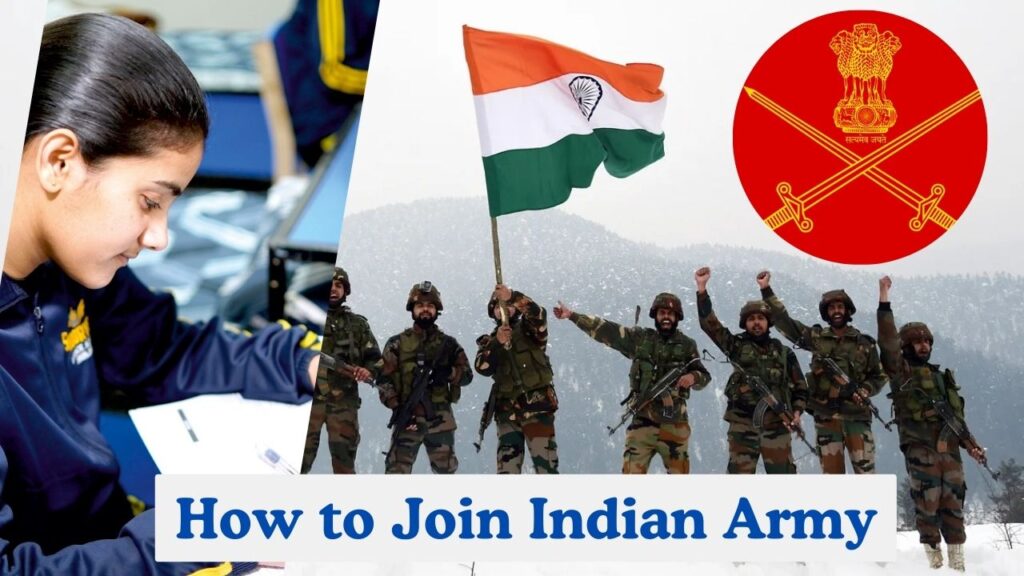
How to join Indian Army: It’s not just a job, a profession or a service, it’s a way of life to be in the Indian Army and a lifetime commitment to the nation. For millions of young Indians, the olive-green uniform stands for honor, meaning and pride that far surpasses any regular jobs. But the path to joining the Indian Army isn’t a smooth one it requires vision, preparation, stamina and the knowledge of different entry points available.
Whether you are a 10 or 12 student, a graduate or one aspiring to get commissioned, the Indian Army has multiple avenues to make that dream a reality. Unique in this sense, this guide shows you everything from entry schemes, through selection stages, fitness, documents, medical standards, ensuring that you can prepare as best you can to help you realise your own dream to serve the nation with pride.
Understanding Your Entry Options
There are hardly any rigid models for recruitment of the Indian Army. The company understands that people with potential can come from anywhere educationally and that is why it has different entry schemes. If you are a class 12 passer, the Agniveer scheme is for you. If you’re a graduate or an engineer, you can apply for the Short Service Commission (SSC) or the Technical Graduate Course (TGC). For people still in class 12 with strong academics, the NDA is a well-known route that leads to officer-level commissions.
What I like about Indian Army recruitment is its open door policy. For soldiers and officers, technical and manpower roles for that matter, there is something for everyone. Your starting point might be different from your colleague’s, but the destination – serving the nation – is the same.
The Most Popular Route: Agniveer Scheme
For most hopefuls it has become like the Agniveer scheme and this is the only option going forward. Introduced to recruit a younger, more dynamic force into the Armed Forces, the scheme is available for men and women aged 17.5 to 21 years. You must have passed class 10th/12th from a recognized board with minimum 50% marks in aggregate.
The submission of the application is easy. Go to the official site joinindianarmy.nic.in and register providing your basic details, e-mail and mobile number. You will fill up application details with your 10th certificate with as per rules. After you have submitted, you will be given a registration number—hold on to this, it is the key to the next step.
Read More 👉 UPSSSC Lekhpal Online Form 2025: Apply Online for 7,994 Revenue Posts
The Three-Phase Selection Gauntlet
After the registration you must prepare yourself for three intense stages. The first state is the Common Entrance Exam (CEE), a written test conducted offline. This test examines your understanding of General Knowledge, Mathematics, Science and Reasoning. It’s not like you need to memorize stuff, the exam is on your logical thinking and problem solving skill.
If you clear the CEE, then you will be invited for the second stage: the Recruitment Rally. This is your physical fitness moment! The rally comprises a Physical Fitness Test (PFT) which is truly exhausting. You must run 1.6 km in 5 minutes and 45 seconds, do at least 6 pull-ups, jump a 9-foot ditch, and complete a zig-zag balance test. They’re not just random drills, they’re meant to test whether or not your body can keep up with the rigors of military life.
The third stage is the medical test and document confirmation. Medical examinations are extensive – they examine your vision, hearing, bone density, heart health, and your general well-being. The Army needs soldiers who aren’t just strong but also medically able to go where it’s hard to go.
Physical Fitness
Being physically fit matters, and you really can’t ignore your way through it. If you really want to join, start your fitness regimen now. Running is your foundation—start with distances you can handle and slowly increase your speed and distance. Do interval training by alternating between high-intensity bursts and recovery intervals.
For pull-ups, who you are is more important than how many you can do right now. If you have no pull-ups yet, use resistance bands/assisted pull-ups or work on negatives to start building strength. Add push-ups, sit-ups and squats for full body strength. Flexibility and balance are also important for many candidates don’t realise, but it is this which is tested in the zig-zag test. Add yoga and agility drills to your training.
Nutrition-related matters are just as vital/nutrition matters are just as vital/nutrition is just as vital Nutrition & hydration are equally important Nutrition Jones in Sydney opined: “it is not only the training [that is important], nutrition is [also]. Fuel your body with protein, complex carbohydrates, fruits and vegetables. Keep hydrated as you train, and stay away from junk food that zaps your energy.
The Officer Route: A Different Path
If you are a class 12 student with good academic record and want to join Indian Army, consider the Technical Entry Scheme (TES for NDA) or the National Defence Academy (NDA). The NDA is conducted by the Union Public Service Commission (UPSC) and the applicants must be aged between 16.5 and 19.5 years have qualified 10+2 to be eligible. The competition is stiff with only 5 to 10 percent getting selected but the reward is a three year training at the National Defence Academy and then a permanent commission in the Indian Army.
For graduates, the Combined Defence Services (CDS) exam, which leads to Indian Military Academy (IMA). Male and female candidates who are graduates are also eligible and the selection procedure consists of a written exam and then the infamous Services Selection Board (SSB) interview.
The SSB Interview: The Ultimate Test
If there is a stage that divides the dreamers and the doers it is the SSB interview. This isn’t your run-of-the-mill job interview; you’ll be subjected to a five-day psychological and personality test to determine how officer-like you are. You will be having the Officer Intelligence Rating (OIR) test, Picture perception and discussion (PPDT), psychological tests, group discussions, outdoor tasks and a personal interview.
Leadership, teamwork, bravery, and the capacity to think on your feet are the qualities that the SSB wants. It evaluates the consistency between what you think, what you say and what you do — an idea based on the ancient “Manasa, Vacha Karmana” principle. The interviewing officer will question your background, your motivation for enlisting, your knowledge of current events, and your capacity to stress.
Documents Required For This Position
- 10th and 12th mark sheets and certificates
- Domicile certificate with photograph
- Caste certificate
- Religion certificate
- School character certificate
- Unmarried certificate (if below 21 years)
- Aadhar card or ID proof
- 20 passport-size color photographs
- Any NCC certificates or sports achievements
The Medical Examination
After passing the physical and mental evaluations, you will have a full medical check-up. The Army requires its soldiers to withstand harsh environments, so the standards are tough. After you cross this last barrier, you will get your joining letter and will be sent to the respective training academy.
Conclusion
Enrolling in the Indian Army is not just about getting a job and a stable source of income. You’d be serving your country, joining a brotherhood that has stayed vigilant over the nation for generations, and doing something that’s bigger than you are. The path is tough, the competition is fierce and the training will test you to your limits.
But here is what makes it so worthwhile: the privilege of wearing the uniform, the gratification of serving one’s country, and the realization that you are a member of an organization that has influenced the future of the nation. If you have the passion, if you have the resolve, and if you can run – the Indian Army awaits you. Start today, hold fast, and who knows maybe, just maybe, a year from now you’ll be standing tall in that uniform, serving the nation with pride.