Those Candidates who are interested in MVI can apply for BPSC Motor Vehicle Inspector Recruitment 2025. The Motor Vehicle Inspector is a technical post for inspecting vehicles for public safety on roads, and emission standards. BPSC conducts this recruitment to fill MVI positions in Bihar Transport Department. Candidates can apply online for this government post 10/06/2025 to 03/07/2025. Check out the important dates, structure, and syllabus to prepare before applying.
Summary of BPSC Motor Vehicle Inspector Recruitment 2025
Exam Conducted
Bihar Public Service Commission (BPSC)
Post Name
Motor Vehicle Inspector (MVI)
Vacancy
28
BPSC Motor Vehicle Inspector Recruitment 2025
To fill the Motor Vehicle Inspector Bihar Government conduct this process. Candidates who passed 10th or diploma are eligible for this exam
Objective type Questions from all the 3 subjects: Mechanical Engineering, General Studies, Motor Vehicle Laws
Interview
For candidates qualified in written exam only appear in Interview
Document Verification
Final stage with certificate checking
Educational Qualification
Candidates who pass 10th from any recognised board are eligible for this exam. A diploma is required to this role from any recognized institute or board in Engineering. Valid driving license is mandatory. Check the eligibility criteria on the official website of the Bihar Government.
Documents Required
Class 10 Marksheet to prove that you have passed the 10th
Diploma Certificate for ensuring the knowledge you gain in engineering
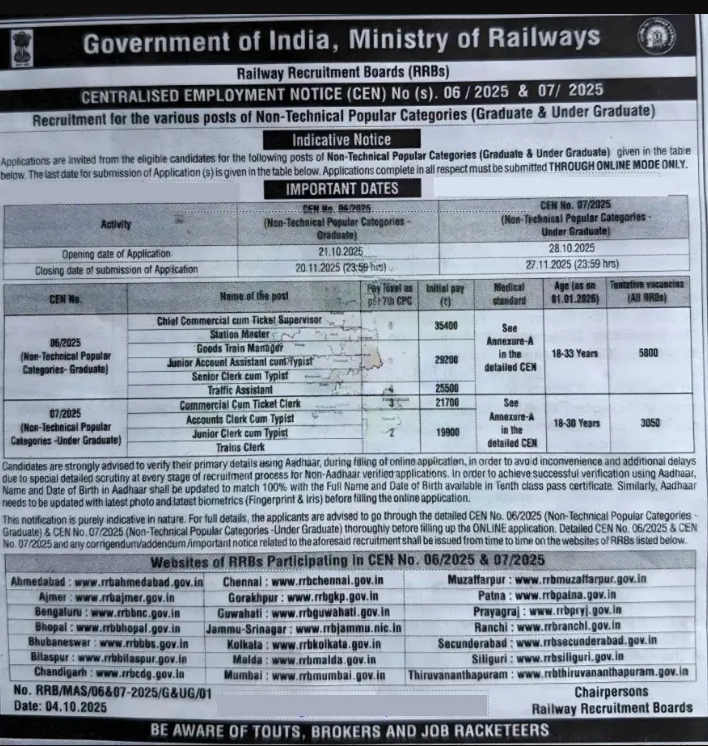
Railway Recruitment Board announced about the NTPC recruitment drive for the interested candidates who are waiting to apply for Railway jobs. RRB posted on the official website about the recruitment drive for the posts of Station Master, Goods Train Manager, Traffic Assistant, Senior Clerk cum Typist, and more. There are 5810 vacancies out there, and the online application process commences on October 21, 2025 and deadlines for submissions are November 20, 2025. Interested candidates can see the full notice for eligibility rules, fees, age limits, pay info, and how the selection works. Graduates who want jobs in railways should barge at this.
Everyone gets confused about choosing their career path. When the context is about Government Jobs vs Private Jobs, there is always a debate among youths. While most people prefer having a good lifestyle, a stable career, and growth in their lives. With growing comparison of Which Career Offers a Better Future in 2025? It’s important to know about both of them so you can make a wise decision in your life.
Let’s explore the real differences between Government and Private Jobs, do not get confused about the path. This honest comparison will help you to decide which one is best for you.
What Defines a Government Job?
When a local, state, or central government offers you a job in different ministries like defense, railways, PSUs, and teaching are called a government jobs.
Advantages of Government Jobs in 2025
Unmatched Job Security:
If you want to work in a safe environment with job security, government jobs are best. Once you clear the exam and get selected, there is no chance to be fired like in the private sector unless there is some serious misconduct.
Stable Work-Life Balance:
You have to work usually from 9 to 5 with weekends off. Those who wish to spend great time with family, and care about health, and mental peace, can consider a government job.
Retirement Benefits:
If you want to enjoy pension, gratuity, and GPF in a government job, choose this career. Retirement perks provide future stability. So, this is something that private jobs won’t offer you even if you are on a senior level.
Respect in Society:
Whether it’s an IAS officer, bank PO, railway officer, school teacher, or a professor, these roles are highly respectable in India. Everyone wants to be treated well, especially in small towns and rural India.
Perks and Allowances:
These jobs come with multiple benefits in your life that reshape your future. It offers HRA, DA, travel allowances, medical reimbursements, paid leaves, LTC, and more.
Disadvantages of Government Jobs
Very Competitive Entry
The competition is held among lakhs of candidates and you have to rank up for the job. So, it is hard but with smart preparation, you can clear any exam for a government job. There are thousands of vacancies each year in this sector.
Slow Career Growth
Promotions are often based on seniority, not performance. You have to wait for a long time to get a promotion to a higher level. Some posts may need internal assessment for the higher position jobs. You could be waiting 10–15 years to move to a higher post.
Limited Learning
Most government jobs are routine-based. Except for scientist jobs, there is less innovation and opportunities to get into the government sector. No new experimenting for new projects, this is the reason why you cannot have career growth so easily.
Transfers and Bureaucracy
Many government roles come with frequent transfers, especially in jobs like IAS, IPS, Armed Forces or bank roles. The relocation of the job is not good for family-oriented people. They have to leave everyone behind for their job. Also, the system which is outdated and has bureaucratic hurdles may give you headaches.
Private jobs are offered by private companies, startups, MNCs, or international firms. These companies offer 8-29 LPA for those candidates who have experience and get to the senior level. The average salary package for the freshers is 2-3 LPA. Private jobs are available in different sectors such as IT, hospitals, education, finance, e-commerce, media, and more.
Advantages of Private Jobs in 2025
Higher Salaries and Incentives
With the right skills, especially in tech, finance, or management, you can earn ₹10–25 LPA with experience for a few years. You can go abroad for more packages due to currency value. Performance bonuses in the management sector are good, and stock options and incentives in sales and marketing are also common.
Faster Promotions
Private companies reward performance, not age or time. They promote you if you deliver results more innovative and useful. You can grow faster than the government employee and sometimes switching companies helps double your salary within a year.
New-Age Work Culture
This new implementation in the work environment of the private sector is incredible. People now have flexible hours, remote work, hybrid setups, and relaxed dress codes, that give them relief when they get stuck in any emergencies. It also offers open communication with management to consider employee affairs in the company with their work.
Global Opportunities
Working in MNCs means working on different projects and learning new skills. The remote-first companies give you exposure to international clients, travel, and even relocation chances abroad. So, either you can work from home for international firms that will pay you in dollars or you can go abroad and set up a life there.
Learning and Upskilling
They gave you a chance to teach or learn through an online platform for their next project. You always find a chance to innovate and explore new things. Either online training or offline private institutes to give training on skills, especially in areas like AI, coding, marketing, data analysis, etc.
Disadvantages of Private Jobs
Job Insecurity
Downsizing, layoffs, and recession are common these days. They are firing thousands of candidates due to AI establishment in many sectors. The need for employment is decreasing in numbers. Your job isn’t guaranteed unless you constantly perform and upgrade your skills.
Long Working Hours
Many roles demand 9–12 hour workdays, and there is no Saturday & Sunday off in many departments. Sometimes, people have to work overtime.
No Pension After Retirement
Some rare companies are offering provident funds (EPF). It is a harsh reality but you’re mostly on your own after retirement.
Corporate Pressure and Politics
There are a lot of events nowadays where people seem to be getting depressed from office politics and unfair promotions to those people who have connections. Managers put pressure on employees to give 100% performance on tasks within a period. These all hurt health and motivation.
Comparison Table for Government vs Private Jobs in 2025
Factor
Government Job
Private Job
Job Security
Extremely High
Medium to Low
Starting Salary
₹25,000 – ₹60,000
₹30,000 – ₹1,50,000
Promotion Speed
Slow (seniority-based)
Fast (performance-based)
Learning Opportunities
Limited
Extensive
Work-Life Balance
Good Variable
Good Variable
Transfer Chances
High in many roles
Very low
Pension/Retirement
Yes
No
Entry Process
Through difficult exams
Interviews/skills-based hiring
Flexibility
Low
High (remote, hybrid options)
Social Status
Still respected highly
Depends on role & company
Which is Better in 2025 – Government or Private Job?
There’s no universal answer. This is a choice that depends on your goals, education, and risk-taking ability. If you want to shape your lifestyle better, point to your goal with less hectic jobs.
A Government Job is Better If:
You want a stable career by getting job security and peace of mind.
You’re okay with slow promotions because of long-term benefits with a fixed salary.
You’re the topper of your class due to your learning capabilities. You can prepare for competitive exams like UPSC, NTPC, SSC, RRB, or other exams.
You value retirement benefits like medical and house allowances, fixed hours, and respect in society.
A Private Job is Better If:
You want fast career growth because you are a quick learner, high income, and have skill-based success.
Get bored with the same work, you can enjoy dynamic work environments in private jobs, new challenges, and global exposure.
You are willing to take risks, learn continuously, understand new concepts easily, and adapt to change.
You are not interested in preparing for a competitive exam, you’re interested in tech, marketing, finance, startups, or remote jobs.
Real Advice for Job Seekers
Your future doesn’t decide in just one day. Take a breath and focus on the present, to achieve in the future you must start developing your skills now.
Think about what matters more to you. The energy you can put into specific work or subject. Examine yourself how hard you can work on any specific task, and point out that skill under your interests of work. Don’t decide right now just give it time like:
Invest in skills.
Even if you’re preparing for government exams, you can learn skills such as Excel, personality development, communication, coding, or digital marketing. Whether you decide on a private or government job, it will be required in both. They can be helpful anywhere.
Try Both If You Can.
While working in the private sector, start preparing yourself for government exams. Apply for a government job whenever you want to switch your career. Both paths are open if you’re strategic.
Don’t Fear Private Jobs.
The idea that private jobs are “unstable” is only true if you stop learning. Many professionals spend years in private jobs and then start their own businesses that provide great stability and income.
Build a Financial Backup.
Whatever job you do, if you are wasting your money that makes it impossible to save, invest, and plan for emergencies. That’s the real security.
So, instead of debating on Government Job vs Private Job. Know your strengths and motives, and take a wise option for your impeccable future.
If you’re planning to join the government sector then prepare well to apply for HSSC CET Group D Recruitment 2026. Get all the details from the official notification which was released on 18/June and check if you are eligible or not. This is a high paying job which sets your career and opens the door for government perks. You are going to be recruited by the Haryana Staff Selection Commission.
The endless refreshing of official websites, the daily rumors on Telegram groups, the anxiety of crossing the upper age limit, and the sheer pressure of exam preparation—it’s a heavy load to carry. But today, you can take a deep breath.
Continue reading the blog to understand the requirement and instruction on how you have to try for selection in HSSC CET Group D Recruitment 2026.
Important Dates You Simply Can’t Miss
When it comes to government competitive exams, missing a deadline is the ultimate heartbreak. Follow these dates and mark it on your calendar to stay alert for the updates.
Eligibility Criteria For HSSC CET Group D Recruitment 2026
You can’t just apply by filling out an application, make sure your education, age and marksheet aligns with the eligibility criteria of HSSC CET Group D. This is an amazing, accessible opportunity for a massive number of candidates across Haryana.
1. Educational Qualifications
Group D post required 10th marksheet from a recognized educational board. Candidates who have it can apply for this post along with other mandatory requirements.
Additionally, Hindi or Sanskrit must be studied by you as subject to the matriculation level. Only lower level job posts get relaxation from this language requirement, other than that every post asks for it.
2. Age Limit Requirements
You must come under the specific age range that is set by the commission to allow maximum participation. As of the closing date of registration (July 3, 2026), you must fall within this range:
Minimum Age: 18 Years
Maximum Age: 42 Years
What is Age Relaxations?
You don’t have to worry about the upper age if you belong one of these categories as Haryana government set some age relaxation for specific reserved categories:
SC and Backward Classes: Relaxation of 5 years.
Persons with Benchmark Disabilities (PwBD): 10-year relaxation (which increases up to 15 years when the candidate is also a part of the SC/BC/EWS categories).
Women Categories: Unmarried women, widows and legally divorced women can avail 5 years relaxation.
Ex-servicemen: Relaxation is the period of their military service plus 3 years.
Application Fees Breakdown
Applicant Category
Application Fee
General Category (Male – Haryana Resident)
₹500
General Category (Female – Haryana Resident)
₹250
SC / BC / EWS (Haryana Resident)
₹250
Ex-Servicemen (ESM) / PwBD
₹250
Non-Residents of Haryana (Male – All Categories)
₹1,000
Non-Residents of Haryana (Female – All Categories)
₹500
How to Apply Online for HSSC CET Group D Recruitment 2026
You don’t have to go anywhere to fill the application, the entire application process is completely online through the official portal of the Haryana government. Follow these instruction to apply:
Head to the Official Portal: Open your web browser and navigate securely to the Website.
Registration or Login: Register yourself with your mobile number and verify it though OTP. Then login with your registration number and find the HSSC CET Group D recruitment.
Fill in Your Details: Click on Apply now for entering into the application portal and enter your personal information, educational background, and select the post. Double-check everything! Because any error could disqualify you during the document verification stage later on.
Upload the Required Documents: Make sure that all the documents are clear and text is visible in the image. You need:
Your 10th-class marksheet.
A clear and white background recent passport-size color photo
Your signature.
Any relevant category certificates (Ensuring they are freshly dated per the new notification rules—e.g., EWS/BC certificates issued on or after April 1, 2026).
The handwritten Undertaking/Declaration as prescribed in Annexure VIII.
Pay the Fee and Submit: Complete the online fee payment through UPI, debit card, or net banking. Finally, submit your form.
Print Your Receipt: Always save a PDF and print a hard copy of the final submitted application and the payment receipt. You will absolutely need these when it’s time to download your admit card or attend document scrutiny.
The best part about the HSSC Group D recruitment is the streamlined selection process. There is no two stage exam, or interview process for your selection like it happens in Group C or higher-tier exams. Your selection depends entirely on the score of the Common Eligibility Test (CET).
Exam Pattern:
Component
Details
Mode of Exam
Offline (OMR-Based)
Total Questions
100 Multiple Choice Questions (MCQs)
Total Marks
100 Marks
Duration
1 hour 45 minutes
Language
Bilingual (Hindi and English)
The Syllabus Weightage:
75% of the Exam: Covers main topics from General Knowledge, Logical Reasoning, Mathematics, English, and Hindi.
25% of the Exam: Focuses on current affairs of Haryana. So you must prepare the history of Haryana along with Literature, Geography, Civics, Climate and Environment and connect dots with current affairs.
There is no negative marking for choosing the wrong answer. You can leave the answer by filling the fifth bubble/circle on the OMR sheet.
Getting a government job is a marathon, not a sprint. It requires commitment, late hours and buckets of patience. The notification has been released, the application portal is live and now the onus is on you.
Use today to get all your paperwork in order, get that online application in without a hitch this week, and then get 100% of your attention focused on your studies. Focus heavily on the Haryana-specific GK, practice offline OMR mock tests to manage your time, and stay positive.
RRB Section Controller is the one who monitors every train to keep them on track without turning it into a chaos. The responsibility is hard but the salary is very good which comes with additional benefits. To hold the position, you must meet the eligibility criteria and understand everything about the job before applying for its application.
The good thing is this is the right time to know about this role and selection process because the Railway Recruitment Board is opening a fresh cycle for 2026.
Who Is an RRB Section Controller?
A Section Controller job is to handle the schedule of running trains. They are the ones who decide which train gets priority at a junction and which one has to wait on a line. The train moves on a signal, that signal is given by the section controller. Indian Railways trust only section controllers to move and stop the train.
It is a desk job with a practical responsibility, it comes with high punctuality and safety of the passengers. So sitting in a control room and making decisions in real time needs the full attention and focus of the person.
Indian Railways put this role under the Operating department and considered as mistakes are non-negotiable terms in this.
RRB Section Controller Eligibility 2026
This post has higher eligibility criteria compared to other RRB non technical posts as this post demands good judgement and coordination which is a higher requirement.
Educational qualification: You need a graduate degree from a recognised university, and the discipline does not matter. No matter if you are from commerce, arts, science, or engineering, you are eligible as long as the degree is completed. Aspirants awaiting their final year results cannot apply this cycle, so if your degree is ongoing, this will not be your chance now.
Age limit: The age of the candidates should be between 20 and 33 years (as on 1st January, 2026), standard age relaxation shall be applicable for reserved categories as per government rules. If you are near either limit, it is worth verifying the exact cutoff date once the detailed notification is out, since a few weeks can make/break eligibility.
Medical standard: candidates must meet the A2 medical standard to hold this position as it requires sustained attention and quick decision-making which includes specific vision and hearing benchmarks. This is more strict than a lot of other railway positions so it is worth getting a basic medical check up early on rather than be surprised later on in the process.
Nationality: Applicants should be Indian nationals or subjects of Nepal or Bhutan, Tibetan refugees who came to India before 1962.
Selection Process for RRB Section Controller
To become an RRB Section Controller, involves clearing four distinct stages. Each stage evaluates different skills and reduces the number of applicants.
It begins with a Computer-Based Test (CBT) that tests candidates on general awareness, reasoning, mathematics and general science and also the subject knowledge related to railway operations.
The aspirants who qualify the CBT are eligible to appear for Computer Based Aptitude Test (CBAT), a stage exclusive for posts of safety and control. This is not a test of theoretical knowledge, rather an examination of your ability to make decisions, maintain situational awareness and stay calm under pressure – all important attributes for a Section Controller.
Candidates who clear both rounds are called for Document Verification in which original certificates, proofs of category, and date of birth are verified with respect to the application.
The last step is a Medical Examination to ascertain the level of A2 fitness. Only those candidates who successfully clear all the stages are considered for the final merit list and merit is decided based on the aggregate performance in the CBT and fulfilling all the eligibility criteria at each stage.
On a daily basis, a Section Controller keeps track of trains running in their section with control charts and communication devices and remains in continuous communication with station masters, loco pilots, and other controllers on the route.
In case of a delay, a breakdown, or an unusual event such as a signal failure, it is the controller who makes the decisions in terms of rerouting or reprioritising trains to reduce the impact of disturbances not on the immediate line but on the total traffic.
It’s also a job with real accountability. The decisions a controller makes influence on-time performance statistics, freight movement goals, and, in certain cases, passenger safety itself.
It is a position that rewards those who can think multiple moves ahead and keep their composure when multiple things are going wrong at once, and that’s precisely why the CBAT phase is part of the selection process.
RRB Section Controller Salary and Benefits
The selected individuals are appointed on Pay Level 6 of 7th CPC having the starting basic pay of Rs. 35,400/month. In addition to the basic salary, employees are eligible for Dearness Allowance, House Rent Allowance, Travel Allowance, and other railway-related benefits such as free or concessional journey passes for the staff and their dependents.
Component
Details
Pay Level
Level 6, 7th CPC
Basic Pay
Rs. 35,400 per month
Job Type
Permanent, Central Government
Perks
DA, HRA, TA, railway travel passes, pension benefits
Advantages of Becoming a Section Controller
Apart from the pay, this is a Central Government job which brings the usual job stability, pension benefits and future security, which is what makes the railway recruitment a preferred choice for most of the graduates to begin with.
Section controllers can be promoted to senior controller and divisional posts in due course and the operational experience obtained at this level is highly regarded throughout the Traffic branch. For those who are looking for a government job that involves intellectually engaging, this post is like the best option through RRB.
Latest RRB Section Controller Recruitment 2026
The Railway Recruitment Board has confirmed 119 approved vacancies for this cycle under CEN 03/2026, spread across railway zones such as East Central Railway, which currently holds the highest zone-wise allocation.
Events
Details
Recruitment cycle
Railway Recruitment Board CEN 03/2026
Post
Section Controller
Approved vacancies
119
Highest zone-wise allocation
East Central Railway
Short notice released
23 June 2026
Detailed notification released
14 July 2026
Online application start date
15 July 2026
Online application last date
14 August 2026
This year vacancies are lesser than previous year for Section Controller so candidates should treat this as a genuinely competitive recruitment and prepare with the right strategy to beat the exam.
You need to apply entirely online through the website of the Railway Recruitment Board of your region. When you visit the official website, you can find this notification on the homepage or in the recruitment section.
Open Section Controller notification link and read all the necessary points before clicking on the apply now button.
Login with registration number and DOB, if you are new then register yourself with a valid phone number or email ID.
Don’t forget your password, write it somewhere to login again and fill the entire application with correct information for yourself.
Upload the required photograph and signature, pay the applicable examination fee around INR 250–500, and submit the form before the deadline.
It is worth downloading and saving a copy of the final submitted application and payment receipt for your own records.
Conclusion
The RRB Section Controller job is among those railway jobs which never get discussed as much as RRB NTPC or Group D, but it really should as it has more workload, salary, and long term job stability.
With 119 vacancies open under CEN 03/2026 and applications starting 15th July 2026, graduates who meet the eligibility criteria have a real window to build a serious career inside Indian Railways. The preparation period is brief, so if this position aligns with your interests, the best place to start is now for the CBT rather than later when the notification fully sinks in.
ICSI announced the results for the Company Secretary Executive Entrance Test which was held 5th & 7th of July. candidates who are present in ICSI CSEET exam can now check their result through the link in the article. You can see your subject-wise scores in a scorecard, subjects included Quantitative aptitude, Reasoning and General awareness, Business communication, legal aptitude, and business environment.
Candidates must secure a 40% score in each subject for clearing this exam and 75% students have passed in may session. Candidates can re appear in the examination when the next session is announced in November 2025.