How to Apply for Bihar Police SI Recruitment 2026

Bihar Police SI

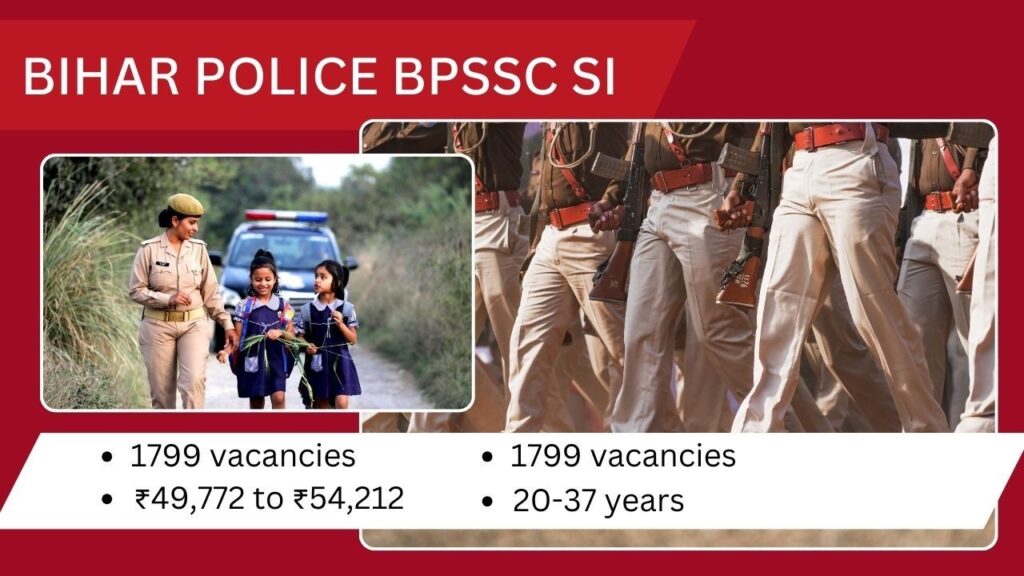
Bihar Police SI: Are you dreaming of Serving your State as a Police? The Bihar Police Subordinate Services Commission (BPSSC) SI recruitment is your best shot at securing a prestigious and well-paid job in the police department. With 1799 Vacancies Released under Advt. This is the high time to apply, as this is to best government jobs in bihar. Let me take you through all the information you need about the SI post from How To Apply to Salary Structure and Career Opportunities. 

What Exactly is a Sub Inspector in Bihar Police?

The Sub Inspector (SI), also known as “Daroga” in Hindi, is an important office in the police force that is scathing about peace, social security, and law in their areas of jurisdiction. Consider them as the police station department of operations. They’re not just desk jockeys — SI’s participate in field operations, investigations, and oversee junior officers. 

They tend to have their hands in all sorts of things like registering First Information Reports (FIRs), investigating crimes, maintaining law and order, and even supervising constables. From conducting raids, to building relationships with the community, to litigating cases in court, SI’s work is ever-changing and requires one to be physically and mentally strong. 

What Does an SI Actually Do?

Let me give you the drab realities of what your daily life as an SI looks like. You’ll have multiple critical jobs to do:

  • Crime Investigation: After investigating the crimes registered in your jurisdiction, you will be required to register FIRs and collect evidence.
  • Supervision: You will also be responsible for the supervision of constables and other junior staff, who you will deploy for patrols and duties.
  • Law and Order: Conducting patrolling at regular intervals so as to check on illegitimate activities and to keep the peace intact.
  • Court Appearances & Litigation Liaison: Handle routine court appearances and day-to-day inquiries from the court, and monitor court administrative compliance. 
  • Community Relations: Establishing reports with the public and keeping in contact with those who live in an area.
  • Paper Trail: Recordkeeping, report writing and office work.
  • Raids & Operations: You will be part of the raids and operations on criminals, but under senior officers.

Basic Eligibility Requirements

Before you start dreaming about recruiting, let’s make sure you meet a couple of very basic eligibility requirements. The good news is that the criteria are straightforward and relatively broad. 

Educational Qualification

You are required to have a bachelor’s degree in any stream from a recognized university. It doesn’t matter whether in any stream – arts, science, commerce or else. All that is required is that you have a valid graduation certificate. You can apply if you are in your final year too, but you will have to submit your degree certificate at the time of document verification. 

Age Limit

CategoryMalesFemales
General20-37 yearsUp to 40 years
OBC/EBCUp to 40 yearsUp to 40 years
SC/STUp to 42 yearsUp to 42 years

Nationality & Other Requirements

you should be an Indian citizen. There is no explicit ban on how many times you can try, just keep in mind you should be within the age limit for each time you apply. 

Note: You will be disqualified by the BPSSC at any stage if you are found ineligible. 

Read More 👉 DSSSB MTS Recruitment 2026: Apply Online for Multi-Tasking Staff Posts

How to Apply For Bihar Police Subordinate Services Commission (BPSSC) SI?

The Application Process is completely online. Here are the steps:

Step 1: Registration

Then go to the official website bpssc.bihar.gov.in and on the Apply Online link for Sub Inspector (SI) recruitment to apply. Register with your e-mail ID and mobile number and then enter basic details like name, date of birth and address. 

Step 2: Pay the Application Fee

The application fee is only ₹100 for all categories, including male, female, and transgender candidates. You have the option to pay by credit card, debit card, net banking or UPI. 

Step 3: Complete Your Application

Now we’ll get to the bottom line. Fill in your educational qualifications, address details etc and upload your photograph and signature. Make sure your photo is 3.5cm × 4.5cm and meets the above requirements. You will also need to upload your certificates and documents applicable to that notification. 

Step 4: Submit and Save

After reviewing everything, submit. Make a printout of the application form and retain it for your records. 

Exam Pattern and Syllabus

To get selected as SI in Bihar police you need to pass through different phases of examination which include your knowledge, physical fitness and your suitability to be the police officer. 

Stage 1: Preliminary Written Examination

Prelims is your first step in the race. It is an objective examination having 100 multiple choice questions in the paper worth 200 marks, with 2 marks allotted for each question. You have two hours to take it. The entire examination is based on General Knowledge and Current Affairs and has questions on:

  • Indian History, 
  • Geography of India, 
  • Indian Polity, 
  • Indian Economy, 
  • Science and Technology, 
  • Art and Culture, 
  • Sports, Awards and recent national and international News. 

There’s negative marking – 0.2 marks get deducted for every wrong answer. You must obtain a minimum of 30% marks to be eligible. Around 20 times the number of vacancies (about 35,980 candidates for 1799 posts) will be shortlisted for the mains examination. 

Stage 2: Mains Written Examination

Once you clear the prelims, a main examination is held which is tougher and more comprehensive in nature.The mains has two papers, 200 marks each: 

Paper I: General Hindi is Preliminaries level to be computed from the following items: grammar, comprehension, vocabulary, synonyms, antonyms and sentence correction. You get 2 hours.

Paper II: General Studies is the second and lengthier paper assessing your knowledge in a wide array of subjects namely Civics, Indian History, Indian Geography, General Science, Economics, Current Affairs, and Mathematics with Mental Ability. This paper also duration of two hours.

All in all, you would be taking 200 questions from both the papers, carrying 400 marks altogether. The qualifying nature of mains is merit based and about 6 times the number of vacancies are called for the physical test. 

Stage 3: Physical Efficiency Test (PET) and Physical Standard Test (PST)

CategoryHeight (cm)Chest (cm) MinWeight Requirement
Males (General/OBC/EBC/EWS)16879Proportionate to height
Males (SC/ST)16079Proportionate to height
Females155Minimum 48 kg
TransgenderAs determinedAs determinedAs determined

Stage 4: Document Verification and Medical Examination

Finally, after you pass the physical standards, you will be subjected to the document verification at which you must bring all your original certificates, and a medical examination to prove that you are physically and mentally capable to perform police duties. The health check includes vision, hearing and general health. 

Exam Dates of Bihar Police SI 

Remember to appear in The Bihar Police SI Prelims Exam will be held on 18 & 21/January/2026. Two sessions will be conducted on both days:

First Shift: 10:00 AM to 12:00PM (Report at 08:30 AM)

Second Shift: 2:30 PM to 4:30 PM (Report at 1:00 PM)

The admit cards were released on 30th december 2025 so download it from the official website. 

Basic Salary Structure

AllowanceAmount (₹)
Basic Pay35,400 per month
Dearness Allowance (DA)4,248
House Rent Allowance (HRA)2,124 to 5,664
Ration Money Allowance3,000
Transport/City Aid600 to 1,500
Medical Allowance1,000
Uniform Allowance900
Vehicle Allowance2,500

All these factors combine to result in a monthly salary of ₹49,772 to ₹54,212. 

Salary Growth Over Time

The interesting thing is your payslip doesn’t stay the same. You will get yearly bumps to your pay that will keep increasing your basic pay every year. After 5 years of service, with the consideration of increments and possible revisions in DA, your salary in hand may be around ₹58,000 to ₹62,000 per month and more than this with a promotion. 

Career Growth of SI

It’s not just the starting salary that makes the job attractive, the role is a springboard to a very rewarding career. The promotion ladder is simple and hierarchical:

SI → Inspector → Deputy Superintendent of Police (DSP) → Additional SP (ASP) → Superintendent of Police (SP)

You advance to a greater pay matrix level with each promotion resulting in tremendous salary hikes. For instance if you are promoted to Inspector your basic pay could rise to a higher stage with which you also get increments in all the allowances.

Promotion is on merit performance on seniority experience and departmental examinations. Good work, solving cases, and maintaining a clean record can fast-track your career.​ 

Conclusion

To be a BPSI is not only a government job but also it is a duty to serve in the society, uphold the law and order and a career opportunity to earn good name with good growth. The pay is good, the work is steady, and the potential for promotion is significant. Here is your opportunity to bring about a change with 1799 vacancies to be filled.

If you are eligible and interested to work hard then no one can stop you from applying. Begin your preparation today, keep on pace and best of luck. The dream to become a Daroga and to make you proud Bihar Police is definitely within your reach! 

Leave a Comment

Your email address will not be published. Required fields are marked *

Aerospace Engineering Courses: Complete Guide to Soar into the Sky with the Right Education

Aerospace Engineering Courses

If you have ever been curious as to how the planes you ride on stay in the air or how a rocket can travel all the way to space, then you think like an aerospace engineer. From Aerospace Engineering Courses, eligibility criteria to future scope and interesting specializations available, this all you need to know guide will help you make an informed decision which you take for pursuing aerospace engineering course in India.

The Indian aerospace industry is booming. ISRO, DRDO, HAL, and a host of private companies are actively hunting for talented engineers to design, build and fly planes and spacecraft. With increasing demand and attractive salary packages, this is the way to your dream career. 

What Exactly is Aerospace Engineering?

Aerospace engineering is the primary engineering discipline concerned with the design, construction, science and technology of aircraft and spacecraft. It is a combination of physics, mathematics, materials science, and advanced tech that address real life problems in the fields of aviation and space travel. 

The range of activities in this field is so broad that it divides into four key specializations:

Aeronautics — This pertains to air within the atmosphere and includes such things as commercial jets, military planes, helicopters, drones (UAVs), and blimps. Aeronautical engineers study flow-air, aircraft design, motion, and propulsion.

Astronautics — A subject of business such as astronauts, rockets, satellites and all the stuff that goes beyond the atmosphere. Astronautical engineers specialize in orbital mechanics, satellite communications, rocket propulsion, and space exploration missions.

Avionics — These are the electronics and computers used in an aircraft and spacecraft. Avionics engineers create the system software of navigation, communication and autopilot systems, etc., in raw air borne machines.

Defense Technologies — This area concentrates on military, and its ability to develop and deploy new systems involving missiles, defense technologies, military drones and weaponized technology. This is important part of national security and defense system. 

Aerospace Engineering Courses

Now let’s move on to the various types of courses under aero space engineering. Whether you are a high school beginner or already have a bachelor’s degree, there is a path for you.

1.Diploma in Aerospace Engineering (3 Years) 

If you are looking forward to pursue a career in aerospace engineering, you can opt for the Diploma in Aerospace Engineering from a reputable board after 10th class.

This is good to start if you have done your 10th grade. It is not really theoretical but ‘practical’ which provides aerospace technologies experience. 

AspectDetails
Duration3 years
Eligibility10th pass with Mathematics and Science (minimum 50% marks)
FocusPractical skills and industry-ready training
Career PathCan pursue B.Tech (lateral entry) or start working
Average Fees₹2-4 Lakh for the entire program

2. Bachelors in Aerospace Engineering — B.Tech (4 Years)

It serves the largest client base and is considered the gateway course for professional aerospace. It is a bachelor’s degree course and the eligibility is 10+2 with Physics, Chemistry and Mathematics (PCM). 

AspectDetails
Duration4 years (8 semesters)
Eligibility12th pass with PCM (minimum 50-60% depending on college)
AdmissionBased on JEE Main Score, state-level exams, or direct merit
Average Fees₹ 2-2.5 Lakh/year in government; ₹5-10 Lakh/year in Private colleges
Total Program Cost₹4-40 Lakh depending on college type

The B.Tech is an all-inclusive course which includes theory and practical based knowledge. Subjects like mathematics, physics, and general engineering will be included in your first two years for foundation then you can choose specializing in aerospace-related subjects in your third year.

3. M.Tech in Aerospace Engineering (2 Years)

M.Tech in Aerospace suits better for those who want a higher level of education in aerospace engineering. Building a professional level career internationally, you must need this degree.

AspectDetails
Duration2 years (4 semesters)
EligibilityB.Tech/BE in Aerospace or related field with 55% minimum marks
AdmissionThrough GATE exam (for government colleges) or merit-based (private)
Average Fees₹40,000-1 Lakh/year in Government; ₹2-4 Lakh/year in Private colleges
Career AdvantageHigher salaries, research opportunities, senior positions

Job opportunities for M.Tech graduates are applicable in research, designing and higher level management. Top companies and research centres look for M.Tech holders for their specialised projects. 

4. Ph.D. in Aerospace Engineering (3-5 Years)

“This Is for the Research and Innovative Curious”. It’s the top aerospace engineer qualification for those who want to know how to research and innovate. 

AspectDetails
Duration3-5 years
EligibilityM.Tech or equivalent with GATE qualification
FocusOriginal research and innovation
OpportunityTeaching, research at ISRO, universities, private labs

5. Aerospace Engineering Few Months Certification Courses 

In just 6 months to 1 year duration, you can enhance knowledge or skills in certain areas. It is best for hands-on experience in a specific field.

Course TypeDurationCostSuitable For
CAD and Aircraft Design6 months₹20,000-50,000Working professionals, students
Avionics Systems6-8 months₹30,000-60,000Interested in Electronics
Propulsion Systems3-6 months₹15,000-40,000Engineers wanting specialization
Aerospace Materials4-6 months₹25,000-50,000Manufacturing professionals

B.Tech Aerospace Engineering Core Subjects

YearSemestersEssential Subjects
1st YearSem 1-2Mathematics/Physics/Chemistry help develop problem-solving skillsEngineering Mechanics/Thermodynamics/Fluid Mechanics/ and Basic Electronics introduce how physical laws apply to real engineering systems.
2nd YearSem 3-4Gas Dynamics and Aerodynamics, which explain how air behaves around aircraftPropulsion and Aircraft Structures teach how engines work and how aircraft are builtStrength of Materials and Computer Programming strengthen technical and analytical skills.
3rd YearSem 5-6You study higher-level aerodynamics, flight dynamics, and structural analysis Heat Transfer and Avionics.
4th YearSem 7-8You learn advanced tools like Computational Fluid Dynamics (CFD)Aircraft Design and Systems

Aerodynamics describes how air moves around air and is an important factor in the level of efficiency of airflow around the wings.

  • Propulsion: Discussion of jet engines, rockets, turboprops
  • Structures deals with building an aircraft to be as strong as possible but still as light as possible.
  • Stability and control the motion of an aircraft.
  • CFD Computational Fluid Dynamics: Uses computers to emulate airflow — a modern necessity
  • Aircraft Design: All of the above are brought to bear on realistic, total aircraft design projects.
  • Most B.Tech courses will involve a lot of lab work, wind tunnel testing, simulators and a capstone design project where you actually design an aircraft or spacecraft. 

Who Are Eligible For Aerospace Engineering

B.Tech (Undergraduate)Need to pass 12th class with PCMB or PCB and should have obtained 50 to 60% marks Meet the age criteria of 17 to 28 yearsEntrance exams such as JEE Main, State Level Exam etc
M.Tech (Postgraduate)Hold a valid B.Tech/BE degree in Aerospace or equivalent with 55% marks Valid GATE score (for government colleges)
DiplomaAfter 10th with Mathematics and Science having 50% marks as a minimum15 years as a minimum age
Lateral Entry to B.Tech 3-year engineering diplomaBSc in Physics, Chemistry, Mathematics

Where Will Aerospace Engineers Work?

OrganizationTypeSpecializationSalary Range (Fresh)
ISROGovernmentSatellites, space missions, rocket development₹8-10 LPA
DRDOGovernmentDefense systems, missile technology₹7-10.5 LPA
HAL (Hindustan Aeronautics)GovernmentAircraft manufacturing, defense₹7-9.5 LPA
Boeing IndiaInternationalAircraft systems, defense solutions₹8-12 LPA
Airbus IndiaInternationalAircraft manufacturing, maintenance₹7-10 LPA
GE AviationInternationalAerospace engine design₹7-9 LPA
Rolls-Royce IndiaInternationalPropulsion systems₹8-11 LPA
Tata Advanced SystemsPrivateAircraft components, defense₹7-11 LPA
Godrej AerospacePrivateSpace and defense hardware₹5.5-7.5 LPA

Salary & Career Growth 

India's aerospace engineering salary

Aerospace Engineering Salary Progression in India

LevelsSalary — LPAMonthly IncomeStages
Fresher (0-1 year)₹4.5-7₹37,500-58,333Graduate joining first job
2-5 years₹8-12₹66,667-1,00,000Intermediate engineer
5-10 years₹8-15₹66,667-1,25,000Senior engineer or team lead
10+ years₹15-25+₹1,25,000-2,08,000+Manager, specialist, researcher

Salary by Sector:

SectorFresher PackageExperienced Package
Government (ISRO, DRDO, HAL)₹7-10 LPA₹20+ LPA
Private Indian Companies₹5-9 LPA₹12-18 LPA
International Companies (Boeing, Airbus)₹8-12 LPA₹20-28+ LPA
Startups & Newer Companies₹4.5-6.5 LPA₹10-14 LPA

The Future Looks Bright

India’s aerospace engineering salary will increase by 20-25% by 2030 and is highly influenced by demand in electric aircraft, AI integration, space exploration, and green aviation related technologies, suggest the industry projections. .

Read More 👉 HR Professional Courses: Get Complete Guide on Career Path, Salary & Growth

The Roadmap To Become Aerospace Engineer

Year 1 & 2: Begin From Basics

The initial two years are dedicated to core subjects such as mathematics, physics and general engineering. These years are tough, but necessary. If you have a strong base in these stuff, then you can understand high level stuff in aero easily later on. 

Year 3: Where Aerospace Engineering Gets Exciting

In year 3, the real aerospace journey begins. You then go on to such specialised areas as aerodynamics, propulsion and aircraft structures.  

Year 4: Major Project and Real-World Problem Solving

Senior year is spent mostly on a senior project. You could design an airplane, build spacecraft systems, or even study a real problem in aerospace engineering. Many of these projects are sponsored by industry, giving students real-world experience and making them more employable. 

Internships: The Key to Career Growth

The majority of aerospace engineering programs require 2 to 3 internships, such as summer and at times semester-long training. Top organizations including ISRO, HAL and Boeing hire interns on a regular basis. This hands on experience is invaluable and it contributes a lot in building a strong resume and career in future. 

Choose Your Specializations

SpecializationFocusScopePreferred Companies
AerodynamicsAirflow, drag reduction, aircraft efficiencyAircraft design, researchISRO, Airbus, NASA etc
PropulsionEngines in Jet engines, space rocketsEngine design, space missionsGE Aviation, Rolls-Royce, ISRO
Flight Dynamics & ControlAircraft stability, autopilots, guidance systemsControl systems, UAVsBoeing, HAL, Airbus
Aircraft StructuresMaterials, stress analysis, lightweight designDesign Structure, & aerospace manufacturingAirbus, HAL
AvionicsRadio System, navigation, ElectronicsUAVs & Avionics Boeing, DRDO

Best Aerospace Engineering Colleges in India

CollegeTypeLocationSpecialization
IIT BombayGovernmentMumbaiAll specializations
IIT MadrasGovernmentChennaiAircraft & Space
IIT KharagpurGovernmentWest BengalAll specializations
IIT KanpurGovernmentUttar PradeshAll specializations
Mahindra UniversityPrivateHyderabadComprehensive curriculum
SRM ISTPrivateChennaiModern labs & industry focus
Chandigarh UniversityPrivatePunjabIndustry-driven curriculum
Ramaiah InstitutePrivateBangaloreWell-equipped facilities
Manipal AcademyPrivateBangaloreResearch-oriented

Conclusion

Aerospace Engineering Courses aren’t simple, it’s a journey through innovation, precision and human ability. Whether you want to design the next generation of commercial planes, put satellites into space, or work on autonomous drones, this is a field with limitless options.

The Indian aerospace industry is poised for growth. With ISRO’s ambitious space programs, HAL’s indigenous aircraft development and international partnerships with Boeing and Airbus, there is no dearth of opportunities. And if you are in the top performers, the world is your sky. 

Leave a Comment

Your email address will not be published. Required fields are marked *

Best Medical Colleges in South India for MBBS You Can’t Miss in 2025!

Best Medical Colleges in South India with top MBBS programs and affordable fees

There are world-class Best Medical Colleges in South India for MBBS which provides quality education and excellent training to produce doctors. The well-established states including Karnataka, Tamil Nadu, Kerala, Andhra Pradesh, and Telangana come under the region of South India. Taking admission in any of these colleges is the right choice for starting your medical journey. South India offers both private and government colleges in a wider range. 

Let’s look into these prestigious colleges which offer both theoretical and practical medical education for students. 

How Did They Become the Best Colleges?

They are equipped with strict regulations to provide strong curriculum, advanced training, hospital exposure, experienced faculty, and support for career growth. After monitoring college prospects and record of successful students, NIRF ranked them as the top colleges of India. The ranking made it easy for students to choose their best college for their higher education. 

Top Government Medical Colleges

Christian Medical College

Christian Medical College, Vellore is private but offers the best education at affordable fees of just Rs. 13,500 yearly for MBBS. This college became a crown jewel of South India and ranked at 3rd position domestically by NIRF due to its top education and low fees.

Christian Medical College Vellore best medical college in South India

Image credit: Christian Medical College

JIPMER Poducheery

Jawaharlal Institute of Postgraduate Medical Education and Research became a best known college for MBBS as it has a strong alumni network. It produces world-class doctors at low fees around Rs. 6000 yearly. It ranked at 4th position in NIRF 2025 due to its exceptional medical education. It is the top medical college of South India, but students need to score well in NEET to get admission here.

JIPMER Puducherry best government medical college in South India

Image credit: JIPMER

Madras Medical College

Chennai offers best government colleges including Madras Medical College which was established in 1835 and ranked at 16th among top medical institutions in India. Students need to score around AIR 944 in NEET for securing a position among 250 MBBS seats. 

Madras Medical College Chennai top government medical college in South India

Image credit: Madras Medical College

AIIMS Network in South India

All India Institute of Medical Sciences has set its footprints in the South India region with highly ranking among global medical institutions. Students aiming to get their MBBS degree from AIIMS can turn their dream into reality without relocation. 

AIIMS Mangalari

AIIMS Mangalari – Andhra Pradesh has become the 29th best medical institution in India by NIRF ranking. It offers a strong curriculum and practical training in a 5 years MBBS program at low fees of around Rs. 15,760 yearly.

AIIMS Mangalagiri top medical college in South India for MBBS

Image credit: AIIMS Mangalari

AIIMS Bibinagar

Telangana also has the best medical college and hospital — AIIMS to provide students hospital exposure for getting real knowledge. This one was established recently but still manages to rank in the top medical institutions of India.

AIIMS Bibinagar best government medical college in South India

Image credit: AIIMS Bibinagar

State-wise Government College For MBBS

Tamil Nadu

There are more than 39 government colleges in Tamil Nadu but the top medical colleges can establish your career faster and stronger.

  • Madras Medical College
  • Stanley Medical College
  • Coimbatore Medical College
  • Government Kilpauk Medical College

Karnataka

  • Bangalore Medical College
  • Mysore Medical College
  • Karnataka Institute of Medical Sciences

Kerala

  • Government Medical College, Kozhikode
  • Government Medical College, Thiruvananthapuram
  • Government Medical College, Kottayam

Telangana

  • AIIMS Bibinagar
  • Gandhi Medical College, Hyderabad 
  • Osmania Medical College, Hyderabad

Andhra Pradesh

  • AIIMS Mangalagiri
  • Sri Venkateswara Medical College, Tirupati 
  • Andhra Medical College, Visakhapatnam

Top Private Medical Colleges

Kasturba Medical College

Kasturba Medical College is ranked under top 10 manipal medical institutions for its top-tier education. It offers MBBS at annual fees of around Rs. 17,80,000 and KMC Mangalore also has the same fee structure but both colleges have different cutoffs. KMC Manipal accepts students with AIR 40,258 and KMC Mangalore accepts at AIR 57,207 NEET cutoff.

Amrita School of Medicine

Amrita School of Medicine is located in Kochi and offers best medical education to their students. They have experienced faculty and strong curriculum, making it the highest-ranked private medical college in South India. It has ranked at 9th in NIRF ranking and it offers MBBS at fees around Rs. 18,50,000. 

St. John’s Medical College

St. John’s Medical College of Bangalore offers MBBS program at fees around Rs. 8,11,285 yearly. It ranked 30th among Indian medical institutions and needed a cutoff AIR 11,483 for admission in the course.

MS Ramaiah Medical College

MS Ramaiah Medical College is also located in Bangalore and comes under top 50 in medical colleges. It offers MBBS at cost Rs. 25,15,750 approx. It is the best college because of its excellent faculty, attached to multi-speciality hospital, and strong alumni network. 

JSS Medical College

JSS Medical College, Mysore is also a top medical college that provides MBBS around Rs. 18,86,900. Admission is accepted for students who do have a cutoff around AIR 122,228 in NEET.

Sri Ramachandra Medical College

Chennai best college – Sri Ramachandra Medical College, ranks among best medical colleges. It is best for MBBS education at fees. Rs. 10,00,000. Students need AIR 313,535 cutoff for admission in this college.

Admission Requirements & NEET Cutoffs

Government colleges are more strict on the NEET cutoffs because of their top-tier education in low fees. They categorized from top to mid-tier colleges, colleges like AIIMS and JIPMER need AIR 1000–5000 NEET cutoffs for students’ admission. While mid-tier colleges require AIR 5000–15,000 NEET cutoffs for admission.

Private colleges have wider variation in NEET cutoffs, top private colleges require AIR 10,000–50,000 and some colleges need AIR 50,000 — 200,000.

But NEET cutoffs significantly depend on the state, year and college type, so check out the college official brochure for admission that mentioned exact NEET score for admission.

Fee Structure Analysis

Government colleges such as AIIMS and top-tier central institutions have offered MBBS programs in a lower range of fees Rs 6000 – Rs 16,000 annually. While state government colleges have a slightly higher range from Rs. 60,000 to 110,000 annually for MBBS. According to the management quota, government college fees range between Rs 6–12 lakh annually.

Private colleges have divided their range between Deemed university and Private colleges, according to management quota which significantly ranges between Rs. 25 lakh to 50 lakh annually. It may slightly lower around Rs. 8 – 12 lakhs in some private colleges. 

Conclusion 

South India’s Medical colleges offer prestigious opportunities for aspiring doctors to take their MBBS degree at an affordable price. Private institutions fees are higher, so aim for the government colleges which offer both excellent academic resources and clinical exposure to medical graduates. These Best Medical Colleges in South India for MBBS will provide you not only a degree but the best education and research ecosystem to become a doctor.

Leave a Comment

Your email address will not be published. Required fields are marked *

B.Sc Agriculture Government Jobs – Career Options, Salary & Exams

B.Sc Agriculture Government Jobs

B.Sc Agriculture Government Jobs offers high salary, security, and professional growth then consider applying in the government sector. In India, government jobs offer many additional perks that private jobs can’t offer. BSc Agriculture opens you a vast range of options in the agricultural sector of India, it offers roles based on research, administration, and field officers.

But getting selected for one of the government jobs is really tough. By preparing hard and strategically, you can achieve your goal. 

Students who have a background in agriculture can be appointed to these roles including Agriculture Officer, Lab Assistant, Forest Officer, AFO, and Specialist. However, clearing out the competitive exams for these roles is still a big deal. 

There are various job opportunities in different sectors like rural development, agriculture research, and many more. Those who are interested in working in agricultural development can take these job roles. 

B.Sc Agriculture Government Jobs – Best Career Options

The field of agriculture offers many options for career, especially in the government sector. You can explore jobs in agriculture that offer stability, high salaries, and contribution to the nation’s development. B.Sc students can grab any of the options in which they find interest. But choosing the job which aligns with your skills is the right decision.

Agriculture Officer 

The Agriculture Officer works for agriculture production by providing techniques and advice to the farmers. To get potential output they implement government policies. 

ResponsibilitiesGood crop selection, pesticide control techniques, irrigation, agriculture development schemes implementation, and inspections.
Recruitment ExamIBPS SO or state-level exam
Salary RangeRs. 40,000 to Rs. 70,000 per month

National Seed Corporation Roles

In this category, there are various roles for BSc Agriculture graduates including Seed Analyst or Assistant Manager. But overall work is related to maintaining seed quality and production of the field.

ResponsibilitiesEnsuring Quality and production, Seed certification, and promoting certified seeds.
Recruitment ExamNSC recruitment exam
Salary RangeRs. 35,000 to Rs. 65,000 per month

Agriculture Research Scientist

Agriculture Research Scientists are very helpful to this industry, they focus on research to provide better options for farming and resolve problems in agriculture.

ResponsibilitiesResearching, innovating, developing varieties of crops, and experimenting with disease-resistant crops.
Recruitment ExamICAR ARS/NET recruitment exam
Salary RangeRs. 60,000 to Rs. 80,000 per month

Field Officer in Fertilizer and Agricultural Companies

There are multiple companies in the public sector that work for agriculture fertilizers and agri-inputs to ensure proper seeding of the crops. The field officer is responsible for distributing them properly in all the different lands. 

CompaniesIFFCO, NFL, and FCI 
Recruitment ExamCompanies recruit field officers through separate exams
Salary RangeRs. 35,000 to Rs. 60,000 per month

State Agricultural Department

Students after BSc in Agriculture can work in different roles for the state agricultural department. The work in these departments is rural development, implementing welfare schemes, and providing field support to farmers.

PostsTechnologists, Agriculture Officer, Development Officer
Recruitment ExamRecruitment through PSC exam
Salary RangeRs. 30,000 to Rs. 55,000 per month

Read More 👉 Government Job vs Private Job: Which Career Offers a Better Future in 2025?

Other Career Options After B.Sc Agriculture

Further Studies: Students can pursue a masters degree in agriculture for more professional growth. Acquire specialization in Agronomy, soil science, and plant breeding can help them solve bigger problems in the agriculture sector. 

Private Sector Jobs: Agro-based companies can hire candidates with a BSc in agriculture for food processing firms, and biotech-related roles.

Entrepreneurship: Start-up ideas are good in the agricultural sector, if you are interested in this, there are options like farming ventures, organic farming, and agritech businesses.

Competitive Exams: UPSC exams like IFS Indian Forest Service will help you get a better job in the government sector with a high salary and additional perks.

Additionally, BSc Agriculture graduates can work as Block Development Officers, Plantation Managers, Food Safety Officers, and Agricultural Banks. These roles can pay you enough to settle down but the starting salary range is not high, 3 to 7 lakh per annum for beginners, it will increase with experience.

Core Agricultural RolesAgricultural Officer, Field Officer, Plantation Manager, Agriculture Technologist
Research & InnovationICAR Scientist, Junior/Senior Research Fellow, Agricultural Research Assistant, Project Associate, Plant Breeder, Animal Breeder, Seed Technologist
Business & Market-FocusedAgricultural Analyst, Agricultural Sales Officer, Marketing Executive
Agricultural Bank JobsLoan Officer, Rural Development, Field Officer, Junior Associate, Probationary Officer.

Teaching and Research Scientist Government Jobs

Many students like to teach and research while being interested in agriculture or farming. Students can get a different post in government jobs. Becoming a teacher in agricultural universities is a great option but check the selection process to get every detail and be prepared. The Pay scale range is Rs. 40,000-70,000 per month. You can level up your position to senior lecturers or researchers. 

Why Pursue a BSc Agriculture

BSc Agriculture is designed to shape students’ skills to become professionals in their respective roles. To achieve your goal, whether it’s research, entrepreneurship, or field officer. You need to polish your skills to keep the agricultural industry on the right track. Providing the best options to minimize the risk and new challenges with crops.

High Demand: With growing demand for food, India has a very large production of food crops. So, it required advancement in the agricultural industry to fulfill the need for crops. 

Good Salary: The average salary package for technologists is 3 LPA and Agriculture Officer is around 9 LPA. The Indian population’s livelihood depends 40% on agriculture. 

Affordable Education: BSc Agriculture is a budget-friendly course. Anyone can afford it, the fee range is 15,000 to 1,00,000. 

Conclusion

BSc Agriculture Government Job is a seamless offer for students to make an impactful career. It opens up a gate to many roles from research and fieldwork to administration and entrepreneurship. This field is largely to secure a job in any role. Students can apply after graduation through competitive exams. These jobs not only provide financial security but a chance for professional growth and future security.

Leave a Comment

Your email address will not be published. Required fields are marked *

Top Government Jobs After MBA in 2025 You Shouldn’t Miss!

After completing your MBA, you may be confused about your career path. Here are the top Government Jobs After MBA, for which you can apply if you are passionate about working in that field. In government jobs you can be worry-less about sudden changes and layoffs in the company like in private jobs. It offers you great perks like professional growth, career stability, and high salaries. There are various roles in the department like HR, Manager, Operations leader, and more. You can choose the career path wisely and check the exams you can take for these roles. 

Indian Administrative Services

If you are ready to take on tough challenges for your career then consider possessing the role of IPS, IAS. These roles are highly powerful but hard to get. As an MBA graduate you have already figured out about management, HR, and operations so being an IAS is a responsible role for the nation not just a job.

EligibilityMBA
RolesPolicy-making, administration, law and order, governance
Salary₹56,100 to ₹2,50,000/month

Public Sector Banks 

It is not a regular desktop job but beyond this. The work related to this role is mostly in Finance or HR. This is a huge role and comes with high responsibility for a person who possesses this job. Public sector banks offer a great opportunity for MBA graduates. These job roles need minds that go beyond the desk job like decision-making and strategies in Finance, HR, and operations.

ExamIBPS, SBI PO
DepartmentRisk, finance, HR, marketing
Salary₹40,000 to ₹90,000/month + benefits

RBI Grade B Officer

RBI Grade B is the best option for MBA graduates as it offers unmatched professional growth. RBI is looking for a person who has great knowledge of your job role. Economics is mandatory because it contains the policies that work for the country. This job offers unparalleled professional growth which involves economic policy implementation, data analysis & financial market operations.

ExamRBI Grade B 
DepartmentPolicy implementation, economic analysis
Salary₹84,000/month approx + bonuses

PSUs 

The Public Sector Undertakings recruitment occurs for various organizations like BHEL, NTPC, and IOCL. Before applying for the role check out everything about the work and exams conducted for this job. Don’t expect start-up thrills in this job but it is a stable and high-paying job. PSUs offer a unique combination of various perks like stability, financial security, and societal impact. If you are seeking a high-impact role then this will be the best option for you. 

ExamGATE
RoleProject Manager, Finance Analyst
Salary₹60,000 to ₹1,80,000/month

SSC CGL – Group B & C Jobs

MBA grads can end up as Assistant Audit Officers or Income tax inspectors as it requires with their abilities and understanding more clearly their concepts, and experience level they have can get them recruited by the Ministry, CAG, or CBDT. Becoming an Income tax officer or assistant audit officer doesn’t matter because both roles have excessive perks and high salaries. If you want to work in Taxation or Finance, choose ITO for your career growth. Financial or accounting goes with the AAO role mostly.

ExamSSC
DepartmentFinance Ministry, CAG
Salary₹44,900 to ₹1,42,000/month

Indian Railways – Manager & Admin Jobs

The railway is not only about Engineers or technicians. They need a man who can handle the management, finance, or logistics so you might be the one that they’re looking for. Managing tasks in the sector is a high-paying job and also requires expertise in this field. It has diverse operations so work involves handling large-scale projects, and resources optimization. Recruitment for this role through RRB and UPSC exams. 

ExamRRB, UPSC
RoleOperations management
Salary₹50,000 to ₹1,50,000/month

Defense Forces

If you want a little bit of adventure in your work then you can apply for a job in the Indian Army, Navy, or Air Force through CDS and AFCAT. You are eligible for the posts like Logistics, Accounts, or Administration branches. MBA graduates can take the exam to join the forces and serve in various roles. You can have excellent salary packages with yearly increments.

ExamUPSC
Departmentadministrative, accounts, ASC
Salary₹56,100+ allowances,  healthcare, and travel concessions

LIC & Insurance Sector 

Some government insurance companies hire MBA graduates for HR roles, and Marketing in government companies like LIC, GIC, AND NIACL. HR and marketing after MBA is a great choice but you handle these roles in the government with a lot of perks like unparalleled stability, competitive pay structure, and opportunity for diverse work exposure. 

ExamLIC AAO 
DepartmentHR, marketing
Salary₹40,000 to ₹90,000/month + Steady promotions

Indian Economic Services (IES)

This is the best career option for those who are interested in reshaping India’s economic policies and strategies. IES professionals work as economic advisors and planners. They contribute their advice for the financial development of the country. This is an influential job role that blends with intellectual ability to give real-world impact by knacking for economic and public finance. 

ExamUPSC
Departmentfinance, policy-maker
Salary₹56,100+ allowances + Post-retirement benefits and pensions

How to Choose the Right Government Job After an MBA?

First of all, you have to match your specialization with your job role. Once you examine yourself with the abilities in which you are perfect, you can get the answer you’re looking for. After choosing the right role, know about the eligibility, exams, and selection process for that particular job role. Think about your aim for the long-term lifestyle.

Top Government Exams MBA Graduates Should Prepare For

  • UPSC Civil Services Exam
  • IBPS PO/SO
  • RBI Grade B
  • SSC CGL
  • GATE
  • AFCAT
  • CDS
  • State PCS Exams

Conclusion

You can get a job in the government sector after an MBA but every sector has its respective recruitment process. Check the notification regularly and stay updated with the notices from the official government site. Choose the right career path in HR, Finance, Accounting, Management, and Team leadership. Know your specialization then clear the exam for selection in a government job. Many Indians are preparing for years to get a job in the government sector because it has lots of perks that individuals cannot have in the private sector.

Leave a Comment

Your email address will not be published. Required fields are marked *

O Level Course 2025: Complete Guide to Fees, Syllabus, Duration & Job Benefits

O Level Course 2025

Students who are interested in the Technical Field can achieve great heights in their career after pursuing NIELIT ‘O’ Level. It opens up the door in both private and government sectors as the requirement of an IT employee is needed everywhere. The world is evolving more into digitalization which has made this field wider and open more vacancies for the candidates. If you also want to make your career stable with a good career path, high-salary, and less hectic job then grab this course now.

Why NIELIT ‘O’ Level Matters in the Digital Age

Chasing after stable and well-paying jobs in India, job-seekers are often driven towards the public sector, where security of jobs and strong perks are widely considered as givens. In today’s increasingly digitised world, being in possession of a recognized and accredited Information technology qualification is not just an advantage – it is a requirement. The NIELIT ‘O’ Level course is at the Midnight of this requirement. 

It is officially considered the same as a Foundation Level CA course. This government approval is really important and gives you the edge that private not accredited courses can never get. The value of this certification is further ratified with its inclusion in the national framework, having been recognized under the National Skills Qualifications Framework (NSQF) at Level 4. 

What Job Roles Can You Get After NIELIT ‘O’ Level

The O Level was structured in such a way as to be responsive to the short-term technical needs of the then contemporary public and private sectors. The stated goal is to prepare students with the skills needed to work in today’s IT-enabled jobs. Among these targeted profiles are User Interface (UI) Designer, Web Designer, Web Publication Assistant, Office Automation Assistant, and IoT Application Integrator.These intentional integration with operational IT rather than simple clerical data entry clearly situates the course as a practical instrument for aspirants to take on current digital workplace requirements. 

Detailed Eligibility Criteria

The basic eligibility criteria require either passing 10+2, or holding a one-year ITI Certificate after Class 10, along with a minimum of one year of experience in the area related to the IT industry. 

The applicants who have passed second year of polytechnic engineering diploma after 10th standard from a government recognized institute are also eligible to apply. 

O’Level Course Duration 

The six-month timeline for graduates enables them to get this commonly required IT credential quickly, thereby reducing the amount of career time lost while waiting for certification. Hence, the ‘O’ Level serves as an important means for enhancing one’s eligibility in a short span of time after the completion of the degree. However, this registration remains valid for five years.

Why Is O’Level Course Value Increasing Day-By-Day?

Mastery in the Revised Syllabus

The importance of NIELIT ‘O’ Level certification in the present high technology world is that O level syllabus is regularly revised and updated which in turn helps to keep the students updated with the latest information and technology available. This syllabus is much beyond the basic knowledge of computing which is now considered old to cater to the demand of the industry for the skills and the industries supported the potential of having high paying jobs. 

Structure and Examination Pattern

The course is staffed with four core theoretical modules, the compulsory practical component, and a project. The four theory modules are:

M1-R5: Information Technology Tools and Network Basics

M2-R5: Web Designing & Publishing

M3-R5: Programming and Problem Solving through Python

M4-R5: Internet of Things and its Applications 

Detailed Module Analysis

All theory subjects will be assessed by a three hours written examination carrying 100 marks. Besides these theory papers candidates are required to pass one full practical examination (PR1-R5) based on the contents of all 4 theory modules, also carrying 100 marks and of three hours duration. Practical work is usually done at the institutionally approved places offering the course. A Project Work (PJ1-R5) is also necessary for certification. 

Read More 👉 Which Entrance Exam Is Best for MBA Abroad in 2025?

Official NIELIT Fees 

The cost a candidate has to bear when applying directly through NIELIT (without availing external tuition) is surprisingly small:

  • Registration Fee is Rs.500 and this registration is valid for 5 years. 
  • A Fee of ₹100.00 is applicable for processing exam applications per examination cycle.
  • The O’ level course fees for each module in the Revision 5 is 1,000 Rs. The total of four modules fee is Rs 4,000.
  • O Level Project Fee (once only for PJ1-R5 submission) The compulsory O Level project fee PJ1-R5 is only ₹100. 

Candidates pursuing O’Level courses from private institutions can get different fees or entire course fees. So, check the total fees amount for this course from the institutions you choose.

Career Pathways in the Private Sector and High-Paying Roles

The NIELIT O Level certification is an address both for private and government jobs. Although the public sector is considered to be the most stable, the private sector has many points of entry and is an important source of early career experience. 

Target Job Profiles 

The level of competence proven through ‘O’ Level is very applicable. There are plenty of O level benefits in government jobs. The roles targeted include vital gating roles such as UI Designer, Web Designer and IoT Application Integrator. Outside these roles, the certification still strongly validates the holder’s knowledge of key IT skills, such as being computer literate, managing data efficiently, using office automation tools, creating simple web applications, and handling databases. These skills are necessary for help desk, IT support, and web maintenance positions in a broad range of private industry. 

Salaries Offered by IT Sector

The average O level course jobs salary in the Private Sector after doing NIELIT ‘O’ Level is around 3 LPA (Lakhs Per Annum). This base figure amounts to roughly ₹ 25,000 per month which is considered as the minimum expectation for blue-collar jobs at the level of data entry operators, junior IT support, or clerical jobs with some know-how of office automation. 

However, In the government sector, For certain technical posts, including Scientific Assistant and some Assistant Programmer positions, that require or consider the O Level equivalency, the Basic Pay can be as high as ₹35,400 even at the entry level. The resulting In-Hand Salary typically settles between ₹45,000 and ₹50,000 per month.  

The Future After O’Level Course 

The NIELIT ‘O’ Level is not a standalone qualification, but it is the essential beginning in a standardized, government-approved system of IT certification that focuses on sustained career advancement. This Systematic faire up Turn is called the DOEACC octuplet. 

From ‘O’ to ‘A’ Level: Advanced Diploma Equivalence

Students may take NIELIT ‘A’ Level after successful completion of ‘O’ Level based on NIOS. This allowed the applicants to expand their skill set to a great extent in specialized areas like Advanced Post Graduate Diploma in Computer Application (APCDCA) or Advanced Diploma (AD) in Computer Hardware Maintenance and Networking. Passing of ‘A’ Level also allows access to mid-level private sector work and makes one more eligible for higher grade government technical posts. 

‘B’ Level and MCA Equivalence

For aspirants to senior management, software developer or research positions the NIELIT route ends with the B Level course. The ‘B’ Level is the high-end among the course level certifications of NIELIT and is professionally recognized by MHRD to be equivalent to Master of Computer Applications (MCA) Degree Course. 

Conclusion

The NIELIT ‘O’ Level is the anchor, pocket friendly and the only entry-level based examination for aspirants who aim at getting a high paying job along with stable income from Indian Public Sector IT for immediate term. It is the basic qualification that enables the accredited path to further study that is comparable to a Master’s degree, so a career begun in government IT isn’t just safe, it has a well-defined and boldly optimistic path for growth. 

Leave a Comment

Your email address will not be published. Required fields are marked *

Scroll to Top