HTET 2026 Online Form: Haryana Teacher Eligibility Test Details

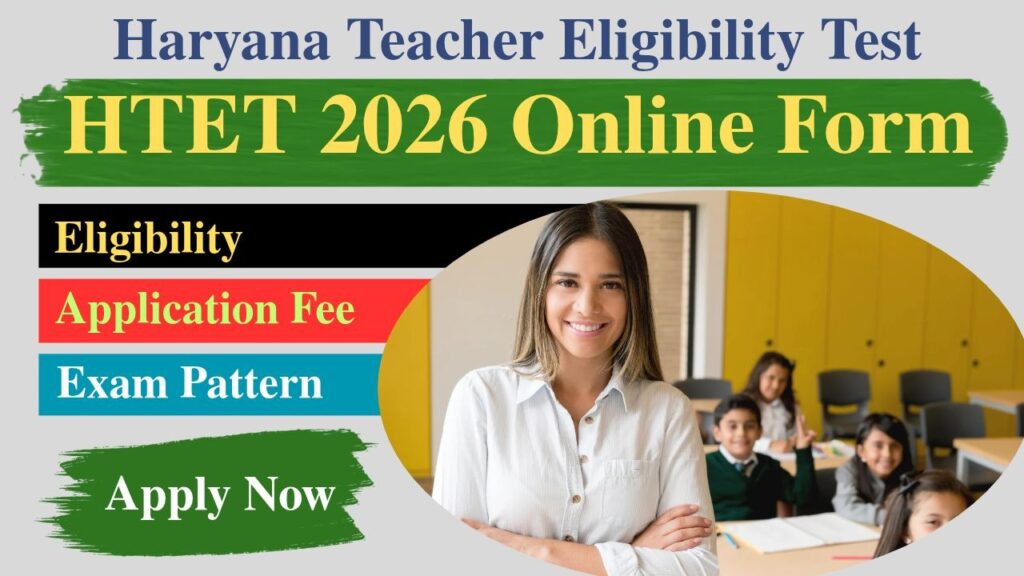
HTET 2026 Online Form

HTET 2026 Notification by Board of School Education Haryana (BSEH), Bhiwani to apply online for Primary Teachers (PRT), Trained Graduate Teachers (TGT), Post Graduate Teachers (PGT) on 18 November 2026.

Candidates who want to become Primary Teachers (PRT), Trained Graduate Teachers (TGT), Post Graduate Teachers (PGT) will have to fill an online application form on the official website.

The HTET 2026 application window will remain open until 27 November 2026 (11:59 PM). Candidates can apply for Level 1, Level 2 or Level 3 according to their educational qualifications. The examination will take place on 26 and 27 December 2026.

HTET 2026 Online Form Overview

Particular Details
Exam name Haryana Teacher Eligibility Test (HTET) 2026
Conducting body Board of School Education Haryana (BSEH), Bhiwani
Official website bseh.org.in
Application mode Online only
Application dates 18 November to 27 November 2026 (11:59 PM) 
Levels PRT (Classes I–V), TGT (Classes VI–VIII), PGT (Senior Secondary)
Exam dates 26 and 27 December 2026
Admit card Download online; it will not be sent by post

HTET 2026 Application Fee

Category One Level Two Levels Three Levels
SC (DSC/OSC) and PH candidates with Haryana domicile Rs. 700 Rs. 1,100 Rs. 1,400
All other Haryana-domicile candidates Rs. 1,200 Rs. 2,000 Rs. 2,600
Non-Haryana domicile candidates, including SC and PH Rs. 1,200 Rs. 2,000 Rs. 2,600

The registration fees vary based on categories, states and number of levels for which the candidate is registering. The candidate can register for one or more levels at once. The fees must be paid online during filling out the HTET 2026 application form.

Apply Now  👉  UPTET 2027 Online Form – Apply Online, Eligibility, Exam Date

Who Are Eligible For HTET Exam 2026

There are three levels including elementary, secondary, and senior-secondary levels for teachers. Applicants must meet the educational and professional qualifications prescribed for their chosen level. 

Level Teaching Classes Broad Eligibility
Level 1 – PRT Classes I–V Senior Secondary with at least 50% marks and D.El.Ed., or equivalent approved teacher-education qualification; Hindi/Sanskrit requirement also applies.
Level 2 – TGT Classes VI–VIII Graduation with the relevant subject and B.Ed./D.El.Ed. or equivalent qualification; subject-specific conditions apply.
Level 3 – PGT Senior Secondary Postgraduate degree in the concerned subject with at least 50% marks and B.Ed.; additional subject-specific conditions apply.

Documents Required

Keep these details and documents ready before starting the application:

  • Active mobile number and email ID.
  • Aadhaar card or other valid identity proof.
  • Class 10 certificate details, especially name, date of birth, and father’s/mother’s name.
  • Educational qualification certificates and marksheets.
  • Teacher-education qualification details, such as D.El.Ed., B.Ed., or equivalent.
  • Category, domicile, and disability-related details, if applicable.
  • Recent passport-size photograph, signature, and left-hand thumb impression in the prescribed format.

How to Apply for HTET 2026 Online Form

  1. Visit bseh.org.in and click “APPLY FOR HARYANA TEACHER ELIGIBILITY TEST -2026” on the homepage.
  2. Select Apply Online, register with your basic details, and log in using the generated credentials or application ID.
  3. Choose the HTET level (PRT, TGT, or PGT) and fill in your personal, address, category, academic, and professional qualification details. You can apply for multiple levels through a single registration.
  4. Upload your photograph, signature, and thumb impression in the prescribed format.
  5. Pay the applicable application fee online, review the details, and submit the form.
  6. Download the confirmation page and keep a printout of your application number and fee receipt for future reference.

Download Now 👉  UP Police Constable Mock Test 2027 – Download PDF

HTET 2026 Exam Pattern

All three HTET levels have 150 multiple-choice questions, carrying one mark each, for a total of 150 marks. The exam duration is 2 hours 30 minutes, and there is no negative marking.

Level Posts Questions Marks Duration
Level 1 PRT 150 150 2 hours 30 minutes
Level 2 TGT 150 150 2 hours 30 minutes
Level 3 PGT 150 150 2 hours 30 minutes

Conclusion 

Eligible candidates should submit the HTET 2026 Online Form by 27 November 2026 to avoid last-minute issues. Carefully check your photograph, category, subject selection, and fee payment before submitting the form. For updates on application corrections, admit cards, exam dates, and results, refer to the official BSEH website and the HTET 2026 Information Bulletin.

Leave a Comment

Your email address will not be published. Required fields are marked *

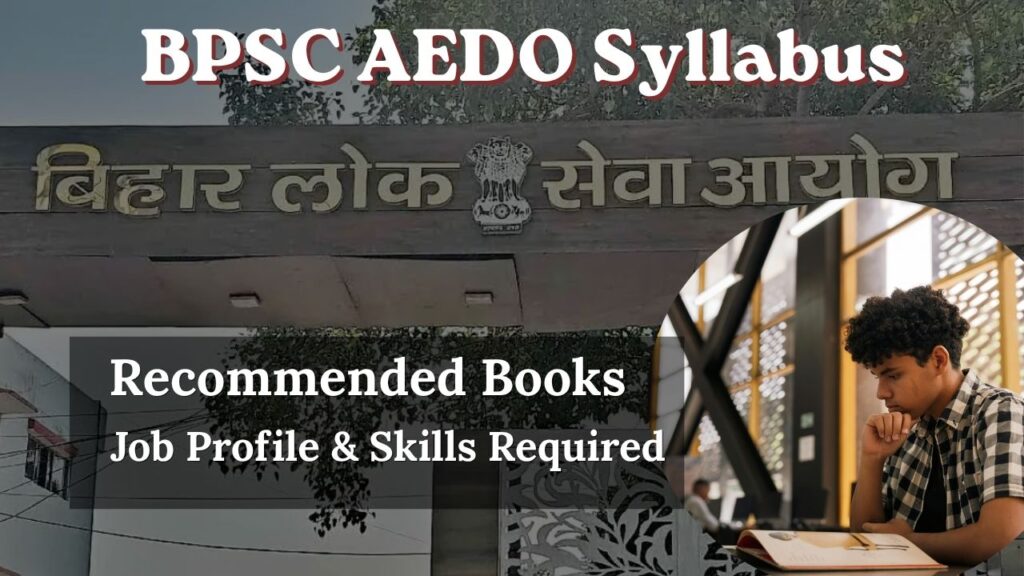
BPSC AEDO Syllabus, Recommended Books, Pattern, Job Profile & Skills Required

BPSC AEDO

BPSC AEDO Syllabus: It gives me immense pleasure to believe that a graduate can make such a difference by choosing to be in the education sector or education administration and directly impacting the lives of so many students. The Bihar Public Service Commission (BPSC) has recently made the entry for the position of Assistant Education Development Officer (AEDO). With 935 posts available, this is a golden chance for the candidates who want to get permanent and reputed government jobs in Bihar. l

But clearing a state level competitive exam is not a cakewalk. It needs a very strategic planning, strong study schedule and well understanding of examination pattern. Decoding the BPSC AEDO Syllabus is your starting line and most vital step, however attaining the job also depends on knowing fully the position that you are going to fill. 

This is the complete guide for BPSC AEDO syllabus in which you can get each and every information regarding this exam. From understanding the job profile and expected salary to analyzing the syllabus and best books, this article is your guide for everything you should know. 

What is the BPSC AEDO Job Profile?

The reality of the job must be understood before beginning preparation. The Assistant Education Development Officer (AEDO) post is a combined administrative and supervisory post. The AEDO is the vital link between the state’s education department and the schools at the ground level. 

As an Assistant Education Development Officer, you ensure the execution of educational policies and keep a watch on schools in that area to see if they adhere to the minimum standards of education and infrastructure. 

Key Responsibilities of an AEDO:

  • Educational Supervision: AEDO officers must check the working of government schools in their region consistently to speed things.
  • Scheme Implementation: Monitoring every government schemes to be implemented properly.
  • Analysis & Reporting: To generate believable reports with information such as student enrollments, attendance rates, dropout rates, and pass rates for students across courses.
  • Administrative Mediation: Redressing grievances of teaching staff, resolving logistical issues, ensuring adequate supplies and proper functioning of schools.
  • Quality Control: To conduct inspections for up keep the good quality in teaching and to ensure the syllabus is covered as per the state board. 

There is no typical desk day in this position. You’ll need to be out in the field or on campus, talking regularly with staff at schools, and taking the lead on identifying and addressing any administrative roadblocks. 

Salary and Perks: Why is the AEDO Role Highly Sought After?

Apart from the prestige and societal level impact associated with the post, the BPSC AEDO post provides very good salary and excellent job security. 

Salary is given under the Pay Level 5 as the government’s pay matrix.

Basic Pay: ₹29,200 per month.

Allowances:

  • Dearness Allowance (DA), 
  • House Rent Allowance (HRA), 
  • Travel Allowance (TA), 
  • Medical Allowances

The initial in-hand salary ranges between ₹40,000 to ₹45,000 per month.

Growth/Promotion: One can become a DEO or take up other high administrative posts in the Bihar Education Department from an AEDO with the experience of years and departmental promotions. 

Eligibility Criteria and Essential Skills Required

Educational & Age Criteria:

CategoryMinimum AgeMaximum Age
Educational Qualification–Any Stream’s Bachelor’s Degree in any discipline from a recognized university 
Unreserved (UR) Male21 years37 years
Women (All Categories)21 years40 years
OBC/EBC21 years40 years
SC/ST21 years42 years

Essential Skills for Success:

  • Fluency in Hindi and English: You need to have good communication skills in Hindi and English while dealing with teachers, government officials and the public.
  • Analysis: Reporting requires you to collect data on student enrollment, for example, or financial records then analyze that information to come to conclusions.
  • Leadership and Mediation: You may need to negotiate disputes within administration to hold the line on discipline and maintain orderly learning conditions.
  • Versatility: You were to expect to go and work at different blocks, and more than you expects at getting curve balls in logistics. 

Complete BPSC AEDO Syllabus and Exam Pattern

Understanding the exam pattern very well will only help you to crack the written exam. Here is a brief about BPSC AEDO exam pattern 

The BPSC AEDO papers are in the objective type questions (MCQs) format spread over three papers. The two-hour papers are of 100 marks each. 

Guideline on Negative Marking: 1/3rd of the mark allocated to the question will be deducted for each wrong answer. Precision is just as important as the number of tries. 

PaperSubjectTotal MarksDurationNature of Exam
Paper 1General Language (English – 30, Hindi – 70)1002 HoursQualifying (Min. 30% in both separately)
Paper 2General Studies1002 HoursEvaluated for Merit
Paper 3General Aptitude1002 HoursEvaluated for Merit

The Detailed BPSC AEDO Syllabus

A focused plan of preparation depends on the exclusive understanding of the given official BPSC AEDO Syllabus. Let us now discuss each paper:

Paper 1: General Language (Qualifying)

This exam is to check your basic grammar knowledge. You will have to obtain a minimum score of 30% in both English and Hindi parts minimum for your other papers to be evaluated. 

English (30 Marks): 

  • Basic Grammar, 
  • Vocabulary, 
  • Synonyms & Antonyms, 
  • Idioms & Phrases, 
  • Sentence Correction, 
  • Reading Comprehension.

Hindi (70 Marks): 

  • Hindi Vyakaran (Grammar), 
  • Sandhi, 
  • Samas, 
  • Paryayvachi Shabd (Synonyms), 
  • Vilom Shabd (Antonyms), 
  • Muhavare (Idioms), 
  • Unseen passages.

Paper 2: General Studies (Merit-Based)

  • History: Indian History both old and new. Bihar contribution in Independence of India. 
  • Geography: Indian Geography. Focus on Bihar economic and physical geography which covers Drainage, soil and mineral wealth of Bihar. 
  • Indian Polity & Economics: Indian Constitution, governance and Policies implemented by the Central Government. 
  • Basic Science: Biology, Physics, and Chemistry of 10th class. 
  • Current affairs & General Knowledge: Big events and global summit of India specifically current events of Bihar in last 10-12 months. 

Paper 3: General Aptitude (Merit-Based)

General Quantitative Aptitude should best be learned by building your fundamentals with clear concepts of class 6th to 8th level books that are worked on in a very plain and simple way on all the necessary things. Concentrate on the following Chapters – Number Systems, Ratio and Proportion, Simplification, Averages, Profit and Loss, Percentages, Simple and Compound Interest, Time and Work, Speed and Distance and some Basic of Mensuration (2D and 3D). 

Also, reasoning plays a vital role, so you must practice topics like Number and Alphabet Series, Analogies, Coding Decoding, Blood Relations, Syllogism and non-verbal reasoning topics like Mirror Images & Paper Folding on a regular basis. 

The data interpretation is also very important aspect in the exams, where you have to frame questions on the basis of tabular data, pie chart and bar graph and solve them, so on these fronts you need along with gre speed you also require gre accuracy. 

Best Books for BPSC AEDO Preparation

With so much information out there, it’s natural to feel intimidated about where to start. The trick is to have a small number of dependable books, go through them a few times and not to hoard too much revision material. Below are some of the best books recommended for each section: 

For General Language:

  • Objective General English by S.P. Bakshi (Arihant Publications)
  • Samanya Hindi by Lucent Publications

For General Studies:

  • General Knowledge by Lucent Publications
  • Bihar Samanya Gyan by Manohar Pandey or Crown Publications
  • NCERT Books (Class 6th to 12th)
  • Monthly Current Affairs Magazines or News Paper

For General Aptitude:

  • Quantitative Aptitude for Competitive Examinations by R.S. Aggarwal (S. Chand)
  • Fast Track Objective Arithmetic by Rajesh Verma (Arihant)
  • A Modern Approach to Verbal & Non-Verbal Reasoning by R.S. Aggarwal

Pro Preparation Strategy to Crack the Exam

Having the right textbooks and knowing the syllabus is only half the battle. How you organize your daily study routine, now that’s the killer, that’s what’s really going to make or break you.

Don’t Disregard Paper 1: Many students end up underestimating the language paper because it is “acting as a gatekeeper”. But if you are not getting minimum 30 per cent in both Hindi and English, you will be disqualified no matter how many marks you are getting in others papers. Form a habit of completing at least 45 minutes language sessions daily.

Concentrate on Bihar-centric issues: Geography, history and current affairs of Bihar carry more weightage in GS. Consider “Bihar Special” as a separate paper and study accordingly. 

Be good at managing your time: You have 100 questions in the Aptitude section to be solved in 120 minutes. It provides you 1 minute for each question. Practice learning to skip the harder and more time-consuming questions and answering the simpler questions first. 

Mock Tests are non-negotiable: Start taking full-length mock tests not later than 2 months prior to the exam. It will get you used to the 1/3rd negative marking pattern. Analyze the questions you get wrong to see where you are weak and to improve your guessing. 

Revise Consistently: Use your weekends to go over everything you learned during the week. Keep your notes brief and clear so you can quickly review them in the last weeks.  

Read More :- UPSSSC Excise Constable Recruitment 2026 Complete Guide to Prepare Early

Conclusion

BPSC AEDO exam is a good way to get a respected and secure job in government service. The competition will be hard but well disciplined based on complete knowledge of BPSC AEDO Syllabus and Exam Pattern will make you ahead from the rest. Get your material, prepare a realistic timetable and start your preparation now. To qualify the state level public service exams, constancy counts more than severity. 

Government Teaching Jobs in India 2026: Latest Vacancies, Eligibility & Recruitment Updates

Government Teaching Jobs in India

If you have ever wanted to impact society on a large scale and have a stable, secure job with great benefits, teaching for the government might be just right for you. In 2026, the government’s education department in India is experiencing a massive surge in job offerings and thousands of opportunities are available in schools and colleges across the country. Whether you’re a new graduate with a teaching degree, or a career changer, there has never been a better time to pursue a Government Teaching Jobs in India.

The beauty of governmental teaching jobs is not just the competitive salary packages, but the unbeatable job security, lifetime pension benefits, and the gratification of making a difference in the lives of young minds. With India making massive investments in education infrastructure, the need for qualified teachers has never been greater. 

The Current Recruitment Landscape

2026 is going to be a critical juncture for aspiring teachers in India. Big organizations are hiring at a scale that’s never been seen before:

Kendriya Vidyalaya Sangathan (KVS) has released the notification for 9126 posts for both teaching and non-teaching posts. These elite central government schools provide some of the best teaching jobs in the country for Trained Graduate Teachers (TGT) and Post Graduate Teachers (PGT) in several subjects.​

Navodaya Vidyalaya Samiti (NVS), which runs high standard residential schools all over rural India is also inviting application for 5841 posts. If you love to deliver quality education in rural areas and you have commitment then NVS is the best place to do that. 

Delhi Subordinate Services Selection Board (DSSSB), India’s largest recruiter, has thrown open the window with 5,346 vacancies for Trained Graduate Teachers and 1,180 vacancies for Primary Teachers. If you have your heart set on becoming a teacher in the capital of India, never let a spring pass without applying for some of the most competitive jobs on the planet.​

Uttar Pradesh, the most populous state in India, is also to recruit around 2 lakh (200,000) teachers in three phases by 2026. This montage of recruitment speaks volumes of the opportunities that exist for Indian teachers!

However outside of these large providers numerous Sainik Schools, state governments and educational boards release notifications throughout the year making teaching opportunities a steady flow. 

What You Need to Qualify

One of the biggest myths is that there are complex eligibility criteria to apply for teaching jobs. Actually the rest is simple, and the ones that are should have been enough to allow talented people to get into the profession.

When it’s About Becoming Primary Teachers 

Along with the 12th standard or its equivalent examination with at least 50% aggregate from a recognized board, you also need to clear the Central Teacher Eligibility Test (CTET) or your State Teacher Eligibility Test (TET) and have either a 2-year Diploma in Elementary Education (D.El.Ed. or 4-year Bachelor of Elementary Education (B.El.Ed.). 

When it’s About Becoming Trained Graduate Teachers 

You must have 50% marks in your subject along with B.Ed. You have to qualify CTET as well as state TET exam. TGT teachers usually teach classes 6-10. 

For Post-Graduate Teachers (PGT)

For the dreamers who still went for higher education. A minimum of 50% marks in a master’s degree in your subject along with the B.Ed qualification is required. Classes 11-12 and specialisations are handled by PGT teachers.​

For Railway and Sainik School Teaching Posts

The eligibility is almost same, but with minor changes as per organization type. Age limit varies from 21 to 40 years as per category.​

The CTET Advantage In Teaching Jobs

The Central Board of Secondary Education (CBSE) the Central Teacher Eligibility Test (CTET) is a boon for teachers in the making. Why it’s so good: 

Validity of CTET Score: It is now clear that CTET score validity has been increased – CTET scores will now be your lifelong companion, which means you don’t have to sit again for the exam even after years of so-called re-preparation.​

Pan-India Mobility : After qualifying CTET, you can apply to teach in central government schools such as Kendriya Vidyalayas, Navodaya Vidyalayas or union territory schools throughout the nation—not just in your native state.

Exams Advantage: Performing well in CTET examination also enhances your chances to get superior teaching job in central govt schools for which the pay and perks are the most lucrative.

The CTET examination for 2026 is scheduled for the 8th of February, and the application process is already open. The Paper I is conducted for the aspirants who want to teach classes 1 to 5 and Paper II is conducted for the aspirants want to teach 6 to 8 classes. Percentage required — You should a minimum of 60% to qualify! 

Salary and Benefits: Why Government Teaching Pays Off

Teaching is no longer a low paying job. Teaching professionals in India have a lot to smile now as they receive an extremely attractive pay scale:

Primary Teachers: A primary teacher will start with approx ₹35,400 as basic pay (₹42,000-₹45,000 with allowances) and can go up to ₹50,000+ in a decade through promotions and increments.​

Trained Graduate Teachers (TGT): with a basic pay of ₹44,900 (₹59,282 with allowances) and it can go up to ₹ 60,000-70,000 with incentives and experience. 

Post-Graduate Teachers (PGT) : Having the highest salaries at school level at a basic pay of ₹47,600 (₹ 56,320 with allowances) and may go beyond ₹75,000-80,000 per month with allowances and increments.​

Apart from the salary, teachers of the government get:

Dearness Allowance (DA): At present DA is about 38% of the Basic Pay and it is revised twice a year considering inflation

House Rent Allowance (HRA) : An additional monthly allowance is given to the employee based on his/her duty Station/location of post.

Transport Allowance: Very good for teachers and further higher in urban.

Medical Facility: Free medical treatment for you and your family in any hospital recognised by the bank’s medical cell.

Gratuity: A lump-sum amount on retirement

Pension Security: Immerse your lifestyle in wealth, NPS is the default pension plan for civil servants which guarantees a lifelong pension of fixed amount in return for financial security in old age.

Leave Benefits: Maternity Leave – 180 days, Paternity Leave – 15 days.

Benefits for Education of Your Children: Education benefits for your children, and your own kids’ education, consider scholarships and fee concessions. 

Read More 👉 Top IET Lucknow CSE Placements – Highest Packages, Recruiters & Career Growth in 2025

Types of Government Teaching Jobs

If you want to teach in India, these are some of the options that attract different types of teachers.

Central Government Schools 

KVS and NVS posts provide the most secure, stable and highest paid teaching jobs along with good perks and national level working.

State Government Schools 

Every state holds its own TET recruitment which provides the benefit of local stability and a home state posting ideally if you want to stay close to your family.

Railway Schools

Recruitment of teachers through Railway Recruitment Board (RRB) which invites applications from eligible candidates for the post of Teacher in various categories with attractive salary and benefits.

Sainik Schools

These elite military backed schools provide teacher with added advantage of working in a disciplined teaching, with great infrastructure and exposure to.

Delhi Government Schools 

The DSSSB recruitment leads to some of the best schools in India at Delhi, now opened for applications. 

The Selection Process

Knowing what to expect in the selection process enables you to be strategic in your preparation. Usually the procedure the candidates have to go through includes a written test to check your subject knowledge and teaching methodology (for TGT/PGT), verification of your qualification in which your educational certificates are scrutinized and in some cases a demo class/test on teaching is conducted where you have to teach a subject to a panel.​

This regimented process guarantees that only the most dedicated, and highest qualified teachers make it to the system. 

Preparation Tips

  • Start by preparing seriously for the CTET or your state TET – these are the pillars of your teaching career. 
  • Enroll in coaching centers if necessary, concentrate on the subject and solve the question papers on a regular basis. 
  • Have good communication skills and be aware of the policies of education. 
  • And more than anything, have a real love for teaching – that comes across waves in interviews and demo classes. 

Conclusion

Government teaching jobs in India will be more than just a job—they will provide a chance to contribute to building India’s future, along with monetary compensation and social prestige. With tens of thousands of vacancies, competitive pay, generous benefits, and a defined career ladder, now is an excellent time to enter this noble profession.

Whether it is the joy of imparting knowledge, the stable job and pension benefits, or the chance to do something for society, government teaching remains a profession that earns you respect for life. The options are there, the way is clear, and your teaching future is just around the bend. So take that leap of faith today—register for CTET, prepare well and stake your claim as an educator of India’s tomorrows. 

RRVUNL JE, Junior Assistant Recruitment 2026: Dates, Eligibility, and Exam Pattern 

RRVUNL JE, Junior Assistant Recruitment

If you’ve been waiting for the Rajasthan Rajya Vidyut Utpadan Nigam Limited to open the portal for candidates to apply for RRVUNL JE, Junior Assistant Recruitment 2026. Total vacancies are 2,005 which will be after the test on various positions including Junior Engineer, Junior Accountant, and Junior Assistant / Commercial Assistant-II. The timeline ends on August 25,  2026 but you have plenty of time from August 5 to apply.

RRVUNL JE, Junior Assistant Recruitment 2026 Short Notice Detail

RRVUNL has issued a short notice for the recruitment of posts in Five Rajasthan Power Utilities, namely, RVUN, RVPN, JVVN, AVVN, and JdVVN. Under Advertisement No. RVUN/Rectt./2026-27/01, the notification includes three types of posts – Junior Engineer (Electrical, Civil, Mechanical), Junior Accountant, and Junior Assistant/Commercial Assistant-II. 

The 2,005 figure is the combined total across all three; the post-wise and utility-wise split hasn’t been published yet and is expected with the detailed notification. If Junior Assistant is your target, keep an eye on that breakdown before you start serious preparation.

Who Are Eligible For This Recruitment

For the Junior Assistant / Commercial Assistant-II post, the qualification bar is straightforward: graduation in any discipline from a recognized university. No specific subject requirement, which is exactly why this post draws such heavy competition every cycle — it’s open to arts, commerce, and science graduates alike.

Age will be calculated as on January 1, 2026, and the usual government relaxations for reserved categories will apply. The exact minimum and maximum age limits for this cycle hadn’t been confirmed in the short notice at the time of writing, so don’t lock in your eligibility assumptions from last year’s cycle — wait for the detailed notification before you rule yourself in or out.

Key dates on your calendar

EventDate
Online Apply Start Date05 August 2026
Online Apply Last Date25 August 2026
Last Date For Fee Payment25 August 2026
Exam DateNotify Later

Treat everything from the detailed notification as the final word — short notices exist to give candidates a heads-up on timelines, not to lock in every eligibility detail.

The selection process — two phases, no interview

RRVUNL has kept this refreshingly simple: there’s no personal interview for these posts. Selection comes down to a written exam followed by document verification, and for Junior Assistant specifically, a second phase most candidates underestimate.

Phase-I is a computer-based test (CBT) — objective-type multiple choice questions, carrying 40% weightage in the final selection.

Phase-II is a Computer Proficiency Test: typing speed and efficiency checks in both Hindi and English. This phase carries 60% weightage — more than the written exam itself.

That weightage split is the single most important thing to internalize if you’re serious about this post. A lot of candidates pour every hour into GK and reasoning practice and treat typing as an afterthought to sort out “closer to the date.” For Junior Assistant, that’s backwards. If your Hindi and English typing speed isn’t already exam-ready, start now — it’s worth more to your final score than the written paper.

What The Written Exam Actually Tests

The Phase-I paper for Junior Assistant and Commercial Assistant-II covers five areas: General English, General Hindi, Reasoning and Mental Ability, Mathematics, and General Knowledge & Everyday Science. It’s a 120-minute objective paper with negative marking of 0.25 for each wrong answer, so accuracy matters as much as coverage — guessing blindly on a paper with this negative marking structure can cost you more than it earns.

The reasoning section leans on standard topics: number and letter series, coding-decoding, analytical reasoning, mirror images, and clock-based questions. Maths covers the usual government-exam staples — simple and compound interest, time and work, time and distance, HCF-LCM, ratios, and simplification. Hindi tests grammar, vocabulary, comprehension, and muhavare (idioms), while English mirrors that at a similar difficulty level. None of this is unfamiliar territory if you’ve prepared for any state-level clerical exam before — the syllabus is conventional, which makes cutoffs high and margins thin.

Salary and Pay Structure

RRVUNL has confirmed a starting salary around ₹33,800 per month for Junior Engineer posts, paid under the Level 10 pay matrix, along with Dearness Allowance, House Rent Allowance, Transport Allowance, and medical benefits. What hasn’t been separately confirmed yet is the exact Junior Assistant pay figure — most of what’s public so far centers on the JE post. 

Until it’s specifically stated in the detailed notification of RRVUNL JE, Junior Assistant Recruitment 2026, don’t presume Junior Assistant gets that salary too; in most of the state power utility recruitments, Junior Assistant and Junior Engineer have different pay levels. 

How To Apply For RRVUNL JE, Junior Assistant Recruitment 2026

Applications go through the official RRVUNL/Rajasthan power utilities recruitment portal once it opens on August 5. The process of RRVUNL JE, Junior Assistant Recruitment 2026 follows the standard pattern: 

Register first then login using User Id, Password along with Captcha, enter required details for education and personal information, photograph and signature in the prescribed format, pay the processing fee and submit the online application. 

Keep scanned copies of your graduation certificate, category certificate (if applicable), and ID proof ready in advance — form-filling day is not the time to be scrambling for document scans.

How to Prepare For The Exam

With the RRVUNL JE, Junior Assistant Recruitment 2026 application window closing August 25, here’s the realistic sequence: 

  • Verify your eligibility against the detailed notification the moment it drops, complete your form early rather than in the last 48 hours.
  • Start splitting your prep time between the written syllabus and typing practice from day one — not after Phase-I is behind you. 
  • Given the 60% weightage on the Computer Proficiency Test, candidates who start typing practice late are competing at a real disadvantage against those who’ve been building speed for weeks. 

That’s the edge worth building now, while the form is still open.

Conclusion 

RRVUNL JE, Junior Assistant Recruitment 2026 is a golden door to get recruited in the state of Rajasthan with five power utilities. Junior Assistant aspirants must note that though the written exam is important, the Computer Proficiency Test has a weightage of 60% and therefore, typing speed and accuracy are as important as the subject knowledge. 

The end date for submission of the online application is 25.08.2023, so complete the registration process before that date. Stay tuned for detailed notification of each post-wise vacancy and eligibility criteria. Start preparing for both the tests from day one to get a better chance of selection.

NTET 2026: Complete Information on Eligibility, Exam Pattern & Syllabus

NTET 2026

Do you want to develop the future of healthcare education in India? If you intend to apply for the post of Assistant Professor, Associate Professor or Professor in ISM or Homoeopathy, then the first step is to qualify the NTET 2026.

National Teachers Eligibility Test (NTET) for teaching in AYUSH Institutions (PCM/PCB) NCISM NCH has notified the conduct of National Teachers Eligibility Test (NTET) for educators in AYUSH colleges. From Minimum Eligibility Criteria, Exam Pattern, Syllabus, to preparation tips, this complete, evergreen guide dresses up all the essential aspects for NTET. 

Let us check out the details to start your academic career. 

What is the NTET 2026 Exam?

The National Teachers Eligibility Test (NTET) is a country level AYUSH teachers suitability test that aims at testing potential teaching capabilities, communication skills and knowledge of educational psychology of prospective AYUSH teachers. Be it Ayurveda, Unani, Siddha or Homoeopathy, the NTET 2026 is a mandatory requirement for teachers to keep abreast with contemporary teaching methods to train future doctors. It tests your teaching potential, not your medical know-how, which you have already been through a sufficient number of times in your postgraduate medical degree. 

NTET 2026 Eligibility Criteria

Cooperating with the rules of UPSC before applying to NTET is the right choice because you can waste your time if you’re not eligible for the examination. Whether it’s a document or age criteria, make sure you lie on the guidelines. NTET is solely for post graduates and final year students of certain medical and para-medical disciplines.

Here is the list for the minimum eligibility criteria:

Basic educational qualification: Must complete your masters in whatever field you have chosen. Graduated students can pursue any of these postgraduate degrees in Ayurveda, Unani, Siddha, Homoeopathy or allied areas to be eligible. 

Related fields: The candidates should have valid bachelor’s degree in AYUSH (BAMS, BUMS, BSMS, BHMS) withMaster of Public Health (MPH) or M.Sc in Anatomy, Physiology, Biochemistry orMicrobiology. 

Students in their final year of education can take the exam if you are progressing and have completed at least 30 months of your masters program. 

Career Stage: Only first time aspirants to the teaching profession (Assistant Professor) at the entry level are required to qualify in this exam. It is also necessary for higher teaching positions if the candidate is coming to teaching from clinical practice or research for a number of years and not for the first time. 

NTET Exam Pattern

FeatureDetails
Mode of ExaminationComputer-Based Test (CBT)
Total Duration120 Minutes (2 Hours)
Total Questions100
Question TypeMultiple Choice Questions (MCQs) with 4 options
Maximum Marks100 Marks
Marking Scheme+1 mark for every correct answer
Negative MarkingNo Negative Marking
Medium of PaperEnglish and Hindi
Difficulty Distribution40 Easy, 40 Medium, 20 Difficult questions

Detailed NTET 2026 Syllabus

The NTET 2026 syllabus is concerned only with teaching techniques, management of the class and human mind. It has been segmented into 8 modules. Here you go, this is What to Study:

Teaching & Training

  • Definition, aims, and levels of teaching (to teach at Memory Level, to teach at Understanding Level, to teach at Reflective Level).
  • Features of adult and youth learners (Educational, Social, Emotional, and Intellectual).
  • Contemporary methods of teaching, clinical teaching and teaching at the bedside.
  • VARK learning style (Visual, Aural, Reading/Writing in Learning, Kinesthetic). 

Communication

  • Definition, nature, types and barriers of communication.
  • Verbal vs non-verbal and intercultural communication.
  • Teacher-Learner and Doctor-Patient communication models.
  • Place of mass media in society and contemporary education.

Classroom Management

  • Maintaining studious engagement, and motivated learning in heterogeneous classrooms.
  • disciplinary management and discipline and positive, inclusive learning environments.
  • Work with real teaching environments such as OPDs, clinical labs, skill labs, and community outreach programs. 

Methods of Evaluation

  • The formative and summative assessment processes in learning.
  • Evaluation mechanisms under the CEC procedures.
  • Evaluation of clinical competence by OSCE (Objective Structured Clinical Exam), long case and short case.
  • Importance of organised feedback in learning.

Educational Technologies

  • The emergent and shifting terrain In medical education: ICT and its management.
  • The utilization of the Internet, e-mail and video conferencing in the contemporary teaching environment.
  • Knowledge of online teaching environments and MOOCs (e.g. SWAYAM and SWAYAMPRABHA). 

Educational Psychology

  • The cognitive development from childhood to adult with storing knowledge and learning through life experience by the human mind.
  • Psychological theories of relevance to teaching: Piaget’s cognitive development, Vygotsky’s sociocultural perspective, Bronfenbrenner’s social context.

Educational Andragogy 

  • Get to know Andragogy (the designated way and technique of teaching adult learners).
  • The principles, needs and characteristics of adult learning.
  • Building Skills for Self-Directed and Lifelong Learning.

Learning and Pedagogy

  • Fundamental notions and sequential procedures of pedagogical analysis.
  • Critical pedagogy and the development of particular learning outcomes.
  • A few guidelines to facilitate doing student-centred teaching-learning workflow effectively.
  • Eligibility Conditions and Validity of the Certificate

Examination Result: 

The candidates are required to obtain the minimum of 50% marks (without any rounding off) in the examination to be considered as “NTET Qualified”.

Certificate Validity: 

On clearing the NCTET, your NTET Eligibility certificate is valid for 10 years from the date of passing. If they fail to join teaching within the 10 years or take a career break of above 10 years, they would need to take up and clear the test once again to continue in teaching. 

Read More:- DECE-LE Admission Form 2026: Apply Online, Eligibility, Exam Date & Full Details

Tips to Crack the NTET 2026

Since teaching is what the NTET 2026 tests and not medical science, your prep plan needs to adjust slightly.

  • Learn the Pedagogy Fundamentals: To learn some of the main educational psychology concepts, read some of the key texts by Piaget, Vygotsky and from contemporary educational models.
  • Concentrate on Clinical Teaching: The usual pedagogy holds only tenuously when considering the OPD and in AYUSH teaching. Attending clinical, bed side and OPD teaching methods, they are very practical.
  • Manage Your Time: There are 100 questions in 120 minutes. Time is more than sufficient, but reading the lengthy scenario-based teaching method questions can be consuming. You will be building your reading speed with regular mock tests.
  • Take Advantage of the ‘No Negative Marking’ Rule: Have a guessing game plan for hard questions. Do not leave a question unanswered on your CBT screen.
  • Keep Abreast with Ed-Tech: Keep track of the latest digital education tools and steps taken by the Indian government in the education sector. 

Conclusion

The NRIMT or NTET 2026 is one of the excellent, forward-looking measures by NCISM & NCH to bring about a unified quality in the AYUSH education throughout the country. This idea of focusing on “how to teach” rather than “what to teach” makes future doctors be taught by qualified, caring and extremely capable teachers.

So with this article, get yourself prepared to land on the hot seat of the National Teachers Eligibility Test. Go in depth with your syllabus and learn to think like the psychology of adult learners and you are on your way to a very successful and satisfying career as a medical teacher.

Best Government Jobs in Dadra And Nagar Haveli

Are you from Dadra and Nagar Haveli? You can apply for government jobs in various posts. As you can check in the list there are many Best Government Jobs in Dadra And Nagar Haveli. Whether you have a background in science, commerce, or arts can get a chance for both technical and non-technical posts. The career growth depends on the person’s experience in work.

S.NoJob TitleDepartment / OrganizationOfficial Website Name & Link
1Assistant ProfessorNAMO Medical Education & Research InstituteDNH Administration, https://dnh.gov.in
2Junior ResidentDirectorate of Medical & Health Services (DMHS)DNH Administration, https://dnh.gov.in
3Post Graduate Teacher (PGT)Directorate of Education, Dadra & Nagar HaveliDNH Education Dept., https://dnh.gov.in
4Assistant EngineerPublic Works Department (PWD), DNHDNH PWD, https://dnh.gov.in
5Revenue InspectorRevenue Department, Dadra & Nagar HaveliDNH Revenue Dept., https://dnh.gov.in
6Forest GuardForest Department, Dadra & Nagar HaveliDNH Forest Dept., https://dnh.gov.in
7Junior EngineerPublic Works Department (PWD), Dadra & Nagar HaveliDNH PWD, https://dnh.gov.in
8AccountantFinance Department, Dadra & Nagar HaveliDNH Finance Dept., https://dnh.gov.in
9Police Sub-Inspector (SI)Dadra & Nagar Haveli Police DepartmentDNH Police Dept., https://dnh.gov.in
10Stenographer Grade CDadra & Nagar Haveli AdministrationDNH Administration, https://dnh.gov.in
11Tax InspectorDadra & Nagar Haveli Tax DepartmentDNH Tax Dept., https://dnh.gov.in
12Lower Division Clerk (LDC)Various Departments, Dadra & Nagar HaveliDNH Administration, https://dnh.gov.in
13Junior Secretariat AssistantDadra & Nagar Haveli AdministrationDNH Administration, https://dnh.gov.in
14Medical OfficerHealth Services, Dadra & Nagar HaveliDNH Health Dept., https://dnh.gov.in
15Driver (Class IV)Dadra & Nagar Haveli AdministrationDNH Administration, https://dnh.gov.in

Scroll to Top