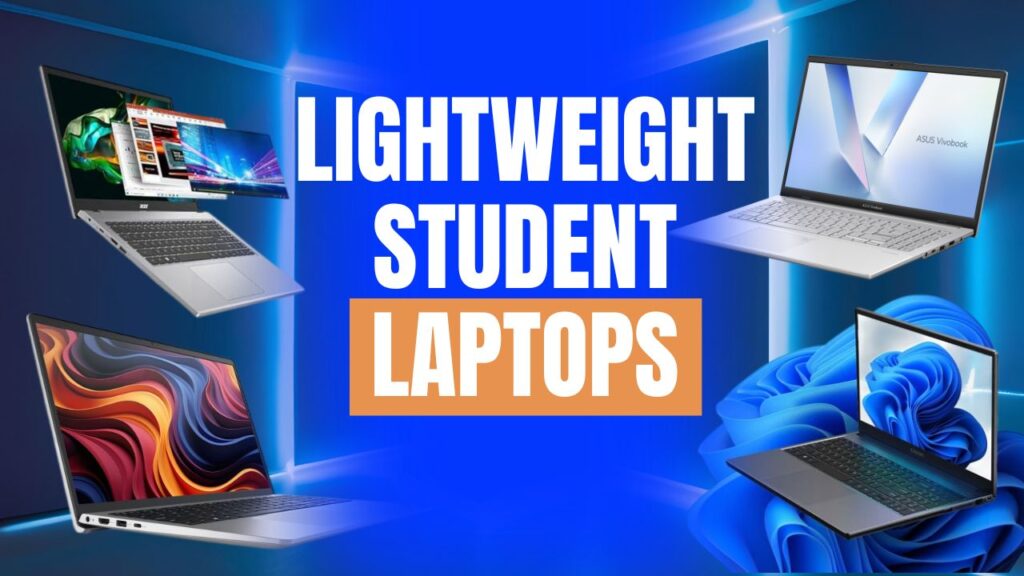
Top Lightweight Student Laptops to Buy in 2026

Student Laptops

Six months into college, nobody’s complaining about their laptop’s benchmark scores. They’re complaining about their shoulders. A 2 kg laptop doesn’t feel heavy in a store demo — it feels heavy on the fourth flight of stairs to a 9 a.m. class, or on the walk from hostel to library with three textbooks and a water bottle sharing the same bag. That’s the real case for lightweight student laptops: not a spec-sheet flex, but something you’ll actually carry every single day for the next three or four years.

Here is a list that sticks to laptops built with that in mind — machines with a confirmed weight under roughly 1.5 kg, or ones explicitly built and marketed as ultraportables where the brand hasn’t published an exact figure for every configuration. Starting from ₹30,000 and goes up to premium models of laptops and every laptop is mentioned with their outstanding features to let you decide which one fits for you.

The prices mentioned below for each laptop as of August 2026 across Indian retailers but they always vary in festive season, so check the live price on online platforms like Amazon and Flipkart or offline store before buying it.

What “Lightweight” Actually Means for a Student Laptop

Under 1.5 kg is the number worth remembering — that’s roughly where a 14-inch laptop stops being a minor inconvenience in a backpack and starts being genuinely easy to forget you’re carrying. Below that, most manufacturers are using magnesium-aluminum alloy or a denser polycarbonate blend instead of the thicker plastic shells common on budget 15.6-inch machines.

The trade-off is usually battery capacity and port selection — thinner chassis mean smaller batteries and fewer full-size ports, so you’ll see more USB-C-only designs and dongles in this category. Screen size matters too: a 14-inch panel can shave 200–300 grams off an otherwise identical 15.6-inch laptop, which is why several picks below come in 14-inch variants specifically. If you genuinely need the extra screen real estate for CAD software or spreadsheet-heavy coursework, that’s a fair trade to make consciously — just don’t assume a 15.6-inch “slim” laptop weighs the same as its 14-inch sibling, because it usually doesn’t.

The Best Lightweight Student Laptops in 2026

1. CHUWI CoreBook X Pro — Under ₹30,000

  • Processor: Intel Core i5-12450H 
  • RAM: 16GB (upgradeable) 
  • Best for: Tightest budgets

If you still want a genuine H series processor, pick CHUWI CoreBook X Pro for ₹30,000 which is a hard ceiling. Instead of U-chip, its offer 12th‑gen Intel Core i5‑12450H and 16 GB of RAM. Combining them will give you excellent performance which you can get in a laptop which costs you twice and both the RAM and SSD are user‑upgradeable later. 

CHUWI CoreBook X Pro


The only drawback is CHUWI is a Chinese brand so it’s hard to find service centers in most regions in India compared to Dell, HP, Lenovo, or Acer. if something goes wrong then it takes longer to repair than usual. Exact weight figures also aren’t always independently confirmed, so check it carefully before buying.

2. Dell Vostro 14 3440 — ₹39,990

  • Weight: 1.46 kg 
  • Processor: Intel Core i3 
  • Best for: Portability-first budget pick

This is the most lightweight student laptop with 1.46 kg at ₹39,990. Dell Vostro is a proven reliable laptop with Core i3 for daily office work, support smooth streaming, and browsing with multiple tabs but it gets stuck when you attend zoom call, play spotify with chrome tabs. 

Dell Vostro


It also offers business-grade hinges and a keyboard that doesn’t get loosen quickly on daily typing. This is a sensible choice for students who want to read PDF’s, make presentations, and complete assignments which don’t require compute-heavy operations.

3. Acer Aspire 15 AS15-42 — ₹40,999

  • Processor: AMD Ryzen 7 7730U 
  • RAM: 16GB 
  • Storage: 512GB Gen4 SSD 
  • Best for: Performance-per-rupee

Give a few hundred extra and get a totally different laptop which supports Ryzen 7 7730U processor and 16GB RAM which most laptops do not offer at this price point. If students want to buy a lightweight student laptop for coding, data work, or large operation tasks which require more cores rather than raw single-thread speed.

Acer Aspire


Acer doesn’t prominently list an exact weight for this configuration but the size of the 15.6‑inch chassis suggests that it will noticeably heavier that the 1.46 kg Vostro. If you need a reliable and well-performing laptop over portability then pick this one.

4. ASUS Vivobook Go 15 (2026) — ₹46,990

  • Category: Ultrabook 
  • GPU: AMD Radeon (integrated) 
  • Best for: Mid-range Windows ultraportable

Its name defined its purpose overall, ASUS launched this Vivobook Go 15 especially for students to carry it easily wherever they go. This new 2026 variant is built with AMD-powered chip and Radeon graphics for more high performance and support for everyday multitasking than Intel’s equivalent integrated graphics.


Exact RAM and storage vary by the specific SKU you land on, and ASUS’s spec sheet for this listing doesn’t pin down a precise weight — the smaller 14-inch Vivobook Go models have historically landed between 1.3–1.5 kg, so this is a reasonable proxy, but confirm the number on the exact variant before ordering. 

5. HP Pavilion Plus 14 — ₹69,990–₹79,999

  • Processor: Intel Core i5-1335U (13th Gen) 
  • RAM: 16GB DDR5 
  • Storage: 512GB SSD 
  • Best for: Video calls and note-taking as daily habits

This is the thinnest laptop in the Pavilion range making it best for students who use the laptop for video calls and take notes directly. The 16GB of DDR5 and a genuinely sharp Full HD panel with a solid webcam of HP Pavilion Plus 14, make it noticeably better for online classes than most laptops at this price. 


Price may fluctuate according to the retailer and offers in your area but this one genuinely listed between ₹69,990 to ₹79,999. You can compare its prices across various platforms before ordering it. 

6. Apple MacBook Air 13″ (M4) — ₹89,990 (MRP ₹97,900)

  • Weight: 1.24 kg 
  • Battery: Up to 18 hours video playback 
  • Best for: Design, media, and Apple-ecosystem students

There is no fan noise, long-lasting battery which survives the whole day with you, and 1.24 kg weight that lets you carry it anywhere. Apple’s silicon efficiency consistently holds up in everyday use. This is the lightest and longest-running laptop on this list with honest value. 


The present cost is ₹97,900 but Flipkart offer brings down the price to ₹89,990. The price has been varying a few times in the last months and still is, so better check the exact price before ordering. 

The only downside is that many engineering programs and courses that involve a lot of CAD are not compatible with macOS exclusively, so be sure to check what you will need, or what your specific programs require, before making the switch. 

Dell Vostro 14 vs Acer Aspire 15: Different Purpose in Same Price

The price difference is just ₹1,000 but ideal for students with totally different purposes, so it’s worth putting them side by side directly.

Dell Vostro 14 3440Acer Aspire 15 AS15-42
Price₹39,990₹40,999
Weight1.46 kg (confirmed)Not confirmed — expect heavier
ProcessorIntel Core i3AMD Ryzen 7 7730U
RAMNot specified in listing16GB
StorageNot specified in listing512GB Gen4 SSD
Best forCarrying it everywhere without thinking about itCoding, multitasking, heavier workloads

If you’re choosing between these two, the question to ask yourself isn’t “which is better” — it’s “do I carry this laptop more often than I max it out.” Arts, commerce, and most humanities students will rarely hit the Vostro’s ceiling and will feel the weight difference every day. Engineering, CS, and design students doing real compute work will hit the Vostro’s ceiling within a semester and should take the Aspire’s extra RAM and cores over the lighter chassis.

Which Laptop Should You Actually Buy

Under ₹30,000 and not fussed about brand recognition: the CHUWI CoreBook X Pro gives you specs nothing else at this price matches, provided you’re comfortable with a smaller service network.

Around ₹40,000 and your coursework is reading- and writing-heavy: the Dell Vostro 14 3440 is the lightest confirmed option in this bracket and built to survive years of daily use.

Around ₹40,000 and your coursework involves code, data, or design tools: the Acer Aspire 15 AS15-42 gives you real multi-core performance for barely more money, at the cost of some portability.

₹47,000 range, want a Windows ultrabook rather than a budget laptop: the ASUS Vivobook Go 15 is the pick, with the caveat that you should confirm the exact weight and RAM on your specific variant before paying.

₹70,000–₹80,000 and you’re on video calls constantly: the HP Pavilion Plus 14’s webcam, display, and DDR5 memory earn their premium over the cheaper picks on this list.

₹90,000 and up, and battery life or a fanless, silent machine matters more than Windows-specific software: the MacBook Air M4 is the lightest and longest-lasting laptop here, full stop — just confirm your course doesn’t require Windows-only tools first.

None of this is a push to spend more than you need to. Most students finish a degree comfortably on the ₹40,000 tier; the ₹70,000-plus laptops earn their price mainly if you’re on calls all day or you specifically want the Apple ecosystem.

Two Things That Matter More Than Weight (But Get Ignored)

Weight gets all the attention because it’s the easiest thing to compare across a spec sheet, but two other factors decide whether a laptop actually holds up through a degree.

RAM you can’t upgrade later. Several budget laptops in this price range solder RAM directly to the motherboard, which means the 8GB you bought with is the 8GB you’re stuck with for the laptop’s entire life. This matters more each year as browsers, note-taking apps, and coursework software get heavier — 8GB that felt adequate on day one can feel tight by the second semester. Where a listing doesn’t explicitly say “upgradeable” or list a soldered/DDR5 spec, it’s worth asking the seller directly before you buy, especially on marketplace listings where the exact SKU isn’t always obvious from the product photo.

Charging reality in a hostel room. A laptop rated for 10+ hours on paper is genuinely useful if you’re not fighting for a plug point between four roommates and a limited number of sockets. USB-C charging (as on the MacBook Air and most of the ultraportables above) means you can share a charger with your phone or a power bank in a pinch — a proprietary barrel-pin charger, common on some budget Windows laptops, means losing that one cable is a bigger problem than it sounds. If your hostel setup involves shared or limited charging points, weigh this alongside battery life rather than treating them as separate factors.

Where to Buy (and How to Not Overpay)

Don’t lock into a single retailer before comparing — Flipkart, Amazon India, Croma, and Reliance Digital regularly carry the same laptop at different prices, and the gap can run into a few thousand rupees on any given week. 

Several brands, including HP, Dell, and Lenovo, run student-ID discount programs periodically that aren’t always visible on the main listing page, so it’s worth checking the brand’s own site alongside the marketplace listing. 

Big sale windows — Flipkart’s Big Billion Days in October and Amazon’s Great Indian Festival are typically when the steepest cuts show up, so if your purchase isn’t urgent, timing it around one of those is the single easiest way to save money on any laptop on this list.

Read More 👉 Best Student Laptops for School and University in 2026 

Conclusion 

Here you can get a list of lightweight student laptops which helps you understand which one fits you better. The laptop which lets you do your work smoothly and easy to carry anywhere is the best one, not the premium price laptops. So read and check by yourself carefully before ordering it because the price can go down or high with time.

Leave a Comment

Your email address will not be published. Required fields are marked *

MPSC Group C Various Post Recruitment 2026: Full Details on Job Profiles

MPSC Group C Various

The MPSC Group C jobs include important administrative and technical staff of the state government in Maharashtra. These are non-gazetted entry-to-mid level jobs under departments of the state which appeal an annual MPSC Group C Various Post Recruitment 2026.

These jobs are in high demand among the graduates and technical diploma holders who want to have a stable career with the state government. 

Here is everything you need to know before you sit down to fill the form — what the posts actually involve, who qualifies, how the selection unfolds, and the dates that matter most.

What Falls Under MPSC Group C Various Post

Group C Different Post is not a single vacancy but a multiple recruitment for variety of positions under class III (non-gazetted) posts, which government department of maharashtra require every year. This year MPSC is issued for five posts: 

Clerk-Typist holds the considerable number of vacancies at 1,864 posts and it also has the maximum competition among candidates. It is a desk-based administrative role — drafting, record-keeping, correspondence, and typing work across various government offices.

Tax Assistant with 282 vacancies is a job role within the state revenue and tax departments that includes assessment support, providing documentation, and other related tasks associated with tax collection and compliance. 

Assistant Motor Vehicle Inspector (AMVI) has a total of 461 vacancies. This technical field post under the Motor Vehicles Department includes inspecting vehicles, testing for safety and emission standards, and  supporting road transport regulation. 

Industry Inspector is open for just 9 vacancies. The work under this position includes overseeing compliance and technical inspection duties tied to industrial establishments within the Directorate of Industries.

Technical Assistant rounds out the list with 3 vacancies. This is a hybrid responsibility, desk-and-technical role requiring both a degree and typing proficiency.

So that is 2,619 seats between them that are vacant — though as always with these things, there are thousands of candidates who are ready to take these role. If you wanna beat them, you just have to prepare yourself.

Eligibility: Who Can Actually Apply

Eligibility is divided by post, and this is also the reason why so many candidates waste time in applying for which they were never going to be even remotely eligible. 

Education Qualification

For Clerk-Typist, Tax Assistant, and Technical Assistant, any bachelor degree is enough to apply for these positions. In addition, a typing test is required for Clerk-Typist and Technical Assistant. So if your typing speed needs some polishing, this is the time to start practising and not after the mains exam. 

AMVI works differently — it does not need a full degree. A 10th pass certificate combined with a three-year diploma in Automobile or Mechanical Engineering gets you in the door, along with the department’s specific physical standards for the role.

Industry Inspector requires a degree or diploma in Civil Engineering.

Age Requirements

Age-wise, the general category window is 18 to 38 years, calculated as on 1 October 2026, while SC, ST, OBC, EWS, and sportsperson categories get relaxation up to 43 years, in line with standard government norms. If you are applying under a reserved category, make sure that box is ticked correctly on the form — MPSC has been explicit that reservation benefits will not be extended to anyone who fails to declare their category at the time of application.

One more thing worth flagging: candidates who are still waiting on results for their qualifying degree are not eligible to apply this cycle. The qualification has to be in hand, not in progress.

Selection Process: What the Journey Looks Like

MPSC runs Group C selection through a layered process, and each stage narrows the field further.

It starts with a Preliminary Examination — a 100-mark, 100-question, computer-based test on General Awareness, to be completed in 60 minutes, with a quarter-mark deducted for every wrong answer. This is purely a screening round; it does not count toward your final merit.

Clear the prelims, and you move to the Main Examination, which is where the real evaluation happens. It is split into three papers — a Language paper testing Marathi and English (100 marks combined, one hour), a General Knowledge paper (100 marks, one hour), and a Special Knowledge paper specific to your chosen post (100 marks, one hour), covering subject matter relevant to Clerk-Typist, Tax Assistant, Technical Assistant, or Industry Inspector roles.

From there, depending on the post you applied for, candidates go through a Skill or Physical Test — typing speed checks for Clerk-Typist and Technical Assistant, and physical standards verification for AMVI. This is followed by Document Verification, a Medical Examination, and finally the Final Merit List, after which selected candidates receive their joining letters.

It is a long process by design — MPSC is filtering thousands of applicants down to a few thousand seats, so patience and steady preparation across each stage matter more than trying to peak for just one round.

Read More 👉 IDBI Bank Specialist Officer Recruitment 2026: Check Every Detail Before Apply

MPSC Group C 2026 Vacancies Breakdown

To lay it out plainly, here is how the 2,619 vacancies split across posts:

PostVacanciesQualification Needed
Clerk-Typist1,864Bachelor’s degree + typing test
Tax Assistant282Bachelor’s degree
Assistant Motor Vehicle Inspector46110th pass + diploma in Automobile/Mechanical Engineering
Industry Inspector9Degree/diploma in Civil Engineering
Technical Assistant3Bachelor’s degree + typing test

Clerk-Typist is clearly where most of the competition — and most of the opportunity — lies this year, simply on volume alone.

Important Dates You Cannot Afford to Miss

Mark these dates in your calendar to not miss the event. If you have filled the form, start preparing for the exam but make sure to check on the official website for any update.

EventsDetails
Application open date & time27 June 2026
Application close date & time17 July 2026
NoteIf reading near closing date, treat as urgent
Fee — General category₹544 (online payment only)
Fee — SC, ST, Female₹344 (online payment only)
Accepted payment methodsDebit card, Credit card, Net banking

The Preliminary Examination will be held on 27 September 2026 as a computer-based test at the designated centres in Maharashtra which gives the candidates enough time to prepare.

Exam Pattern of MPSC Group C in Detail

With applications closed, the real preparation starts now, and it helps to understand exactly what each stage is testing before you open a single book.

The Preliminary Examination is a single 100-mark paper of 100 objective questions, to be finished in 60 minutes, with 0.25 marks deducted for every wrong answer. It exists purely to screen candidates through to the mains; your prelims score does not carry forward into the final merit, so the goal here is simply to clear the cut-off, not to maximise the score.

The Main Examination is where selection actually happens, and it is split into three papers. Paper 1 tests language ability — 60 marks from Marathi and 40 from English, both within a single one-hour sitting. Paper 2 is General Knowledge, another 100 marks in an hour, drawing from history, geography, polity, economy, and current affairs. 

Paper 3 is Special Knowledge, post-specific and worth 100 marks in an hour, testing subject matter tied directly to the role — administrative and clerical knowledge for Clerk-Typist, taxation and civics-linked topics for Tax Assistant, and technical subject knowledge for Industry Inspector and Technical Assistant.

Candidates shortlisted for Clerk-Typist and Tax Assistant then go through a typing skill test, while AMVI candidates are evaluated against the department’s physical standards, before the process moves to document verification and medical examination.

Syllabus Breakdown of MPSC Group C Posts

The syllabus for prelims is vast and the syllabus is designed that way, which includes current affairs (national and state level), history with focus on Maharashtra and the Indian freedom struggle, geography of India and Maharashtra, Indian political system and Indian constitution, general science at the level of roughly Classes 8 to 10, simple arithmetic and numerical ability, and a reasoning or intelligence test portion that looks at how fast and accurately you can think through a problem. 

The Language paper in the mains exams tests Marathi and English through grammar, vocabulary and comprehension – no exotic stuff, but here depth is not as important as consistency. The General Knowledge paper is an advance on prelims on the same general areas, but demands crisper memory and more awareness of current affairs, including government plans, developments in the economy and social issues. 

The post-specific Special Knowledge paper is where the syllabus branches out. Clerk-Typist and similar administrative posts draw questions from general knowledge, reasoning, basic mathematics, and general science. Tax Assistant candidates can expect civics, constitutional provisions, current affairs, and questions tied to economic reforms and laws. Technical Assistant and Industry Inspector papers lean into subject-specific technical knowledge relevant to their departments, alongside a share of general aptitude and reasoning questions.

How to Prepare for MPSC Group C Posts

Given that the prelims exam falls on 27 September 2026, you are looking at roughly two and a half months from today — enough time to build a real strategy, provided you don’t spend the first month deciding where to start.

Start by treating current affairs as a daily habit rather than a last-week cram. A brief daily read of a newspaper involving national news and developments in Maharashtra, and a monthly review in the form of a compilation, generally serves this section better than any one book could. 

For History & Geography, you must be ready with both the national syllabus as well as Maharashtra related topics as MPSC places a lot of importance on the history, culture and geography of the state. Standard Indian NCERT books are a must, but having one dedicated book on Maharashtra GK will give you an upper hand. 

As far as Political Science is concerned, make the Indian Constitution, governance, public administration and some important concepts of public policy should be your study focus because these topics are most asked in both, Prelims and Mains exam. 

Questions on general science do not go beyond the school-level knowledge, so NCERT-class 8 to 10 science is good for preparation. Mathematics and reasoning sections require the candidates to be both fast and accurate, so daily timed practice of arithmetic and reasoning problems is much more useful than irregular long study sessions. 

Once understand the core syllabus, and start revising according to the pattern by solving previous years’ MPSC Group C papers and full-length mock tests under timed conditions. It makes you familiar with the 60-minute-pressure of each paper, and lets you know specific topics MPSC tends to repeat.

Read More 👉 RRB Section Controller 2026: Job Role, Eligibility, Salary, and How to Apply

Salary for MPSC Group C Recruitment 2026 

Everyone is curious what they can get in MPSC recruitment at Group C level. So the salary breakdown is mentioned in round-figures as the exact salary amount is only shared by the official members of the department.

PostPay LevelSalary (Basic Pay)
Assistant Motor Vehicle Inspector (AMVI)S-14₹38,600 – ₹1,22,800
Industry InspectorS-13₹35,400 – ₹1,12,400
Technical AssistantS-10₹29,200 – ₹92,300
Tax AssistantS-8₹25,500 – ₹81,100
Clerk-Typist (Marathi/English)S-6₹19,900 – ₹63,200

Conclusion

The MPSC Group C 2026 recruitment is a huge chance for anyone looking to join the Maharashtra state government, with over 2,600 positions up for grabs. Only apply for those posts for which you are eligible and interested, keep all required documents ready and submit the application well before the last date to avoid any problem at the end. An early application and concentrated study can do wonders for your chance of success. 

If you have already submitted your application, practice and revise the core syllabus of your exam and beat the competition. Wait for the results and take a seat at the state’s department to have a stable life.

Leave a Comment

Your email address will not be published. Required fields are marked *

How to Apply for Bihar Police SI Recruitment 2026

Bihar Police SI

Bihar Police SI: Are you dreaming of Serving your State as a Police? The Bihar Police Subordinate Services Commission (BPSSC) SI recruitment is your best shot at securing a prestigious and well-paid job in the police department. With 1799 Vacancies Released under Advt. This is the high time to apply, as this is to best government jobs in bihar. Let me take you through all the information you need about the SI post from How To Apply to Salary Structure and Career Opportunities. 

What Exactly is a Sub Inspector in Bihar Police?

The Sub Inspector (SI), also known as “Daroga” in Hindi, is an important office in the police force that is scathing about peace, social security, and law in their areas of jurisdiction. Consider them as the police station department of operations. They’re not just desk jockeys — SI’s participate in field operations, investigations, and oversee junior officers. 

They tend to have their hands in all sorts of things like registering First Information Reports (FIRs), investigating crimes, maintaining law and order, and even supervising constables. From conducting raids, to building relationships with the community, to litigating cases in court, SI’s work is ever-changing and requires one to be physically and mentally strong. 

What Does an SI Actually Do?

Let me give you the drab realities of what your daily life as an SI looks like. You’ll have multiple critical jobs to do:

  • Crime Investigation: After investigating the crimes registered in your jurisdiction, you will be required to register FIRs and collect evidence.
  • Supervision: You will also be responsible for the supervision of constables and other junior staff, who you will deploy for patrols and duties.
  • Law and Order: Conducting patrolling at regular intervals so as to check on illegitimate activities and to keep the peace intact.
  • Court Appearances & Litigation Liaison: Handle routine court appearances and day-to-day inquiries from the court, and monitor court administrative compliance. 
  • Community Relations: Establishing reports with the public and keeping in contact with those who live in an area.
  • Paper Trail: Recordkeeping, report writing and office work.
  • Raids & Operations: You will be part of the raids and operations on criminals, but under senior officers.

Basic Eligibility Requirements

Before you start dreaming about recruiting, let’s make sure you meet a couple of very basic eligibility requirements. The good news is that the criteria are straightforward and relatively broad. 

Educational Qualification

You are required to have a bachelor’s degree in any stream from a recognized university. It doesn’t matter whether in any stream – arts, science, commerce or else. All that is required is that you have a valid graduation certificate. You can apply if you are in your final year too, but you will have to submit your degree certificate at the time of document verification. 

Age Limit

CategoryMalesFemales
General20-37 yearsUp to 40 years
OBC/EBCUp to 40 yearsUp to 40 years
SC/STUp to 42 yearsUp to 42 years

Nationality & Other Requirements

you should be an Indian citizen. There is no explicit ban on how many times you can try, just keep in mind you should be within the age limit for each time you apply. 

Note: You will be disqualified by the BPSSC at any stage if you are found ineligible. 

Read More 👉 DSSSB MTS Recruitment 2026: Apply Online for Multi-Tasking Staff Posts

How to Apply For Bihar Police Subordinate Services Commission (BPSSC) SI?

The Application Process is completely online. Here are the steps:

Step 1: Registration

Then go to the official website bpssc.bihar.gov.in and on the Apply Online link for Sub Inspector (SI) recruitment to apply. Register with your e-mail ID and mobile number and then enter basic details like name, date of birth and address. 

Step 2: Pay the Application Fee

The application fee is only ₹100 for all categories, including male, female, and transgender candidates. You have the option to pay by credit card, debit card, net banking or UPI. 

Step 3: Complete Your Application

Now we’ll get to the bottom line. Fill in your educational qualifications, address details etc and upload your photograph and signature. Make sure your photo is 3.5cm Ă— 4.5cm and meets the above requirements. You will also need to upload your certificates and documents applicable to that notification. 

Step 4: Submit and Save

After reviewing everything, submit. Make a printout of the application form and retain it for your records. 

Exam Pattern and Syllabus

To get selected as SI in Bihar police you need to pass through different phases of examination which include your knowledge, physical fitness and your suitability to be the police officer. 

Stage 1: Preliminary Written Examination

Prelims is your first step in the race. It is an objective examination having 100 multiple choice questions in the paper worth 200 marks, with 2 marks allotted for each question. You have two hours to take it. The entire examination is based on General Knowledge and Current Affairs and has questions on:

  • Indian History, 
  • Geography of India, 
  • Indian Polity, 
  • Indian Economy, 
  • Science and Technology, 
  • Art and Culture, 
  • Sports, Awards and recent national and international News. 

There’s negative marking – 0.2 marks get deducted for every wrong answer. You must obtain a minimum of 30% marks to be eligible. Around 20 times the number of vacancies (about 35,980 candidates for 1799 posts) will be shortlisted for the mains examination. 

Stage 2: Mains Written Examination

Once you clear the prelims, a main examination is held which is tougher and more comprehensive in nature.The mains has two papers, 200 marks each: 

Paper I: General Hindi is Preliminaries level to be computed from the following items: grammar, comprehension, vocabulary, synonyms, antonyms and sentence correction. You get 2 hours.

Paper II: General Studies is the second and lengthier paper assessing your knowledge in a wide array of subjects namely Civics, Indian History, Indian Geography, General Science, Economics, Current Affairs, and Mathematics with Mental Ability. This paper also duration of two hours.

All in all, you would be taking 200 questions from both the papers, carrying 400 marks altogether. The qualifying nature of mains is merit based and about 6 times the number of vacancies are called for the physical test. 

Stage 3: Physical Efficiency Test (PET) and Physical Standard Test (PST)

CategoryHeight (cm)Chest (cm) MinWeight Requirement
Males (General/OBC/EBC/EWS)16879Proportionate to height
Males (SC/ST)16079Proportionate to height
Females155Minimum 48 kg
TransgenderAs determinedAs determinedAs determined

Stage 4: Document Verification and Medical Examination

Finally, after you pass the physical standards, you will be subjected to the document verification at which you must bring all your original certificates, and a medical examination to prove that you are physically and mentally capable to perform police duties. The health check includes vision, hearing and general health. 

Exam Dates of Bihar Police SI 

Remember to appear in The Bihar Police SI Prelims Exam will be held on 18 & 21/January/2026. Two sessions will be conducted on both days:

First Shift: 10:00 AM to 12:00PM (Report at 08:30 AM)

Second Shift: 2:30 PM to 4:30 PM (Report at 1:00 PM)

The admit cards were released on 30th december 2025 so download it from the official website. 

Basic Salary Structure

AllowanceAmount (₹)
Basic Pay35,400 per month
Dearness Allowance (DA)4,248
House Rent Allowance (HRA)2,124 to 5,664
Ration Money Allowance3,000
Transport/City Aid600 to 1,500
Medical Allowance1,000
Uniform Allowance900
Vehicle Allowance2,500

All these factors combine to result in a monthly salary of ₹49,772 to ₹54,212. 

Salary Growth Over Time

The interesting thing is your payslip doesn’t stay the same. You will get yearly bumps to your pay that will keep increasing your basic pay every year. After 5 years of service, with the consideration of increments and possible revisions in DA, your salary in hand may be around ₹58,000 to ₹62,000 per month and more than this with a promotion. 

Career Growth of SI

It’s not just the starting salary that makes the job attractive, the role is a springboard to a very rewarding career. The promotion ladder is simple and hierarchical:

SI → Inspector → Deputy Superintendent of Police (DSP) → Additional SP (ASP) → Superintendent of Police (SP)

You advance to a greater pay matrix level with each promotion resulting in tremendous salary hikes. For instance if you are promoted to Inspector your basic pay could rise to a higher stage with which you also get increments in all the allowances.

Promotion is on merit performance on seniority experience and departmental examinations. Good work, solving cases, and maintaining a clean record can fast-track your career.​ 

Conclusion

To be a BPSI is not only a government job but also it is a duty to serve in the society, uphold the law and order and a career opportunity to earn good name with good growth. The pay is good, the work is steady, and the potential for promotion is significant. Here is your opportunity to bring about a change with 1799 vacancies to be filled.

If you are eligible and interested to work hard then no one can stop you from applying. Begin your preparation today, keep on pace and best of luck. The dream to become a Daroga and to make you proud Bihar Police is definitely within your reach! 

Leave a Comment

Your email address will not be published. Required fields are marked *

CBSE Group A, B & C Admit Card 2026 Download Link, Exam Date

CBSE Group A, B & C Admit Card

Central Board of Secondary Education (CBSE) is going to hold the Group A, B & C Tier-1 examination for various posts including Racing Officer, Assistant Secretary, Assistant Director, Accounts Officer, Junior Translation Officer, Junior Accountant, Junior Assistant, Assistant Professor and Superintendent. From 31 January 2026 To 01 February 2026. Candidates who will qualify the examination will be recruited for these posts as per the final result to be declared by CBSE. 

In December 2025, the application form was filled and candidates who are waiting for the exams can now check their admit card. If the link is still not open then check again after a few hours on the official website of cbse.nic.in

To download these, candidates will need the Application Number and Date of Birth. And no need to carry the exam hall ticket after downloading it for the exam. 

CBSE Group A, B & C Important Dates

EventDate
Notification Date02/December/2025
Application Start02/December/2025
Apply Online Last Date27/December/2025 (Extended)
Fee Payment Date27/December/2025
Correction Date29 & 30/December/2025
Exam City Date (Tier-1)17/January/2026
Admit Card Date (Tier-1)Before Exam
Exam Date (Tier-1)31/January/2026 to 01/February/2026
Result DateNotify Later

CBSE Group A, B & C Recruitment – Age Limit

CriteriaDetails
Minimum Age18 Years
Maximum Age27 / 30 / 35 Years (Post-wise)
NoteFor detailed age relaxation rules, read the official CBSE Notification 2025

Group A Posts – Vacancy & Eligibility

Post NameVacanciesStudy
Assistant Secretary08Undergraduate Required
Assistant Professor & AD (Academics)12PG Degree (55% marks) or equivalent from a recognised university (category-wise relaxation applicable)
Assistant Professor & AD (Training)08PG Degree or equivalent from a recognised university
Assistant Professor & AD (Skill Education)07PG Degree or equivalent from a recognised university
Accounts Officer02Graduate/postgraduate in Economics, Commerce, Accounts, Finance, Business Studies or Cost Accounting or any other professional qualification like MBA (Finance), CA, ICWA. 

Group B Posts – Vacancy & Eligibility

Post NameVacanciesStudy
Superintendent27Bachelor’s degree in any discipline having basic knowledge of computer and typing speed 35 WPM in English or 30 WPM in Hindi. 
Junior Translation Officer09PG Degree in Hindi or English or equivalent

Group C Posts – Vacancy & Eligibility

Post NameVacanciesStudy
Junior Accountant16Intermediate Marksheet; Necessary Subjects including Accountancy / Commerce / Economics / Business Studies / Finance with good typing speed
Junior Assistant35Intermediate Marksheet; speed of typing should be 35 WPM in English or 30 in WPM in Hindi. 
CategoryGroup A PostsGroup B & C Posts
Gen / OBC / EWS₹1750/-₹1050/-
SC / ST / ESM / PH / All Female₹250/-₹250/-
Total Posts124

Read More 👉 RBI Bank Office Attendant Recruitment 2026: Notification, Apply Online & Details

CBSE Group A, B & C Admit Card 2026 Download 

How To Download Your CBSE Group A, B & C Admit Card 2026?

1. Visit the official CBSE website or tap on the direct link given below.

2. Search and click on the link for CBSE Group A, B & C Admit Card/Hall Ticket 2026 Download.

3. Fill in your Application Number and Date of Birth in the given column.

4. Press “Submit”.

5. Your admit card will be displayed on the screen. Save it or take a print out for future reference.

6. Bring with you a hard copy of your admit card and a valid photo ID when you appear for the examination and submit the same at the examination centre. 

Apply nowClick Here
Admit CardLink Activate Soon
Official WebsiteClick Here

Leave a Comment

Your email address will not be published. Required fields are marked *

Data Science vs AI: Which Career Is Better?  

Data Science vs AI

Students in this generation really got stuck on choosing a stable career. In India, the choice is not limited between doctor or engineer anymore, there are a lot of options such as Data Science and Artificial Intelligence. Both are growing fields that offer wider opportunities. Continue reading to understand why Data Science vs AI comparison is important.

Most students couldn’t differentiate these two courses since they are somehow interconnected, every AI engineer needs data science fundamentals, and every good data scientist today is expected to know basic machine learning but work responsibilities, eligibility, and salary is different.

What Data Science Really Involves

Data Science, at its core, is about making sense of information that already exists. You’re looking at sales numbers, customer behaviour, hospital records, whatever the industry, and pulling out patterns that help a business make a decision. 

Data scientists at Paytm or JPMorgan often involve arranging raw data using manual coding and models to analyze trends, behaviour, and developing dashboards that allows managers to anticipate what might happen in the following quarter. The job depends a lot on statistics, SQL, Python and increasingly on data visualization tools to turn complex datasets into actionable insights. 

What AI Really Involves

Artificial Intelligence, on the other hand, is a trained model to automatically read data and process it without needing to be handled manually by any human. If Data Science is about interpreting the past, AI is about building machines that can act in the present or future. 

This includes machine learning models, deep learning, computer vision, natural language processing, and now heavily, generative AI and agentic systems. An AI engineer is more of a software builder than an analyst because constructing an AI model that not only reads data but also processes it with its own brain. 

Eligibility: Who Can Actually Get In

For Data Science Courses

The eligibility bar is comparatively relaxed. If you’ve cleared class 12 with Maths, Statistics, or Computer Science as a core subject, you can walk straight into a B.Tech, BSc or BCA in Data Science. 

For postgraduate programs, you need a bachelor’s degree in engineering, science, commerce, or even economics, along with basic statistics knowledge. This is why so many commerce and arts graduates in India are successfully switching into data roles through PG diplomas.

For AI Courses

AI is stricter about your technical background. Most AI degree programs, especially the IIT B.Tech in Artificial Intelligence, expect you to clear JEE Advanced, which means your foundation in Maths and Physics has to be genuinely strong from school itself. 

For M.Tech and PG-level AI programs, GATE scores are usually mandatory, and the cutoffs at institutes like IIT Patna and IIT Kharagpur are competitive. 

If you’re coming from a non-technical background, entering AI usually means starting with an online certification first and building up your programming and linear algebra skills before you can even think about a formal AI degree.

Best Courses for Data Science

If you want the government-institute route, the IIT Madras BS in Data Science and Applications is one of the most respected options right now, since it’s fully online and doesn’t require JEE, only a qualifier exam. 

IIT Roorkee & Kanpur, and IIIT Bangalore also offer certificate programs for both Data Science and AI. Other private universities like Christ University, NMIMS, and Symbiosis are recommended highly from former students and educators across India for offering BSc or MSc in Data Science.

If you are working professional and want to upgrade your career skills without spending three years to get a degree then shorter bootcamp-style programs from Scaler, DataTrained, and Great Learning are the best options for you. They provide courses that are designed specifically for getting a job within six to twelve months.

Best Courses for AI

If you have cleared JEE Advanced, B.Tech in Artificial Intelligence from IIT Hyderabad, IIT Madras, IIT Kharagpur, and IIT Gandhinagar are the right options for you to start your career journey in AI.

If you are a working professional, the IIT Roorkee Executive Program in Applied Data Science and AI, delivered through Jaro Education, has become a common pick because it doesn’t require you to quit your job. IIM and ISB executive AI programs are aimed specifically at managers who want to lead AI-driven teams rather than build models themselves, so that’s a different crowd entirely.

If you’re just testing the waters before committing money, NPTEL’s free AI and ML courses through IIT Madras are a genuinely good starting point, and they carry an official certificate for a token fee.

Read More 👉 Technical Government Jobs in India: A Complete Guide for Engineers and Diploma Holders

Fees: What You’ll Actually Pay

Data Science Courses Fees 

  • A Data Science course in India can be found at every possible cost. Free learning options are NPTEL, YouTube, and financial-aid courses on Coursera. 
  • Short online certification programs generally cost around ₹30,000, while structured postgraduate programs from training institutes typically range from ₹70,000 to ₹1.6 lakh. 
  • If you are looking for a degree such as BSc, MSc, or MBA in Data Science, the fees will be in the range of ₹1.5 lakhs to ₹4 lakhs. 
  • Certificate courses offered by IITs are generally in the range of ₹80,000 to ₹2.5 lakh, varying with the course content and duration. 

AI Courses Fees

  • AI courses are typically a little more expensive than Data Science courses since they may provide access to high-end computing resources or specialized labs, plus more industry-relevant training. 
  • Short online certification courses usually range from ₹20,000 to ₹50,000 and structured professional programmes—like the executive certification from the IIT—come at a cost of around ₹1.5 lakh and upwards. 
  • The fee for a four-year B.Tech in Artificial Intelligence at an IIT ranges from Rs 8.8 lakh to Rs 12 lakh, institute and fee structure wise. 
  • The executive AI programs of top business schools including IIMs and ISB are meant for the working professionals and usually vary from ₹3 lakh to ₹5 lakh for six to twelve months duration courses. 

So if budget is your biggest constraint right now, Data Science is genuinely the more affordable entry point, especially if you go the online-certificate-plus-portfolio route instead of a full degree.

Data Science vs AI Career Scope that Leads Better Opportunities

An entry-level data scientist in India can expect to earn from ₹3.5 LPA to ₹6 LPA in companies as data analyst, business intelligence analyst, junior data scientist. With 3 to 5 years experience and expertise in machine learning or big data tools like Spark, a candidate’s salary can go up to ₹15 LPA to ₹25 LPA.

Typically, the starting salary for AI roles is a bit higher at around ₹6 LPA to ₹10 LPA for a fresher AI or ML engineer, and experts working in NLP, computer vision, or generative AI at senior level are drawing ₹20 LPA to ₹40 LPA, sometimes more if they are working with LLM-based systems at a product company. 

Why does AI pay more at the top end? 

It’s not magic, it is because there are less people who can actually build these systems, and deploy these systems than there are people who look at a data set and analyse it. 

What Should You do After Completing the Course

Finishing the course is the easy part. If you have completed a Data Science course, your first step should be creating 3 to 4 real projects using publicly available datasets from Kaggle, preferably related to Indian industries like retail, fintech, or agriculture, as recruiters in this region love to see work that’s locally relevant. 

Learn to use SQL a little more than just the basics, learn how to tell a business story with your visualisations in Power BI or Tableau, and start applying for data analyst positions even before you feel “ready” because they all expect you to be learning on the job anyway. 

If you have recently completed an AI course, then your attention should be on deploying models rather than merely training models. You should write code on a Jupyter notebook and be able to turn it into an actual production run using tools like Docker and some minimal MLOps. 

Also publish the codes on GitHub because interviewers trust your hard work and concepts more than your certificate. And for where the industry is going, get serious about generative AI frameworks and agentic workflows, because that’s where the strongest demand for new hires is today, not in vanilla supervised learning, alone. 

Which One Should You Actually Pick

If you enjoy working with numbers that already exist, you like storytelling through data, and you want a lower-cost, faster entry into a paying job, Data Science is the safer and quicker route. If you’re strong in maths and coding, you’re patient enough to handle a steeper learning curve, and you want to be closer to building the technology rather than interpreting it, AI offers a higher ceiling, both in salary and in long-term relevance, but it demands more from you upfront, in both eligibility and course investment.

There isn’t a universally “better” choice here, there’s only the one that matches what you’re good at and what you’re willing to put in over the next two to three years. Most people building serious careers today don’t pick one and abandon the other anyway, they start in Data Science to build the foundation, and move into AI once they’ve got the fundamentals locked in.

Read More 👉 How To Prepare Current Affairs For Government Exams: A Complete Strategy

Conclusion

It’s better to understand the difference between Data Science vs AI before getting more confused. There is no single factor, but your budget, schedule, eligibility, and level of knowledge might affect your decision. 

Most importantly, your interests also matter. Getting confused in them is easy because they are somehow connected but work, courses, fees, and salary are totally different.  

Leave a Comment

Your email address will not be published. Required fields are marked *

RRB Section Controller 2026: Job Role, Eligibility, Salary, and How to Apply

RRB Section Controller 2026

RRB Section Controller is the one who monitors every train to keep them on track without turning it into a chaos. The responsibility is hard but the salary is very good which comes with additional benefits. To hold the position, you must meet the eligibility criteria and understand everything about the job before applying for its application.

The good thing is this is the right time to know about this role and selection process because the Railway Recruitment Board is opening a fresh cycle for 2026.

Who Is an RRB Section Controller?

A Section Controller job is to handle the schedule of running trains. They are the ones who decide which train gets priority at a junction and which one has to wait on a line. The train moves on a signal, that signal is given by the section controller. Indian Railways trust only section controllers to move and stop the train.

It is a desk job with a practical responsibility, it comes with high punctuality and safety of the passengers. So sitting in a control room and making decisions in real time needs the full attention and focus of the person.

Indian Railways put this role under the Operating department and considered as mistakes are non-negotiable terms in this. 

RRB Section Controller Eligibility 2026

This post has higher eligibility criteria compared to other RRB non technical posts as this post demands good judgement and coordination which is a higher requirement. 

Educational qualification: You need a graduate degree from a recognised university, and the discipline does not matter. No matter if you are from commerce, arts, science, or engineering, you are eligible as long as the degree is completed. Aspirants awaiting their final year results cannot apply this cycle, so if your degree is ongoing, this will not be your chance now. 

Age limit: The age of the candidates should be between 20 and 33 years (as on 1st January, 2026), standard age relaxation shall be applicable for reserved categories as per government rules. If you are near either limit, it is worth verifying the exact cutoff date once the detailed notification is out, since a few weeks can make/break eligibility. 

Medical standard: candidates must meet the A2 medical standard to hold this position as it requires sustained attention and quick decision-making which includes specific vision and hearing benchmarks. This is more strict than a lot of other railway positions so it is worth getting a basic medical check up early on rather than be surprised later on in the process. 

Nationality: Applicants should be Indian nationals or subjects of Nepal or Bhutan, Tibetan refugees who came to India before 1962.

Selection Process for RRB Section Controller

To become an RRB Section Controller, involves clearing four distinct stages. Each stage evaluates different skills and reduces the number of applicants.

It begins with a Computer-Based Test (CBT) that tests candidates on general awareness, reasoning, mathematics and general science and also the subject knowledge related to railway operations. 

The aspirants who qualify the CBT are eligible to appear for Computer Based Aptitude Test (CBAT), a stage exclusive for posts of safety and control. This is not a test of theoretical knowledge, rather an examination of your ability to make decisions, maintain situational awareness and stay calm under pressure – all important attributes for a Section Controller. 

Candidates who clear both rounds are called for Document Verification in which original certificates, proofs of category, and date of birth are verified with respect to the application. 

The last step is a Medical Examination to ascertain the level of A2 fitness. Only those candidates who successfully clear all the stages are considered for the final merit list and merit is decided based on the aggregate performance in the CBT and fulfilling all the eligibility criteria at each stage. 

Read More 👉 How To Prepare For Railway RRB ALP Exam And Secure High-Paying Government Job

Work Responsibility of a Section Controller

On a daily basis, a Section Controller keeps track of trains running in their section with control charts and communication devices and remains in continuous communication with station masters, loco pilots, and other controllers on the route. 

In case of a delay, a breakdown, or an unusual event such as a signal failure, it is the controller who makes the decisions in terms of rerouting or reprioritising trains to reduce the impact of disturbances not on the immediate line but on the total traffic. 

It’s also a job with real accountability. The decisions a controller makes influence on-time performance statistics, freight movement goals, and, in certain cases, passenger safety itself. 

It is a position that rewards those who can think multiple moves ahead and keep their composure when multiple things are going wrong at once, and that’s precisely why the CBAT phase is part of the selection process. 

RRB Section Controller Salary and Benefits

The selected individuals are appointed on Pay Level 6 of 7th CPC having the starting basic pay of Rs. 35,400/month. In addition to the basic salary, employees are eligible for Dearness Allowance, House Rent Allowance, Travel Allowance, and other railway-related benefits such as free or concessional journey passes for the staff and their dependents. 

ComponentDetails
Pay LevelLevel 6, 7th CPC
Basic PayRs. 35,400 per month
Job TypePermanent, Central Government
PerksDA, HRA, TA, railway travel passes, pension benefits

Advantages of Becoming a Section Controller

Apart from the pay, this is a Central Government job which brings the usual job stability, pension benefits and future security, which is what makes the railway recruitment a preferred choice for most of the graduates to begin with. 

Section controllers can be promoted to senior controller and divisional posts in due course and the operational experience obtained at this level is highly regarded throughout the Traffic branch. For those who are looking for a government job that involves intellectually engaging, this post is like the best option through RRB. 

Latest RRB Section Controller Recruitment 2026

The Railway Recruitment Board has confirmed 119 approved vacancies for this cycle under CEN 03/2026, spread across railway zones such as East Central Railway, which currently holds the highest zone-wise allocation. 

Events Details
Recruitment cycleRailway Recruitment Board CEN 03/2026
PostSection Controller
Approved vacancies119
Highest zone-wise allocationEast Central Railway
Short notice released23 June 2026
Detailed notification released14 July 2026
Online application start date15 July 2026
Online application last date14 August 2026

This year vacancies are lesser than previous year for Section Controller so candidates should treat this as a genuinely competitive recruitment and prepare with the right strategy to beat the exam.

Read More 👉 RRB RPF New Vacancy Notification 2026: Details Explained For RPF Constable

How to Apply for RRB Section Controller 2026

You need to apply entirely online through the website of the Railway Recruitment Board of your region. When you visit the official website, you can find this notification on the homepage or in the recruitment section. 

  • Open Section Controller notification link and read all the necessary points before clicking on the apply now button.
  • Login with registration number and DOB, if you are new then register yourself with a valid phone number or email ID. 
  • Don’t forget your password, write it somewhere to login again and fill the entire application with correct information for yourself.
  • Upload the required photograph and signature, pay the applicable examination fee around INR 250–500, and submit the form before the deadline. 
  • It is worth downloading and saving a copy of the final submitted application and payment receipt for your own records.

Conclusion

The RRB Section Controller job is among those railway jobs which never get discussed as much as RRB NTPC or Group D, but it really should as it has more workload, salary, and long term job stability. 

With 119 vacancies open under CEN 03/2026 and applications starting 15th July 2026, graduates who meet the eligibility criteria have a real window to build a serious career inside Indian Railways. The preparation period is brief, so if this position aligns with your interests, the best place to start is now for the CBT rather than later when the notification fully sinks in. 

Leave a Comment

Your email address will not be published. Required fields are marked *

Scroll to Top