Having completed 10th and an ITI and awaiting a railway gate to open – the RRC NR Apprentice programme is that gate. The Railway Recruitment Cell of Northern Railway has released 4,651 Act Apprentice trainee positions for 2026/27. Applications can be made between 11th November and 11th December 2026. Notification RRC/NR/03/2026/Act Apprentice was made on 6 th November 2026.
RRC NR Apprentice 2026: Key Dates and Vacancies
RRC Northern Railway has announced 4,651 apprentice training slots for 2026–27. Applications opened on November 11 and close on December 11, 2026, at 11:59 pm.
Event
Date
Notification issued
November 6, 2026
Online applications opened
November 11, 2026
Last date to apply online
December 11, 2026, at 11:59 pm
Last date for fee payment
December 11, 2026
Expected merit-list release
February 2027 — tentative
Cluster
Training slots
Lucknow
1,525
Delhi
1,312
Ambala
979
Total across all six clusters
4,651
RRC NR Apprentice 2026 Eligibility, Selection Process & Application Fee
Eligibility criteria:
Candidates should have passed class 10 (with at least 50% aggregate) and an ITI certificate which is recognised by NCVT/SCVT. Both should be passed by 6th November, 2026.
Age criterion :
Candidates should be minimum 15 years and less than 24 years as on 11th December, 2026. Category wise age relaxation will be applicable.
How selected?
Candidates will be selected on merit based on the average of percentages scored in class 10 and ITI. Both are weighted equally. There is no written test or personal interview.
Application charges:
Rs 100. SC, ST, PwBD and female candidates are exempted. The application can be made by clicking on the “Engagement of Act Apprentice” available on the official website.
There is neither examination nor viva. Assessment is made using your 10th and ITI percentages. For this reason, all marks are significant. Forms are not amendable following rejection.
There are two reasons for which forms are rejected. Firstly, if your chosen cluster/unit does not include your trade then your form will automatically be rejected and no money will be returned. Secondly, if forms contain different marks to those on your mark sheet then these will be rejected during verification.
Whilst completing your form, ensure that your supporting information is available. This should include; a photograph, signature and thumb print, all in JPG format and between 10-50KB.
How To Apply For RRC NR Apprentice 2026
Click on ‘Engagement of Act Apprentice 2026’ from the RRCNR (rrcnr.org) website.
Provide your name, date of birth, mobile telephone number and email address to set up an account. Login information will then be emailed and texted to you.
Login and enter your personal, educational and ITI qualifications information.
Scan/upload a photo, signature and thumbprint along with any necessary certificates; adhering to the format and size requirements detailed within the portal. Also, make any relevant application payment.
Check that all information is correct. Submit your application no later than 11 th December 2026. Retain a copy of both your application and payment receipt for your own reference.
Open the official website, find a link and match your trade to a cluster’s slot list before you pay anything. If your trade has no slot in your preferred cluster, apply where it does. Don’t wait for the last week, because servers on closing days are unreliable.
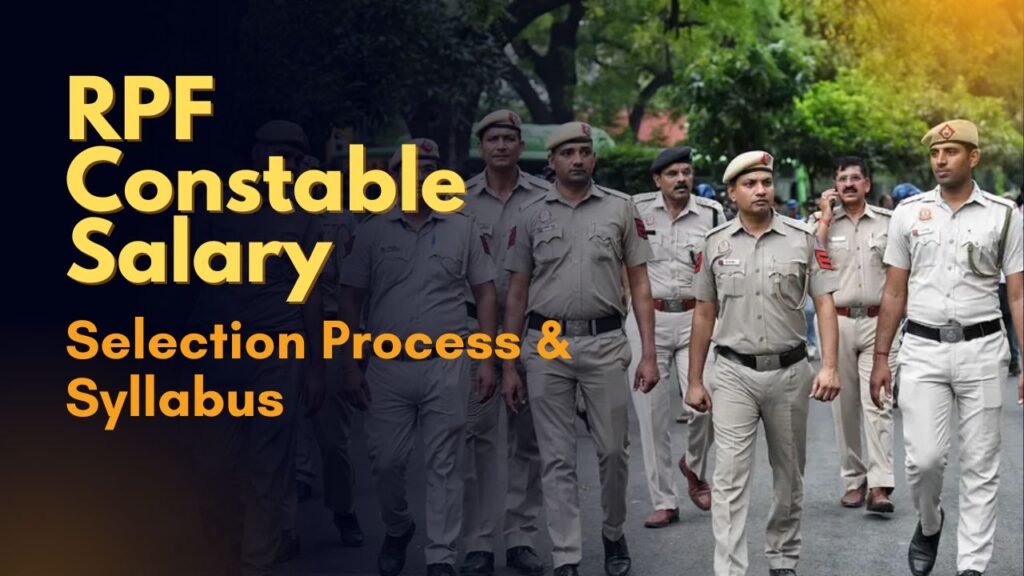
RPF is one of the most popular and important central forces of India, providing a secured career and good remuneration both for male and female aspirants. If you are dreaming of getting a prestigious government job which provides security for your job and financial stability, RPF Constable is your stepping stone for a bright future. So let’s go deep down to the bottom with everything you need to know about this great career.
Understanding RPF Constable Salary
The compensation package is fairly competitive for those who do not have a long track record in government employment. An RPF constable gets a basic pay of Rs. 21,700 per month for an RPF constable which looks low at first, but with various allowances the total amount becomes pretty attractive.
Your salary after allowances addition is usually between Rs.26,000 to Rs.32,000 per month with the variation being based on the city of posting and the type of allowance you are entitled to. The consolidated monthly remuneration (all-inclusive) is between Rs. 37,420 and Rs. 44,460 which is equal to Rs. 3.12 lakhs to Rs. 3.84 lakhs annually.
There are different components of salary in the salary structure that makes your take-home pay higher. You get a Dearness Allowance (DA) of Rs 10,850 which is 50 per cent of your basic pay as a you help me keep pace with inflation. The HRA depends upon your place of posting and it lies between 8 – 30 percent of your basic salary. Transport Allowance and City-wise Others benefits add further to your income.
The RPF salary becomes more alluring because of the regular increments, which are granted at the end of every year of the service. Moreover, you also avail medical facilities, pension schemes as per 7th Pay Commission recommendations and many more benefits which ensure financial stability for life.
The process to become an RPF Constable from a wannabe has a selection process that is fairly straightforward and designed to winnow out the best and fittest. Knowing the steps will give you a strategic edge in your preparation and you can rest assured when you go through the recruitment.
Stage 1: Computer-Based Test (CBT)
The first barrier is the Computer-Based Test, which is the entirety of the selection process. The CBT comprises a 120 marks, 120 multiple-choice questions exam, and you are given 90 minutes to take it. You get one mark for each right answer, but here is the catch: you get one-third of a mark deducted for every wrong one, so choose wisely.
The exam is held in Hindi, English, and in some regional languages so that aspirants from all backgrounds can take it without any difficulty. The level is of 10th standard but don’t take it lightly as questions asked would be based on your overall learning not only from memorizing.
Stage 2: Mandatory Physical Efficiency Test and Physical Measurement Test (PET & PMT) For Candidates
Only the candidates, who qualify the CBT, are called for the Physical Test, This phase has two parts, which are both important in your selection.
The Strength, Endurance and Fitness test tries out your strength, stamina and fitness through real activities. Male candidates are required to run 1600 meters in 5 minutes 45 seconds while female candidates are required to run 800 meters in 3 minutes 40 seconds. You only get one try for the running event—no second chances here, so train hard. And you also have the long jump and high jump tests where you’re given two tries.
Leaping 14 feet in the long jump and 4 feet in the high jump is a requisite for male candidates. Female aspirants have much relaxed parameters: 9 feet for long jump and 3 feet for high jump. Note: ex-servicemen are not required to take the PET but they do have to clear the PMT.
The Physical Measurement Test (PMT) measures your height and chest measurements against certain standards. The male applicants must hold a minimum height of 165 cm (160 cm for SC/ST categories), with an unexpanded chest measurement of 80 cm and an expanded chest measurement of 85 cm. Height requirements for Female Candidates is 157 cm (152 cm for SC/ST Categories). These measurements are to make sure you comply with the physical standards exigent of this job.
Stage 3: Document Verification (DV)
Those who qualify in the PET and PMT are called for document verification, where your eligibility stands verified. You need to submit the originals for age proof, educational qualification, caste certificate (if any) and identity proof.
Stage 4: Medical Examination
The end stage in selection is a medical examination in) depth by RPF medical officers. You should be fit according to medical category ‘B-1’ as per Indian Railway medical manual in order to consider for the post.
RPF Constable Syllabus
First analyze the syllabus then start your preparations accordingly. The RPF Constable CBT syllabus consists of three crucial components considered equal in weightage covering other aspects of your aptitude.
General Awareness (50 questions)
Here, you will be examined on the things happening now, history of India, geography, polity, Indian economy and general science. Topics such as Indian Constitution, fundamental rights and duties, directive principles, economic theories, environment, sports, art and culture and major breakthroughs in science are part of the Topics. So keep yourself updated with the current affair and a little bit knowledge of Indian history, geography and general knowledge for this section.
Arithmetic (35 questions)
Mathematics is not only an instrument of calculation here, nevertheless it is also a matter of thinking and reasoning. The maths section covers number system, percentage, ratio and proportion, simple and compound interest, profit and loss, mensuration, time and work, speed and distance along with elementary algebra. Most of the questions focus on testing your conceptual understanding of math that you can relate to real-life, so it’s always better to have an idea on concepts than mug up formulas.
General Intelligence & Reasoning (35 questions)
Your Mind & Reasoning ability are tested on topics like Analogies, Coding-Decoding, Number Series, Syllogism, Blood Relations, Seating Arrangement, and Non-Verbal Reasoning. Your performance in this region will get a healthy boost from developing logical thinking and practicing pattern recognition.
Preparing Strategically for Success
To crack RPF Constable Exam, do preparation in a systematic way. Firstly, comprehend the syllabus in depth, then solve previous year papers on a large scale. Divide your time according to the level of each question in study time since each topic has equal weight. Information is updated frequently at the official RPF website (rpf.indianrailways.gov.in/RPF), so keep visiting for more notifications.
Don’t wait until the date of the PET slowly approaching for physical preparation. Start your workout regimen now—running, jumping and strength training should be daily activities. Academics are important, but so is physical fitness in this selection.
Your RPF Constable career is tough but highly satisfying. After all, a little planning, hard work and a bit of luck is all you need to make your way through this process and reach a coveted post that will provide you not only with financial security and job stability, but respect in society, as well. Begin preparing now and earn your living in the Railway Protection Force.
Conclusion
Being an RPF Constable is not only a government job but a career to serve in among the most disciplined and respected central forces of India. The financial outlook is good and long-term because you get a good starting salary with allowances, plus regular increments, medical benefits and pension security.
The selection procedure, although tough, transparent is doable with the right mix of brains and brawn. Having a knowledge of syllabus, daily practice for CBT and starting physical training for PET/PMT at an early stage will help you a lot in achieving success.
If you have the right attitude, are disciplined, and able to concentrate hard, then the RPF Constable post can provide you with the pride and social standing besides financial independence and job security. Begin your preparation today, be consistent, and march confidently towards a bright future with RPF.
The link is active now for RRB ALP Admit Card 2026 for the candidates who prepare for CBT–1 exam. They can download the RRB ALP Admit Card 2026 from 9th February 2026, and Hall tickets can be now downloaded from the official websites of the RRBs. Exam candidates for February 13, 16, 17, 18 can now download admit cards. Get yours before the test dates!
RRB ALP Admit Card 2026 Release Dates
The release of the RRB ALP Admit Card 2026 is after the notification on exam dates, which stated that candidates have enough time to prepare.
Exam Date
Admit Card Release Date
13th February 2026
9th February 2026 (Released)
16th February 2026
12th February 2026 (Released)
17th February 2026
13th February 2026 (Released)
18th February 2026
14th February 2026
Age Limit
Applicants must fall within the age limit of 18-30 years as on 1st July, 2025. There are age relaxations – such candidates from certain categories can apply under relaxed age limits:
Age relaxation of 5 years is applicable for the SC/ST candidates.
3 years age relaxation for OBC candidates only.
Required Qualifications
The eligibility criteria is that he should be passed in matriculation(10th) from a recognized board and he should be either ITI pass in the respective trade or diploma in engineering from any recognized institute.
It is necessary for the candidates to check their qualifications and their technical skills because it is most required for the post of Assistant Loco Pilot.
Fitness Requirement
The candidates should fulfill the prescribed medical and physical standards of RRB to be considered fit for the work.
How to Access The Admit Card For ALP Exam
To download the admit card, candidates are required to visit the official website of RRB.
Find and click on the RRB ALP Admit Card 2026 section, candidates have to login using their registration details to get the download link of the document.
Candidates should hold the hard copy of the admit card on the day of the exam as the admit card is mandatory for the entry to the exam center.
Admit Card contains examination center name, city, date of exam, subject name, candidate’s name and roll number.
Salary
The RRB ALP salary 2026 is structured to offer competitive pay. The starting salary of the candidates selected for the post of Assistant Loco Pilots are entitled to Rs 19,900 to Rs 35,000 per month as per the 7th Pay Commission salary.
The salary is made up of the basic pay and several allowances. These allowances include the following – Dearness Allowance, Night Duty Allowance, Special Allowance.
The total salary is likely to further increase with the course of time as there are promotions. When the aspirants grow in their careers, then also increments come, taking their earnings to some more sums.
Selection Process
The selection for RRB ALP 2026 consists of multiple stages intended to test the ability of the candidates. The process normally consists of:
Computer Based Test (CBT) Stage I: This first qualifying examination is of 75 marks and covers various subjects.
Computer-Based Test (CBT) Stage II: Those who qualify in the first stage will go to the second stage, which is even more detailed.
Computer Based Aptitude Test (CBAT): Candidates also are required to appear for the CBAT on their application for certain positions within the Loco Pilot organization to measure their suitability for the job.
Document Verification: The successful candidates will be subjected to verification of their qualifications and credentials after the assessment tests.
Training: who cleared all the above stages can now get trained and start their job.
The procedure is separated into several parts, focusing primarily around a Computer-Based Test (CBT).
Exam Pattern
CBT—Stage 1
Parameter
Details
Test Stage
Computer-Based Test—Stage 1 (CBT-1)
Duration
60 minutes
Total Questions
75
Maximum Marks
75
Purpose
Screening test to assess candidates’ preliminary knowledge in various subjects
CBT—Stage 2
Parameter
Details
Test Stage
Computer-Based Test —Stage 2 (CBT-2)
Structure
Two parts: Part A and Part B
Part A Subjects
Mathematics, General Intelligence & Reasoning, Basic Science
Part B Subjects
Technical Ability
Computer-Based Test for Aptitude and Trade (CBAT)
The test has been made mandatory for the eligible candidates for some Loco Pilot posts and it checks their suitability for the work.
Verification of Documents
To establish the eligibility and credentials of the candidates. Candidates must provide valid documents of the information they claim to have.
Medical Examination
The final selection will include a medical examination for candidates who qualify the document verification. It is mandatory to check any disease, or health issue in the candidates that makes the post inconvenient.
Syllabus for RRB ALP 2026
The syllabus for RRB ALP 2026 primarily encompasses on Number system, decimal, fraction ratio and more from mathematics, logic and reasoning for increase critical thinking using analogies, series, sequence, syllogism, General science focus on basic bio, chemistry, and physics that helps in understanding simple phenomena. General Knowledge from history, events, and current affairs are important then technical abilities will give you clear engineering and technology questions from the ALP exams.
Getting a government job in Uttar Pradesh is every youth’s dream. In 2025, the UP government has brought many amazing job opportunities – in many fields like police, teacher, engineer, clerk, and health department. In this blog you will find the best government jobs for which you can apply according to your qualification!
If you are an engineer at the crossroads of your career and question if you should jump into the private sector rat race or check out government jobs for jollies, we have some good news for you. The Indian government and its PSUs are going to recruit a massive number of engineers in 2026, and this might be your golden opportunity to get a job with immense stability, good pay and superb benefits. Now, let’s take a look at Best Government Jobs for Engineers in India 2026 that are waiting for you.
Why Government Jobs Matter for Engineers
Here’s the thing about government jobs that many young engineers seem not to realize: government jobs offer something that’s increasingly hard to come by in this volatile economic climate — stability and long-term security, even if it means starting with a lower salary (and slower pace of promotion) than you might get in the private sector. You won’t have to worry about sudden lay-offs when the market takes a dive, and your job security is guaranteed by the power of the whole nation to back you up.
The pay scale in government service has also undergone a sea-change. A recently qualified engineer in a government job is paid somewhere between ₹3,00,000 and ₹4,50,000 per year, with regular, foreseeable increments based on your years of service. Further, government jobs have full medical coverage, housing allowances, pensions schemes, flexible working hours and good leave policies – benefits that are all but vanished in private organisations.
Top Government Job Categories for Engineers in 2026
1. PSU Recruitment Through GATE
PSUs (Public Sector Undertakings) are the behemoths of India’s industrial sector, and they are hiring in a big way in 2026. Over 50 major PSUs such as IOCL, ONGC, NTPC, BHEL, Power Grid, GAIL are on recruiting mode for engineering graduates. These organizations pay a competitive salary of ₹40,000 to ₹80,000 per month for entry level jobs with quick career advancement.
If you have done well in your B.Tech / B.E., then good GATE (Graduate Aptitude Test in Engineering) score will help you in getting through. GATE scores are valid for 3 years, so you can still be content even if you haven’t appeared for it yet, so start booking your seats on these high profile jobs.
Major PSUs to recruit in 2026 are Power Grid Corporation (for electrical engineers), IOCL (for mechanical, electrical and computer science engineers), ONGC (for offshore and onshore engineering posts), NTPC (for thermal, hydro power projects) and GAIL (for pipeline and energy management posts).
2. UPSC Engineering Services Examination (ESE)
This is the highest and most difficult scale of government engineering jobs. The UPSC Engineering Services Exam is the door to Grade A and Group B posts in services like the Indian Engineering Service, Indian Telecommunication Service and Indian Engineering Service, Central Water Engineering Service, Border Roads Engineering Service etc.
The Date for the ESE 2026 (prelims) is 8th February 2026 and for mains is 21st June 2026. The competition is fierce, but so are the prizes. Selected candidates are placed at pay level 10 of 7th Pay Commission matrix, which implies good salary growth along with prestige. The job involves huge responsibilities and the opportunity to make a real impact in driving the infrastructure and development projects in India.
Selection procedure is a 3-step process: preliminary exam (500 marks), the mains exam (600 marks), and personality test (200 marks).
3. SSC Junior Engineers and Assistant Engineers
The SSC JE recruitment is conducted for multiple Ministerial and Departmental posts under group “B” between its two divisions Central Public Work Department and Survey of India and other such Departments of the Government of India. These jobs are Group B (non-gazetted) positions at Level 6 and the pay-scale is Rs 55,000 to Rs 65,000 per month after the take home is calculated in allowance.
What makes SSC JE positions so desirable, is that old people can sit for the exam. It’s a pretty simple format for an exam all about engineering basics and common sense/general knowledge. The promotion prospect is fixed and you can get promoted to Assistant Executive Engineer (AEE) after getting experience which in turn you can get promoted to Executive Engineer , salary wise you can earn up to 1,80,000 p.m. as an Executive Engineer.
4. Indian Railways and Infrastructure Projects
Indian Railways, having a large rail network in the world, is constantly recruiting engineers in track maintenance, signal systems and infrastructure development. These posts also carry special allowances for field posting and provision of accommodation in various parts of India.
On the same lines, NHAI, CPWD, state public works departments also recruit civil engineers from time to time. If you like the idea of watching your work become real highways, bridges, and other public works, these agencies provide tremendously fulfilling careers.
5. Defense and Space Research Organizations
For engineers with an interest in high-tech and national security, ISRO (Indian Space Research Organisation), DRDO (Defense Research and Development Organisation) and BEL (Bharat Electronics Limited) are dream organisations. ISRO also hires in large numbers for satellite programmes, launch vehicles and space applications. DRDO is related to defense technology development.
These jobs are mentally stimulating, have cutting-edge equipment, and give you a deep feeling of having played a part in your country’s technological progress. The pay is competitive, though often little lower than the best PSUs, but the feeling of a fulfilling career and the scope for innovation are unmatched.
Engineering Branches with Maximum Government Job Opportunities
If you are still studying in college or if you are planning to choose a specialization, then these are the engineering branches which will have maximum demand for government jobs in 2026:
Civil Engineering roles are plenty in Infrastructure development, Railways, and Water resources projects. Mechanical Engineering finds good demand with manufacturing PSUs and thermal power stations. Electrical Engineering is always sought after in power generation, transmission and distribution. CSE & ECE has been the most sought after branch with the arrival of the digital age, leading to many opportunities in telecommunications, space programmes and defence research.
The path is well-defined: Your academic performance should be of high standard – most government bodies ask for a minimum of 60-65% in your engineering stream. Second, for those going for PSU jobs, crack GATE exam in 4-6 months of focused-study. Third, for the coveted ESE examination, if you can bear to start early, score high, because competition is tough but rewards are great.
Start with official website of recruiting bodies such as UPSC, SSC, GATE and individual PSU websites. Create job alerts on government job websites, subscribe to official notifications on Facebook and Twitter, and do not forget to apply for the jobs. Many positions close within days of notification.
Is a Government Job Right for You?
Government work is for you, if you care more for stability than getting rich quickly, like the predictability of your daily schedule, and want to do something useful for the country. The salary increment may look like a slow pace compared to the private sector counterparts at the start, but you can enjoy better lifetime earning and security through pension schemes and long term benefits.
There are more openings than ever before across government agencies for the year 2026. If you are a fresh graduate or an individual with experience looking for a career change, your time is now. With focus, the right approach, and a bit of luck, securing a top government engineering position in 2026 can be less of a pipe dream and more of an attainable objective.
So start preparing today and you may be launching a multidimensional government career offering security, advancement and the satisfaction of playing a part in India’s development story by the turn of the year.
Conclusion
Best Government Jobs for Engineers in India 2026 aren’t just about steady pay—they are about establishing a stable, respected, and mission-driven career. There is massive hiring across PSUs, UPSC Engineering Services, Railways, infrastructure bodies and premier organisations like ISRO, DRDO where engineers have more national development converging with professional growth opportunities than ever before.
The private sector might offer faster rewards, yet government jobs have security for life, predictable growth and benefits which really stand the test of time. If you want to prepare smartly and stay focused, then 2026 could be the year that you transition from being lost in the career wilderness to a future defined by stability, impact, and pride for having served the nation.
Madras University has officially posted the results on their official website, Students who have given the examination of the V and VI semesters can check their results now. You can also check the result by following the direct link in this article. Those who are unsatisfied with the scores get an advantage to revaluation as per the university’s rules.
Students can get their results with details such as name, registration number, year, subject-wise marks, obtained and total marks, and result status.