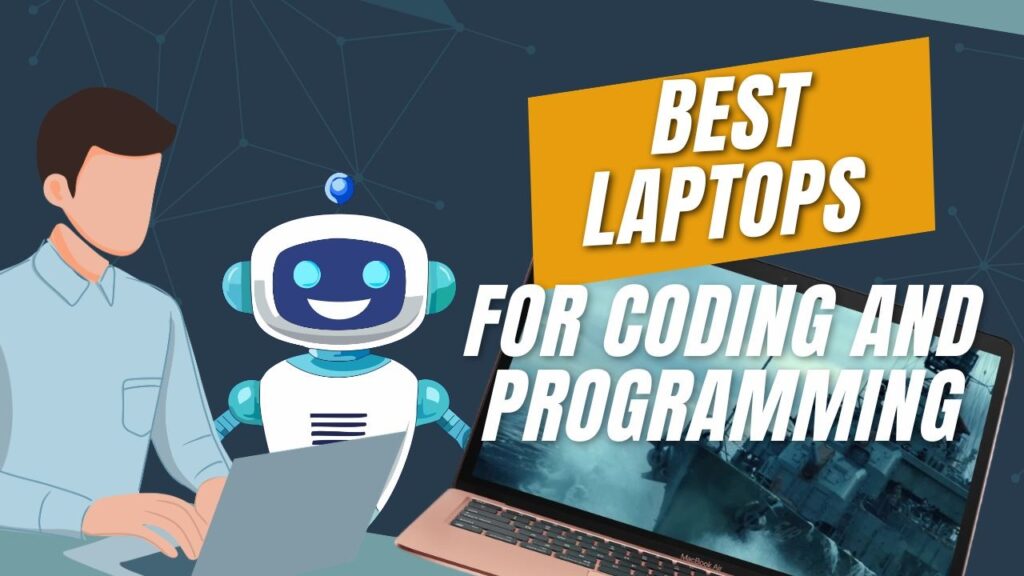
Best Laptops for Coding and Programming: Top Picks for Every Budget

Best Laptops for Coding and Programming

If you are in the last semester of B.Tech or you got the first internship, and it requires VS Code, three Docker containers, Android Studio’s emulator, and eighteen Chrome tabs open at once on a laptop your parents bought you in 2021 with 4GB of RAM. That’s the moment most Indian coders realise their machine is the bottleneck, not their skills. And they started looking for the Best Laptops for Coding and Programming.

A gaming laptop’s RTX 4070 is dead weight if you’re building REST APIs all day, and a fanless ultrabook will choke the moment you spin up a local Postgres instance alongside two VMs. What actually matters for most development work — web, app, backend, data — is RAM headroom, a fast NVMe SSD, sustained CPU performance, and a keyboard you can survive eight hours on. A dedicated GPU only earns its price tag if you’re doing CUDA-based ML work, training models locally, or running the Android Studio emulator constantly.

Make sure that your laptop has 16GB RAM, not 8GB — Chrome alone with dev tools open can eat 4-6GB. Picking 24-32GB when you’re running Docker and VMs together. If there are SDKs, node_modules folders, and Android SDK files that take up to 50 GB itself then pick 512GB NVMe SSD. The best CPUs of current-gen are Intel Core Ultra 5, AMD Ryzen 5/7, or Apple M-series and these are the best options for IDEs and compilers. Coders don’t need a higher-end chip unless they’re compiling large codebases consistently. 

You must understand that laptop prices in India move fast, sometimes 8-10% within a few weeks around sale events. Every price below is what these models were listed at in the first half of August 2026 on Flipkart, Amazon, or the brand’s own India store — treat them as a strong reference point, not gospel, and check the live price before you check out.

Common Mistakes Indian Buyers Make When Choosing a Coding Laptop

The “i5 always beats i3” assumption costs people money every single sale season. Code compilation goes smoother in a 13th Gen Core i3 with 16GB RAM laptop than 11th Gen i5 with 8GB, because for coding, RAM headroom and SSD speed is more important than processor tag on it. Check the generation and RAM on it. 

The second mistake is buying a gaming laptop “just in case” you need the GPU later. Unless you already know you’re headed into machine learning, computer vision, or heavy Android emulator work, that RTX card is dead weight adding to the price, the heat, and the battery drain — money better spent on RAM or storage.

The third mistake which most ‘students and I’ made was to pick a laptop with a good processor and ignore the screen size and keyboard which is necessary for coding. They bothered a lot when you sit for 8 hours with it and fix errors. If you are shopping online then check practical reviews or sit with it on a story.

Read More 👉 Top Lightweight Student Laptops to Buy in 2026

The 11 Best Laptops for Coding in India 

1. Apple MacBook Air 13 (M4, 16GB/256GB)

This is the finest and most expensive laptop but offers excellent performance with Apple M4 chip, 16GB unified memory, 256GB SSD, that help running programs smoothly. It doesn’t get shut down when you are working in a campus because 18 hours of battery life makes it possible with no fan noise.

With price around ₹89,990-97,900, macOS delivers a Unix-based environment — a native terminal, Homebrew, and zero WSL workarounds. So there is no need for WSL during your production, you can just focus on your development tools. However, if you are installing Xcode, Docker Desktop, and multiple projects then a 256GB SSD is less than you need for your project. The files are big and you need more space so pick 512GB version if your budget allows.

Students enrolled in a Full-stack and iOS development programs that require macOS and not Windows can select this laptop for their best use.

2. ASUS Vivobook S16 OLED (Core Ultra 5 225H, 16GB/512GB) 

ASUS offers not just a laptop but a digital book with 16-inch OLED display for ₹85,990. With Intel Core Ultra 5 225H processor, 16GB LPDDR5X, 512GB SSD, of space it runs every software and program very smoothly. You can use this machine for multi-tasking and production on a genuinely large, colour-accurate screen that helps in working in a single laptop with split-pane coding without an extra monitor on one side. 

You must be aware that OLED panels are more prone to burn-in with static IDE toolbars left on screen for hours so be careful with that. Most people recommend to dim the brightness or use auto-hide dock settings. Otherwise it’s the best machine for developers who want big screens on work or on campus without lugging a 17-inch brick.

3. ASUS Zenbook 14 OLED (Core Ultra 7 255H, 32GB/1TB) 

Raise the budget and buy ASUS Zenbook 14 OLED at ₹1,31,990. If you need to run large codebases and softwares like Docker, two VMs, and a browser with 20 tabs simultaneously then you need a system that is built on Intel Core Ultra 7 255H, 32GB LPDDR5X, 1TB SSD. Not any other laptop is worth at this price point than ASUS with 14-inch 3K OLED, Thunderbolt 4

There is no drawback than its premium price for a 14-inch laptop. But this is the best piece for Data Scientists and Backend Engineers doing heavy multitasking who are not planning to buy another laptop for the next four years.

4. Lenovo IdeaPad Slim 5 (Ryzen AI 5 330, 16GB/512GB)

If your budget allows, you can check out the Lenovo IdeaPad Slim 5 laptop specs. An AMD Ryzen AI 5 330 processor which gives excellent performance, 16GB RAM, 512GB SSD in  ₹97,890. Best for coders with 14-inch display, and an integrated NPU for on-device AI tasks. 

Its value is increasing day-by-day because AMD’s price-to-performance here beats most Intel equivalents at this exact price point. But the issue is RAM is soldered on some variants so carefully check the exact model and the upgradation system before you buy it. Either way this is the best laptop for developers who want better performance.

5. Lenovo ThinkPad E14 Gen 5 (13th Gen Core i5-1335U, 16GB/512GB) 

If your budget is low and you want a laptop on which you can easily run large codebases then this ₹74,990 Lenovo ThinkPad E14 Gen 5 is best for you. It built on Intel Core i5-1335U and offering space of 16GB RAM, 512GB SSD which makes it perfect for backend and enterprise developers. 

When you sit for hours on coding and typing then you realize ThinkPad keyboards with spill-resistant are amazing and 14-inch WUXGA IPS display for working on multiple softwares. But it won’t be good in integrated graphics and also plain IPS panels feel dated next to the OLED competition at this price.

6. HP OmniBook 3 (AMD Ryzen AI 300 series) 

HP OmniBook 3 is available at just ₹69,999 with features that any coder needs for their production. AMD Ryzen AI 300 processor with a 50 TOPS NPU which remarkably out-performs every task and other laptop at this price point. The big display of 14-inch and 15.6-inch, both are available with FHD display, HP True Vision camera. 

But the power that the display consumes is high, it tops out at 250 nits so this is not good for working outdoors where you can’t get a power source. Overall laptop performance is good enough for students and early-career developers who have less budget.

7. Dell Inspiron 15 3520 (12th Gen Core i5-1235U, 16GB/512GB) 

Intel Core i5-1235U (12th Gen) laptop is fantastic for web developers or early backend developers who want the nearest service center and have less budget. It comes with 16GB DDR4, 512GB SSD which is good for handling compilation with a big screen of 15.6-inch but 120Hz brightness of display is not good enough to see for 8 hours or outside. That doesn’t matter for coders because they mostly do coding inside and in-office so modern AI-focused processor at this competitive price is a good choice.

8. Acer Aspire Lite AL15-41 (Ryzen 5 5625U, 16GB/512GB) 

AMD Ryzen 5 5625U is good but the U series might get stuck during multi-tasking so it is good only for college students who started learning coding. Space is given for running IDE smoothly and compilation with 16GB DDR4, 512GB SSD but do not run any task simultaneously. The 15.6-inch FHD display and metal body is convenient for students to carry it for college.

One thing about the Acer Aspire Lite is good that they give a proper 16GB configuration, not 8GB at just ₹56,990. It is rare to find this kind of laptop which supports Docker and multiple IDE instances open without raising any issue.

9. Acer Aspire 3 A324-53 (13th Gen Core i3, 16GB/512GB) 

Acer Aspire 3 offers 13th Gen i3 with 16GB RAM, provides sufficient performance for coding and beats older i5 laptops in day-to-day development work. The newer processor matters more than the i5 badge because coding needs a system who handles new libraries and data. The tech evolves every year that’s why upgrades or new versions support more tasks and software easily than older models.

Specifications are Intel Core i3 13th Gen, 16GB RAM, 512GB SSD are given at ₹46,900 which is affordable for most of the students and new developers who need VS Code, Python, and Java to run smoothly. 15.6-inch FHD IPS is good for coding so it won’t affect on eyes but there is no discrete graphics and a plain plastic chassis, it’s designed for work rather than premium looks. 

10. Lenovo LOQ 15ARP9 (Ryzen 7 7435H, 24GB RAM, RTX 4060 8GB)

The RTX 4060 is a great pick for developers who are working for CUDA-based machine learning, local AI models, andAndroid Studio emulator running full-speed with hardware acceleration. As ML engineers, Android developers who lean on the emulator daily need AMD Ryzen 7 7435H, 24GB RAM, 512GB SSD, NVIDIA RTX 4060 8GB, all of it.

Anyone doing local AI/GPU work can afford it in ₹1,03,290. But it’s actually built for gaming purposes and battery life is shorter so it is difficult to work without sitting near a power source. 

11. HP OmniBook 5 (Snapdragon X Elite, 16GB/1TB) 

You can get a Qualcomm Snapdragon X Elite X1-26-100 processor, 16GB RAM, 1TB SSD for ₹87,990 from HP. don;t get confused because it uses an ARM-based processor so you can expect issues of compatibility while running some development tools. Its always-on connectivity, and Copilot+ PC support is amazing with excellent battery life that can easily last through a full workday. You can buy it if you work mostly in browser-based IDEs, lightweight scripting, or cloud-hosted dev environments but check your specific toolchain before buying.

MacBook Air M4 vs ASUS Vivobook S16 OLED: The Real Choice Most Buyers Face

Most people narrow this list down to “Mac or Windows,” so here’s the direct comparison:

MacBook Air M4 (16GB/256GB)ASUS Vivobook S16 OLED (16GB/512GB)
Price₹89,990-97,900₹85,990
Storage256GB (upgrade recommended)512GB
Battery lifeUp to 18 hoursRoughly 8-10 hours real-world
OS/toolingmacOS, native Unix terminalWindows 11, WSL2 for Linux tooling
Best trade-offBattery and build quality, less storageMore storage and screen real estate, shorter battery

And if your stack includes iOS, native Unix tools, or you’re often travelling without a charger, the MacBook Air wins. If you’re on Windows-only enterprise tools, need the extra storage right away, or want a larger screen for the same price, the Vivobook S16 is the superior purchase. 

Which One Should You Actually Buy?

If you are a first year budget student then Acer Aspire 3 A324-53 is the decent option. Its 16GB RAM and price under ₹47,000 make it more appropriate for coding than a costlier i5 laptop with just 8GB RAM. If you want better all-round performance and more potential to grow, the Acer Aspire Lite AL15-41 or Lenovo IdeaPad Slim 5 are decent choices for Docker and running multiple IDEs without breaking the bank at under ₹80,000. 

If you’re doing CUDA, local ML training, or heavy Android emulator work, skip everything else and get the Lenovo LOQ with the RTX 4060 — no other laptop here will keep up. And if you want a machine that will still feel fast in three years and don’t mind paying for it, it comes down to the MacBook Air M4 for Unix-native workflows or the ASUS Zenbook 14 OLED if you’re staying on Windows and want 32GB as standard.

A quick note on operating system, since it comes up in every comments section: Linux dual-boot is still viable on nearly every Windows laptop on this list if you’d rather skip WSL2 entirely, though ThinkPads and the Acer/Dell budget picks tend to have the smoothest driver support for that route. 

macOS gives you native Unix without the dual-boot hassle, but locks you out of any Windows-only enterprise software your future employer might require — worth checking if you’re already targeting a specific industry like banking or government-adjacent IT, where Windows is still often mandated.

Check current pricing on Flipkart, Amazon.in, Croma, or the brand’s official India store before buying — several of these models moved 8% or more in the past month alone, in both directions. And if a listing shows a price noticeably below everything here, treat it as a flag to double-check the seller and warranty terms rather than an automatic win.

Read More 👉 Best Student Laptops for School and University in 2026

Conclusion 

When you are searching for the Best Laptops for Coding and Programming, you are expecting one simple answer but it isn’t. The best one is the one which fits in your budget, works efficiently, and is durable to handle all your workload. So make a list of 2-3 laptops which come into your budget and work needs then compare their pricing and look for a special discount offer before buying it.

If you are buying online then check practical reviews and videos from people who have actually used it before and work on it so you can get an idea whether it is good for you or not.
Leave a Comment

Your email address will not be published. Required fields are marked *

UPSC Principal and Vice-Principal Recruitment 2026: Must Check Complete Details

UPSC Principal and Vice-Principal Recruitment 2026

UPSC Principal and Vice-Principal Recruitment 2026 has started and now is the time to grab the chance if you want to become a government school head. UPSC has only put out a short notice so far. The detailed advertisement including the one with the actual syllabus, exam pattern, and category-wise vacancy split hasn’t dropped yet. So here’s a full breakdown of the recruitment drive.

If you’re an educator eyeing a senior administrative role in the government school system, this is  the largest hiring drive right now.

Overview of UPSC Principal and Vice-Principal Recruitment 2026

UPSC released the short notice for UPSC Principal and Vice-Principal Recruitment 2026 on 21 July 2026, for hiring multiple candidates for this position. This is a huge chance for educators in India, if you are one of them and want to apply then hurry. The online application form will be accepted from 25 July 2026 to 14 August 2026.

Here’s the vacancy split:

  • Principal: 124 posts (Pay Level-12), including 7 reserved for Persons with Benchmark Disability (PwBD)
  • Vice-Principal: 704 posts (Pay Level-10)
  • Total: 828 posts

That’s a heavily Vice-Principal-weighted drive — for every Principal vacancy, there are roughly five to six Vice-Principal openings. If you’re an aspirant with fewer years of leadership experience, the odds naturally favor the Vice-Principal track.

Important Dates for UPSC Principal and Vice-Principal Recruitment 2026 

You should start preparing for collecting the documents and be ready to apply on 25/July/2026.

EventDate
Notification released21 July 2026
Online application start25 July 2026
Last date to apply (online)14 August 2026 (till 11:59 PM)
Last date for fee payment14 August 2026
Exam / selection dateTo be notified later

Eligibility Needed for this Recruitment

Education Requirement: The short notice indicates that candidates need a Master’s degree from a recognized university and a Bachelor of Education (B.Ed) or equivalent qualification, along with relevant teaching and administrative experience. 

Experience: Exact experience requirements (how many years and in what role you have worked before) has not been confirmed yet – that kind of detail is usually in the full notification. But still min 10 years as PGT/TGT in recognised schools for principal post is needed and min 2 years as PGT or 3 years as TGT in recognised schools for Vice‑Principal.

Age Limit: The maximum age is placed between 35 and 50 years depending on the post, and is reckoned as on 14 August 2026 (the last date of application). The relaxation in age will be applicable as per the standard rules of Govt. of India for reserved category. If you’re close to a cutoff, don’t eyeball it — run your date of birth through an age calculator against 14 August 2026 before you assume you’re eligible.

Application Fee

Reported fee for General/OBC/EWS male candidates is Rs. 25, payable online via net banking, debit/credit card, or UPI. As always with UPSC, women candidates and SC/ST/PwBD candidates typically get fee exemptions — but confirm this against the official notification rather than a secondary source once it’s out.

Scope in UPSC Principal and Vice-Principal Recruitment 2026 

A few things make this recruitment worth paying attention to beyond the headline vacancy count:

It’s Group-A territory. Selected Principals will function as Group-A gazetted officers, which puts this squarely in the same administrative tier as many other UPSC-recruited posts — not just a teaching promotion, but a genuine entry into government administrative service.

Pay Level-12 for Principal is a serious jump. For anyone currently at a lower pay level in the school, this is a meaningful step up the ladder, not a lateral move.

828 posts in one go is unusually large. Government recruitment drives of this size don’t come around often, which also means competition will likely be intense, especially for the 124 Principal seats.

Read More 👉 NICL Assistant Online Form 2026: Apply Online & Eligibility

What to Do Right Now

  1. Don’t wait for the detailed notification to start preparing your documents. Educational certificates, experience certificates, and category certificates take time to compile — start pulling these together now.
  2. Double-check your age eligibility against 14 August 2026 using the post-wise limits once confirmed.
  3. Register or update your One-Time Registration (OTR) on the UPSC ORA portal if you haven’t already — this step trips up more candidates at the last minute than almost anything else.
  4. Keep checking upsc.gov.in directly, not just other sites, but check the official website and notification for every update on this recruitment. 

How to Fill Application Form for UPSC Principal And Vice-Principal Recruitment 2026 

Click on https://upsconline.nic.in/ora to redirect on the official website.

  1. If you are new then do One‑Time Registration with a valid Mobile number and email ID.
  2. Login to apply for Principal and Vice‑Principal recruitment 2026 or go to the recruitment section.
  3. Fill the application form with your correct information like Personal Details, education, teaching experience, Reservation Details, Posting Preference etc.
  4. Once you fill it now upload the documents of the same detail as you mentioned in the application form.
  5. Preview & Verify then submit Application Fee if you don’t belong to the reserved category.
  6. Submit and save the form for your records.

Conclusion 

This is a genuine opportunity for experienced educators to move into senior administrative roles within Delhi’s government school system, with a clear pay grade jump and Group-A status attached. But the sensible move right now is preparation, not panic — get your documents in order, watch the official portal for the detailed notification, and apply well before the 14 August deadline rather than in the final scramble.

Leave a Comment

Your email address will not be published. Required fields are marked *

SSC Job List 2026: Complete Guide to SSC Posts, Exams and Eligibility

SSC Job List 2026

For decades, a government job has been the most lucrative career option in India. These SSC Job List 2026 will help you to take the right direction of your career. As we head into 2026, the Staff Selection Commission (SSC) still remains the dream gate for lakhs of aspirants to get their foot into stability, respect and serving the nation.

If you are preparing your career roadmap for this year, then getting to know about the huge range of SSC jobs is step one! From the Central Secretariat to paramilitary forces, desk-bound jobs to high-octane field jobs, the SSC 2026 calendar is bulging.

So, here is the detailed information of Your SSC Job List 2026 by Exams and Qualification. 

SSC Combined Graduate Level (CGL) 

The SSC CGL which is popularly known as ‘Mini-IAS’ exam is the most reputed exam for selection to Group B and C posts in various SSC Job List 2026 in ministries and departments. Candidates need to have a Bachelor’s Degree in any stream to be eligible. 

Some of the SSC Job List 2026 under SSC CGL are: 

1. Assistant Section Officers (ASOs) watchful policy realization in the Central Secretariat Service (CSS) in the Ministry of External Affairs (MEA), or Intelligence Bureau (IB) or the ASOs business is largely on one’s table at any rate!Desk based post of execution policy.

2. Roles in the Ministry of Finance related to taxation that are high-paying and profitable are Income Tax Inspector and GST Inspector.

3. AAO or Assistant Audit Officer – Indian CAG This is the Gazetted post In SSC CGL under the Indian Comptroller and Auditor General (CAG) and working with the Indian Comptroller & Auditor General this post is unique.

4. Sub-Inspector in CBI: This post is for those who are willing to serve in the National Investigative Agency. 

SSC Combined Higher Secondary Level

SSC CHSL is a great opportunity for 12th pass candidates to get an entry level post in the government sector. 

Job Roles:

1. These posts (Junior Secretariat Assistant and Lower Divisional Clerk) are the best paying jobs at entry level which are the backbone of office administration and are indispensable to the smooth working of the office.

2. Data Entry Operator (DEO): Hold the responsibility for maintenance of essential Government files, up-to-date and complete, with accuracy. 

This examination leads to secure and respectable employment within government organizations. 

SSC MTS & Havaldar 

This is an excellent opportunity to enter in the Multi Tasing Staff job role or Havaldar, 10th pass candidates can get a central government job/staff.

Job Roles:

MTS (Multi Tasking Staff): It serves as a kind of general office support, some such duties include, running files, pushing files from one desk to another, housekeeping in office space, across various government ministries.

Havaldar: Havaldar post Candidate Should belong to Central Board of Indirect Taxes & Customs (CBIC) and Central Bureau of Narcotics (CBN). The duties of the security personnel are all field-based i.e. they are related to security and watch and ward. 

SSC GD Constable

The SSC GD Constable 2026 Recruitment if you would like to serve in uniform and keep yourself physically fit, then consider it. The exam is held for recruitment to various Paramilitary forces like:

  • BSF —-Border Security Force  
  • CISF —-Central Industrial Security Force  
  • CRPF —-Central Reserve Police Force  
  • ITBP —-Indo-Tibetan Border Police  
  • SSB —-Sashastra Seema Bal  
  • AR —Assam Rifles  

Qualification Criteria: The applicants must have cleared 10th standard with some physical standards in order to be eligible for the recruitment. 

SSC CPO

The SSC CPO exam is a good chance for the ones who want to be a Sub-Inspector (SI). It is a tough but rewarding path to take. Candidates are required to have a graduation degree and Qualify Physical Endurance Test to be eligible. 

Selected candidate have the opportunity to serve in prestigious position like Sub-Inspector in Delhi Police (which is considered one of the most orderly police service) or Sub-Inspector in Central Armed Police Forces (CAPFs) – BSF, CRPF and more. 

SSC Specialized Exams

Stenographer (Grade C & D)

If you are good at shorthand typing and can crack SSC Exam then SSC Stenographer may be a door for you to enter into government jobs. 

Via this exam candidate is selected for the post of Stenographer in various ministries, departments and organizations of Government. 

The core responsibilities of this role involve providing dictation assistance to senior officials, drafting official documents, processing correspondence and carrying out administrative tasks. 

They frequently are called upon to assist higher-ranking officers, making it a key supporting position in the government system. You can get a great pay from this job role as it requires your skills. 

Junior Engineer 

The SSC Junior Engineer exam is disputed for the candidates who have a Diploma/Degree from the recognized board in a relevant field of engineering i.e. Civil, Mechanical, Electrical etc. 

The result of SSC Junior Engineer Exam contains qualified candidates who are selected for appointment in various government departments, organizations such as public works, infrastructure, etc. 

They also oversee such projects as cleaning and maintaining government buildings and roads, write technical reports, and verify that engineering projects conform to safety and quality requirements. 

SSC Selection Posts (Phase XIV):

The Staff Selection Commission Selection Post Exam is a good opportunity to get a government job for the person who has educational qualification of 10th pass 12th pass and Graduates. 

Unlike other SSC exams which appoint the candidates for common posts, this exam appoints candidates for distinct and specialised posts in various central government departments. 

These posts can be for Scientific Assistant or Laboratory Attendant or even Library Clerk, Data Entry Operator or Technical Assistant. Every post has different eligibility criteria and different skills that are needed as per the requirement of department. 

Due to the wide range of posts, the Selection Post examination is an ideal platform for the people who are having professional or vocational qualifications and interested to work in a particular domain in the government sector. 

Read More:- BSc Operation Theatre Technology: Course Guide, Fees, Career & Salary

Why SSC Job List 2026 is Important?

  1. Job Security: Students can rely on their jobs for lifetime as it is not like private jobs undisputed, particularly in times of economic downturn.
  2. Work-Life Balance: There are public holidays and weekends leave can be more relaxful and also on the weekdays you have to work only 9 to 5.
  3. Salary and Perks: The salary is very competitive with the 7th Pay Commission norms. Benefits such as HRA (House Rent Allowance), DA (Dearness Allowance) and medical benefits for family are some of the major highlights.
  4. Social Prestige: It is a centrally administered ministry, so it has a good standing in society to serve in it or the national police force. 

SSC Job List 2026 Exam Timeline

The SSC Job List 2026 exam timeline is given for the students to take an idea to begin their journey, accurate date and time are declared by the official website of SSC. Students who are interested in any of these job posts can check the official notice of the exam on the official website.

Exam Name (2026)Notification Date (Expected)Exam Month
CGL March/2026May—June/2026
CHSL April/2026July—Sept/2026
MTS June/2026Sept—Nov/2026
CPO May/2026Oct–-Nov/2026
GD Sept//2026Jan—March/2027

Conclusion

Whether you are a 10th-pass student or a postgraduate engineer, the SSC Job List 2026 has all the opportunities for you. The only question you must ask yourself is which post defines my personality better? If you love discipline and being outdoors, go for CPO or GD, if you love a quiet office and wielding admin powers, go for CGL. 

Leave a Comment

Your email address will not be published. Required fields are marked *

UPSSSC PET Syllabus 2026 PDF: Subject-wise Topics & Exam Pattern

UPSSSC PET Syllabus

If you are among the lakhs of aspirants who are going to appear in the UPSSSC PET Syllabus 2026 exam, you are already aware of the procedure — this exam is the filter. Clear it and a plethora of Group B and Group C government jobs in Uttar Pradesh awaits you. If you fail to clear it, and none of those Mains exams even become an option. 

This is why having a proper understanding of the syllabus From day one is more important than just diving in and doing some random practice sets. 

So, let’s analyze the UPSSSC PET Syllabus 2026. What is asked in the exam, marks distribution of each section and how you should prepare to crack the exam. 

What Exactly Is UPSSSC PET?

UPSSSC PET refers to the Preliminary Eligibility Test, which is organized by the Uttar Pradesh Subordinate Services Selection Commission. Think of it less as a “final” recruitment test and more as a preliminary screen. 

It’s compulsory — you cannot even fill out the application form without a valid PET scorecard. If you pass the PET test, your score is good for three years, so you can use it to apply for multiple positions during that period without having to retake the test. 

The examination is offline on pen and paper using OMR sheet and it is for basic level aptitude and general awareness and not for anything very technical or domain specific. 

Exam Pattern: The Numbers You Need to Know

Before diving into subjects, it helps to understand the shape of the paper:

FeatureDetails
Total questions100
Total marks100 (1 mark per question)
Duration2 hours
Negative marking0.25 marks deducted for every wrong answer
Question typeObjective, multiple-choice with four options

That quarter of a mark negative marking is worth remembering — guessing blindly can damage your score, so accuracy is as important as speed here. 

Subject-Wise Breakdown

The UPSSSC PET Syllabus is spread across roughly 15 sections, each with a fixed number of questions and marks. Here’s how it typically looks:

Indian History & Indian National Movement (5 questions, 5 marks each — 10 total) This spans a broad history, including the Indus Valley Civilization, Vedic culture, Jainism/ Buddhism, and leaves off at the Maurya, Gupta, Mughal dynasties and the freedom struggle. Questions on the Swadeshi Movement, Civil Disobedience Movement and the rise of revolutionary nationalism, the Quit India Movement, personalities like Netaji Subhash Chandra Bose and the Azad Hind Fauj. 

Geography (5 questions, 5 marks) Topography of India and the world, lakes and rivers and their valleys, underground water, Himalayas, deserts, minerals, political mapping, weather conditions, India Times, and population trends and movements of people. 

Indian Economy (5 questions, 5 marks) This is a narrative of India’s economic path from 1947 to 1991 and thereafter — the Five-Year Plans, the mixed economy model, the green revolution, bank nationalization, the 1991 economic reforms, and more recently GST and post-2014 structural/sector reforms. 

Indian Constitution & Public Administration (5 questions, 5 marks) The Fundamental Rights and Duties, Directive Principles, parliamentary and federal system, relations between the Union and the States, the judiciary, and local government through Panchayati Raj institutions. 

General Science (5 questions, 5 marks) Basic Physics, Chemistry, and Biology — roughly at a Class 12 difficulty level, so nothing too advanced, but you do need conceptual clarity.

Elementary Arithmetic (5 questions, 5 marks) Integers, percentages, basic calculations, square and cube roots, powers, means and such basic and general topics in math. 

General Hindi (5 questions, 5 marks) Grammar-related — synonyms, antonyms, one-word substitutions, gender differentiation, homophones, idioms, and proverbs, frequent mistakes, and quizzes on famous writers and their productions. 

General English (5 questions, 5 marks) Basic grammar rules along with an unseen passage to test comprehension.

Logical Reasoning (5 questions, 5 marks) A fairly mixed bag — blood relations, coding-decoding, number series, syllogisms, venn diagrams, direction sense, puzzles, statement-conclusion questions, and hysteresis. .

Current Affairs (10 questions, 10 marks) World and national events — that’s where being on top of the recent news really serves you well. 

General Awareness (10 questions, 10 marks) A miscellany of neighboring countries, capitals and currencies, Indian states and UTs, national and international day, sports, art and culture, awards, famous books and authors and environment related issues. 

Hindi Unseen Passages (10 questions, 10 marks) Two comprehension passages in Hindi to test reading and interpretation skills.

Graph Interpretation (10 questions, 10 marks) Two graphs, testing your ability to read and analyze data quickly.

Table Interpretation (10 questions, 10 marks) Similar to graph analysis, but with tabular data instead.

The following three sections — passages in Hindi, graphs and tables — carry 30 marks in total. That’s almost a third of your total marks, and it’s often the section that candidates underestimate the most. 

Read More 👉 Best BTech Colleges in Lucknow: Fees, Placements, and Admission Reality for 2026

How to Approach Your Preparation

Considering how dispersed this syllabus is, trying to learn everything at the last minute is just not going to cut it. A better way to think about this is to think of this as a marathon, not a sprint: 

  • Prioritize the data interpretation sections. As graphs, tables and Hindi passages are for 30 marks, regular practice in this section can give you an advantage over other candidates who concentrate only on GK. 
  • Don’t skip static GK for the sake of current affairs. History, geography, economy, and polity constitute 20 marks, and these topics remain static — once you study them thoroughly, they are yours forever. 
  • Revise Hindi grammar rules actively. Many candidates, especially those confident in Hindi, tend to get careless here. Small grammatical nuances trip people up more often than expected.
  • Practice with a timer. Two hours for 100 questions sounds comfortable, but data interpretation and comprehension sections eat up time fast if you’re not used to them.
  • Use previous year papers. They’re one of the best ways to understand the actual difficulty level and question framing, rather than relying purely on assumptions about what “might” come.

Read More 👉 IBPS PO MT XVI Recruitment 2026: What Every Banking Aspirant Needs to Know

Conclusion

The UPSSSC PET Syllabus isn’t designed to be intimidating — it’s designed to test whether you have a well-rounded, functional understanding of general knowledge, basic aptitude, and language skills. The trick isn’t studying harder in isolation; it’s studying smart, giving weight to sections based on their actual mark share, and revising consistently rather than in bursts.

Leave a Comment

Your email address will not be published. Required fields are marked *

Indian Army SSC Technical 68th Men Recruitment: Details for Engineering Graduates

Indian Army SSC Technical 68th Men Recruitment

If you’re an engineering graduate eyeing a career in uniform, the wait is over. Indian Army SSC Technical 68th Men Recruitment is going on. The Indian Army has thrown open applications for the 68th Short Service Commission (Technical) Course, Men, set to commence in April 2027. Alongside it, the 39th SSCW Tech entry has been announced for women candidates. Together, the two intakes will fill 381 vacancies, and this piece breaks down everything a male candidate needs to know before hitting submit.

How Many Seats Are Actually Available

There are overall 381 posts, out of which 350 are for SSC Tech 68th Course for male candidates and 31 posts are for SSCW Tech 39th Course for female candidates. That’s a meaningful jump from recent cycles, where vacancy counts hovered in the double digits, so this is genuinely one of the larger technical intakes the Army has floated in a while.

Important Dates You Cannot Miss

The online application portal for male candidates opens from 9/July/2026 to 7/August/2026. That’s a short window for filling out the application form. 

ItemDetails
Opening date (male)9/July/2026
Closing date (male)7/August/2026
DurationLess than 30 days

Applications are submitted exclusively through the official Join Indian Army website, joinindianarmy.nic.in. No offline forms, no third-party portals — anything else claiming to process your application should be treated as a scam.

Who Can Apply

Eligibility is fairly specific, and getting it wrong is the easiest way to get your application rejected at the shortlisting stage itself.

Age limit: Candidates must be between 20 and 27 years old as reckoned against the course commencement benchmark.

Educational qualification: You need a B.E./B.Tech degree in a relevant engineering discipline from a recognized university. Final-year students aren’t excluded either — they can apply provided they submit proof of having cleared the degree, along with semester-wise mark sheets, by the time the selection process demands it.

Marital status: The entry is open only to unmarried male candidates.

Nationality: Applicants must be Indian citizens, or in specific cases, subjects of Nepal or Bhutan, or persons of Indian origin holding the requisite eligibility certificate.

The Selection Process For Indian Army SSC Technical 68th Men Recruitment

Here’s something that surprises a lot of first-time applicants — there’s no written entrance test for SSC Tech entries. Selection runs entirely on academic merit and a structured evaluation process. Once your application is cleared based on your records which you have provided, you’re called for the Services Selection Board interview.

The SSB interview is conducted over several days that takes assessment step-by-step to check the candidate’s leadership potential and mental resilience. There are group tasks, and personal interview rounds that are structured in a way that test skills of candidates rather than just textbook knowledge. 

Those who clear the SSB are required to appear for medical examination, and the medical board recommends the merit list after taking medical fitness into consideration. 

Where and How Long the Training Runs

Candidates who qualify in the final merit list will be put through the 49 weeks training at Officers Training Academy(OTA), Gaya, Bihar. Should the course commence as planned in April 2027, the training would end in the beginning of 2028 and exact training calendar will be confirmed by the Indian Army closer to the start of the course. 

During training, cadets receive a monthly stipend of ₹56,100, which cushions the transition before commissioning.

Read More 👉 Government Jobs After Graduation in India: Complete Guide for 2026

What You Earn Once Commissioned

On successful completion of the training, candidates are commissioned as Lieutenants in Pay Level 10 having a minimum pay of ₹56,100 which can go up to ₹1,77,500 in Level 10 as per the 7th CPC Pay Matrix. With military allowances and field area pay, and other perks added, a fresh lieutenant’s effective pay package normally works out to about the ₹17-18 lakh per annum figure although that doesn’t include free medical coverage or travel concessions. 

As officers move up the ranks — Captain, Major, and beyond — pay levels rise accordingly, all the way up to the Chief of Army Staff at Level-18.

Conclusion 

If you’re an engineering graduate looking for a career that combines technical work with leadership responsibility and long-term financial security, this is one of the more accessible entry points into the Indian Army officer cadre — no written exam, a straightforward merit-based shortlisting process, and one of the larger vacancy counts seen in recent SSC Tech cycles. The application window is short, though, so candidates planning to apply should start gathering their engineering mark sheets and eligibility documents well before 9 July 2026.

Leave a Comment

Your email address will not be published. Required fields are marked *

IBPS PO MT XVI Recruitment 2026: What Every Banking Aspirant Needs to Know

IBPS PO MT XVI Recruitment

If you began your preparation for the IBPS PO with the mock tests of the last year, then your syllabus is already out of date with yesterday’s blueprint. The IBPS PO MT XVI cycle for 2026 has evolved quite a bit in terms of number of vacancies, in the Mains exam, and even in the rounds after the interview, so aspirants who do not revise their strategy might find themselves sitting in the exam hall solving a paper that is no more. 

Here are the real differences this time around and what that means for how you prepare. 

What Changed in IBPS PO MT XVI 2026

The IBPS PO MT XVI detailed notification was published on 30 June and 01 July 2026 on ibps.in, inviting applications for the posts of Probationary Officer and Management Trainee in 11 participating public sector banks for the recruitment year 2027–28. 

The total number of vacancies mentioned in the first notification was 6,715. That figure has since shifted — as per the 20 July 2026 update from IBPS, the number stands at 7,365, which is approximately 29% more than last year’s intake. 

Two banks, UCO Bank and Union Bank of India, had not yet submitted their vacancy numbers as of this update, so the final count may change once more before the end of the process. Bank of Baroda, Canara Bank, and Bank of Maharashtra currently have the largest number of vacancies. 

The date for application also got extended. It was initially scheduled to end on 21 July 2026 but IBPS extended the last date to 26 July 2026. This year also brings something new with effect: a two-day correction window post registration closure, so candidates who find an error in their form after submission are not doomed by it. 

Important Dates for IBPS PO MT XVI Recruitment 2026

MilestoneDate
Detailed notification released30 June – 1 July 2026
Online application window1 – 26 July 2026 (extended from 21 July)
Preliminary exam22 & 23 August 2026
Main exam4 October 2026
Personality Test / InterviewTo be announced

Treat the interview and personality test dates as provisional until IBPS confirms them closer to the Mains result — that stage of IBPS PO MT XVI typically gets scheduled bank-wise, so your call letter will carry the exact date and centre.

Eligibility Criteria

To apply for IBPS PO MT XVI Recruitment, you need a graduation degree in any discipline from a recognised university, with your mark sheet or provisional degree certificate in hand at the time of registration — IBPS doesn’t accept “result awaited” candidates. 

The age bracket is 20 to 30 years as on 1 July 2026; the usual government relaxations for reserved categories apply, but confirm the exact slab-wise relaxation against the official notification PDF rather than assuming it mirrors last year’s, since IBPS has been known to revise fine print between cycles.

The application fee is ₹175 for SC/ST/PwBD candidates and ₹850 for everyone else, payable online through the IBPS portal.

Salary and Pay Scale

An IBPS PO MT XVI Recruitment selected candidate shall begin at the basic pay of ₹48,480. When DA, HRA and other allowances are included, the salary comes to around ₹74,000-76,000 per month in-hand, although it may vary based on place of posting and allowances structure of individual banks. 

Read More :- UPSC Principal and Vice-Principal Recruitment 2026: Must Check Complete Details

The Exam Pattern For IBPS PO MT XVI Really Diverges From Last Year

Prelims remains the same. It’s still 100 questions for 100 marks on English Language, Quantitative Aptitude and Reasoning Ability, with 60 minutes for the duration which is divided into three separate timers of 20 minutes each. A ¼ mark will be deducted for each wrong answer and your Prelims score is only a qualifying hurdle — it is not taken into account for the final merit list. 

Mains is what makes IBPS PO MT XVI Recruitment seem an altogether different exam. The objective paper has increased from 145 questions to 170 questions, while the total marks remain 200 in a duration of 160 minutes. The English Language now asks more questions but awards fewer marks – 20, down from 40, so that each English question is worth less than it ever was.  

General/Economy/Banking/Digital/Financial Awareness has been increased to around 50 questions for 60 marks and is one of the heaviest sections in the exam and also Data Analysis & Interpretation has been given more marks.  

The subjective paper remains 25 marks for 30 minutes, although sources vary on whether it’s essay writing and comprehension or if it includes letter writing — do confirm this with your admit card and the official notice when released, don’t take either version for your final source of information. 

Selection Process: Four Stages, Not Three

Where IBPS PO MT XVI Recruitment used to run Prelims, Mains, and Interview, this cycle adds a fourth step: a Personality Test, conducted after Mains and before the interview. It’s mandatory for anyone shortlisted, but non-qualifying — its purpose is to hand the interview panel a personality profile rather than to filter candidates out on its own. 

The interview itself is still conducted by the individual participating banks, and you’ll need at least 40% to qualify (35% for SC/ST/OBC/PwD candidates). 

Final merit combines Mains and Interview scores in an 80:20 ratio — Prelims marks play no role beyond getting you through the door.

One Preparation Tip You Shouldn’t Skip 

Don’t wait until after Prelims to deal with the Mains shift. Because Banking Awareness and Data Analysis & Interpretation now carry noticeably more weight in IBPS PO MT XVI’s Mains paper, block out a fixed weekly slot — even 30 minutes, three times a week for RBI circulars, recent monetary policy changes, and current banking-sector news, starting today rather than after Prelims is done. 

Candidates who leave Banking Awareness for a last-minute cram before Mains are the ones most exposed by this year’s restructured weightage.

Read More:- MPPSC ADPO Recruitment 2026: Everything Law Graduates Need to Know 

Review These Details Before Applying

The vacancy count for IBPS PO MT XVI Recruitment isn’t fully locked yet, with two banks’ numbers still pending, and the interview-stage calendar hasn’t been released. Keep checking ibps.in directly rather than relying on secondhand vacancy figures as you get closer to results — in a cycle with this many moving parts, the official notification is the only version worth trusting completely.

Conclusion 

The IBPS PO MT XVI Recruitment 2026 notification came with more vacancies and a new selection process, so it is a good chance to grab for banking aspirants. Check your eligibility, apply online, and start preparing for Prelims and the revised Mains exam today. 

There might be updates for vacancies and schedules from IBPS’s side, so keep visiting the official site for the latest notifications and do not trust other websites. 

Leave a Comment

Your email address will not be published. Required fields are marked *

Scroll to Top