New Federal Student Loan Limits 2026: What Graduate Students Need to Know

New Federal Student Loan Limits

An Indian student admitted to a US master’s program this year might do the maths on a $60,000 tuition bill and assume a loan will fill the gap. The New Federal Student Loan Limits that took effect on 1 July 2026 make that assumption riskier than ever, and for many applicants the federal system was never an option in the first place.

Graduate PLUS loans are no longer available starting July 1, 2026. That program let graduate students borrow up to the full cost of attendance without lifetime borrowing caps. The New Federal Student Loan Limits 2026 introduce a replacement with strict annual and lifetime borrowing ceilings.

Graduate student loans are capped annually at $20,500, with an aggregate cap of $100,000. Professional student loans are capped annually at $50,000, with an aggregate cap of $200,000. On top of that, all student borrowers beginning in July will have a total aggregate borrowing limit of $257,500.

The legal source is a 2025 law, and the Department of Education released the final regulations in the May 1, 2026, Federal Register. These changes explain why understanding the New Federal Student Loan Limits is now important for anyone planning to finance a graduate degree in the US.

Who Counts as a “Professional” Student Under the New Federal Student Loan Limits?

Amounts borrowed for students enrolled in 11 professional degree programs are limited to $50,000 per year, and they may borrow an aggregate amount equal to $200,000 over their lifetime. Graduate students in other programs, such as accounting, engineering, nursing, and many other fields, can borrow $20,500 in any one year, and their total borrowing during their academic career cannot exceed $100,000.

Some fields are included (law, medicine, dentistry, veterinary) but others like engineering, nursing, and most of the courses most Indians choose to study overseas (MS in computer science/data science etc.) are not. If you want to study a non-professional course costing $55k per year, you’ll only get less than half covered by the federal limit.

A group consisting of 24 states and the District of Columbia has sued in federal court in a case involving nursing and health care degrees. In any case, always check the latest updates before using both results.

Why Most Indian Students Feel This Indirectly

You must be at least a US citizen or eligible non-citizen to receive federal loans. This means students on F-1 visas will not be eligible, whatever the New Federal Student Loan Limits say. To determine which category you fall into head to the official eligibility page on studentaid.gov. Green card holders and some other categories have different rules.

These caps are important for two reasons. Firstly, they change the private market you will be borrowing from. Graduates and postgraduates are increasingly borrowing from private lenders as they are no longer covered by federal aid. So there will be higher competition between American borrowers and your lender and cosigner.

Secondly, universities are becoming more cautious in their admissions. With fewer domestic students able to gain loans, universities will place a greater emphasis on accepting full-paying international students. There may be tighter scholarship money in some courses. This is just an inference however, no university has confirmed this.

Read More 👉  Best Short-Term Certificate Programs That Can Lead to High-Paying Jobs in 2027

What Indian Applicants Should Do Instead

Price the whole degree, not the first year. Be sure to include tuition fees, living expenses and health insurance. If your degree is 2-years long and costs $60k per year then that will be $120k in total. This can’t be covered by any federal options.

Compare three lender types. Public Sector and Private sector institutions offer collateralized loans. They often have lower interest rates. However, NBFCs tend to be quicker but have higher costs. International lenders such as US education lenders may require a US co-signer. Always ask each lender what the full repayment schedule is and whether there will be interest charged whilst you are studying.

Ask the university’s financial aid office one specific question: “What funding do international students in my program actually receive?” Department-level assistantships and tuition waivers often matter more than any loan.

Treat the exchange rate as a cost. While at current rates $20,500 is quite expensive, but if the rupee falls it can mean paying back extra in lakhs. You do run the risk of borrowing in dollars and earning in rupees once you get back to India. However, if you are planning to stay and work in the US then it will be much better.

If you’re a US permanent resident or hold another eligible status, the New Federal Student Loan Limits apply to you directly. Borrow the federal amount first because its repayment terms are usually gentler, then fill the gap privately. Students who borrow a new federal Direct Loan on or after July 1, 2026, will be eligible for only two repayment plans.

Conclusion

The New Federal Student Loan Limits 2026 make it more important than ever to understand how much you can borrow before accepting a US university offer. Before you accept an offer, write down the program’s total cost, the funding you can confirm in writing, and the gap.

Get two quotes in writing. If the amount required to bridge the gap exceeds what you would be comfortable borrowing based on your anticipated starting salary (in rupees), this is an indication that you may want to look at cheaper options or a different intake.


Leave a Comment

Your email address will not be published. Required fields are marked *

IIT Delhi MBA Fees – Complete Details on Tuition, Hostel And Other Charges

IIT Delhi

The IIT Delhi MBA is considered one among the best return on investment management course in India. Offering a perfect blend of quality education, good industry connect at a manageable fee, it enables students to dream big without the fear of being burdened with debts in private b-school cost. For 2025-27 batch, the total IIT Delhi MBA Fees 2025 is 12.17 lakhs which makes it one of the cost effective option in top management institutes of India. 

IIT Delhi makes quality affordable with a transparent detailed batch-wise payment plan, clearly defined hostel and academic fees, and several options for financial assistance. In addition, the program provides a good return on investment (ROI) as the average placement package is ₹25.82 LPA, which further adds to the enunciation as a top choice for prospective business leaders. 

IIT Delhi MBA Fee Structure 

IIT Delhi MBA fee is ₹ 12.17 lakhs for 2025-27 batch and this makes it one of the least expensive top Indian b-schools. The fee is designed so that the students can derive maximum benefit from it, but still, it should be within the reach of students coming from varied financial backgrounds.  

Complete Breakdown of Detailed Fee Components

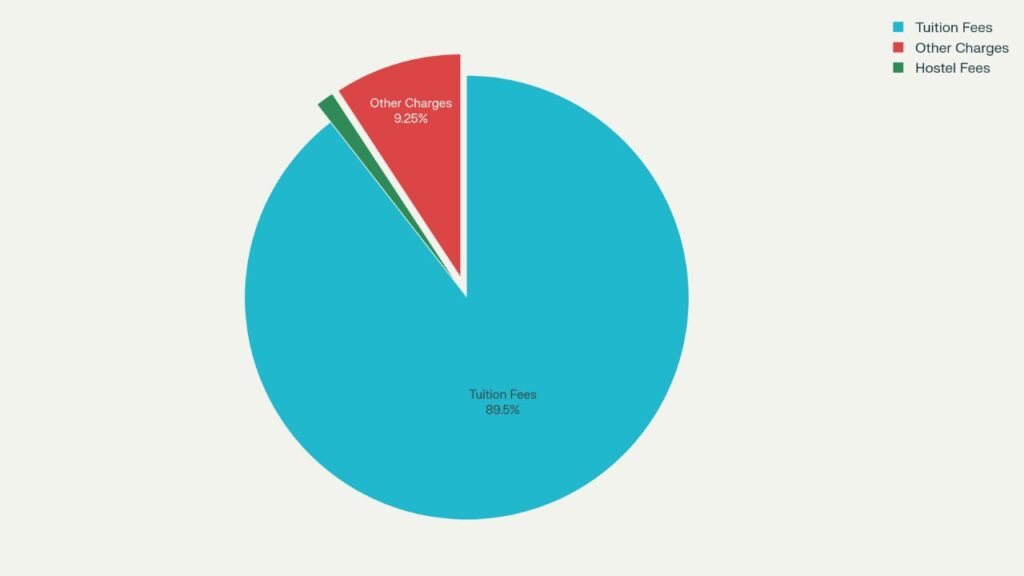
The tuition fee for the two-year course is ₹12,00,000, which is payable in four equal installments of ₹3,00,000 per semester. All the education fees, materials for courses and learning resources and even the use of campus facilities are covered by these fees. The total cost of accommodation in the dormitory for two years is Rs. 17,200 or 8,600 per semester.

Complete Breakdown of Detailed Fee Components

Mess fees are to be paid extra and they vary according to consumption, hostel fees are Rs 8,600 per semester. Semester fees are 22,400 for academic and administrative purposes which include the use of internet, sports equipment, library and student-welfare programs. 

Total tuition fees₹12,00,000
Per semester₹3,00,000
Total hostel₹17,200
Per semester hostel₹8,600
Academic charges₹22,400

First Semester Payment Structure

The admission fee structure is categorized based on the candidate’s classification. The fee for the first term for candidates in the General, OBC, and EWS categories is ₹3,31, 000, inclusive of hostel fees and other relevant expenditure like tuition. Those who belong to the SC, ST or PwD categories, however, get a Tuition Fee Waiver. First term fees are drastically reduced for these categories to Rs 31, 000, which is only for the hostel and other miscellaneous expenses. This tiered fee system also reflects a commitment to ensuring equitable access to education, as well as to financial viability for marginalized populations. 

How IIT Delhi MBA Fees Compare with Other Top Colleges

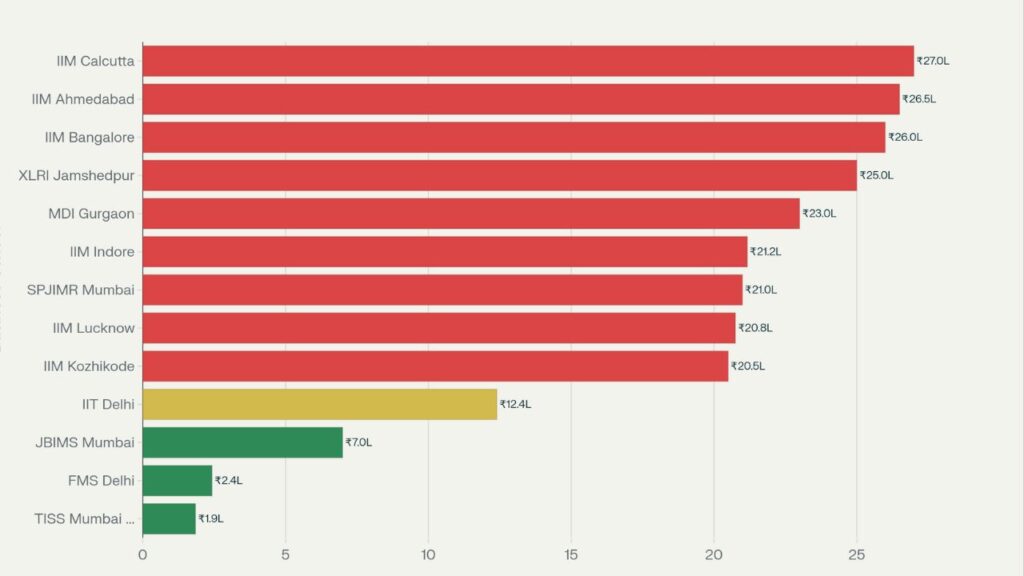
Comparison of MBA Fees Across Top Indian Colleges

How IIT Delhi MBA Fees Compare with Other Top Colleges

IIT Delhi offers great value for money as compared to other top b-schools in India. The fee structure makes it a kind of cross between the premium IIMs and the dirt cheap government ones. 

Old IIMs (Higher Fee Range)
IIM Calcutta₹27.00 lakhs
IIM Bangalore₹26.00 lakhs
IIM Ahmedabad₹26.50 lakhs
Newer IIMs (Moderate Fee Range)
IIM Lucknow₹20.75 lakhs
IIM Kozhikode₹20.50 lakhs
IIM Indore₹21.17 lakhs
Private B-Schools
XLRI (Xavier School of Management) Jamshedpur₹25.00 lakhs
ISB (Indian School of Business) Hyderabad₹40.50 lakhs
MDI (Management Development Institute) Gurgaon₹23.00 lakhs
SPJIMR (Shreyans Prasad Jain Institute of Management & Research ) Mumbai₹21.00 lakhs
Budget-Friendly Government Colleges
FMS (Faculty of Management Studies) Delhi₹2.43 lakhs
JBIMS (Jamnalal Bajaj Institute of Management Studies) Mumbai₹7.00 lakhs
TISS (Tata Institute of Social Sciences) Mumbai₹1.85 lakhs

Although these institutes charge very minimal fees, IIT Delhi gives a middle path with a reasonable fee structure and excellent results. 

IIT Delhi MBA Program Cost Breakdown (Total ₹12.17 Lakhs)

Return on Investment Analysis

The exceptional 2024 Placement Performance demonstrates that IIT Delhi’s MBA Program offers a tremendous return on investment (ROI). Graduates are offered an average salary package of ₹25.82 LPA, the highest package is an impressive ₹41.13 LPA while the median package is ₹24.45 LPA. The program’s remarkable 100 percent placement record is a testament to its strong industry relations and career support. It is the most lucrative choice for an aspiring management professional for a total programme fee of ₹ 12.17 Lakhs. Students have managed their expenses for a few months after they start working. 

Financial Support and Scholarship Options

IIT Delhi provides several support to the students who want to pursue MBA to ensure that everyone gets a chance of education. SC/ST/PwD students are entitled for 100% tuition fee waiver under category based benefits except for hostel and other fees. Furthermore, meritorious students are also eligible for merit scholarships, which are awarded on the basis of their programme-wide academic performance. Also, due to prestige of the institute, education loan for MBA course can be availed from all major banks. And given the school’s elite status, those loans typically carry competitive interest rates. 

Payment Schedule and Methods

In order to ensure transparency and ease of understanding for all students, the fee payment follows a semester-wise structured format. As per the schedule of payment, the fee for the 1st semester is to be paid at the time of admission. Fees are payable at the beginning of each subsequent semester. For your convenience, the fee can also be paid in two installments over two years, making finances a little easier to manage. 

Multiple modes of payments are available for easy transactions. Students can pay online from the time of official portals which ensures the safe and efficient process. Bank loans are disbursed by demand drafts. To suit different taste, there is also bank transfer payment option. This systematic procedure keeps the payment process formal and transparent, at the same time ensuring flexibility and accessibility to the students. 

Why Choose IIT Delhi MBA

Why Choose IIT Delhi MBA

Academic Excellence

The institute, which was ranked 4th in Management by NIRF 2024, is renowned for its outstanding academics and is supported by a strong faculty having rich research and industry experience. The curriculum is broad-based and focuses on experiential learning to ensure that the students are well-prepared to face real-world challenges. 

Industry Connections

It has great industry connections, and excellent placement support with top recruiters due to its vast alumni network in prestige companies, recurring industry interactions and guest lectures. 

Facilities & Location Advantage

The modern facilities on the state of the art campus include a well-equipped library, state of the art computer laboratories, sports and leisure facilities. Opportunity to work in corporate offices and the institution is located strategically in Delhi NCR, the emerging business hub of India making it the best for commerce studies.

Read More:- DSSSB Recruitment 2025 – Latest Vacancy, Eligibility & Application Details

Conclusion

For Indian business schools, the IIT Delhi MBA delivers the best price, quality and outcomes combination you can get. With a total fee of Rs 12.17 lakhs, it holds itself at a higher standard than many of the private IIMs while giving exceptional value for money when compared with the ones that are more prestigious. Given the reputed brand, good placements and affordable fees, it is an excellent value for money for MBA aspirants. 

Transparent breakdowns of fees and category-wise concessions ensure accessibility to students from diverse backgrounds. When viewed from the perspective of ROI, career opportunities and ranking experience, IIT Delhi MBArr its place among the topmost feasible options in India in business school arena. 

CAT vs CMAT: Which Exam Is Better for Your MBA Journey?

Preparing for an MBA program to establish your career in the management sector might be tough but possible with the right college. Top colleges can give you a lot of opportunities right after completing your MBA program. CAT vs CMAT is a common debate that generated from the confusion among students. CAT (Common Admission Test) and CMAT (Common Management Admission Test) are entry tickets for great business schools. There is a slight difference in both exams, IIMs accept only CAT highest scores. So, it might be difficult to achieve the highest scores among lakhs of students. 

Other top business schools can accept both CAT and CMAT scores for admission. The best way to achieve the best scores in these exams is the right strategy for preparation.

Get deeper details of their exams to clear out and get into yourself in the top business schools of India.

The CAT: Gatekeeper to the Elite

CAT is one of the tough exams for students who have eyes on a top-tier management career can start preparing for this exam. Students who work hard and learn properly are able to beat the competition. This exam is designed in three sections — Verbal & Reading Comprehension, Data Interpretation & Logical Reasoning, and Quantitative Aptitude. 

Read More 👉 Difference Between CBSE and ICSE: Which Board is Better for Your Future?

Why CAT Matters

Prestige and Recognition: CAT is an entrance exam to most of the reputed colleges, especially IIMs. IIM colleges are given to those students who got the highest scores. Beyond IIMs, other colleges also take the CAT score as mandatory procedure for the admission in MBA programs. 

Test your True Potential: This test is not just a normal test but it checks your ability to think under pressure. Questions are tough and based on the purpose of assessing a candidate’s analytical ability and problem solving skills. CAT is a well-known test of your management aptitude.

Gateway to Top Placements: Business schools provide opportunities to their students with higher offers from top companies. Business schools who accept CAT scores for admission have a highly valuable and strong alumni network that can be helpful to find good jobs.

The CMAT: Smart & Strategic Choice

CAT is a risky but high-rewarding exam, it will open the gates to bigger opportunities. But if you are unable to clear, CMAT is a smart and strategic choice for those students. It also opens a wider range of opportunities for your career. It is easier than CAT but comes with five sections including Quantitative & Data Interpretation, Logical Reasoning, Language Comprehension, General Knowledge, Innovation & Entrepreneurship.

Why CMAT Matters

Wider Acceptance: there are 1000+ colleges in India accepting CMAT scores for admission. AICTE-approved thousands of colleges offering various programs, especially management. 

Less Intense Competition: students who take CAT exams but not get selected for the IIM college, this is the best option because the competition for top seats is less intense. CMAT is a huge advantage for good students who aim for broader opportunities. 

Focus on All-Round Knowledge: General Awareness is included in the CMAT exam which tests your ability of current world knowledge. The Innovation & Entrepreneurship section tests students’ ability for forward thinking that will be helpful in the business world.

FeatureCAT (Common Admission Test)CMAT (Common Management Admission Test)
DifficultyVery HighModerate
AcceptanceIIMs & other Top-Tier B-Schools (FMS, MDI)1,000+ AICTE-approved colleges (JBIMS, GIM)
Exam Pattern3 sections with strict sectional time limits5 sections with no sectional time limits
Skills TestedDeep analytical, logical, and verbal skillsFoundational aptitude plus general knowledge
Career ProspectsHigher average salary, top placementsGood placements, strong ROI, broader options

CAT or CMAT: Which Exam is For You?

The decision is yours in the end because it depends on your strength and aim to clear these exams.

CAT is the right option for those who want to get into IIM or most reputed top Indian business schools. Students having confidence in their analytical skills, able to give proper time to establish a command on analytical thinking. Sure to clear the CAT exam with your preparation journey, so it will maximize your chances of high-paying jobs.

CMAT is a great and smart option for students to get admission in top business schools across India. Students can easily crack the exam without the stress of high competition. A wider range of options is a great benefit for students. A strong general knowledge is countable in a great skill that will make a huge impact. 

Conclusion

It’s not fixed that there is only one exam you can take, you can take both CAT vs CMAT exams. CMAT is a solid backup for the CAT exam, many students are unable to clear CAT, they have a second option to enter into the management. The common thing is preparation, the only way for admission in an MBA program. It’s a journey for self-improvement and achieving your success with the right strategy.

Government Job vs Private Job: Which Career Offers a Better Future in 2025?

Government Job vs Private Job

Everyone gets confused about choosing their career path. When the context is about Government Jobs vs Private Jobs, there is always a debate among youths. While most people prefer having a good lifestyle, a stable career, and growth in their lives. With growing comparison of Which Career Offers a Better Future in 2025? It’s important to know about both of them so you can make a wise decision in your life.

Let’s explore the real differences between Government and Private Jobs, do not get confused about the path. This honest comparison will help you to decide which one is best for you.

When a local, state, or central government offers you a job in different ministries like defense, railways, PSUs, and teaching are called a government jobs.

Unmatched Job Security:

If you want to work in a safe environment with job security, government jobs are best. Once you clear the exam and get selected, there is no chance to be fired like in the private sector unless there is some serious misconduct.

Stable Work-Life Balance:

You have to work usually from 9 to 5 with weekends off. Those who wish to spend great time with family, and care about health, and mental peace, can consider a government job.

Retirement Benefits:

If you want to enjoy pension, gratuity, and GPF in a government job, choose this career. Retirement perks provide future stability. So, this is something that private jobs won’t offer you even if you are on a senior level.

Respect in Society:

Whether it’s an IAS officer, bank PO, railway officer, school teacher, or a professor, these roles are highly respectable in India. Everyone wants to be treated well, especially in small towns and rural India.

Perks and Allowances:

These jobs come with multiple benefits in your life that reshape your future. It offers HRA, DA, travel allowances, medical reimbursements, paid leaves, LTC, and more.

Very Competitive Entry

The competition is held among lakhs of candidates and you have to rank up for the job. So, it is hard but with smart preparation, you can clear any exam for a government job. There are thousands of vacancies each year in this sector. 

Slow Career Growth

Promotions are often based on seniority, not performance. You have to wait for a long time to get a promotion to a higher level. Some posts may need internal assessment for the higher position jobs. You could be waiting 10–15 years to move to a higher post.

Limited Learning

Most government jobs are routine-based. Except for scientist jobs, there is less innovation and opportunities to get into the government sector. No new experimenting for new projects, this is the reason why you cannot have career growth so easily. 

Transfers and Bureaucracy

Many government roles come with frequent transfers, especially in jobs like IAS, IPS, Armed Forces or bank roles. The relocation of the job is not good for family-oriented people. They have to leave everyone behind for their job. Also, the system which is outdated and has bureaucratic hurdles may give you headaches. 

Read More 👉 Top 10 High Salary Courses After 12th Science Without NEET – No Medical Exam Needed

Private jobs are offered by private companies, startups, MNCs, or international firms. These companies offer 8-29 LPA for those candidates who have experience and get to the senior level. The average salary package for the freshers is 2-3 LPA. Private jobs are available in different sectors such as IT, hospitals, education, finance, e-commerce, media, and more.

Higher Salaries and Incentives

With the right skills, especially in tech, finance, or management, you can earn ₹10–25 LPA with experience for a few years. You can go abroad for more packages due to currency value. Performance bonuses in the management sector are good, and stock options and incentives in sales and marketing are also common.

Faster Promotions

Private companies reward performance, not age or time. They promote you if you deliver results more innovative and useful. You can grow faster than the government employee and sometimes switching companies helps double your salary within a year.

New-Age Work Culture

This new implementation in the work environment of the private sector is incredible. People now have flexible hours, remote work, hybrid setups, and relaxed dress codes, that give them relief when they get stuck in any emergencies. It also offers open communication with management to consider employee affairs in the company with their work.

Global Opportunities

Working in MNCs means working on different projects and learning new skills. The remote-first companies give you exposure to international clients, travel, and even relocation chances abroad. So, either you can work from home for international firms that will pay you in dollars or you can go abroad and set up a life there.

Learning and Upskilling

They gave you a chance to teach or learn through an online platform for their next project. You always find a chance to innovate and explore new things. Either online training or offline private institutes to give training on skills, especially in areas like AI, coding, marketing, data analysis, etc.

Job Insecurity

Downsizing, layoffs, and recession are common these days. They are firing thousands of candidates due to AI establishment in many sectors. The need for employment is decreasing in numbers. Your job isn’t guaranteed unless you constantly perform and upgrade your skills.

Long Working Hours

Many roles demand 9–12 hour workdays, and there is no Saturday & Sunday off in many departments. Sometimes, people have to work overtime. 

No Pension After Retirement

Some rare companies are offering provident funds (EPF). It is a harsh reality but you’re mostly on your own after retirement. 

Corporate Pressure and Politics

There are a lot of events nowadays where people seem to be getting depressed from office politics and unfair promotions to those people who have connections. Managers put pressure on employees to give 100% performance on tasks within a period. These all hurt health and motivation.

FactorGovernment JobPrivate Job
Job SecurityExtremely HighMedium to Low
Starting Salary₹25,000 – ₹60,000₹30,000 – ₹1,50,000
Promotion SpeedSlow (seniority-based)Fast (performance-based)
Learning OpportunitiesLimitedExtensive
Work-Life BalanceGood VariableGood Variable
Transfer ChancesHigh in many rolesVery low
Pension/RetirementYes No
Entry ProcessThrough difficult examsInterviews/skills-based hiring
FlexibilityLowHigh (remote, hybrid options)
Social StatusStill respected highlyDepends on role & company

There’s no universal answer. This is a choice that depends on your goals, education, and risk-taking ability. If you want to shape your lifestyle better, point to your goal with less hectic jobs. 

You want a stable career by getting job security and peace of mind.

You’re okay with slow promotions because of long-term benefits with a fixed salary.

You’re the topper of your class due to your learning capabilities. You can prepare for competitive exams like UPSC, NTPC, SSC, RRB, or other exams.

You value retirement benefits like medical and house allowances, fixed hours, and respect in society.

You want fast career growth because you are a quick learner, high income, and have skill-based success.

Get bored with the same work, you can enjoy dynamic work environments in private jobs, new challenges, and global exposure.

You are willing to take risks, learn continuously, understand new concepts easily, and adapt to change.

You are not interested in preparing for a competitive exam, you’re interested in tech, marketing, finance, startups, or remote jobs.

Your future doesn’t decide in just one day. Take a breath and focus on the present, to achieve in the future you must start developing your skills now.

Think about what matters more to you. The energy you can put into specific work or subject. Examine yourself how hard you can work on any specific task, and point out that skill under your interests of work. Don’t decide right now just give it time like:

Invest in skills.

Even if you’re preparing for government exams, you can learn skills such as Excel, personality development, communication, coding, or digital marketing. Whether you decide on a private or government job, it will be required in both. They can be helpful anywhere.

Try Both If You Can.

While working in the private sector, start preparing yourself for government exams. Apply for a government job whenever you want to switch your career. Both paths are open if you’re strategic.

Don’t Fear Private Jobs.

The idea that private jobs are “unstable” is only true if you stop learning. Many professionals spend years in private jobs and then start their own businesses that provide great stability and income.

Build a Financial Backup.

Whatever job you do, if you are wasting your money that makes it impossible to save, invest, and plan for emergencies. That’s the real security.

So, instead of debating on Government Job vs Private Job. Know your strengths and motives, and take a wise option for your impeccable future.

FSO Recruitment 2026: HPSC Opens 45 Food Safety Officer Posts  

FSO Recruitment

If you hold a food technology degree and have been waiting for Haryana FSO Recruitment 2026 then fill the form because it closes on 19 October at 5:00 PM. The Haryana Public Service Commission (HPSC) published Advertisement No. 25/2026 on 19 September for 45 Food Safety Officer (Group-B) posts in the Food & Drugs Administration Department. 

Take a look at eligibility criteria before applying and get ready the required documents to fill the correct information. After applying, prepare yourself according to the FSO Recruitment 2026 Food Safety Officer exam pattern and selection process.

FSO Recruitment 2026: Dates and Vacancies

EventDate
Notification published19 September 2026
Online applications open28 September 2026
Last date to apply and pay fee19 October 2026, 5:00 PM

All 45 posts sit under a single designation. The category-wise split (General, SC, BC, EWS and so on) is in the PDF.

HPSC Haryana Category-wise Posts

CategoryVacancies
Unreserved (UR)22
Deprived Scheduled Castes (DSC)5
Other Scheduled Castes (OSC)5
Backward Classes-A (BC-A)5
Backward Classes-B (BC-B)3
EWS5
Total45

HPSC Food Safety Officer Eligibility: Qualification and Age

The commission accepts degrees in food-related disciplines, and the list is wider than most candidates expect. It includes: 

  • Food Technology
  • Food Engineering 
  • Food Processing and Preservation 
  • Food Biotechnology 
  • Food Safety and Quality Management
  • Food Plant Operations Management
  • Process and Food Engineering 
  • Food Nutrition and Dietetics 

If your degree title isn’t on that list word for word, check the notification’s equivalence clause before paying a rupee. A rejected application doesn’t get the fee back.

Age is counted on the closing date, 19 October 2026. The limit is 18 to 42 years, with relaxation for reserved categories under the Haryana government. A General category candidate who turned 43 on 1 October is out, even by a few weeks.

One more disqualifier gets overlooked. If the candidate has a food business, or any kind of relation with food import or sale food articles, they will not be qualified for this post. 

Salary and Career Path

Selected candidates get ₹35,400 per month under the Level 6 of the Haryana pay matrix. The total amount may be higher because of additional allowances and benefits. The pay level will increase with time and experience for all the Food Safety Officers.

On the ground, the job means inspecting food businesses, drawing samples and enforcing the Food Safety and Standards Act, 2006. It’s regulatory work, closer to a field inspector’s than a lab technician’s.

HPSC FSO Selection Process

The HPSC FSO Recruitment 2026 selection process doesn’t depend on a single paper. There are three stage processes starting with a screening test which highly matters. The next stage will be a Subject Knowledge Test, an interview and one most important thing to understand is that HPSC can change how it limits candidates called forward.

How to Apply Online For HPSC FSO Recruitment 2026

The process has four stages: registration, filling particulars, fee payment and final submission of the signed form.

  1. Register on hpsc.gov.in with a personal email ID and mobile number, and keep both active until recruitment ends.
  2. Select Advertisement No. 25/2026, Food Safety Officer (Group-B).
  3. Fill in your details and pay the category-wise fee online by net banking, debit card or credit card.
  4. Print the submitted form, sign it, then upload the signed copy with your documents.

Step 4 is where applications die. The commission rejects forms that skip the signed upload, so don’t close the tab after payment. Download your e-admit card later from the HPSC site, since nothing is posted to you.

Candidate categoryApplication fee
All remaining candidates, including General/UR male candidates and candidates from other states₹1,000
Haryana women candidates₹250
Haryana DSC, OSC, BC-A (NCL), BC-B (NCL), ESM, and EWS candidates₹250
DESM candidates of Haryana belonging to their vertical reserved category₹250
DESM candidates of Haryana belonging to UR category₹1,000
Haryana candidates with benchmark disability (PwBD), at least 40% disabilityNil

Conclusion

Apply if your degree matches the listed disciplines, you’re within 18–42 on 19 October, and you have no stake in a food business. Do it before 5:00 PM, because the portal tends to slow down in the final hours.

Don’t start with the syllabus, concentrate on the Food Safety and Standards Act, learn the regulations and labeling, licensing and limits. Candidates must explain what to do when the sample fails, not just how the process works in a Subject Knowledge Test. Your degree gets you through the door, but the Act is what the interviewers will probe.

If you’re reading this after the deadline, the next step is to keep the Act and the sampling procedures warm and watch hpsc.gov.in for the next FSO cycle, since the 2026 pattern may not repeat on the same schedule.

Top IET Lucknow CSE Placements – Highest Packages, Recruiters & Career Growth in 2025

IET Lucknow CSE Placements

IET Lucknow CSE is expected to witness a similar cut-throat competition in 2025 as well as it has been the top choice among the engineering candidates in the state of Uttar Pradesh. With growing placements, robust academics and an exploding tech ecosystem, the institute still shines through as a safe bet for students looking for careers in software, IT and emerging tech.

This guide will simplify everything you need to know about what to expect IET Lucknow CSE for this year in a practical, straightforward. If this is the course for you or if you are advising someone on college choices, these insights will give you a good idea what 2025 studying CSE at IET really means. 

Quick Overview of IET Lucknow CSE

Eligibility & Admission45% score in 12th, JEE Main/CUET with cutoff AIR 47,364-55,000, and counselling
Total Fee₹3.44-4.04 lakhs for 4-year course
Core TopicsProgramming, DSA, DBMS, Networking, AI/ML, Web Development, Cybersecurity, Operating System & Design
Placement RecordsRate: 80-90%, Package: ₹6-8 LPA

Eligibility & Admission For IET Lucknow CSE 

The applicant must have a 45% score in 12th or given its equivalent examination from a recognized board then apply for the admission in IET CSE course. Physics and Mathematics are compulsory and then one subject from Chemistry, Biology, Biotechnology, Technical Vocational Subjects or Computer Science is taken. 

Applicants from the general category should have at least 45% mark on aggregate in these subjects. Applicants for reserved seat quota should produce the valid certificate during the counselling. Please remember that 75% is nothing but a cut-off and that generality-based for admission to IET Lucknow. 

You are required to qualify in an entrance examination for admission as the entrance is not on merit basis for the B.Tech CSE course. It is mandatory to have a valid score in the JEE Main or CUET (UG) entrance examination. You have to apply for Uttar Pradesh Technical Admission Counselling (UPTAC) after getting the required score. 

The admission into various courses depends on your All India Rank in JEE Main or CUET UG and availability of seats. During the counselling, seat allotment is normally done on the basis of Common Rank List (CRL), considering category-wise quota. Important papers like your mark sheet, proof of identity, admit card/score card of the entrance exam, caste/domicile certificate etc. have to be submitted during document verification. 

All procedures to the application and admissions process must be done through the official portals of UPTAC and IET Lucknow. 

2025 Fee Structure For IET Lucknow CSE 

The total fee amount for the course is ₹3.40 lakhs in tuition and ₹34,100 for caution money, exam fees and other incidentals. Students are required to pay roughly Rs 1.05 lakh for the first year that covers the tuition and annual and one-time charges. The price of hostel stay without mess charges is around Rs 58,000 per annum, these are not education fees. The total fee for the course is around Rs 25.02 lakhs, making it way higher for NRI candidates.

Core Curriculum Topics

The scope of topics is broad and comprehensive to prepare the students with a solid background of computer science and discipline related areas. 

Programming knowledge is predicated on knowledge of data structures and programming concepts in such languages as C, C++, Python, and Java. Mathematics for computing includes topics in discrete mathematics, probability and statistics, linear algebra, and numerical methods, designed to enhance the student’s analytical thinking. In order for students to develop an overall understanding of computational theory, core courses in computer science focus on algorithms, computational theory, compiler design, operating systems, database management systems (DBMS), computer organization, and microprocessors. 

These topics were taught at an appropriate level to make students well grounded in computer science and related areas. Programming is based on data structures and programming principles in such languages as C, C++, Python, and Java. Mathematics for computing Discrete mathematics, probability and statistics, linear algebra and numerical methods to develop thinking skills are covered in this subject. In addition, core computer science classes include algorithms, theory of computation, compiler design, operating systems, dbms (database management systems), computer architecture, and microprocessors to allow for a full understanding of computational concepts. 

Students are now taught web technologies, cloud computing, object-oriented programming, and software engineering to prepare for industry use in web-based software development. Examples of network and security topics include modern connectivity and security concerns such as computer networks, information security, cryptography, network protocols. Also as advanced electives students can take courses-in machine learning, data mining, pattern recognition, natural language processing either in data science or artificial intelligence. 

The work experience is gained via lab work, industry training/internships and major project in the pre-final and final year of the course. Students can also pursue electives in more specific areas of interest and emerging technology like image processing, embedded systems, Internet of Things (IoT), high-performance computing.

Read More:-   Check IBPS Clerk 2025 Prelims Result – Latest Update & Direct Link

Placement Excellence

CSE branch has good placement opportunities with about 70-80% students getting placed. The average salary package is Rs. 6 to Rs. 8.5 LPA with a median of Rs. 6.15 lakh per annum.

Surprisingly, the highest package offered in this branch is as high as Rs. 13.5 lakh per annum, suggesting high paying jobs in top-notch companies. 

Top recruiters are reputed software and 50+ IT companies such as TCS, Amazon, Deloitte etc which generally release jobs for SDE (Software Development Engineers) - largest application to all Engineering streams and the highest paying jobs. Applications for internships open from the second year itself, with stipends up to ₹2 LPA in reputed firms, giving an early practical exposure. 

Career Growth Opportunities

Approximately 35% of graduates go on to complete higher education such as an MBA or M.Tech. The school has a strong alumni network that excels at multinational tech companies that provide mentorship and networks. In addition, vertical 24×7 incubation support is provided to entrepreneurs, stimulating a vibrant startup ecosystem. 

Revenues earned by AI and ML professionals is uniformly high and comparable to ER&D engineers with professionals earning between ₹10 and ₹16 LPA. NITIE promotes entrepreneurship through vibrant clubs like Innovation and Incubation Center (IIC) and the Entrepreneurship Cell (E-Cell) on campus, where students have the opportunity to transform their ideas into business ventures.  

How to Maximize Placements

  1. For achieving the success in your academic and professional life you are required to focus on these:
  2. Keep your CGPA 7.0+ or more so that you would have good academic record.
  3. Spend some time on competitive programming solving 200+ problems on LeetCode to improve your coding.
  4. Try to get some good summer internships from your 2nd year onwards.
  5. You can specialize in the field of AI/ML, DevOps or so on for best-paying jobs and best/utilising your education.
  6. Have a good GitHub profile with some real projects that demonstrate your technical skills.
  7. Join hackathons, coding competitions, etc.. to improve your problem solving skills and network! 

Why Choose IET Lucknow CSE?

Affordable fees (₹3.44-4.04 lakhs for 4 years), strong placements (80-90%, ₹8-9 LPA) and presence of some premium recruiters makes IET Lucknow CSE a very good investment. It has a 85% home state quota and hence very much easy for uttar pradesh residents. Growing packages for AI/ML roles, an enthusiastic startup culture and more – the institute offers many career options beyond traditional jobs. 

Conclusion

The Department of CSE at IET Lucknow, consistently shares steady placement, industry-oriented training, and a holistic technical exposure — all at a much reasonable fee than most of the engineering institutes in India. With an average package of 6-8 LPA, the institute has top recruiters like TCS, Amazon, Deloitte etc. and the campus culture revolves around coding, internships and innovation, giving students great preparation for both company roles and higher studies.

In case if you care for quality of learning, good return of investment, and good career growth in software, AI/ML, research, or entrepreneurship field to name a few, then IET Lucknow CSE is your safe and value for money option for 2025. 

Scroll to Top