AI Is Replacing Human Jobs in 2026: Which Careers Are at Risk? 

AI Is Replacing Human Jobs

In the 2026 financial year, the biggest IT companies including TCS, HCLTech, Wipro, Infosys, and Tech Mahindra have laid massive layoffs, collectively reduced headcount by 6,981 jobs. Job seekers get curious if their degree is worth the job because AI Is Replacing Human Jobs. The industry’s requirements are rapidly changing so do their employees. 

This swing hit many students in their journey of career building. This guidance will highlight the factors of layoffs and job roles that are replaced by AI, and which career has still scope for you. It deserves attention, but it isn’t proof that whole careers are vanishing. AI Is Replacing Human Jobs unevenly. It is going after specific tasks and entry-level seats far faster than it is erasing professions. 

What Is Happening to Jobs in India in 2026

The massive layoffs in India covering tech, IT services, global capability centres (GCCs), and back-office operations careers. Amazon is cutting off 100 jobs in India earlier in October to reduce their broader workforce. There are 1000-3000 roles that are affected by the Oracle extended layoff in India. TCS completed a restructuring involving about 12,000 roles, mostly middle and senior management. Overall figure is counted 134,917 tech layoffs globally, and Indian-specific 25,000 to 35,000 roles are affected. 

TCS describes this as a skills mismatch, not AI displacement. Its HR chief has said the restructuring covered about 1% of staff, roughly 6,000 people. Analysts connect the cuts to AI anyway, because India’s people-heavy IT services model is under pressure. HCLTech, for instance, has said its revenue grew 4 to 5% over two years while its headcount stayed flat, a pattern the company calls non-linearity. Revenue is no longer rising in step with the number of people on payroll.

Higher-risk areasWhy
Routine software testing, support, BPO, data operationsTasks are more automatable and easier to offshore/consolidate.
Mid-level and senior IT-services rolesTCS’s cuts were concentrated in these layers.
Back-office roles in banking GCCsGlobal banks are targeting operational-cost reductions.
Generic fresher hiringCompanies are becoming more selective in campus hiring.

While jobs are vanishing, India’s overall technology workforce grew 2.3% from last year 59 lakh. The latest reports suggest 797,722 employees exited in October 2026 from largest IT firms in India. The fall of 3% from 822,144 a year earlier. However, 4,258 people were added in TCS, 6,450 in HCLTech and 5,446 by Tech Mahindra. Meanwhile 6,716 employees leave from Wipro. This dynamic indicates that hiring hasn’t stopped but the requirement of skills and knowledge asks something more advanced than a normal repetitive task which automates easily.

Why Freshers Feel the Impact First

The campus hiring has become more selective than before. TCS just cuts the half bandwidth in fresher hiring. It selects around 25,000 freshers which is lower than 40,000–42,000 from previous years hiring data. Infosys has held its guidance at around 20,000. It looks like jobs are vanishing from the market.

Basic tasks like writing use cases, making presentations, data entry, handling customers at Tier 1 and simple coding tasks come at entry-level positions which AI tools could handle best. When a firm needs fewer people for that layer, it hires fewer freshers rather than laying off veterans, and nobody announces a hiring that never happened. That is why the damage shows up in placement season before it shows up in layoff headlines.

Which Careers Are at Risk as AI Is Replacing Human Jobs

NITI Aayog’s Roadmap for Job Creation in the AI Economy warns that query actions need human attention to avoid risk of rapid redundancy. There are two scenarios of the stakes, the first is losing 1.5 M tech-sector jobs by 2031 or creating up to 4 million new AI-related roles. Media coverage has quoted the downside as high as 2 million. These are scenarios that depend on how well India reskills, not forecasts. The report also projects customer-service headcount falling from around 2 — 2.5 million in 2023 to about 1.8 million by 2031.

The survey of employers by the World Economic Forum’s Future of Jobs Report 2025 suggests that the 170 million jobs created and 92 million exited is expected in future years. It is showing a 78 million net gain. Among its fastest-declining roles are data entry executive, telemarketers, customer service representatives, accounting clerks, copy editors and proofreaders, market research analyst, translator, junior software engineers. 

Here is how the evidence lines up for roles Indians ask about most:

RoleWhat the evidence saysWhy it is exposed
L1 support, help deskNamed by NITI Aayog as at riskScripted, high-volume queries
Junior QA, manual testingNamed by NITI AayogTest generation is increasingly automated
Data entry, clerical, adminDeclining in WEF’s surveyRule-based and repetitive
Bookkeeping, routine accountingAccountants and auditors on WEF’s decline listReconciliation and categorisation can be automated
Customer service (voice and chat)NITI projects a shrinking headcountFirst-line queries are being automated

The table doesn’t say accountants disappear or that testing as a discipline ends. It points to the repetitive layer of each job. A senior accountant who advises on tax structuring and a junior who tags invoices both have the title “accountant,” but their exposure is very different.

What Are the Fastest-Growing Job Roles in India

The WEF lists big data specialists, fintech engineers, and AI and machine learning specialists among its fastest-growing roles. Care roles, teaching and delivery work also grow, driven mostly by demographics rather than technology.

India’s own data shows the same split. NITI Aayog flags a widening gap between the supply and demand of AI talent, and lists emerging roles such as AI prompt engineers, AI architects, AI ops engineers and ethical AI specialists. Companies are building these businesses already. HCLTech reported quarterly advanced-AI revenue of $155 million and won a deal worth over $100 million to build AI data centres for a global technology company. Wipro has launched a dedicated AI-native business unit. Tech Mahindra says about a tenth of its business-process services book is now work training, fine-tuning and evaluating AI models for the firms that build them.

Nasscom estimates the tech sector at about $315 billion in FY26, with AI revenue of $10–12 billion. That is still a small slice. Whether the new AI work scales fast enough to offset the decline in the old work is the open question, and no source can answer it yet.

Jobs are being cut in one place and left unfilled in another, and the two don’t match automatically. A laid-off L1 support agent doesn’t become an AI architect by default. That gap is the real risk for workers.

How to Prepare for the AI Era, by Career Stage

If you are a student. The entry-level seat is shrinking, so graduate with something more than the next 25,000 candidates can show. Build two or three real projects, learn to work with AI tools instead of around them, and pick up one domain such as finance, healthcare or logistics so you aren’t competing purely on coding speed.

If you are a recent graduate. Don’t depend on one campus cycle. Look at global capability centres, product companies and non-IT employers that need data and automation skills. A shipped project that solves a real problem is worth more than a fourth certificate.

Being experienced won’t necessarily protect you: TCS’s restructuring affected employees at mid and senior levels. Make a list of your regular duties and those that call for sound judgment, strong client relationships, or personal accountability. Then focus more of your time on the latter. 

Conclusion

Most of your work follows a script, clearing a queue or producing a standard output. It will take a few years to plan for change if this has been the case. On the other hand, if it requires judgment, relationships or knowledge of the domain, the tools of the trade are more likely to be changed by AI than the role itself. 

Either way, the next steps are the same. This month pick the five tasks you do the worst and try to figure out which one an existing AI tool already does. Then choose what you’re going to learn to surpass what it can do.


Leave a Comment

Your email address will not be published. Required fields are marked *

Courses for Interior Designing in India: Admission, Colleges & Careers

Courses for Interior Designing in India

If you are the type of person who regularly moves your furniture around, cleans windows to get the perfect paint color, or critiques lighting in every restaurant you dine in, maybe you have a calling. Your Search for Courses for Interior Designing starts when the question pops up: How do you get paid to have that passion? 

In these days, interior design is no longer just about “making things look pretty.” It is a complex mix of architecture, psychology, technology, and art. Whether you are a high school graduate looking to pursue a degree or a working professional residing in Lucknow wanting to make a creative pivot, this guide is your blueprint. Let’s talk about everything you need to know to about the interior design courses, colleges, and careers. 

Why Formal Education Matters

Let’s be real for a second. You may have a great eye for decorating, but professional interior design is a whole other story. It deals with strength of materials, building codes, ergonomics, and space planning.

A formal course will teach you the “grammar” of design. You are taught to talk with contractors, architects and clients. You go from saying, “I think this blue looks nice,” to, “This particular shade of teal offsets the warm undertones of the timber flooring and captures the natural light coming in from the north-facing window.” 

Types of Courses

Course TypeDurationEligibilityWhat You’ll Get
Bachelor’s —B.Des / B.Sc3-4 YearsB.Sc Or B.Des require 10th & 12th marksheet from Science StreamIn-depth technical knowledge related to Designing
Diploma / Advanced Diploma1-2 YearsKey Formula for fast entry in careerFocused on Practical more than theory, Skill Polishing
Certificate Courses3-6 MonthsHobbyists or professionals adding a specific skill (like CAD or V-Ray).Specific skills only. Prefer for less professional people
Professional Level (M.Des / M.Sc)2 YearsAfter having a degree of B.Des/B.Arch. These masters courses offered for specific specializationResearch-oriented, higher leadership roles, and teaching opportunities.

Top Colleges 

  • NID—National Institute of Design
  • CEPT University—Ahmedabad
  • IIT Delhi, Bombay
  • VIT
  • IIAD—Indian Institute of Art & Design
  • IMS Design
  • Amity University, Lucknow
  • Integral University
  • Gov. Girls Polytechnic
  • Babu Banarasi Das University 

What Will You Actually Learn?

Your course will probably be part art and part engineering. There’s a chance that you will be spending your first year hours hand-sketching and studying Color Theory. In your final year, you will be making hyper-realistic 3D renders that look like photographs. 

The “Hard” Skills (Tech You Need to Master in 2025):

To make it in the business these days, you have to know your way around a computer. These are the software tools you’ll probably end up knowing inside and out when you graduate:

AutoCAD - 2D blueprints industry standard It’s non-negotiable.

SketchUp: The Simplest 3D Building Tool Out There. Consider it as digital clay.

Revit / BIM – essential on large commercial jobs where you need to work closely with architects.

AI Homestyler: more recent and cloud based AI tools that are rising in popularity as they render fast. 

Read More :- UP Police Computer Operator Grade-A Online Form 2025: Apply, Dates & Eligibility

The “Soft” Skills:

  • Client Management: How to tell a client their idea won’t work without offending them.
  • Budgeting: planning of champagne dreams on a beer budget.
  • Project Management: Getting the plumbers, electricians and carpenters to not kill each other. 

Career Scope & Salary

Driven by an expanding middle class and real estate boom, India is witnessing an upsurge in the interior designing industry.

Various paths for a Interior Designers:

Residential Designer: Homes, apartments, villas. (High emotional connection with clients).

Commercial/Corporate Designer: Offices, co-working spaces. (Higher budgets, strict deadlines).​

Hospitality Designer: Hotels, cafes, restaurants. (Very creative, high visibility).

Set Designer: Design sets for movie or tv (Big in Mumbai/Hyderabad). 

Salary Expectations

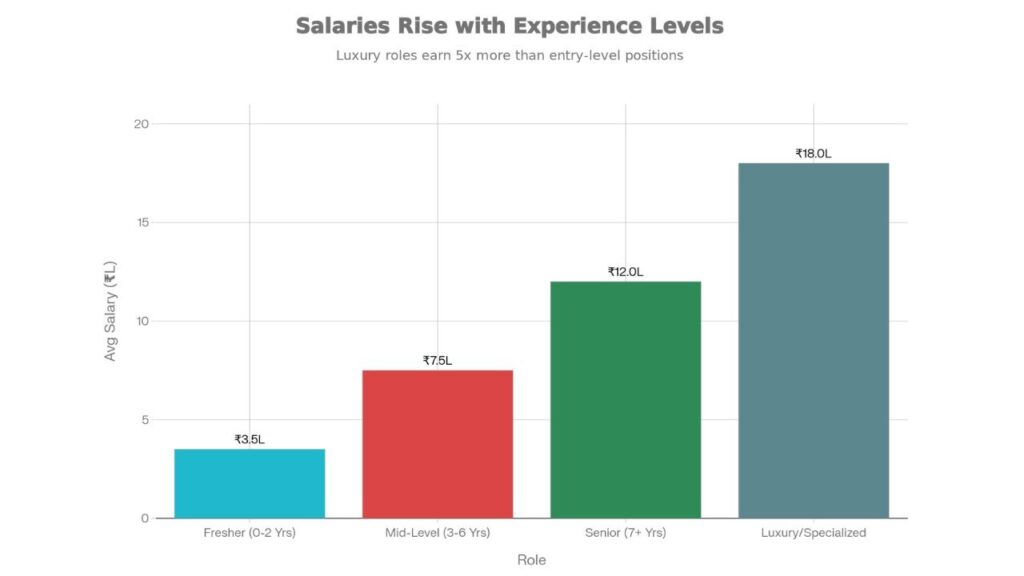
Entry-level compensation can be humdrum, but expansion is meteoric once you acquire a portfolio. Specialized positions, particularly in Luxury or Commercial sectors, offer much greater pay.

The chart exhibits how, even though you may begin as a junior at about ₹3.5 Lakhs per annum, it does pay off after all. A Senior Designer with 7+ years of experience can earn comfortably north of ₹12 Lakhs, and if you start your own firm or get into luxury consulting, the sky’s the limit (₹18 Lakhs+).

Admission Procedure For B.Des/M.Des in Major Colleges

For premiere govt colleges (like NID) you will have to appear for entrance exams like NID DAT or UCEED. They test your drawing ability, creativity, and spatial logic.

In case of private universities (such as Amity or Integral in Lucknow), admissions are essentially on the basis of marks secured in 12th and DAT (Design Aptitude Test) or portfolio review. 

And build a portfolio, even if you’re not studying design. Draw a corner of your room. Redesign your kitchen on paper. Capture the textures you like. Your potential and passion matters, not perfection.

Conclusion

Courses for Interior designing are not for the weak hearted. Dusty job sites, demanding clients, and nights spent staring at a computer screen. But it is also hugely gratifying. There is a unique thrill in walking into a space you designed — watching people live, laugh and work in a place that began as a sketch in your notebook.

If you like to mix creativity with logic, and art with engineering, this is the year to look forward to for starting out. Whether you opt for a degree from Amity Lucknow or a diploma to begin your career at the earliest, the world is holding its breath for your designs. 

Uttar Pradesh Public Service Commission Release Result for LT Grade 

Uttar Pradesh Public Service Commission

As per the Uttar Pradesh Public Service Commission, English & Biology LT Grade teacher result declaration was held on 24th feb 2026. The merit lists will be available for candidates who appeared in these examinations to check and download from the official website of uppsc. Candidates were required to authenticate the details on the portal in order to view their result. Candidates are suggested to evaluate their result and download it as soon as possible as the merit list will be accessible for a short duration.  

Uttar Pradesh Public Service Commission Details at a Glance

AspectDetails
OrganizationUttar Pradesh Public Service Commission
Key FunctionsRecruitment via exams/interviews
ExamsLT Grade Teacher
Result Date24th feb 2026
WebsiteClick Here 
LT Grade Vacancies7466 

Steps to Follow for Downloading the Result

  1. Check the Official site of UPPSC: for Obtaining the notification when it is released.
  2. Go to the Results Tab: At the official website, and click on the LT Grade Teacher result 
  3. Enter Details: To check your score, you must submit some information, including that related to you such as your Roll Number and Verification Code. (Make sure you submit the same information that was used in your UPPSC Application.
  4. Save or Print Your Result: Obtain your results and take a print out for future reference. 

Details Included in the Result

There are many important points of the UPPSC merit list through which the performance and eligibility of the candidates, who appeared in the examination, could be known effectively. 

  • Candidate Roll Number: Providing the roll number of each candidate is a good practice as it facilitates verification and identification of the results.
  • Candidate Name: The names of qualified candidates in the merit list to be considered for the next rounds of selection process.
  • Category: The candidate’s category (General/ OBC/ SC/ ST) is also mentioned in the merit list which is considered while checking the rank and the eligibility of the candidate as per reservation policies. 
  • Marks Obtained: This shows the marks obtained by each candidate in the examination, which is important for candidates to know how they performed in the exam and also for the sake of transparency.
  • Cut-off Marks: In addition, the cut-offs for each category are also provided, i.e., the minimum marks needed to qualify for further process.
  • Rank: Candidates are ranked on their performance, and such rank becomes the relative position amongst the other candidates. 

Read More 👉 Indian Revenue Service: India’s Most Underrated Career Path

UPPSC LT Grade Teacher Exams Cut-Off Marks?

Female Candidates

SubjectGeneralOBCSCST
Hindi73.5071.9768.5466.62
Sanskrit74.1372.5869.42– 
English73.9872.3369.01– 
Mathematics/Science74.8672.2268.4565.36 
Biology76.7975.2772.53– 

Male Candidates

SubjectGeneralOBCSC
Hindi74.3172.3568.49 
English74.0371.5268.23 
Useful Links
English ResultClick Here
Biology ResultClick Here
Official WebsiteClick Here

GovUpdatewala is your trusted source for real-time updates on government exams and jobs in India. We provide verified info on SSC, UPSC, Banking, Railways, Defense, and Teaching exams. From syllabus and patterns to important dates and career tips — we support aspirants at every step.

UPSSSC Lower PCS Recruitment 2026: Notification, Vacancy, Eligibility & Apply Online

UPSSSC Lower PCS 2026

It is now or never for those aspiring for an administrative job in Uttar Pradesh. On 30 March 2026 the notification of UPSSSC Lower PCS 2026 Recruitment was released to recruit candidates on various positions. A large number of candidates regard this as an excellent chance to get their foot in the door of the executive branch of the state, as opposed to merely an employment opportunity. 

This recruitment drive offers 2,285 job vacancies for 11 different departments for aspiring candidates. Look out this blog for every date and details to apply.

UPSSSC Lower PCS 2026 at a Glance

FeatureDetails
Notification Date30/March/2026 
Registration Period29/May/2026 to 18/June/2026 
Total Vacancies2,285 Posts 
Mandatory RequirementValid UPSSSC PET 2025 Scorecard 
Selection ModeMains Written Exam (Objective) 
Official WebsiteClick Here

Understanding the Vacancy Breakdown

The 2026 notification is surprisingly wide, including departments from Urban Development to Agriculture. With this range if you come from a background in Commerce, Arts or Science there is a niche for you. 

Post NameVacancies
Assistant Treasury Accountant548
Auditor (Lekha Parikshak)419 
Amin / Auctioneer323 
Executive Officer (Nagar Nikay)238 
Clerk-cum-Typist / Cashier229 
Assistant Consolidation Officer (Chakbandi)168
Assistant Manager (Non-Technical)134
Mandi Supervisor Grade-246

The posts of Executive Officer and Assistant Treasury Accountant are generally the most popular on account of the potential for administration and advancement. 

Eligibility for UPSSSC Lower PCS Recruitment

The lower PCS threshold has a dual-eligibility gate. It’s not just about having a degree, you have to have the right “ticket” from last year. 

1. The PET 2025 Mandate

In case, you possess a valid score card with non-zero marks and you didn’t appear for Preliminary Eligibility Test (PET) in 2025 then you are not eligible to apply for the Lower PCS 2026. To prepare a Initial Main exam list, the Commission consider PET scores. 

2. Educational Qualifications

If you have a graduation degree from any field, you are eligible to apply for this recruitment. 

Post-Specific Qualifications:

  • Executive Officer: Graduation is sufficient to apply, but for the purpose of regularisation, you require to have ‘O’ Level Computer Diploma from NIELIT.
  • Auditor: This post usually prefer candidates who are commerce background (B. Com) or post graduate diploma in accountancy.
  • Clerk-cum-Typist: in Hindi, 25 w.p.m. of speed is required. 

3.Age Limit (As of July 1, 2026)

The starting range of age is 21 years and you are allowed till 40 years. The government expands the maximum age limit according to the candidate’s category.

The Selection Process UPSSSC Lower PCS 2026

There are not so many long detailed interviews for these jobs now. The process for choosing the 2026 hosting is now simpler and more merit based.

  • Shortlisting: Candidates will be shortlisted for consideration based on their normalized PET 2025 scores. 
  • Main Written Examination: It is the most important stage and most of the times it determines your final selection.
  • Document Verification (DV): The last stage in which all your papers and certificates are verified for genuineness. 

Exam Pattern (Mains)

FeatureDetails
Total Questions100 MCQs
Total Marks100
Duration2 Hours (120 Minutes)
Negative Marking0.25 (1/4th) per wrong answer

Core Syllabus of UPSSSC Lower PCS

There are three papers in the 2026 syllabus. The secret is to find the right balance between the static general knowledge part and the dynamic UP Special part.

Part 1: Subject related & General knowledge (65 Marks) 

It covers the History of India and the Indian National Movement, Polity, Constitution, World Geography, and the Indian Economy. Science, Technology and Environmental Ecology also receives a great deal of attention. 

Part 2: Computer & IT (15 Marks)

With all the focus on e-governance, you will be tested on hardware/software, IT gadgets, MS Office (Word/Excel) and Internet Protocols. 

Part 3: General Knowledge of Uttar Pradesh (20 Marks)

This is often where homegrown candidates excel. It deals with the history, culture, art, festivals, geography, and present administrative patterns of UP. 

Read More :- Jail Prahari Recruitment 2026 For A Steady Salary, And Clear Career 

Salary and Perks

In 7th CPC, UPSSSC Lower PCS salary range is lucrative that lies between Pay levels 4 to 6.

Pay Scale: ₹25,500 to ₹1,12,400.

Salary range depends on region and profile of the job (Class A, B, OR C) so it can be up to ₹32,000 to ₹45,000 a month in-hand salary.

Benefits: HRA, DA, medical facilities, and the prestige of being a “Gazetted” or senior “Non-Gazetted” government officer. 

Step-by-Step Instructions To Fill the Form

  1. Sign In: Visit here and search for UPSSSC Lower PCS Online Application Form 2026. Register yourself with mobile/email or login.
  2. Information: Your personal information (Name, DOB, Gender, Domicile, Education) are required to be filled by you carefully.
  3. Documents: Attach all necessary documents required to validate your information.
  4. Payment of Fees: A token application fee of Rs 25 has been imposed across all categories (General/OBC/SC/ST). Please be informed that in case you are shortlisted for the Mains, a separate exam fee has to be paid subsequently.
  5. Print: Keep a print out of the final submitted application form at the time of Document Verification. 

Conclusion

The UPSSSC Lower PCS 2026 is a great opportunity for those who want to serve the people of Uttar Pradesh with a stable and respected career. The window from May 29 to June 18 is going to be too fast for you to catch it so keep your files ready (especially your PET 2025 scorecard and caste/domicile certificates). 

Best Government Jobs for Women in India – Secure, Respected & High Paying Careers!

Best Government Jobs for Women

There are plenty of Best Government Jobs for Women in India which offer high salaries, job security, and a reputed career. If you want to work in a disciplined environment without relocation, you can choose a government job. In India, women have the leverage to get promoted and reserve vacancies in the women’s seats but you must clear out the examination. 

Whether you are a young graduate or a married woman returning to work, both can apply for these government jobs. You can serve the nation with pride and also relief from future headaches after retirement. Explore these roles and select your path that aligns with your interests and qualifications.

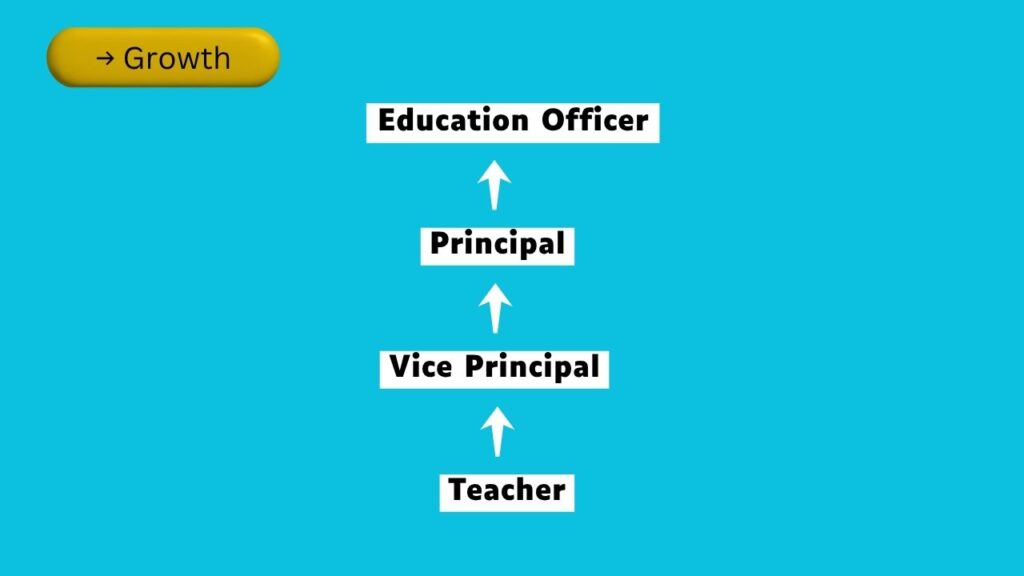
There are several posts in teaching such as PGT, TGT, and PRT. The school time for teachers is 6 to 7 hours which is usually less than any corporate job. One of the benefits is holidays during summer and winter vacations. Most of the women in India prefer to become teachers because it’s not that hard, also getting promotions to vice principal or principal.

Teaching jobs are the most reliable jobs for women who love teaching and are B.Ed qualified. Also, women can easily handle this job with their children’s responsibilities. It is the best option to ensure stable career growth and job security. In the government sector, teachers also get high salaries.

Posts: 

  1. PRT (Primary Teacher)
  2. TGT (Trained Graduate Teacher)
  3. PGT (Post Graduate Teacher)

Why It’s a Good Fit For Women:

  • Working hours are less, usually for 6-7 hours a day. That’s a huge benefit for the women to handle both work and family.  
  • Vacation holidays are one of the perks. 
  • You don’t have to relocate for the job. You can teach in small-town schools.
  • Generally, the school staff has women in more numbers than men. So, it is safe for women to work there.
Government Teacher Jobs

Graduates with a commerce stream can choose their career in banking. If you are interested in finance, accounting, account management, and many other posts that can give you a chance to get a high-salary. 

Post: 

  1. Probationary Officer (PO)
  2. Clerk
  3. Assistant (RBI, NABARD)

Why It’s a Good Fit for Women:

  • Banking jobs are usually for 8 to 9 hours but it has weekends off, especially for clerk roles. It fits for the woman who wants a career in banking.
  • There is no need to stress out about the relocation of the job.
  • Government banks offer high-paying jobs and allowances. 
  • It also provides maternity leaves so it is good for women to establish both career and personal life.

Growth Path:

The promotion happens internally so you can grow professionally from clerk to manager or from PO to General Manager.

Read More 👉 Top Highest Paying Government Jobs in India That Pay Like Private Sector!

Posts:

  1. Indian Administrative Service (IAS)
  2. Indian Foreign Service (IFS)
  3. Indian Revenue Service (IRS)

Why It’s a Good Fit for Women:

  • If you have skills that fit this role such as decision-making and logical thinking.
  • It provides authority, Power, and Policy-making.
  • Women officers who are successful in this role already inspire others.
  • It provides authority, Power, and Policy-making.
  • Women officers who are successful in this role already inspire others.

Reality Check:

IPS is a highly respectable and high-paying job but includes field duties, which may be difficult to cooperate sometimes with women due to family responsibilities.

Best For:

Women who are ambitious to serve the nation with pride and take leadership roles. So, if you are willing to serve your life for this life, you can take the job by preparing well for competitive examinations and fitness.

Also Read: Government Job vs Private Job: Which Career Offers a Better Future in 2025?

Popular posts:

  1. Assistant Audit Officer
  2. Income Tax officer
  3. Statistical Investigator
  4. Assistant Section Officer
  5. Assistant Audit Officer (AAO)

Why It’s a Good Fit for Women:

  • If you don’t want to work in the field and prefer a desk job then it is a fit role for you. 
  • Most of the posts are desk jobs.
  • All-India postings but women often get local postings.
  • The additional benefits are very attractive.

Growth Path:

There is a chance for professional growth internally in the secretary position.

Best for:

If you want a well-stabilized career with a high-paying government job in regular office hours, you can select this sector after graduating from any stream.

Posts:

  1. Anganwadi Supervisor
  2. Lower Division Clerk
  3. Village Development Officer
  4. State PSC Officers

Why It’s a Good Fit for Women

  • Women’s postings mostly happen in their hometown.
  • So there is no need to struggle with understanding a new language.
  • The selection process is not that hard as compared to UPSC or SSC.
  • Fixed working hours and a safe environment.

Best for: 

Those who want to work in their hometown without leaving their family. Women can be selected for this role because the selection process is not hard.

Posts:

  1. Assistant Manager
  2. Engineers
  3. Administrative Officers

Why Are PSUs Good for Women?

  • The salary for these roles is higher with other benefits.
  • Other benefits like medical coverage, flexible leave, and a good environment.
  • Fixed hour making is more comfortable for women.
  • Women with children can manage their working lives with these jobs.

Best For:

Those who have a background in science or commerce. Some roles require engineering graduates and other roles looking for MBA graduates. These desk jobs are reliable and comfortable for women but they must have a required qualification to apply.

Posts:

  1. Assistant Loco Pilot
  2. Station Master
  3. Junior Engineer
  4. Ticket Collector/Examiner
  5. Goods Guard
  6. Travelling Ticket Examiner (TT/TTE)

Why Are Clerk, JE, and Station Master Good for Women?

  • These jobs are non-field and safe for women, typists and office assistants are less hectic than any corporate job.
  • Women often get posted in their hometowns or local urban areas.
  • Additional benefits in government jobs are impressive such as medical insurance, travel allowance, and education for children. 

Cons:

There are technical or station-based roles that involve shift timings that might get hard for women. Most women get manageable locations so they can manage.

Best For:

Women who have a background in arts and commerce can also be considered to apply for Railway jobs. If they want to apply in technical roles then they must have an engineer’s degree.

Posts:

  1. SSC Officer in Logistics
  2. Education Officer
  3. Administrator

Why Do These Roles Fit for Women?

  • These roles offer good pay, respect in society, and discipline.
  • Women have to serve 10 to 15 years on a service commission and get retirement benefits.
  • Selection in NDA can happen based on merit.
  • Who want to establish their life in adventure and challenges, it is perfect for young women who want to take short but impactful experiences.

Reservation for female candidates in PSUs is 30-35%. This advantage can draw women to choose their career in the government sector where they get special allowances including maternity leave, additional leaves, and travel allowance.

Women often get promoted by preferences for relocation due to their family responsibilities. Senior community of women are supportive of fellow women and they receive high cooperation which makes their life easier and financially stable.

  • If you want desk jobs then go for the PSUs and SSC because they often offer jobs like these to women. 
  • Physically fit women can prefer jobs in defense and UPSC civil service because they require physical fitness and capabilities.
  • If you prefer rotational shifts or technical roles in railway as it is a high-paying job then you can choose this path.
  • There are higher numbers of women who prefer teaching jobs due to their holiday benefits and fewer hours of working. You can choose to be a teacher in any location so there’s no need to relocate and you can easily spend time with families.

The concern about finding a high-paying job ends up stressing out and makes you agitated with your career. If you want to build a career that provides a balanced work life, and mental peace, and allows you to spend time with family, consider government jobs. Whether you are a young woman or married and returning to work, government jobs offer stability, job security and other perks. Find the Best Government Jobs for Women in India and select a career path that aligns with your personality and priorities. 

JEE Main Result 2026 – Eligibility, Syllabus, Dates, Pattern Explained

JEE Main Result

The JEE Main 2026 exam has been made the necessary academic test for Indian engineering aspirants since now for the engineering aspirants. On 16th February 2026, candidates who appeared for the exam will be able to check the JEE Main Result 2026 for January session. JEE Main is a system that requires one to be mentally strong, strategically enduring and regulation-tight  not only about ability. 

JEE Main Result the gateway exam for prestigious technical institutions in the country including the National Institutes of Technology (NITs), Indian Institutes of Information Technology (IIITs), and Centrally Funded Technical Institutes (CFTIs) the exam goes through a scale of participation that is unprecedented globally. Because it also serves as the single entrance path to the JEE Advanced, it represents a major turning point for the Indian education system. 

The information shows a strong increase in registrations with more than 1.35 million candidates for Session 1 alone. This demographic bulge requires a granular analysis of the test’s structural elements, including eligibility rules and the statistical normalization of scores. 

NTA Reforms & Administrative Changes in JEE Main 2026

In a bid to ensure the sanctity of the procedure, the NTA has brought in game changing measures:

  • Biometric Security : Now there is a “Live Photograph” taken during application that restricts impersonation.
  • Operative Changes: The test will be given on multiple dates and will require an advanced statistical “normalization” process to equate different levels of difficulty.
  • JEE Main Result Timeframes: Although administrative delays such as the Session 1 result postponement from February 12 to February 16, 2026 — do induce stress, they are vital for thorough validation of data. 

Examination Schedule and Timeline 

The NTA has adopted a two-tier system for the hour long sessions, offering candidates a tactical cushion. This enables students to view the January attempt as a baseline and the April attempt as a fine-tuning move.

The JEE Main Result 2026 Session 1 

Paper 1 (B.E. / B.Tech) was held on January 21, 22, 23, 24, and 28 over multiple days, while Paper 2 (B.Arch/Planning) was held on January 29.

The JEE Main Result delay is due to the complexity of the normalization process, it is now expected on February 16. For the NTA to be fair, it must normalize the scores within the millions of data points. 

Session 2 Dates 

EventSession 1 (January)Session 2 (April)
Application WindowConcluded1—25/Feb/ 2026
Exam Dates21–29/Jan/20262–9/Apr/2026
JEE Main Result Declaration16/Feb/202620/Apr/2026 (Expected)

Eligibility Architecture: The 75% Rule and Beyond

It is necessary to know the funnel of eligibility to avoid getting disqualified in the stage of admission process.

Age and Attempts Age: There is no upper age limit for JEE Main, however some institutions may have their own fixed limits.

The Three-Year Window: You should have passed Class 12 in 2024, 2025 or appearing in 2026.

Attempts: The exam can be attempted for three consecutive years by the candidates. 

The Performance Threshold

But the access to NITs, IIITs and CFTIs is limited by eligibility criteria that includes:

General/OBC-NCL/EWS: Minimum 75% in aggregate in class 12th.

SC/ST: 65% aggregate minimum.

Option 2: Be in the Top 20 percentile of your respective Board. 

State of Eligibility

Your ‘Home State Quota’ will be decided on the basis of the state of examination of your Class 12, not your residential status. For example, a student of Bihar coaching in Kota (Rajasthan) will come under Rajasthan Home State quota. 

Read More:- Railway RRB ALP Admit Card 2026: Download Now From Direct Link

Examination Pattern For JEE Main

AspectDetails
Exam ModeComputer-Based Test (CBT); focuses on application and speed.
Total Marks300
Duration3 Hours
SubjectsPhysics, Chemistry, Mathematics (each with two sections)
Section A20 Mandatory MCQs per subject
Section B10 Numerical Value Questions (NVQs) per subject; attempt any 5
Penalty Rule-1 negative marking for both MCQs and NVQs; precision required

Subject-Wise Syllabus Breakdown

Mathematics, Physics and Chemistry have strategic places where one must focus to improve performance:

Mathematics:  

Learn Calculus and Algebra well as they are the basics.Don’t ignore Vectors and 3D Geometry as these are very easy and carry good amount of marks in examinations.Also focus on Coordinate Geometry, Matrices and Statistics for high yield.

Physics:  

Concentrate on concepts and the use of the formulas. Modern Physics, Semiconductors = very good marks, not much calculation. Things are inevitably going to move around in your lab, so you need to be comfortable with experimental skills, especially Vernier Calipers and Error Analysis, handy points as well.

Chemistry:  

Chemistry is a very efficient subject for which you could save a lot of time and spend more time in Mathematics.  

Physical Chemistry: Be good at numericals to do well.  

Inorganic Chemistry: Be good in p-block trends;solidify your knowledge of Coordination Compounds.  

Organic Chemistry: Learn the reaction mechanisms and Biomolecules,bcoz they are very important.

Your study time can be better used and your score can be higher by focusing on these areas with the greatest yield. 

Post-Session 1 Roadmap to April

Reviewing how you did in January is the first step towards doing well in April.

  • Category A (98+ Percentile): Begin dedicating 70% of your time to JEE Advanced questions.
  • Category B (90-98 Percentile): Look for “low-hanging fruit.” Earn higher accuracy in Physics and Chemistry to enter the elite group.
  • Category C (<90 Precentile): Go back to basics. Concentrate your efforts on the most common chapters that ask questions instead of covering all the syllabus. 

The “Golden Window”

To Those Who Are Taking Boards In Feb-March The gap between the last Board exam and JEE on April 2 is crucial. Prepare Board to learn NCERT concepts which are directly used in the questions of Inorganic Chemistry and theoretical Physics. 

JoSAA & CSAB Counselling Process 2026

Admissions counselling for engineering in India is not limited to just ranking, as the Centralised Joint Seat Allocation (JoSAA) Authority in six rounds of seat allotment. Candidates may opt Freeze to accept and confirm their seat, Float to accept their seat and appear for seat updation in subsequent rounds, or Slide to retain the seat and try for an improved branch in the same institute. If there are still vacant seats after the JoSAA rounds, the procedure is continued by CSAB through special rounds which tend to be the last chance for many students with lower ranks to get an admission in a reputed NITs and other top institute. 

Conclusion

JEE Main 2026 is not just a good entrance exam—it is a good portal to sift through all the engineering institutes in the top Indian engineering colleges. Success is based on more than just knowledge: you also need to have a plan, be consistent, and make smart decisions. From understanding the exam pattern and eligibility criteria to utilising both attempts to the maximum and managing JoSAA–CSAB counselling effectively, every step will determine your outcome. Clarity, discipline, long term vision and direction in studying helped these students not only to qualify, but to open the right “doors” for their future. 

Scroll to Top