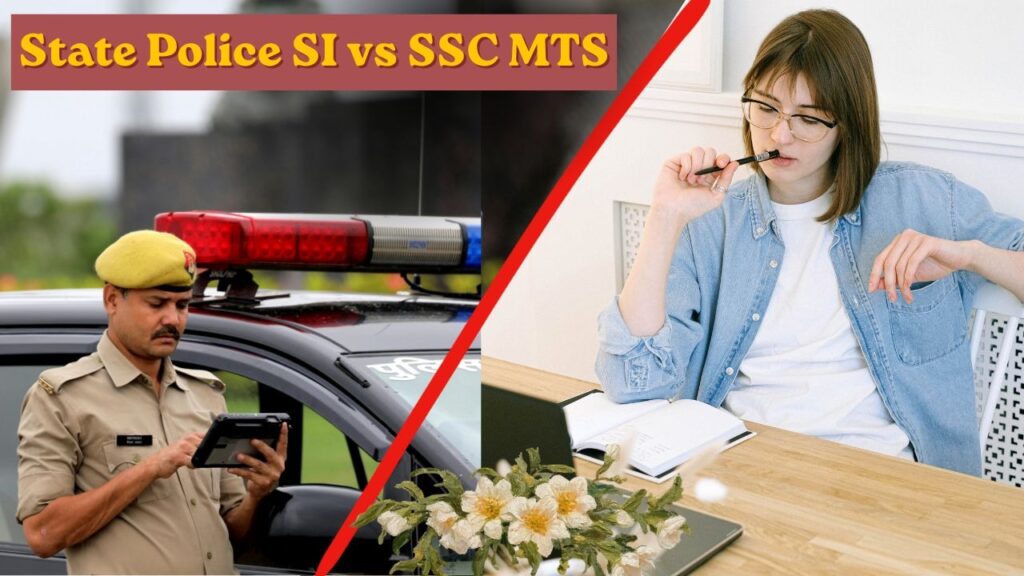
The hype and excitement for government jobs in India is vast and often overwhelming. People cut off everything just to clear competitive exams. Two most big names that pop up frequently are State Police Sub-Inspector (SI) and SSC Multi-Tasking Staff (MTS). At first glance, comparing State Police SI vs SSC MTS is like comparing apples to oranges. One is a field power stuffed job and other is a desk job as administrator.
Many students get confused to choose their field because they don’t know the responsibilities and real-time work, they’re just watching money. Ask a single question and do yourself a favor for finding the right answer.
Do you want the power and prestige of the uniform, or the stability and work-life balance of a central government desk job?
Let’s understand this through this guide which breaks down every detail from these two paths to let you decide which job aligns with your lifestyle.
Job Roles and Responsibilities in Real
State Police Sub-Inspector (SI)
A person is going to work under Police regulations at the lowest rank position. Going to the scene of a crime report or checking who breaks the law as the first investigating officer, and filing a charge sheet in court is Sub-Inspector responsibility. This position comes in Group B (Non-Gazetted) or Group C Jobs.
It is a desired job for a person who has a bulky body and good physical strength with a sense of justice, and a desire for social status. It’s a 24/7 job, changing shifts, and responsible to maintain public safety, law and order, and investigate crime scenes.
SSC Multi-Tasking Staff (MTS)
All the paperwork is required to maintain that the system works properly, MTS employees are responsible for maintaining files, photocopying, delivering couriers to provide essential support in various Central Government Ministries, Departments, and Offices.
It is a desired job for quiet and routine seeking people who want a secure position at government desk with minimal stress and ample time to prepare for higher exams (like UPSC or SSC CGL). It comes under Group C posts.
Why Compare These Two?
The comparison becomes necessary when students get confused because of Entry Barriers and Aspirant Demographics.
SSC MTS: Students can take entry in the government sector after 10th pass and take a tag on their resume.
State Police SI: Wait for the graduation to complete and then apply to take authority in their local area.
Tip: You can apply for both and become a government employee.
Eligibility and Selection Process
The requirements are different for these two positions because their responsibilities are opposite. Physical standards also matter for the SI job. Let’s take a deep look:
Feature
State Police SI
SSC MTS
Educational Qualification
Graduation (Any Stream)
10th Pass (Matriculation)
Age Limit
21 – 28 years (Varies by state)
18 – 25 or 18 – 27 years
Physical Standards
High (Height, Chest, Vision)
None (Except for Havaldar posts)
State Police SI conduct two tests — Prelims and Mains to check your knowledge in GS, Maths, Reasoning, and Language (Hindi/English). After clearing the written examination, candidates who are shortlisted will go to the next phase of Physical Efficiency Test and Physical Standard Test. These tests will check your endurance capacity while running, long jump, and high jump along with height and chest measurement.
Medical Examination for checking eyesights, flat feet and knock-knees are also mandatory to allow you to take the field job.
SSC MTS has a streamlined selection process which starts with an objective-type exam. This Computer Based Examination divided into two sessions —
Session I
Numerical and Mathematical Ability & Reasoning
Session II
General Awareness & English Language
CBT follows PET/PST but only for havaldar posts, and it has only walking test and physical measurement. You will be called for document verification once you finish all these tests.
Salary and Benefits
Most of the students decided their career according to the salary and benefits. State Police SI pay at Level 6 which means basic pay is ₹35,400. It can be around ₹55,000 to ₹75,000 total salary by including other allowances. Salary varies based on the city/state of the person.
SSC MTS pays at the Level 1 scale, basic pay is around ₹18,000 with additional benefits it can sum up to ₹28,000 to ₹32,000.
Choose wisely, because your choices impact on your lifestyle, perks and your mindset.
Preparation Strategy to Compete in Exam
Few subjects are common in both State Police SI vs SSC MTS exams. You can prepare yourself for both exams if you are still in 10th grade.
Mathematics, Reasoning, and General Awareness are mandatory subjects for both exams.
Make your basics clear by practicing on Basic arithmetic, percentages, profit & loss, and interest etc.
Try a mock test online and buy books in which Coding-decoding, blood relations, and syllogisms questions are presented.
Read newspapers and follow famous personas and good channels on youtube for Current affairs, History, Geography, and Polity.
Analyze Previous Year Questions to obtain Extreme Speed and Accuracy in every answer. Physical activity is required for SI selection, so dedicate 1 hour every morning to any game and running outside.
Career Growth and Promotions
State Police SI
Sub-Inspector (SI)
Inspector
Deputy Superintendent of Police (DSP)
Additional Superintendent of Police (ASP)
In some cases, top performers reach the rank of SP (IPS level) near retirement.
SSC MTS
Multi-Tasking Staff
Lower Division Clerk (LDC) – via Departmental Exams
Upper Division Clerk (UDC)
Assistant Section Officer (ASO)
The MTS profile is often seen as a stepping stone. Most candidates clear CGL or State PSCs while working as MTS.
Need Help To Choose Your Right Path?
Take paper and pen for side-by-side comparison for both SI and MTS jobs. In those comparison right your pros and cons:
What is your “Why”?
Pros
Cons
State Police SI
Power, uniform, field action, high paying
24/7 job, vary shifts, transfer different states, crime scenes, stressful
SSC MTS
Stable job, grow family, decent work, prepare for IAS
Low salary, ton of preparation to clear exam
If you choose SI then prepare yourself for facing crime scenes & handling dead bodies, political pressure, and angry crowds. Maintain physical stamina and strength with regular exercise.
If you choose MTS then prepare yourself for preparation for the next rank for higher posts but it is a decent job and requires less stress to manage.
The State Police SI role is a “Life Style.” It offers high pay with great authority which makes you become a man with power that has a direct impact on society. SSC MTS is a desk job for people who maintain discipline and want a peaceful life.
My advice is don’t lose the chance, if you are in 10th grade you can apply for SSC MTS and take the hit while preparing for other other options like IAS or State Police SI. you can decide after your graduation but if you are graduated then choose accordingly.
Regardless of your choice, the key is consistency. Start your preparation today, pick your syllabus, and don’t stop until you crack the examination.

Most of the students join the corporate sector but private jobs won’t provide security, high-salary, and additional perks which the government sector offers to the employees. But position matters in government jobs too if you have a higher position in the department, your salary will be more and other perks. There are many government jobs after graduation in India in the different departments.
But you must understand which department suits you best. Let’s look into the details of each government job after graduation. Don’t rush, just focus on what you want to achieve in life.
Why Government Jobs Still Matter
People who spent years working in a public sector bank or Ministry of finance described that money attracts you but the major reason is you never have to worry about if you’ll have a job next year or not.
If you watch it closely, you are going to understand — A government job in India isn’t just a paycheck. It comes with job security that private companies rarely match. It comes with a pension through the National Pension System, so the years after retirement aren’t a financial scramble. Government jobs offer fixed working hours, but there are exceptions. Defence and UPSC is tougher and no fixed hours. Most jobs are not that tough so you can give time to your family. In India, society gives more respect to government employees than private employees.
There is one more thing, if you belong to SC, ST, OBC, and EWS categories, government recruitment includes reservation benefits that make the competition a little more balanced than it is in the open private market.
None of this means government jobs are easy to get. But it explains why so many students keep this door open, even while exploring others.
Government Jobs After Graduation in India
There is no one big exam for a government job, it gives you job security and high salaries that makes it tough to compete with lakhs of students and being selected.
IBPS conducts the PO and Clerk exams for most public sector banks, while State Bank of India runs its own separate recruitment for similar roles.
If you want something closer to economic policy, RBI hires for Grade B officer and Assistant positions, and NABARD focuses specifically on rural and agricultural banking.
Job Title
Minimum Qualifications
Example Employers / Recruiting Bodies
Accountant / Junior Accountant
Bachelor’s degree in Commerce (B.Com) or equivalent; some posts accept diploma in accounting
State departments, municipal corporations, central ministries, cultural institutions
B.Com, proficiency in Tally / Govt accounting rules
Department of Economic Affairs, ministries, central govt offices
Treasury Officer / Cashier (Treasury)
B.Com; sometimes specific treasury certificates
State treasuries, municipal treasuries
Internal Revenue Agent / Revenue Inspector
Graduation; specialized departmental exams
Tax departments, revenue directorates
Central Government Jobs
The Staff Selection Commission runs several exams worth knowing. SSC CGL is the big one, opening doors to positions like Income Tax Inspector and Assistant Audit Officer. SSC CHSL leads to roles like Data Entry Operator or Lower Division Clerk.
If you studied engineering, SSC JE is built specifically for you. And if you can take dictation quickly, there’s SSC Stenographer.
Job / Exam
Minimum Qualification
Common Extra Requirement
SSC CGL
Graduation degree
Post-wise age and skill test requirements
SSC CHSL
12th pass OR Graduation
Typing/skill test for some posts
SSC MTS
10th pass OR Graduation
Age relaxation as per category
SSC JE
Diploma or B.E./B.Tech in relevant field
Technical qualification in engineering branch
SSC CPO
Graduation in any stream
Fitness and medically fit
Railways, Largest Employer in the Country
RRB NTPC opens up roles like Station Master and Traffic Assistant for general graduates. RRB ALP is for those drawn to operating trains as Assistant Loco Pilots.
RPF handles railway security and law enforcement. And RRB JE, again, is the engineering route.
Railway Job Post
Main Work
Basic Eligibility
Usual Recruitment Route
Station Master
Controls train movement and station operations
Graduation in any stream
RRB NTPC Graduate-level exam
Goods Train Manager
Manages goods train operations and coordination
Graduation in any stream
RRB NTPC Graduate-level exam
Senior Clerk cum Typist
Handles records, typing, office work, and data entry
Graduation with typing skill where required
RRB NTPC Graduate-level exam
Junior Accounts Assistant cum Typist
Accounts work, billing, clerical finance tasks
Graduation, usually commerce preferred
RRB NTPC Graduate-level exam
Commercial cum Ticket Clerk
Ticketing, passenger support, commercial counters
Graduation in any stream
RRB NTPC Graduate-level exam
Trains Clerk
Train records, movement entries, office coordination
Graduation in any stream
RRB NTPC Graduate-level exam
Traffic Apprentice
Supports railway operations and traffic control work
Graduation in any stream
RRB recruitment / NTPC-related notifications
Section Controller
Monitors train operations and sectional control
Graduation; often a high-responsibility post
RRB notification / senior railway recruitment
Junior Engineer (JE)
Technical supervision in civil, electrical, mechanical, signal, etc.
the exam that produces IAS and IPS officers. It’s open to graduates from any stream, but it’s also the toughest exam in this entire list, with three stages testing not just knowledge but stamina and patience.
Each state also runs its own version through its Public Service Commission. UP has UPPSC, Bihar has BPSC, Madhya Pradesh has MPPSC, and so on, each recruiting for state-level administrative roles.
UPSC Service / Post
Group
Main Work
Basic Eligibility
Indian Administrative Service (IAS)
All India Service
District administration, policy implementation, public welfare, law and order coordination
Graduation in any stream
Indian Police Service (IPS)
All India Service
Internal security, policing, crime control, public order
Graduation in any stream
Indian Foreign Service (IFS)
Group A
Diplomacy, foreign relations, embassies, international representation
Central government accounting and financial reporting
Graduation in any stream
Indian Defense Accounts Service (IDAS)
Group A
Defence finance, budgeting, accounts management
Graduation in any stream
Indian Railway Protection Force Service (if allotted through UPSC-related services)
Group A/B depending on cadre
Security and protection of railway property and passengers
Graduation in any stream
Central Civil Services Group A
Group A
Administration in central ministries and departments
Graduation in any stream
Central Civil Services Group B
Group B
Assistant-level administrative and policy work
Graduation in any stream
Defense Jobs
If discipline and service appeal to you more than office work, the defence sector offers CDS for officer entry into the Army, Navy, and Air Force, and AFCAT specifically for the Air Force.
Defence Job / Entry
Main Role
Basic Eligibility
Selection Route
Indian Army Officer
Lead troops, field operations, administration
Graduation in any stream
CDS / SSC (Non-Technical) / other officer entries
Indian Navy Officer
Naval operations, technical or executive duties
Graduation; engineering degree for technical entries
CDS / SSC Executive / technical entries
Air Force Officer
Flying, ground duty, administration, support roles
Graduation in any stream for many entries
AFCAT / CDS / NCC special entry
Short Service Commission Officer
Temporary officer role in Army, Navy, or Air Force
Graduation; post-specific rules apply
SSC entry routes
CDS Officer Entry
Commissioned officer in Army, Navy, or Air Force
Graduation in any stream
CDS written exam, SSB, medical
AFCAT Officer Entry
Air Force officer in flying, technical, or ground duty branches
Graduation in any stream; technical branches need relevant degree
AFCAT, interview, medical
NCC Special Entry
Officer entry for NCC cadets
Graduation + NCC certificate requirements
Direct officer selection, no written AFCAT/CDS in some cases
Teaching has its own path too. CTET or your state’s TET exam qualifies you to teach in schools, while UGC NET is for those who want to lecture at the college level. KVS and Navodaya Vidyalaya recruitment also fall in this teaching bucket.
Important Tip: You didn’t need to pick just one. Many students prepare for two or three of these at the same time, since the subjects often overlap.
Teaching Job
Level
Basic Eligibility
Main Exam / Route
Primary Teacher (PRT)
Class 1–5
Graduation in some cases, usually with D.El.Ed / B.El.Ed; CTET Paper 1 for central jobs
CTET / TET + recruitment exam
Trained Graduate Teacher (TGT)
Class 6–10
Graduation in relevant subject + B.Ed; CTET Paper 2 for central schools
CTET / TET + recruitment exam
Guest Teacher
School / institute
Graduation, sometimes B.Ed preferred
Local government recruitment / walk-in / contract basis
Special Educator
School level
Graduation + special education qualification
Recruitment through education department / DSSSB / state boards
Who Can Actually Apply
The good news is that most of these exams simply ask for a graduation degree, in any subject. You don’t need a specific stream unless the job itself is technical, like engineering posts in SSC JE or RRB JE, which obviously expect an engineering background.
Most exams accept candidates roughly between 18 and 32, though SC, ST, and OBC candidates usually get age relaxation, and the exact numbers shift slightly from year to year.
You also need to be an Indian citizen for nearly all of these roles, and for defence or paramilitary jobs like CDS or RPF, there are physical fitness standards on top of everything else.
Never assume for the exam updates. Dates are extended sometimes and shifts every year. Every government organization publishes its own official notification that declares eligibility and process. Rules shift slightly year to year, so do not rely on people’s words or what happened last year.
Once you decide which field you are going to join, you have to figure out the process itself, which felt confusing the first time but became simple once he broke it down.
It starts with tracking official notifications. Websites like ssc.nic.in,ibps.in, rrbcdg.gov.in, and upsc.gov.in post recruitment notifications which include detailed instruction and a timeline to open the portal where you can apply. It happens every year, so checking them regularly matters.
Once a notification drops, the first step is registering online, usually with just a mobile number and email. Then comes the actual application form, where personal details, educational background, category, and post preferences need to be filled in carefully.
Remember that correction windows are short, so a careless mistake here can follow you for the whole process. After that, documents like your photograph, signature, and category certificates need to be scanned and uploaded.
Then there’s the application fee, though SC, ST, PWD, and female candidates often get a waiver or discount here. Once everything is submitted, the admit card becomes available a few weeks before the exam date, and then it’s just down to showing up and going through whatever stages that particular exam has, whether that’s a single test or a longer chain of prelims, mains, and interview.
How To Prepare For Government Exams?
Once you know that these exams exist doesn’t mean you are fully prepared for it. You need to read the syllabus properly instead of skimming it.
Every exam leans on a mix of Current Affairs, Simple Mathematics, Logic and Reasoning, and English or Hindi, but the weight given to each section changes depending on the exam.
After you study the topics of a specific exam, check previous year papers, not to memorize answers, but to understand the pattern, the difficulty level, and how questions are usually framed and paired with regular mock tests.
This technique will teach you how to manage time under pressure, since most of these exams are brutally time-bound. Make Current affairs a daily habit too, especially since banking and SSC exams lean heavily on it. If your exam has more weightage on Current Affairs then prepare well for it day-by-day.
What made the real difference, though, was a basic timetable. Not a rigid one, just something that kept you showing up every day instead of cramming in bursts. And you had to decide between coaching and self-study. Most students who cracked their exams recommend choosing both. As some subjects are hard that need guidance and some are easy, you can prepare it by yourself. There’s no universal right answer here. It depends on how you learn best.
For decades, students have been doing wrong while preparing for the government exams which can be put away and made aware future generations to stop going wrong.
Some students put all their effort into one single exam and ignore everything else, which is risky given how competitive these exams are.
Others miss notification deadlines simply because they weren’t checking regularly.
A lot of students skip mock tests entirely, only to be blindsided by time pressure on the actual exam day.
And many treat current affairs as optional, which costs them marks in exams where it’s actually a major scoring section.
Conclusion
There are massive numbers of vacancies every year in government jobs after graduation in India. If you also finish your college this year or previous year, you can apply for any of the jobs which fits into your profile.
Check the official notifications daily to find the dates for application, admit card, and exam date. Some exams take multiple phases to get selected but some require a simple exam. Students who can stay consistent, give hours to study, and set their goals can achieve it by going through a tough process of selection.
There are a lot of students who filled the application form for teaching in Kerala and appeared in the exam. They can check their Kerala TET Result 2026 on the official website of Kerala Pareeksha Bhavan. Many candidates wonder about the salary and professional growth at this stage, so here is the full detailed guide to Kerala TET exam. From eligibility to selection process, everything is here.
Achieving a qualifying score on the Kerala Teacher Eligibility Test (KTET) will help to achieve a teaching career. If you missed the 2026 cycle, you can apply next year but knowing every detail lets you understand how to crack the exam.
Overview of Kerala TET Result 2026
The Kerala Teacher Eligibility Test was conducted smoothly over two days, morning and afternoon shifts due to a large number of applicants.
Exam Name
Kerala Teacher Eligibility Test (KTET)
Conducting Body
Kerala Pareeksha Bhavan (KPB)
Exam Cycle
December Session (Exams held Feb 21 & 23, 2026)
Result Declaration Date
May 26–27, 2026
Official Website
https://ktet.kerala.gov.in
Credential Required
Category, Registration Number, and Date of Birth
Certificate Validity
Lifetime Validity
What is the Kerala TET (KTET) Exam?
Students in Kerala who are dreaming about becoming an educator, The Kerala Teacher Eligibility Test (KTET) is specifically structured to prepare you for teaching and provide you with an official certificate to be able to teach in school. Kerala Pareeksha Bhavan conducts this exam to check whether a candidate has the right knowledge and teaching skills to handle students effectively.
KTET is designed to evaluate applicant’s psychological understanding of children, teaching methods and proficiency in subjects. There four separate categories for specific educational tier:
Category I (Lower Primary): Focus on Classes 1 to 5.
Category II (Upper Primary): For those who can teach Classes 6 to 8.
Category III (High School): Focuses on relevant subjects for Classes 9 to 12
Category IV: Special teachers (foreign language or Arts) and Physical Education instructors.
Why is The Kerala TET Exam Important?
If you want to become an Educator then you need to clear this exam and please remember that this exam will allow you to teach school across Kerala only, not any other state.
Mandatory Entry Requirement
The state government makes this test mandatory to clear for teaching. Without a valid KTET scorecard, you cannot legally apply for teaching vacancies advertised by the Kerala Public Service Commission (KPSC) or state-aided institutions.
Lifelong Validity Benefits
KTET certificates now come with lifetime validity, that’s a huge relief for the teaching professionals. You never have to go through the stress of retaking the test to renew your qualification status.
Professional Credibility and Up-skilling
Preparing for the KTET naturally moulds you into a well-rounded teacher. As it covers the curriculum which increases your understanding of educational psychology and child development.
Step-by-Step Procedure to Check Kerala TET Result 2026
Open your web browser and visit the official Kerala Teacher Eligibility Test website.
Find KTET Result 2026″ link in the notice or on the homepage.
Use the drop-down menu to select your specific exam category and type your Registration Number and DOB to login.
Check the result and verify your name and marks to make sure that it’s yours, then download the PDF.
Eligibility Criteria for Kerala TET
Category
Classes Covered
Minimum Educational Qualifications
Category I
Classes 1–5
Passed 12th with 45% marks, plus Trained Teachers’ Certificate OR Diploma in Elementary Education
Category II
Classes 6–8
BA/BSc/BCom with 45% marks + Bachelor of Education (BEd) OR Higher Secondary + 4-year Bachelor in Elementary Education (BElEd)
Category III
Classes 9–12
Master’s degree with 50% marks + BEd degree
Category IV (Specialist/Language)
Specialist / Language subjects
Certificate, Diploma, or degree in the specific language/subject plus Training Certificate
Minimum Qualifying Marks (Cut-Offs)
The 150 objective-type multiple-choice questions of the KTET exam carry one mark for right answers. There is no negative marking for incorrect selections. But candidates have to score above the cut offs and its varying by their category:
90 out of 150 marks — General/Unreserved Category
82 out of 150 marks — Reserved Categories (SC/ST/OBC/PH)
Selection Process for Kerala TET
Once you got Kerala TET Result 2026 scorecard, you must follow the further path to secure a job:
Document Verification: Immediately after qualifying, you must report to the designated District Educational Officer (DEO) for a thorough physical document verification. Authorities will check your certificates, ID, and educational certificates.
Eligibility Certificate: Once the DEO confirms your documents are original, you will get a formal, valid-for-life KTET Eligibility Certificate.
Applying via KPSC: You must monitor KPSC notification for teacher eligibility so that you can apply for government school.
Career Prospects and Salary Structure
The doors will be open for you for the lifetime of teaching. You can apply everywhere in Kerala for stability, high community respect, and a rewarding compensation package.
Diverse Career Pathways
Primary School Teacher (LPST): Guiding children through their formative learning years.
High School Assistant (HSA): Specializing in core thematic subjects like Physics, Mathematics, Social Science, or Literature for older students.
Specialist Educator: Instructing students on Arts and curriculum activities which grow their mind into creativity. Give training on the grounds and manage sports development as a Physical Education teacher.
Institutional Growth: Experience in teacher matters, you will be promoted to the seniority level like Headmaster/Headmistress in a same school without any exam or interview..
Expected Salary Scale
Candidates after clearing KTET examination can easily get the teaching job in Kerala schools. They receive income according to their level of teaching, higher classes require more attention and effort. Primary Teachers get between ₹35,600 to ₹75,400 per month. And High School Teachers earned ₹41,300 to ₹87,000 per month.
People also give private tuitions or join coaching centers to earn passive income. The exam increases the chance of getting more valuable offers in future.
Kerala TET Result 2026 is out now and candidates can check using their registration number and DOB. Once you get your scorecard, you have to check the teacher jobs notification in Kerala for securing a high paying teaching job.
If you haven’t applied this year, you can apply next time but knowing every detail regarding this examination will help you understand how to clear the examination and most importantly check whether you are eligible or not.
RRB NTPC Graduate New Vacancy Notification 2026 is a great chance for job seekers who want stable and high-paying careers in the government sector. As this is one of the largest employers in the world. Lakhs of students who have graduated recently can apply for this exam and prepare for it.
The Railway Recruitment Board (RRB) has brought transparency in the recruitment process by issuing the annual recruitment calendar. It is helpful for students in focusing their preparation with a crystal clear, organized roadmap for exams rather than browsing through the notifications everyday.
This detailed guide will cover everything you need to know about the RRB NTPC Graduate vacancies in 2026 – from available seats to who can apply.
What Is RRB NTPC Graduate?
Non-Technical Popular Categories is an exam for roles on different zonal railways and production units of the Indian Railways, this recruitment drive run by Railway Recruitment Board every year.
It doesn’t require any technical degree as it is non-technical, so many graduates can apply for this exam. It provides stability, career growth, and respect in your early age. Apply as fast as you can because there are thousands of students waiting for this opportunity already.
Undergraduate level posts aren’t paid as high as graduate level posts within the railway system.
RRB NTPC Graduate New Vacancy Notification 2026 – Numbers Breakdown
There are 8,868 vacancies under 2026 recruitment drive in which 5,810 vacancies are for graduate-level posts that leaves only 3,058 for 12th pass students. The application process for (CEN) 06/2025 was finished in 2025 and the CBT-1 exam took place from March 16 to March 27, 2026.
Now candidates are waiting for the CBT-1 result so that they can move to the next stage CBT-2 of selection. If you missed this chance then apply for the upcoming RRB NTPC Graduate posts in August 2026. The notification will release soon according to the RRB Annual Calendar. The formal assessment of vacancies across zones will start between June and July 2026 and official notification will drop in August.
Activity
Timeline
Vacancy Assessment across Zones
June 2026
Indenting of Vacancies in OIRMS Portal
July 2026
Proposal for Draft CEN Notification
August 2026
Release of Official Public Notification
August 2026
Commencement of Online Applications
August – September 2026
CBT Stage 1 Examination
Late 2026 / Early 2027
The Ministry of Railways set the calendar for the candidates to prepare themselves. The vacancy number dropped from last year (11,558) means the competition is tighter. Take this matter seriously to prepare properly for securing a seat in Railways.
List of Graduate Posts and Their Roles
You have chosen your preference in different roles in the application form. To make a decision, you must know the job profile under the title, so here are the primary graduate-level options:
1. Station Master (SM)
It is a highly responsible role that falls under Pay Level 6 in which you have to check running trains have reached their assigned destination safely and efficiently. Safety of passengers and the public by controlling signals and ensuring all the safety protocols have followed is Station Master responsibility.
2. Goods Train Manager (GTM)
Also known as Good Guard, they are responsible for safety and movement of Goods Train. You will work along with Loco Pilot, check packages reached at their destination, and ensure no damage occurs during transit. This position has the maximum share of vacancies in recent charts.
3. Chief Commercial cum Ticket Supervisor (CCTS)
You must have the ability to handle communication in pressure because this role is responsible for managing ticket counters, checking reservations, overseeing luggage and handling customers politely whether you are in mood or not. Overall, you have to deal directly with the public or supervise commercial tasks.
4. Senior Clerk cum Typist
You must have fast typing speed as it is required to handle clerical work, maintain staff files, process data, and assist higher authorities in administrative departments. Senior clerk is an excellent job if you prefer an officer desk job with regular working hours.
5. Junior Accounts Assistant cum Typist (JAA)
Numbers are your skill? Then Junior Accounts Assistant cum Typist is an ideal job for you. You are responsible for managing financial bookkeeping, processes bills, keeps track of expenditures, audits internal payments. Working in the finance and account department of railway is to ensure that the railway zone’s finances are running smoothly without any false transmission..
6. Traffic Assistant
Control rooms are the system’s mind so the trains run smoothly. Traffic Assistant works there and manages line clearances along with assisting operational managers in optimizing railway traffic networks in control rooms to handle traffic movement operations.
Salary and Perks
Post Name
7th CPC Pay Level
Initial Basic Pay (INR)
Station Master
Level 6
₹35,400
Goods Train Manager
Level 5
₹29,200
Chief Commercial cum Ticket Supervisor
Level 5
₹29,200
Junior Accounts Assistant cum Typist
Level 5
₹29,200
Senior Clerk cum Typist
Level 5
₹29,200
Traffic Assistant
Level 4
₹25,500
These salaries are the bare minimum. And as you gain more experience and move up in the salary matrix, there are incremental hikes. Additional benefits of working for the railways include free or concessional travel on the railways, medical facilities, pension (under National Pension System) and job security that few private players offer.
Are You Eligible For The RRB NTPC Graduate New Vacancy Notification?
You have to be eligible to apply for the 2026 vacancies to be announced. Getting a job in Indian railways is the ambition of all the job seekers.
Education Required
As it is a graduate-level vacancy, you must have a degree in any stream from a recognized university or college. If you are in the final year, you can apply but a degree certificate must be obtained by the university at the document verification process.
Age Limit For Candidates
Minimum
18 Years
Maximum
33 Years
Age Relaxations for Reserved Categories
OBC
3 Years (36 years )
SC / ST
5 Years (38 years )
PwBD
10 to 15 Years
Ex-Servicemen
Period of service rendered plus an additional 3 years
Medical Standards
Jobs in the railway have their own medical standards. Applicants must satisfy vision standards and other physical fitness requirements to ensure you take responsibilities of the biggest network of India.
Complete Application Process for RRB NTPC Graduate New Vacancy Notification
Visit the application portal on the official site of the Railway.
Put your number and email on the registration box to make your account and remember the credentials.
Fill out the application form with correct details including education, category, and personal information.
Choose your preferred job roles (check 3 preferences) and region where you can work easily.
Upload document — ID, Signature, Photo, Category certification, Educational Certificate. Pay the amount to complete the application via online payment methods
General / OBC / EWS Candidates
Rs 400
SC / ST / Female / Ex-Servicemen / PwBD
Rs. 250
Check your application once again to edit the incorrect or mistake. Submit and print it out for later references.
Exam Dates For Both Undergraduate And Graduate Level Post
The Graduate Level CBT 1 examination has already been held from 16 March to 27 March 2026. If you had appeared for that, the subsequent rounds will come accordingly your performance.
The second CBT at the undergraduate level is being held from 7 May to 21 June 2026 in various stages at present. More than 6.3 million candidates had registered for the exam at the UG level alone. That should give you some idea of how tough this recruitment is.
The RRB NTPC Selection Process
This is the multi-level selection process in which you must go through four stages of selection to secure a position:
Stage 1: CBT 1
The first stage of the exam in which 100 questions have been asked from Mathematics, General Intelligence and Reasoning, and General Awareness. You have to give the correct answer within 90 minutes because the wrong answer took one-third of a mark. But CBT-1 marks are not counted in merit list, it is just a door for CBT-2 exam.
Stage 2: CBT 2
The paper is more relevant to your preferred job role and difficulty level also depends on different pay levels but the syllabus is the same as CBT-1. This is where you have to perform well because a CBT-2 score adds to the final merit.
Stage 3: Skill Test
Only hard level posts will attempt this stage such as Station Master and Traffic Assistant posts. There is a Computer-Based Aptitude Test which has 30% weightage in the final merit, so clear it with concentration.
Typing tests are required for Junior Clerk, Senior Clerk, and Accounts Assistant roles. Typing speed in both English and Hindi are required but it is just a qualifying test.
Stage 4: Document Verification and Medical Exam
Original documents are checked by the authorities to verify every detail you provided. Then a medical test to analyze if you have any permanent illness or weak vision.
Complete Syllabus of RRB NTPC Graduate New Vacancy Notification
Mathematics — Prepare basic 10th level questions from topics like integers, decimals, LCM and HCF, ratio and proportion. Focus more widely on percentage, profit and loss, simple and compound interest, time and distance. If you have more time and do not wanna miss a single question then practice on algebra, geometry, trigonometry, and elementary statistics.
General Intelligence and Reasoning — Prepare your logic skills with practice on pattern recognition, analogies, coding-decoding. Basic mock tests will help you, there are other topics such as series, puzzles, syllogisms, Venn diagrams, and data sufficiency.
General Awareness — Most of the questions come from this topic, keep aware of the current events, General Science, Indian history, geography, politics, and economy. Check news everyday and follow government schemes and policies regularly.
Exam pattern is crucial to understand because it will help you complete the paper in a limited time. Both CBT-1 and CBT-2 feature multiple-choice questions (MCQs) but the difficulty level and questions density is different.
CBT-1 Exam Pattern
Subject Area
Number of Questions
Total Marks
Mathematics
30
30
General Intelligence & Reasoning
30
30
General Awareness
40
40
Total
100
100
CBT-2 Exam Pattern
Subject Area
Number of Questions
Total Marks
Mathematics
35
35
General Intelligence & Reasoning
35
35
General Awareness
50
50
Total
120
120
Tips to Crack the RRB NTPC 2026
Since the vacancies have shrunk, the competition gets higher and you need a right strategy to crack the exam.
Basics are important so start practicing questions in maths and reasoning. Then move to the advanced level questions but start with basics will build your core foundation. Solve previous year questions and mock tests so you become fluent with some questions which are repeated many times.
Take time to revise because both accuracy and speed matters. Focus on General Awareness because most of the scores depend on that section. It needs your daily consistency so don’t break the score.
If you are preparing for the Station Master role then prepare for CBAT too. Because the Psycho test is also important without clearing this stage, you can secure a position.
Conclusion
The RRB NTPC Graduate 2026 is a major employment opportunity for graduates in this year. Yes, the vacancies are less than previous year. Yes, there is stiff competition. But that has never stopped determined aspirants from cracking it.
If you have already given CBT 1, continue preparing for the CBT-2. If you missed the chance, do not worry, the Railway Recruitment Board will release the next recruitment notification in August. So, it is a great time to start laying your groundwork so when the next notification pops up, you can hit the ground running.
BPSC AEDO Syllabus: It gives me immense pleasure to believe that a graduate can make such a difference by choosing to be in the education sector or education administration and directly impacting the lives of so many students. The Bihar Public Service Commission (BPSC) has recently made the entry for the position of Assistant Education Development Officer (AEDO). With 935 posts available, this is a golden chance for the candidates who want to get permanent and reputed government jobs in Bihar. l
But clearing a state level competitive exam is not a cakewalk. It needs a very strategic planning, strong study schedule and well understanding of examination pattern. Decoding theBPSC AEDO Syllabus is your starting line and most vital step, however attaining the job also depends on knowing fully the position that you are going to fill.
This is the complete guide for BPSC AEDO syllabus in which you can get each and every information regarding this exam. From understanding the job profile and expected salary to analyzing the syllabus and best books, this article is your guide for everything you should know.
What is the BPSC AEDO Job Profile?
The reality of the job must be understood before beginning preparation. The Assistant Education Development Officer (AEDO) post is a combined administrative and supervisory post. The AEDO is the vital link between the state’s education department and the schools at the ground level.
As an Assistant Education Development Officer, you ensure the execution of educational policies and keep a watch on schools in that area to see if they adhere to the minimum standards of education and infrastructure.
Key Responsibilities of an AEDO:
Educational Supervision: AEDO officers must check the working of government schools in their region consistently to speed things.
Scheme Implementation: Monitoring every government schemes to be implemented properly.
Analysis & Reporting: To generate believable reports with information such as student enrollments, attendance rates, dropout rates, and pass rates for students across courses.
Administrative Mediation: Redressing grievances of teaching staff, resolving logistical issues, ensuring adequate supplies and proper functioning of schools.
Quality Control: To conduct inspections for up keep the good quality in teaching and to ensure the syllabus is covered as per the state board.
There is no typical desk day in this position. You’ll need to be out in the field or on campus, talking regularly with staff at schools, and taking the lead on identifying and addressing any administrative roadblocks.
Salary and Perks: Why is the AEDO Role Highly Sought After?
Apart from the prestige and societal level impact associated with the post, the BPSC AEDO post provides very good salary and excellent job security.
Salary is given under the Pay Level 5 as the government’s pay matrix.
Basic Pay: ₹29,200 per month.
Allowances:
Dearness Allowance (DA),
House Rent Allowance (HRA),
Travel Allowance (TA),
Medical Allowances
The initial in-hand salary ranges between ₹40,000 to ₹45,000 per month.
Growth/Promotion: One can become a DEO or take up other high administrative posts in the Bihar Education Department from an AEDO with the experience of years and departmental promotions.
Eligibility Criteria and Essential Skills Required
Educational & Age Criteria:
Category
Minimum Age
Maximum Age
Educational Qualification
–
Any Stream’s Bachelor’s Degree in any discipline from a recognized university
Unreserved (UR) Male
21 years
37 years
Women (All Categories)
21 years
40 years
OBC/EBC
21 years
40 years
SC/ST
21 years
42 years
Essential Skills for Success:
Fluency in Hindi and English: You need to have good communication skills in Hindi and English while dealing with teachers, government officials and the public.
Analysis: Reporting requires you to collect data on student enrollment, for example, or financial records then analyze that information to come to conclusions.
Leadership and Mediation: You may need to negotiate disputes within administration to hold the line on discipline and maintain orderly learning conditions.
Versatility: You were to expect to go and work at different blocks, and more than you expects at getting curve balls in logistics.
Complete BPSC AEDO Syllabus and Exam Pattern
Understanding the exam pattern very well will only help you to crack the written exam. Here is a brief about BPSC AEDO exam pattern
The BPSC AEDO papers are in the objective type questions (MCQs) format spread over three papers. The two-hour papers are of 100 marks each.
Guideline on Negative Marking: 1/3rd of the mark allocated to the question will be deducted for each wrong answer. Precision is just as important as the number of tries.
Paper
Subject
Total Marks
Duration
Nature of Exam
Paper 1
General Language (English – 30, Hindi – 70)
100
2 Hours
Qualifying (Min. 30% in both separately)
Paper 2
General Studies
100
2 Hours
Evaluated for Merit
Paper 3
General Aptitude
100
2 Hours
Evaluated for Merit
The Detailed BPSC AEDO Syllabus
A focused plan of preparation depends on the exclusive understanding of the given official BPSC AEDO Syllabus. Let us now discuss each paper:
Paper 1: General Language (Qualifying)
This exam is to check your basic grammar knowledge. You will have to obtain a minimum score of 30% in both English and Hindi parts minimum for your other papers to be evaluated.
English (30 Marks):
Basic Grammar,
Vocabulary,
Synonyms & Antonyms,
Idioms & Phrases,
Sentence Correction,
Reading Comprehension.
Hindi (70 Marks):
Hindi Vyakaran (Grammar),
Sandhi,
Samas,
Paryayvachi Shabd (Synonyms),
Vilom Shabd (Antonyms),
Muhavare (Idioms),
Unseen passages.
Paper 2: General Studies (Merit-Based)
History: Indian History both old and new. Bihar contribution in Independence of India.
Geography: Indian Geography. Focus on Bihar economic and physical geography which covers Drainage, soil and mineral wealth of Bihar.
Indian Polity & Economics: Indian Constitution, governance and Policies implemented by the Central Government.
Basic Science: Biology, Physics, and Chemistry of 10th class.
Current affairs & General Knowledge: Big events and global summit of India specifically current events of Bihar in last 10-12 months.
Paper 3: General Aptitude (Merit-Based)
General Quantitative Aptitude should best be learned by building your fundamentals with clear concepts of class 6th to 8th level books that are worked on in a very plain and simple way on all the necessary things. Concentrate on the following Chapters – Number Systems, Ratio and Proportion, Simplification, Averages, Profit and Loss, Percentages, Simple and Compound Interest, Time and Work, Speed and Distance and some Basic of Mensuration (2D and 3D).
Also, reasoning plays a vital role, so you must practice topics like Number and Alphabet Series, Analogies, Coding Decoding, Blood Relations, Syllogism and non-verbal reasoning topics like Mirror Images & Paper Folding on a regular basis.
The data interpretation is also very important aspect in the exams, where you have to frame questions on the basis of tabular data, pie chart and bar graph and solve them, so on these fronts you need along with gre speed you also require gre accuracy.
Best Books for BPSC AEDO Preparation
With so much information out there, it’s natural to feel intimidated about where to start. The trick is to have a small number of dependable books, go through them a few times and not to hoard too much revision material. Below are some of the best books recommended for each section:
For General Language:
Objective General English by S.P. Bakshi (Arihant Publications)
Samanya Hindi by Lucent Publications
For General Studies:
General Knowledge by Lucent Publications
Bihar Samanya Gyan by Manohar Pandey or Crown Publications
NCERT Books (Class 6th to 12th)
Monthly Current Affairs Magazines or News Paper
For General Aptitude:
Quantitative Aptitude for Competitive Examinations by R.S. Aggarwal (S. Chand)
Fast Track Objective Arithmetic by Rajesh Verma (Arihant)
A Modern Approach to Verbal & Non-Verbal Reasoning by R.S. Aggarwal
Pro Preparation Strategy to Crack the Exam
Having the right textbooks and knowing the syllabus is only half the battle. How you organize your daily study routine, now that’s the killer, that’s what’s really going to make or break you.
Don’t Disregard Paper 1: Many students end up underestimating the language paper because it is “acting as a gatekeeper”. But if you are not getting minimum 30 per cent in both Hindi and English, you will be disqualified no matter how many marks you are getting in others papers. Form a habit of completing at least 45 minutes language sessions daily.
Concentrate on Bihar-centric issues: Geography, history and current affairs of Bihar carry more weightage in GS. Consider “Bihar Special” as a separate paper and study accordingly.
Be good at managing your time: You have 100 questions in the Aptitude section to be solved in 120 minutes. It provides you 1 minute for each question. Practice learning to skip the harder and more time-consuming questions and answering the simpler questions first.
Mock Tests are non-negotiable: Start taking full-length mock tests not later than 2 months prior to the exam. It will get you used to the 1/3rd negative marking pattern. Analyze the questions you get wrong to see where you are weak and to improve your guessing.
Revise Consistently: Use your weekends to go over everything you learned during the week. Keep your notes brief and clear so you can quickly review them in the last weeks.
BPSC AEDO exam is a good way to get a respected and secure job in government service. The competition will be hard but well disciplined based on complete knowledge of BPSC AEDO Syllabus and Exam Pattern will make you ahead from the rest. Get your material, prepare a realistic timetable and start your preparation now. To qualify the state level public service exams, constancy counts more than severity.
If you’ve ever seen a surgical scene in a film, the camera almost always lingers on the surgeon. While behind every successful operation, there is a team, who make everything run smoothly silently in the background. One of the most vital members of the team is Operation Theatre Technologists. Degree in BSc Operation Theatre Technology (BSc OTT) trains students to undertake this pivotal position in the healthcare organisation.
It is a professional undergraduate course for aspirants who wish to collaborate with surgeons, anesthesiologists and nurses within the operating room. From instrument preparation to ensuring sterility to direct procedure support, OT technologists are paramount to patient safety and managing successful surgeries.
For the students who are interested in medicine but do not want to do MBBS, BSc Operation Theatre Technology course has emerged as a very lucrative career option with rising demand in hospitals across India and abroad.
What is BSc Operation Theatre Technology About?
BSc OTT (BSc Operation Theatre Technology) is an undergraduate course which makes you ready to be the backbone of surgeries. OT professionals ensure the operating theater is clean, equipment works flawlessly and patients are protected during their surgical journey, above and beyond what the surgeons have time to do themselves. The training enables you to work as a surgical technologist with surgeons and anesthesiologists in the operating room, as a surgical instrument sterilizer, and an assistive user of the advanced technology on which today’s surgical procedures rely.Consider it the technical conductor of an orchestra where every instrument must play perfectly in time.
Course Duration and Structure: What to Expect
This is the interesting part and also the part you should keep a very close eye on because it changes depending on where you study.
Standard Duration: BSc Operation Theatre Technology is a 3-year course and accompanied by the attendance of a 6 month to 1 year mandatory internship.However, a few top listed universities such as SRM University, Apollo University provide the option of pursuing it as a 4 year course.Professional training in anesthesia technology is provided along with OT management.
Welcome to Year 1, Are you ready to make a start all you need to do is dust off your knowledge for the big four; Anatomy, Physiology, Biochemistry and Microbiology. But it’s not like just cramming textbooks. You will also begin to understand more general nursing principles, as well as the language that healthcare professionals really speak on a daily basis. Think of it as learning to walk before you run.
The second year is when things start to get a bit more “real”. You’ll advance into pharmacology, gain surgical skills, and for the first time — enter the realm of OT management and sterilization techniques. That’s when you start to realize how all that stuff you learned in Year 1 actually relates to what takes place in an operating room.
Year 3 is where it gets real. You will be learning advanced surgical procedures, anesthetic methods and intensive care. There’s a similar emphasis on quality control, because in medicine, precision and responsibility aren’t optional, they are everything.
Then you do the Internship and that is where everything changes. No more simulations. No more hypotheticals. You’ll be in a real hospital operating theatre, assisting in real surgeries on real patients. Yes, it’s intense. And I was tested in ways I never thought I would be. After all, it is the final stage of your training, but also the most important one, because this is when you stop being a trainee and start becoming a practitioner.
Are You Eligible For BSc Operation Theatre Technology?
Check your qualification before applying for the admission into this course, Here’s what you need based on official university guidelines:
Educational Background: You need to have done Class 12 (10+2) in Science stream with Physics, Chemistry And Biology (PCB) as core subjects. Some universities allow Mathematics instead of Biology, but the latter is the better choice.
Minimum Marks: Most organizations expect you to have minimum 50% aggregate marks in your PCB. While 55% and 60% needed for the top colleges like AIIMS Delhi and Brainware University.
Age Limit: Starting from 17 and the upper age limit is usually 40 years, with 5% relaxation for reserved categories.
Medical Fitness: A compulsory medical certificate of fitness from a government medical officer must make sense since you’ll be hectoring life.
Admission Process: How to Get In
If you’ve been panicking over entrance exams, here’s some relief. The cut throat competition is not that much higher as compared to BSc Operation Theatre Technology when it comes to MBBS seats. It’s really not too bad if you know what to expect.
For most colleges, both government and private, it all boils down to your Class 12 PCB percentage. That’s it. If you work hard in your board exams, that work directly opens doors for you here. No complicated formulas, no years of entrance prep — just your actual academic performance talking.
A few universities want to play it their own way. There is no one all India entrance test for BSc Operation Theatre Technology but a few institutions/universities conduct their own tests or they accept students based on their CUET scores for admission.
Course Fee
As we all presume that it’s not always a career choice that’s based on passion, but also what makes practical sense for you and your family.
BSc Operation Theatre Technology fees: The good news here is BSc Operation Theatre Technology is really one of the less costly healthcare courses you will find anywhere, more so if you get a government college seat. We’re talking anywhere from ₹10,000 to ₹50,000 per annum and that is fairly affordable when you compare with most private medical courses. For a lot of students, this is what separates the dream from the doable.
Private colleges have, as one would expect, a more varied selection. Most are in the range of ₹50,000 to ₹2,50,000 per annum, but among the premium institutions the total cost of the course can go up to ₹10 lakhs for the entire programme.
That’s a big cost, so you should consider what you’re getting in return — facilities, faculty, hospital partnerships, and placement assistance all make a difference. Other expenses like books and hostel costs are not included in these fees.
A majority of the government hospitals and colleges provide scholarships or stipends for pursuing internships. It is helpful for taking ideas on how things work. So look into what assistance you’re eligible for before you commit anything. That one conversation or Google search could save you a pretty meaningful amount of money over four years.
Where Can Your Career Take You?
Here’s where your heart might skip a beat (and I mean that in the best possible way). The Indian healthcare sector is booming and OT technologists are highly demanded.
OT Technician/Technologist: Your main role will be to assist in surgeries and help in the theatre
Anesthesia Technologist: Role required to keep monitor patients and machines.
Surgical Assistant: Assisting doctors/surgeons during operations.
CSSD Technician: Crucial industrial service in central sterile supply departments
Emergency Care Technician: Managing Critical Care and Trauma Cases
Salary Expectations
You can have a good career in this field and it no doubt grows much better with intense experience. For freshers 0-1 years experienced, they get paid from 15k to 25k in government hospitals with job security, pension and all other benefits.
Private hospitals salary ranges from minimum 20k to 35k and maximum 40k in top corporate chains.
₹ 30,000 to ₹ 50,000 per month – With 2 to 5 years Experience Team leader Position holders And Private sector job holders.
Senior Experienced – If you are a senior with 5+ years of experience, you can earn anywhere between 50,000 to 80,000+ Rs per month, be it managerial role or any other specialized area. So, this just build up that how much you can get financial support and more out of this career.
The Next Step After BSc Operation Theatre Technology Course
Having gained experience in BSc Operation Theatre Technology, expanses of job associated with go up in professional life are endless. Experts may become teachers to mentor and educate students who want to become OT technologists, or they may apply their skills in medical equipment sales, with firms such as Siemens or GE Healthcare, which can be quite rewarding.
Also, a career in hospital management through MBA in Hospital Management can lead to the door to the top management.
Specialization is also a viable option for career growth with specialized certifications in robotic surgery, endoscopy and critical care. Learning always pays off for career growth.
Postgraduate studies such as MSc in Operation Theatre Technology or Anesthesia Technology allow individuals to take on advanced clinical roles, while MBA in Hospital Administration qualifies one for leadership opportunities.
PG Diplomas in Critical Care or specific Surgical Procedures, along with Certifications in Robotic Surgery, Laparoscopy or Medical Coding, also enhance the career prospects. It is through these career paths that professionals can grow both personally and professionally but at the same time make a meaningful impact on the healthcare sector.
Conclusion
BSc Operation Theatre Technology is not only a degree, it’s an opportunity to be a crucial part of life saving surgeries. With the healthcare industry in India expected to grow to $638 billion by 2025 and the medical device market expanding at 28% per year, the need for talented OT practitioners is strengthening.
You’ll be at the heart of the hospital, seeing medical miracles every day, and have a stable, respectable career with real upward mobility. If you envisage a career in India’s best AIIMS hospitals or want to work abroad, this degree takes you there.
The operating room isn’t for everyone—it’s stressful, physically and mentally exhausting, and you have to be totally exact. But for those who have the passion for healthcare and the disposition to work in a high-pressure set-up, BSc Operation Theatre Technology provides a career path, that allows you to make a difference in the lives of patients — each and every day.