Best Government Jobs in Maharashtra in 2025

If you are looking for a good government job in Maharashtra in 2025, then you are at the right place. Every year the Maharashtra government releases recruitment in many departments in which lakhs of candidates apply. Government job is not just a job, it is a means of a secure future, good salary package, and respect.

Let’s see the list of top 15 government jobs in Maharashtra:

Top 15 Best Government Jobs in Maharashtra in 2025

S.No.Job TitleDepartment/OrganizationEligibilityOfficial Website
1Deputy CollectorMaharashtra Public Service Commission (MPSC)Graduation in any stream + MPSC examhttps://mpsc.gov.in
2Maharashtra Police Sub-Inspector (PSI)Maharashtra Police DepartmentGraduation + MPSC (Combine Exam) + Physical Testhttps://mahapolice.gov.in
3Assistant Motor Vehicle InspectorMaharashtra Transport DepartmentDiploma in Mechanical/Auto Engineeringhttps://mpsc.gov.in
4TalathiMaharashtra Revenue DepartmentGraduation + Knowledge of Marathihttps://mahabhumi.gov.in
5Zilla Parishad Health OfficerMaharashtra Health DepartmentMBBS/BHMS/BAMS + Maharashtra Registrationhttps://zp.mah.nic.in
6Clerk-TypistMaharashtra Secretariat & ZPsGraduation + Typing Certificatehttps://mahapariksha.gov.in
7Maharashtra Forest GuardForest Department, Maharashtra12th Pass + Physical Testhttps://mahaforest.gov.in
8Junior Engineer (Civil/Electrical)Maharashtra PWD / MJP / ZPDiploma/B.E. in Civil/Electrical Engineeringhttps://mahapwd.com
9Assistant Section Officer (ASO)Mantralaya / MPSCGraduation + MPSC Group B Examhttps://mpsc.gov.in
10Staff NurseMaharashtra Health DepartmentGNM/B.Sc. Nursing + Registrationhttps://arogya.maharashtra.gov.in
11Maharashtra Electricity EngineerMaharashtra State Electricity Board (MSEB)B.E./B.Tech (Electrical)https://mahadiscom.in
12Maharashtra Agriculture OfficerDepartment of Agriculture, MaharashtraB.Sc. Agriculturehttps://mahaagri.gov.in
13Gram SevakPanchayat Raj Department12th Pass + MS-CIT Certificatehttps://rdd.maharashtra.gov.in
14FiremanMaharashtra Municipal Corporations10th/12th + Physical & Firefighting Training[Varies by corporation]
15Maharashtra Judicial Services (Judge)Bombay High CourtLLB + Judicial Service Examhttps://bombayhighcourt.nic.in

Leave a Comment

Your email address will not be published. Required fields are marked *

Difference Between CBSE and ICSE: Which Board is Better for Your Future?

Students studying in classrooms representing CBSE and ICSE boards, highlighting differences in learning styles

Finding out the Difference Between CBSE and ICSE is important because it matters for the future of students. In India, ICSE (Indian Certificate of Secondary Education) affiliated schools are expensive but recognized internationally, and have become popular among students who want to achieve international opportunities. 

And CBSE (Central Board of Secondary Education) has a wide range of affiliated schools which makes it cheaper but effective for national-level exams. Both have different teaching methods, syllabus structure, exam pattern & marks, and career opportunities.

This comparison is not for making it good or bad, showing their strengths and weaknesses will help students to decide better for their future.

Overview of CBSE and ICSE

CBSE – Central Board of Secondary Education

  • CBSE board is run under the Government of India.
  • A wider range of schools are affiliated to CBSE.
  • It is more on the side of theoretical education and focuses on subjects like Science & Maths.
  • Popular among aspirants of NEET, JEE, NDA, and UPSC as it covers all the exams syllabus concisely. 

ICSE – Indian Certificate of Secondary Education

  • Council for the Indian School Certificate Examinations (CISCE) is a private education board which governs ICSE board.
  • As compared to CBSE, schools affiliated to ICSE in India and abroad are less in numbers.
  • It focuses on both theoretical and practical knowledge equally on all subjects including arts, science, and languages.
  • Its balanced education is valued internationally.

Curriculum and Teaching Style

CBSE curriculum is more structured and straightforward, it does not contain any extra details on any topic which makes it less but precise for exams. It prioritizes subjects like Science and Mathematics, designed with theoretical conceptual knowledge which makes it ideal for competitive exams. Other subjects like English and Hindi have fewer chapters and syllabi in comparison to ICSE. It is best for the engineering, medical, or government exams focused students.

ICSE curriculum is designed with lengthy explanations and balanced across subjects. It also focuses on other subjects like Literature, language and practical projects for balanced education. ICSE boards students have to study in-depth of each subject. That feels burdened sometimes but it improves analytical ability. It is best for overall knowledge, communication skills, and global recognition opportunities seeking students.

Read More 👉 Meet the Best History Teacher for Competitive Exams Who Can Boost Your Score

Difficulty Level

CBSE is easier in comparison to ICSE as it has a concise syllabus that covers easily within less time. It encourages more theoretical knowledge than projects. Students can easily clear exams with less academic pressure but it improves basic knowledge. ICSE is more detailed on every topic and stressing on projects, lab world, internal assessments making it heavier for children to cover. But it is best for building overall skills that improves analytical thinking.

Examination Pattern and Grading System

CBSE follows a continuous and comprehensive evaluation system to reduce exam stress and declaring results in CGPA Cumulative Grade Point Average system. Questions in the exam are based on the NCERT books. 

ICSE follows marks-based evaluation and grades are assigned according to the percentage. Questions asked in exams need both depth of knowledge and analytical ability to represent the answer. In the final result, 20-30% makes are dependent on the internal assessments so projects are becoming necessary.

Recognition in India and Abroad

CBSE is recognized in major schools in India, making it best for students who plan to continue study in India. It is popular among the JEE, NEET, NDA and UPSC aspirants. ICSE is recognized globally by foreign universities. Developing language and communication skills with its english-oriented syllabus can help students to continue their studies in foreign universities. 

Language and Communication Skills

If students want to continue their studies abroad, develop communication skills, and aim for jobs where language like English will be needed then ICSE is the best option because CBSE is more focused on Science and Maths. However, CBSE emphasizes English and Hindi but not on the higher level.

Which is More Expensive?

Many government schools are affiliated to CBSE board which make it affordable for the students. Private CBSE schools also have affordable fees in comparison to ICSE affiliated schools. More expensive due to their huge curriculum, projects, and emphasis on quality teaching.

Career and Competitive Exams

Competitive exams aspirants prefer to study in CBSE affiliated schools because it covers a more concise syllabus on important subjects like Economics, Maths and Science. However, ICSE boards schools produce creative minds. They emphasize on English Language & Literature, and analytical skills to help students secure their career in international companies.

Pros and Cons at a Glance

CBSE ProsCons
Easier syllabusLack of strong foundation in English and humanities
Affordable FeesLimited application-based learning
20,000+ schools
Ideal for competitive exams
ICSE ProsCons
Tough syllabusMore-time consuming
International RecognitionExpensive schools
Strong English and analytical skillsLess useful for Indian competitive exams
Encourages overall development

Which Board Should You Choose?

It totally depends on your future goals, aiming to make your career in the medical field, engineering, or government sector then CBSE is a good option because it contains an overall concise syllabus that is needed to study in most of the Indian entrance exams. CBSE board students also can go abroad but they have to study hard even on their english and communication skills. Where ICSE is providing overall development, students can go abroad for higher studies with strong language skills and well-rounded knowledge. 

Both boards have their strengths and weaknesses, for making the right decision, students should choose their board according to their interest, learning style, and career plan. 

FeatureCBSEICSE
Curriculum FocusScience & Math oriented, exam-basedBalanced syllabus, includes languages & arts
Difficulty LevelEasier, conciseDetailed, more challenging
Teaching StyleTheoretical, less projectsPractical, project-based, strong English focus
RecognitionBest for Indian exams (NEET, JEE, UPSC)Internationally valued, good for global studies
EvaluationCGPA/percentage, NCERT-style questionsMarks-based, detailed assessment + projects
LanguageModerate EnglishStrong English & literature
AvailabilityWidely available, govt. & private schools, affordableLimited, mostly private and costlier
ExtracurricularAcademics priority, fewer activitiesEqual focus on academics & extracurriculars
Best ForStudents preparing for Indian competitive examsStudents aiming for holistic or overseas education

Conclusion

Which board is best is a little bit complex, you must know the Difference Between CBSE and ICSE before you select your board. Students and parents both have to understand what are the career goals and which board is good for their children. Some students are not able to handle the tough syllabus of ICSE and some students want to go abroad, so it should be according to your plan not by other people’s recommendation.

IIT BHU Fees for BTech: Tuition, Hostel & Other Charges Explained

IIT BHU fees for 4 years btech

Students must be aware of the entire IIT BHU fee structure if they are planning to pursue the B.Tech degree for 4 years, as the Institute operates on an income- and category-based system. IIT BHU is considered one of the best value for money engineering colleges in India with good placements and govt backed fee waivers and the fee is moderate as compared to many other IITs. 

The overall academic fee for four years for General/OBC/EWS students having an annual family income of more than ₹5 lakh is almost ₹10.4 lakh, while due to hefty tuition fee waivers, the students coming from lower income groups or reserved categories are charged a lot less. Students should also keep in mind that in addition to tuition realistic these fees are as well as hostel and mess charges while calculating up the actual four-year budget.  

IIT BHU B.Tech Fees Overview

IIT BHU (Varanasi) has a caste cum income-based fee structure and hence what you have to pay depends both on your caste category as well as your annual income. Academic fees include the fees for tuition, examination, registration, hostel seat rent and other institutional charges, but mess fees must be paid separately every semester.​

For a General/OBC/EWS student with income above ₹5 lakh per annum, the total academic cost for 4 years of B.Tech (not including mess and personal expenses) comes to around ₹10.41 lakh. The addition of hostel and mess makes the true 4 year cost regularly cross ₹11.5-12 lakh, based on yearly revisions and your lifestyle. 

IIT BHU B.Tech Fees Fee Structure Table

The following is the approximate fee structure of B.Tech course of IIT BHU for 4 years for various categories and income slabs (Mess charges are not included). These figures are for indicative purpose for 2025-entry students and are subject to minor changes in future circulars. 

CategoryAdmission CostSemester FeeFirst-Year Total4-Year Total 
GEN/OBC/EWS with Income less than ₹5L₹15,750​₹1,06,350₹1,21,600​₹10,00,000
GEN/OBC/EWS with Income less than ₹1-5L₹15,750₹39,683₹54,933~₹3,20,000
GEN/OBC/EWS with Income less than ₹1L₹15,750₹6,350₹21,600~₹50,000
SC/ST/PwD with no income limitations₹15,750₹6,050₹21,300~₹48,000

Fee Structure in More Detailed Way

One-Time Charges at Admission₹5,750
Refundable Deposits at Admission₹9,000
Tuition Fee₹1,00,000
Additional Charges₹16,500 per semester

Realistic Budget: Academic + Hostel + Mess

While academic fees only are quoted in brochures, parents should calculate fees with hostel and mess included so as to not suffer a financial shock later. IIT BHU Hostel fee (seat rent plus utilities) is very nominal compared to fees, but mess bills are a hefty recurring cost.​

  • Seat rent for the hostel and utilities: a few thousand rupees per semester (added to the normal semester fee).
  • Mess advance: usually ₹15,000–17,000 a semester – rates depend on the mess committee.
  • Estimated four-year mess cost: ₹1.2–1.4 lakh (based on eight regular semesters and modest inflation has been taken into account).
  • General/OBC/EWS Candidates who have their house income less than 5 lakh have a good all inclusive practical 4 year budget (academics+hostel+mess) would be around 12 lakh. 

This is the lower fee budget particularly for those who receive full or partial tuition waivers, students with lower-income can have a shot at IIT BHU. 

Read More 👉 UP Board Exam Date 2026 – Latest Time Table, Schedule & Updates

Comparison With Other Top Universities

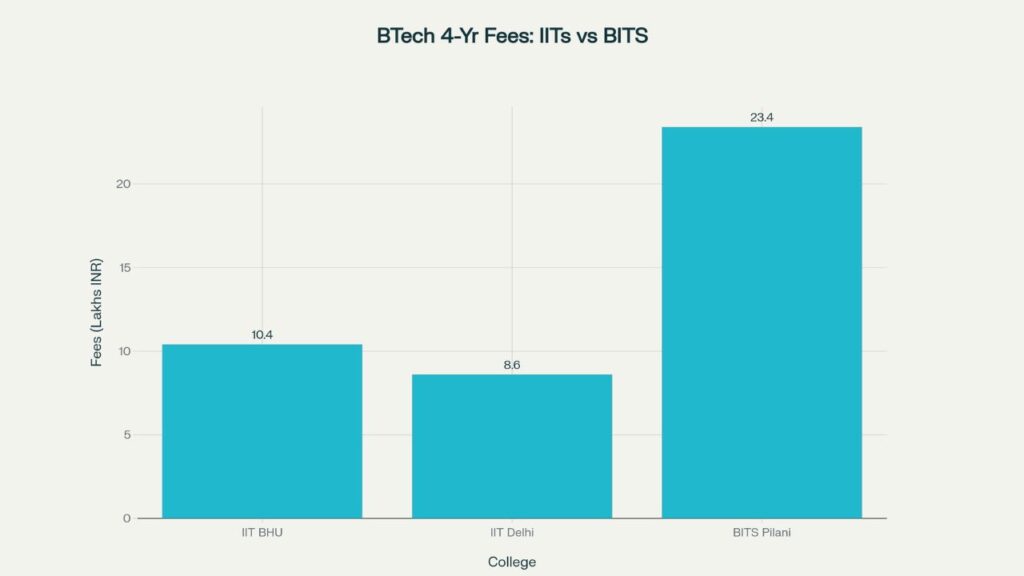
In order to get a sense of how affordable IIT BHU is, it makes sense to compare its 4-year B.Tech fee with that at other reputed institutes like IIT Delhi and BITS Pilani. The following amounts (approximates) are for General/OBC/EWS students with income above ₹5 lakh per year and do not include hostel/mess. 

InstituteApprox. 4-Year Academic Fees Verdict
IIT BHU₹ 10.4 lakhAmong the lowest 4-year IIT fees. 
IIT Delhi₹ 8.6–8.7 lakhSlightly lower than most IITs; very strong ROI. 
BITS Pilani (any campus)₹ 19–22 lakhNearly 2x IIT BHU; private, higher annual tuition.

Both IIT BHU and IIT Delhi receive government subsidies that make the cost of tuition approximately ₹8–10 lakh for 4 years.​

Since BITS Pilani is a private deemed institution the fees are much higher, the total cost for 4 years (including hostel and mess) can easily cross ₹22-24 lakh. 

Fee Comparison With IIT Delhi And BITS Pilani

4-year BTech Academic Fee Comparison (2025)

IIT BHU and IIT Delhi 4-year fees are about ₹10.4 lakh and ₹8.6 lakh respectively for the same duration. Meanwhile, tuition fees at BITS Pilani vary from ₹19 lakh to ₹22 lakh for 4 years, not inclusive of inflation and full residential expenses. 

For students who are granted income-based fee waiver or belong to SC/ST/PwD categories, IIT BHU becomes significantly better option over private colleges, as their burden of tuition fees is substantially reduced or waived off. This balance of modest fees, good placements and central government support is what makes IIT BHU one of the best ROI engineering options now available in India. 

Conclusion

The B.Tech fee at IIT BHU is kept as per the income slabs of students, Hindi Medium assistance patches are provided. With substantial waivers for economically backward sections and SC/ST/PwD students, and government subsidies making the aggregate academic fee lesser than most of the premier institutes, IIT BHU promises one of the best ROI among the top engineering colleges. 

The bottomline is that the 4-years cost of attendance remains affordable when compared to private institutes like BITS Pilani, whose fees can run to almost twice this amount, even after adding hostel and mess charges. If you are a student who wants a good mix of fees, quality education with good placements, IIT BHU is a very cost-effective and future proof bet. 

MTech vs MBA in 2025: Who Earns More and Why? Find Out Now!

MTech vs MBA who earns more

Most of the students after completing their graduation get more confused about their postgraduation than they were for the graduation. The most comparable degrees are MTech vs MBA in 2025, where both offer a well-opted career growth of Indian students. The postgraduate degree can open doors for more salary positions and knowledge if you have pursued it from the top college. BTech, BCA, and BSc (Computer Science) students get confused while choosing their higher education. Let’s make one thing clear — MTech vs MBA comparison is important because you must know the difference of value that both degrees hold in the industries.

MTech can offer you a wide range of fields such as Mechanical, Electrical, Computer Science, Civil, Electronics, Aerospace, AI, Data Science, Biotechnology, Chemical, and Cybersecurity. Whether you choose Mechanical or AI but know one thing that today’s world is evolving more into AI and cybersecurity. So, while selecting your career just check out the fastest growing field to fast career growth.

On the other hand, an MBA also offers a diverse range of fields such as management in marketing, operations, IT, Resources of the company. So, sometimes the same companies which can offer you an engineering position can also hire you as a manager because the company needs brilliant minds who can manage things to run everything smoothly.

Understanding Importance of MTech vs MBA in 2025 

MTech can offer you a path as an engineer in the industry, while an MBA can offer you a position of assistant manager, manager, operation leader, and many more. 

Closer Look to MTech

Candidates who are interested in Mathematics, Physics, and Chemistry can choose to opt this degree for building their career in engineering. The core skills for this field are technical, logical, critical which require your attention and full focus on the education.

Closer Look to MBA

MBA is a master of business administration for acquiring skills that need to manage and run operations in the industry. The core subjects in MBA are Managerial Economics, HR Management, Operation Management, Strategic and Accounting Management.

Is MTech Degree Worth in 2025?

In recent days, the world is evolving in tech, so the requirements of techies are increasing day-by-day. But MTech from top universities are worth the placement in top companies which offer you a great salary. MTech will get you ready for the cutting-edge products of the industries such as Artificial Intelligence, Electric Vehicles, or Semiconductors design. The sharp innovative minds are worth the value of an MTech degree.

How Valuable is an MBA in 2025?

An MBA from a top business school is worth it in 2025. This degree will increase your chances to a higher level position in the corporate companies. There are opportunities for you to join international companies. The departments like finance, consulting, and management can offer you a great path to reach for the high salary. 

Career Opportunities & Top Companies

Now the difference starts between both the degrees. The role, companies, and responsibility are different for both fields. 

For an MTech Graduates: There are various job roles in the companies like Design Engineer, R&D Engineer, AI/ML, Assistant Software Engineer, Senior Software Engineer, VLSI Design and Data scientist in the Google, Infosys, Wipro, Intel, Siemens, Tata, Mahindra, ISRO, and DRDO.

For MBA Graduates: Job roles are manager in consultant, Product, Marketing, Brand, Investment Banker, Financial Analyst, and Operation Head in top companies like BCG, Goldman Sachs, Morgan, Procter & Gamble, Hindustan Unilever, and Microsoft.

If you have noticed, some companies are mentioned in both because they hire  M.Techs for core tech roles and MBAs for product management and business strategy roles.

Who Earns More in 2025?

It’s not that simple because it totally depends on the knowledge and skills of the candidates. The recent placement report from top MBA colleges (IIM, ISB) have shown the average package of MBA graduates is Rs. 28-35 LPA. 

On the other hand, MTech graduates from top colleges (IIT, NIT) have a bit lower average salary package of around Rs. 20-28 LPA but candidates with polished skills in trendy departments like AI, VLSI design, can also get higher packages of around Rs. 40-50 LPA.

Read More 👉 Top Government MTech Colleges in India You Must Know in 2025

Why The Difference Between MTech & MBA in 2025 

If you want to climb instantly with high income then MBA from top IIM colleges can help you get an average package of around Rs. 25 LPA. This can justify your massive investment for education that is why it is called an ROI program. 

An M.Tech provides a rock-solid foundation for a career but you must have adapted expertise in tech. Your salary growth also depends on your skills and technical knowledge to build core products for the company to establish their growth. You will be heading towards your long-term financial rewards in technology-focused leadership roles.

Conclusion

Choose to Pursue MBA if:

  • You have great skills in communication, leadership, and strategic management.
  • You are interested in business, finance, and regular operation,
  • You want a good salary package from the start of your career.

Choose to Pursue MTech If: 

  • You have command on core concepts of technical education.
  • You want to follow your passion in engineering.
  • You are a quick learner that helps you adapt to new technologies fast.

The choice does not depend on MTech vs MBA in 2025 but it’s all about passion vs management, depth vs breadth. Choose wisely because your career will become a part of your life. So, having a goal that aligns with your interest is important and worthy.

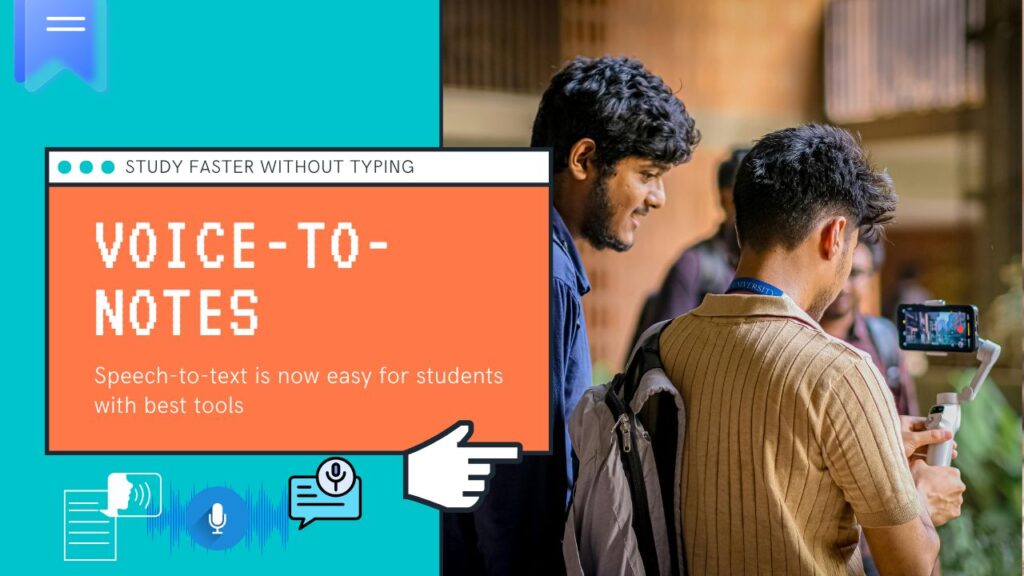
Voice-to-Notes Tools for Students: Study Faster Without Typing

Voice-to-Notes Tools

Voice-to-Notes Tools are really helpful from turning large study lectures into simple notes in just few minutes. Writing everything down is an old fashion technique that takes a lot of time for a few pages notes but everything is going easy with fast pacing technologies. Whether it’s hours of session or long research sheets, enabling speech to text is the smarter way to take notes. 

You’re forty minutes into a lecture, the professor has moved through three concepts, and your notes still say “photosynthesis — light reaction —” because your hand gave up before your brain did. Speaking runs at roughly 150-160 words a minute while typing tops out around 40 for most people. 

That gap is the entire case for Voice-to-Notes Tools , and for Indian students juggling coursework in English, Hindi, or a regional language, the tool you pick matters more than the concept itself — because most of the tools were built for American office meetings, not for Indian classrooms. 

Best Voice-to-Notes Tools For Indian Students 

There are plenty of tools that can turn your voice into text but then you find an error — spelling, whole different word (except, accept), not able to turn your regional language — that’s because it doesn’t understand. Some AI integrated voice tools that turn your every word into text without major errors is here:

Gboard Voice Typing — free, and it’s already on your phone

Before downloading anything, check what you have. Google’s Gboard keyboard has an in-built voice typing feature which you can use by clicking on the mic icon. If the icon is invisible then enable it from the setting so Voice-to-Notes can be easy and quick without downloading any new app.


It works in Hindi plus eight regional languages — Bangla, Gujarati, Kannada, Malayalam, Marathi, Tamil, Telugu, and Urdu — Indian students can use this keyboard in any app that takes input in the same language, not just Google’s own apps. 

For a student jotting quick revision notes in Hindi between classes, this is the lowest-friction option because there is no signup, no subscription, no separate app to remember to open.

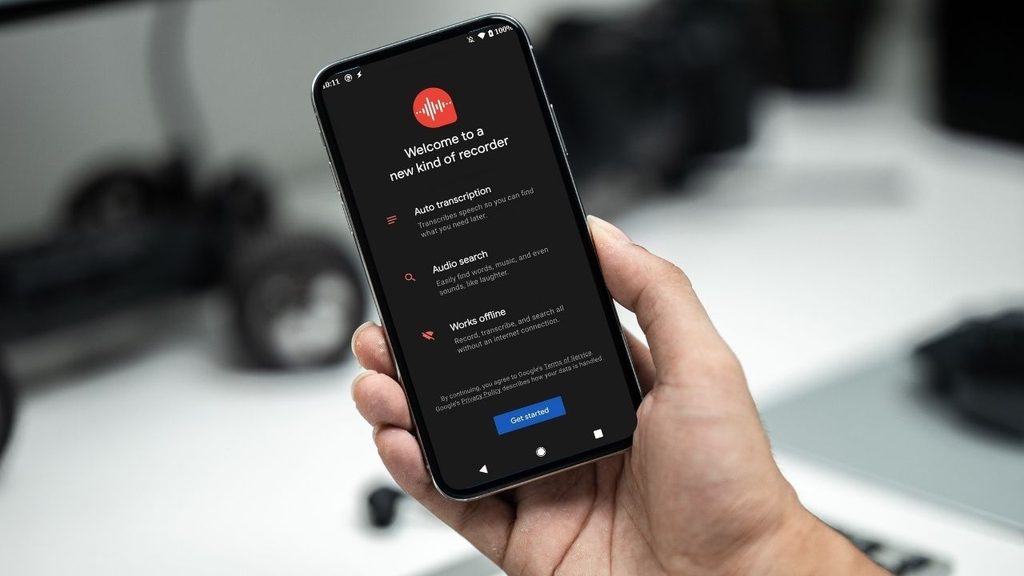
Google Recorder — real-time transcription, best if you have a Pixel

Google Recorder transcribes live as you speak and runs the processing on-device, which matters if your hostel Wi-Fi is unreliable. The catch: it’s tied to Pixel phones for its full real-time transcription experience, so if you’re on a different Android device or iPhone, this one’s off the table.

Otter.ai — good for English lectures, but it skips Hindi entirely

Otter is the name that comes up first in most “best Voice-to-Notes Tools” lists, and for English-medium lecture capture it’s genuinely capable — live transcription, speaker labels, searchable transcripts. 

The free tier gives you 300 minutes of transcription a month, capped at 30 minutes per recording, which covers maybe eight or nine standard lecture sessions before you hit the wall. The Pro plan runs $16.99/month billed monthly, or roughly $8.33/month if you pay annually (about $99.99/year). 

But for Indian students: Otter’s transcription supports English and a small set of other languages — Spanish, French, German, Japanese, Chinese depending on the source you check — but not Hindi or Indian regional languages. If your coursework happens in Hindi medium, Otter simply won’t understand you, no matter which plan you’re on.

Wispr Flow

Wispr Flow is the strongest option because it works inside almost any application. Students who want long-form writing and fast drafting can use this tool but unlimited dictation requires a subscription, which costs around $15 per month or $12 per month when billed annually. Since it supports more than 100 languages and gives accuracy for names and jargon along with AI editing, the cost is worth it.

VoiceToNotes.ai 

Its features include real-time transcription, grammar correction, AI summaries so it can become a useful tool for students which turn spoken thoughts into structured notes. Some professionals consider this tool as more affordable than many full-featured AI assistants but free usage is limited. The catch: accuracy still depends on microphone quality and background noise.

Mindgrasp

Mindgrasp is primarily an AI learning and content-understanding platform. Students can use it for lectures and study material — it helps in creating flashcards and quizzes automatically. Best for exam preparation and research but some features are tied to specific subscription tiers. 

Lisup 

Lisup focuses on accessibility and hands-free writing. It can be used across desktop applications so access will be easy and it is specifically designed for in-place speech-to-text features. It’s not built for broader use but enough for students to take notes easily. 

Soniox — the app actually built for Hindi dictation

Soniox is less well-known in student circles but solves exactly the gap Otter leaves open. It handles Hindi across regional varieties like Khariboli and Braj Bhasha, works system-wide across any app or text field on your phone rather than locking you into one note-taking interface, and covers 60-plus languages total with the ability to switch languages mid-sentence. 


It’s useful if you naturally code-switch between Hindi and English while explaining a concept to yourself. It’s free to start, with weekly free credits rather than a hard monthly cap, and the company states it doesn’t store your recordings or use them for model training, which is worth knowing if you’re dictating exam-prep notes you’d rather keep private.

Sarvam AI — worth watching, not quite a student app yet

Sarvam is India’s most-funded sovereign AI company, and its speech models (Saaras v3) handle 22 Indian languages with genuinely strong accuracy claims. But as of now, Sarvam’s product lineup is built mainly for enterprises — voice agents for banks and government call centers, APIs for developers — rather than a polished consumer app you’d install and use for lecture notes. 

A consumer-facing voice app was announced in February 2026, aimed at exactly this kind of mass-market, multilingual use case, but a public launch isn’t happening right now.

Read Also 👉 Why ChatGPT Ads Deserve a Place In Your 2027 Media Plan 

Why Do Students Need These Tools?

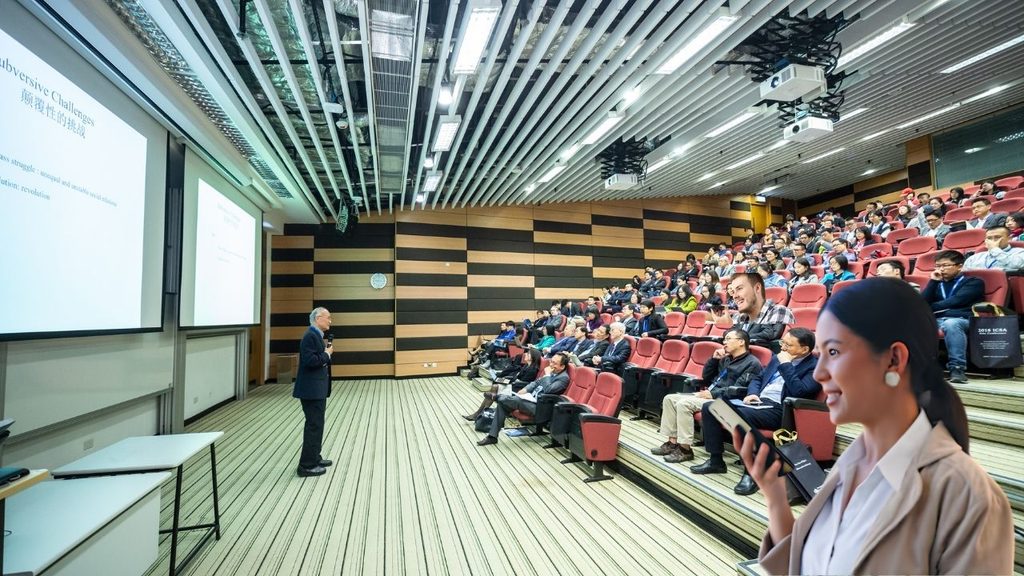
Most of the time students missed points while trying to understand the same topic simultaneously. Writing it down on paper or in a mobile is the same thing — it consumes a lot of time and misses points. So, these Voice-to-Notes Tools help students take notes without tiring their hands. 

There are some free and some paid tools, if you just need to take notes of what your processor is explaining then a free tool is enough for you. But if you are a Ph.D student or you need to do heavy research, organize every note, and make summaries from online content, you need a tool which can handle all of that, even if it costs you a little.

Which Speech-to-Text Tools are Best For Studies?

Google’s Gboard keyboard is the best free Voice-to-Notes Tools which I have used personally and crafting many documents in English, Hindi and Urdu. I recommended to students who wanted to take notes before exams and stop writing everything manually and waste their time. 


Gboard offers unlimited access to use on any other applications like docs, word, and on any device (mobile or laptop). Most of the students take their mobile to the college, so it runs smoothly. But sometimes it makes minor errors in spelling which you can edit later. 

Second is Wispr Flow but you have to pay after a limited use and many students can’t afford it but those who can afford can consider Wispr Flow as the best tool for making notes.

Read Also👉 Upgrade Laptop Like New Model In Low Budget

Conclusion for Voice-to-Notes Tools

The world is changing and for solving traditional problems by adapting new technology. One of the old problems is taking notes in a mid-session in your classrooms. Students have to understand the topic and write down their important concepts — two jobs at once.

If they forgot, they have to ask other students and it appears a problem if you don’t have a lot of friends. So the problem is solved now, you can spend your time to understand the topic without worrying about the notes as these Voice-to-Notes Tools do that job for you.


Best IIT College in Uttar Pradesh – Complete Ranking & Admission Guide

Best IIT College in Uttar Pradesh

Selecting the Best IIT Colleges in Uttar Pradesh is the largest challenge to face any engineering aspirant. The state has only two IITs – IIT Kanpur and IIT (BHU) Varanasi – but its institutions have perennially churned out India’s top engineers, researchers, innovators and global leaders. The two colleges have excellent reputations on both national and international scales, world-class faculties, state-of-the-art labs, and one of the best placement records in the nation.

Whether you’re shooting for a top-300 JEE Advanced rank or making your way to a legacy-rich IIT with great future prospects, this guidance narrates rankings, fees, application process, placements and career outcomes, helping you make a smart and informed choice. So, let’s take a look at the top engineering colleges in Uttar Pradesh. 

IIT Kanpur: The Engineering Powerhouse

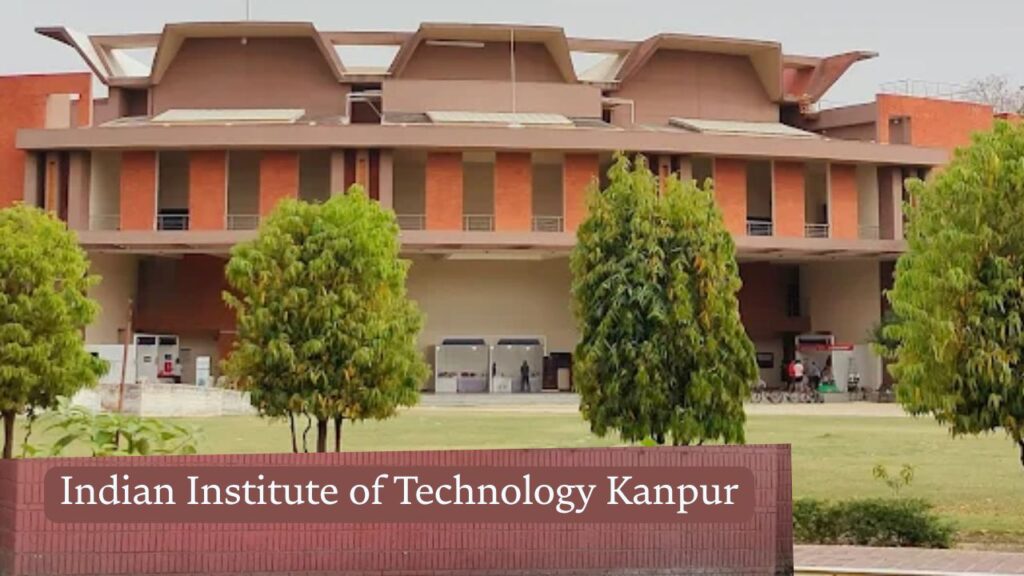
Founded in 1959, IIT Kanpur is now the best engineering school in UP. Ranked #4 in NIRF Engineering Rankings 2025, It always manages to be among the best universities making it as top engineering schools in India. The institute provides a high quality of education with its sprawling 1037-acre campus in Kalyanpur, Kanpur. 

IIT Kanpur
Image credit: IIT Kanpur

Admission and Eligibility

The admissions in the undergraduate B.Tech courses of IIT Kanpur are through JEE Advanced only. The cutoff for cse (computer science and engineering) for the year 2025 was 271 in very high competitions. Along with your JEE Advanced score you should have a minimum of 75% in Class 12 (65% for SC/ST categories). The institute accepts GATE scores for some of the postgraduate programmes (depending on the discipline), as well as IIT JAM and CAT scores. 

Fee Structure 

B.Tech fees is ₹ 2.30 – 2.50 lakhs per year, and ₹ 20,000 to ₹ 30,000 a semester for mess and hostel. So, a higher secondary B.Tech Degree will cost around Rs 8.6 lakhs, which is reasonable for quality education. Apart from these the institute has several other scholarships such as Merit-cum-Means (MCM) Scholarship, schemes for SC/ST students etc. 

Career Prospects & Placements  

Placement record of IIT Kanpur is known to be excellent. The average package for the B.Tech graduates is between ₹ 26.90 and ₹ 30.86 LPA while the highest package is ₹ 1.9 crore per annum. Top recruiters such as Google, Microsoft, Amazon, Tata Steel etc. ensure good options in core and tech industries. 

IIT (BHU) Varanasi: The Heritage Institution

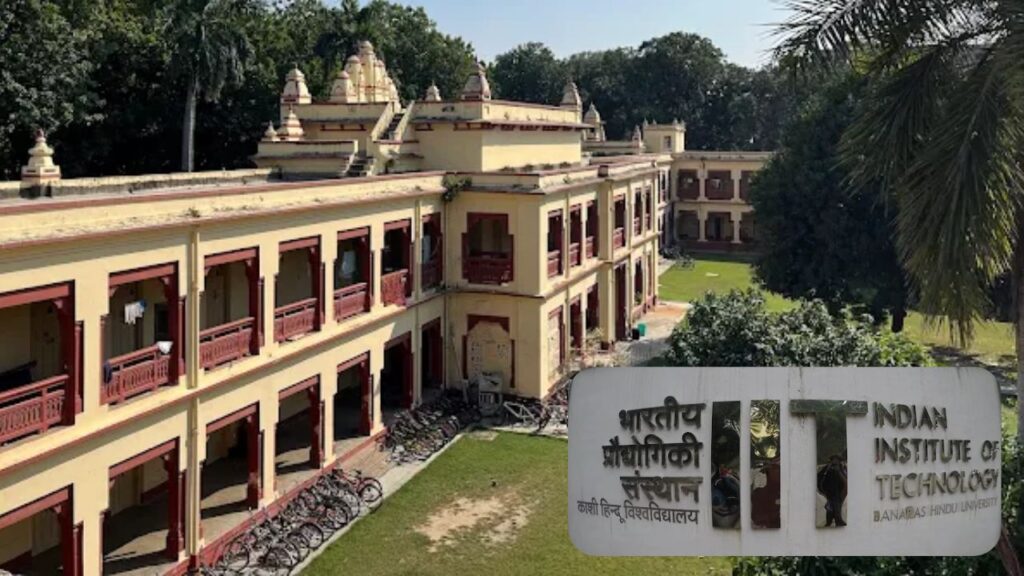
IIT (BHU) Varanasi was formed in 1919 to deliver vast education to new generations and is still doing it. Its one purpose is served well as everyone can see with their own eyes on the alumni network of IIT BHU. It is also grounded in a tradition of academic excellence spanning centuries, even now it actually tops on the edge and holds 10th position, according to NIRF Engineering Rankings 2025.

IIT (BHU) Varanasi
Image credit: BHU

Admissions Process & Eligibility Requirement

BHU conducts admissions through JEE Advanced as well, similar to IIT Kanpur. The closing rank for CSE in 2025 was around 2,500, however the cutoff is significantly lower. This means that if you take the JEE via BHU, you could get into a good IIT even if you don’t make a very high rank. For students of general category, minimum 75% is required in class 12 fulfilling the eligibility criteria. 

BHU B.Tech Fees

Banaras Hindu University B.Tech program fees range from 3.17 L to 8.51 L for full course, whereas tuition fee is in the range of 1,00,000 to 1,20,000 per semester and hostel fee ranges between 25,000 to 28,000. With this, it rates somewhere around or even less expensive than IIT Kanpur, depending on the branch. 

Career Prospects & Placements

BHU has no less amazing placement figures. The highest package is ₹1.68 crore per annum and the average package is ₹22.77 LPA. Over 80% of students were placed in 2024, and the CSE average lies within ₹25-₹28 LPA. Google, Qualcomm, Uber and Goldman Sachs are the top recruiters. 

Read More 👉 Bihar DElEd Entrance Result 2025 OUT: Check Marks, Rank & Admission Status

Making Your Choice

The selection is on the basis of your JEE Advanced score but both colleges are great for education. IIT Kanpur has a slightly better average package as well as branding if you fall under the top 300–400. Then, IIT (BHU) Varanasi is your best bet if your rank lies between 1,500 and 3,000. It combines legacy with excellent career outcomes. In both situations you are paying for the brightest engineering futures in India, twice. 

Comparison Between IIT BHU & IIT Kanpur

The top JEE advanced students looking for a slightly better average package and brand name in a tier 2 engineering college should go with IIT Kanpur. It has a good number of students with a rank below 500, as the the #4 ranking for NIRF along with the world class facilities attracts students from all over the country.

IIT BHU Varanasi is equally competitive and is a great choice, though it does have a lower ranking (#15). Owing to a much lower cutoff rank (~2,500 as compared to ~271 for CSE), a lot more students qualify for it and yet it boasts great placement stats. The history of the institution is over 100 years and that provides some historical prestige but that many applicants doesn’t value. 

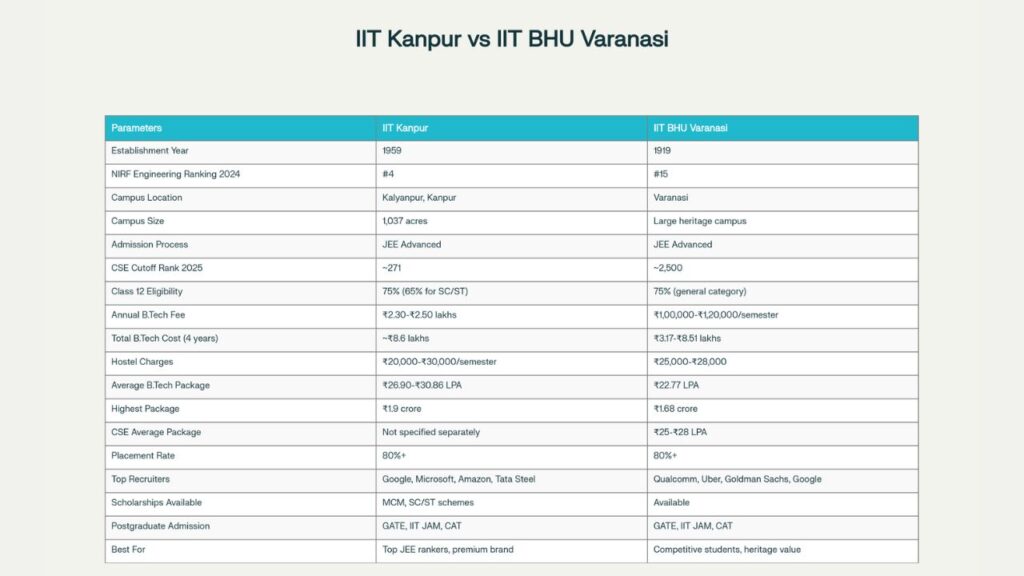
Comprehensive Comparison of IIT Kanpur and IIT BHU Varanasi

Both universities provide good scholarship opportunities, have good placement and see participation from best global companies. Your decision should be based on your JEE Advanced rank, finances, and if you place more value in brand (Kanpur) or accessibility + heritage (BHU Varanasi). 

Conclusion

These are the best IIT colleges in Uttar Pradesh which offer outstanding core academics, research, placements, and student life. If you are a high ranked aspirant and looking for an elite brand name with more research options and slightly higher average packages then IIT Kanpur is the clear winner.

But for hot IIT rank holders in the range of 1,500–3,000 and who want an IIT that combines tradition with bang for your bucks, a rock solid faculty and stellar placements year in and year out, IIT (BHU) Varanasi is the way to go. 

Whichever institution you opt for, both pave the way to brilliant careers, worldwide prospects and a life-changing four-year experience of engineering. 

Scroll to Top